

Pentagon Successfully Tests Hypersonic Flying Bomb

MEDIA ROOTS – Two weeks ago the U.S. department of defense tested a new weapon that, by being able to travel faster than the speed of sound and strike any location on the planet in under an hour, combines the global reach of the Cold War’s intercontinental ballistic missiles, and the surgical precision of today’s robotic flying drones.

In doing so, the military problem of Mutually Assured Destruction that once kept adversaries at bay is being stripped away, making the use of military force more “reasonable.”

The new weapon, called the “Advanced Hypersonic Weapon,” or AHW, is a remote controlled flying weapons delivery system (a flying bomb) that travels at hypersonic speeds within the earth’s atmosphere.  The weapon was launched from the Hawaiian islands and steered 2,300 miles over the Pacific ocean to the Marshall Islands in under half an hour.

The AHW is a first-of-its-kind glide vehicle designed to fly long range carrying a payload of up to 5500 kgs, including a nuclear bomb, according to a statement issued by the US  Department of Defense.  A hypersonic speed is one that exceeds Mach 5- or five times the speed of sound (3,728 mph).

Among other things, this means the army will no longer have to depend on forces stationed around the world as they can lay down fire power anywhere they need from the comfort of a home base, without risking any American lives.

During the Cold War, the West and East developed nuclear and intercontinental missile delivery capabilities, but the concept of Mutually Assured Destruction made the actual use of the weaponry “unreasonable.”  Using them would have been an act of insanity and suicide for both parties because the destruction would be so wide spread for everyone involved.  As instruments of policy, these weapons were deemed useless.

The new AHW, however, promises to be a very usable weapon of policy.  By eliminating the need for U.S. forces in the immediate theater of war, the AHW moves offensive actions further along a continuum that distances the warrior from their target and, in effect, from the moral responsibility for pulling a trigger.

Such a weapon even allows for plausible deniability.  No blood on their hands, and you certainly can’t place them at the scene since they were halfway around the world at the time.

For these reasons, the AHW is a weapon that allows its possessor a step in the direction of absolute power.  We don’t risk our people, we don’t risk our sense of morality, and we don’t even risk blame.  It’s a clean and detached method of warfare, but how will it change our moral and ethical code as a people who are sponsoring this futuristic weaponry?

Written by Joel E. Hersch for Media Roots

Photo by Flickr user lrargerich

No Accountability for Military Contractors

MEDIA ROOTS- Perhaps one of the most abhorrent aspects of US foreign policy in the 21st century is the privatization of the US military and the government’s outsourcing of military jobs to corrupt war contractors.
Despite Obama’s early campaign rhetoric about scaling down the use of contractors, he has increased their presence– they now make up approximately 50% of the total military force in both Afghanistan and Iraq.  

Military contractors are murderous thugs-for-hire who act above the law and hold zero allegiance to any constitutional body. Blackwater’s sordid slew of contemptuous behavior and criminal actions during the Iraq war might have cast a negative light upon them, but it didn’t stop the Obama administration from awarding their criminality with a quarter billion dollar contract to continue working in US war zones.

This unaccountability for criminal acts is not unique to Blackwater. Halliburton subsidiary Kellogg Brown & Root (KBR) is a private security company that employs more US private contractors and holds larger contracts with the US government than any other firm in Iraq.

In 2007, a KBR employee named Jamie Leigh Jones claimed that she was gang raped by multiple KBR workers at a camp in Iraq’s Green Zone. After she reported the rape, she was reportedly locked in a shipping container and threatened with her job if she took further action. Appallingly, KBR has turned the case around and is now suing Jones for making “frivolous claims”, demanding $2 million in damages.

“They have beaten us and now they are attempting to crush us,” her lawyer, Todd Kelly, told the Wall Street Journal. “This is an attempt by KBR to chill other people from bringing claims against them.”

It’s shameful that these corporations have essentially no oversight from the US government– the Crime Victims Office at the Department of Justice was unable to investigate the incident because of a lack of jurisdiction over private contractors in Iraq.

Now it’s Jones’s word against KBR, and it doesn’t look like she has much of a chance to win against the monolithic corporation. Let’s just hope she can walk away without having given them a dime.

Written by Abby Martin

Photo by flickr user wenews

Posted in Uncategorized | 1 Reply

MR Original – Afghanistan: Endless War for Resources

MEDIA ROOTS- This year marked the tenth anniversary of America’s invasion of Afghanistan, officially making it the longest war in US history. Now that Osama Bin Laden is finally confirmed dead, the federal government’s logic of continuing the occupation remains unclear.

Initially, the Bush administration irrationally insisted that any sovereign nation harboring terrorists was itself complicit in “terror” and therefore open for pre-emptive US military action. This rationale is absurd– just because one criminal might be living inside of a particular country doesn’t make that entire country guilty of the criminal’s crimes.

In 2002, Secretary of Defense Donald Rumsfeld was quick to tell CNN that US forces had successfully pushed the Taliban and Al Qaeda out of the region, and reports reveal that Osama Bin Laden hadn’t even been in Afghanistan since 2001. Additionally, a White House spokesperson recently admitted that there hasn’t been a terrorist threat in the country for the last eight years.

So what has the US been doing in Afghanistan for the last decade?

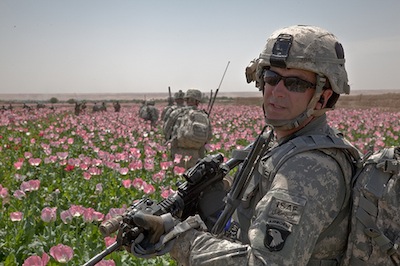
War has always been about two things: resources and control. Alongside the supposed surprise discovery of Afghanistan’s $1 trillion wealth of untapped minerals, it’s more than coincidental that before the US invasion, the Taliban along with the UN had successfully eradicated the opium crop in the Golden Crescent. Now 90% of the world’s heroin comes from Afghanistan.

As reported by Global Research:

Heroin is a multibillion dollar business supported by powerful interests, which requires a steady and secure commodity flow. One of the “hidden” objectives of the war was precisely to restore the CIA sponsored drug trade to its historical levels and exert direct control over the drug routes.

Immediately following the October 2001 invasion, opium markets were restored. Opium prices spiraled. By early 2002, the opium price (in dollars/kg) was almost 10 times higher than in 2000.

In 2001, under the Taliban opiate production stood at 185 tons, increasing  to 3400 tons in 2002 under the US sponsored puppet regime of President Hamid Karzai.

While highlighting Karzai’s patriotic struggle against the Taliban, the media fails to mention that Karzai collaborated with the Taliban. He had also been on the payroll of a major US oil company, UNOCAL. In fact, since the mid-1990s, Hamid Karzai had acted as a consultant and lobbyist for UNOCAL in negotiations with the Taliban.

In today’s globalized world, one can’t discount the role that multinational corporations play in US foreign policy decisions. Not only have oil companies and private military contractors made a killing off the Afghanistan occupation: big pharmaceutical companies, who collectively lobby over $250 million to Congress annually, need opium latex to manufacture drugs for this pill happy nation.

Another fact worth mentioning is that Karzai, a notable player in Afghanistan’s opium trade, has been receiving regular payments from the CIA since the invasion. Even more infuriating, the US government has been paying Taliban insurgents to protect supply routes and to “switch sides” in a poor attempt to neutralize the insurgency and buy loyalty from the fighters. The fundamental logic of funding both sides of the war to “win” is possibly the most incomprehensible concept to grasp. Clearly, this war is meant to be sustainednot won.

Fast forward to ten years later, and the turmoil within the country still looms heavy. Last Thursday, the Taliban claimed responsibility for a deadly attack that killed 27 US soldiers and wounded dozens more. Earlier this month marked the deadliest day for US troops since the war started when a rocket propelled grenade shot down a helicopter and killed 30 US soldiers.

In June of this year, Obama delivered a speech about drawing down in Afghanistan, which corporate media outlets touted as a major step to ending the war (Media Roots cut through the speech rhetoric). Yet, a glaringly under reported factor of the praised “drawdown” is the fact that even if the reductions are carried out as planned, the US will still have far more troops in Afghanistan than at any point during Bush’s administration. Furthermore, the US and Afghanistan are about to sign a strategic pact that will allow thousands of special forces troops to remain in Afghanistan until 2024.

Considering how the US is spending at least $6.7 billion a month in Afghanistan and over 55% of Americans think that the US should immediately withdrawal, this issue should be a constant hot topic in the public dialogue– especially amidst the debate of economic sacrifice. Yet in 2010, the corporate news only allotted a measly 4% of its coverage to the war in Afghanistan.

The unsustainability of America’s endless wars and imperialistic foreign policy is the elephant in the room that not enough people in the public arena seem to want to discuss. Sadly, because Americans are conditioned to not bring up politics and religion with others, many are confined to their own rigid perspective fed by biased corporate media outlets. We must begin to challenge this societal dogma if we ever want to progress our society and evolve our collective human consciousness.

Written by Abby Martin

Photo by flickr user DVIDSHUB

MR on Project Censored’s Costs of War Show

MEDIA ROOTS- Abby Martin from Media Roots co-hosts Project Censored’s special three and a half hour KPFA program “Costs of War.” At the beginning of each hour, there is an MR report on the economic, human and environmental costs of US wars in the Middle East. During the program multiple, multiple experts in different fields of study are interviewed on the show about their research for the extensive Brown University study Costs of War. The show focuses on on the socio-economic impacts of the wars in Iraq and Afghanistan and related subjects from scholars worldwide. Listen to the show here or below.

Fund Drive Special: Cost of War – August 11, 2011 at 12:00pm

Click to listen (or download)


Interview Schedule:

12:00-12:20 Catherine Lutz, Professor Anthro, Brown University, Project Director, Solders and Contractors: Recommendations and Neta Crawford, Professor Political Science at Brown University, Cost of War Project Director,

12:30-12:50 Norah Niland: Former Director Human Rights: United Nations Assistance Mission in Afghanistan, Afghanistan, social change and women, and Matthew Evangelista, Professor of History and Political Science, Cornell University, Alternatives to War

1:00-1:20 Winslow Wheeler, of the Straus Military Reform Project of the Center for Defense Information Washington DC. Department of Defense Budget, Military Cost of War

1:30-1:50 Dahr Jamail, Human Costs of War, Refugees, Life on the Ground and resistance in the military, Author: “The Will to Resist,”

2:00-2:20 John Tirman, MIT, Author of “The Deaths of Others” The Fate of Civilians in America’s Wars, Topic: Civilian Civilan Deaths In War—

2:30-2:50 Linda Bilmes, Professor Public Policy Harvard Kennedy School, Topic: Costs of Veteran Care

3:00-3:20 John Pilger, Journalist and Film Producer, covering his new documentary, “The War We Don’t See”

Catherine Lutz, Director of Costs of War: Catherine Lutz on Why We Can’t Turn the Page on America’s Wars {Costs of War} from Watson Institute on Vimeo.

Visit www.CostsOfWar.org for more information

Howard Zinn: Human Nature and Aggression

MEDIA ROOTS Howard Zinn challenges the philosophy that acts of aggression are integral to human nature and discusses how one’s society and surrounding environment is what creates of hostility. The excerpt is taken from the documentary You Can’t Be Neutral On a Moving Train.

Howard Zinn, “On Human Nature and Aggression.” From You Can’t Be Neutral On a Moving Train, 2004.

DVD available from firstrunfeatures.com.