 YES! MAGAZINE – Can local laws have a real effect on the power of giant corporations?
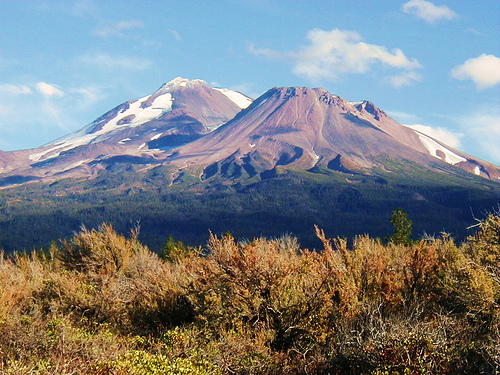
Mt. Shasta, a small northern California town of 3,500 residents
nestled in the foothills of magnificent Mount Shasta, is taking on
corporate power through an unusual process—democracy.
The citizens of Mt. Shasta have developed an extraordinary
ordinance, set to be voted on in the next special or general election,
that would prohibit corporations such as Nestle and Coca-Cola from
extracting water from the local aquifer. But this is only the
beginning. The ordinance would also ban energy giant PG&E, and any
other corporation, from regional cloud seeding, a process that disrupts
weather patterns through the use of toxic chemicals such as silver
iodide. More generally, it would refuse to recognize corporate personhood,
explicitly place the rights of community and local government above the
economic interests of multinational corporations, and recognize the rights of nature to exist, flourish, and evolve.
Mt. Shasta is not alone. Rather, it is part of a (so far) quiet
municipal movement making its way across the United States in which
communities are directly defying corporate rule and affirming the
sovereignty of local government.
Since 1998, more than 125 municipalities have passed ordinances that
explicitly put their citizens’ rights ahead of corporate interests,
despite the existence of state and federal laws to the contrary. These
communities have banned corporations from dumping toxic sludge,
building factory farms, mining, and extracting water for bottling.
Many have explicitly refused to recognize corporate personhood. Over a
dozen townships in Pennsylvania, Maine, and New Hampshire have
recognized the right of nature to exist and flourish (as Ecuador just
did in its new national constitution).
Four municipalities, including Halifax in Virginia, and Mahoney,
Shrewsbury, and Packer in Pennsylvania, have passed laws imposing
penalties on corporations for chemical trespass, the involuntary
introduction of toxic chemicals into the human body.
These communities are beginning to band together. When the attorney
general of Pennsylvania threatened to sue Packer Township this year for
banning sewage sludge within its boundaries, six other Pennsylvania
towns adopted similar ordinances and twenty-three others passed
resolutions in support of their neighboring community. Many people were
outraged when the attorney general proclaimed, “there is no inalienable
right to local self-government.”
Bigger cities are joining the fray. In November, Pittsburgh’s city council voted to ban corporations in the city from drilling
for natural gas as a result of local concern about an environmentally
devastating practice known as “fracking.” As city councilman Doug
Shields stated in a press release, “Many people think that this is only
about gas drilling. It’s not—it’s about our authority as a municipal
community to say ‘no’ to corporations that will cause damage to our
community. It’s about our right to community, [to] local
self-government.”
What has driven these communities to such radical action? The
typical story involves a handful of local citizens deciding to oppose a
corporate practice, such as toxic sludge dumping, which has taken a
huge toll on the health, economy, and natural surroundings of their
town. After years of fighting for regulatory change, these citizens
discover a bitter truth: the U.S. environmental regulatory system
consists of a set of interlocking state and federal laws designed by
industry to serve corporate interests. With the deck utterly stacked
against them, communities are powerless to prevent corporations from
destroying the local environment for the sake of profit.
Enter the Community Environmental Legal Defense Fund,
a nonprofit public interest law firm that champions a different
approach. The firm helps communities draft local ordinances that place
the rights of municipalities to govern themselves above corporate
rights. Through its Democracy School,
which offers seminars across the United States, it provides a detailed
analysis of the history of corporate law and environmental regulation
that shows a need for a complete overhaul of the system. Armed with
this knowledge and with their well-crafted ordinances, citizens are
able to return to their communities to begin organizing for the passage
of laws such as Mt. Shasta’s proposed ordinance.
The Community Environmental Legal Defense Fund is collaborating with Global Exchange,
an international environmental and workers’ rights organization, to
help supporters of the Mt. Shasta ordinance organize. In an interview
for this article, I asked Shannon Biggs, who directs Global Exchange’s
Community Rights Program, if she expected ordinances of this type to be
upheld in court. Biggs was dubious about judges “seeing the error of
their ways” and reversing a centuries-old trend in which courts grant corporations increased power. Rather, she sees these ordinances as powerful educational and organizing tools that can lead to the major changes necessary to reduce corporate power,
put decision-making back in the hands of real people rather than
corporate “persons,” and open up whole new areas of rights, such as
those of ecosystems and natural communities. Biggs connects the current
municipal defiance of existing state and federal law to a long
tradition of civil disobedience in the United States, harkening back to
Susan B. Anthony illegally casting her ballot, the Underground Railroad
flouting slave laws, and civil rights protesters purposely breaking
segregation laws.
But the nascent municipal rights movement offers something new in
the way of political action. These communities are adopting laws that,
taken together, are forming an alternative structure to the global
corporate economy. The principles behind these laws can be applied
broadly to any area where corporate rights override local
self-government or the well-being of the local ecology. The best place
to start, I would suggest, is with banning corporations from making campaign contributions to local elections.
The municipal movement could provide one of the most effective routes to building nationwide support for an Environmental and Social Responsibility Amendment
to the U.S. Constitution. In fact, the movement is already expanding.
In Pennsylvania, people are now organizing on the state level and
similar stirrings have been reported in New Hampshire.
What about your community?
Allen D. Kanner, Ph.D., is a cofounder of the Campaign for a Commercial-Free Childhood, co-editor of Psychology and Consumer Culture and Ecopsychology, and a Berkeley, California child, family, and adult psychologist.
This article originally appeared in © Tikkun.
Photography by ThreadedThoughts



 REUTERS
 YES! MAGAZINE
 Tunisia is ranked the 62nd most unequal country, with a Gini Coefficient of 40.