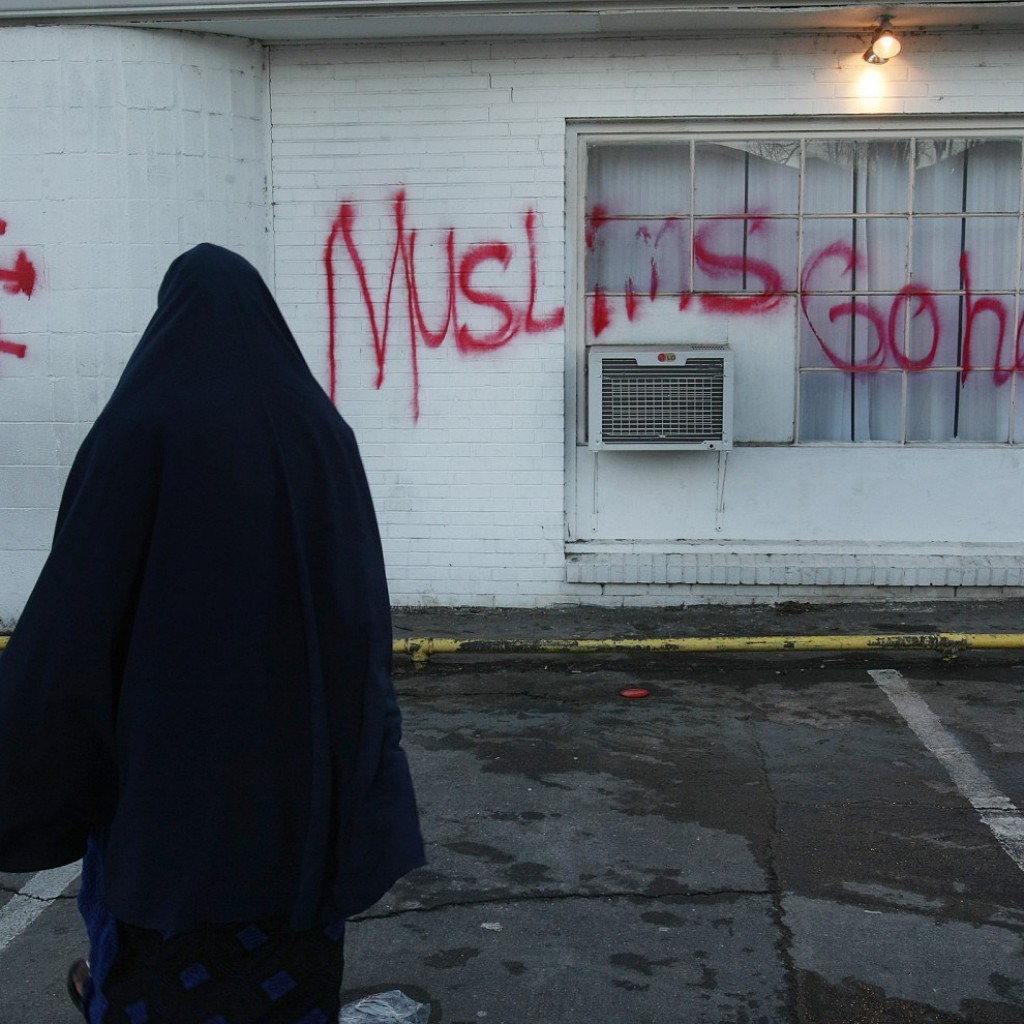
 2015 was the most dangerous year for Muslims in America, setting records for hate crimes against them. There have been dozens of attacks on mosques, including firebombings, and physical assaults like stabbings, shootings and beatings against Muslims (and perceived Muslims) grew to the highest numbers ever recorded.
Already wrapping up as a deadly year, the last few months of 2015 saw hate crimes against Muslim Americans dramatically increase. Members of the community are saying the climate of hate is worse now than after 9/11.
Abby Martin interviews Dr. Deepa Kumar, professor of media studies at Rutgers University and author of Islamophobia and the Politics of Empire, about the roots of this alarming situation. From confronting right-wing arguments, to examining how Islamophobia is a reinforcement and basis for the structures of Empire, the first Empire Files episode of 2016 gives essential context to the wave of anti-Muslim hate in America and beyond.
The Most Dangerous Year for Muslims in America
**
DEEPA KUMAR: I think that if you look at the year 2015, it has been a horrible year for Muslims not just in the United States, but around the world because if you see the two events that book-end 2015, it is the Charlie Hebdo attacks, the horrific Charlie Hebdo attacks in France and the Paris attacks later on towards the end of the year and then San Bernardino, and what these attacks have done is that they have exacerbated and really ratcheted up what we’ve seen as tendencies since 9-11. What are some of these tendencies? Well, first of all hate crimes against Muslims and those who look Muslim have skyrocketed. It’s not just people being verbally and physically attacked. We’ve seen mosques being desecrated. We’ve seen all sorts of horrific attacks of these sorts, but we’ve also seen the rise of a kind of a xenophobic nationalism where White supremacy has been the center of nations remaking themselves, like France or like the United States and so on saying these people are a fifth column, they don’t belong here and so on, and what these attacks have done…it has legitimized this, but what it’s also legitimized is the various security apparatuses, so what happens after the Paris attacks is that the French police carried out more than 2,000 raids on Muslims, both citizens as well as immigrants, arrested hundreds of Muslims and so forth, and it legitimizes these activities by the state to keep us safe. So you’ve seen really an exacerbation of the logic of the war on terror take place over the last year. So I’m not surprised that many Muslims feel that today we are in a worse situation than we were back after 2001.
ABBY MARTIN: How do you define Islamophobia?
DK: Islamophobia is anti-Muslim racism, but what I want to argue is that it’s more than just verbal attacks. It’s more than people facing discrimination at work, or facing insults or slights by people around them–what’s called micro-aggressions. It’s also more than physical attacks–hate crimes and those sorts of things. Islamophobia is these things and people do experience verbal and physical attacks, but I want to argue, in my definition of Islamophobia, is that it is an ideology that is tied to a set of practices that sustain and reproduce Empire. I think it’s very important to actually look at the structures of Empire because it’s only when we do that we get to the roots of what causes Islamophobia. Why is it produced? Who benefits from it? Why does it proliferate in the way that it has over the last fifteen some years? And this is not some sort of academic exercise. I am an academic, but this is not just some abstract exercise. It’s important to get to the roots in order to more effectively fight this form of racism. That’s why I’ve argued in the past that simply doing education around Islam, or having inter-faith dialogue, while important, is not enough because it’s not simply about a set of bad ideas in people’s heads. It’s rooted into the very structure of Empire, and that’s where we need to target our attention and our energy and activism.
AM: And one of the objections we hear consistently, particularly from right-wingers, is that Islamophobia does not and cannot exist because Islam is not a race. Your response?
DK: Well they are right. That is to say they’re right in one part of it: Islam is not a race. Muslims are not a race. This doesn’t mean that they don’t face racism, so I think we’ve got to see that both go side by side. Muslims are not a race, but the racism that Muslims face is very real. There’s been a systematic process since 9-11 to keep fear of Muslims and fear of terrorism alive in the American imagination. You talked about a Sikh man who was attacked earlier this year, last year. I think that’s a really big clue as to how racism against Muslims actually works, or those who are perceived to be Muslims, actually works, which is it’s a form of cultural racism that is based on turbans, people wearing turbans, or people wearing hijabs or other forms of Islamic religious clothing. There is an assumption that is made that these people all have a certain behavior that is constant, that is something about their nature that’s constant because when they practice Islam they are programmed to be violent. They are programmed to be misogynistic. If you’re a woman, you’re programmed to be subservient. You’re programmed to be a terrorist and so on and so forth. And so there is a very systematic way in which an entire group of people is turned into a race through this category of Islam in the same way that Jews are turned into a race through the practice of Judaism and so on, and then the entire group gets targeted in these ways. Races don’t exist naturally. They are produced and they’re typically produced by the elite in order to serve certain interests and to serve certain agendas. I think it’s really important always to look at what historical conditions… what is going on in the political economy that leads to the production of races then that leads to the this process of rationalization because when we get to that we get to the heart of why racism exists and how we can fight against it.
AM: I want to address another talking point that I hear used pretty often by people like Bill Maher and Sam Harris: 70% of Muslims in France support ISIS. What’s your response to these kinds of sweeping statements? People will constantly use them and say, “Look we can’t be Islamophobic because we’re just criticizing the religion and look we’re just looking at the data.”
DK: Islam is practiced by 1.5 billion people around the world. It looks different in different countries and there are just as many political views the people in Muslim-majority countries hold as there are around the West, so they’re just as different a group and non-homogeneous a group as those in the West.
What people like Bill Maher and people like Sam Harris do is they collapse all of those differences and they find data that suits their homogenizing mission in order to paint everybody with the same brush strokes. One myth that gets peddled again and again is that Muslim women are just so horribly oppressed all over the world. Well, that’s not true. I mean, first of all, let’s admit that Muslim women, just like all other women in the world, do face oppression. They do face things like inability to get good jobs, or lack of adequate pay or what have you. Women in the US face the same sort of situation. However, conditions vary widely across the Muslim-majority countries. In Saudi Arabia women can’t drive, but in Bangladesh women have been elected to heads of state, not once but twice. And so these are all different countries with different histories. There are regional differences. There are local differences. There are differences between country and town, and that diversity is simply not acknowledged by the likes of Sam Harris and the New Atheists, and all the rest of it.
If anything you know what they do is use the clash of civilizations argument. They somehow hold up this mantle of the West as being this place of enlightened values, and say that they want to critique all religions, but if you look at their work, the work of the New Atheists, the sharpest knife is dug into Islam. That’s true of Hitchens. It’s true of Dawkins. It’s true of Sam Harris and so on, so they actually have an agenda, but they hide behind objectivity as a way to spout Islamophobia as academic, as research.
AM: Exactly. Last year in Texas a Muslim man was outright executed. Before the killer executed this Muslim man, he said, “Go back to Islam.” They haven’t charged him with a hate crime. Authorities said that they don’t have enough evidence to prove that he has hatred even though multiple times on social media accounts he was talking about Islam, Arabs etcetera. I wanted you to talk about why the establishment is so hesitant to just call reality what it is, call these crimes what they are and charge them accordingly.
DK: There is overwhelming data of hate crimes committed against Muslims, but the problem is that the legal system in the United States refuses to acknowledge racism in any kind of systematic way. This is not just true of Muslims and Muslim-Americans. As Michelle Alexander points out in her book “The New Jim Crow,” this is true too of how African-Americans are treated when they go before a judge or what have you. Questions of racism rarely hold up as a legal grounds from which to try a particular case. It’s been a struggle and the same is happening in the case of Muslims as well. Often there will be… in my discussions with lawyers and friends and colleagues who are lawyers… what they’ve told me is that in cases that they have prosecuted there are just ridiculous things that are brought up as evidence to show that somebody is radicalized. What is this evidence? That they had a copy of the Koran in their pocket. That means this person must have been getting ready to commit a violent crime. That’s ridiculous. That’s Islamophobic. That’s cultural racism. It’s the idea I mentioned earlier that somehow Islam is this virus that programs people to go out and do murderous things, so I think there’s a fundamental problem with the way the legal system works that does not acknowledge in any systematic way how racism operates and the actions that people take–violent actions that people take.
Let me say this. I was following the coverage of San Bernardino versus that of the Planned Parenthood shooting, and the differences could not be clearer in terms of how perpetrators of gun violence are treated. So Planned Parenthood happens. The religion of Robert Dear was barely mentioned–maybe a few mentions here and there–even though we know he’s an evangelical Christian, even though we know he was a great admirer of this group called the Army of God, which is this right-wing fundamentalist anti-abortion group that’s committed murders and violence. He calls them heroes, so we know he’s at least in part driven by this kind of Christian fundamentalist ideology, but that doesn’t become part of the story because the reason Robert Dear did this is something is wrong with him. There’s something in his head that’s wrong because we won’t associate his actions with the actions of White Christians overall. We won’t call on White Christians to apologize for the actions of Robert Dear. San Bernardino happened and yes these people are religious. They are fundamentalist and so on. Now, however, even President Obama says there is an extremist ideology that is spreading through Muslim communities and all Muslims have to take responsibility for it. Why are Muslims any more responsible for the actions of the San Bernardino shooters than Christians for Robert Dear?
You see the double standards, and so straight away of course the story is entirely about Islam. It’s about the virus of Islam. It’s about how Islam makes people do all sorts of violent things and the war on terror becomes the way in which the story is spun, so one cheeky way of looking at this is to say they actually carried out what is a tradition that’s as American as apple pie which is shootings. That really is so endemic to American society in a way that it’s not in other societies and we might see this as a sign of their “integration,” but in fact, of course, othering has become so much a part of media coverage, so much common sense ideology, that immediately there are frameworks that come into being that present their violence as somehow being tied to terrorism, as tied to Islam; whereas our violence, people like Robert Dear, are just isolated individuals.
AM: The clash of civilizations is of course the ideology that Islam is destined to clash with the West, that our cultures are just intrinsically separate and they can’t ever coexist, but it seems like time and again this theme is in one part manufactured by the Empire in terms of either destabilizing Middle Eastern countries, to suppress progressive reform, and also to just exacerbate radical Islam. I wanted you to just mention this mantra and also the actual reality of Empire and how it is perpetuated.
DK: In particular Bernard Lewis would write an essay titled “The Roots of Muslim Rage” in which he argues that politics has nothing to do with why people in the Middle East may be angry with the United States or may have grievances with Western Europe. Colonialism has nothing to do with it. The formation of Israel has nothing to do with it. He says that there is an irrational rage that has spanned 14 centuries which characterizes this inevitable clash. First of all, that’s not true. It is not at all the clear case that the East and West have always clashed. There have been various periods of cooperation right through history which I don’t have the time to get into, but it’s in my book. But it becomes a convenient way in which to define the politics in the post-Cold War era. One enemy that justifies US imperialism and US reach all over the world is gone. What is it going to be substituted by? And Samuel Huntington actually, the political scientist, would pick up this term “Clash of Civilizations” and his theory of what politics will be characterized by in the post-Cold War world is the following: conflict is not going to be political conflict. It is going to be culture and Mahmood Mamdani, who has written this book called “Good Muslim, Bad Muslim,” says that what that does is it very conveniently displaces all the political stuff onto the cultural terrain and now we don’t have to talk about occupation. We don’t have to talk about war. We don’t have to talk about drone strikes, which is what we see in the era of the war on terror. We’ll just call it a clash of cultures. These people, they like to wear hijabs. That’s why we don’t get along with them and so on, never mind that every democratic movement that’s existed in the Middle East has been squashed by the US government in order to keep oil flowing, in order to keep alive the dictators who are the allies of the US, and so forth. All of those political grievances get sidelined and instead culture becomes the focus, and I think that’s an extremely problematic way to look at what is fundamentally a political issue.
AM: So what are the roots of Islamophobia and how is it related to Empire maintaining itself?
DK: So all empires, at least most empires, rely on some form of othering in order to justify wars, in order to justify taxation, in order to justify conscription and so on and so forth. I mean this is not just true of American imperialism, and I will talk about American imperialism, but I want to actually start all the way with antiquity, with the Roman Empire. Rome was this massive empire that stretched from England, Hadrian’s Wall in England, all the way to the Euphrates, covering parts of North Africa and the Middle East and so forth, and the question is how did the Roman Empire actually manage to do this? So when the Romans went about conquering people in England or France, or what have you, one of the first things that they would do is try to inculcate them in Roman values, Roman lifestyle, Roman culture, Roman architecture and so on. And when the people accepted these cultural values of Rome, they became Romans. So in this large empire everybody was considered Roman, but for people who were not as easily conquered, who resisted, and who wouldn’t come under the Roman fold just as easily, there was a term invented for them. They were called barbarians.
And the Romans invented this very interesting hierarchy, this kind of typology which was the following: they said all human beings have two elements that define them. One is the physical body. The other is the mind. It is intelligence. It is spiritual rationality, stuff like that, and what they would argue is that Romans–not all Romans–elite Romans are driven by the mind. The mind controls the body. They are rational. They’re intelligent and in that sense they are closer to God; whereas the barbarians are closer to animals because the body controls the mind and therefore they are inferior, and therefore it’s justified that we go off and kill them and bring their people and make them slaves. Or one of the routine forms of entertainment in Rome was that the barbarians would be brought to these amphitheaters and killed either by animals or gladiators or what have you.
So that’s Rome. Now let’s move to the United States. I think there are a lot of similarities, but also some differences. The US takes over the reins of the Middle East from France and Britain in the post-World War period and in fact actually NSC-68 [National Security Council Report 68], which is the secret policy document that I believe was written in 1950, would lay out quite clearly why militarism was going to be the key way in which the US was going to fill the vacuum left behind by the collapse of European empires, the rise of the Soviet Union, and how the world has now become a battlefield and militarily that’s how the US is going to assert its hegemony.
In the Middle East it has many geostrategic interests, rivalry with the Soviet Union, but oil certainly is a part of the story, and Daniel Yergin tells us that part of what he calls the postwar petroleum order is about creating a certain arrangement between oil producing states or states to which oil would flow, so that cheap oil would be available for the reconstruction of Europe, the Marshall Plan and so on because Europe was destroyed by World War II, so anyone who disrupted this post war petroleum order was necessarily an enemy. They were either hand-in-glove with the Soviet Union or they were just barbaric, people who lived in the desert and so on who needed to be taken out.
And so that’s the mythology. They learned the Orientalist language from Europe and started to apply it to people of Middle-Eastern origin as a way to establish control over the flow of oil, so these ideas don’t just exist in ether, in Hollywood films or in novels and so on for no reason. They are systematically reproduced in the academy. They’re reproduced in think tanks. They are used by political figures. They are reproduced in the media and so on as a way to justify US policy, and of course at first it’s about demonizing the Arab, but then the demonization of the Arab turns into the demonization of the Muslim.
Of course today we don’t throw Muslims and Arabs to the lions. We don’t have those sorts of practices, but we do target Arabs and Muslims and South Asians through the national security state, through imprisonment, through indefinite detention, through racial profiling, through surveillance of mosques, of community centers, of college groups and so on and so forth. So there is very much within the system an attempt both to racialize people within Empire as well as to racialize people outside Empire.
I’ve spoken to the similarities, but I do want to make a point of what the differences are. So the key difference really is that racism as a systematic ideology and a set of practices actually is modern in origin; that is, it comes in to being only with the birth of capitalism, and so there are some very important ways in which othering under Rome or othering by various feudal monarchs in the Middle Ages and so on is different from the kind of racism that we see today. Anti-Muslim racism is much more systematic in the era of capitalism and imperialism, in a way that it wasn’t earlier.
AM: And I think Donald Trump shocked the world by his declaration of a ban on Muslims entering this country if he were to be president. This could just be hyperbolic, but at the same time his new campaign ad is actually doubling down on this and making this one of the main pillars of his whole campaign. It’s just shocking. What is the political significance of what we’re witnessing here?
DK: Donald Trump is basically stating out loud and making explicit what actually has been US policy for the last few decades. That is, if you look at the mass deportation of immigrants under Obama, it’s huge. Over two million people have been deported, but you don’t talk about that. In polite society you don’t say such things, and Donald Trump is actually giving voice to some of the most horrific racist, rabid right-wing rhetoric. When he says let’s prevent Muslims from coming in or let’s create a registry and a database to document all Muslims… You don’t say that if you are a respectable politician, but in practice we have been doing that.
Over the last 20 some years, there’s been an attempt to systematically collect information on various groups of Middle Easterners. In fact, going all the way back to the late 70s and Iranians and then counter-terrorism policy under Reagan, and then the 1996 anti-terrorism and effective death penalty act of Bill Clinton, and then later after 9-11 programs and so on. There’s an attempt to collect this information in a database about Muslim immigrants and Muslim citizens and so on, and for people like Trump who represent the class of the 1%, bashing immigrants has been staple because if you look at the same period of time, we’ve seen a massive growth of class inequality, class polarization. The vast majority of people around the world have grown poorer. The 1% has grown phenomenally rich. There have been cuts in social services, attacks on the welfare state. Tuition costs for colleges have been going up. Health care costs have gone up. This is the neoliberal system, but rather than blame the 1%, the regime of the 1%, it’s easy to bash immigrants, and you’ve seen this logic everywhere. This is not just a Western European or American phenomenon. In Russia and Australia, in India, in Myanmar–all over the world this Islamophobic agenda has helped to deflect attention away from the structural inequality and to point fingers, to scapegoat Muslims as a way to get people to fight with each other rather than to look at the structural problems caused by neoliberalism.
So I think to see Donald Trump as some sort of lone wolf who is responsible for the escalation of Islamophobia or who is otherwise corrupting a great political system, I think is deeply problematic because Donald Trump is just a part of a larger system which both Democrats and Republicans are responsible for creating.
AM: What can we, as non-Muslims who are appalled by this Islamophobic rhetoric, do to build solidarity and internationalism with the Muslim community?
DK: One of the things I started this discussion with is to say that we need to understand the roots of Islamophobia. We need to understand that it’s more than just a set of bad ideas, of prejudices in people’s heads, but in fact, it is an ideology and a set of practices that make the war on terror possible. It is what sustains the war on terror, and so the first thing we have to do is to recognize that simply combating these bad ideas is not enough, although that’s important. I think if we don’t get to the root of what causes Islamophobia, which is Empire, which is the national security state, which is the neoliberal order in which we live, and the class power that sustains all of this… if we don’t target that and we don’t target and dismantle imperialism and capitalism, then we’re not going to do away with Islamophobia. As we hold counter-demonstrations when the far right, for instance, is attacking a Muslim mosque, or a Muslim community center, at the same time as we write articles, at the same time as we do education, if we don’t have a long-term strategy that is targeted at opposing these structures of Empire and neoliberalism, then we wind up doing things in the short term which may actually create the same problems again in the middle term, and we wind up fighting these fights again and again. So we’ve got to have a short-term strategy, but we have to keep the long-term goal in mind, and we need to come together across national lines and build a global movement that can take on the regime of the 1% and actually build one that prioritizes the interests of the 99%.
**
FOLLOW // @EmpireFiles // @AbbyMartin // @ProfessorKumar
WATCH // YouTube.com/EmpireFiles
Transcript by Dennis Riches
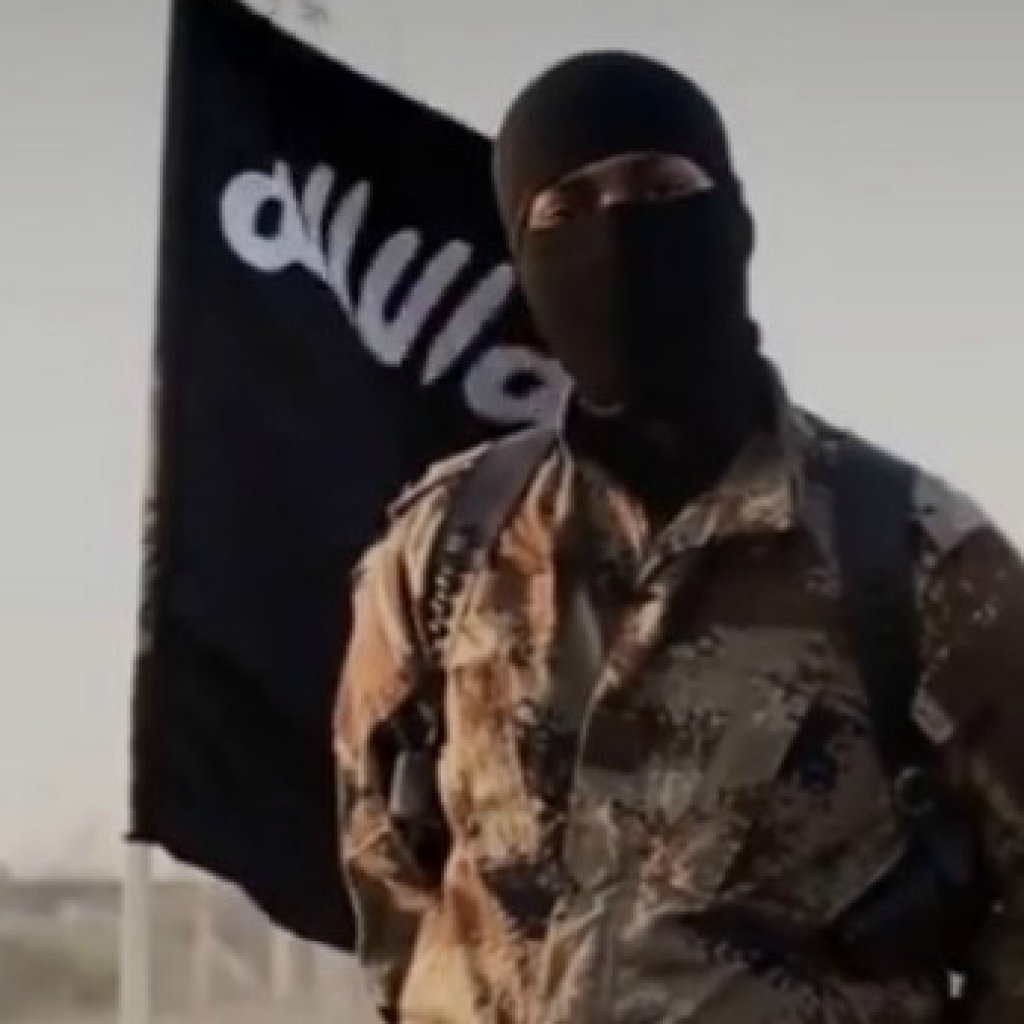 In light of the Paris attacks there has been a rise in anti-Muslim animus as well as a deluge of propaganda and myth-making by the establishment media. Not only has inciteful political rhetoric been rationalized, but the hysteria has pushed many into calling for infringements on civil rights for American Muslims.
  Robbie and Abby Martin discuss the hypocritical and deceptive nature of mainstream and alternative media coverage of the Charlie Hebdo shooting in France and why framing the event as a ‘freedom of speech’ issue is an opportunistic attempt to hijack the narrative into “the terrorists hate us for of our freedoms”. The intense global wave of Islamophobia following the attacks is examined and compared to post 9/11 hysteria.
 On September 11th, 2001, the Bush administration started inoculating themselves with Cipro, the antibiotic to prevent anthrax infection. Several journalists were also told to take Cipro by government officials, yet the precautionary advice wasn’t provided to the American public.