Space-Time Cloak Could Make Events Disappear?

NATIONAL GEOGRAPHIC– It’s no illusion: Science has found a way to make not just objects but entire events disappear, experts say.

According to new research by British physicists, it’s theoretically possible to create a material that can hide an entire bank heist from human eyes and surveillance cameras.

“The concepts are basically quite simple,” said Paul Kinsler, a physicist at Imperial College London, who created the idea with colleagues Martin McCall and Alberto Favaro.

Unlike invisibility cloaks—some of which have been made to work at very small scales—the event cloak would do more than bend light around an object.

Instead this cloak would use special materials filled with metallic arrays designed to adjust the speed of light passing through.

In theory, the cloak would slow down light coming into the robbery scene while the safecracker is at work. When the robbery is complete, the process would be reversed, with the slowed light now racing to catch back up.

If the “before” and “after” visions are seamlessly stitched together, there should be no visible trace that anything untoward has happened. One second there’s a closed safe, and the next second the safe has been emptied.

Read more about Space-Time Cloak Possible, Could Make Events Disappear?

© 2011 National Geographic

Photo by Flickr user hembergler
Scientists ‘Trap’ Anti-Matter for Record 16 Minutes

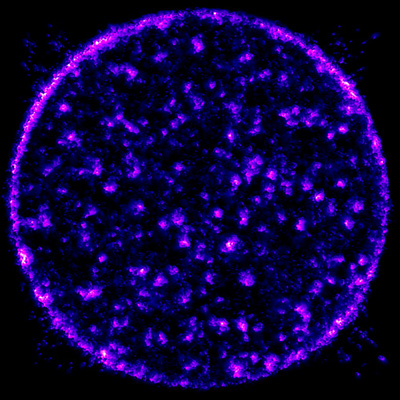
RAW STORY– Scientists said Sunday they had trapped and stored antihydrogen atoms for a record 16 minutes, a stunning technical feat that promises deeper insights into the mysteries of antimatter.

Particles and anti-particles annihilate each other in a small flash of energy when they collide.

At the moment of the big bang, nearly 14 billion years ago, matter and antimatter are thought to have existed in equal quantities. If that balance had persisted, the observable Universe we inhabit would never have come into being.

For unknown reasons — and fortunately for us — Nature seemed to have a slight preference for matter, and today antimatter is rare.

This asymmetry remains one of the greatest riddles in particle physics.

Ongoing low-energy experiments with hydrogen atoms could be a key step toward solving it.

“We can keep the antihydrogen atoms trapped for 1,000 seconds. This is long enough to begin to study them — even with the small number that we can catch so far,” said Jeffrey Hangst, spokesman for the ALPHA team conducting the tests at the European Organisation for Nuclear Research (CERN) in Geneva.

In the study, published in the journal Nature Physics, researchers report trapping some 300 antiatoms.

Scientists used CERN’s high-energy accelerator to create the antihydrogen atoms, and then chilled them to near-zero temperatures.

The aim is to use laser and microwave spectroscopy to compare the immobilised particles to their hydrogen counterparts.

The same team succeeded last fall in trapping dozens of antimatter atoms and holding them in place for a fraction of a second, a world first at the time.

But that was not long enough for the excitable particles to settle into the stable “ground” state needed for precise measurements.

The new benchmark extended this storage time 5,000 fold, making it possible to carry out crucial experiments.

Read the full story about Scientists ‘Trap’ Anti-Matter for Record 16 Minutes.

© 2011 RAW STORY

Photo by Flickr user Fire Brace

Military Robots and the Future of War

April, 25 2011

TED– The future of war also is featuring a new type of warrior. And it’s actually redefining the experience of going to war, you can call this a cubicle warrior. This is what one Predator drone pilot described of his his experience fighting in the Iraq war, while never leaving Nevada, quote, “You’re going to war for 12 hours, shooting weapons at targets, directing kills on enemy combatants and then you get in the car and you drive home, and within 20 minutes you’re sitting at the dinner table talking to your kids about their homework.” Now the psychological balancing of those experiences is incredibly tough. And in fact those drone pilots have higher rates of PTSD than many of the units physically in Iraq.

Peter Warren Singer is the director of the 21st Century Defense Initiative at the Brookings Institution — where his research and analysis offer an eye-opening take on what the 21st century holds for war and foreign policy. His latest book, Wired for War, examines how the US military has been, in the words of a recent US Navy recruiting ad, “working hard to get soldiers off the front lines” and replacing humans with machines for bombing, flying and spying. He asks big questions: What will the rise of war machines mean to traditional notions of the battlefield, like honor? His 2003 book Corporate Warriors was a prescient look at private military forces. It’s essential reading for anyone curious about what went on to happen in Iraq involving these quasi-armies.

Read more and see an interactive transcript about PW Singer on military robots and the future of war.

© 2011 TED

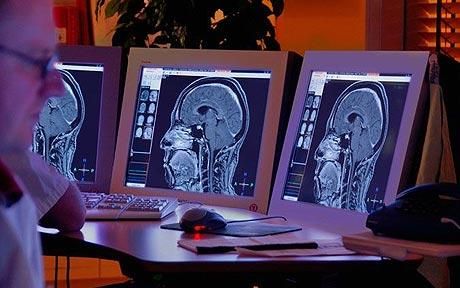
Computers that Read Minds are Being Developed by Intel

TELEGRAPH– Unlike current brain-controlled computers, which require users to imagine making physical movements to control a cursor on a screen, the new technology will be capable of directly interpreting words as they are thought.

Intel’s scientists are creating detailed maps of the activity in the brain for individual words which can then be matched against the brain activity of someone using the computer, allowing the machine to determine the word they are thinking.

Preliminary tests of the system have shown that the computer can work out words by looking at similar brain patterns and looking for key differences that suggest what the word might be.

Dean Pomerleau, a senior researcher at Intel Laboratories, said that currently, the devices required to get sufficient detail of brain activity were bulky, expensive magnetic resonance scanners, like those used in hospitals.

But he said work was under way to produce smaller pieces of equipment that can be worn as headsets and that can produce the same level of detail.

Continue reading about Computers that Read Minds are Being Developed by Intel.

© Telegraph, 2010

Photo by ALAMY

Zeitgeist: Addendum – Documentary

Zeitgeist: Addendum, sequel to Zeitgeist: The Movie, was created as a Not-for-Profit expressions to communicate what the author felt were highly important social understandings which most humans are generally not aware of. The movie attempts to locate the root causes of this pervasive social corruption, while offering a solution.

This solution is not based on politics, morality, laws, or any other “establishment” notions of human affairs, but rather on a modern, non-superstitious based understanding of what we are and how we align with nature, to which we are a part. The work advocates a new social system which is updated to present day knowledge, highly influenced by the life long work of Jacque Fresco and The Venus Project.

http://www.zeitgeistmovie.com/

http://thezeitgeistmovement.com/


Cover photo by flickr user Zeitgeist Granada