Outlawing Cash for Second Hand Goods in Louisiana

MoneyyyFlickrpurpleslogMEDIA ROOTS — Many of us notice our society’s shift away from the use of anonymous cash and toward the use of databeast-tracked digital money.  But many are unaware that there are steps already being taken to outlaw cash in favour of debit/credit cards and digital transactions.  In Louisiana, House Bill 195 of the 2011 Regular Session (Act 389) was passed this summer by its State Legislature and Republican Governor Bobby Jindal.  This law makes it illegal to use cash in transacting second-hand goods.  The question becomes, ‘who actually motivated this law and why?’ 

The bill states:

“A secondhand dealer shall not enter into any cash transactions in payment for the purchase of junk or used or secondhand property.  Payment shall be made in the form of check, electronic transfers, or money order issued to the seller of the junk or used or secondhand property and made payable to the name and address of the seller.  All payments made by check, electronic transfers, or money order shall be reported separately in the daily reports required by R.S. 37:1866.”

Ackel & Associates LLC, a professional law firm in Louisiana, describes the new legislation as the U.S. Government taking private property without due process.  As one may have expected, the justifying pretext involves police crime-fighting. One Louisiana State Rep co-author of the bill, Rickey Hardy, argued the law is intended to be “a mechanism to be used so the police department has something to go on and have a lead” in combating theft.  Yet, while local cops take no interest in white-collar crime, even shielding major financial criminals from nationwide Occupy Movement protests, they will definitely be ready to bust thrift shops, local antique stores, flea markets, and anyone who dares to use cash in second-hand retail transactions in Louisiana.

Already, we see class-division in the U.S. reflected between those who make virtually all purchases through digital transactions and those who rely on cash.  Here’s one possible scenario:  First an individual legislator (with or without external influence) establishes a precedent under law enforcement pretexts in a state, which may not often capture the national imagination.  Then it spreads to other states.  Unchecked, something that seemed outlandish at first becomes orthodox convention.  First, second-hand cash transactions are outlawed.  Then the slippery slope slide into fully outlawing cash becomes inevitable.  It may sound like a far-fetched concept, but in light of this legislative trajectory it’s not implausible.

Messina

***

NATURAL NEWS — Besides prohibiting the use of cash, the law also requires such “dealers” to collect personal information like name, address, driver’s license number, and license plate number from every single customer, and submit it to authorities. And the only acceptable form of payment in such situations is a personal check, money order, or electronic transfer, all of which must be carefully documented.

The stated purpose of the law, which excludes non-profits and pawn shops, is to curb criminal activity involving the reselling of stolen goods, particularly metals such as copper, silver, and gold. But according to A&A, existing Louisiana state law already requires businesses and other resellers of secondhand goods to account for transactions, and has specific laws already on the books that address the selling of stolen goods.

The new law is so broad and all-encompassing that individuals who buy and sell on sites like eBay or Craigslist using cash will also be in violation of it. Even a stay-at-home-mom who holds a garage sale with her neighbors more than once a month could be required to refuse cash from customers, as well as keep a detailed record of every single purchase made, and who made it.

There really is no legitimate reason for banning cash payments, especially in light of the required collection of detailed and excessive personal information. The measure is simply just another excuse for the government to spy on individuals, and take away their economic and civil liberties.

Read more about Louisiana prohibits residents from using cash when buying, selling secondhand goods.

© 2011 Natural News Network

***

Photo by flickr user purpleslog

Pentagon Successfully Tests Hypersonic Flying Bomb

MEDIA ROOTS – Two weeks ago the U.S. department of defense tested a new weapon that, by being able to travel faster than the speed of sound and strike any location on the planet in under an hour, combines the global reach of the Cold War’s intercontinental ballistic missiles, and the surgical precision of today’s robotic flying drones.

In doing so, the military problem of Mutually Assured Destruction that once kept adversaries at bay is being stripped away, making the use of military force more “reasonable.”

The new weapon, called the “Advanced Hypersonic Weapon,” or AHW, is a remote controlled flying weapons delivery system (a flying bomb) that travels at hypersonic speeds within the earth’s atmosphere.  The weapon was launched from the Hawaiian islands and steered 2,300 miles over the Pacific ocean to the Marshall Islands in under half an hour.

The AHW is a first-of-its-kind glide vehicle designed to fly long range carrying a payload of up to 5500 kgs, including a nuclear bomb, according to a statement issued by the US  Department of Defense.  A hypersonic speed is one that exceeds Mach 5- or five times the speed of sound (3,728 mph).

Among other things, this means the army will no longer have to depend on forces stationed around the world as they can lay down fire power anywhere they need from the comfort of a home base, without risking any American lives.

During the Cold War, the West and East developed nuclear and intercontinental missile delivery capabilities, but the concept of Mutually Assured Destruction made the actual use of the weaponry “unreasonable.”  Using them would have been an act of insanity and suicide for both parties because the destruction would be so wide spread for everyone involved.  As instruments of policy, these weapons were deemed useless.

The new AHW, however, promises to be a very usable weapon of policy.  By eliminating the need for U.S. forces in the immediate theater of war, the AHW moves offensive actions further along a continuum that distances the warrior from their target and, in effect, from the moral responsibility for pulling a trigger.

Such a weapon even allows for plausible deniability.  No blood on their hands, and you certainly can’t place them at the scene since they were halfway around the world at the time.

For these reasons, the AHW is a weapon that allows its possessor a step in the direction of absolute power.  We don’t risk our people, we don’t risk our sense of morality, and we don’t even risk blame.  It’s a clean and detached method of warfare, but how will it change our moral and ethical code as a people who are sponsoring this futuristic weaponry?

Written by Joel E. Hersch for Media Roots

Photo by Flickr user lrargerich

Scientists Remodel Brains’ Visions Into Digital Video

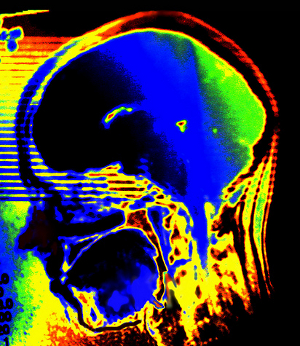
MEDIA ROOTS- Ten years ago, the concept of visually mapping out one’s thoughts, dreams or memories seemed like far-fetched science fiction. Now, it’s a looming reality. UC Berkeley scientists have made a mind-blowing technological breakthrough by developing a system that collects visual activity in the human brain and roughly remodels it as digital video clips. After the process is perfected it will eventually lead to the reconstruction of dreams onto computers.

Abby

***

GIZMODO They used three different subjects for the experiments—incidentally, they were part of the research team because it requires being inside a functional Magnetic Resonance Imaging system for hours at a time. The subjects were exposed to two different groups of Hollywood movie trailers as the fMRI system recorded the brain’s blood flow through their brains’ visual cortex.

The readings were fed into a computer program in which they were divided into three-dimensional pixels units called voxels (volumetric pixels). This process effectively decodes the brain signals generated by moving pictures, connecting the shape and motion information from the movies to specific brain actions. As the sessions progressed, the computer learned more and more about how the visual activity presented on the screen corresponded to the brain activity.

After recording this information, another group of clips was used to reconstruct the videos shown to the subjects. The computer analyzed 18 million seconds of random YouTube video, building a database of potential brain activity for each clip. From all these videos, the software picked the one hundred clips that caused a brain activity more similar to the ones the subject watched, combining them into one final movie. Although the resulting video is low resolution and blurry, it clearly matched the actual clips watched by the subjects.

Think about those 18 million seconds of random videos as a painter’s color palette. A painter sees a red rose in real life and tries to reproduce the color using the different kinds of reds available in his palette, combining them to match what he’s seeing. The software is the painter and the 18 million seconds of random video is its color palette. It analyzes how the brain reacts to certain stimuli, compares it to the brain reactions to the 18-million-second palette, and picks what more closely matches those brain reactions. Then it combines the clips into a new one that duplicates what the subject was seeing. Notice that the 18 million seconds of motion video are not what the subject is seeing. They are random bits used just to compose the brain image.

Given a big enough database of video material and enough computing power, the system would be able to re-create any images in your brain.

Read more about Scientists Reconstruct Brains’ Visions Into Digital Video In Historic Experiment

© 2011 Gizmodo


Video comparing reconstructed clips from human brain activity compared to actual images shown

http://gallantlab.org


Photo by Flickr user alles-schlumpf

Regulation of Animal-Human Hybrids Needed

INTERNATIONAL BUSINESS TIMES– Experiments that create animal-human hybrids by implanting human material in lab animals should be more rightly regulated, a group of British scientists said in a new report.

It may sound like something from a horror movie, but implanting a small number of human genes or cells in animals is nothing new: scientists have already made strides in medical treatment by testing cancer drugs on mice engineered to have human DNA, by seeing how human stem cells behave in rats, and by studying a blood clotting problem through goats with a human protein in their milk. But a report issued by the UK’s Academy of Medical Sciences recommended creating a government body to advise whether certain tests should be permissible.

“There are a small number of future experiments, which could approach social and ethically sensitive areas which should have an extra layer of scrutiny,” said Martin Bobrow, a professor of medical genetics at the University of Cambridge  chair of the group who wrote the report. “There are good reasons for doing these experiments because they lead you to a better understanding of really important questions, but we need to go slowly and it needs to be regulated in a way that’s open, and transparent and looks very carefully at each step.”

2008 experiment in which British researchers created a human-animal embryo sparked considerable controversy, with religious groups condemning the experiment. Bobrow and his colleagues wrote that most experiments should be allowed to proceed, but they elaborated a small number of experiments that could cross the line.

“Where people begin to worry is when you get to the brain, to the germ [reproductive] cells, and to the sort of central features that help us recognize what is a person, like skin texture, facial shape and speech,” Bobrow told reporters. “The closer [an animal brain] is to a human brain, the harder it is to predict what might happen,” he added.

The report references the issue’s powerful resonance, addressing what the authors dub the “‘Frankenstein fear’ that the medical research which creates ‘humanised’ animals is going to generate ‘monsters.'” A poll included in the study found that a majority of respondents supported the idea of research using animals that contained human material, so long as it was to advance medicine. But people were wary of anything that would sacrifice the mental capacities that separate humans from animals.

Read more about Report Calls for Regulation of Animal-Human Hybrid Experiments

© 2011 International Business Times

Photo by Flickr user Gravitywave

Telex To Help Defeat Web Censors

BBC– Developed by US computer scientists the software, called Telex, hides data from banned websites inside traffic from sites deemed safe.

The software draws on well-known encryption techniques to conceal data making it hard to decipher.

So far, Telex is only a prototype but in tests it has been able to defeat Chinese web filters.

Outside in

Telex was developed to get around the problem that stops other anti-censorship technologies being more effective, said Dr Alex Halderman, one of the four-strong team that has worked on Telex since early 2010.

Many existing anti-censorship systems involve connecting to a server or network outside the country in which a user lives.

This approach relies on spreading information about these servers and networks widely enough that citizens hear about them but not so much that censors can find out and block them.

Telex turns this approach on its head, said Dr Halderman.

Read more about Telex To Help Defeat Web Censors

© 2011 BBC

Photo by Flickr user sploosh37