


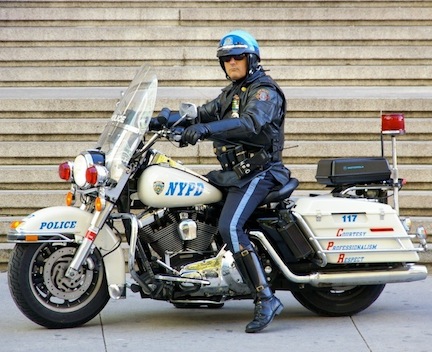
 MEDIA ROOTS – This article by David Noriega, published on TheNewInquiry, vividly diagrams the pressures inherent on a young college graduate when he goes to work for the NYC Civilian Complaint Review Board, wherein he investigates citizens’ complaints against NYPD officers. Where other areas that have the means use attorneys for the important task of holding peace officers accountable to citizens, the overextended CCRB provided steady employment for recent grads like Mr. Noriega, as long as they could accomplish the task of minimizing paperwork and consequences for the NYPD.
Younger, more inexperienced workers were more likely to follow orders and be amenable to a culture that valued exoneration of officers, discounting citizen grievances, and not taking a stand on controversial issues like stop-and-frisk. The author expresses some guarded hope, and lists some recent, albeit limited, improvements to the CCRB’s function. This cautionary tale will give you a glimpse of what it feels like to be on the inside of a powerless bureaucratic machine whose ostensible task is keeping the NYPD from abusing its authority.
Laurie Kirchner for Media Roots
*****
THENEWINQUIRY – I will always remember the first time a cop lied to me. Or rather, the first time that I knew beyond a doubt that a cop was lying to me, sitting right there in the interview room with a tape recorder in front of him.
It was early in my tenure as an investigator at the New York City Civilian Complaint Review Board, the city agency established in 1993 to investigate allegations of misconduct against NYPD officers. The case was a fairly straightforward stop-and-frisk incident near the massive New York City Housing Authority complexes along Avenue D in Manhattan. The complainant, a man in his early 20s, alleged that a plainclothes cop had stopped, frisked, and searched him after he stepped out of a bodega. He’d given a guy a cigarette, and before he knew it, the cop came up from behind him, grabbed him by the coat, and after a quick scuffle, pushed him against a wall.
I’d already interviewed the cop’s unusually forthcoming partner, whose testimony matched the complainant’s. That’s how I knew the cop was making stuff up. Lots of stuff.
Continue reading The Thin Blue Line
*****
photo by Jean-Edouard BABIN under creative commons
 MEDIA ROOTS – It may be a sign of a public awakening when news of government surveillance hits the front page of Gawker’s future and technology blog,
  MEDIA ROOTS- Sometimes I forget that I am living in a police state, and then I hear about stories like this: last Thursday, Bay Area Rapid Transit (BART) shut off cellphone service at several stations in an attempt to stop a planned protest over another fatal shooting by BART police. It was spun as a preventative safety measure by BART and officials, but it’s a disturbing commentary on how de-valued privacy and civil disobedience have become in our society.