MEDIA ROOTS — Abby Martin of Media Roots and RT extends meaningful and challenging questions to the iconic hip hop artist and activist Immortal Technique, who notes what “seems to be a meticulous strategy to keep anything that is thought-provoking out of the mainstream.”
Like other renegades, such as artists like Zack de la Rocha, Tom Morello, Morrissey and Paul Mooney, independent recording artist Immortal Technique delivers a potent interview on an array of sundry topics. They discuss music, conspiracy, politics, culture and the evolution of consciousness throughout the extended thirty minute interview for RT TV.
Messina
***
RT — Hip-hop artist Immortal Technique is a self-described social guerrilla. Felipe Coronel is the real name of the Peruvian-born, Harlem-raised political activist who raps about politics, religion and racism. Since the genesis of the OWS movement, Tech has been an active voice for the cause, and on July 10 a documentary will be released showing his everyday life. He now joins us with more on his beliefs and his work.
***
Abby Martin: “Something you rarely see these days in the MTV-generated music industry mainstream: hip hop with a message of raw truth. Felipe Coronel, better known as Immortal Technique, is a Peruvian-born, Harlem-raised hip hop artist and political activist, a self-described social guerilla. Tech’s views about politics, religion, classism, and racism are expressed poetically and powerfully through his lyrics. And some of his albums pack more historical relvance than an entire school history book. To maintain control over his work, Tech has never signed with a label, which gives him ultimate freedom of expression. He’s a vocal supporter of many political movements and struggles for justice. Since the Occupy Wall Street movement started last year, he’s been an active voice of support for the cause. And now a new documentary coming out July 10 gives us an intimate look at his life, music, and activism. Here’s a sneak peek.”
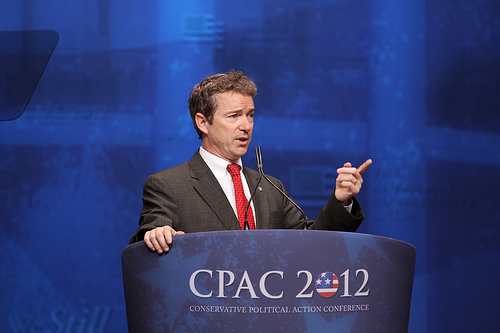
MEDIA ROOTS – In a surprising turn of events last Thursday, Senator Rand Paul came out on the Sean Hannity Show on Fox news to make a special announcement: his endorsement for GOP presidential candidate Mitt Romney. The announcement was a blow to the Ron Paul liberty movement who are still rallying for Ron Paul until the very end of the game. Despite his statement of concession in a recent newsletter, many die hard Ron Paul fans are still hoping that there’s a chance for him to win the nomination with unbound delegates in Tampa.
But what does it say when his own son comes out to endorse his rival? Many are theorizing that the endorsement signifies Rand Paul “selling out” to the war mongering establishment that has worked to shut out his father’s libertarian ideals for so long. Others are stating that it’s simply a political strategy to bring the liberty ideas into the mainstream. I explore the issue in three segments below for RT TV, all with varying guest opinions and theories.
Love him or hate him, Ron Paul is unique in his political authenticity, and that unwavering genuineness of ideals is currently unmatched by any sitting representative. Above all else, this endorsement further elucidates that the American people cannot count on the members of the political establishment to do the bidding of the people–we can only count on ourselves to change the world around us. Wasting countless hours and precious energy on electing political representatives with the hope that they will “create change from the inside” may lead to only greater disillusionment, disempowerment and disengagement.
The political establishment has proven itself time and time again to represent the corporate bottom line of profit maximization, despite the consequences for humanity. Voting is important, a civic duty if you will, but it is literally the least thing anyone can do to participate. The votes that truly matter happen in our daily actions: the way in which we choose to live our lives, the businesses we support or don’t support, the dialogue in which we engage with our community. Finding and voicing your passion will impact the world more than casting a ballot into an inherently flawed political system ever will.
Abby
***
Jack Hunter, official blogger for Ron Paul 2012, argues that the endorsement of Romney was a smart political move by Rand.
Lew Rockwell of the Ludwig Von Mises Institute talks about the need to work outside the system to effect change.
Even though Ron Paul himself sent out a concession letter admitting to not having enough delegates to win the nomination, Paco Elijah of Occupy the Media and Robert Vaughn, CA coordinator for Ron Paul’s campaign, argue that Ron Paul still has a chance to win. The youtube comments against me in this video are vicious, simply for calling out obvious truths.
MEDIA ROOTS – For the last half century, an organization comprised of the .001% of the world’s elite called the Bilderberg Group has met annually around the world with almost no official press coverage. During the meetings, the top 140 of the world’s power brokers in banking, oil, food, media, defense, royalty and politics are believed to make policy decisions behind closed doors that affect the rest of the world.
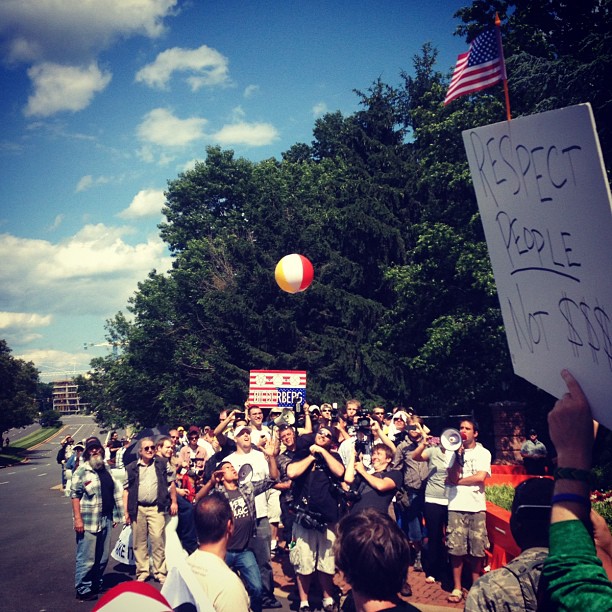
On Thursday, May 31st – Sunday, June 3rd, the annual Bilderberg Conference took place at the Westfields Marriot in Chantilly, Virginia, a city located right next to Washington, DC. I went to cover this year’s Bilderberg Conference and mass protests that took place all weekend for RT TV. People across many political spectrums–including Ron Paul libertarians to Occupy Wall Street protesters–joined together to rally against the covert meeting of the minds, in which the protesters claim sets a global agenda to perpetuate their own power structure at the subjugation of humanity.
Abby
Abby Martin reports on the history of the Bilderberg Group and cites some of its most notable attendees from past years.
Abby Martin covers the first day of the Bilderberg Group to find out why people are protesting. Featuring interviews with Dan Dicks of Press for Truth TV, Luke Rudkowski of WeAreChange, Mattew Medina of Truth Exposed Radio and Alex Jones of InfoWars.
Abby Martin reports from the second day of the Bilderberg Conference protests during a torrential downpour.
After Bilderberg came to a close, Abby Martin wraps up the event and gives some insight on what transpired over the weekend.
INFOWARS – “Any citizen of the United States, wherever he may be, who, without authority of the United States, directly or indirectly commences or carries on any correspondence or intercourse with any foreign government or any officer or agent thereof, with intent to influence the measures or conduct of any foreign government or of any officer or agent thereof, in relation to any disputes or controversies with the United States, or to defeat the measures of the United States, shall be fined under this title or imprisoned not more than three years, or both…”
To be absolutely clear –Any citizen without United States authority who speaks intentionally of influence with foreign government officials about disputes or controversies any country has with America shall be fined and imprisoned.
Americans attending the Bilderberg conference in Chantilly, Virginia this past weekend violated the Logan Act. Given this is America these individuals are innocent until proven guilty, however that is a process for the courts. Each American citizen attending the meeting should prove to a jury of his or her peers that in fact they did not engage discussion with foreign government officials with the intent to influence the conduct of that foreign government in the context of an existing dispute or controversy with the United States. It is not up to executive branch officials, legislators, police, military or media to decide their guilt or innocence –it is up to the courts. That being said, it seems clear sufficient probable cause, motive and opportunity exists to issue arrest warrants.
Historical Origins of the Logan Act
The Logan Act all begins with a treaty between America and Britain called the Jay Treaty. You can research the contents and reasons behind the Jay Treaty on your own, it is only important here to understand that it angered the French who had been a staunch ally of America since the 1778 Treaty of Alliance. America had declared neutrality in the conflict between Britain and France and the Jay Treaty violated that neutrality. Pouring salt into that wound America also refused to re-pay debts owed to France, suggesting the debt was owed to the French monarchy and not to the newly founded Republic of France. The French were furious and began seizing American trade ships and refused to accept an American ambassador to negotiate. This spurred the Quasi-War.
Along comes a physician, farmer and future United States Senator named George Logan. As the founder of the Democratic-Republican society in 1793 he was not well liked by the coalescing and strengthening Federalist Party who lusted for an American central bank. In 1798, Logan travelled to Paris and met with the infamous French diplomat Charles “lame devil” Talleyrand and former exile Philippe Merlin de Douai, who held the highest political office in the new French republic. Like modern American Bilderberg participants Logan identified himself as merely an American citizen and like modern Bilderberg meetings they discussed matters of general dispute, controversy and interest to the French foreign power.
George Logan reported an expanding American anti-French sentiment, while he insisted that he did not intend to explain America’s position nor criticize French positions. He was merely there to discuss general matters emanating from the controversy and dispute evident in the mutual relations between France and America. The success of Logan’s trip is largely due to the timing as the French were anxious to extricate themselves from foreign entanglement to focus on domestic issues. Only days after Logan’s departure American seamen held in French jails were released and the trade embargo was lifted. Praise was showered upon Logan by Democratic-Republican newspapers and this drew the ire of the dominant Federalist Party.
Then Secretary of State Timothy Pickering, charged with conducting the nation’s foreign policy, suggested to Congress that they act to curb individual interference with sovereign foreign affairs. With very little debate the Logan Act glided through the Federalist majority House and Senate. George Logan would become a United States Senator representing Pennsylvania from 1801 to 1807. Irony would later see George Logan dispatched on an unsuccessful private diplomatic mission to avoid the War of 1812. So, the Logan Act was historically conceived by a Secretary of State to protect the State Departments authority.
Today the State Department allows their responsibility to be hi-jacked by foreign lobbyists, corporate interests, privately conceived and controlled “think tanks,” and international legislative bodies such as the United Nations. This is the very premise for convening the annual Bilderberg meeting and the corresponding premise for the Logan Act. The mainstream media facilitates the dilution of sovereign American foreign policy by ignoring the facts and history, disguising it with misguided articles that place the word “conspiracy,” or by suggesting nothing tangible is being accomplished.
Abby Martin of RT TV interviews former Captain Ray Lews about his case
RT TV– Retired Captain Ray Lewis served within the ranks of the Philadelphia, Pennsylvania Police Department for nearly a quarter of a century. Now he is at odds against the force’s higher ups, however, over his role with Occupy Wall Street.
Captain Lewis became a regular at protest and rallies since the infancy of the Occupy movement last year. Regularly donning his Philadelphia PD uniform, Lewis was caught at demonstrations across the country demanding for changes within the system. Speaking with RT, though, the 24-year veteran of the force says it hasn’t been easy.
After first involving himself with OWS, Lewis says he received a letter from the department condemning his uniformed protests. “They want to make sure that no other officers join me in promoting this Occupy movement,” he tells RT. According to the captain, the aesthetic of a uniformed officer rallying against the backbone of the law enforcement industry is the reason behind the department’s demands.
“It is my belief that they were pressured by corporate America, because the one sign I carry on a daily basis is to ask people to watch the documentary Inside Job,” says Lewis. “Inside Job is a scathing, indicting film of banks, specifically in the 2008 financial collapse, and anybody who watches that documentary will fully understand the corruption of our banks in this country.”
The ties between the police and the nation’s financial institutions might not be clear cut, but Lewis attests that it is certainly there.
“In Philadelphia, the Fraternal Order of Police — a lot of cops want to be the president of that union — and they have elections. And these elections are run just like any other political election: they are based on money. A lot of advertising goes into these elections and those cops don’t pay for that advertising out of their back pockets. This advertising is paid for by corporations, banks, financial institutions.
“Subsequently, when you are elected, you are beholden to those financial institutions. And when I come out condemning those financial institutions, if the president of the [union] wants to get continuing contributions, he better pay heed to the banks,” explains Lewis. Now, he says, his benefits with the Philly PD could be revoked if the department decides to pursue an investigation into his role with the protest movement.
Lewis says that the union’s response to his participation in the Occupy movement wasn’t exactly what he had expected. He tells RT he “was taken aback” when he received a letter in the mail from high higher-ups at the Fraternal Order of Police.
“They threatened me with having a hearing, perhaps to expel me,” he says. “I was surprised that they took that extent, without even giving me the courtesy of a phone call and finding out exactly what I was doing; what I was about.”
After going public with his grievances over his demands, Lewis was let off the hook — for now. He says that the way the department acted over his involvement with the Occupy movement should be a chilling wake up call to the rest of the country, though.
“When they come out and say what I’m doing is illegal or improper and give me an order to immediately cease and desist wearing my uniform…or they will take any and all unnecessary action to stop me, what’s so egregious about this is it sends the message to officers that they can violate people’s First Amendment rights,” he says.
Today Lewis says he has yet to be expelled but is still sure that the department will continue to investigate his role with OWS. As for the movement itself, he says he has no expectations but is still behind it 100 percent.
“It’s not going to do any good wondering where it’s going to go,” he says. “I’d rather spend my time and my positive energy on determining what path I can take, what can I do to further the goals of the movement.”
RT TV – The looming threat of cyberterrorism is being ramped up by the day–from government officials to mainstream media pundits–who say that cyberterror will soon outweigh terrorism as the number one security threat facing the United States.
It’s a threat that’s all too certain, as the federal government continues to make the claim stressing how it’s not a matter of if, but when a cyber attack will occur in this the US. At a recent congressional hearing entitled “America is Under Cyber Attack: Why Urgent Action is Needed,” Subcommittee Chairman Michael McCaul exclaimed how “It’s not a matter of if, but when a cyber Pearl Harbor will occur.”
The rhetoric is so pervasive, that there is even an entire cyberterror exhibit called “Weapons of Mass Disruption” at the International Spy Museum in Washington, DC, a museum whose executive director spent 36 years at the CIA.The room displays multiple disaster scenarios it claims are likely to happen when a cyber attack destroys the power grid and infrastructure of this country.
Mark Stout, historian at the International Spy Museum, explains that the room is not there to cause panic–it simply exists as a beacon of awareness about the issue. He says that as technology advances along with our reliance on and integration with computer systems, it’s becoming more important to focus on cyberterrorism. However, Stout does express the similar talking point of the likely possibility of this happening in the near future, warning that “there will come a time and it will be within our lifetime, probably relatively soon, that there will be a major cyber terrorist attack.”
Also on display at the “Weapons of Mass Disruption” exhibit is a well produced graphic film reel of government officials and top military brass urging warnings about the threat. “We know that there are half a dozen countries in the world that have developed cyber weapons,” states James A. Lewis, Director of Center for Strategic International Studies, in the film.
However, the threat surpasses nation states. The government is also pointing fingers at ubiquitous web entities such as Anonymous, the leaderless hacktivist group who has been shutting down highly secure government websites in addition to their repeated calls for mass civil unrest in the US.
Overall, the cyberterror hype seems to be working–a recent poll reveals that Americans are now more scared of cyberterrorism than actual terrorism.
In response to the climate of fear, the federal government has already started to draft legislation to deal with the threat. The Cyber Intelligence Sharing and Protection Act, or CISPA, is a bill that would permit massive collusion between corporations and the government to gain access to private user data. It has already passed the House, and is now awaiting a Senate vote.
Critics of the legislation warn that the bills proposed are too broad, and could pave the way for government abuse. “When it comes to protecting our civil rights and civil liberties, we don’t usually give the government a blank check, and that’s what these bills have done in a lot of ways,” explains Matt Wood, Policy Director for Free Press. He continues to describe how the government’s excessive response doesn’t match the threat, and that these laws could be used simply for corporations to capitalize off the elimination of privacy at the risk of impeding Net Neutrality. “It could be a competitive threat, it doesn’t have to be something you and I define as a cyber security threat, just a threat to their current bottom line or business,” Wood states.
Whether or not CISPA passes the Senate, one thing remains clear. The government will continue its constant attempts to control the Internet, and the blanket threat of cyberterrorism may be the perfect avenue to convince the people of this country into giving up their rights to privacy on the Internet once and for all.



 MEDIA ROOTS –
  MEDIA ROOTS – For the last half century, an organization comprised of the .001% of the world’s elite called the Bilderberg Group has met annually around the world with almost no official press coverage. During the meetings, the top 140 of the world’s power brokers in banking, oil, food, media, defense, royalty and politics are believed to make policy decisions behind closed doors that affect the rest of the world.