 ABC NEWS– In the early 1960s, America’s
top military leaders reportedly drafted plans to kill innocent people and
commit acts of terrorism in U.S.
cities to create public support for a war against Cuba.
ABC NEWS– In the early 1960s, America’s
top military leaders reportedly drafted plans to kill innocent people and
commit acts of terrorism in U.S.
cities to create public support for a war against Cuba.
Code named Operation Northwoods, the plans reportedly included the possible
assassination of Cuban émigrés, sinking boats of Cuban refugees on the high
seas, hijacking planes, blowing up a U.S.
ship, and even orchestrating violent terrorism in U.S.
cities.
The plans were developed as ways to trick the American public and the
international community into supporting a war to oust Cuba’s
then new leader, communist Fidel Castro.
America’s
top military brass even contemplated causing U.S.
military casualties, writing: “We could blow up a U.S.
ship in Guantanamo Bay
and blame Cuba,”
and, “casualty lists in U.S.
newspapers would cause a helpful wave of national indignation.”
Details of the plans are described in Body of Secrets (Doubleday), a new
book by investigative reporter James Bamford about the history of America’s
largest spy agency, the National Security Agency. However, the plans were not
connected to the agency, he notes.
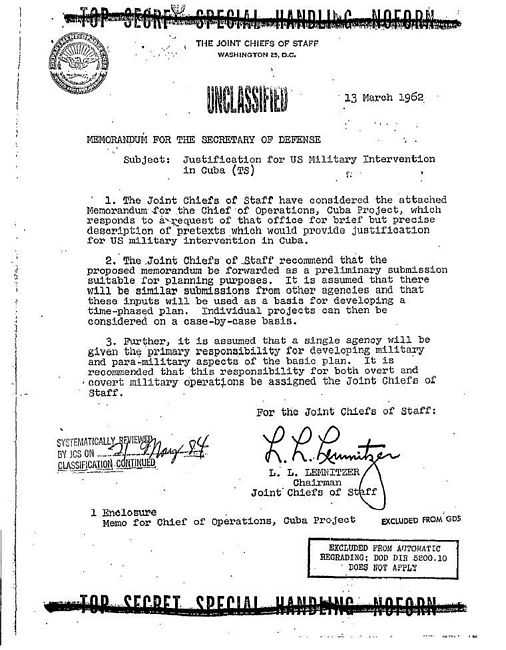
The plans had the written approval of all of the Joint Chiefs of Staff and
were presented to President Kennedy’s defense secretary, Robert McNamara, in
March 1962. But they apparently were rejected by the civilian leadership and
have gone undisclosed for nearly 40 years.
“These were Joint Chiefs of Staff documents. The reason these were held
secret for so long is the Joint Chiefs never wanted to give these up because
they were so embarrassing,” Bamford told ABCNEWS.com.
“The whole point of a democracy is to have leaders responding to the
public will, and here this is the complete reverse, the military trying to
trick the American people into a war that they want but that nobody else
wants.”
Gunning for War
The documents show “the Joint Chiefs of Staff drew up and approved
plans for what may be the most corrupt plan ever created by the U.S.
government,” writes Bamford.
The Joint Chiefs even proposed using the potential death of astronaut John Glenn during the
first attempt to put an American into orbit as a false pretext for war with Cuba, the documents show.
Should the rocket explode and kill Glenn, they wrote, “the objective is
to provide irrevocable proof … that the fault lies with the Communists et all Cuba
[sic].”
The plans were motivated by an intense desire among senior military leaders
to depose Castro, who seized power in 1959 to become the first communist leader
in the Western Hemisphere — only 90 miles from U.S.
shores.
The earlier CIA-backed Bay
of Pigs invasion of Cuba
by Cuban exiles had been a disastrous failure, in which the military was not
allowed to provide firepower.The military leaders now wanted a shot at it.
“The whole thing was so bizarre,” says Bamford, noting public and
international support would be needed for an invasion, but apparently neither
the American public, nor the Cuban public, wanted to see U.S.
troops deployed to drive out Castro.
Reflecting this, the U.S.
plan called for establishing prolonged military — not democratic — control over
the island nation after the invasion.
“That’s what we’re supposed to be freeing them from,” Bamford
says. “The only way we would have succeeded is by doing exactly what the
Russians were doing all over the world, by imposing a government by tyranny,
basically what we were accusing Castro himself of doing.”
‘Over the Edge’
The Joint Chiefs at the time were headed by Eisenhower appointee Army Gen.
Lyman L. Lemnitzer, who, with the signed plans in hand made a pitch to McNamara
on March 13, 1962, recommending Operation Northwoods be run by the military.
Whether the Joint Chiefs’ plans were rejected by McNamara in the meeting is
not clear. But three days later, President Kennedy
told Lemnitzer directly there was virtually no possibility of ever using overt
force to take Cuba,
Bamford reports. Within months, Lemnitzer would be denied another term as
chairman and transferred to another job.
The secret plans came at a time when there was distrust in the military
leadership about their civilian leadership, with leaders in the Kennedy
administration viewed as too liberal, insufficiently experienced and soft on
communism. At the same time, however, there real were concerns in American
society about their military overstepping its bounds.
There were reports U.S.
military leaders had encouraged their subordinates to vote conservative during
the election.
And at least two popular books were published focusing on a right-wing
military leadership pushing the limits against government policy of the day.
The Senate
Foreign Relations Committee published its own report on right-wing
extremism in the military, warning a “considerable danger” in the
“education and propaganda activities of military personnel” had been
uncovered. The committee even called for an examination of any ties between
Lemnitzer and right-wing groups. But Congress didn’t get
wind of Northwoods, says Bamford.
“Although no one in Congress could have known at the time,” he writes,
“Lemnitzer and the Joint Chiefs had quietly slipped over the edge.”
Even after Lemnitzer was gone, he writes, the Joint Chiefs continued to plan
“pretext” operations at least through 1963.
One idea was to create a war between Cuba and another Latin
American country so that the United States
could intervene. Another was to pay someone in the Castro government to attack U.S.
forces at the Guantanamo naval base
— an act, which Bamford notes, would have amounted to treason. And another was
to fly low level U-2 flights over Cuba,
with the intention of having one shot down as a pretext for a war.
“There really was a worry at the time about the military going off
crazy and they did, but they never succeeded, but it wasn’t for lack of
trying,” he says.
After 40 Years
Ironically, the documents came to light, says Bamford, in part because of
the 1992 Oliver Stone
film JFK, which examined the possibility of a conspiracy behind the
assassination of President Kennedy.
As public interest in the assassination swelled after JFK’s release,
Congress passed a law designed to increase the public’s access to government
records related to the assassination.
The author says a friend on the board tipped him off to the documents.
Afraid of a congressional investigation, Lemnitzer had ordered all Joint
Chiefs documents related to the Bay of Pigs destroyed,
says Bamford. But somehow, these remained.
“The scary thing is none of this stuff comes out until 40 years
after,” says Bamford.
See Declassified Document HERE.
In the early 1960s, America’s
top military leaders reportedly drafted plans to kill innocent people and
commit acts of terrorism in U.S.
cities to create public support for a war against Cuba.
Code named Operation Northwoods, the plans reportedly included the possible
assassination of Cuban émigrés, sinking boats of Cuban refugees on the high
seas, hijacking planes, blowing up a U.S.
ship, and even orchestrating violent terrorism in U.S.
cities.
The plans were developed as ways to trick the American public and the
international community into supporting a war to oust Cuba’s
then new leader, communist Fidel Castro.
America’s
top military brass even contemplated causing U.S.
military casualties, writing: “We could blow up a U.S.
ship in Guantanamo Bay
and blame Cuba,”
and, “casualty lists in U.S.
newspapers would cause a helpful wave of national indignation.”
Details of the plans are described in Body of Secrets (Doubleday), a new
book by investigative reporter James Bamford about the history of America’s
largest spy agency, the National Security Agency. However, the plans were not
connected to the agency, he notes.
The plans had the written approval of all of the Joint Chiefs of Staff and
were presented to President Kennedy’s defense secretary, Robert McNamara, in
March 1962. But they apparently were rejected by the civilian leadership and
have gone undisclosed for nearly 40 years.
“These were Joint Chiefs of Staff documents. The reason these were held
secret for so long is the Joint Chiefs never wanted to give these up because
they were so embarrassing,” Bamford told ABCNEWS.com.
“The whole point of a democracy is to have leaders responding to the
public will, and here this is the complete reverse, the military trying to
trick the American people into a war that they want but that nobody else
wants.”
Gunning for War
The documents show “the Joint Chiefs of Staff drew up and approved
plans for what may be the most corrupt plan ever created by the U.S.
government,” writes Bamford.
The Joint Chiefs even proposed using the potential death of astronaut John Glenn during the
first attempt to put an American into orbit as a false pretext for war with Cuba, the documents show.
Should the rocket explode and kill Glenn, they wrote, “the objective is
to provide irrevocable proof … that the fault lies with the Communists et all Cuba
[sic].”
The plans were motivated by an intense desire among senior military leaders
to depose Castro, who seized power in 1959 to become the first communist leader
in the Western Hemisphere — only 90 miles from U.S.
shores.
The earlier CIA-backed Bay
of Pigs invasion of Cuba
by Cuban exiles had been a disastrous failure, in which the military was not
allowed to provide firepower.The military leaders now wanted a shot at it.
“The whole thing was so bizarre,” says Bamford, noting public and
international support would be needed for an invasion, but apparently neither
the American public, nor the Cuban public, wanted to see U.S.
troops deployed to drive out Castro.
Reflecting this, the U.S.
plan called for establishing prolonged military — not democratic — control over
the island nation after the invasion.
“That’s what we’re supposed to be freeing them from,” Bamford
says. “The only way we would have succeeded is by doing exactly what the
Russians were doing all over the world, by imposing a government by tyranny,
basically what we were accusing Castro himself of doing.”
‘Over the Edge’
The Joint Chiefs at the time were headed by Eisenhower appointee Army Gen.
Lyman L. Lemnitzer, who, with the signed plans in hand made a pitch to McNamara
on March 13, 1962, recommending Operation Northwoods be run by the military.
Whether the Joint Chiefs’ plans were rejected by McNamara in the meeting is
not clear. But three days later, President Kennedy
told Lemnitzer directly there was virtually no possibility of ever using overt
force to take Cuba,
Bamford reports. Within months, Lemnitzer would be denied another term as
chairman and transferred to another job.
The secret plans came at a time when there was distrust in the military
leadership about their civilian leadership, with leaders in the Kennedy
administration viewed as too liberal, insufficiently experienced and soft on
communism. At the same time, however, there real were concerns in American
society about their military overstepping its bounds.
There were reports U.S.
military leaders had encouraged their subordinates to vote conservative during
the election.
And at least two popular books were published focusing on a right-wing
military leadership pushing the limits against government policy of the day.
The Senate
Foreign Relations Committee published its own report on right-wing
extremism in the military, warning a “considerable danger” in the
“education and propaganda activities of military personnel” had been
uncovered. The committee even called for an examination of any ties between
Lemnitzer and right-wing groups. But Congress didn’t get
wind of Northwoods, says Bamford.
“Although no one in Congress could have known at the time,” he writes,
“Lemnitzer and the Joint Chiefs had quietly slipped over the edge.”
Even after Lemnitzer was gone, he writes, the Joint Chiefs continued to plan
“pretext” operations at least through 1963.
One idea was to create a war between Cuba and another Latin
American country so that the United States
could intervene. Another was to pay someone in the Castro government to attack U.S.
forces at the Guantanamo naval base
— an act, which Bamford notes, would have amounted to treason. And another was
to fly low level U-2 flights over Cuba,
with the intention of having one shot down as a pretext for a war.
“There really was a worry at the time about the military going off
crazy and they did, but they never succeeded, but it wasn’t for lack of
trying,” he says.
After 40 Years
Ironically, the documents came to light, says Bamford, in part because of
the 1992 Oliver Stone
film JFK, which examined the possibility of a conspiracy behind the
assassination of President Kennedy.
As public interest in the assassination swelled after JFK’s release,
Congress passed a law designed to increase the public’s access to government
records related to the assassination.
The author says a friend on the board tipped him off to the documents.
Afraid of a congressional investigation, Lemnitzer had ordered all Joint
Chiefs documents related to the Bay of Pigs destroyed,
says Bamford. But somehow, these remained.
“The scary thing is none of this stuff comes out until 40 years
after,” says Bamford.
© COPYRIGHT ABC, 2001



 FOX NEWS– As it fights two wars, the Pentagon is steadily and dramatically increasing
the money it spends to win what it calls “the human terrain” of world
public opinion. In the process, it is raising concerns of spreading propaganda
at home in violation of federal law.
FOX NEWS– As it fights two wars, the Pentagon is steadily and dramatically increasing
the money it spends to win what it calls “the human terrain” of world
public opinion. In the process, it is raising concerns of spreading propaganda
at home in violation of federal law. MUCKRAKER REPORT
 ABC NEWS