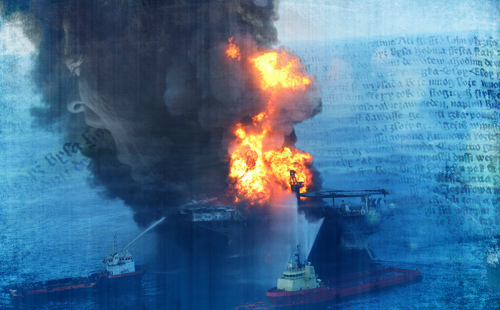
 The BP Deepwater Horizon oil spill dumped 172 million gallons of crude oil into the Gulf of Mexico and caused a holocaust of sea creatures. As a result, tens of thousands of Gulf residents are now suffering – both emotionally due to a loss of livelihood and physically due to contamination.
Earlier this month, Gulf victims won a major battle against BP concerning the access to compensation funds. For over a year, the oil company had claimed that the settlement process was unfair, because individuals that suffered no harm were allegedly scamming the company out of billions of dollars. Thankfully, the 5th Circuit Court rejected the corporation’s appeal, but BP’s moral bankruptcy goes far beyond blocking compensation payouts.
Investigative journalist Dahr Jamail cites former BP officials who are disgusted with how the company has reneged on its pension promises to employees and warn Deepwater Horizon oil spill victims to expect the same kind of treatment.
Russell Stauffer, a former BP head of finance for the Gulf of Mexico, says that the company has cut hundreds of employee pensions by up to 75% from what they were originally promised back in 1987. Another former employee, Kirk Wardlaw, compared the pension situation to the plight of the Gulf oil spill victims, saying:
“Those depending on BP to do the right thing in the Gulf of Mexico should be aware of BP’s unfair and callous treatment of…employees, failure to adhere to their own Code of Conduct and the willingness to hide behind a standard of ‘we did what was technically legal.'”
It would be one thing if this was a struggling mom and pop business failing to compensate its employees and victims of its own gross incompetence – but this is a multinational money hoarding machine. The corporation rakes in billions of dollars per year and remains one of Pentagon’s premiere oil and gas providers.
Even more frustrating is how BP hasn’t felt prompted to step up its safety standards after causing one of the worst environmental crisis in US history. Only nine months ago, the Petroleum Safety Authority in Norway said that the lack of maintenance and management of BP’s oil platform in the North Sea lead to a leak of about 125 barrels of oil. This after the same agency had already discovered that the platform had inadequate fire and explosion protection which could have caused another major accident.
One would think that bad press would have cut into BP’s profits by now, but the company posted record profits last year of $20 billion in just the first quarter. Perhaps the millions of dollars the company is spending on PR to control the narrative is helping maintain its image of ‘responsibility.’
Since the disaster, investigative journalist Dahr Jamail has dedicated much of his fantastic journalistic efforts towards revealing the truth behind the crisis and pressuring to hold the guilty parties accountable. Jamail joined Breaking the Set to elucidate BP’s hostile tactics to silence dissent, from blocking scientists who are reporting on affected areas to hiring a company to employ online trolls to harass critics.
Abby Martin
***
Dahr Jamail on BTS: BP Pays PR Trolls to Threaten Online Critics
***
AM: Talk about the PR firm Ogilvy & Mather that BP hired to silence its enemies online.
DJ: They were hired primarily to run BP America Facebook page. That’s what they did in addition to basically doing the general PR effort for BP through the disaster; to manage the message, as they put it themselves, and they did this very effectively. For example, when Tony Hayward made that gaff of saying, ‘I want my life back,’ it was Ogilvy that was in charge of basically doing disaster control on that. So, they came in and started becoming BP apologists and making it appear as though, ‘Oh, it was taken out of context,’ on all of BP’s social media; BP’s Twitter feed, as well as BP’s America Facebook page.
AM: Let’s talk about specific examples of what was happening when people were expressing concerns on the Facebook page.
DJ: Problems arose when people were using the page as it was set up. It was to give BP feedback, positive and negative—mostly negative—about how they were handling the oil spill. One woman goes by the alias ‘Marie’ because she feels she is under direct threat from people working for BP and Ogilvy, says that people were coming on the pages and harassing those who were making regular, critical comments against BP. Internet trolls is what they are referred to as, and they are people who go in cause disruption in chat rooms, and in comments sections and meeting places online. Marie started receiving bellicose, derogatory remarks, degrading remarks, and then this escalated to over-threats. Trolls posting pictures of side arms, and even arsenals of semi-automatic weapons. Even as much as contacting people at their workplaces and causing disruption there. This was happening not just to her but to several other people as well. Marie ended up collecting reams of data, screenshots, tracking down the Facebook profiles of these people, and then carrying it all the way to directly linking them to people already working directly for BP or Ogilvy. Marie believes, as does the law firm that she’s hired to investigate this further that BP and Ogilvy have hired these trolls directly to harass and silence critics of BP.
AM: Breakdown really quickly again what evidence is there to show that these trolls do indeed work for the PR firm or BP directly.
DJ: Marie found the Facebook profiles of the people making threats and went through their friends’ lists. She found out people who work for BP or Ogilvy directly, had interactions with these friends. She found in other instances some of the trolls that were friends and associates worked very closely now, as well as in the past, with people directly employed with BP.
AM: We know about the ‘sock puppet’ accounts that you can host up to ten different accounts and make it look like totally legitimate Facebook profiles, which could be the case here. Let’s talk about outside the Internet. Scientists have also been blocked from oil spill access zones to do their jobs and make proper assessments. Can you elaborate on that part of the story?
DJ: Right. There’s a woman I spoke with, she’s an Associate Professor of Entomology at Louisiana State University. Linda Hooper-Bui is her name. Dr. Hooper-Bui told me that early on in the spill she was going out and collecting data to survey how the ecology was going to be impacted. Specifically, insects and spiders. How are these populations in the marsh areas around the impact zone being impacted? She had started to collect data, and her studies are going well, and then she started running into a problem with the Sheriff’s departments, people working for the U.S. Coast Guard, as well as people working for Fish & Wildlife. People from these services would come out—all of them always accompanied by someone working directly for BP—and they were barring her from going back into these areas where she had previously collected data; barring her from going back in to continue her studies, despite the fact that she had permits issued from the relevant states where she was carrying out her research that granted her access into these areas.
Dr. Hooper-Bui took this up with them and said, ‘Look, I have the proper permits. I’m a scientist just trying to do my research for my major university here,’ they said, ‘Look, we can have you arrested if you if you try to push this matter.” So, she was literally barred from continuing that on. This prompted her out of frustration to write a rather searing op-ed for the New York Times on this matter criticizing BP for doing just what I mentioned, and being afraid of the data that she was producing, which was showing deleterious impacts on these insect and spider populations that she was studying from the oil spill. That same morning that she published this op-ed with the New York Times, she received a call from a Chief Financial Officer from BP, asking her how much money she would need to be quiet. This came in the form of, ‘How about we hire you and pay you whatever amount you want to ask for.’ She refused to do so and made very public statements about exactly what was happening. She was never contacted by that person again.
AM: Is this sort of intimidation still going on to this day, or was this only in the immediate aftermath of the spill?
DJ: Well, the online intimidation, according to Marie, who continues to track these things, says that there was enough pressure applied through the Deputy Ombudsman of BP. A woman named Billie Garde. Garde then eventually took up the issue with BP. When the government accountability project got involved shortly after that, the Ombudsman finally replied to the government accountability project and Marie, and most of the trolling and harassment stopped. But she said there do still appear to be two of the trolls that were active from the beginning that still make a presence known on the BP America Facebook page. So, it has declined rather dramatically, but it does still continue at least to a certain extent. There’s also the harassment that goes on and the people targeted are people who have compensation claims against BP. For example, financial compensation claims. Several of these people around the Gulf Coast have talked to me about instances where they have received harassment from people, but they haven’t been able to directly tie them to BP itself.
AM: BP is fighting tooth and nail to not provide those compensation claims. We’ll get into that a little bit later. It seems counterproductive for a ‘public relations’ firm. It’s the opposite of what they should be doing, which is galvanizing support for the company. What’s different about what BP’s doing? If you’re a giant corporation and you have the money, I feel like a lot of people would engage in these kind of tactics. What’s different about this?
DJ: Clearly they have enough money—hundreds of millions to be exact—and enough resources at their disposal that they felt running a big enough spin campaign the day after the oil spill of non-stop TV, newspaper ads, radio ads would be enough to convince everybody that things are better than they really are. Another instance I outline is Steven Marino. Marino worked for Ogilvy, the PR firm that convinced BP to set up the BP America Facebook page and then let them run it, and he gave a very interesting talk at University of Texas-Austin exactly two years after the spill. Almost to the day. Marino spoke to a class of business students about the PR machine that BP ran. He was very specific about the types of things that they would do. He gave the example of the BP TV commercial where we see an African-American woman named ‘Iris’ who claims to be from New Orleans. She appears to be working for BP and she’s standing there with a BP shirt on and says, ‘I’m from New Orleans. I’m here with BP, and we’re not going to leave until we make things right.’ Marino said that they would run these ads, track the immediate impact of them via Facebook and Twitter, gauge audience response, recut the ads based on that response, and run them again immediately in order to, quote unquote, “target the constituents more effectively.” This was the insidious and precise level that they were functioning on, and continue to function on today.
AM: Dahr, you’ve been investigating the Gulf since the Deepwater Horizon oil spill in 2010. As you just mentioned, if we watch the BP commercials, it’s a birdwatchers paradise. ‘The Gulf’s fine! Come on down! Eat the seafood! It’s all good!’ Can you talk about the reality on the ground as it stands today?
DJ: This is really a silent disaster. Silent, not because it’s not happening, but because of, the media and government silence that surrounds what’s going on. First and most obvious, there’s been dramatic ongoing impact on the ecosystem. For example, just this year from March to August, three million pounds of oil debris washed up on the shores of the state of Louisiana. That is twice the amount in the same time period for last year. Every time there’s a storm, when there’s seasons changing, there’s just this constant barrage of oil debris washing up not just in Louisiana, but in Alabama, Mississippi and Florida as well. There are pictures widely available as evidence, today.
As a result, we see a fishing industry that is in crisis. I’ve talked to fisherman during my last visit and they’re saying, ‘Look, one of the problems we’re seeing is there’s no babies. We’re not seeing baby fish. We’re not seeing baby crabs. We’re not seeing baby shrimp.’ So, what we’re worried about is while we’re still catching fish and fish numbers are declining slightly, there’s still no new fish coming into replace what we’re catching. That’s very distressing to them, particularly considering that we’re about three and a half years past the origin of the disaster. We have to remember that in the wake of Exxon Valdez in 1989, in Alaska, it took four years for the herring population to collapse. We need to keep that in context. That’s why this is one of the big issues going on down in the Gulf. People are obviously concerned about.
AM: We’re not going to see the real effects for generations. This is a whole ecosystem that’s connected to a lot of different things, Dahr. Then there’s Corexit, the highly toxic dispersant that BP sprayed all over the surface of the water to make it look like there was less oil. Who knows what that’s doing? Let’s talk really quickly since we are almost out of time about the state of compensation claims in the Gulf. BP originally predicted total payouts to be around eight billion dollars, and they’ve surpassed that. But do you think that they’ve been punished enough? As we know, BP was still one of the main oil and gas providers for the Pentagon. Did the government do enough to punish this corporation?
DJ: Absolutely not. They’ve been very tight on paying out compensation claims. They’ve paid out only a few. A handful of health related compensation claims. None for psychological damage, even though there’s a mess—another silent disaster down there. There’s a massive amount of psychological trauma, PTSD, alcoholism and drug abuse happening because of economic distress of people. The fishing industry is in a state of collapse and problems related to that. They’ve not paid out one compensation claim dealing with any of that, and they’ve taken a defensive tactic with the ongoing federal trial in New Orleans, saying, ‘Well, we’re being taken advantage of. People are filing too many false claims.’ So, they’re doing everything they can to effectively weasel out of paying compensation that is due. The federal government is not helping the people that have these claims against BP. The people with the claims are saying, ‘Look, we are not getting any help.’
***
Follow @DahrJamail on twitter and read his work here.
Transcript by Juan Martinez, Photo by flickr user Wisely Woven



 There are few things more harmful to the public discourse than the cloak of false respectability – especially on a nationally or globally disseminated news network. When corporate media broadcasts propaganda, a benighted public is duped into believing the twaddle of stark raving mad political ideologues as though they were the very words of Socrates by satellite. The mainstream’s reach and influence is staggering, and when unchallenged, fatal. Take, for instance, the estimable Republican Representative Mike Rogers of Michigan. Let’s consider for a moment the aura of respectability that enveloped, like a hot towel on a transatlantic flight, the mindless bluster Rogers so thoughtfully aired for the nation last month on
  Millions of viewers were exposed to this dialogue, and millions more will see it in syndication. As they watch, few will be aware of some damning omissions.
 The BP Deepwater Horizon oil spill dumped 172 million gallons of crude oil into the Gulf of Mexico and caused a holocaust of sea creatures. As a result, tens of thousands of Gulf residents are now suffering – both emotionally due to a loss of livelihood and physically due to contamination.