Outlawing Cash for Second Hand Goods in Louisiana

MoneyyyFlickrpurpleslogMEDIA ROOTS — Many of us notice our society’s shift away from the use of anonymous cash and toward the use of databeast-tracked digital money.  But many are unaware that there are steps already being taken to outlaw cash in favour of debit/credit cards and digital transactions.  In Louisiana, House Bill 195 of the 2011 Regular Session (Act 389) was passed this summer by its State Legislature and Republican Governor Bobby Jindal.  This law makes it illegal to use cash in transacting second-hand goods.  The question becomes, ‘who actually motivated this law and why?’ 

The bill states:

“A secondhand dealer shall not enter into any cash transactions in payment for the purchase of junk or used or secondhand property.  Payment shall be made in the form of check, electronic transfers, or money order issued to the seller of the junk or used or secondhand property and made payable to the name and address of the seller.  All payments made by check, electronic transfers, or money order shall be reported separately in the daily reports required by R.S. 37:1866.”

Ackel & Associates LLC, a professional law firm in Louisiana, describes the new legislation as the U.S. Government taking private property without due process.  As one may have expected, the justifying pretext involves police crime-fighting. One Louisiana State Rep co-author of the bill, Rickey Hardy, argued the law is intended to be “a mechanism to be used so the police department has something to go on and have a lead” in combating theft.  Yet, while local cops take no interest in white-collar crime, even shielding major financial criminals from nationwide Occupy Movement protests, they will definitely be ready to bust thrift shops, local antique stores, flea markets, and anyone who dares to use cash in second-hand retail transactions in Louisiana.

Already, we see class-division in the U.S. reflected between those who make virtually all purchases through digital transactions and those who rely on cash.  Here’s one possible scenario:  First an individual legislator (with or without external influence) establishes a precedent under law enforcement pretexts in a state, which may not often capture the national imagination.  Then it spreads to other states.  Unchecked, something that seemed outlandish at first becomes orthodox convention.  First, second-hand cash transactions are outlawed.  Then the slippery slope slide into fully outlawing cash becomes inevitable.  It may sound like a far-fetched concept, but in light of this legislative trajectory it’s not implausible.

Messina

***

NATURAL NEWS — Besides prohibiting the use of cash, the law also requires such “dealers” to collect personal information like name, address, driver’s license number, and license plate number from every single customer, and submit it to authorities. And the only acceptable form of payment in such situations is a personal check, money order, or electronic transfer, all of which must be carefully documented.

The stated purpose of the law, which excludes non-profits and pawn shops, is to curb criminal activity involving the reselling of stolen goods, particularly metals such as copper, silver, and gold. But according to A&A, existing Louisiana state law already requires businesses and other resellers of secondhand goods to account for transactions, and has specific laws already on the books that address the selling of stolen goods.

The new law is so broad and all-encompassing that individuals who buy and sell on sites like eBay or Craigslist using cash will also be in violation of it. Even a stay-at-home-mom who holds a garage sale with her neighbors more than once a month could be required to refuse cash from customers, as well as keep a detailed record of every single purchase made, and who made it.

There really is no legitimate reason for banning cash payments, especially in light of the required collection of detailed and excessive personal information. The measure is simply just another excuse for the government to spy on individuals, and take away their economic and civil liberties.

Read more about Louisiana prohibits residents from using cash when buying, selling secondhand goods.

© 2011 Natural News Network

***

Photo by flickr user purpleslog
Police Using Surveillance System to Monitor Cellphones

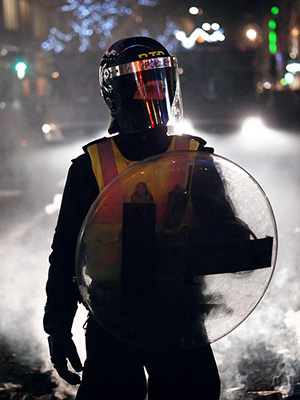
RiotPolice-FlickrUserHozinjaMEDIA ROOTS— As people in the U.S. and abroad endeavour to exercise their rights and civil liberties, such as the right to freedom of speech and peaceful assembly, the state and its police forces continue finding methods to repress such civic activity.  An important component of social control and repression of dissent has been the curtailment of telecommunications. 

Earlier this year, when San Francisco Bay Area Rapid Transit (BART) police killings spurred groups, such as ‘No Justice, No Bart!,’ to call for critical mass demonstrations, BART officials attempted to thwart communication among activists by cutting mobile phone service entirely to transit stations targeted by demonstrators.

Not to be outdone in the U.K., the Metropolitan Police Service of Greater London has been “operating covert surveillance technology that can masquerade as a mobile phone network, transmitting a signal that allows authorities to shut off phones remotely, intercept communications and gather data about thousands of users in a targeted area.”

Messina

***

THE GUARDIAN– The surveillance system has been procured by the Metropolitan police from Leeds-based company Datong plc, which counts the US Secret Service, the Ministry of Defence and regimes in the Middle East among its customers. Strictly classified under government protocol as “Listed X”, it can emit a signal over an area of up to an estimated 10 sq km, forcing hundreds of mobile phones per minute to release their unique IMSI and IMEI identity codes, which can be used to track a person’s movements in real time.

The disclosure has caused concern among lawyers and privacy groups that large numbers of innocent people could be unwittingly implicated in covert intelligence gathering. The Met has refused to confirm whether the system is used in public order situations, such as during large protests or demonstrations.

Nick Pickles, director of privacy and civil liberties campaign group Big Brother Watch, warned the technology could give police the ability to conduct “blanket and indiscriminate” monitoring: “It raises a number of serious civil liberties concerns and clarification is urgently needed on when and where this technology has been deployed, and what data has been gathered,” he said. “Such invasive surveillance must be tightly regulated, authorised at the highest level and only used in the most serious of investigations. It should be absolutely clear that only data directly relating to targets of investigations is monitored or stored,” he said.

The company’s systems, showcased at the DSEi arms fair in east London last month, allow authorities to intercept SMS messages and phone calls by secretly duping mobile phones within range into operating on a false network, where they can be subjected to “intelligent denial of service”. This function is designed to cut off a phone used as a trigger for an explosive device.

A transceiver around the size of a suitcase can be placed in a vehicle or at another static location and operated remotely by officers wirelessly. Datong also offers clandestine portable transceivers with “covered antennae options available”. Datong sells its products to nearly 40 countries around the world, including in Eastern Europe, South America, the Middle East and Asia Pacific. In 2009 it was refused an export licence to ship technology worth £0.8m to an unnamed Asia Pacific country, after the Department for Business, Innovation and Skills judged it could be used to commit human rights abuses.

Read more about Met police using surveillance system to monitor mobile phones.

© 2011 Guardian News and Media Limited

Photo by flickr user Hozinja

FBI Informant Plan to Instigate Terrorism Backfires

MEDIA ROOTS- This is an older story worthy of re-posting because it’s a perfect example of how the federal government actively tries to perpetuate ‘terrorism’ in an attempt to justify the continuation of the ‘War on Terror’. Back in December 2010, an FBI informant (and former criminal) was paid $177,000 tax free in the course of 15 months to try to exploit psychologically troubled people into committing acts of violence at a California mosque. Hilariously, the plot backfired on him when senior members of the mosque ended up reporting HIM to the FBI. It is highly disturbing that precious US taxpayer resources are being wasted on outrageous plots like these in order to validate a virtually non-existent threat.

Abby

***

DAILY MAIL– An FBI informer sent to infiltrate a California mosque was made the subject of a restraining order after scaring Muslim worshippers with demands for holy war.

Craig Monteilh was known to members of the Irvine Islamic Center as Farouk al-Aziz, an apparently devout and at times over-zealous Muslim.

But when he began speaking of jihad and plans to blow up buildings, senior figures at the mosque reported him the FBI – the very people who sent him.

Now the FBI is facing criticism for its use of such stooges which have backfired in a number of cases.

The law enforcement agency’s problems have been confounded after Monteilh, a petty criminal with forgery convictions, went public with claims he received $177,000 tax free in 15 months for his work.

Shakeel Syed, of the Islamic Shura Council of Southern California which represents more than 75 mosques told the Washington Post: ‘The community feels betrayed.

‘They got a guy, a bona fide criminal, and obviously trained him and sent him to infiltrate mosques.

‘And when things went sour, they ditched him and he got mad. It’s like a soap opera, for God’s sake.’ 

The emergence of details of the FBI’s attempted infiltration comes after an Oregan man was arrested for planning to bomb a Christmas tree lighting ceremony.

An explosive device he was discovered in possession of had been supplied to him by an undercover FBI agent and was made by FBI technicians in a case of apparent entrapment.

Worshippers said that in Monteilh’s 10 months at the mosque, he became almost manic in his devotion, attending prayers five times a day but he was secretly recording conversations.

However, when he began to tell Muslims he had access to weapons they became convinced he was a terrorist and ironically reported the informant to the FBI.

An FBI informer sent to infiltrate a California mosque was made the subject of a restraining order after scaring Muslim worshippers with demands for holy war.
Craig Monteilh was known to members of the Irvine Islamic Center as Farouk al-Aziz, an apparently devout and at times over-zealous Muslim.
But when he began speaking of jihad and plans to blow up buildings, senior figures at the mosque reported him the FBI – the very people who sent him.
Now the FBI is facing criticism for its use of such stooges which have backfired in a number of cases.
The law enforcement agency’s problems have been confounded after Monteilh, a petty criminal with forgery convictions, went public with claims he received $177,000 tax free in 15 months for his work
Shakeel Syed, of the Islamic Shura Council of Southern California which represents more than 75 mosques told the Washington Post: ‘The community feels betrayed.
‘They got a guy, a bona fide criminal, and obviously trained him and sent him to infiltrate mosques.
‘And when things went sour, they ditched him and he got mad. It’s like a soap opera, for God’s sake.’ 
The emergence of details of the FBI’s attempted infiltration comes after an Oregan man was arrested for planning to bomb a Christmas tree lighting ceremony.
An explosive device he was discovered in possession of had been supplied to him by an undercover FBI agent and was made by FBI technicians in a case of apparent entrapment.
Worshippers said that in Monteilh’s 10 months at the mosque, he became almost manic in his devotion, attending prayers five times a day but he was secretly recording conversations.
However, when he began to tell Muslims he had access to weapons they became convinced he was a terrorist and ironically reported the informant to the FBI.

Read more about FBI Informant Scares Muslim Suspects So Much With His Talk Of Violent Jihad That They Report Him To Authorities.

© 2011 Daily Mail

Photo by Flickr user Sebastian-Lewis

TSA To Put HUB Fliers On The Spot

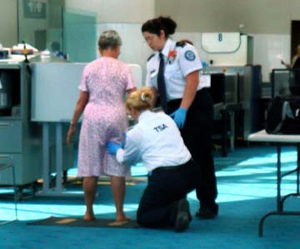
MR: Great, exactly what we need: “Israeli-style screenings” by the TSA. Despite the increased scrutiny against the TSA’s invasive security procedures that involve groping children and humiliating the elderly, a new element of interrogation is being added to the security program in Logan Airport.

BOSTON HERALD– Boston’s TSA screeners — part of a security force whose competency has come under fire nationwide — soon will be carrying out sophisticated behavioral inspections under a first-in-the-nation program that’s already raising concerns of racial profiling, harassment of innocent travelers and longer lines.

The training for the Israeli-style screening — a projected $1 billion national program dubbed Screening Passengers by Observation Techniques — kicks off today at Logan International Airport and will be put to use in Terminal A on Aug. 15. It requires screeners to make quick reads of whether passengers pose a danger or a terror threat based on their reactions to a set of routine questions.

But security experts wonder whether Transportation Safety Administration agents are up to the challenge after an embarrassing string of blunders — including patting down a 95-year-old grandmother in Florida and making her remove her adult diaper and frisking a 3-year-old girl who screamed “stop touching me” at a checkpoint in Tennessee.

Civil libertarians argue the screening is TSA showmanship — coming just weeks before the 10th anniversary of the Sept. 11, 2001, terrorist attacks — and could quickly devolve into profiling.

Read more about TSA To Put HUB Fliers On The Spot

© 2011 Boston Herald

Photo by Flickr user Lindsmo

Imperialism, Self-Censorship, Spying, Empowerment

Media Roots Radio- US Imperialism, Spying, Self-Censorship, Building Communities by Media Roots

MEDIA ROOTS – In this discussion, Abby & Robbie Martin cover US imperialism: wars, costs, media and government propaganda; the culture of self-censorship and the erosion of privacy in the US; information as power and how communication is an important tool to strengthen and build communities.

The above timeline is interactive. Scroll through it to find out more about the show’s music and to resources mentioned during the broadcast. To see a larger version of the timeline with clickable resources go to the soundcloud link below the player.

If you would like to directly download the podcast click the down arrow icon on the right of the soundcloud display. To hide the comments to enable easier rewind and fast forward, click on the icon on the very bottom right.

This Media Roots podcast is the product of many long hours of hard work and love. If you want to encourage our voice, please consider supporting us as we continue to speak from outside party lines. If you donate, we want to thank you with your choice of art from AbbyMartin.org as well as music from RecordLabelRecords.org. Much of the music you hear on our podcasts comes from Robbie’s imprint Record Label Records, and Abby’s art reflects the passion and perspective that lead her to create Media Roots.org.

$40 donation: One 8×10 art print and one RLR release (You choose! Tell us in the Paypal notes.)

$80 donation: Two 8×10 art prints and two RLR releases (You choose!)

$150 donation: Four 8×10 art prints and four RLR releases (You choose!)

Even the smallest donations are appreciated and help us with our operating costs.

Thanks so much for your support!

Listen to all previous episodes of Media Roots Radio here.