
MR Original – Global War On Drugs: Status Quo

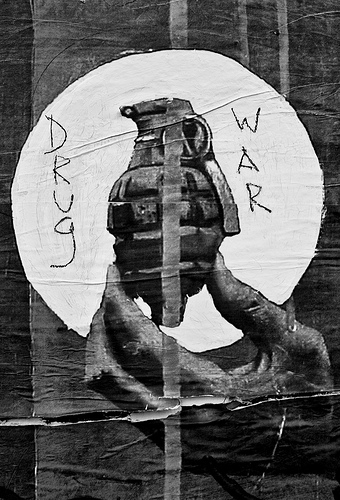
drugwarFlickrBrandonDoranMEDIA ROOTS — Pretext for ulterior motive is the standard operating procedure for US/NATO imperialism.  Like the so-called War on Terror, the so-called War on Drugs is equally preposterous in its lack of credibility, serving only the function of justification for increasing police state control of our everyday lives, the enrichment of the ruling-class 1%, and totalitarianism.  Media Roots contributor Christian Sorensen concludes part two of his two-part series on the global War on Drugs.  In the first installment, Sorensen discussed how we got here; this installment discusses where we are now.

Messina

***

FEAR AND THREATS

Since Pentagon’s comportment in the War on Terror and the War on Drugs is nearly identical, Pentagon officials have abandoned any attempts at separating the two. Today, the Pentagon actively attempts to tie War on Terror and the War on Drugs together. Aligning well with scare tactics of powerful lobbies, the Pentagon is interested in using fear of terror in order to expand its military hegemony in Latin America. Secretary of Defense Panetta frames the situation; the threat of violent extremism is spreading throughout Latin America, according to Panetta. “We always have a concern about, in particular, the [Iranian Revolutionary Guard] and [their] efforts… to expand their influence, not only throughout the Middle East but also into this region… In my book, that relates to expanding terrorism.” Senior officials allege that “narcotics trafficking, transnational organized crime, and terrorist networks form a nexus that increasingly requires an interagency and coalition approach to combat effectively.”

General Fraser presents Iran’s “connections” with Hezbollah “terrorist groups” as a concern, even dedicating an entire section of his posture statement to Violent Extremist Organizations and Influence of Iran. According to Fraser, those organizations raise funds in Latin America, but are also “involved in illicit activity.” So we continue to watch “that connection between the illicit activity and the potential pathway into the United States.” General Dempsey spreads fear that terrorists could use the drug trade networks to smuggle themselves and weapons of mass destruction into the United States. Dempsey’s predecessor professes transnational drug crime “ties in very nicely with the support of terrorists.” One assistant Secretary of Defense asserts “criminals” and “insurgents” are “nearly indistinguishable.” Dempsey promises “the time to pressure this network is now, and we are.”

General Fraser is short on reasons to be fearful of “a number of violent extremist organizations” in Latin America, so he was forced to dig deeply. Fraser cited a bombing from 18 years ago as reason to be alarmed of radical clerics in Latin America. Scrounging for links, Fraser mentioned Jamaica’s Sheikh Abdullah al-Faisal as an example of efforts of “the radicalization of converts and other Muslims.” Fraser also referenced the “government’s successful detection and thwarting of the plot to assassinate the Saudi ambassador to the United States” as reinforcing “the importance of that monitoring and the effectiveness of U.S. countermeasures.” (This “plot” was widely panned by former U.S. intelligence and military officials as a potential false flag, including former-CIA case officer Robert Baer). The Deputy Assistant Secretary of Defense for Counternarcotics and Global Threats repeated the Saudi plot as proof that traffickers and terrorists are now “working together in ways that previously we hadn’t seen.”

Other Pentagon officials, like Michael Sheehan and William Wechsler, formally united the War on Terror with the War on Drugs. Since “terrorism, drug trafficking and other forms of transnational organized crime are increasingly intertwined,” Sheehan advises that the Pentagon must “leverage all of the elements of national power to protect citizens and U.S. national security interests and to enable our foreign partners to do the same.” According to Sheehan, terrorism and organized crime needs a response governed by complementary, mutually reinforcing, and increasingly related strategies. Wechsler, a bureaucrat with a background in entirely in corporate finance, ties Terror and Drugs together, noting: “Loose criminal networks… have diversified their illicit activities and also may have connections with other hostile actors, including terrorist groups, insurgencies and elements of rogue or hostile states.” Fear is the Pentagon’s substrate, nourished through unsubstantiated, inflated claims.

Exploitation isn’t limited to Latin America. The Pentagon now uses the War on Drugs to reinforce its military presence in Europe and Africa. Brigadier General Scraba explains that drug traffickers have allied with terror networks in Europe too, which results in “far more sophisticated criminal networks able to operate across national borders.” Admiral James Stavridis established the Joint Interagency Counter Trafficking Center (JICTC) in Stuttgart in order to confront this matter, which he described as “a major national security threat to the United States.” AFRICOM has a similar center known as Counternarcotics and Maritime Interagency Operations Center. Stavridis refers to these entities as “fusion organizations.” Realists refer to them as tools of military imperialism. Secretary Panetta calls them instruments for “promoting security” and “promoting peace.” Sadly, all of the Pentagon’s geographic Combatant Commands incorporate counter-narcotics programs into their theater campaign plans. No matter the location, the Pentagon uses fear to subdue self-determination, independent military action, or non-capitalist inclinations.

ARROGANCE and IGNORANCE

If the fear-mongering and corporate greed inherent to the military-industrial complex don’t scare Latin American leaders, then arrogance and ignorance might. For example, General Dempsey (Scalopus Pentagonus) is only able to view entire continents through the neo-colonial lens of military power. He finds South America and Africa “fascinating,” and calls these continents “theaters,” employing the imperial nomenclature of the Pentagon’s lexicon, which long ago divided the entire world into Areas of Responsibility. Despite economic, geographic, and cultural differences, Dempsey insists that “security issues… manifest themselves similarly” across all South American countries.

Defense Secretary Panetta’s ignorance is especially notable. Panetta claims “the United States and Chile are neighbors, we are friends, and we have built a longstanding defense relationship founded on mutual respect, shared values and the goal of advancing peace and stability in this hemisphere and beyond.” Certainly, Panetta recognizes the arrogance and deliberate misdirection inherent in his own words. He either never learned about USA’s support for General Augusto Pinochet or he slyly ignored it; Panetta is either ignorant about history or a cunning political operator. Neither bode well for Latin America.

Pentagon officials display more ignorance when viewing diplomacy as threatening. General Fraser points out Iranian President Ahmadinejad (the U.S. corporate media’s current demon of choice) had visited Latin America six times in six years. According to Fraser, Iran has also established dozens of Shi’a cultural centers across Latin America. Yet the General fails to mention that religious missionary work is inherent to all three Abrahamic religions. U.S. Christian missionaries, for example, have had far more success than Iran at establishing religious centers in Latin America.

Finally, Fraser spreads thick irony when affirming that USSOUTHCOM works with “other U.S. government agencies and international partners’ military and law enforcement agencies to track, capture and prosecute people who have made several countries in the Americas the most violent in the world.” USSOUTHCOM, the un-appointed police force of the Americas, is calling others “violent.” To repeat, a Unified Combatant Command in the world’s largest military is calling others violent. The Pentagon’s blindness is remarkable, especially since Fraser insists that the mission in Latin America “is one that stresses us, if you will, to think differently.” Despite Fraser’s words, the Pentagon continues expanding and throwing money and weaponry at social and economic issues.

DISSENT, LOUD AND CLEAR 

The War on Drugs has failed, according to the Global Commission on Drug Policy, a high-level international panel comprised of many public policy experts and former heads of state from Greece, Poland, Colombia, Mexico, and Brazil. The Commission’s concludes:

“Vast expenditures on criminalization and repressive measures directed at producers, traffickers and consumers of illegal drugs have clearly failed to effectively curtail supply or consumption. Apparent victories in eliminating one source or trafficking organization are negated almost instantly by the emergence of other sources and traffickers. Repressive efforts directed at consumers impede public health measures to reduce HIV/AIDS, overdose fatalities and other harmful consequences of drug use. Government expenditures on futile supply reduction strategies and incarceration displace more cost-effective and evidence-based investments in demand and harm reduction.” 

The Commission recommends: end the criminalization of non-violent drug users; encourage governmental experimentation with various legalization strategies; treat and rehabilitate those who require assistance; respect the human rights of all participants, including farmers and couriers; end prohibition; and re-schedule drugs in order to address blatant anomalies, like classifying marijuana and MDMA as Schedule 1 Controlled Substances.

Two passages from the Commission’s report are of particular importance:

“Replace drug policies and strategies driven by ideology and political convenience with fiscally responsible policies and strategies grounded in science, health, security and human rights – and adopt appropriate criteria for their evaluation… Ensure that the international conventions are interpreted and/or revised to accommodate robust experimentation with harm reduction, decriminalization and legal regulatory policies.”

“Arrest and incarceration has filled prisons and destroyed families without reducing the drug availability or weakening criminal organizations. Drug control resources are better directed elsewhere.”

In addition to the refreshing rationality of these recommendations, former presidents of Mexico, Colombia, and Brazil candidly affirm USA’s War on Drugs is a failure. In urging the U.S. to debate drug legalization, former Colombian President Cesar Gaviria accurately stated “society is spending $40 billion each year in fighting drugs… and has more than 500,000 people in jail. But they are spending that money in a way that is not efficient. The consumption is not being reduced.” At the recent Summit of the Americas, Guatemalan President Otto Perez Molina strongly promoted decriminalizing drugs as a means by which to tackle the drug problem. Former Mexican President, Vicente Fox, advocates the benefits of legalization: less violence. Embracing the language of diplomacy, incumbent Mexican President Felipe Calderon feels “misunderstood” in agreeing to the U.S. War on Drugs. As a partial result of its antiquated drug policies, USA was quite isolated at the most recent Summit of the Americas.

WAR SOLVES NOTHING

After decades of war against drugs, nothing is solved.

U.S. generals, politicians, and Senior Executive Service careerists throw weaponry, exercises, operations, and interagency collaborations at drugs, but none addresses U.S. demand. Pursuing the production and transportation of drugs, which is the primary focus of the War on Drugs, will never reduce U.S. demand. According to rudimentary economics, supply will always meet insatiable demand. We, the citizens of the United States of America, are the world’s biggest market for cocaine. (We also consume 80% of the world’s opiate pain-killers). According to the Congressional Research Service, the U.S. demand for drugs has actually “enhanced the power of Drug Trafficking Organizations, other allied gangs, and organized criminal groups.” Since “war” was declared, drug use in the United States has actually increased.

The costs associated with the Drug War are astounding. Billions are spent annually. USSOUTHCOM has spent $8 billion in Colombia alone in less than ten years. Billion dollar initiatives like Plan Colombia and Merida are failures. Over $1 trillion has been spent in total. According to Harvard Professor Jeffrey Miron, “current policy is not having an effect of reducing drug use, but it’s costing the public a fortune.” Other costs are equally exorbitant; untold amount of fuel, funding, manpower, and energy are sunk into the War on Drugs. The U.S. Navy, Air Force, DEA, ATF, ICE, CIA, State Department, CBP, NSA, AFISR, and FBI all grab a bureaucratic piece of the War on Drugs pie. Detection, monitoring, interdiction, and detention equipment are continually purchased, used, refurbished, and wasted. President Obama even declared organized, transnational crime a “national emergency,” allowing for the United States to summon more funding and resources to the “battle.”

Lives are also wasted. USSOUTHCOM General Fraser acknowledges 67,000 murders in Central America from 2007-2010. At least 45,000 have died in Mexico since 2006. Some place the figure at 47,515 deceased Mexican citizens since late 2006. Other estimates indicate 50,000 dead in Mexico over the same timeframe. Defense Secretary Panetta acknowledges 150,000 murders in Mexico in the War on Drugs in total. The body bags pile up daily. An untold number of men, women, and children have been disappeared. A human being is killed in Honduras every seventy-four minutes. In May 2012, DEA helped kill 4 civilians in Honduras. Unfortunately, there are no statistics that can enumerate injuries, grieving souls, lost potential, or sacrificed democracy.

Imagine the national-level impact if USA ceased its War on Drugs. USSOUTHCOM’s entire bureaucratic existence would crumble. The profits of “defense contractors” (e.g. Booz Allen Hamilton, CACI) would diminish. CBP might actually have to admit to the system’s racism. D.C. think tanks would fold. Retired generals, like Barry McCaffrey who profits from promoting conflict, would creep quietly into obscurity. South American Defense officials, who live in relative opulence and who benefit from syphoning from the Pentagon’s neural plug, would also shrink into the darkness. Leading U.S. bureaucrats would be forced into early retirement, including the Assistant Defense Secretary for Homeland Defense, the Deputy Commissioner for Customs and Border Protection, and the Chief of U.S. Border Patrol. Pentagon officials like Michael Sheehan, Garry Reid, William Wechsler, and USSOUTHCOM’s entire leadership would have to find other pretexts to justify military hegemony. These senior U.S. officials are the real criminals. Instead of helping their fellow global citizens, they kill thousands throughout the Americas, incarcerate millions domestically, and waste billions of taxpayer dollars. This simple exercise in imagination highlights how innumerable officials need the War on Drugs to justify their presences.

ALTERNATIVES

U.S. drug laws are unsustainable, specifically unjust marijuana laws. Unjust laws are legal codes, which a powerful group compels everyone to obey, but does not make the law applicable to their elite friends. For example, the rich men who compose a majority in U.S. Congress, have access to premiere legal teams, and carry white skin tones, are not prosecuted in similar proportion to African-American males on marijuana charges. African-Americans are “arrested for marijuana possession at twice, three times, or even four times the rate of whites in every major country of California… This seems especially unfair, because young blacks actually smoke marijuana less than young whites.” Moreover, the out-group is unable to enact new legislation or change the status quo in any meaningful way, since common voting power in the United States drowns beneath corporate lobbies’ overwhelming influence.

Instead of enduring war, the United States can embrace decriminalization or legalization. Under decriminalization, personal drug possession and usage are legally prohibited, but not punished as criminal violations. Under legalization, all drug use is legal; possession and distribution is not punishable by law. With legalization, U.S. adults are responsible for the welfare of their own bodies. Both systems are preferable to war, murder, corporate exploitation, militarization, incarceration, racism, and all the other debilitating trends accompanying the current War on Drugs.

In July 2001, Portugal decriminalized all drugs. Glenn Greenwald, a constitutional scholar and successful author, analyzed Portugal’s decriminalization. Evidentially, decriminalization of all drugs was a boon for Portuguese society. According to Greenwald, “judged by virtually every metric, the Portuguese decriminalization framework has been a resounding success” and “has had no adverse effect on drug use.” Many corollary benefits also occurred, including no increase in drug use among youth and dramatic reductions in sexually transmitted disease.

Greenwald concludes: “By freeing its citizens from the fear of prosecution and imprisonment, Portugal has dramatically improved its ability to encourage drug addicts to avail themselves of treatment. The resources that were previously devoted to prosecuting and imprisoning drug addicts are now available to provide treatment programs to addicts.” The model of decriminalization can certainly be applied to the United States, but it doesn’t necessarily address issues like drug trafficking, murder, and military excess.

There are numerous benefits to legalization. By definition, legally regulated and distributed drugs would displace and eventually replace illegal drug traffic from Latin America. Keeping drugs illegal places production and distribution in the hands of criminal elements. Hence, legalizing drugs allows licit business entrepreneurs to embrace new markets. Criminal elements are naturally excluded from the picture. According to a RAND study, if both Mexico and the United States were to legalize marijuana, “the economics of the trafficking cartels would take a serious hit.”

With legalization comes taxation. Profits from the hemisphere’s drug trade, which some officials place at roughly $400 billion per annum, can be mainstreamed and taxed. Benefits resound. For example, taxation of intrastate drug sales could provide California with sufficient funding for its public education system, which suffered cuts due to years of government irresponsibility. Furthermore, all funding that was once allocated to the pursuit, seizure, and destruction of illegal drugs, in addition to the incarceration and judicial prosecution of those who use drugs, could be spent more effectively on public educating and brightening the futures our children. Drug taxation is a tremendous asset for the U.S. government whose policymakers are always pressed to find more funding avenues. In addition to billions of dollars in state revenue, legalization would allow law enforcement and judicial professionals to turn their attention to the real bad guys: murderers, rapists, and thieves.

An excerpt from a New York Times article in 1970 sums up the ideal approach:

“It is possible to stop most drug addiction in the United States within a very short time. Simply make all drugs available and sell them at cost. Label each drug with a precise description of what effect – good and bad – the drug will have on the taker. This will require heroic honesty. Don’t say that marijuana is addictive or dangerous when it is neither, as millions of people know – unlike “speed,” which kills most unpleasantly, or heroin, which is addictive and difficult to kick.”

POLICY CORRECTIONS

Ultimately, some combination of decriminalization (for the hard drugs) and legalization (for marijuana) will likely take effect as the unsustainable War on Drugs collapses. When this occurs, several policy corrections are necessary. Firstly, treatment and rehabilitation, which are more cost effective than war and incarceration, can be favored for hard drug users. Instead of incarceration and punishment, those who suffer from addiction to hard drugs can recuperate through treatment and recovery, benefitting society in the process. Secondly, USA can learn from the Brazilian model and only deploy its military to countries that have a United Nations mandate. Social wars, whether on drugs or terror, can be entirely avoided. Thirdly, funding hitherto allocated to the Inter-American Development Bank (IADB), the International Narcotics Control and Law Enforcement (INCLE), and the Economic Support Fund (ESF) for use in the War on Drugs can now be used solely to boost economic development, reduce poverty, or enhance education throughout Latin America. Fourthly, U.S. Congress needs to be held accountable. Potential remediation includes imposing term limits on all representatives and senators, banning corporate personhood, and restricting lobbying in its current form.

Many traditionalists will opposed positive changes. Some gentle truths ease the mental block. Firstly, god, however defined, created all marijuana and coca plants. Secondly, George Washington grew marijuana; hemp’s industrial uses are manifold. Thirdly, men and women throughout Latin America turn to agriculture to provide for their families. None, especially coca farmers in Colombia, are terrorists in our War. They raise a crop, no different than raising fruit. Fourthly, the principle of states’ rights demands that the federal government cease raiding California marijuana dispensaries, which are legally incorporated under California law. (See HR 2306 for a resolution that would allow states to regulate respective strategies to deal with marijuana). Fifthly, a majority of U.S. citizens favor legalizing marijuana. Sixthly, it’s patriotic, just, and in complete concord with our Declaration of Independence and U.S. Constitution to question the Pentagon’s abuse of power. We would oppose the disgrace known as the War on Drugs if we were true heirs to the revolution of 1775. Finally, marijuana and coca have been around for thousands of years, and will outlast the DEA’s existence by thousands of years.

In the meantime, Latin American governments can push back. Currently, “enhancing security capacity” means submitting to U.S. military hegemony and corporate interests. If any Latin American country desires their “security” to be enhanced in that manner, then all parties must recognize that USA will use its “whole of government,” all of its interdiction capabilities, and its full spectrum of monitoring technologies in order to achieve its objectives. But you don’t have to take my word for it, as all aforementioned examples illustrate. To avoid hegemonic nightmares, every Latin American country can follow Ecuador’s lead and not renew leases for U.S. military bases. Instead of entertaining Washington’s imperial drive, all can just say no. Together, they can. Certainly, the U.S. government will try and maneuver to stay in Latin America by threatening to withdraw Foreign Military Financing and economic aid from assertive countries. This is not a problem. Governments can easily recoup that amount through agriculture profits, free from Pentagon oppression, and by decreasing defense spending. What was once spent on aiding and abetting USA’s drug war can now be spent on social services and education.

Rebellious pioneers motivate those who resist the Pentagon’s imperialism in the United States and throughout Latin America. The indefatigable Bob Marley rhetorically rallies our collective spirit: “How long shall they kill our prophets while we stand aside and look?” Percy Bysshe Shelley incites us to “rise like lions after slumber, in unvanquishable number” and shake our chains to earth like dew. For, we “are many, they are few.”

Written by Christian Sorensen for Media Roots

Additional labour by Messina

***

Photo by Flickr user Brandon Doran
Posted in Uncategorized | 1 Reply

Abby Martin Interviews Hip Hop Artist Immortal Technique

MEDIA ROOTS Abby Martin of Media Roots and RT extends meaningful and challenging questions to the iconic hip hop artist and activist Immortal Technique, who notes what “seems to be a meticulous strategy to keep anything that is thought-provoking out of the mainstream.”

Like other renegades, such as artists like Zack de la Rocha, Tom Morello, Morrissey and Paul Mooney, independent recording artist Immortal Technique delivers a potent interview on an array of sundry topics.  They discuss music, conspiracy, politics, culture and the evolution of consciousness throughout the extended thirty minute interview for RT TV.

Messina

***

RT — Hip-hop artist Immortal Technique is a self-described social guerrilla.  Felipe Coronel is the real name of the Peruvian-born, Harlem-raised political activist who raps about politics, religion and racism.  Since the genesis of the OWS movement, Tech has been an active voice for the cause, and on July 10 a documentary will be released showing his everyday life.  He now joins us with more on his beliefs and his work.

***

Abby Martin:  “Something you rarely see these days in the MTV-generated music industry mainstream: hip hop with a message of raw truth.  Felipe Coronel, better known as Immortal Technique, is a Peruvian-born, Harlem-raised hip hop artist and political activist, a self-described social guerilla.  Tech’s views about politics, religion, classism, and racism are expressed poetically and powerfully through his lyrics.  And some of his albums pack more historical relvance than an entire school history book.  To maintain control over his work, Tech has never signed with a label, which gives him ultimate freedom of expression.  He’s a vocal supporter of many political movements and struggles for justice.  Since the Occupy Wall Street movement started last year, he’s been an active voice of support for the cause.  And now a new documentary coming out July 10 gives us an intimate look at his life, music, and activism.  Here’s a sneak peek.”

***

MR Original – Global War On Drugs: A Brief History

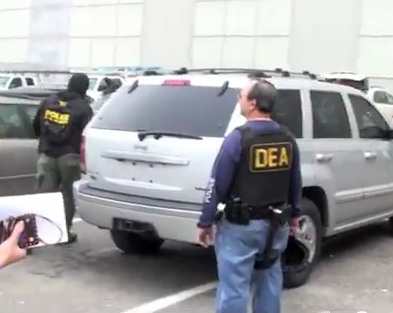
DEAMEDIA ROOTS — Disregarding the 1970 National Commission on Marijuana and Drug Abuse, which recommended de-criminalizing marijuana usage, President Nixon opted to declare a War on Drugs.  Every U.S. President since Nixon has repeated this approach.  In order to understand our present condition, we must analyze this war’s key traits, including its history, the means by which it achieves its aims, and its beneficiaries.
HISTORY and MODUS OPERANDI

The CIA and the Pentagon boast a shocking tradition of interference in Latin America, a brief summary of which includes: Bolivia 1964; Brazil 1961; Chile 1973; Costa Rica; Dominican Republic 1963; Ecuador 1960; El Salvador 1980; Grenada 1983; Guatemala 1954; Guyana 1953; Haiti 1959 and 1987; Honduras and Nicaragua in the 1980s; Mexico and Colombia 1980s-present; Panama 1989; Peru 1965; Uruguay 1969; Venezuela 2002; and Honduras 2009.  This short list doesn’t include several examples of election interference, Foreign Military Financing, or clandestine Foreign Internal Defense.  Looking at a map of Latin America, one would have great difficulty finding a nation in which the USA hasn’t interfered.

Today, the Pentagon exploits Latin America through Southern Command (USSOUTHCOM).  Success in the so-called War on Drugs rests on the Pentagon’s ability to build international and interagency partnerships, according to USSOUTHCOM Commander General Fraser.  Pentagon officials also camouflage U.S. military interference in sovereign nations as the pursuit of “common interests.”  These interests include: border protection, tackling transnational organized crime, stopping “those who would undermine the stability of nations,” violent extremist organizations, narco-terrorism, “narco-syndicates,” and criminal gangs.  Sweetening the proverbial pot, Pentagon officials always tout their specialties – cyber security, airlift capacity, ISR, logistics, C4S, humanitarian assistance, and intelligence fusion – in order to induce cooperation from Latin American government elites.

Colombia is an excellent example of how the Pentagon operates in Latin America.  U.S. military officials divvy out armaments and lip service while deliberately ignoring Colombia’s appalling human rights record.  (U.S. General Martin Dempsey, Chairman of the Joint Chiefs of Staff under Obama, admits all Colombian military leaders “have received at least some American military training.”)  Omitting any mention of human rights violations, Obama’s Secretary of Defense Leon Panetta declares that Colombia “is one of our closest partners in the hemisphere and an emerging regional and global leader.”  General Douglas Fraser even asserts that Colombia “can serve as a model for other regional nations.”

General Dempsey boldly alleges the Colombian people have “become fond of [the Colombian Armed Forces’] presence,” contrary to published reports.  Dempsey supports “Colombia’s strategy” against the FARC, which he describes as the “main terrorist group in the country.”  In reality, “Colombia’s strategy” is imposed from above by the Pentagon, and remains in place through the USA’s excessive Foreign Military Financing (bribery) to Colombia.  A substandard diplomat, Dempsey drags the USA’s name through the mud: “As the chief of our armed forces, I come here today to first of all say thank you, and secondly, how much we admire your courage and democratic values. I commit to continuing to be a good partner with you in this conflict.”  Even rudimentary knowledge of U.S. imperialism should cause Latin American officials to think twice before signing on to the USA’s War on Drugs.

TENTACLES

USSOUTHCOM personnel have monitored drug trafficking across Latin America for more than twenty years.  Under this paradigm, U.S. tax dollars pay for military raids, drills, foreign internal defense operations, and counter-narcotics reconnaissance missions (including using assets in Mexico and Curacao).  In military parlance, the Pentagon merely provides “unique military platforms, personnel, systems and capabilities that support federal law enforcement agencies and foreign security forces involved in counter-narcotics missions.”  This presence is enhanced by task forces, exercises, operations, international agreements, and general training.

Task Forces include JTF-Vulcano and JITF-South. JTF-Vulcano, which is nominally under Colombian leadership, was established in December 2011 and aims to defeat the FARC.  In March 2012, Dempsey visited JTF-Vulcano with “virtually the entire Colombian defense leadership.” JITF-South is the primary instrument through which USSOUTHCOM interdicts maritime drug shipments.  Its boundaries frequently cross into areas of responsibility belonging to USNORTHCOM, USSOUTHCOM, USEUCOM, and USPACOM.  Although nominally operating out of USSOUTHCOM’s headquarters in Miami, many of JITF-South’s activities are run out of El Salvador, Panama, Soto Cano and other bases throughout Honduras.

The Pentagon and U.S. government agencies extend their reach through various exercises and operations:

Fused Response—the “largest bilateral exercise of its kind in the Western hemisphere”—includes aspects of field training, command post instruction, communications work, staff planning, and reconnaissance drills.  It is designed to enhance nations’ ability to “work together in any circumstance [my emphasis].”  PANAMAX involves 17 nations and advertises itself as training to “protect and guarantee safe passage of traffic through the Panama Canal,” despite focusing mostly on counter-narcotics procedures.  Tradewinds is “conducted in the Caribbean region and focuses on countering drug, arms and human trafficking.”  CRUZEX works on “broad applications across many spectrums of conflict” and trains with military counterparts “so that we can integrate seamlessly during future operations as part of a larger coalition.”  Unitas stresses countries “operate and train together in scenario-based environments, which include theater security operations, anti-terrorism and anti-narcotic operations, live-fire exercises, humanitarian assistance and disaster response.”

Martillo is a multinational, interagency drug-interdiction operation run by JITF-South, and focuses on both coasts of the Central American isthmus.  Its aim is to “use persistent surveillance to force traffickers to move their shipping routes into international waters.”  Its other goal is to “deny transnational criminal organizations the ability to move narcotics, precursor chemicals for explosives, bulk cash and weapons along Central American shipping routes.”  (For propaganda pictures of Operation Martillo, see here.)  Through these task forces, exercises, and operations, the Pentagon retains the right to VBSS (Visit, Board, Search, and Seize) any private property traveling in USSOUTCOM’s area of responsibility.  Hence, it is reasonable to conclude that the Pentagon enjoys full hegemony, both directly and indirectly, throughout Latin America.

Executive and legislative programs and international agreements till the international soil for Pentagon expansion.  Existing on various jurisdictional and hierarchical planes, these programs include, but are not limited to: Andean Counterdrug Initiative (ACI), the Andean Trade Promotion and Drug Eradication Act (ATPDEA), Plan Colombia, the Merida Initiative, the Caribbean Basin Security Initiative (CBSI), the Central America Regional Security Initiative (CARSI), the U.S. – Colombia Action Plan on Regional Security Cooperation, the U.S.-Brazil Defense Cooperation Dialogue, the U.S.-Colombia Trade Promotion Agreement, the U.S.-Brazil Defense Cooperation Agreement, and the West Africa Cooperative Security Initiative (WACSI).  Some of these programs, like ATPDEA, aim to provide economic alternatives to cocaine production, but misuse their power through scorched-earth policies, which eradicate all crops in the Pentagon’s crosshairs.  Moreover, blanket use of defoliants and pesticides affect the livelihood of indigenous farming communities.  Other programs, like Merida, shower more than a billion dollars across Mexico and Central America with no tangible results.  All of these programs waste time, lives, treasury, and agriculture.

The Defense Language Institute English Language Center (DLIELC) and the Western Hemisphere Institute for Security Cooperation (WHINSEC), are two training institutions providing the Pentagon with leverage over, and connections to, Latin American militaries.  DLIELC, which is located primarily at Lackland AFB, Texas, trains foreign military personnel in American English.  WHINSEC, which is complicit in flooding Latin America with numerous atrocities, claims to provide “professional education and training for civilian, military and law enforcement students from nations throughout the Western Hemisphere.”  Tellingly, WHINSEC’s link to its page on “Democracy, Ethics and Human Rights” cannot be found.  (For an official U.S. Army video about WHINSEC, see here.  For the reality of WHINSEC, see here.)

These schools, the Center for Hemispheric Defense Studies, bilateral exchange programs, and various senior-level forums allow the Pentagon to network with young Latin American officers.  Through these connections, the Pentagon can dictate policy, manipulate foreign militaries, sustain the War on Drugs, facilitate CIA coups d’état, and generally undermine democracy.  The Pentagon also uses these connections in order to marginalize any institutions offering a counter-vision to the USA’s regional military and economic hegemony, like the Central American Integration System and the Bolivarian Alliance for the Americas (ALBA).

With the hemisphere covered, the Pentagon has turned its attention on the “homeland,” formerly known as the United States of America (270).  The Pentagon’s arsenal, which was once reserved for warzones abroad, is now deployed at home against the War on Drugs.  Noting the “effectiveness” of weapons platforms and special operations forces in Iraq and Afghanistan, an Assistant Defense Secretary remarked these systems and units can be applied to “protect our borders as well.”  The Pentagon recently sent more air assets to the USA’s Southwest border, describing its support to Customs and Border Protection (CBP) as giving them “more flexibility against an adaptive adversary.”  For the record, CBP has grown to about 21,500 personnel in recent months along the border.  The Pentagon, which already provides ISR platforms to the U.S.-Mexico border, also intends to “ramp up” this support throughout 2012.  Based on this evidence, the Posse Comitatus Act is being turned into gossamer.

The militarized Bureau of Narcotic Enforcement’s Campaign against Marijuana Planting (CAMP) is a solid example of domestic militarization, and is just one droplet in the War on Drugs’ excess.  A phenomenal waste of taxpayer dollars, CAMP thrives on bureaucratic inefficiency as it tackles California’s marijuana crops.  More than 110 agencies have participated in CAMP, which is “the largest law enforcement task force in the United States.”  Contrary to the acclaim on CAMP’s website, such rabid inefficiency should never invoke a sense of accomplishment.  Littered with disheartening statistics, CAMP’s website states that the “1,675,681 plants seized with an estimated street value of more than $6.7 billion” had surpassed the previous record by 540,989 plants.  When considered realistically, removing this amount of marijuana from the market has not impacted the plant’s supply or consumption.  All of CAMP’s efforts were for naught; all of the taxpayer dollars that contributed to CAMP’s “successes” were wasted, and the U.S. taxpayer continues to get bamboozled.  Whether home or abroad, the Pentagon has successfully created an aperture, known as the Global War on Drugs, through which to jam military hegemony and from which U.S. corporate interests profit.

MILITARY INDUSTRIAL COMPLEX

Just like the War on Terror, the military-industrial complex fuels the War on Drugs.

Panetta couches the sale of war materiel to Colombia as “the United States [standing] in solidarity with Colombia and its campaign [against the narco-terrorist group FARC]… We will continue to provide training, equipment and assistance that Colombia has requested in order to defeat this common enemy.”  It’s a clever gambit: impose a war upon a Colombia – through USA’s insatiable drug demand, Capitol Hill’s flawed policy response, and the Pentagon’s insatiable military expansion – then require that Colombia purchases war materiel from USA’s domestic armaments industry.

As a minute example, Panetta confirmed on his trip to Colombia that the U.S. “is prepared to facilitate the sale of 10 helicopters, five U.S. Army Black Hawks and five commercial helicopters, to help Colombia’s efforts against the FARC.”  Insisting on keeping USA’s “industrial base” afloat, Pentagon officials continually mention “technology transfers” as one of the “common interests” uniting Latin America and USA.  Unfortunately for Brazil, Colombia, Peru, et alii, the phrase “technology transfer” simply means “buy from us.”  Ominously, General Dempsey articulated that drones (remotely piloted vehicles) are part of these transfers.  Panetta and Brazilian Defense Minister Amorim discussed expanding two-way trade into areas of advanced defense technology.  Panetta’s candor illustrates the military-industrial complex’s power: “We continue to look for ways to improve the technology we share with Brazil so hopefully Brazil can provide jobs and opportunities for its people as we provide jobs and opportunities for ours.”  In sum, help USA’s war machine, por favor.

More than seven U.S. weapons manufacturers toured Brazil prior to Pentagon officials’ April visit this year.  Tellingly, the Pentagon has submitted Boeing’s Super Hornet (F/A 18-E/F) to the Brazilian Air Force’s F-X2 fighter competition.  Panetta explicates: “This offer is about much more than providing Brazil with the best fighter available…  With the Super Hornet, Brazil’s defense and aviation industries would be able to transform their partnerships with U.S. companies, and they would have the best opportunity to plug into worldwide markets.”  Of course, General Dempsey boasts, “I went in hoping that we wouldn’t get bogged down in a single weapons system or on technology transfer and we didn’t.”

Entrenched U.S. corporate interests (e.g. Pfizer, Johnson & Johnson, Lockheed Martin, Raytheon, GEO Group, CCA, MTC) also fuel the War on Drugs.  They lobby daily for strict drug laws to keep their profits robust.  Pharmaceutical companies favor the status quo, since they’re unable to profit from the marijuana plant whose naturally occurring cannabinoids are difficult to synthesize or patent.  Weapons manufacturers favor the status quo, since they profit excessively from producing aircraft, weaponry, and ammunition with which to “fight” the drug war.  Finally, private prison industries favor the status quo in order to fill their occupancy quotas and keep their jails filled.

TWINS

Having analyzed this War’s history, appendages, and beneficiaries, we realize that the War on Drugs and the War on Terror are virtually indistinguishable. Examples abound:

Both the War on Drugs and the War on Terror escalated under President Obama’s direction. Upon ascension to office, the Obama administration increased USA’s military and espionage interference in Latin America, Southwest Asia, Africa, and elsewhere.  The administration also altered the names of the War on Terror and the War on Drugs.  The War on Terror became Overseas Contingency Operations, while the administration simply stopped using the phrase War on Drugs.  When pressed on the seemingly ineffective nature of counter-narcotics efforts, Obama’s advisers indicate that it’s too soon to judge the results.  The U.S. public was fed the same excuses about the Afghanistan troop “surge.”  In Afghanistan, U.S. Forces assert that Afghans are leading the fight.  In Central America, U.S. Forces assert that the respective host nation military is leading the fight.

The Pentagon trains Afghan army and police forces, and also trains Mexican soldiers and federal police.  Pentagon officials also frame their Wars on Drugs and Terror as a “responsibility” that USA has to the rest of the world.  In both Afghanistan and Mexico, corruption is always cited as the main obstacle to “success.”

According to Pentagon officials, the porous Colombia-Venezuela border makes it a prime shipping point for cocaine and “terror group” activities.  Similarly, the porous Afghanistan-Pakistan border is often cited as teeming with terrorist activity and narcotic trading.  Officials view borders, not policy, as the problem.  

In confronting Drugs and Terror, policymakers consistently fail to see each “war” within their wider contexts.  The War of Drugs is implemented through attempting to crush the supply of drugs.  The War on Terror is implemented through attempting to kill the terrorists.  In both cases, the Pentagon and D.C. policymakers never examine internal issues; the War on Drugs never examines domestic drug policies, while the War on Terror never examines imperial foreign policies.

Pentagon officials are unable to envision the War on Drugs and the War on Terror without reference to conventional numerical metrics.  For example, they aim to cut the FARC’s numbers in half by 2014 and they applaud sending 10,000 more troops to help JTF-Vulcano.  In the same mindset, the Pentagon attempted “surges” in Iraq and Afghanistan. Pentagon officials also use numbers to laud the “progress” they’ve made.  For example, they boast about drug seizures, without acknowledging that confiscating drugs doesn’t impair the overall drug flow.  Likewise, killing terrorists, insurgents, civilians, and children doesn’t stop terrorism.

U.S. agencies are complicit in arming the all sides in the War on Drugs and the War on Terror.  U.S. officials have run illegal arms and smuggled weaponry to drug cartels.  (After this information was disclosed, the U.S. government conveniently reaffirmed its commitment to combatting arms trafficking, and repeated this commitment often over the next six months.)  In the War on Terror, USA has funded various terrorist organizations.  Today, the MEK is a fan-favorite among U.S. policymakers.

Even U.S. personnel cross over from the War on Terror to the War on Drugs.  The Commander in charge of U.S. military operations in Central America was once in charge of U.S. military operations in Baghdad.  According to General Dempsey, the Pentagon is sending “brigade commanders who have been in Iraq and Afghanistan” to Colombia, because “the challenges they face are not unlike the challenges we’ve faced in Iraq and Afghanistan.”  DEA’s FAST (Foreign-Deployed Advisory Support Team) honed its militancy against the poppy industry in Afghanistan and is now pursuing cocaine distributors in Central America.  The U.S. ambassador to Mexico even has extensive experience working in Afghanistan.

Failed tactics and strategies from War on Terror are now being used in the War on Drugs.  These include emphasis on becoming a network, recycling a “clear, hold and build” mindset, and weaponizing healthcare.

General Stanley McChrystal, the former 4-star in charge of ISAF, was a proponent of molding USA’s forces into a flexible network in order to defeat the Taliban’s fluid network.  Secretary of State Hillary Clinton repeated this thinking at the Global Counterterrorism Forum in September 2011 when she stated: “We can build an international counterterrorism network that is as nimble and adaptive as our adversaries.” Dempsey later reaffirmed this concept when addressing Duke University in January 2012.  In March, Dempsey applied this GWOT concept to the War on Drugs: “If you are going to beat a network, you’ve got to have a network.”  In grafting the War on Drugs onto the Pentagon’s European area of operations, the director of EUCOM’s Joint Interagency Counter Trafficking Center explained: “In order for us – the United States and international community – to have the best chance of disrupting and dismantling illicit trafficking, we, too, have to be a network of networks.”  William F. Wechsler, a deputy assistant secretary of defense, agrees: “A network of adversaries requires a network to defeat it.”

“Clear, hold and build” – in which NATO forces “clear” insurgents out of localities, and “hold” population centers in order to “build” civilian institutions – is the Pentagon’s favored strategy in Afghanistan.  Although it hasn’t provided any fruit in Afghanistan, the Pentagon is now applying it to the War on Drugs by introducing these procedures in Colombia.  General Dempsey appreciates “what we called in Iraq clear, hold, build,” and boasted about it  when speaking in Brazil and Miami.  (Dempsey doesn’t consider that these tactics never achieved anything beyond “fragile and reversible” results in Afghanistan.)  Furthermore, U.S. bases in Central America are now patterned after U.S.  Forward Operating Bases in Iraq and Afghanistan, and U.S. military compounds in northern Mexico have been modeled after U.S. “fusion intelligence centers” in Afghanistan.

The Pentagon also uses healthcare as a weapon in its counterinsurgency campaigns in Afghanistan and Colombia. USA has a long history of using Civil Affairs (CA) programs in Afghanistan.  To the U.S. military, Civil Affairs essentially means performing good deeds for local populations in order to “leverage” this goodwill during imminent military operations.  In Afghanistan, CA often takes the form of medical clinics.  Similarly, the Colombian military has incorporated “civil affairs” into most operations.  In the words of the American Forces Press Service, health care is “a big draw.”  In fact, one of JTF-Vulcano’s first orders of business was to set up a healthcare program in Tibu, Colombia.  In Honduras, USSOUTHCOM also uses medicine as a tool to win hearts and minds.  In 2011, USSOUTHCOM conducted 56 medical exercises in 13 countries, which is a testament to its widespread implementation.  If U.S. military elites actually cared for the health and safety of native populations, they would end the War on Drugs and use deep pockets to provide state-of-the-art clinics for all of the War’s victims.  But they don’t.  Instead, they use healthcare as a weapon, all in an attempt to lure the locals’ “hearts and minds.”

Both the so-called War on Drugs and the War on Terror involve hyping amorphous, unsubstantiated threats.  Pentagon officials claim that Latin American trafficking organizations “are using 21st century technologies to commit their crimes.”  We heard the same allegations about the criminality of pre-occupation Iraq.  Both terrorists and narco-terrorists, according to the official narrative, exercise “command and control” over significant territory, adapt quickly, and are an “asymmetric” threat.  Both entities are “syndicated,” which means that they will “ally themselves” with any organization that “suits their needs at the time.”  Remember when Saddam was “allied” with al-Qaeda?  In Dempsey’s words, “they’re networked, they are decentralized and they are syndicated.”  Vice Admiral Kernan, second in command at USSOUTHCOM, warns of “insidious” parallels between terrorists and translational criminal organizations.  General Dempsey recognizes “the threat that transnational organized crime presents, not just because of what they transport to our shores, but what they could also transport — terrorists and weapons and weapons of mass destruction.”  Other officials present USA’s presence in Latin America as a “quest to halt proliferation and prevent weapons of mass destruction from falling into enemy hands.”  Drawing on a sordid history, unimpeded expansion, and backed by the military-industrial complex, the War on Drugs increasingly resembles the War on Terror.

Written by Christian Sorensen for Media Roots [Please see the upcoming MR Original article Global War On Drugs: Status Quo]                                                        Additional labour by Messina

***

Photo by Robbie Martin

Abby on Info Wars: Alternative Media Becoming Mainstream

MEDIA ROOTS – I was recently interviewed by Aaron Dykes on the Info Wars Nightly News to discuss several issues: the Bilderberg Group and the evolution of the global protest movement; Stuxnet and the CIA’s covert warfare in Iran; the US government’s fearmongering about cyberterrorism; the increasing irrelevancy of the corporate media and the rise of citizen journalism; the alternative media becoming the new mainstream; information as power and applying your passion to effect positive change.

Abby

***

Abby Martin on Info Wars Nightly News

***

Abby Martin Reports for RT: Bilderberg 2012 Wrap Up

MEDIA ROOTS – For the last half century, an organization comprised of the .001% of the world’s elite called the Bilderberg Group has met annually around the world with almost no official press coverage.  During the meetings, the top 140 of the world’s power brokers in banking, oil, food, media, defense, royalty and politics are believed to make policy decisions behind closed doors that affect the rest of the world. 

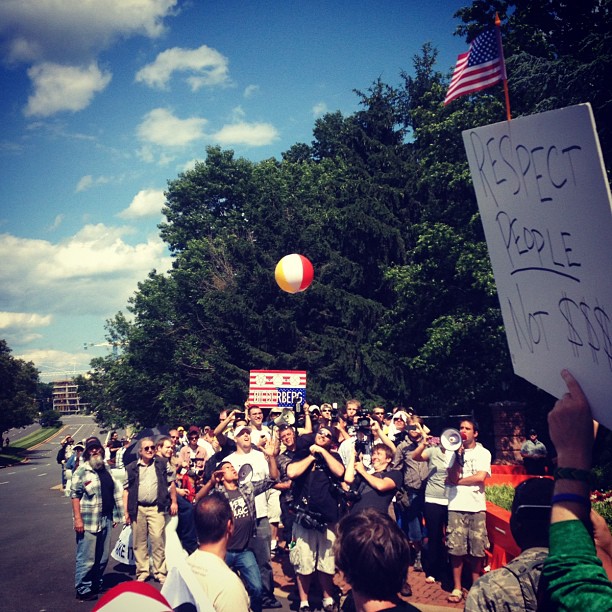
On Thursday, May 31st – Sunday, June 3rd, the annual Bilderberg Conference took place at the Westfields Marriot in Chantilly, Virginia, a city located right next to Washington, DC.  I went to cover this year’s Bilderberg Conference and mass protests that took place all weekend for RT TV.  People across many political spectrums–including Ron Paul libertarians to Occupy Wall Street protesters–joined together to rally against the covert meeting of the minds, in which the protesters claim sets a global agenda to perpetuate their own power structure at the subjugation of humanity.

Abby


Abby Martin reports on the history of the Bilderberg Group and cites some of its most notable attendees from past years.


Abby Martin covers the first day of the Bilderberg Group to find out why people are protesting.  Featuring interviews with Dan Dicks of Press for Truth TV, Luke Rudkowski of WeAreChange, Mattew Medina of Truth Exposed Radio and Alex Jones of InfoWars.


Abby Martin reports from the second day of the Bilderberg Conference protests during a torrential downpour.


After Bilderberg came to a close, Abby Martin wraps up the event and gives some insight on what transpired over the weekend.


Check out the full list of participants from InfoWars.com.

***

INFOWARS“Any citizen of the United States, wherever he may be, who, without authority of the United States, directly or indirectly commences or carries on any correspondence or intercourse with any foreign government or any officer or agent thereof, with intent to influence the measures or conduct of any foreign government or of any officer or agent thereof, in relation to any disputes or controversies with the United States, or to defeat the measures of the United States, shall be fined under this title or imprisoned not more than three years, or both…”

To be absolutely clear –Any citizen without United States authority who speaks intentionally of influence with foreign government officials about disputes or controversies any country has with America shall be fined and imprisoned.

Americans attending the Bilderberg conference in Chantilly, Virginia this past weekend violated the Logan Act. Given this is America these individuals are innocent until proven guilty, however that is a process for the courts. Each American citizen attending the meeting should prove to a jury of his or her peers that in fact they did not engage discussion with foreign government officials with the intent to influence the conduct of that foreign government in the context of an existing dispute or controversy with the United States. It is not up to executive branch officials, legislators, police, military or media to decide their guilt or innocence –it is up to the courts. That being said, it seems clear sufficient probable cause, motive and opportunity exists to issue arrest warrants.

Historical Origins of the Logan Act

The Logan Act all begins with a treaty between America and Britain called the Jay Treaty. You can research the contents and reasons behind the Jay Treaty on your own, it is only important here to understand that it angered the French who had been a staunch ally of America since the 1778 Treaty of Alliance. America had declared neutrality in the conflict between Britain and France and the Jay Treaty violated that neutrality. Pouring salt into that wound America also refused to re-pay debts owed to France, suggesting the debt was owed to the French monarchy and not to the newly founded Republic of France. The French were furious and began seizing American trade ships and refused to accept an American ambassador to negotiate. This spurred the Quasi-War.

Along comes a physician, farmer and future United States Senator named George Logan. As the founder of the Democratic-Republican society in 1793 he was not well liked by the coalescing and strengthening Federalist Party who lusted for an American central bank. In 1798, Logan travelled to Paris and met with the infamous French diplomat Charles “lame devil” Talleyrand and former exile Philippe Merlin de Douai, who held the highest political office in the new French republic. Like modern American Bilderberg participants Logan identified himself as merely an American citizen and like modern Bilderberg meetings they discussed matters of general dispute, controversy and interest to the French foreign power.

George Logan reported an expanding American anti-French sentiment, while he insisted that he did not intend to explain America’s position nor criticize French positions. He was merely there to discuss general matters emanating from the controversy and dispute evident in the mutual relations between France and America. The success of Logan’s trip is largely due to the timing as the French were anxious to extricate themselves from foreign entanglement to focus on domestic issues. Only days after Logan’s departure American seamen held in French jails were released and the trade embargo was lifted. Praise was showered upon Logan by Democratic-Republican newspapers and this drew the ire of the dominant Federalist Party.

Then Secretary of State Timothy Pickering, charged with conducting the nation’s foreign policy, suggested to Congress that they act to curb individual interference with sovereign foreign affairs. With very little debate the Logan Act glided through the Federalist majority House and Senate. George Logan would become a United States Senator representing Pennsylvania from 1801 to 1807. Irony would later see George Logan dispatched on an unsuccessful private diplomatic mission to avoid the War of 1812. So, the Logan Act was historically conceived by a Secretary of State to protect the State Departments authority.

Today the State Department allows their responsibility to be hi-jacked by foreign lobbyists, corporate interests, privately conceived and controlled “think tanks,” and international legislative bodies such as the United Nations. This is the very premise for convening the annual Bilderberg meeting and the corresponding premise for the Logan Act. The mainstream media facilitates the dilution of sovereign American foreign policy by ignoring the facts and history, disguising it with misguided articles that place the word “conspiracy,” or by suggesting nothing tangible is being accomplished.

Read the full article of Issuing Bilderberg Arrest Warrants for Violation of the Logan Act here.

Written by Chris Martin

Photo by Abby Martin