Should We Give Cancer Patients ‘Magic Mushrooms’?

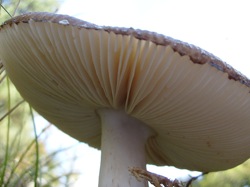
ATLANTIC WIRE– According to a new study, psilocybin, the active ingredient in “magic mushrooms” has a beneficial psychological impact on terminal cancer patients. Researchers in Los Angeles found that the hallucinogen reduced anxiety and depression, giving patients peace in their final days.

The experiment involved 12 subjects with advanced-stage cancer between the ages of 36 and 58. While some are skeptical of the pilot study, others are hailing a new era of psilocybin testing.

  • Here’s How They Did the Study, writes Rosemary Black at The New York Daily News: “The patients had two sessions apiece. In one, they received psilocybin and in the other, they got a placebo. The patients and doctors were able to tell which drug was administered about 80% of the time. For the study, which was reported in the Archives of General Psychiatry, the patients got a fairly low dose of the drug. In addition to feeling less anxious, they reported needing fewer narcotic pain relievers.”

  • A Huge Success, writes Claire McCormack at Time: “The results demonstrated a substantial improvement in symptoms of anxiety and at six months recorded a statistically significant improvement on one depression scale. This outcome indicates that the study may be the first step in restoring the drug’s flawed reputation from the 1960s and 1970s when it was widely abused for non-medical reasons.”

Continue reading about Should We Give Cancer Patients ‘Magic Mushrooms’?.

© Atlantic Wire, 2010

Picture of Art by Maria Scott and Abby Martin

Rachel Sussman: The World’s Oldest Living Things

July 2010

TED– Rachel Sussman shows photographs of the world’s oldest continuously living organisms — from 2,000-year-old brain coral off Tobago’s coast to an “underground forest” in South Africa that has lived since before the dawn of agriculture.

Rachel Sussman is on a quest to celebrate the resilience of life by identifying and photographing continuous-living organisms that are 2,000 years or older, all around the world.

Continue reading about Rachel Sussman: The World’s Oldest Living Things.

© TED, 2010

Bizarre Sea Slug is Half Plant, Half Animal

MOTHER NATURE NETWORK– It looks like any other sea slug, aside from its bright green hue. But the Elysia chlorotica is far from ordinary: it is both a plant and an animal, according to biologists who have been studying the species for two decades.

Not only does E. chlorotica turn sunlight into energy — something only plants can do — it also appears to have swiped this ability from the algae it consumes.

Native to the salt marshes of New England and Canada, these sea slugs use contraband chlorophyll-producing genes and cell parts called chloroplasts from algae to carry out photosynthesis, says Sidney Pierce, a biologist at the University of South Florida in Tampa.

That genetic material has since been passed down to the next generation, eliminating the need to consume algae for energy.

However, the baby slugs can’t carry out photosynthesis until they’ve stolen their own chloroplasts, which they aren’t yet able to produce on their own, from their first and only meal of algae.

Continue reading about Bizarre Sea Slug is Half Plant, Half Animal.

© Mother Nature Network, 2010

Photo by Nicholas E. Curtis and Ray Martinez

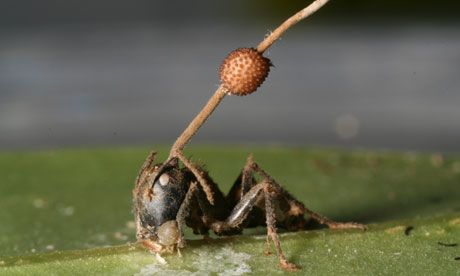
‘Zombie Ants’ Controlled by Parasitic Fungus for 48 Mil Yrs

GUARDIAN– The oldest evidence of a fungus that turns ants into zombies and makes them stagger to their death has been uncovered by scientists.

The gruesome hallmark of the fungus’s handiwork was found on the leaves of plants that grew in Messel, near Darmstadt in Germany, 48m years ago.

The finding shows that parasitic fungi evolved the ability to control the creatures they infect in the distant past, even before the rise of the Himalayas.

The fungus, which is alive and well in forests today, latches on to carpenter ants as they cross the forest floor before returning to their nests high in the canopy.

The fungus grows inside the ants and releases chemicals that affect their behaviour. Some ants leave the colony and wander off to find fresh leaves on their own, while others fall from their tree-top havens on to leaves nearer the ground.

The final stage of the parasitic death sentence is the most macabre. In their last hours, infected ants move towards the underside of the leaf they are on and lock their mandibles in a “death grip” around the central vein, immobilising themselves and locking the fungus in position.

“This can happen en masse. You can find whole graveyards with 20 or 30 ants in a square metre. Each time, they are on leaves that are a particular height off the ground and they have bitten into the main vein before dying,” said David Hughes at Harvard University.

Continue reading about ‘Zombie Ants’ Controlled by Parasitic Fungus for 48 Million Years.

© Guardian, 2010

Photo by David P Hughes

Posted in Uncategorized | 1 Reply

Giant Mushroom Largest Living Organism Ever Found

mushroomABC NEWS– Walking through the Malheur National Forest in eastern Oregon you would be hard pressed to notice it. But a fungus spreading through the roots of trees now covers 2,200 acres, making it the largest living organism ever found.

Popularly known as the honey mushroom, the Armillaria ostoyae started from a single spore too small to see without a microscope and has been weaving its black shoestring filaments through the forest for an estimated 2,400 years, killing trees as it grows.

“When you’re on the ground, you don’t notice the pattern, you just see dead trees in clusters,” Tina Dreisbach, a botanist and mycologist with the U.S. Forest Service’s Pacific Northwest Research Station in Corvallis, Ore., said Friday.

The outline of the giant fungus, strikingly similar to a mushroom, stretches 3.5 miles across, and extends an average of three feet into the ground. It covers an area as big as 1,665 football fields. No one has estimated its weight.

“There hasn’t been anything measured with any scientific technique that has shown any plant or animal to be larger than this,” said Gregory Filip, associate professor of integrated forest protection at Oregon State University and an expert in Armillaria.

Dead Trees Reveal Fungus

Until now, the largest known organism was another Armillaria ostoyae found in 1992 in Washington State. It covered 1,500 acres near Mount Adams.

“We just decided to go out looking for one bigger than the last claim,” Filip said.

Continue reading about Giant Mushroom Largest Living Organism Ever Found.

© ABC, 2010

Photo by flickr user gabster10