Abby Martin highlights the disproportionate nature of the American political and media establishment, and moderates a debate between three people who represent the voices of the US’ growing political alternatives; Anarchism, Socialism & Libertarianism.
Abby talks to Scott Crow, author of ‘Black Flags and Windmills’ and founder of the Anarchist Common Ground Collective, Eugene Puryear, former vice-presidential candidate for the Party for Socialism and Liberation, and Austin Peterson, Production Director at Freedomworks and editor of LibertarianRepublic.com, about domestic and foreign policy through the lens of each separate ideology.
***
Breaking the Set’s Alternative Voices Debate: Anarchism, Socialism, & Libertarianism
Abby Martin hosts an epic conversation with the prolific Dr. Cornel West on everything from the prison industry and institutionalized racism, US empire and imperialism, corporate greed, the notion of ‘conscious capitalism’ and gearing for the revolution on Breaking The Set.
MEDIA ROOTS — The ‘Fair Share of the Common Heritage’ is a philosophical economic principle that every sentient being—human and non-human—has a right to a fair share of the wealth derived from the earth’s natural resources and humankind’s accumulated cultural knowledge.
This includes all of the planet’s natural resources that human beings need to survive, as well as the technological inventions that help to progress the evolutionary consciousness of our global society.
The main crisis facing “the Commons” is the corporate privatization of resources integral to life, such as water.
Some have heard of the phrase the ‘Tragedy of the Commons,’ a theory put forth by ecologist Garrett Hardin that describes how private property is a better way to ecological preservation. According to Hardin, humans are incentivized to act in their own self-interest and will ultimately compete, abuse and deplete a resource they share in common. However, Hardin’s concept was based on many theoretical assumptions.
“Ostrom studied what makes collective action work in irrigation systems, pastures, forests and fisheries all over the world. Co-operation to manage key resources is not automatic, but neither is the “tragedy of the commons”. Respect for collective property rights is crucial to providing the necessary incentives for people to maintain resources.” Policies of nationalising or privatising the commons have too often eroded the incentives or authority of local users to manage their resources. Ostrom showed that giving communities scope to set their own rules (PDF), ones adapted to local conditions, is important. Outsiders’ technical and local knowledge plays a role, but people are more likely to monitor and enforce rules they have had a say in setting.”
Most importantly, we shouldn’t get entrapped in the barriers of language or be imprisoned to preconceived terminology when we consider the concept of the Commons. Like Ostrom’s research shows, a combination of ideologies are put into practice that differ from community to community to manage and share the Commons.
Abby Martin interviews Project Censored board members about the ‘Fair Share of the Common Heritage,’
***
“We do not have this personal ownership, per se, of one thing over another or ownership isn’t used in a heirarchical capacity.” — Mickey Huff, Director, Project Censored.
“The basic resources that we rely upon, but also things like DNA, those basic things that nature passes on from generation to generation that we have in common,” Kenn Burrows, Professor of Holistic Studies.
MEDIA ROOTS — Abby Martin of Media Roots and RT extends meaningful and challenging questions to the iconic hip hop artist and activist Immortal Technique, who notes what “seems to be a meticulous strategy to keep anything that is thought-provoking out of the mainstream.”
Like other renegades, such as artists like Zack de la Rocha, Tom Morello, Morrissey and Paul Mooney, independent recording artist Immortal Technique delivers a potent interview on an array of sundry topics. They discuss music, conspiracy, politics, culture and the evolution of consciousness throughout the extended thirty minute interview for RT TV.
Messina
***
RT — Hip-hop artist Immortal Technique is a self-described social guerrilla. Felipe Coronel is the real name of the Peruvian-born, Harlem-raised political activist who raps about politics, religion and racism. Since the genesis of the OWS movement, Tech has been an active voice for the cause, and on July 10 a documentary will be released showing his everyday life. He now joins us with more on his beliefs and his work.
***
Abby Martin: “Something you rarely see these days in the MTV-generated music industry mainstream: hip hop with a message of raw truth. Felipe Coronel, better known as Immortal Technique, is a Peruvian-born, Harlem-raised hip hop artist and political activist, a self-described social guerilla. Tech’s views about politics, religion, classism, and racism are expressed poetically and powerfully through his lyrics. And some of his albums pack more historical relvance than an entire school history book. To maintain control over his work, Tech has never signed with a label, which gives him ultimate freedom of expression. He’s a vocal supporter of many political movements and struggles for justice. Since the Occupy Wall Street movement started last year, he’s been an active voice of support for the cause. And now a new documentary coming out July 10 gives us an intimate look at his life, music, and activism. Here’s a sneak peek.”
MEDIA ROOTS— Graham Hancock, arguably the world’s foremost expert on ancient mysteries, has devoted his life to uncovering and demystifying the rituals, legends, and wisdom of ancient cultures. In this video, he investigates oft-ignored inconsistencies. For example, he discusses the true age of the Great Sphinx of Giza, which remains under debate. Scholars’ estimates vary widely, though mainstream Egyptologists generally believe it was constructed approximately 4,500 years ago, whereas Hancock asserts heavy water erosion indicates the Sphinx was built quite earlier than believed, at a time when the Giza Plateau wasn’t even a desert yet.
Hancock also questions how Egyptian culture could have attained, such an advanced state so quickly. As he explains, cultures generally undergo evolutionary processes before reaching a point of historic greatness or iconic status. There is usually a progression, in which the building blocks of a society are gradually created over time, giving rise to increased sophistication as the civilization matures. However, with ancient Egypt this does not seem to be the case. Egypt seemingly appeared out of nowhere, complete with massive, architectural wonders, a complex mythology, and an eerily accurate astronomy. Yet, no concrete evidence links Egypt to a previous culture. So, where did ancient Egyptians develop their wisdom? Or should we be asking: Where did the Egyptians come from?
In the video, Hancock lays out a fascinating theory. He believes an ancient culture existed far earlier than contemporary scientists believe, which laid the foundation for Egyptian civilization. He suggests around the end of the last ice age, approximately 10,500 BCE, a cataclysmic natural disaster altered the course of mankind by disrupting this ancient culture. Because most people at this time were living close to water, flooding from the disaster killed the vast majority of them. However, the small minority, which survived retained the wisdom of their antecedents.
Who were these people? Hancock believes they were from Atlantis, the mythical lost island, which most scholars have concluded to be non-existent. For example, Alex Cameron wrote in Greek Mythography in the Roman World (124), “It is only in modern times that people have taken the Atlantis story seriously; no one did so in antiquity.”
Hancock also investigates a number of other ancient artifacts, mysterious discoveries, and cultural anomalies. With cultivated elocution and an erudite demeanor, Hancock tempers his non-traditional theories with cool, detached logic and reasoning. Whether one’s persuaded by him or not, one can’t deny his ability to bring excitement and attention to the study of ancient cultures. For example, Hancock tells us ancient cultures were much more in tune with nature, astronomy, and the Earth itself, all of which helped shape their worldview. Consequently, their wisdom and spirituality was much deeper and more encompassing than modern cultures. In fact, Hancock’s theories may cause you to wonder whether humanity has progressed at all since the time of the ancients.



 MEDIA ROOTS — The ‘Fair Share of the Common Heritage’ is a philosophical economic principle that every sentient being—human and non-human—has a right to a fair share of the wealth derived from the earth’s natural resources and humankind’s accumulated cultural knowledge.
 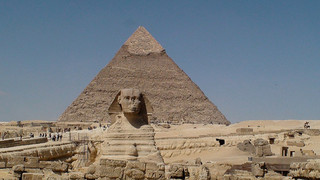 MEDIA ROOTS — Graham Hancock, arguably the world’s foremost expert on ancient mysteries, has devoted his life to uncovering and demystifying the rituals, legends, and wisdom of ancient cultures. In this video, he investigates oft-ignored inconsistencies. For example, he discusses the true age of the Great Sphinx of Giza, which remains under debate. Scholars’ estimates vary widely, though mainstream Egyptologists generally believe it was constructed approximately 4,500 years ago, whereas Hancock asserts heavy water erosion indicates the Sphinx was built quite earlier than believed, at a time when the Giza Plateau wasn’t even a desert yet.