The Climate Change “Debate” and Marketization of Nature: Everyone Loses

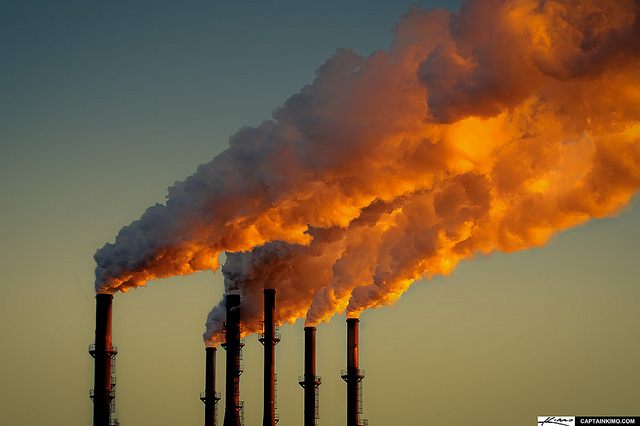
FactoryFlickruserKimSengDespite near-unanimous global scientific and governmental consensus that global warming is accelerating due to human activity, debating this fact is still a favorite political pastime in the United States.

Governments around the world acknowledge the science that connects industrialization, increased greenhouse gas emissions, and their detrimental impact on the climate, and are currently acting upon solutions. Yet the US, one of the largest greenhouse gas producers, has repeatedly refused to participate in global climate reform. To further confound this reality, the November midterm elections placed ardent climate-change deniers in line for senior legislative environmental policy positions.

Meanwhile, the evidence continues to mount. An abundance of reports show that not only does climate change exist, but that it’s human-induced and will cause severe and non-reversible negative consequences for the planet. Most recently, the Intergovernmental Panel on Climate Change (IPCC) released its 2014 Climate Change Report, which states the observed changes in the climate are “unequivocal” and that carbon dioxide, methane and other greenhouse gas emissions have increased exponentially in the past 60 years. The majority of carbon emissions are absorbed into the ocean, causing rapid acidification which has already caused mass die-offs.

Despite having presented overwhelming evidence from over 130 countries that support this conclusion, IPCC reports continue to be attacked by US media outlets. In 2007, minor errors in the Climate Change Report were widely exploited to justify a denial of its findings, forcing scientists in the US to respond in an open letter. Instead of acknowledging climate change science, the US media continues to distort reality by creating a false equivalency between the two sides.

Additionally, when extreme weather phenomenons are reported, climate change is rarely mentioned as a contributing factor. Project Censored found that out of 450 news segments about weather anomalies in 2013, only 16 of them mentioned climate change.

One may be inclined to believe that politicians who deny man-made climate change are innocuously naïve, but many times they are consciously furthering the neoliberal business agenda at the expense of the planet. Accepting the true human impact on the world would mean instilling regulations to curb pollution, which would cut into corporate profits. As Naomi Klein keenly elucidates, the destructive nature of neoliberalism does not lend itself to a sustainable environment, now or ever. Free-market advocates don’t look at earth resources beyond market shares, and their corporate mantra is to continuously maximize profits.

Fossil fuel companies know their time is running out, so they’ve launched a propaganda war to confuse the American public about climate change, raising serious questions about democracy and the right to information. Journalist George Monbiot has extensively researched the ties between oil companies and the reproduction of climate change disinformation. As Abby Martin on Breaking the Set revealed, those who want to protect oil interests fund think-tanks with the sole aim of derailing climate change evidence and environmental advocacy.

One example of intentionally manipulating public opinion is EPA Facts, whose single purpose is to debunk research by the Environmental Protection Agency. Sourcewatch describes it as a “front group operated by the PR firm Berman & Co.” which manages several similar groups that work to further market fundamentalism, including anti-minimum wage campaigns, food safety, and a host of other social policies. Another egregious example of this collusion is the American Enterprise Institute. This Exxon Mobil-funded think tank blatantly offered funding to scientists and academics that could produce research to dismiss human caused climate change.

Other industries that contribute significantly to greenhouse gas emissions, such as the beef industry, also have ties to climate change denial. A report by the 2006 UN Food and Agriculture Organization (FAO) found that livestock production is responsible for up to 18 percent of total emissions, more than all transportation combined. Coincidentally, Koch Industries, which oversees Matador Cattle Company, has consistently funded climate change denial.

These astroturf groups have subverted the dialogue, toxified the political process and halted environmental progress. Sociologist Robert J. Bruelle found just how prevalent they are too, with at least 140 organizations existing solely to poison the well and delay legislative action on climate change. Mega rich donors who also want to chip in are becoming more savvy in their funding techniques, using third-party agencies such as Donors Capital Fund to anonymously funnel money into neoliberal policies. As the Guardian revealed last year, anonymous billionaires donated up to $120 million to anti-climate groups to discredit the scientific consensus using Donors Trust.

As journalist Lee Fang discussed on Democracy Now, Republicans who deny man-made climate change and are largely backed by fossil fuel companies will soon be in key positions to block environmental policies. This includes Senator Jim Inhofe in the Environment Committee, Senator Ron Johnson in the Homeland Security and Government Reform Committee, and possibly Senator Ted Cruz in the Science Subcommittee, which controls federal scientific research. Beyond their proclaimed skepticism or outright denial of climate change, these leaders’ ties with oil giants will dismiss any chance of judicious policy decisions.

Because campaign funding is intimately tied to corporate interests, Americans must recognize the influence that corporations and politicians have on media, advertising, think-tank research, and other avenues of information. It’s also a critical time to recognize neoliberalism (or market-fundamentalism) as a toxic system that places corporate profit over any chance for democracy. Acknowledging climate change as a global reality is the first step to demanding sustainable environment policies and proper investment in renewable energy sources.

Other countries are quickly progressing on this front. Germany’s Energiewende project (energy transition plan) has successfully turned nearly one-third of their electricity production carbon-free over the past ten years, and are projected to be 100% renewable as early as 2050. The country’s renewable plan uses electricity through solar photovoltaic and onshore wind power energy.

The US could do this too. Dr. Mark Jacobson from Stanford University developed a plan for America to shift to 100 renewables by 2050, tailoring the proposals for each state based on regional resources available. California, for instance, would meet its energy needs by switching to 55% solar, 35% wind, 5% geothermal, and 4% hydroelectric power. Details of the intricate plan include land requirements, projected cost and savings, expected job creation, and how the proposed trade-off would significantly reduce pollution and global warming emissions.

Plans like this demonstrate the potential the US has in shifting its energy policies and being a leader in sustainable development. Rather than watching the fictitious ‘climate change’ debate unfold, the American public should be aggressively advocating for the development and implementation of green energy plans. It is now or never, and unfortunately, the planet cannot wait.

Written by Sabrina Nasir

Photo by flickr user Kim Seng
Posted in Uncategorized | 1 Reply

Big Oil is More Than Big Trouble for the Environment

MEDIA ROOTS – The global petroleum industry has long been the antagonist for environmental and animal-rights advocates. But more recently, “Big Oil” has emerged as a literal threat to democracy for its vast political influence and ability to contrive wars for profit. A report released last month by the National Wildlife Federation exposed to what extent the oil industry, along with coal, affect elections in America.
Speaker of the House John Boehner tops the list of congressman receiving financial aid from the energy industry. Many of these donors stand to benefit from the proposed construction of the Keystone XL pipeline, an ecologically-damaging project that would send diluted bitumen – a tar-like substance – to American oil refineries, and the congressman has repeatedly castigated the president for delaying its permit. If that wasn’t bad enough, the congressman actually owns investments in some of these companies. Congress is exempt from various trade-laws and last year 60 Minutes highlighted Boehner’s record of insider-trading.

More recently, Congress passed a bill referred to as the “Stop the War on Coal Act.” Congressman Johnson, also a Republican from Ohio, authored the bill and explained the bill wasn’t about climate change as much as it was about public health and safety. But dissenters of the bill argue it actually endangers millions of Americans and virtually declares war on public health. Furthermore, the bill could possibly pave way for a similar bill that would further secure the stature of the petroleum industry.

Big Oil should be considered a big country

Seven of the top ten highest-grossing corporations in the world, as ranked by Fortune magazine earlier this year, are of the oil industry. Royal Dutch Shell, the list’s top revenue-generator, is on par with the gross domestic product of Iran. But if it was its own country, it would be the twenty-fifth highest-grossing country in the world.

When considering these seven corporations together, they are the sixth highest-grossing entity worldwide – government or corporate. And because these entities are private corporations, and considered persons by the Supreme Court, they are not subject to the same level of public scrutiny or congressional oversight. While it may not be surprising that over three-quarters of all petroleum refined in the United States produces gasoline, diesel, and jet fuels, it may be news to some just who is consuming these fuels the most.

The petrodollar war, not the terror war

Purchasing over one percent of the world’s refined oil – by far more than any other single entity – is the U.S. Department of Defense. Over half of this consumption is used to fuel jet engines with the Air Force being the branch of greatest oil demand. The department consumes nearly double the amount of fuel annually as the Republic of Ireland and, during the height of battle in Iraq just a half-decade ago, American troops were consuming well over one million gallons of fuel daily making them the highest oil-consuming soldiers in world history. This past year, the military handed taxpayers a $20 billion energy bill which roughly equates to the cost of an automobile tank for every man, woman, and child in the country.

Less than a month after 9/11 several news outlets were reminding readers that oil was actually more of an issue than terrorism. L.A. Weekly pushed the envelope of sensitivity by offering “it’s the oil, stupid” just eight days after terrorists allegedly hijacked four airplanes. These claims are based on the fact that Big Oil has been vying for an Afghan pipeline for decades.

During the Bush-Cheney era, both of whom are previous oil executives themselves, Big Oil lobbied the federal government over $393 million, with nearly a million dollars diverted to Senator Obama during his 2008 campaign for the White House. But as the majority of Americans of all political backgrounds continue to favor renewable energy options, this Congress continues to turn a blind eye and instead demonizes governments – such as those of Iran and Venezuela – that refuse to trade crude oil in U.S. Dollars. “Petrodollar warfare” is the true reason why the U.S. invaded Iraq in 1990, and again in 2003, and is why Iran continues to remain in the military’s crosshairs.

Corporate media complicity

Meanwhile, the corporate media establishment has yet to connect the dots of history for the general public or sound the alarm on the true cause of this grim outlook. In fact, many of these outlets outright support the industry as reported in a Media Matters study earlier this year regarding the coverage of the Keystone XL pipeline. The report showed that while only a quarter of Keystone XL coverage featured the massive demonstrations of people speaking out against the project, the media continued to parrot industry job estimates even though these predictions had already been widely discredited.

Starting in 1980, the FCC began deregulating the media industry which resulted in over 90% of media outlets being owned by just six corporate entities. Already this year over $153 million oil industry dollars have been spent in the corporate media establishment – mere pocket change for this influential group of executives. The result is a misguided society concerned more by the threat of terror than the more realistic threat of economic collapse.

Embedded below is an episode of FTM Daily, a radio program hosted by economist Jerry Robinson, which further explores the extent of the petrodollar system, its influence on the value of the U.S. dollar, and reveals who the major players are.

Oskar Mosco is the managing editor for Media Roots.

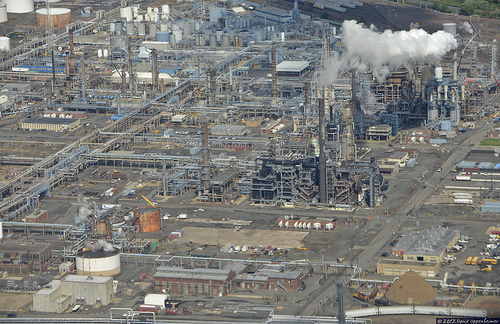
Photograph: © 2013 David Oppenheimer – Performance Impressions

***

Earlier this year on FTM Daily, Jerry Robinson features an examination of the

Petrodollar system that is what the now-volatile U.S. Dollar is based on.

Posted in Uncategorized | 1 Reply

Leaked Contract Reveals BP’s Control of Iraqi Oil

MEDIA ROOTS– To all those who mocked the anti-war community’s “no blood for oil” mantra, turns out BP has zeroed in on controlling a huge piece of Iraq’s oil pie. Instead of being punished for irreversibly polluting the earth’s oceans, BP’s criminality continues to be rewarded with even more government contracts. In addition to the $2 billion in annual US defense contracts, the company was awarded a 20 year contract deal with the Iraqi government to control their oil in 2009. Shockingly, a recently leaked version of that contract reveals that BP has locked in payment from future Iraqi governments, irrespective of whether or not oil is even extracted.

Abby

***

NEW LEFT PROJECT– A leaked contract between BP and the Iraqi government has revealed the extent to which the company has gained control over Iraq’s oil. The 20-year contract for the Rumaila field near Basra published today by oil industry watchdog PLATFORM, commits future Iraqi governments to paying BP whether or not it extracts oil, irrespective of OPEC quotas and of the state of Iraqi pipeline and export infrastructure.

BP was awarded the deal at an auction in June 2009, but suspicions were raised when the company did not sign the contract until four months later. The Iraqi government said nothing had changed in the interim, only “clarifications” – claims that the leaked contract show not to be true.

This leaked version was compared in a briefing published today, ‘From Glass Box to Smoke Filled Room –  How BP secretly renegotiated its Iraqi oil contract and how Iraqis will pay the price’ with the official model contract, dated 23 April 2009, which formed the basis of the first bid round. The report shows that several key changes were made, including:

> BP could opt to be paid for oil not produced as a result of OPEC quotas or Iraqi infrastructure bottlenecks. In the model contract for which companies bid at the auction, the cost of such scenarios would have been shared by both sides.

> The threshold for BP’s project expenditure at which Iraqi approval was required was raised from $50m to $100m and tight time limits applied to Iraqis’ ability to check such expenditures are legitimate and not inflated.

Greg Muttitt, author of the report and the recently published book “Fuel on the Fire – Oil and Politics in Occupied Iraq” said:

“The changes that took place behind closed doors at first look like technical details. But look more closely and you see their real meaning: BP, not the Iraqi government, will effectively control future rates of production. This gives the company a stranglehold on the Iraqi economy”.

Kevin Smith, a campaigner from oil industry watchdog PLATFORM said:

“Fully informed public debate and scrutiny are vital to prevent the worst excesses of exploitation taking place when oil contracts are agreed. Whatever pressure BP has brought to bear in these backroom dealings, the changes are clearly to the detriment of the people of Iraq.”

Also revealed today:

In April 2009, just two months before the auction at which BP won the contract, Iraqi Ministry of Oil officials sought training on commercial and negotiating skills – from BP, the very company with which it would be negotiating.

When parliamentarians called the Oil Minister in for questionning on the contract, Iraqi Prime Minister Nouri al-Maliki wrote privately to the speaker of parliament calling for him to block the it, on grounds that the questionning would hold back Iraq’s progress, in a way that would be “in harmony” with recent terrorist bombings in Baghdad.

© 2011 New Left Project, Press Release by PLATFORM

Photo by Flickr user Daniel Fogg

Glencore: Profiteering From Hunger and Chaos

AL JAZEERA– The rapid rise in prices for food, fuel and commodities has been disastrous for the world’s poor, including Indonesian market vendor Lia Romi. But it’s a bonanza for multinational trading firms such as Glencore.

While Romi has trouble feeding her family, Glencore – the world’s largest diversified commodities trader – is planning a US$11billion share sale, likely the largest market debut ever seen on the London Stock Exchange.

“The price for our daily food has at least doubled in the past two years,” Lia Romi told Al Jazeera through a translator. “Food costs 100 per cent of my family’s daily income [of about $3]. I have nothing saved and I owe [money] from my [market stall] business.”

While Romi, and millions like her, worry about feeding their families, the initial public offering from the commodity speculating giant will create at least four billionaires, dozens worth more than $100million and several hundred old fashioned millionaires. Chief Executive Ivan Glasenberg is set to make more than $9bn from the share sale. And speculating on food prices is an important part of his wealth.

Controlling prices

Valued at about $60billion, Glencore controls 50 per cent of the global copper market, 60 per cent of zinc, 38 per cent in alumina, 28 per cent of thermal coal, 45 per cent of lead and almost 10 per cent of the world’s wheat – according to information the firm disclosed prior to its share sale. It also controls about one quarter of the world market in barley, sunflower and rape seed.

Read more about Glencore: Profiteering From Hunger and Chaos

© 2011 Al Jazeera

Photo by Flickr user ashcroft54

BP Plans to Drill in Gulf of Mexico Within Months

GUARDIAN– Environmentalists reacted angrily after BP predicted it would be back drilling in the Gulf of Mexico within months despite facing billions in financial penalties over the Deepwater Horizon disaster – and despite balls of tar still washing up on beaches.

The oil giant’s finance director, Byron Grote, told City analysts: “We expect to be back and actively drilling during the second half of the year.” Such a return would be a major victory for BP – which last summer was threatened by a proposed law to ban the company from the Gulf for up to seven years.

“BP’s reckless approach led to the worst oil disaster in American history, but one year later they’re off the hook and ready to take more risks,” said Phil Radford, director of Greenpeace USA. “It’s a testament to the political influence of these big oil companies that right now Tony Hayward is sailing his luxury yacht rather than facing criminal charges,” he added.

Continue reading about BP Plans to Drill in Gulf of Mexico Within Months.

© 2011 Guardian