
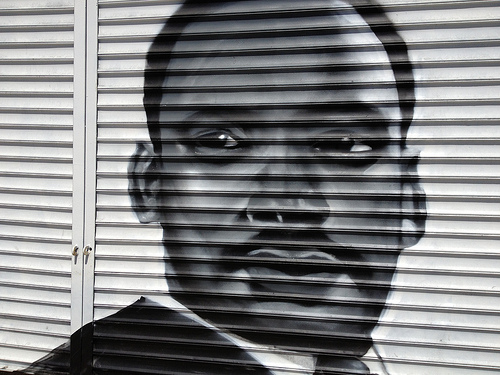
‘I Have a Nightmare,’ But We All Have a Choice

MLKbyjasonRosenburgNow that the nation has celebrated MLK’s heroic agitation for civil rights, there’s another facet of Martin Luther King Jr. often ignored in the media that deserves reflection.

What do MLK, JFK and RFK share in common?

Indeed, all three of them had undeniable charisma which directly and emphatically threatened the powers that be. Each demanded a presence with their sheer character, possessing an uncanny ability to embody the words they spoke rather than simply acting as another suit-and-tie with a political platform pre-scripted by some other PR suit-and-tie.

All three had the ability to enact change at a fundamental level, because they were personally convicted and committed to dissenting against war in a world that had become hellbent on destruction and violence.

But there is a further striking similarity between these three charismatic leaders: all of them were assassinated after focusing their critiques against the war machine.

In his formative stages, MLK was a radical proponent of non-violent protest against segregation and racism. He orchestrated sit-ins and marches in order to fight on behalf of African-Americans and the deprivation of their basic civil liberties as stamped in the Constitution. Nowadays, MLK is known for his success as a civil rights champion in regards to race equality. But later down the road, he had a stark realization which radically shifted the way he thought about political dissidence. This change of heart is what I wish to underscore, in remembrance of MLK and what he was willing to stand – and die – for.

We’re all familiar with MLK’s “I Have a Dream Speech” speech that he delivered in 1963 in Washington, D.C., culminating his March on Washington protest. In the speech, MLK envisions a day when racial inequality is no more, replaced by an egalitarian, racially colorblind America. However, in April of 1967, some four years later, Martin Luther King had a different culprit in mind – American foreign policy. In a speech entitled “Beyond Vietnam: A Time to Break Silence” delivered at Manhattan’s Riverside Church, King excoriates the military industrial complex and sees it as a fundamental wrong that ought to be first and foremost on our minds. King begins by addressing himself, critiquing his own “silence” on matters of foreign policy:

“Over the past two years, as I have moved to break the betrayal of my own silences and to speak from the burnings of my own heart, as I have called for radical departures from the destruction of Vietnam, many persons have questioned me about the wisdom of my path. At the heart of their concerns this query has often loomed large and loud: “Why are you speaking about the war, Dr. King?” “Why are you joining the voices of dissent?” “Peace and civil rights don’t mix,” they say. “Aren’t you hurting the cause of your people,” they ask? And when I hear them, though I often understand the source of their concern, I am nevertheless greatly saddened, for such questions mean that the inquirers have not really known me, my commitment or my calling. Indeed, their questions suggest that they do not know the world in which they live.” 

He then goes on to say, in some of the most moving words I have ever heard:

“As I have walked among the desperate, rejected and angry young men, I have told them that Molotov cocktails and rifles would not solve their problems. I have tried to offer them my deepest compassion while maintaining my conviction that social change comes most meaningfully through non-violent action. But, they asked, what about Vietnam? They asked if our own nation wasn’t using massive doses of violence to solve its problems, to bring about the changes it wanted. Their questions hit home, and I knew that I could never again raise my voice against the violence of the oppressed in the ghettos without having first spoken clearly to the greatest purveyor of violence in the world today, my own government.

For those who ask the question, “Aren’t you a Civil Rights leader?” and thereby mean to exclude me from the movement for peace, I have this further answer. In 1957 when a group of us formed the Southern Christian Leadership Conference, we chose as our motto: “To save the soul of America.” We were convinced that we could not limit our vision to certain rights for black people, but instead affirmed the conviction that America would never be free or saved from itself unless the descendants of its slaves were loosed from the shackles they still wear.

Now, it should be incandescently clear that no one who has any concern for the integrity and life of America today can ignore the present war. If America’s soul becomes totally poisoned, part of the autopsy must read “Vietnam.” It can never be saved so long as it destroys the deepest hopes of men the world over.”

We could call this MLK’s “I Have A Nightmare” speech, as King begins to realize that the systemic evils involved in racism are also found in the roots of militarism. After transitioning his critique from domestic to foreign policy, King was shortly thereafter assassinated.

Likewise, JFK lived out the beginning of his first term acquiescing to the Joint Chiefs of Staff and the CIA in their bid to prevent the dominoes from falling in favor of Communism, orchestrating coups and military operations in different regions of the world so to spread the seed of democracy and fulfill the long held tenants of Manifest Destiny. Like MLK, over time JFK eventually transitioned his aim toward the end of his first term, threatening to remove troops from Vietnam, negotiate an arms-treaty with Russia, and call for peace with Cuba, all of which would have effectively shut down the military machine. JFK was assassinated shortly thereafter.

Furthermore, RFK, who in his early years as the Attorney General to JFK was quite hawkish in regards to covert operations against Cuba, platformed his own presidential bid on fulfilling his brother’s wishes for peace, not war. RFK was also assassinated shortly thereafter.

Is it simply a coincidence that all three of these charismatic leaders were snuffed out by psychotic, nutty lone assassins whilst activating their political stance to reappropriate a republic that had been hijacked by aggressive militarism? In the case of MLK’s assassination, a Memphis, Tenn. grand jury in 1999 ruled his death not as the result of a lone nut but rather a government conspiracy, warranted by an enormous amount of evidence.

Fast forward to today, with Obama being another charismatic possessing the ability to sway an entire nation with his rhetorical skills. He too started out like JFK in critiquing the war machine, but after getting into office wholly relented to the military-industrial complex. In similar fashion to JFK’s unsanctioned war crimes, Obama’s drone policy has claimed the lives of many innocent human beings and so-called “terrorists,” strikes which are happening without Congressional oversight and thereby subject to the rubric of a war crime per international law.

Will we perhaps see a pang of conscience in Obama like we’ve seen with the aforementioned charismatics? Maybe. But let’s not forget, JFK committed his own war crimes even though he’s often heralded as an agitator of peace. Early on in his presidency, he was directly responsible for authorizing operations like Operation Mongoose, and the coup of South Vietnam’s president. Yet in the end, JFK had the spine to face up to his own atrocities and instead promote peace and democracy.

Although, it’s important to note that JFK made reform late in his first term, whereas Obama has dutifully served his corporate paymasters and war mongers all the way through his first term and so far into his second.

A considerable amount of evidence points to the simple fact that our presidents are only figureheads. They hold very little political power in any actual, substantive sense, because their financial backers and corporate lobbies are the ones ultimately calling the shots. Nevertheless, U.S. Presidents do retain the highest office in the land and thus have a media platform unlike any other individual. They are able to reach the masses immediately with a single speech.

While Obama has demonstrated himself to be an agent of illegality, we as political dissidents must not fall into the trap of demonizing him. Russian novelist and Nobel Prize winner, Aleksandr Isayevich Solzhenitsyn, once said:

“If only there were evil people somewhere insidiously committing evil deeds, and it were necessary only to separate them from the rest of us and destroy them. But the line dividing good and evil cuts through the heart of every human being. And who is willing to destroy a piece of his own heart?”

In the same vein of JFK, Obama retains the ability to choose to turn against the military machine and stand up for what is right and just and good. In similar fashion to MLK, Obama still has the chance to look deep within himself and break the betrayal of his own silence.

Will Obama use his undeniable charisma and fight back against the corporate masters that currently play him like a puppet, as did some of his predecessors? Or will he continue to live up to his placard of hope and change in name only, nothing more than a nice-looking, smiley suit-and-tie on strings?

One thing is for sure: if Obama were to cut the strings and stand up for what’s right, there could very well be a heavy price to pay.

Written by Mike David Micklow

Photo by flickr user Jason Rosenburg
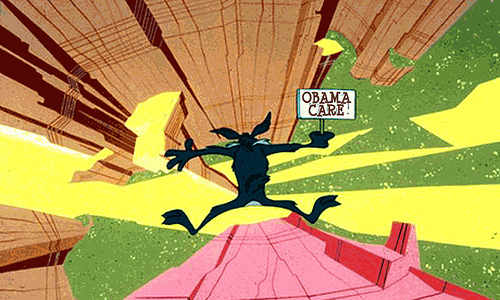
“Obamacare” and the Bogus Healthcare Debate

OBAMACAREcharlesfettingerThe biggest secret of politics in the United States is that a majority of the population is to the left of both major parties.

This can be amply demonstrated by comparing public opinion on a host of issues to the policies pushed by corporate and political elites. Whether it’s US aggression overseas, raising taxes on corporations and the Super Rich, expanding social services or any number of other issues, there is a vast disconnect between the people and those who purport to represent them.

This perhaps more than anything explains the widespread lack of public interest in voting. Rather than a result of apathy or ignorance, as many elite pundits arrogantly assert, public withdrawal from the electoral process is actually an informed choice. Since people often rightly view voting as a lose-lose proposition, voter turn-out in the United States is significantly lower than anywhere else in the industrialized world, plus millions who do vote do so with little enthusiasm.

On no issue is the disconnect between elites and the public more striking than health care. For decades, public opinion has favored a single payer system such as exists in every other industrialized country. Simultaneously, corporate elites and their representatives in the two major parties have been waging an unrelenting war on the people’s right to comprehensive health care. Their goals are to privatize Medicare, destroy Medicaid, and shift the cost of employment-based plans in both the public and private sectors to workers.

This disconnect is what lends the discussion about the Patient Protection and Affordable Care Act (PPACA) now before the Supreme Court such a comical tone. Amidst all the pathetic cries about Obamacare, nowhere is it mentioned that millions of those who oppose PPACA do so not because it’s a Marxist-Leninist attack on individual liberty, but because they recognize the law as a sell-out to the insurance and pharmaceutical industries. President Obama did not call on those who live and work on the frontlines of the health care crisis – nurses, social workers, public health advocates, the uninsured, the insured who have been denied necessary care – to write the bill. He delegated that task to insurance industry representatives, and they have been salivating ever since at the billions in additional profits they will reap when PPACA goes into effect.

***

Abby Martin Breaks the Set on Obamacare: Where Corporations Come First

The Democrats’ claim that there was no political will for a public option, let alone single payer, was Elite Speak for those of us in charge don’t care what the public wants. No one who’s paying the slightest bit of attention should have expected otherwise. Candidate Obama received $25 million from the insurance industry in 2008, after all, roughly four times as much as John McCain. And as most reasonably bright nine-year olds understand, Met Life, Pfizer and the rest of the ruling class are not in the business of financing Marxist-Leninist revolution.

Following the lead of the rest of the world is off the table in the boardrooms of the Super Rich even though the lack of a single payer system has been an important factor in the decline of US industry’s competitiveness (Swedish, Japanese and German automakers, for example, do not have to pay a dime for workers’ health insurance). Instead, the 1% has moved much production overseas while attacking the living standards of those domestic industrial workers who remain. The massive shift of the costs of employment health plans to workers has been a major piece of the unprecedented upward redistribution of wealth that’s occurred in this country over the last forty years.

Regardless of what supporters of PPACA may say, our health care system will remain wholly inadequate. Costs will remain out of reach, care will still be denied, needed services will remain at unacceptable levels or disappear altogether, women, people of color and children will be disproportionately impacted, and the overall result will be a further deterioration in living standards for the vast majority.

Momentum for single payer is far from dead, however. Like all efforts for social justice, the push for single payer received a tremendous infusion of energy from the Occupy Wall Street movement. Among other things, Occupy shone much-needed light on who it is that really owns this country. If that light continues to grow brighter, the openings for real health care reform – not to mention many other necessary social changes – increase.

Andy Piascik is a long-time activist and award-winning author. Write him at [email protected].

Photo by flickr user charlesfettinger

How Opium is Keeping US in Afghanistan: CIA’s Shady History of Drug Trafficking

opiumByBeggsEven though present-day Afghanistan flies under the news radar, it remains to be the longest military quagmire in US history. Aside from troops still occupying the country, thousands of private contractors are on the ground that the Pentagon can’t even account for. Considering how Obama’s foreign policy strategy has been to replace ground troops with drone strikes, the administration’s logic behind continuing the occupation remains unclear.
War has always been about resources and control. Alongside the supposed surprise discovery of Afghanistan’s $1 trillion wealth of untapped minerals, the Taliban had successfully eradicated the opium crop in the Golden Crescent before the US invasion. Now, more than 90% of the world’s heroin comes from the war torn country.

As reported by Global Research:

“Immediately following the October 2001 invasion, opium markets were restored…By early 2002, the opium price (in dollars/kg) was almost 10 times higher than in 2000. In 2001, under the Taliban opiate production stood at 185 tons, increasing  to 3400 tons in 2002 under the US sponsored puppet regime of President Hamid Karzai.”

After more than twelve years of military occupation, Afghanistan’s opium trade isn’t just sustaining, it’s thriving more than ever before. According to a recent report from the UN Office on Drugs and Crime, 2013 saw opium production surge to record highs:

“The harvest this May resulted in 5,500 metric tons of opium, 49 percent higher than last year and more than the combined output of the rest of the world.”

Wow, that’s a lot of opium – and a lot of money being made. So, who is reaping the spoils?

***

How Opium Greed is Keeping US Troops in Afghanistan

Many people outright dismiss the notion of the CIA overseeing the trade of illegal drugs as crazy talk. However, history shows that it’s crazy not to entertain such a notion, especially during times of war profiteering.

In 2012, a Mexican government official from Juarez told Al Jazeera that the CIA and other international security forces “don’t fight drug traffickers” and that instead, the agency tries to “manage the drug trade.”

Back in the fifties, the CIA turned a blind eye to drug trafficking through the Golden Triangle while training Taiwanese troops against Communist China. As William Blum reports in Rogue State: 

“The CIA flew the drugs all over Southeast Asia, to sites where the opium was processed into heroin, and to trans-shipment points on the route to Western customers.”

These are far from isolated incidents. During the eighties, the CIA financially and logistically backed anti-communist contras in Nicaragua who also happened to be international drug traffickers.

Former Representative Ron Paul elaborated on the CIA’s notorious corruption when speaking to a group of students about Iran-Contra:

“[Drug trafficking] is a gold mine for people who want to raise money in the underground government in order to finance projects that they can’t get legitimately. It is very clear that the CIA has been very much involved with drug dealings. We saw [Iran-Contra] on television. They were hauling down weapons and drugs back.”

Surprisingly, mainstream publications still regard the Iran-Contra CIA drug trafficking scandal as a ‘conspiracy theory.’ I explain why it’s not on Breaking the Set:

***

Iran-Contra and the CIA’s Cocaine Trafficking

Circumstantial evidence aside, there is no conclusive proof that the CIA is physically running opium out of Afghanistan. However, it’s hard to believe that a region under full US military occupation – with guard posts and surveillance drones monitoring the mountains of Tora Bora – aren’t able to track supply routes of opium exported from the country’s various poppy farms (you know, the ones the US military are guarding).

In today’s globalized world of rule-for-profit, one can’t discount the role that multinational corporations play in US foreign policy decisions either. Not only have oil companies and private military contractors made a killing off the occupation, big pharmaceutical companies, which collectively lobby over 250 million dollars annually to Congress, need opium latex to manufacture drugs for this pill happy nation. As far as the political elite funneling the tainted funds, the recent HSBC bank scandal exposed how trillions of dollars in black market sales are brazenly being laundered offshore.

Multinational corporations are in it for the long haul, despite how low public support is for the war. A little mentioned strategic pact has already been signed that will allow a US troop presence to remain in Afghanistan until 2024.

The US’ goal of sustained warfare to oversee the world’s opium trade has been alleged by many, including foreign military officials. In 2009, a former commander in the Russian invasion of Afghanistan, General Mahmut Gareev, said to RT:

“Americans themselves admit that drugs are often transported out of Afghanistan on American planes. Drug trafficking in Afghanistan brings them about 50 billion dollars a year – which fully covers the expenses tied to keeping their troops there…[the US military doesn’t] have any planned military action to eliminate the [Taliban].” 

The unwinnable nature of the war becomes more apparent when learning that the US government was paying Taliban insurgents to protect supply routes and “switch sides” in an attempt to neutralize the insurgency. The logic of funding both sides of the war to “win” is too incomprehensible a concept to grasp. Clearly, this war is meant to be sustained.

Baseless rhetoric aside, here’s the hard, hypocritical truth: this government is fighting a multi-billion dollar ‘War on Drugs’ worldwide, resulting in thousands of deaths every year and millions of nonviolent drug users rotting away in prison. Yet, the US is at the very least protecting the largest source of the deadliest and most addictive drug on the planet. If not for the obvious, then why?

Written by Abby Martin for Media Roots 

Follow me @AbbyMartin

Photo by Flickr user Beggs, thanks to Sherwood Ross for the quotes

Media Roots Radio – Corporate Mercenaries and Historical Revisionism

On this edition of Media Roots Radio, Abby and Robbie Martin catch up on current events and dissect the corporatocracy, its control over information and policy, espionage and infiltration of global activism, private mercenaries and corporations’ role in war profiteering over the decades and the historical revisionism being done by the political and media establishment. They also discuss the bombshell revelations of the CIA cover-up regarding Saudi Arabia’s involvement in the 9/11 attacks.

***

The above timeline is interactive. Scroll through it to find out more about the show’s music and to resources mentioned during the broadcast. To see a larger version of the timeline with clickable resources go to the soundcloud link below the player.

If you would like to directly download the podcast click the down arrow icon on the right of the soundcloud display. To hide the comments to enable easier rewind and fast forward, click on the icon on the very bottom right.

This Media Roots podcast is the product of many long hours of hard work and love. If you want to encourage our voice, please consider supporting us as we continue to speak from outside party lines. Even the smallest donations are appreciated and help us with our operating costs.

Thanks so much for your support!

Listen to all previous episodes of Media Roots Radio here.

Oliver Stone Uncensors American History

UntoldHistoryAmericans grow up learning history through the lens of a victorious US empire. This notion isn’t just bred through the educational system – every major institution in society maintains the same perspective in order to help unify the people under a national identity.

Although it benefits the whole if there is a sense of unity among the population, the false belief that an arbitrary national border makes one human better than the other is socially destructive. Not only is this isolated worldview of American exceptionalism insulting to non-Americans, it’s a propaganda tool used to manufacture consent for the US government’s disastrous and hypocritical policies.

Throughout the last half century, the United States has acted as military arbitrator of the world, policing other countries in the name of “freedom” while constantly waging war to undermine other nations’ democracies.

This classified history of America is deeply explored in a ten-part documentary Showtime series called The Untold History of the United States, a film adaptation of the joint book authored by Academy Award-winning director Oliver Stone and prolific historian Peter Kuznick.

The epic saga looks back with a critical eye at historical events that went under reported at the time, but ended up crucially shaped America over the 20th century. From the dropping of two atomic bombs over Japan to the Cold War and the fall of Communism, this in-depth, provocative documentary series challenges many Americans’ long held political paradigms.

Oliver Stone and historian Peter Kuznick have corrected American history on Breaking the Set before. Recently, they came on again to discuss the truth behind everything from JFK’s legacy to Obama’s expansion of the surveillance state.

Abby

***

Abby Martin Breaks the Set with Oliver Stone and Historian Peter Kuznick.

***

LIKE Breaking the Set @ http://fb.me/BreakingTheSet
FOLLOW Abby Martin @ http://twitter.com/AbbyMartin