Obama Administration Establishing “New Normal”

ACLUGroup Releases 18-Month Review Of President’s National Security Policies And Civil Liberties

FOR IMMEDIATE RELEASE
CONTACT: (212) 549-2666; [email protected]

NEW YORK – The Obama administration has repudiated some of the Bush administration’s most egregious national security policies but is in danger of institutionalizing others permanently into law, thereby creating a troubling “new normal,” according to a new report released today by the American Civil Liberties Union.

“Establishing a New Normal: National Security, Civil Liberties, and Human Rights Under the Obama Administration,” an 18-month review of the Obama administration’s record on national security issues affecting civil liberties, concludes that the current administration’s record on issues of national security and civil liberties is decidedly mixed: President Obama has made great strides in some areas, such as his auspicious first steps to categorically prohibit torture, outlaw the CIA’s use of secret overseas detention sites and release the Bush administration’s torture memos, but he has failed to eliminate some of the worst policies put in place by President Bush, such as military commissions and indefinite detention. He has also expanded the Bush administration’s “targeted killing” program.

The 22-page report, which was researched and written by staff in the ACLU’s National Security Project and Washington Legislative Office, reviews the administration’s record in the areas of transparency, torture and accountability, detention, targeted killing, military commissions, speech and surveillance and watchlists.

“President Obama began his presidency with a bang, signing executive orders that placed the power of the presidency behind the restoration of the rule of law and gave meaning to the president’s stated view that America must lead with its values,” said Anthony D. Romero, Executive Director of the ACLU. “Unfortunately, since that time, the administration has displayed a decidedly mixed record resulting, on a range of issues, in the very real danger that the Obama administration will institutionalize some of the most troublesome policies of the previous administration – in essence, creating a troubling ‘new normal.’ We strongly urge the president to shift course and renew his commitment to the fundamental values that are the very foundation of our nation’s strength and security.”

According to the ACLU’s report, the first 18 months of Obama’s presidency have been marked by a pattern wherein significant achievements for civil liberties have often been followed by setbacks. For instance, the positive step of releasing Justice Department memoranda that purported to authorize the Bush administration’s torture regime was followed by the troubling decision to fight the release of photos depicting the abuse of prisoners in CIA custody. The administration’s commitment to dismantle Guantánamo has been undermined by its assertion of the authority to detain people indefinitely without charge or trial. And prohibitions against torture have been weakened by the failure to hold top Bush administration officials accountable for their role in the torture program.

“The Obama administration should work with Congress to restore the rule of law, and discourage any legislation that would institutionalize policies that were widely regarded as unlawful under President Bush. Together, Congress and the White House should make sure that abuses of power like the Patriot Act are dismantled, not extended, and that policies like indefinite detention are never signed into law,” said Laura W. Murphy, Director of the ACLU Washington Legislative Office. “It is not too late for President Obama to build a legacy of justice and fairness.”

The report concludes that, in addition to the initial executive orders, the administration has taken other positive steps and made genuine progress in some areas such as improvements to the government’s handling of Freedom of Information Act requests, the release of key documents related to the U.S. torture program and an executive order disavowing torture. It also addresses more troubling practices such as the use of the “state secrets” doctrine to block lawsuits brought by torture survivors, the revival of the discredited military commissions to prosecute some Guantánamo detainees, the assertion of broad surveillance powers and the authorization of a “targeted killing” program to kill terrorism suspects, including American citizens, wherever they are located, without due process.

“In its first days, the Obama administration took some important steps to restore civil liberties and the rule of law,” said Jameel Jaffer, Deputy Legal Director of the ACLU. “It has not, however, abandoned the ‘global war’ framework that was the basis for many of the last administration’s counterterrorism programs. Indeed, some of the Obama administration’s policies – like the policies on indefinite detention, military commissions and targeted killings – are entrenching this framework, presenting a profound threat to human rights and the rule of law. We urge the Obama administration to recommit itself to the ideals it articulated in its very first days. President Obama should not make ‘global war’ the new normal.”
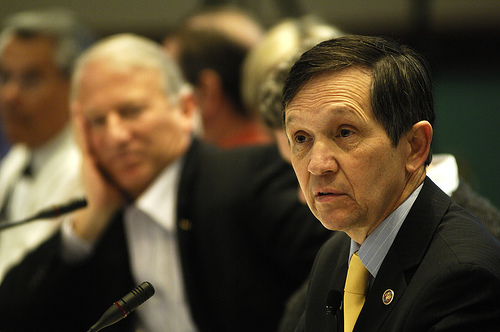
Kucinich, Ron Paul: Get US troops out of Pakistan

RAW STORY– Two US lawmakers – a Republican and a Democrat – proposed a bill this week demanding the withdrawal of all US troops in Pakistan, where they are conducting covert operations against militants.

“We have known that US forces have been operating in secret inside the territories of Pakistan without congressional approval,” Democratic Representative Dennis Kucinich said Friday, pointing to reports the United States was stepping up its presence there.

He said the House of Representatives was expected to take up the resolution next week. The measure was introduced late Thursday.

Kucinich said the covert operations were a “violation of the 1973 War Powers Resolution introduced after the Vietnam War that only allows the president to send US armed forces into military operations abroad if Congress approves the decision or if the United States is under a serious threat or attack.”

“It is our constitutional responsibility as members of Congress to act,” Kucinich added. 

Washington is working to deepen engagement with the nuclear power across the border from war-wracked Afghanistan and overcome rife anti-Americanism after years of perceived neglect of bilateral relations.

Joining Kucinich on the bill was Ron Paul, a Texas Republican who espoused libertarian views during his failed 2008 bid for the presidency.

Paul said the US military has “significantly increased” its operations in Pakistan, without providing figures.

He also noted the increased use of unmanned drone attacks in Pakistan since President Barack Obama came to office a year and a half ago.

“This increasing US military activity in Pakistan has little to do with protecting the United States and in fact is creating more enemies than it is defeating,” Paul said.

“The administration, like its predecessor, is misusing language in the original post-9/11 resolution to prosecute a wider regional war and Congress is sitting quietly on the sidelines. This must stop.”

The Pentagon says only a small number of US soldiers operate in Pakistan, mostly Special Forces tasked with training Pakistani troops along the Afghan border. Those US forces are not officially engaged in combat operations.

Kucinich previously tabled a resolution demanding that all US troops withdraw from Afghanistan, but it was rejected in March.

Washington has branded the rugged tribal area along the Pakistan-Afghanistan border a global headquarters for Al-Qaeda and other militants, who use it as a base to launch attacks on US-led forces in Afghanistan.

But the presence of US troops is a sensitive issue in Pakistan due to prevailing anti-American sentiment in the country, as well as conspiracy theories about US military operations and a perception that they threaten Pakistani sovereignty.

Photo by SEIU International

© COPYRIGHT RAW STORY, 2010

Rules of America’s Rule of Law

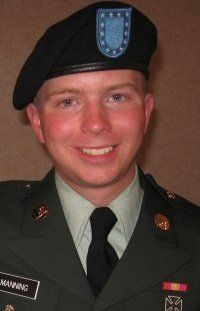
SALONThe U.S. today charged Bradley Manning with a variety of crimes relating to his alleged leaks of classified material to WikiLeaks, most prominently including the Apache attack video that spawned worldwide debate over the American occupation.  The 22-year-old whistle-blower faces 52 years in prison.  Marcy Wheeler has interesting analysis of the charges, including some contradictions with the account previously offered by Wired, and I’ll have more on this shortly, but for now, I just wanted to review the contemporary rules governing the Rule of Law in the U.S.:

* If you torture people or eavesdrop on Americans without the warrants required by the criminal law, you receive Look-Forward Imperial Immunity.

* If you shoot and kill unarmed rescuers of the wounded while occupying their country and severely wound their unarmed children sitting in a van — or if you authorize that conduct — your actions are commended.

* If you help wreck the world economy with fraud and cause hundreds of millions of people untold suffering, you collect tens of millions of dollars in bonuses.

If you disclose to the world evidence of war crimes, government lawbreaking, or serious corruption, or otherwise embarrass the U.S., you will be swiftly prosecuted to the fullest extent of the law and face decades in prison.

I hope those rules are clear because, as this all shows, Justice is Blind and We’re All Equal Before the Law.  In America — clearly — these are not mere slogans.  WikiLeaks said today, and I agree, that “if the charges against Manning are true, he will be the Daniel Ellsberg of our times.”  Ellsberg himself has said the same.  Perhaps Manning should have tortured people or criminally eavesdropped on Americans as he leaked these documents; then he could have availed himself of that sweet Presidential protective shield.  As was true for Ellsberg, the issue isn’t that Manning is being prosecuted; the issue is the extreme disparities in how such decisions are made and what that reveals about the objectives and priorities of those responsible for these decisions.

UPDATE:  The discussion over the charging documents at Marcy Wheeler’s blog reveals just how many important, unanswered questions there continue to be in this case.  That fact, combined with the obvious seriousness of this case, render absolutely inexcusable Wired‘s ongoing concealment of the Manning/Lamo chat logs except for the very heavily edited parts they selectively released.  Yet again, we find an outlet claiming it engages in “journalism” to be playing the lead role in concealing key facts.

Written by Glenn Greenwald

© COPYRIGHT SALON.COM 2010

Charges Announced for Soldier Accused of Leaking Video

Jul6 6, 2010

NY TIMES– An Army soldier in Iraq who was arrested for leaking a video of a deadly American helicopter attack here in 2007 has also been charged with downloading more than 150,000 highly classified diplomatic cables that could, if made public, reveal the inner workings of American embassies around the world, the military here announced on Tuesday.

The full contents of the cables remain unclear but according to formal charges filed on Monday, it appeared that a disgruntled soldier working at a remote base east of Baghdad gathered some of the most guarded, if not always scandalous secrets of American diplomacy. He disclosed at least 50 of the cables “to a person not entitled to receive them.”

With the charges, a case that stemmed from the furor over a graphic and fiercely contested video of an American helicopter killing 12 people, including a reporter and a driver for Reuters, mushroomed into a far more extensive and potentially embarrassing leak. The charges cited only one cable by name, “Reykyavik 13,” which appeared to be one made public by Wikileaks.org, a Web site devoted to disclosing the secrets of governments and corporations. The website decoded and in April made public an edited version of the helicopter attack in a film it called “Collateral Murder.”

In the cable, dated January 13, the American deputy chief of mission, Sam Watson, detailed private discussions he held with Iceland’s leaders over a referendum on whether to repay losses from a bank failure, including a frank assessment that Iceland could default in 2011. (The referendum failed, but negotiations continue.)

Wikileaks, which reportedly operated in the country for a time, disclosed a second cable from Iceland in March profiling the country’s leaders, including Prime Minister Johanna Sigurdardottir.

Although hardly sensational in tone, the cable does reveal a complaint over the “alleged use of Icelandic airspace by CIA-operated planes” by the Icelandic ambassador to the United States, Albert Jonsson, who is described as “prickly but pragmatic.” r Such are the sorts of assessments diplomats go to great lengths to keep private.

Wikileaks has not acknowledged receiving the cables or video from the analyst, Private First Class Bradley E. Manning, 22, whose case has been the subject of vigorous debate between defenders and critics. Private Manning, who served with the Second Brigade of the 10th Mountain Division, based at Contingency Operating Station Hammer, was arrested in May and transferred to a military detention center in Kuwait after allegedly revealing his activities in online chats with a former computer hacker, who turned him in to the authorities.

Read full article HERE.

© COPYRIGHT NY TIMES, 2010

Robert Gates Tightens Rules for Military and the Media

HUFFINGTON POST– Defense Secretary Robert Gates ordered military officials Friday to get Pentagon clearance for interviews and other media contacts after President Barack Obama fired the top general in Afghanistan for embarrassing comments in a magazine article.

Gates’ order, which is effective immediately, tells officials to make sure they are not going out of bounds or unintentionally releasing information that the Pentagon wants to hold back.

The order was issued in a brief memo sent to military and civilian personnel worldwide. It does not spell out exactly how the new directive will work but appears to require hundreds or thousands of officers to funnel interview requests through a small central office at the Pentagon.

“I am concerned that the department has grown lax in how we engage with the media,” Gates wrote.

“We have far too many people talking to the media outside of channels, sometimes providing information which is simply incorrect, out of proper context, unauthorized, or uninformed by the perspective of those who are most knowledgeable,” about how the information may fit into larger government operations or goals.

The order, first reported by The New York Times on its website Friday night, has been in the works since long before Gen. Stanley McChrystal stunned his bosses with criticism and complaints in a Rolling Stone article that his superiors did not know was coming.

“We were not happy with the content, and we were not happy that we didn’t know about it,” Assistant Defense Secretary Douglas Wilson said this week.

Read more HERE.

© COPYRIGHT HUFFINGTON POST, 2010