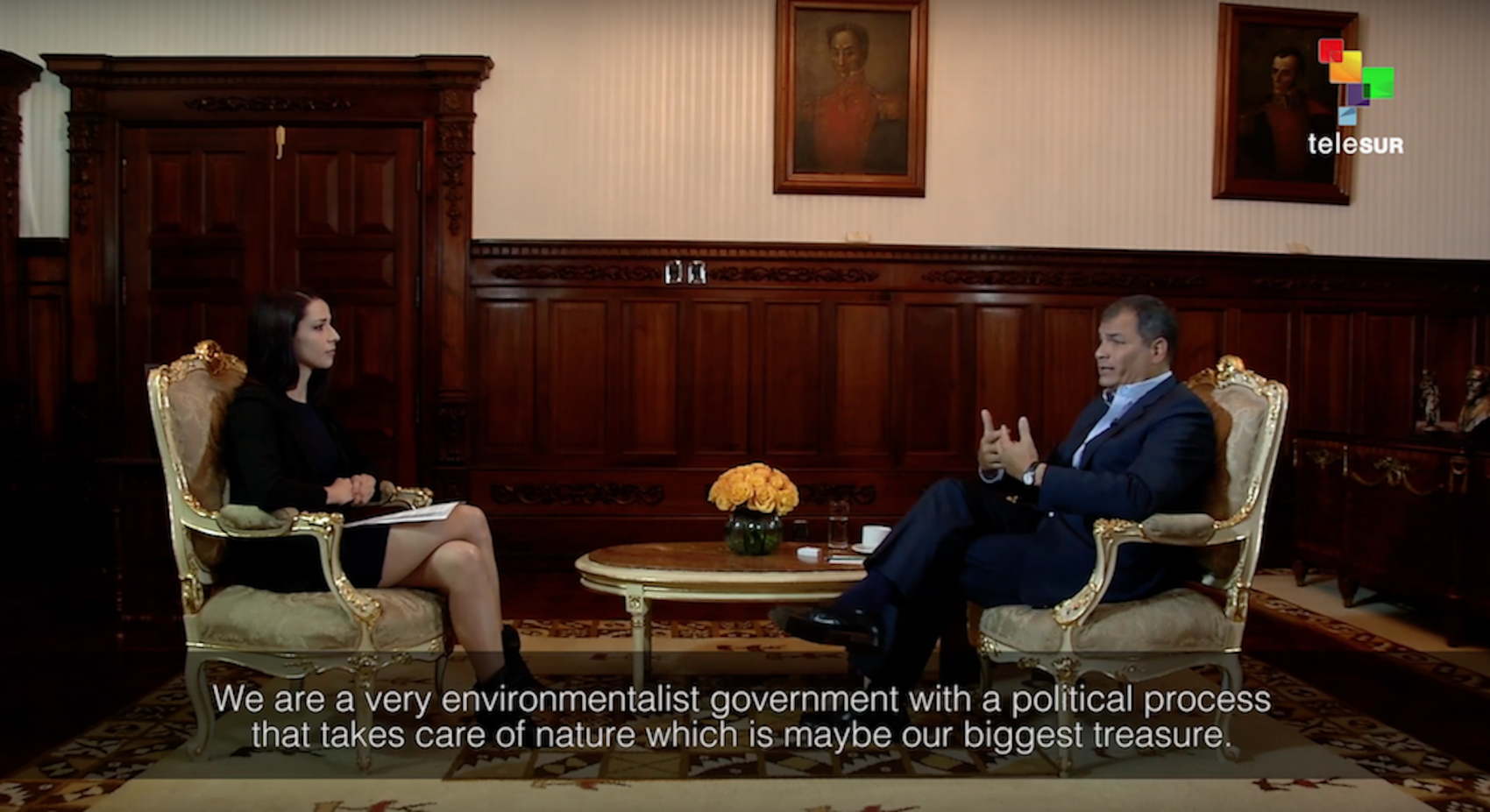
Abby Martin Interviews President Rafael Correa on Empire & the Environment

ABBY AND CORREA

After touring Chevron’s oil pollution in the Ecuadorean Amazon, Abby Martin sits down for an exclusive interview with Ecuador’s president, Rafael Correa, about the legal battle against the corporation and push to decolonize the country from Western powers.

They discuss Ecuador’s new constitution that grants legal rights to nature for the first time in history, the country’s proposed ban against individuals using tax havens holding public office, and his administration’s dismantling of neoliberalism, stressing that the world order must shift, so that people come before capital.

Despite its diplomatic relationship with the United States, Correa comments on how Ecuador remains the subject of ongoing regime change efforts and democratic subversion on behalf of the U.S. government through NGOs like USAID. However, Correa is determined that being in the crosshairs of U.S. Empire will only embolden their fight for independence.

When asked about whether Trump or Clinton would be better for the future of Latin America, Correa’s response is surprising. He says Trump’s crudeness would be better to “revitalize the left” in Latin America, but that Hillary would be better for the sake of people in the U.S.


Abby Martin Interviews Ecuador’s President Rafael Correa 

**

FOLLOW // @EmpireFiles & @AbbyMartin

WATCH // YouTube.com/EmpireFiles

Posted in Uncategorized | 1 Reply

The Capitalist Network That Runs the World

MEDIA ROOTS- In an empirical study using complex systems analysis models, mathematical theorists in Zurich have revealed the architecture of transnational corporations’ (TNCs) interconnectedness. The report bolsters the charges made of late by the Occupy Wall Street Movement touting society’s obscene inequality—1% of the population owns almost half of all U.S. wealth.  This study’s findings, an uncanny correlative of the individual TNC to the individual ruling-class elitist, reveal that less than 1% of all TNCs essentially control 40% of the global economy. 

Messina

***
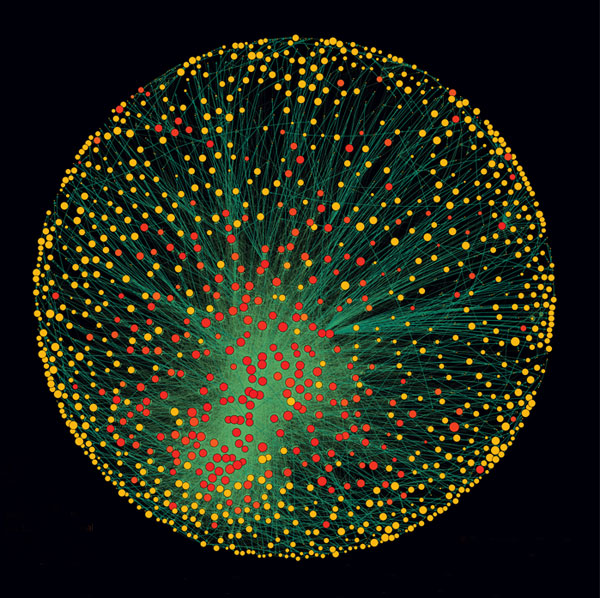
CapitalistNetworkPLoSOneNEW SCIENTIST— AS PROTESTS against financial power sweep the world this week, science may have confirmed the protesters’ worst fears. An analysis of the relationships between 43,000 transnational corporations has identified a relatively small group of companies, mainly banks, with disproportionate power over the global economy.

The study’s assumptions have attracted some criticism, but complex systems analysts contacted by New Scientist say it is a unique effort to untangle control in the global economy. Pushing the analysis further, they say, could help to identify ways of making global capitalism more stable.

The idea that a few bankers control a large chunk of the global economy might not seem like news to New York’s Occupy Wall Street movement and protesters elsewhere (see photo). But the study, by a trio of complex systems theorists at the Swiss Federal Institute of Technology in Zurich, is the first to go beyond ideology to empirically identify such a network of power. It combines the mathematics long used to model natural systems with comprehensive corporate data to map ownership among the world’s transnational corporations (TNCs).

“Reality is so complex, we must move away from dogma, whether it’s conspiracy theories or free-market,” says James Glattfelder. “Our analysis is reality-based.”

The work, to be published in PLoS One, revealed a core of 1318 companies with interlocking ownerships (see image). Each of the 1318 had ties to two or more other companies, and on average they were connected to 20. What’s more, although they represented 20 per cent of global operating revenues, the 1318 appeared to collectively own through their shares the majority of the world’s large blue chip and manufacturing firms – the “real” economy – representing a further 60 per cent of global revenues.

When the team further untangled the web of ownership, it found much of it tracked back to a “super-entity” of 147 even more tightly knit companies – all of their ownership was held by other members of the super-entity – that controlled 40 per cent of the total wealth in the network. “In effect, less than 1 per cent of the companies were able to control 40 per cent of the entire network,” says Glattfelder. Most were financial institutions. The top 20 included Barclays Bank, JPMorgan Chase & Co, and The Goldman Sachs Group.

Read more about the capitalist network that runs the world.

© 2011 Reed Business Information Ltd.

Image by PLoS One

Recent Discovery: Wild Fish Uses Tool

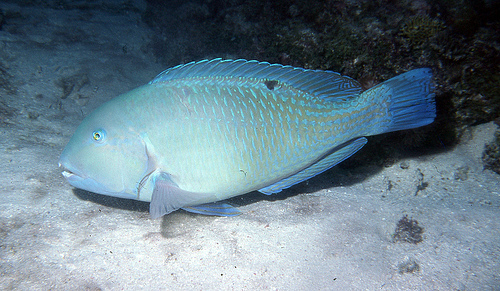
NATIONAL GEOGRAPHIC– A blackspot tuskfish off Australia has its mouth full as it carries a cockle to a nearby rock, against which the fish was seen repeatedly bashing the shellfish to get at the fleshy bits inside.

A recent study in the journal Coral Reefs says the picture—snapped at a depth of nearly 60 feet (18 meters) in Australia’s Great Barrier Reef in 2006—is the first ever taken of a tool-using fish in the wild.

Professional diver Scott Gardner was just about out of air and swimming back to the surface when he heard an odd cracking sound nearby. Swimming over to investigate, he spotted the foot-long (30-centimeter-long) fish at work.

“When Scott showed me his photos, I said ‘Wow, this is quite amazing,'” said study co-author Alison Jones, a coral ecologist at Central Queensland University in Rockhampton, Australia.

Read more about Wild Fish Uses Tool.

© 2011 National Geographic

Photo by flickr user Wadjin

Regulation of Animal-Human Hybrids Needed

INTERNATIONAL BUSINESS TIMES– Experiments that create animal-human hybrids by implanting human material in lab animals should be more rightly regulated, a group of British scientists said in a new report.

It may sound like something from a horror movie, but implanting a small number of human genes or cells in animals is nothing new: scientists have already made strides in medical treatment by testing cancer drugs on mice engineered to have human DNA, by seeing how human stem cells behave in rats, and by studying a blood clotting problem through goats with a human protein in their milk. But a report issued by the UK’s Academy of Medical Sciences recommended creating a government body to advise whether certain tests should be permissible.

“There are a small number of future experiments, which could approach social and ethically sensitive areas which should have an extra layer of scrutiny,” said Martin Bobrow, a professor of medical genetics at the University of Cambridge  chair of the group who wrote the report. “There are good reasons for doing these experiments because they lead you to a better understanding of really important questions, but we need to go slowly and it needs to be regulated in a way that’s open, and transparent and looks very carefully at each step.”

2008 experiment in which British researchers created a human-animal embryo sparked considerable controversy, with religious groups condemning the experiment. Bobrow and his colleagues wrote that most experiments should be allowed to proceed, but they elaborated a small number of experiments that could cross the line.

“Where people begin to worry is when you get to the brain, to the germ [reproductive] cells, and to the sort of central features that help us recognize what is a person, like skin texture, facial shape and speech,” Bobrow told reporters. “The closer [an animal brain] is to a human brain, the harder it is to predict what might happen,” he added.

The report references the issue’s powerful resonance, addressing what the authors dub the “‘Frankenstein fear’ that the medical research which creates ‘humanised’ animals is going to generate ‘monsters.'” A poll included in the study found that a majority of respondents supported the idea of research using animals that contained human material, so long as it was to advance medicine. But people were wary of anything that would sacrifice the mental capacities that separate humans from animals.

Read more about Report Calls for Regulation of Animal-Human Hybrid Experiments

© 2011 International Business Times

Photo by Flickr user Gravitywave

Howard Zinn: Human Nature and Aggression

MEDIA ROOTS Howard Zinn challenges the philosophy that acts of aggression are integral to human nature and discusses how one’s society and surrounding environment is what creates of hostility. The excerpt is taken from the documentary You Can’t Be Neutral On a Moving Train.

Howard Zinn, “On Human Nature and Aggression.” From You Can’t Be Neutral On a Moving Train, 2004.

DVD available from firstrunfeatures.com.