
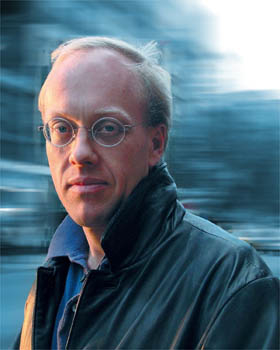
Chris Hedges: The Collapse of Industrial Civilization & the Antidote to Defeatism

Chris Hedges flickr theNerdPatrolPine Ridge is one of the poorest counties in the US, and its conditions are comparable to developing countries. This is partly why Pulitzer Prize-winning journalist and brilliant social critic, Chris Hedges, has referred to places like Pine Ridge as capitalism’s “sacrifice zones.”

Although this systemic subjugation is as old as civilization itself, the oppression of people in far away lands is now backed with an unprecedented amount of military force. Society’s toxic perpetuation of the “Military Mind” causes profound destruction, both domestically and internationally.

As 21st century capitalism thrives on an unsustainable model of endless growth, Hedges discusses the inevitable collapse of industrial civilization, analyzes cult-like behavioral patterns that rise out of desperation and explores the antidote to defeatism in an enlightening interview series with Breaking the Set.

“I don’t fight fascists because I’ll win. I fight fascists because they are fascists.” – Chris Hedges

Abby

 **

 Chris Hedges Part I: Crisis Cults and the Collapse of Industrial Civilization

**

Chris Hedges Part II: The Military Mind and the Antidote to Defeatism

**

AM: Why are places like Pine Ridge so susceptible to extreme poverty?

CH: These are places where unfettered capitalist forces – backed by force on behalf of the railroad companies, timber merchants, and the people who profited from decimating the buffalo herds – minding concerns, came in and seized the land of Native Americans and killed most of them. Not only that, but after herding them into what—in essence—were prisoner of war camps set out to destroy their culture, their religion, their language. That’s why Indian children were taken from their parents and put in Christian boarding schools where they were not allowed, for instance in Pine Ridge, to speak Lakota. What’s happening now with the late end of the industrial age and capitalism is that the reservation; that environment that Native American people have endured and suffered under is being extended and growing in greater and greater areas. We’re all being sacrificed as the residents of Charleston, West Virginia were sacrificed when their water was poisoned by coal companies, and it’s still poisoned. Although they’ve been told to drink it, people and children are coming home from school sick. This is not something that is unknown to Native Americans. I think that whole demented project of ceaseless exploitation, expansion, and violence. The template for that was set in the Westward expansion.

AM: You discuss how the world is globally integrated under an unsustainable form of capitalism, but America positions itself atop the totem pole justified by the notion of American exceptionalism. How do you think that that notion plays into the global collapse?

CH: Well, corporations are preying on the United States in the way that they prey on all nation’s states. They are in this essence super-national. They owe no loyalty to any one nation. That’s how you have seen the decimation of the American manufacturing base; that is how you’ve seen the transference of capital overseas where it lies beyond the reach of taxation. You have seen the rise of the decimation of the working class, and the rise of tremendous numbers of poor, whether they are listed as ‘in poverty’ or a category called ‘near poverty’. We’re now talking about half the country. The myth of America is still there; the idea of if you work hard, you can make something of yourself; the idea that we have a right to travel the globe and impose our virtues—supposed virtues—on other countries by force, which is what we are doing and attempting to do throughout the Middle Easy, although it’s not going very well for us.

Imperialism has always been a mask for trade, for business, for control of natural resources. That has been true since the United States began its imperialist expansion with the conquest of the Philippines, Cuba, the control of the Caribbean for sugar and bananas, into the Middle East for oil. So, what we are seeing is a clash between the myths that America once used to identify itself. Let’s not forget that many of the most fervent supporters of imperialist expansion came from labor unions. I mean, GOMPers was at the Versaille Treaty. All segments of this society are complicit. But these forces, which in essence kind of cannibalize both the natural environment and exploit human labor and have been doing this on the outer reaches of empire for decades, are now being done internally just as it was done in the original conquest of the United States against Native Americans.

AM: You talk about the impending environmental catastrophes, and also the severe economic uncertainty on the horizon—why do you think there is no sense of urgency on a large scale to address these troubling trends?

CH: Because they’re not reported. The commercial media is about bread and circus. It’s about spectacle. It’s about celebrity gossip. It’s about the Super Bowl. I mean, every week it’s something new. If we had a responsible media, especially a broadcast media, we would understand that climate change at this point is an emergency; that at this point the effects of climate change are unstoppable, and if we don’t radically configure our relationship with the ecosystem, very, very quickly the human species itself is in jeopardy. You can look at the World Bank report on climate change, turn up the heat, the World Bank can hardly be accused of being a radical organization and they speak at the end of that report in utterly apocalyptic terms. So, scientists—especially people who study climate change—they know very well what’s happening, and yet we are not hearing their voices.

We are mesmerized by electronic hallucinations, and that’s of course how corporations want it. When forty percent of the summer Arctic Sea ice melts, companies and corporations, like Shell Oil, look at the death throes of our planet as a business opportunity and they’ll run up and drop a half a billion dollar drill bits down into the Arctic Sea. I think what we have seen is a kind of iron control of the systems of information by corporate power who are determined to exploit, and exploit, and exploit until collapse, and now we’re about to see—in all likelihood—the President approve the northern leg of the Keystone XL Pipeline. So, it’s an uninformed public. It’s a public which has been diverted. They’re emotional and intellectual energy has been invested into spectacle, coupled with a ruthless corporate totalitarianism that thinks only in terms of quarterly profit and has absolutely no concern for the common good or sustenance of the ecosystem that might provide some kind of decent and acceptable living standards for future generations.

AM: Chris, but on the flip side you’ve also said that as collapse become palpable, humanity will retreat in what anthropologists call ‘crisis cults’. What is a ‘crisis cult’ and why does our psychological hardwiring always revert back to these modes of groupthink?

CH: When things become so desperate, human societies retreat into forms of magical thinking. At the end of the Indian Wars and the latter part of the 19th Century, you saw the rise of the Ghost Dance which swept through the remnants of native communities. These communities believed that the Great Spirit, the warriors would come back; the buffalo herds would come back; they would get their lands back; the white colonizer would disappear. That is replicated, as anthropologists have studied, throughout societies that collapse.

Now, the way we express our crisis cult, is through the radical Christian right, again, a form of magical thinking which denies evolution, which believes in the rapture; that those believers, when Jesus returns, will be raptured up into heaven. That’s a classic example of a crisis cult, so that when things become desperate you gather in a church, you pray, you carry out Christian ritual, you tend to lash out at a society to purge. You see it in the rhetoric. Whether it’s against homosexuals; whether it’s against undocumented workers, Muslims, a long list of contaminants that will somehow make the society right—all of that has within it the makings of a crisis cult. But crisis cults are what societies do when despair reaches such a level—and we’re certainly headed in that direction—when you are unable in a real way to affect the environment of the world around you, then you wrap yourself in these cocoons of fantasy.

AM: In the article The Myth of Human Progress, you write in reference to truth that people quote, ‘get as close as they can before the flames and heat drive them back. This intellectual and moral honesty, Nietzsche wrote, comes with a cost. Those singed by the fire of reality become ‘burnt children’, he wrote, eternal orphans in empires of illusion. Chris, if this is the way it has always worked, and those who seek truth are constantly ostracized, is humanity just doomed to be subject to empires of illusion?

CH: Well, I’m quoting Nietzsche there about looking down that only artist and philosophers have the capacity to look into what he calls the ‘molten pit of reality’, and when they come back out they find that the wider populous which is unable to look can’t deal with it. So, I depart a little bit from Nietzsche there. Nietzsche, like Plato, says that you create illusions, myth in order to explain a reality or help people cope with a reality. Unfortunately, the role of truth tellers in distraught or disturbed societies, and we have our own examples of that whether it’s Noam Chomsky, or Ralph Nader, or Cornell West—all of them, for getting up and speaking an unpleasant truth, have been pushed to the fringes of society.

The Liberal class is guilty, maybe even guiltier than the stations like MSNBC, which are utterly subservient to the Democratic Party and to the cult of Barack Obama, have kept those voices form us. So it’s not just the right, it’s the left, too; they are both trading in a false reality and that’s very dangerous, because when you can’t confront reality, when your society shuts out those voices that seek to describe what reality is and how it works, then you can’ talk about hope and you can’t talk about change because all hope and change is essentially redirected into a dead political process, or redirected in phantasm, in the idea that Barack Obama is going to save us from Wall Street or from the drone wars, or from environmental degradation. It’s a bit like those poor prisoners in the Gulag were writing letters to Uncle Joe Stalin. That is symptomatic and I think the United States would be probably a good example of an empire in serious decay and decline. These are qualities that are symptomatic of a society that no longer has the intellectual and moral health to face hard facts, readjust and carry out forms of self-criticism and self-correction.

AM: Let’s talk about that new Oxfam study that recently came out that shows how eighty-five people control the equivalent of the bottom half of the World’s wealth. What’s your response to people that say, “We just have to remove those eighty-five people”?

CH: Well, it’s a system of corporate power which is not necessarily driven by individuals so much as driven by corporate interests. Exxon Mobil, Citibank, Goldman-Sachs. So, you can arrest and imprison the head of Golman-Sachs, Lloyd Blankfein—which is where he belongs—but somebody will take his place. What has to happen is we have to break the back of corporate power which is now global, and break the logic whereby everything is about profit; that nothing has value beyond its monetary value. That’s an extremely dangerous moment for any society to live in, because when nothing has an intrinsic value, whether that’s water, air and human beings, then the ruthlessness of those corporate forces mean that you will squeeze every ounce of potential profit. Everything becomes a commodity and you squeeze those commodities until there’s nothing left and that’s exactly what’s happening. So, it’s not individuals, it’s the rise of corporate power which is a species of totalitarianism. Different; it differs from past systems of totalitarianism but it is no less totalitarian than fascism or communism, or totalitarian forces.

AM: Right. The system is a machine at this point. If those people died today, it would still grind on. In a recent article you discuss the menace of the military mind and how only devotion to establish forms of behavior result in individual success. How do you think this concept applies to the director of National Intelligence, James Clapper, and his feelings towards journalists who have exposed NSA documents?

CH: Well, I speak as a former war correspondent who spent twenty years covering conflicts around the globe—Latin America, the Middle East, the Balkans, Africa—so, I know the military really well and blind obedience, aggressiveness resort to violence.  All of these things; you know, destruction of individuality, all of these things work really well on a battlefield. They don’t work very well in a peacetime society. So, when Clapper made this comment that Edward Snowden and his quote-unquote ‘accomplices’—and he was clearly referring to journalists such as Laura Poitras and Glen Greenwald—should be prosecuted, I understood exactly what he was saying. He was a former Lieutenant General; he comes out of this military culture which detests the press, and has always made war on an independent press. Their vision of journalism are all the little lackeys who sit through their press conferences and follow them around and write glowing tributes to their heroism, or whatever they’re directed to write in press pools.

But actual journalism is something that within the military culture they’re deeply hostile, too, and the triumph of military values is—again—symptomatic of a civilization in decline; the rigidity, the celebration of hyper-masculinity, the lack of empathy, the belief that every problem should be dealt with by force both internationally and domestically, militaristic hyper-masculine regimes speak exclusively in the language of force, and then you see within popular culture, subsequently, a celebration of those hyper-masculine military values. I’ve been in enough combat to tell you those values are quite useful in a firefight, but they will destroy a civil society. I think that is a window into how tattered our civil society has become, and how we have shifted our allegiance from an open society, from empathy, from a capacity to embrace various opinions and outlooks and political stances to this increasingly rigid militaristic society, and Clapper is a figure who exemplifies precisely this sickness.

AM: Chris, in a recent speech you gave, you said quote, ‘I do not know if we can build a better society. I do not even know if we will survive as a species. But I know these corporate forces have us by the throat. And they have my children by the throat. I do not fight fascists because I will win. I fight fascists because they are fascists.” Chris, Glen Greenwald recently spoke about how one man, Edward Snowden, has changed the world, and that singular capacity is the antidote to defeatism. What do you regard as the antidote to defeatism?

CH: You can’t talk about hope if you don’t resist, and Edward Snowden has certainly resisted. Heroically. We must carry out the good, or at least the good so far in as we can determine it, and then we have to let it go. The Buddhists call it ‘karma’. I come out of the seminary; that’s what faith is. It’s the belief that it goes somewhere even if empirically everything around you seems to point in the other direction. Once we give up, once we stop resisting, then we’re finished. Not only finished in a literal sense, but finished spiritually and morally. So, I fall back in moments of distress like this on that belief, which is one that I learned in seminary; that we have a capacity and an ability and a moral duty to fight against forces of evil even if it looks almost certain that those forces will triumph.

Transcript by Juan Martinez, Photo by flickr User theNerdPatrol

***

LIKE Breaking the Set @ http://fb.me/BreakingTheSet
FOLLOW Abby Martin @ http://twitter.com/AbbyMartin

PBS Mask of Respectability Sells Iran Nuclear Propaganda

CharlieRosebyDavidShankboneThere are few things more harmful to the public discourse than the cloak of false respectability – especially on a nationally or globally disseminated news network. When corporate media broadcasts propaganda, a benighted public is duped into believing the twaddle of stark raving mad political ideologues as though they were the very words of Socrates by satellite. The mainstream’s reach and influence is staggering, and when unchallenged, fatal. Take, for instance, the estimable Republican Representative Mike Rogers of Michigan. Let’s consider for a moment the aura of respectability that enveloped, like a hot towel on a transatlantic flight, the mindless bluster Rogers so thoughtfully aired for the nation last month on The Charlie Rose Show.

PBS’ Charlie Rose commands a high station in the china shop of American respectability, somewhere above the delicate porcelain of Frontline and slightly beneath the glittering chandelier of The New York Times. Rose has an impressive array of interviewees on his lengthy resume, which doubtless adds to the gravitas of the man, as he peers across an oaken table at his terrified guest, his long and rugged face and watery eyes outlined against a pitiless backdrop of black.

Beyond the matchless imprimatur of Charlie Rose, Rogers is preceded by his own titles, which unfurl like royal insignia across the screen: Rep. [R] Mich. Chairman of the Permanent Select Committee. Most of us haven’t the slightest notion of the “Permanent Select Committee” is, or what is does. Nor does anyone on air explain its significance. We know only that it has the ring of authority to it (it is in fact a committee tasked with providing oversight of the intelligence community).

Next is Rogers’ personal demeanor, which itself suggests everything fine and decent about the state of Michigan. He is white, middle-aged, modestly overfed. His hair pleases with its bland and faded side parting, and he assumes a look of kindly and good-humored politesse.

Rogers is beamed in from the beltway, where all things of significance occur. He is said to be in the “Russell Rotunda”. He stands or sits, flanked by a few impressive Dorian columns, which signify decorum and justice and tradition, of which, presumably, Rogers humbly partakes. On the other side of the camera sits Rose, his left hand, like a satyr’s mangled claw, carving new grooves into his line-saturated brow. Charlie is distraught over something. What might it be? After expressing his consternation visually, Rose stammers himself toward a coherent question: What do you make of this deal with Iran?

Cut to Rogers, his manly, Midwestern, and homely smile, for a moment untroubled, suddenly drops off his face as the most fearsome four letters in the idiom surge through his earpiece. Inside Washington, the phrase, “Iran” serves like a Pavlovian on-switch for beltway fearmongerers. Rogers begins to drone through his talking points: Iran has gotten everything it wanted from this deal, namely the ability to continue enriching uranium; America did not get what it wanted, namely the eternal cessation of all Iranian nuclear activities; Rogers himself is “worried” and “concerned” and clearly afraid for the fine people of Michigan that Iran will continue its “nuclear weapons program”.

Rose, picking up that Rogers is more or less savaging the Obama administration in his drubbing of the temporary pact with Iran, breaks in and forces Rogers to admit that the cessation of fuel-related work at the Arak facility is a good thing, since it will prevent Iran from pursuing a bomb via plutonium, as against its supposed present pursuit via uranium. Briefly derailed, Rogers recovers and paints a few more worrisome images for the edification of the trusting viewer, namely an “arms race in the Middle East”. In this he parrots Shimon Peres, who touts the idea that Iran achieving a nuclear bomb would cause all other Middle Eastern countries to crave one. Rose, his visage now curdling into a painful clutch of arched wrinkles, attempts to interrupt, but Rogers cuts him off three times (with all the forcefulness of Peter denying Christ). Finally, with the utmost decorum and courtesy, Rose bids Rogers adieu, thanking him for gracing the American public with his matchless sagacity.

Rose then breaks for commercial, presumably a horrifically tepid message from Arthur Daniels Midland Company, one of the world’s leading food monopolies, much to the chagrin of numberless third world subsistence farmers; or perhaps a thoughtful piece of mendacity from BP, one of the world’s leading thieves of Iraqi oil, much to the bootless anxiety of the Iraqi people.

Sins of Omission

NuclearSymbolbyFreeGrungeTexturesMillions of viewers were exposed to this dialogue, and millions more will see it in syndication. As they watch, few will be aware of some damning omissions.
First, Iran is fully within its rights under the Nuclear Non-Proliferation Treaty (NPT) and its agreements with the International Atomic Energy Commission (IAEA). It has the right, as do all signatories, to develop peaceful nuclear energy (as contrasted with non-peaceful nuclear energy of the kind being perpetually pursued by the United States).

Second, there isn’t a shred of evidence that suggests Iran is trying to develop a nuclear warhead. Not if you believe successive National Intelligence Estimates of the United States. Perhaps Rogers has overlooked these fine reports. After all, he repeatedly misrepresents Iran’s civilian nuclear energy program, calling it a “nuclear weapons program”. He would deserve censure for this, were not his voice drowned in the din of his Republican and Democratic colleagues rehearsing the same lie.

Third, Iran made concessions in this agreement. It agreed to limit its uranium enrichment to five percent, a level from which, perhaps, a dirty bomb might be cobbled together, were Iranian leadership of a mind to pursue collective suicide by building and using one. It also agreed to halt fuel production at the Arak site. An additional facility would likely have to be built there to reprocess spent fuel into plutonium, like enriched uranium a fissile material usable in a nuclear weapon. It also agreed to convert all its existing 20 percent enriched uranium into unusable formulae. Lastly, it agreed to grant the IAEA regular access to its enrichment facilities. For this, a mere four billion of its rightful monies was unfrozen by the U.S. and its allies. The remaining tens of billions in sanctions on the Iranian economy and money tied up in foreign banks have been left in place, frozen, and untouched. No matter that these sanctions have had devastating effects on the Iranian economy and society.

Fourth, the United States’ attempt to sharply curtail Iran’s nuclear program is hypocritical, to put it mildly. Not only did the U.S. support civilian nuclear energy in Iran during the Shah’s reign decades ago, but America can hardly be regarded seriously when it suggests that other nations don’t have the right to pursue nuclear weapons. The United States possesses thousands of nuclear weapons, and its viciously aggressive and perennially aggrieved Middle Eastern proxy Israel has an additional 80 nuclear weapons—and a total monopoly of weaponized uranium in the Middle East. Rogers seems to think Iran has an interest in not only pursuing a weapon, but in launching a pointless and suicidal arms race against the two most powerful nuclear states in the world. Not to mention his conjuring of a certifiable former Israeli prime minister whose own histrionic notions—that Iran would instantly bomb Israel if only it could—has been contradicted by saner members of the Israeli military who have admitted that Iran poses no “existential threat” to its statehood, including former defense minister Ehud Barak.

Thanks to Charlie Rose, Rogers’ ceaseless fatuities have been aired and absorbed by countless Americans, while none of his lies have been challenged, countered, or discredited. We only got to witness Rose and Rogers exchanging pleasantries at the conclusion of the dialogue, as though they had just finished a highly erudite tete a tete on the Higgs Boson particle.

Now, when the viewer turns to CNN or FOX News, he or she will sooner or later be served images of some Arab Imam (perhaps Hezbollah’s Hassan Nasrallah) frothing with fury, his trembling turbaned head and well-fingered beard striking fear into the heart of clean-shaven, well-meaning Americans, who prefer the easy decorum of the Rose-Rogers dialogue to the visceral anger of an aggrieved party. What they won’t see or hear is what Nasrallah may be saying, possibly condemning American interference in Syria—not an unreasonable critique.

Having heard gentlemanly Mike Rogers, and having seen Nasrallah, they might readily conclude that one is sane and reasonable and the other a madman of historic proportions. This invidious conclusion, equal parts ignorance, misinformation, and xenophobia, is what you get when you treat the unreasonable as respectable and the unfamiliar as threatening. On its face, the mainstream media seems rather inconsequential, with its grim-faced interlocutors soft-peddling questions to tendentious Congressional lightweights. But as Hannah Arendt once said, even evil can be banal.

Jason Hirthler can be reached at [email protected]

Photo by David Shankbone, Free Grunge Textures

Posted in Uncategorized | 1 Reply

How Neoliberalism and NGOs Stunt Civil Society: Reflections on Palestine

PalestineFlagFlickrFreeTextureDesignsThe act of giving to charities has become synonymous with creating a better world. Yet charities have also infiltrated our society, soliciting donations with constant advertisements.
Of course, the act of giving, purportedly for selfless reasons, results in good feelings and perhaps does help build schools or hospitals in some communities. But what are the larger consequences of the charity industrial complex, particularly of international charities that operate in the developing world?

It is oftentimes Non-Governmental Organizations [NGOs] such as Save the Children or Ducere Foundation that serve as charities. The number of NGOs has risen drastically over the past few decades, and now span across various categories – BINGOs [Business-friendly or Big International NGOs], DONGO [Donor Organized NGO], QUANGO [Quasi-Autonomous NGO], INGO [International NGO], and so on. First coined in 1945 by the United Nations, NGO is defined as a “not-for-profit group, principally independent from government, which is organized on a local, national or international level to address issues in support of the public good.”

There are polarizing views about the NGO industry – some regard it as groups of ‘do gooders’ that promote liberal democracy, while others see it as imperial spreaders of Eurocentric hegemony. NGOs have always been a continuation of imperial power, being created and staffed with colonial administrators in the wake of countries winning their independence. Today’s neoliberal economic modality ensures the global elite to safeguard their capital, and therefore, it’s pertinent to understand the role of the NGO industry within this terrain of power.

Neoliberalism is rooted in the perverse notion that the market and monetization are neutral and natural indicators of social needs, which has resulted in mass privatization of previously state-operated services such as health, education, and military intelligence, in addition to the deregulation of trade barriers in order to enhance the mobility of capital. This toxic ideology usurped the previous ideological hegemon of state-led economics after a series of events equated the ‘free market’ with ‘freedom’ – the 1973 oil crisis, the 1979 Volcker shock and the decline of the Soviet Union. It has since been egregiously applied as a ‘one recipe fits all’ economic model, oftentimes being imposed on developing countries in exchange for debt relief by international financial institutions, such as the International Monetary Fund (IMF).

One component of neoliberalism is the restructuring of the state – deemed to be inherently corrupt – into a neoliberal one. The state’s previous role under the Keynesian (state-led) economic model was to serve as a developmental actor in providing social services. It was expected to provide electricity, healthcare, education, telecommunications, and other basic services. Neoliberalism’s assault on the state has shrunk its role into simply a managerial one, in order to ensure deregulation and advance privatization.

NGOs fit into the narrative by becoming the primary providers of social services like education and healthcare. Although it appears to be the solution to governments not sufficiently providing for their people, it’s a short-term remedy that doesn’t address long-term needs and how constituents ultimately need to advocate for themselves.

While it’s unfair to umbrella all NGOs with the same depiction, most international NGOs encompass a Jekyll and Hyde dichotomy. They are subjected to neoliberal-dictated confines which marginalize the poor, yet (innocently or not) seek to provide much needed services to the poor. The result is a de-radicalized populous, less likely to advocate for state solutions to long-standing geopolitical issues due to the ideological restructuring of the market, the naturalization of NGO services, and the normalization of geopolitical issues as being terminal and requiring the aid-industry to continue its band-aid solutions. This very complex construction of the NGO industry as a ‘Jekyll and Hyde’ apolitical third sector ultimately serves to negate any space for local alternatives to neoliberalism to grow.

In 1949, the United Nations Relief and Works Agency for Palestinian Refugees [UNRWA] was established by the United Nations General Assembly resolution 302 (IV) to provide relief and work programs for Palestinian refugees. The organization was set up as a temporary solution to serve the Palestinians until UN Resolution 194, which facilitates the right to return, takes effect. Because Resolution 194 continues to fail to be implemented, the UNRWA is continuously rewarded, and now provides a variety of social services, including health and education.

NGOs have been ordained as ‘bottom up’ development actors and representatives of the people. Yet the UNRWA’s existence as a temporary provider for over fifty years serves to naturalize its own services while normalizing the geopolitical issue surrounding the occupied territories. Its assertion to be apolitical is contradictory, because the existence of an apolitical actor in a political sphere is ultimately politically influential. The perpetual renewal of the UNRWA’s mandate depoliticizes the necessity to legitimize Resolution 194, that is, the right to return.

Additionally, Israel continues to be exempt from international law as an occupying authority, as denoted by the 1907 Hague Regulations and the Fourth Geneva Convention. Nearly all of the responsibility that the occupier has to its occupied population are negated by Israel, including: the confiscation of private property, the condition to ensure public order and safely, and the the responsibility to ensure public health and food to the population under occupation. Palestinians remain disenfranchised in regards to land access and resources.

The UNRWA does provide services that help a lot of Palestinians, but the larger long-term notions of its presence is difficult to ignore. Additionally, the UNRWA provides services to Palestinians outside of the occupied territories, which only complicates the problem. The provision of these services may (temporarily or not) subdue the desire for the right to return, thereby disintegrating the ‘Palestine question.’ The depoliticization of the Palestine occupation serves as a way for Western parties to detach from the issue and fund relief organizations rather than reconsider the policy actions their governments undertake in continuing the brutal occupation.

This is just one example of how NGOs are often embedded with a contradictory, short-term framework in providing needs but ultimately being detrimental for the interests of local populations. Of course, there are many NGOs that are local and independently funded, with an ability to provide short-term needs while addressing long-term issues. These should not be discounted; however, neither should the imperial construct in which all NGOs ultimately exercise their bargaining power. As neoliberalism continues to undo the victories in social service gains over the past several decades, the material and ideological role of NGOs should be assessed within a changing power terrain that upholds the free market and dismantles the welfare state. Organic, and local alternatives to neoliberalism are desperately needed now, or seemingly benign NGOs’ Jekyll and Hyde nature will inevitably disintegrate the space in which these alternatives can ever be developed.

Written by Sabrina Nasir for Media Roots

Photo by Flickr user Free Grunge Textures

‘I Have a Nightmare,’ But We All Have a Choice

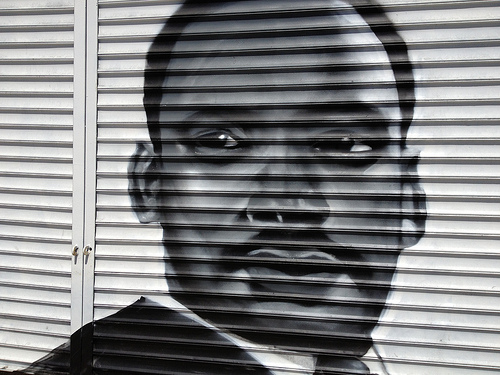
MLKbyjasonRosenburgNow that the nation has celebrated MLK’s heroic agitation for civil rights, there’s another facet of Martin Luther King Jr. often ignored in the media that deserves reflection.
What do MLK, JFK and RFK share in common?

Indeed, all three of them had undeniable charisma which directly and emphatically threatened the powers that be. Each demanded a presence with their sheer character, possessing an uncanny ability to embody the words they spoke rather than simply acting as another suit-and-tie with a political platform pre-scripted by some other PR suit-and-tie.

All three had the ability to enact change at a fundamental level, because they were personally convicted and committed to dissenting against war in a world that had become hellbent on destruction and violence.

But there is a further striking similarity between these three charismatic leaders: all of them were assassinated after focusing their critiques against the war machine.

In his formative stages, MLK was a radical proponent of non-violent protest against segregation and racism. He orchestrated sit-ins and marches in order to fight on behalf of African-Americans and the deprivation of their basic civil liberties as stamped in the Constitution. Nowadays, MLK is known for his success as a civil rights champion in regards to race equality. But later down the road, he had a stark realization which radically shifted the way he thought about political dissidence. This change of heart is what I wish to underscore, in remembrance of MLK and what he was willing to stand – and die – for.

We’re all familiar with MLK’s “I Have a Dream Speech” speech that he delivered in 1963 in Washington, D.C., culminating his March on Washington protest. In the speech, MLK envisions a day when racial inequality is no more, replaced by an egalitarian, racially colorblind America. However, in April of 1967, some four years later, Martin Luther King had a different culprit in mind – American foreign policy. In a speech entitled “Beyond Vietnam: A Time to Break Silence” delivered at Manhattan’s Riverside Church, King excoriates the military industrial complex and sees it as a fundamental wrong that ought to be first and foremost on our minds. King begins by addressing himself, critiquing his own “silence” on matters of foreign policy:

“Over the past two years, as I have moved to break the betrayal of my own silences and to speak from the burnings of my own heart, as I have called for radical departures from the destruction of Vietnam, many persons have questioned me about the wisdom of my path. At the heart of their concerns this query has often loomed large and loud: “Why are you speaking about the war, Dr. King?” “Why are you joining the voices of dissent?” “Peace and civil rights don’t mix,” they say. “Aren’t you hurting the cause of your people,” they ask? And when I hear them, though I often understand the source of their concern, I am nevertheless greatly saddened, for such questions mean that the inquirers have not really known me, my commitment or my calling. Indeed, their questions suggest that they do not know the world in which they live.” 

He then goes on to say, in some of the most moving words I have ever heard:

“As I have walked among the desperate, rejected and angry young men, I have told them that Molotov cocktails and rifles would not solve their problems. I have tried to offer them my deepest compassion while maintaining my conviction that social change comes most meaningfully through non-violent action. But, they asked, what about Vietnam? They asked if our own nation wasn’t using massive doses of violence to solve its problems, to bring about the changes it wanted. Their questions hit home, and I knew that I could never again raise my voice against the violence of the oppressed in the ghettos without having first spoken clearly to the greatest purveyor of violence in the world today, my own government.

For those who ask the question, “Aren’t you a Civil Rights leader?” and thereby mean to exclude me from the movement for peace, I have this further answer. In 1957 when a group of us formed the Southern Christian Leadership Conference, we chose as our motto: “To save the soul of America.” We were convinced that we could not limit our vision to certain rights for black people, but instead affirmed the conviction that America would never be free or saved from itself unless the descendants of its slaves were loosed from the shackles they still wear.

Now, it should be incandescently clear that no one who has any concern for the integrity and life of America today can ignore the present war. If America’s soul becomes totally poisoned, part of the autopsy must read “Vietnam.” It can never be saved so long as it destroys the deepest hopes of men the world over.”

We could call this MLK’s “I Have A Nightmare” speech, as King begins to realize that the systemic evils involved in racism are also found in the roots of militarism. After transitioning his critique from domestic to foreign policy, King was shortly thereafter assassinated.

Likewise, JFK lived out the beginning of his first term acquiescing to the Joint Chiefs of Staff and the CIA in their bid to prevent the dominoes from falling in favor of Communism, orchestrating coups and military operations in different regions of the world so to spread the seed of democracy and fulfill the long held tenants of Manifest Destiny. Like MLK, over time JFK eventually transitioned his aim toward the end of his first term, threatening to remove troops from Vietnam, negotiate an arms-treaty with Russia, and call for peace with Cuba, all of which would have effectively shut down the military machine. JFK was assassinated shortly thereafter.

Furthermore, RFK, who in his early years as the Attorney General to JFK was quite hawkish in regards to covert operations against Cuba, platformed his own presidential bid on fulfilling his brother’s wishes for peace, not war. RFK was also assassinated shortly thereafter.

Is it simply a coincidence that all three of these charismatic leaders were snuffed out by psychotic, nutty lone assassins whilst activating their political stance to reappropriate a republic that had been hijacked by aggressive militarism? In the case of MLK’s assassination, a Memphis, Tenn. grand jury in 1999 ruled his death not as the result of a lone nut but rather a government conspiracy, warranted by an enormous amount of evidence.

Fast forward to today, with Obama being another charismatic possessing the ability to sway an entire nation with his rhetorical skills. He too started out like JFK in critiquing the war machine, but after getting into office wholly relented to the military-industrial complex. In similar fashion to JFK’s unsanctioned war crimes, Obama’s drone policy has claimed the lives of many innocent human beings and so-called “terrorists,” strikes which are happening without Congressional oversight and thereby subject to the rubric of a war crime per international law.

Will we perhaps see a pang of conscience in Obama like we’ve seen with the aforementioned charismatics? Maybe. But let’s not forget, JFK committed his own war crimes even though he’s often heralded as an agitator of peace. Early on in his presidency, he was directly responsible for authorizing operations like Operation Mongoose, and the coup of South Vietnam’s president. Yet in the end, JFK had the spine to face up to his own atrocities and instead promote peace and democracy.

Although, it’s important to note that JFK made reform late in his first term, whereas Obama has dutifully served his corporate paymasters and war mongers all the way through his first term and so far into his second.

A considerable amount of evidence points to the simple fact that our presidents are only figureheads. They hold very little political power in any actual, substantive sense, because their financial backers and corporate lobbies are the ones ultimately calling the shots. Nevertheless, U.S. Presidents do retain the highest office in the land and thus have a media platform unlike any other individual. They are able to reach the masses immediately with a single speech.

While Obama has demonstrated himself to be an agent of illegality, we as political dissidents must not fall into the trap of demonizing him. Russian novelist and Nobel Prize winner, Aleksandr Isayevich Solzhenitsyn, once said:

“If only there were evil people somewhere insidiously committing evil deeds, and it were necessary only to separate them from the rest of us and destroy them. But the line dividing good and evil cuts through the heart of every human being. And who is willing to destroy a piece of his own heart?”

In the same vein of JFK, Obama retains the ability to choose to turn against the military machine and stand up for what is right and just and good. In similar fashion to MLK, Obama still has the chance to look deep within himself and break the betrayal of his own silence.

Will Obama use his undeniable charisma and fight back against the corporate masters that currently play him like a puppet, as did some of his predecessors? Or will he continue to live up to his placard of hope and change in name only, nothing more than a nice-looking, smiley suit-and-tie on strings?

One thing is for sure: if Obama were to cut the strings and stand up for what’s right, there could very well be a heavy price to pay.

Written by Mike David Micklow

Photo by flickr user Jason Rosenburg

Oliver Stone Uncensors American History

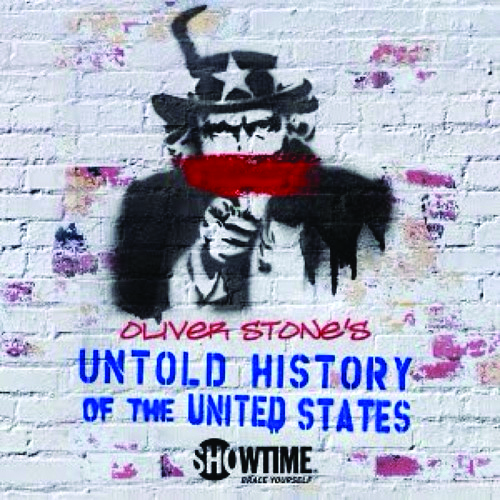
UntoldHistoryAmericans grow up learning history through the lens of a victorious US empire. This notion isn’t just bred through the educational system – every major institution in society maintains the same perspective in order to help unify the people under a national identity.

Although it benefits the whole if there is a sense of unity among the population, the false belief that an arbitrary national border makes one human better than the other is socially destructive. Not only is this isolated worldview of American exceptionalism insulting to non-Americans, it’s a propaganda tool used to manufacture consent for the US government’s disastrous and hypocritical policies.

Throughout the last half century, the United States has acted as military arbitrator of the world, policing other countries in the name of “freedom” while constantly waging war to undermine other nations’ democracies.

This classified history of America is deeply explored in a ten-part documentary Showtime series called The Untold History of the United States, a film adaptation of the joint book authored by Academy Award-winning director Oliver Stone and prolific historian Peter Kuznick.

The epic saga looks back with a critical eye at historical events that went under reported at the time, but ended up crucially shaped America over the 20th century. From the dropping of two atomic bombs over Japan to the Cold War and the fall of Communism, this in-depth, provocative documentary series challenges many Americans’ long held political paradigms.

Oliver Stone and historian Peter Kuznick have corrected American history on Breaking the Set before. Recently, they came on again to discuss the truth behind everything from JFK’s legacy to Obama’s expansion of the surveillance state.

Abby

***

Abby Martin Breaks the Set with Oliver Stone and Historian Peter Kuznick.

***

LIKE Breaking the Set @ http://fb.me/BreakingTheSet
FOLLOW Abby Martin @ http://twitter.com/AbbyMartin