
The Sikh Experience in America

The Sikh Experience in America

Despite being the fifth most popular religion of the world, people of the Sikh faith are rarely recognized as such in the US. With a sharp rise in Islamophobia, Sikhs are frequent targets of bigoted hate crimes, often mistaken for Muslims or Hindus. The first victim of post-9/11 hate crimes was a 49 year old Sikh man – shot to death outside of the gas station he owned. Six Sikhs were murdered in Wisconsin in 2012 when a man opened fire in a Sikh gurdwara, murdering them in cold blood in what was the deadliest attack at a place of worship since the Jim Crow era. Most recently a Sikh man was shot in his own driveway after being told to “go back to your own country.” With the incidences of hate crimes and discrimination against American citizens of middle eastern and Asian descent growing rapidly since Trump entered the political spotlight, most Sikhs have experienced it personally.

A 2015 Stanford study found that 70% of Americans misidentify Sikhs as Muslims and nearly 50% think that Sikhism is a sect of Islam. An estimated 500,000-700,000 Sikhs live in the US. Despite that, the vibrance of the Sikh community is rarely seen in US mass media or pop culture – further leading to a misidentification and misunderstanding of Sikhs and Sikhism, one of the most loving and inclusive religions in the world today.

Journalist Abby Martin visited a Sikh gurdwara in Virginia to speak with the Sikh community there about their personal experiences with discrimination, hate crimes, and cultural ignorance. During her visit she observed common Sikh practices, spoke of long standing Sikh traditions, and partook in a large traditional meal. During her time at the gurdwara Abby also spoke with Georgetown Professor and civil rights attorney, Arjun Singh Sethi.

***

Abby Martin: With the rise of Islamophobia in the United States, harassment and violence not only impacts Muslims, but people perceived to be Muslims, in particular, people of the Sikh faith. Four days after 9/11, an 49-year-old Sikh man named Balbir Singh Sodhi was shot to death outside of the gas station he owned, marking the first hate crime casualty after the attacks. According to witnesses, the perpetrator had said he wanted to, “shoot some towel-heads” to avenge the actions of Osama Bin Laden.In just the first month after 9/11, the Sikh Coalition documented more than 300 cases of violence and discrimination against Sikhs in America. Hate crimes against Sikhs peaked in 2012 when Wade Michael Page charged into a Sikh temple in Oak Creek, Wisconsin, murdering six Sikh Americans in cold blood. It was the deadliest attack against a place of worship since the Jim Crow era.The Trump phenomenon gave new energy to Islamophobes with hate crimes against Muslims and those perceived as Muslims skyrocketing over the past year. On March 6th, 2017, a Sikh man was shot on his driveway by a masked assailant who told to, “Go back to your country.” A week prior to that, an Indian man was shot to death in a bar by a man who told him a variation of the same racist slur, before opening fire on him and his friend. The perpetrator said he thought they were both Iranian.Sikhism is the fifth largest religion in the world, but Sikhs are one of the most mistaken and misunderstood minority groups in the country. A 2015 Stanford study found that 70% of Americans misidentify Sikhs with beards and turbans as Muslims. The same study found that 49% of Americans think Sikhism is a sect of Islam. There are currently an estimated 500,000 Sikhs living in the U.S., many of whom are American citizens. In addition to racism, as a consequence of the U.S. Empire’s campaigns, the cultural richness, diversity and beauty of the Sikh American community, are rarely seen in mass media and popular culture.That’s why I wanted to explore this community for myself. I visited a Sikh place of worship, called the gurdwara, in Virginia. My guide was, civil rights lawyer and professor at Georgetown University. I talked to members of the community about their experiences as a Sikh in America.

Speaker: I came here in ’98.

Abby Martin: Oh, wow. So, right before 9/11?

Speaker: Yeah.

Abby Martin: Did you, kind of see a shift when that happened?

Speaker: Oh, definitely. … because I went to high school here, so I sat … you can see how, after 9/11, the tensions in the schools were… … trying to see … of guys, maybe … name-calling …

Speaker: When they seen us with the beard and the turban on the streets, on the public places, they hate us. They shoot us. They march on us. They give us problems.

Speaker: My niece, who’s a medical doctor, and she was just walking by, and there was – in Florida – and there was two white people who was leaf-blowing and they blew leaves on her face. And… (laughs) …you know, and they can’t tell. They’re, like, “Go back to your country.” So, that’s, pretty sad that that’s how people feel about other people.

Speaker: Even my father, he, actually works in a very small, small town in America. He owns a gas station. And he wears a turban. He has a beard and everything, and so he receives terrible comments. He’s had to deal with it.

Speaker: My husband is Sikh. He wears a turban. And he works in the county and he works in the Department of Environment, so when they go to schools to bring awareness about the environment, the kids don’t recognize Sikhs. They’re, like… they talk about Islam, they talk about Bin Laden, and that’s pretty sad.

Speaker: In America, I would say do not discrimination because I’m … Sikh. But discrimination as a brown person.

Speaker: Yeah, I work in D.C. most of the time, and I didn’t hear anything. Whenever I go, like, hiking to West Virginia … where, like, I’ll go to, like national parks, or something, like, where people never seen me before, first thing they will tell you is, like, you know, go back to Afghanistan or something, right?

Speaker: A lot of time we have seen people simply not educated enough who understand why my son is covering his head. They think… sometimes they thought, like, it’s… he is not well enough, he’s covering his head, and sometimes they want to know what is under his head and his covering.To very, very first discussion, like, when you have at parent-teacher meeting, we were able to talk to them, and explain to them this is all religion, this is what is not right for us, this what is right for us, and we gave them, you know, hey, if somebody has a question, definitely, we are here to help. Ask us, and we can… you know, learn together.

Abby Martin: Considering the widespread lack of knowledge about their faith, I asked people about what Sikhism teaches, and what it means for them.

Speaker: Biggest misconception either we’re Muslims or we’re Hindus. I think even in India there’s a misconception that we’re Hindus. And so even the government treats us as Hindus. But in America they look at us like Muslims. So, nobody really knows that, we’re our own distinct separate ideology and faith and it kind of makes it hard for us to explain, because we always have to use it as a reference point, because that’s what people know.

Speaker: The ideology of the Sikh religion believes in international brotherhood. Love all. Resect other communities. Respect other religious feelings. Equality of society. You see here? The people sit down on the floor. That’s mean everybody doesn’t matter he’s a billionaire, he’s doing labor, they have to sit down here on the floor.

Speaker: Whatever we got from God we are thankful for. We are grateful. We are happy that we are beautiful. And I think every individual in this world is beautiful as that person is created, every individual, and we need to respect individuality of that person.

Speaker: No arrogance. Nothing. This is one thing, arrogance…

Speaker: You’re not better than anyone else.

Speaker: Yes. What you sow, that you reap. It’s written even in the Bible. This is a basic of Sikhism, … that when you die, you take nothing with you. You take only with your deeds. It’s not even balanced whether you are Bill Gates or a guy on the street, and when he goes, stand before the Lord, it is only his deeds.

Speaker: Being a Sikh for me personally is having a discipline to really, just practice and express my love for God. As a Sikh, we believe in our ten Gurus. They taught us values of truth and love and being honest and sharing and those universal things I think they’re in all faiths. I guess what distinguishes us, though; the cultural ties kind of play a big role. So, we keep an external identity. If you were to walk into a gurdwara, the church, you would just… the culture of it is very different. But, in essence, it’s the same, I feel.

Speaker: There are a couple of types of the turban. You will see turbans of … different. It is mine. This is traditional 500 years ago. You will see that … is modern.

Speaker: I didn’t really know how to tie a turban before, and when I got to know when I was in 9th grade, I felt, really good, like something… it’s a sign to remember everyone. If I go to some place where nobody knows me, then he will be able to know and remember me, like a sign to remember, and I’m proud to be Sikh. Yeah. Wearing a turban.

Speaker: See, if I cut my hair, that will make me fit in the college, but at the same time, I want to be stand up … I can explain why do I have … because I believe in God.

Speaker: Whenever I come here, they usually tell me, can you teach me how to tie a turban, and you … yeah. Yeah. So, they just, like, always ask me, like, how to tie a turban, and I usually suggest to them, go to YouTube and everything, you can find everything… yeah. Yeah. So…

Abby Martin: Tell me more about the women’s role in Sikhism?

Speaker: When we come to the gurdwara, it’s everything is equal. We come, we can sing upstairs, and it’s not about only men can sing, and only men can do… there is no division of any duties or any responsibilities. The woman can be next to the … side … The woman could be on the stage singing … The woman could be cooking. The woman could be serving food, the same for men. They are doing the same thing. So, the level of equality that we have in Sikhism it’s amazing.

Abby Martin: I sat down with Arjun for a traditional Sikh communal meal, called langar.

Arjun Singh Sethi: This is a religious and cultural tradition of the Sikh faith that after the ceremony is concluded, all are welcome to come to the gurdwara for a meal. And if you go to gurdwaras in India, you will find not just Sikhs, you will find Muslims, you will find Hindus, you will find day laborers, all are welcome to enjoy the vegetarian food that’s served.It usually consists of bread, some yogurt, some salad, some lentils, some potatoes, chickpeas, of course, all cooked Indian style. The Sikh faith itself is extraordinarily inclusive, so later today, I think you’re going to, actually get a glimpse of the Holy Book … upstairs, and it is an extraordinarily unique Holy Book because it contains the writings, not just of Sikhs, but actually contains the writings of Muslims, of Sufis, and … of other traditions, as well.Everyone congregates upstairs, usually there is a … priest, who sings holy hymns. Everybody joins in the recital of those hymns, and then it concludes with a reading from the Holy Scripture, and then everyone comes down for the meal.

Abby Martin: There was, definitely lots and lots of amazing food.Part of the activities at the gurdwara also includes a school for kids.

Arjun Singh Sethi: Our main focus with the school here is to make… give exposure to our children about our culture and Sikhism. School is primarily divided into two pieces. One is the teaching of language. We are from Northern India, most of the Sikhs, so our main language is Punjabi, and our scriptures, … which means … as a true guru, it’s written in Punjabi. So, it’s extremely important for us to teach our kids to learn the main language.The second part of the school is, which you probably noted, is the history. We have a lot of focus on teaching our kids the Sikh history so they know, you know, where we originated from, what are the different challenges throughout the lifetime so far we have, and where we are heading now.

Abby Martin: Sikh contributions to science, culture and more are extreme importance. Among them are Narinder Singh Kapany, dubbed the Father of Fiber Optics, whose work revolutionized communications, medical equipment and more. Artist Amrita Sher-Gil, known as India’s Frida Kahlo and a pioneer of modern art, renowned novelist and poet, Amrita Pritam, … Singh, American civil rights attorney who won major victories against the Bush era torture machine, and electronic music pioneer Talvin Singh.Music is, actually an integral part of Sikhism. A large number of the community members are musicians themselves.

Speaker: I always went to the gurdwaras. I was little. I don’t… it’s just my heart of my life that I never felt that I could live without it. So, this was my part where I connected as a kid – the singing. And it connected me and I started going and looking at the keys, and I started working at it at home, no lessons, nothing, it’s just spiritual.

Speaker: (singing)

Abby Martin: Sikhism is a relatively young religion, founded around 500 years ago in the Punjab region of what is today Northern India. Around 75% of Sikhs still reside in the Punjab region. A cultural melting pot, with Sikh being its only indigenous religion. The religion was stared by a Hindu man name Nanak. Founded as a rejection of gender division, the caste system, and social inequality, this new religious community faced heavy persecution from its inception, first by an emperor, then by the British Colonial occupation, and still today by the Indian government. As recently as 1984, the Indian government carried out an anti-Sikh massacre led by Indian army troops. Upwards of 20,000 Sikhs were brutally tortured and murdered. Hundreds of thousands fled.To this day, many seek political asylum in the U.S. and beyond, as their status as one of the many persecuted minorities in India puts them in danger.Sikhs began immigration to the United States over a hundred years ago, in 1899, mainly to California. They helped build America, as farm workers, rail workers and other types of manual labor. They immediately faced violence and discrimination.In 1907, anti-Asian riots swept the west coast of North America from Vancouver to California. In the town of Bellingham in Washington State, a lynch mob of about 500 white men, in an organization called the Asiatic Exclusion League, marched into a Sikh neighborhood in protest of them getting jobs in lumber mills. Scores of innocent Sikhs were beaten and forced to flee.The U.S. government codified the discrimination into law. The California Alien Land Law of 1913 barred Sikhs from owning property. Then in 1917, the Asiatic Barred Zone Act made it illegal for Sikhs – or anyone else from Asia as a whole – to immigrate to the U.S. In fact, everyone from the entire continent of Asia was prohibited from becoming U.S. citizens until 1946.Sikhs actually served in the U.S. military in both World War I and World War II, with long-standing uniform exceptions for their traditional turban and beard. But in 1981, Sikhs were inexplicably barred from the military for the next 40 years. It was not until 2012 that the first major city allowed the Sikhs to become police officers. The NYPD didn’t even lift this ban until 2016.I talked to Arjun about the state of Sikh discrimination today and what’s really behind it all.

Arjun Singh Sethi: This is what we know, and this is according to a report by the Bridge Initiative. Hate violence against Muslims is roughly 7 to 9 times higher now than it was after 9/11, which is extraordinarily startling. Because I felt after 9/11 that things couldn’t possibly get any worse. There were many, many reports of acts of hate, incidents of hate violence against Sikh Americans, Muslim Americans, and other minority communities and what we actually saw in 2016, and really even late 2015, was that it was what I call, “open season” against Muslims, against Arabs, against South Asians because they make easy targets.I think it’s also important to think about not just hate violence but the various ways in which these communities are criminalized. Right? So, you think about something like Watch List, a suspicious activity reporting countering violent extremism programs, all of these programs allow for the profiling of these communities and it has always been my belief that if the government is going to profile me and treat me as a second-class citizen, why wouldn’t everyday Americans?

Abby Martin: You know, people think that Trump is this aberration, and they’re shocked, and how did this openly racist, bigoted reality star get into the White House. But, really, this has been festering for a long time. When you’re not prosecuting war criminals and torturers, that’s kind of giving carte blanche to the next administration that they too can do this and get away with it. What are your thoughts on kind of this normalization of Islamophobia?

Arjun Singh Sethi: Sure. I have no doubt that Trump has emboldened nativism, racism and discrimination, but it’s always been there. And I would say that it has become institutionalized. I was talking a little bit earlier about criminalization. You see it with respect to things like hate violence. So, Trump might have been the catalyst, but it was there to be catalyzed.

Abby Martin: Mm-hmm.

Arjun Singh Sethi: If you think about things like suspicious activity reporting, suspicious activity reporting, that program, basically asked local law enforcement to report what they perceived to be suspicious activity reporting to the FBI. The problem is, what is suspicious activity reporting? I will tell you. It is Muslim, Arab, South Asian Americans purchasing computers at Best Buy for their home business.It is Muslim, Arab, South Asian Americans taking photos of the Golden Gate Bridge. It is buying pallets of water at Costco. Those are actual cases. Even just thinking about the president. I’m not a fan of President Bush, but President Bush visited a mosque a few days after 9/11. It took President Obama eight years. It took him eight years to go to a mosque.

Abby Martin: Under the Trump administration not only are we going to see this exacerbation of hate crimes and vitriol, but it’s almost this false narrative that Steve Bannon and people who are, you know, managing these Alt-Right media types, that put out their… that the hate crimes aren’t real. That this isn’t happening. That Islamophobia is not real.

Arjun Singh Sethi: There are people who can tell you that they have been targeted. I can tell a little bit about my life. Just in the last few years, I’ve had numerous instances where people have said, “ISIS, go home. You don’t belong here.” I had a situation the day before inauguration. For lunch, I picked up lunch in Chinatown, I come out of a restaurant, and there are three men who had just gotten off a bus who started elbowing one another and pointing at me.This is two blocks from my apartment in Washington, D.C., you know, five blocks away from Georgetown University Law Center where I’m a professor.

Abby Martin: When speaking about the horrific anti-Sikh massacre in Wisconsin, Arjun gave important insight about the reaction of both the politicians and Sikhs themselves.

Arjun Singh Sethi: The political rhetoric at the time. President Obama called us in his speech a few days after the attack, “part of the broader American family”. There’s really only one American family, and we’re a part of it. I believe Candidate Romney at that time called us sheikhs. President Obama never came to the gurdwara. The First Lady never came to the gurdwara. We had a high-ranking official, who came, but a lot of Sikhs did feel excluded, and they did feel slighted, and I do think in many ways it was a lost opportunity.What I will tell you is most extraordinary about that event and I think it’s something that all of America and the world can learn from is the day after that attack, the Sikhs typically conclude their religious ceremony with a prayer called the Ardas. You actually filmed it earlier today, where people stand up and fold their hands. And in that Ardas, they ask the Lord to say a prayer for the six people who were murdered, but also for the culprit. For Wade Michael Page, who actually stormed the Sikh temple that day and also, I believe took his own life.For me, that showed the extraordinary power of forgiveness, of restoration. The Sikh community was ready to move on. They were ready to forgive. And I think that’s one of the most powerful traditions of this faith.

FOLLOW // @EmpireFiles & @AbbyMartin

WATCH // YouTube.com/EmpireFiles
A Deeper Look at Islamophobia in America

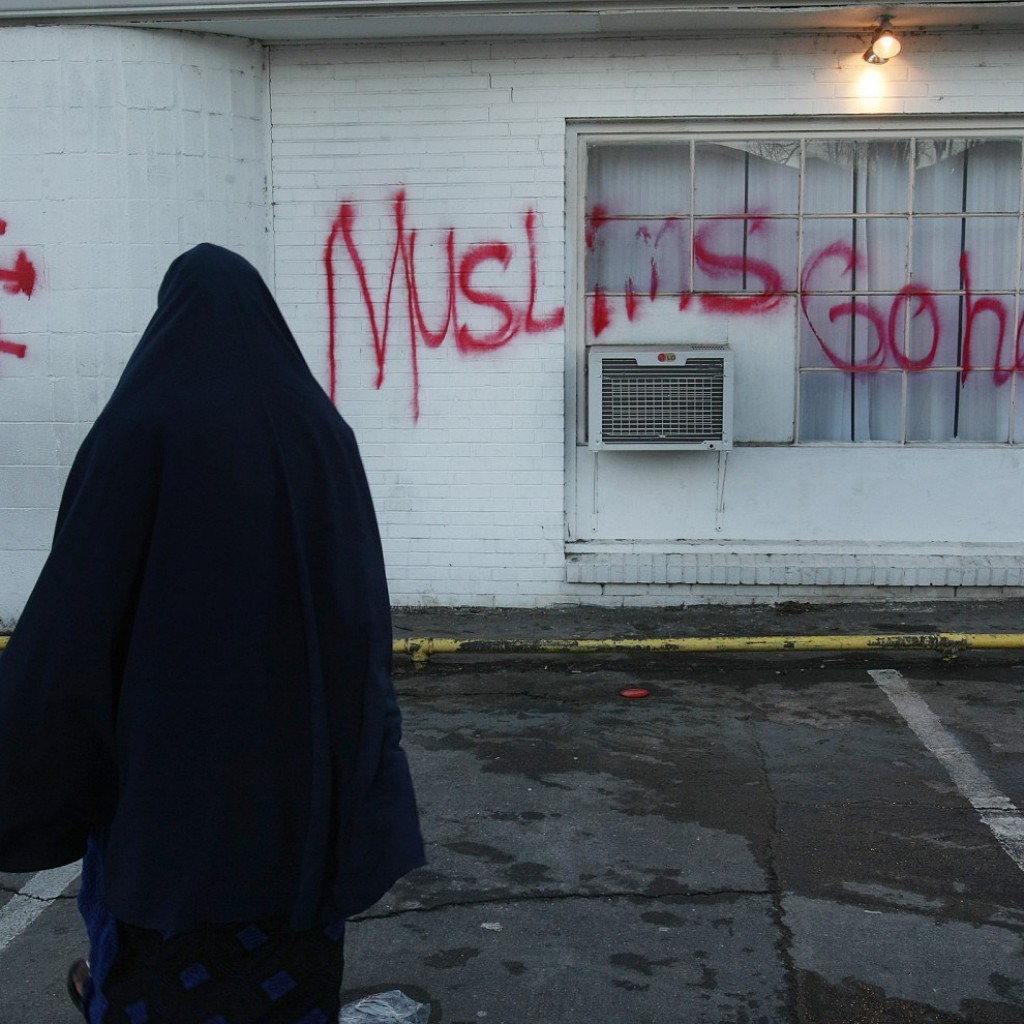
Muslim Vandalism2015 was the most dangerous year for Muslims in America, setting records for hate crimes against them. There have been dozens of attacks on mosques, including firebombings, and physical assaults like stabbings, shootings and beatings against Muslims (and perceived Muslims) grew to the highest numbers ever recorded.

Already wrapping up as a deadly year, the last few months of 2015 saw hate crimes against Muslim Americans dramatically increaseMembers of the community are saying the climate of hate is worse now than after 9/11.

Abby Martin interviews Dr. Deepa Kumar, professor of media studies at Rutgers University and author of Islamophobia and the Politics of Empire, about the roots of this alarming situation. From confronting right-wing arguments, to examining how Islamophobia is a reinforcement and basis for the structures of Empire, the first Empire Files episode of 2016 gives essential context to the wave of anti-Muslim hate in America and beyond.


The Most Dangerous Year for Muslims in America

**

DEEPA KUMAR: I think that if you look at the year 2015, it has been a horrible year for Muslims not just in the United States, but around the world because if you see the two events that book-end 2015, it is the Charlie Hebdo attacks, the horrific Charlie Hebdo attacks in France and the Paris attacks later on towards the end of the year and then San Bernardino, and what these attacks have done is that they have exacerbated and really ratcheted up what we’ve seen as tendencies since 9-11. What are some of these tendencies? Well, first of all hate crimes against Muslims and those who look Muslim have skyrocketed. It’s not just people being verbally and physically attacked. We’ve seen mosques being desecrated. We’ve seen all sorts of horrific attacks of these sorts, but we’ve also seen the rise of a kind of a xenophobic nationalism where White supremacy has been the center of nations remaking themselves, like France or like the United States and so on saying these people are a fifth column, they don’t belong here and so on, and what these attacks have done…it has legitimized this, but what it’s also legitimized is the various security apparatuses, so what happens after the Paris attacks is that the French police carried out more than 2,000 raids on Muslims, both citizens as well as immigrants, arrested hundreds of Muslims and so forth, and it legitimizes these activities by the state to keep us safe. So you’ve seen really an exacerbation of the logic of the war on terror take place over the last year. So I’m not surprised that many Muslims feel that today we are in a worse situation than we were back after 2001.

ABBY MARTIN: How do you define Islamophobia?

DK: Islamophobia is anti-Muslim racism, but what I want to argue is that it’s more than just verbal attacks. It’s more than people facing discrimination at work, or facing insults or slights by people around them–what’s called micro-aggressions. It’s also more than physical attacks–hate crimes and those sorts of things. Islamophobia is these things and people do experience verbal and physical attacks, but I want to argue, in my definition of Islamophobia, is that it is an ideology that is tied to a set of practices that sustain and reproduce Empire. I think it’s very important to actually look at the structures of Empire because it’s only when we do that we get to the roots of what causes Islamophobia. Why is it produced? Who benefits from it? Why does it proliferate in the way that it has over the last fifteen some years? And this is not some sort of academic exercise. I am an academic, but this is not just some abstract exercise. It’s important to get to the roots in order to more effectively fight this form of racism. That’s why I’ve argued in the past that simply doing education around Islam, or having inter-faith dialogue, while important, is not enough because it’s not simply about a set of bad ideas in people’s heads. It’s rooted into the very structure of Empire, and that’s where we need to target our attention and our energy and activism.

AM: And one of the objections we hear consistently, particularly from right-wingers, is that Islamophobia does not and cannot exist because Islam is not a race. Your response?

DK: Well they are right. That is to say they’re right in one part of it: Islam is not a race. Muslims are not a race. This doesn’t mean that they don’t face racism, so I think we’ve got to see that both go side by side. Muslims are not a race, but the racism that Muslims face is very real. There’s been a systematic process since 9-11 to keep fear of Muslims and fear of terrorism alive in the American imagination. You talked about a Sikh man who was attacked earlier this year, last year. I think that’s a really big clue as to how racism against Muslims actually works, or those who are perceived to be Muslims, actually works, which is it’s a form of cultural racism that is based on turbans, people wearing turbans, or people wearing hijabs or other forms of Islamic religious clothing. There is an assumption that is made that these people all have a certain behavior that is constant, that is something about their nature that’s constant because when they practice Islam they are programmed to be violent. They are programmed to be misogynistic. If you’re a woman, you’re programmed to be subservient. You’re programmed to be a terrorist and so on and so forth. And so there is a very systematic way in which an entire group of people is turned into a race through this category of Islam in the same way that Jews are turned into a race through the practice of Judaism and so on, and then the entire group gets targeted in these ways. Races don’t exist naturally. They are produced and they’re typically produced by the elite in order to serve certain interests and to serve certain agendas. I think it’s really important always to look at what historical conditions… what is going on in the political economy that leads to the production of races then that leads to the this process of rationalization because when we get to that we get to the heart of why racism exists and how we can fight against it.

AM: I want to address another talking point that I hear used pretty often by people like Bill Maher and Sam Harris: 70% of Muslims in France support ISIS. What’s your response to these kinds of sweeping statements? People will constantly use them and say, “Look we can’t be Islamophobic because we’re just criticizing the religion and look we’re just looking at the data.”

DK: Islam is practiced by 1.5 billion people around the world. It looks different in different countries and there are just as many political views the people in Muslim-majority countries hold as there are around the West, so they’re just as different a group and non-homogeneous a group as those in the West.

What people like Bill Maher and people like Sam Harris do is they collapse all of those differences and they find data that suits their homogenizing mission in order to paint everybody with the same brush strokes. One myth that gets peddled again and again is that Muslim women are just so horribly oppressed all over the world. Well, that’s not true. I mean, first of all, let’s admit that Muslim women, just like all other women in the world, do face oppression. They do face things like inability to get good jobs, or lack of adequate pay or what have you. Women in the US face the same sort of situation. However, conditions vary widely across the Muslim-majority countries. In Saudi Arabia women can’t drive, but in Bangladesh women have been elected to heads of state, not once but twice. And so these are all different countries with different histories. There are regional differences. There are local differences. There are differences between country and town, and that diversity is simply not acknowledged by the likes of Sam Harris and the New Atheists, and all the rest of it.

If anything you know what they do is use the clash of civilizations argument. They somehow hold up this mantle of the West as being this place of enlightened values, and say that they want to critique all religions, but if you look at their work, the work of the New Atheists, the sharpest knife is dug into Islam. That’s true of Hitchens. It’s true of Dawkins. It’s true of Sam Harris and so on, so they actually have an agenda, but they hide behind objectivity as a way to spout Islamophobia as academic, as research.

AM: Exactly. Last year in Texas a Muslim man was outright executed. Before the killer executed this Muslim man, he said, “Go back to Islam.” They haven’t charged him with a hate crime. Authorities said that they don’t have enough evidence to prove that he has hatred even though multiple times on social media accounts he was talking about Islam, Arabs etcetera. I wanted you to talk about why the establishment is so hesitant to just call reality what it is, call these crimes what they are and charge them accordingly.

DK: There is overwhelming data of hate crimes committed against Muslims, but the problem is that the legal system in the United States refuses to acknowledge racism in any kind of systematic way. This is not just true of Muslims and Muslim-Americans. As Michelle Alexander points out in her book “The New Jim Crow,” this is true too of how African-Americans are treated when they go before a judge or what have you. Questions of racism rarely hold up as a legal grounds from which to try a particular case. It’s been a struggle and the same is happening in the case of Muslims as well. Often there will be… in my discussions with lawyers and friends and colleagues who are lawyers… what they’ve told me is that in cases that they have prosecuted there are just ridiculous things that are brought up as evidence to show that somebody is radicalized. What is this evidence? That they had a copy of the Koran in their pocket. That means this person must have been getting ready to commit a violent crime. That’s ridiculous. That’s Islamophobic. That’s cultural racism. It’s the idea I mentioned earlier that somehow Islam is this virus that programs people to go out and do murderous things, so I think there’s a fundamental problem with the way the legal system works that does not acknowledge in any systematic way how racism operates and the actions that people take–violent actions that people take.

Let me say this. I was following the coverage of San Bernardino versus that of the Planned Parenthood shooting, and the differences could not be clearer in terms of how perpetrators of gun violence are treated. So Planned Parenthood happens. The religion of Robert Dear was barely mentioned–maybe a few mentions here and there–even though we know he’s an evangelical Christian, even though we know he was a great admirer of this group called the Army of God, which is this right-wing fundamentalist anti-abortion group that’s committed murders and violence. He calls them heroes, so we know he’s at least in part driven by this kind of Christian fundamentalist ideology, but that doesn’t become part of the story because the reason Robert Dear did this is something is wrong with him. There’s something in his head that’s wrong because we won’t associate his actions with the actions of White Christians overall. We won’t call on White Christians to apologize for the actions of Robert Dear. San Bernardino happened and yes these people are religious. They are fundamentalist and so on. Now, however, even President Obama says there is an extremist ideology that is spreading through Muslim communities and all Muslims have to take responsibility for it. Why are Muslims any more responsible for the actions of the San Bernardino shooters than Christians for Robert Dear?

You see the double standards, and so straight away of course the story is entirely about Islam. It’s about the virus of Islam. It’s about how Islam makes people do all sorts of violent things and the war on terror becomes the way in which the story is spun, so one cheeky way of looking at this is to say they actually carried out what is a tradition that’s as American as apple pie which is shootings. That really is so endemic to American society in a way that it’s not in other societies and we might see this as a sign of their “integration,” but in fact, of course, othering has become so much a part of media coverage, so much common sense ideology, that immediately there are frameworks that come into being that present their violence as somehow being tied to terrorism, as tied to Islam; whereas our violence, people like Robert Dear, are just isolated individuals.

AM: The clash of civilizations is of course the ideology that Islam is destined to clash with the West, that our cultures are just intrinsically separate and they can’t ever coexist, but it seems like time and again this theme is in one part manufactured by the Empire in terms of either destabilizing Middle Eastern countries, to suppress progressive reform, and also to just exacerbate radical Islam. I wanted you to just mention this mantra and also the actual reality of Empire and how it is perpetuated.

DK: In particular Bernard Lewis would write an essay titled “The Roots of Muslim Rage” in which he argues that politics has nothing to do with why people in the Middle East may be angry with the United States or may have grievances with Western Europe. Colonialism has nothing to do with it. The formation of Israel has nothing to do with it. He says that there is an irrational rage that has spanned 14 centuries which characterizes this inevitable clash. First of all, that’s not true. It is not at all the clear case that the East and West have always clashed. There have been various periods of cooperation right through history which I don’t have the time to get into, but it’s in my book. But it becomes a convenient way in which to define the politics in the post-Cold War era. One enemy that justifies US imperialism and US reach all over the world is gone. What is it going to be substituted by? And Samuel Huntington actually, the political scientist, would pick up this term “Clash of Civilizations” and his theory of what politics will be characterized by in the post-Cold War world is the following: conflict is not going to be political conflict. It is going to be culture and Mahmood Mamdani, who has written this book called “Good Muslim, Bad Muslim,” says that what that does is it very conveniently displaces all the political stuff onto the cultural terrain and now we don’t have to talk about occupation. We don’t have to talk about war. We don’t have to talk about drone strikes, which is what we see in the era of the war on terror. We’ll just call it a clash of cultures. These people, they like to wear hijabs. That’s why we don’t get along with them and so on, never mind that every democratic movement that’s existed in the Middle East has been squashed by the US government in order to keep oil flowing, in order to keep alive the dictators who are the allies of the US, and so forth. All of those political grievances get sidelined and instead culture becomes the focus, and I think that’s an extremely problematic way to look at what is fundamentally a political issue.

AM: So what are the roots of Islamophobia and how is it related to Empire maintaining itself?

DK: So all empires, at least most empires, rely on some form of othering in order to justify wars, in order to justify taxation, in order to justify conscription and so on and so forth. I mean this is not just true of American imperialism, and I will talk about American imperialism, but I want to actually start all the way with antiquity, with the Roman Empire. Rome was this massive empire that stretched from England, Hadrian’s Wall in England, all the way to the Euphrates, covering parts of North Africa and the Middle East and so forth, and the question is how did the Roman Empire actually manage to do this? So when the Romans went about conquering people in England or France, or what have you, one of the first things that they would do is try to inculcate them in Roman values, Roman lifestyle, Roman culture, Roman architecture and so on. And when the people accepted these cultural values of Rome, they became Romans. So in this large empire everybody was considered Roman, but for people who were not as easily conquered, who resisted, and who wouldn’t come under the Roman fold just as easily, there was a term invented for them. They were called barbarians.

And the Romans invented this very interesting hierarchy, this kind of typology which was the following: they said all human beings have two elements that define them. One is the physical body. The other is the mind. It is intelligence. It is spiritual rationality, stuff like that, and what they would argue is that Romans–not all Romans–elite Romans are driven by the mind. The mind controls the body. They are rational. They’re intelligent and in that sense they are closer to God; whereas the barbarians are closer to animals because the body controls the mind and therefore they are inferior, and therefore it’s justified that we go off and kill them and bring their people and make them slaves. Or one of the routine forms of entertainment in Rome was that the barbarians would be brought to these amphitheaters and killed either by animals or gladiators or what have you.

So that’s Rome. Now let’s move to the United States. I think there are a lot of similarities, but also some differences. The US takes over the reins of the Middle East from France and Britain in the post-World War period and in fact actually NSC-68 [National Security Council Report 68], which is the secret policy document that I believe was written in 1950, would lay out quite clearly why militarism was going to be the key way in which the US was going to fill the vacuum left behind by the collapse of European empires, the rise of the Soviet Union, and how the world has now become a battlefield and militarily that’s how the US is going to assert its hegemony.

In the Middle East it has many geostrategic interests, rivalry with the Soviet Union, but oil certainly is a part of the story, and Daniel Yergin tells us that part of what he calls the postwar petroleum order is about creating a certain arrangement between oil producing states or states to which oil would flow, so that cheap oil would be available for the reconstruction of Europe, the Marshall Plan and so on because Europe was destroyed by World War II, so anyone who disrupted this post war petroleum order was necessarily an enemy. They were either hand-in-glove with the Soviet Union or they were just barbaric, people who lived in the desert and so on who needed to be taken out.

And so that’s the mythology. They learned the Orientalist language from Europe and started to apply it to people of Middle-Eastern origin as a way to establish control over the flow of oil, so these ideas don’t just exist in ether, in Hollywood films or in novels and so on for no reason. They are systematically reproduced in the academy. They’re reproduced in think tanks. They are used by political figures. They are reproduced in the media and so on as a way to justify US policy, and of course at first it’s about demonizing the Arab, but then the demonization of the Arab turns into the demonization of the Muslim.

Of course today we don’t throw Muslims and Arabs to the lions. We don’t have those sorts of practices, but we do target Arabs and Muslims and South Asians through the national security state, through imprisonment, through indefinite detention, through racial profiling, through surveillance of mosques, of community centers, of college groups and so on and so forth. So there is very much within the system an attempt both to racialize people within Empire as well as to racialize people outside Empire.

I’ve spoken to the similarities, but I do want to make a point of what the differences are. So the key difference really is that racism as a systematic ideology and a set of practices actually is modern in origin; that is, it comes in to being only with the birth of capitalism, and so there are some very important ways in which othering under Rome or othering by various feudal monarchs in the Middle Ages and so on is different from the kind of racism that we see today. Anti-Muslim racism is much more systematic in the era of capitalism and imperialism, in a way that it wasn’t earlier.

AM: And I think Donald Trump shocked the world by his declaration of a ban on Muslims entering this country if he were to be president. This could just be hyperbolic, but at the same time his new campaign ad is actually doubling down on this and making this one of the main pillars of his whole campaign. It’s just shocking. What is the political significance of what we’re witnessing here?

DK: Donald Trump is basically stating out loud and making explicit what actually has been US policy for the last few decades. That is, if you look at the mass deportation of immigrants under Obama, it’s huge. Over two million people have been deported, but you don’t talk about that. In polite society you don’t say such things, and Donald Trump is actually giving voice to some of the most horrific racist, rabid right-wing rhetoric. When he says let’s prevent Muslims from coming in or let’s create a registry and a database to document all Muslims… You don’t say that if you are a respectable politician, but in practice we have been doing that.

Over the last 20 some years, there’s been an attempt to systematically collect information on various groups of Middle Easterners. In fact, going all the way back to the late 70s and Iranians and then counter-terrorism policy under Reagan, and then the 1996 anti-terrorism and effective death penalty act of Bill Clinton, and then later after 9-11 programs and so on. There’s an attempt to collect this information in a database about Muslim immigrants and Muslim citizens and so on, and for people like Trump who represent the class of the 1%, bashing immigrants has been staple because if you look at the same period of time, we’ve seen a massive growth of class inequality, class polarization. The vast majority of people around the world have grown poorer. The 1% has grown phenomenally rich. There have been cuts in social services, attacks on the welfare state. Tuition costs for colleges have been going up. Health care costs have gone up. This is the neoliberal system, but rather than blame the 1%, the regime of the 1%, it’s easy to bash immigrants, and you’ve seen this logic everywhere. This is not just a Western European or American phenomenon. In Russia and Australia, in India, in Myanmar–all over the world this Islamophobic agenda has helped to deflect attention away from the structural inequality and to point fingers, to scapegoat Muslims as a way to get people to fight with each other rather than to look at the structural problems caused by neoliberalism.

So I think to see Donald Trump as some sort of lone wolf who is responsible for the escalation of Islamophobia or who is otherwise corrupting a great political system, I think is deeply problematic because Donald Trump is just a part of a larger system which both Democrats and Republicans are responsible for creating.

AM: What can we, as non-Muslims who are appalled by this Islamophobic rhetoric, do to build solidarity and internationalism with the Muslim community?

DK: One of the things I started this discussion with is to say that we need to understand the roots of Islamophobia. We need to understand that it’s more than just a set of bad ideas, of prejudices in people’s heads, but in fact, it is an ideology and a set of practices that make the war on terror possible. It is what sustains the war on terror, and so the first thing we have to do is to recognize that simply combating these bad ideas is not enough, although that’s important. I think if we don’t get to the root of what causes Islamophobia, which is Empire, which is the national security state, which is the neoliberal order in which we live, and the class power that sustains all of this… if we don’t target that and we don’t target and dismantle imperialism and capitalism, then we’re not going to do away with Islamophobia. As we hold counter-demonstrations when the far right, for instance, is attacking a Muslim mosque, or a Muslim community center, at the same time as we write articles, at the same time as we do education, if we don’t have a long-term strategy that is targeted at opposing these structures of Empire and neoliberalism, then we wind up doing things in the short term which may actually create the same problems again in the middle term, and we wind up fighting these fights again and again. So we’ve got to have a short-term strategy, but we have to keep the long-term goal in mind, and we need to come together across national lines and build a global movement that can take on the regime of the 1% and actually build one that prioritizes the interests of the 99%.

**

FOLLOW // @EmpireFiles // @AbbyMartin // @ProfessorKumar

WATCH // YouTube.com/EmpireFiles

Transcript by Dennis Riches

Posted in Uncategorized | 1 Reply