JUAN GONZALEZ:
Three U.S. senators called for a congressional probe on Thursday on
safety issues at the nation’s aging nuclear plants. The request from
Democratic senators Barbara Boxer of California, Sheldon Whitehouse of
Rhode Island, and independent Bernard Sanders of Vermont comes following
a pair of new exposés by the Associated Press. In a special series
called “Aging Nukes,” the AP revealed that the U.S. Nuclear Regulatory
Commission and the nuclear power industry have been working in tandem to
weaken safety standards to keep aging reactors within the rules. Just
last year, the Nuclear Regulatory Commission weakened the safety margin
for acceptable radiation damage to reactor vessels.
AMY GOODMAN:
The AP report also revealed radioactive tritium has leaked from 48 of
the 65 U.S. commercial nuclear power sites, often into groundwater from
corroded, buried piping. Leaks from at least 37 of those facilities
contained concentrations exceeding the federal drinking water standard,
sometimes hundreds of times the limit.
We’re joined now from Boston by Jeff Donn, who wrote the exposés for
the Associated Press, the national writer for the AP and member of the
AP investigative team.
Jeff, welcome to Democracy Now! Why don’t you lay out your
exposés one at a time, what you found in light of what happened in
Fukushima, what we’re dealing with here in this country?
JEFF DONN:
Well, there are two big ideas. One is that, as you summarized, the
nuclear industry and their government regulators have been working
together to lower safety standards as aging nuclear systems and parts
and plants come close to violating those standards and those rules. And
that’s been a pattern for decades now, and we’re seeing a lot of it as
these plants get older and older.
The other big idea here is that the plants have had piping buried
underneath, underground, covered underground for so long the piping
can’t be properly inspected. It’s rarely looked at carefully, visually.
It’s rarely dug up. And it’s been so long now that a lot of that is
corroding, and you have leaks, that we’ve documented, at three-quarters
of the sites. And in fact, a Government Accountability Office, the
congressional investigative arm, released—had a report released a day or
two ago after our series, and in that they say the Nuclear Regulatory
Commission, the federal regulators say, you know what? There have been
either leaks or spills—presumably many related to aging, some not, but
radioactive leaks or spills—of tritium and other radionuclides at all
the plants.
JUAN GONZALEZ:
Well, Jeff, the picture that you paint here, especially when you
describe what’s happening at some of these plants, is really—it’s
amazing, the extent of, in essence, the cracks, the corrosion. How
exactly do they weaken the standards when they discover some of these
problems at particular plants?
JEFF DONN:
Well, what they do first is that the industry comes to government,
typically—this is the pattern you see—or sometimes government comes to
industry and says, “We’ve got all these parts or systems that are coming
close to the standard, even sometimes violating the standard. What do
we do about it?” And so, they set off on a round of research—and the
government does some of the research, the industry does some of the
research—and they find, again and again, that the standards can be
lowered. The operative phrase that you hear and you read again and again
is that “the standards were overly conservative.” So then they find
justification to lower those standards, and suddenly a group of parts or
systems that were coming close to violating rules, or do violate the
rules, are back within the rules. The other half of it is that the
regulators sometimes can’t get the systems and parts back within the
rules, so then they begin issuing waivers or amendments or special
exceptions that still allow the nuclear plants to keep running.
AMY GOODMAN:
I just want to go back to the tritium water. Explain the dangers of
this and how this is possible all over this country and what exactly it
means and what can be done to stem the leaks. I mean, you have Vermont.
They are poised to shut down their plant.
JEFF DONN:
Yeah, that’s a very good question, and it’s a little bit confusing to
people, I think. Tritium itself, at the levels that it’s been released,
is probably not a great health threat. It doesn’t penetrate the skin
very well. It’s not like the gamma radiation that people were talking
about in Japan. The main danger from tritium, the main health danger, is
if you were to drink it. The EPA sets a limit
for how much can be in drinking water. None of the leaks have entered
drinking water in amounts that would violate the EPA limit so far.
Part of the problem—and the GAO report I
was just talking about points this out—part of the problem is that the
industry and the regulators don’t really have a good handle on what’s
happening in those pipes and vaults and all that equipment under the
ground, that they don’t have technologies that really allow them to see
that very well. So, the GAO report says we
don’t really know about how bad the leaks are. That’s one part of the
problem. Another part—that’s a part that bears on public health.
Another part is that it raises questions about the integrity of the
plants, about the integrity of their cooling systems. Some, not all, but
some of this piping carries water that’s used to cool the reactors. And
in an emergency, as we saw in Japan, you desperately need that water to
cool the reactors, because the radiation produces a lot of heat, and
you’ve got to keep it cool. So, that’s the other half of the problem:
what do all these leaks say about the integrity of that piping and, even
in a broader sense, about the integrity of a lot of parts that can’t
easily be seen in nuclear power plants, like all those miles of
electrical cable underneath the power plants that are needed by the
operators to see what’s going on in the plant?
JUAN GONZALEZ: And Jeff—
JEFF DONN: So it raises a lot of questions that trouble engineers.
JUAN GONZALEZ:
Jeff, doesn’t the presence of tritium also indicate that probably other
radioactive materials like strontium or cesium might also be
getting—leaking from these plants?
JEFF DONN:
It does, because tritium—that’s a radioactive form of hydrogen, by the
way, and that’s why it gets into water, H20. It does. Tritium moves
through the soil more readily than some of those other radioactive
substances, so it’s often—you often see it first. And then, there are
lots of cases where you see other more powerful radioactive substances
that do more health harm, in equal amounts, after you see the tritium.
That’s—you’re right. That’s part of why the tritium is a concern.
AMY GOODMAN:
Can you name names of plants? For example, let’s talk New York. What’s
outside of New York City, of tens of millions of people, the plant and
where it stands today?
JEFF DONN:
Well, they’ve had—there are so many problems that it’s hard to
enumerate them all. But, for example, they’ve had radioactive leaks from
the spent fuel pools at Indian Point—the spent fuel pool. The spent
fuel pool is where they keep the radioactive fuel after they’ve used it
in the reactor, and that fuel remains thermally hot and radioactive for
years to come, so you have to keep it cool, just like the fuel in the
reactor. And they’ve had leakage from that spent fuel pool at Indian
Point, which is about 25 miles north of New York City. And we know how
important the spent fuel pools are in a different context in Japan, at
the Fukushima Daiichi plant, because a lot of the
radioactive—radioactivity that was released in the air there was from
the spent fuel pool. So, there’s been a lot of focus on the spent fuel
pools recently. And even the chairman of the Nuclear Regulatory
Commission, Gregory Jaczko, has hinted recently that maybe we do need to
look at the spent fuel pools in the United States and how securely
we’re keeping the spent fuel.
AMY GOODMAN: And what about evacuation plans, I mean, at places like Indian Point? And you can go around the country.
JEFF DONN:
Well, that’s something that we’ll be saying more about on Monday, in a
story that’s coming out on Monday. And I don’t want to get ahead of my
employer, but I can tell you that we’ll be—we’ll have a lot to say about
how much population growth there has been around the 65
nuclear—commercial nuclear power sites in the United States over last 30
years—we did a historical mapping analysis with mapping software—and
where the evacuation plans that communities must make for evacuation, if
it’s necessary around the plants, where they have weaknesses and where
they haven’t kept up to date with the population growth.
JUAN GONZALEZ:
Jeff, your articles also talk about the problems with the reactor
vessels that enclose the reactors and that you found major problems, as
well, there, in the documents that you obtained, the monitoring
documents that you obtained from the government?
JEFF DONN:
Yeah, it’s real interesting. One of the biggest areas of aging
difficulties has been in so-called embrittlement of the steel around the
reactors. And what that means is that if you bombard something with
neutrons from a chain reaction, like the one that goes on inside these
reactors, if you bombard steel with neutrons for years and years, it
gets more brittle. And as it gets more brittle, like, say, a reed from
the beach that maybe you brought home and it gets brittle, when it
undergoes a force, it’s more likely to suddenly shatter, to break. And
the reactor vessels are like that. The vessels are these gigantic steel
tubs that surround the chain reaction, the radioactive fuel, and they
provide a shield from it, and they hold it. They keep the area around it
safe. And so, over the years, they’ve got increasingly brittle. There
was even one reactor in the early 1990s, the Yankee Rowe reactor in
western Massachusetts, that had to be closed largely because of concerns
about its vessel getting brittle.
And as—fairly early on, actually, in the industry’s history,
government and regulators started to notice that reactors were
approaching the embrittlement standard for the vessels, and in some
cases even violating that standard. And instead of saying, “OK, what can
we do to get the reactors back within the standard? Is it possible to
do a process called annealing, that would make them less brittle? Is it
possible to replace them?” what the industry and the government did is
they launched another round of research and decided, “You know what? We
can back off a little bit on the standard and allow the vessels to
become more brittle.” And that’s continued. There was a second round of
this, that’s taken years, that just culminated in the last year or two,
where they raised that safety standard again. Again, the same pattern,
saying, “We didn’t need to be so strict.” In other words, “We didn’t
need to be so safe. It’s safe enough.” Because the government and
industry argue that, for all the changes, the reactors still remain
safe—maybe not as safe as they were before, but plenty safe. That would
be their argument.
AMY GOODMAN:
Well, we’re going to leave it there, Jeff Donn, national writer for the
Associated Press, member of the AP investigative team, has done this
series, “Aging Nukes.” We will continue to report on what you’re doing.
Thanks so much, Jeff, for reporting to us from Boston.
 The original content of this program is licensed under a Creative Commons Attribution-Noncommercial-No Derivative Works 3.0 United States License. Please attribute legal copies of this work to
 democracynow.org
.
Some of the work(s) that this program incorporates, however, may be
separately licensed. For further information or additional permissions,
contact us.



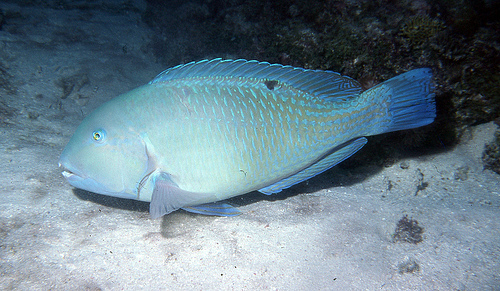 NATIONAL GEOGRAPHIC– A blackspot tuskfish off Australia has its mouth full as it
carries a cockle to a nearby rock, against which the fish was seen repeatedly bashing the
shellfish to get at the fleshy bits inside.
NATIONAL GEOGRAPHIC– A blackspot tuskfish off Australia has its mouth full as it
carries a cockle to a nearby rock, against which the fish was seen repeatedly bashing the
shellfish to get at the fleshy bits inside. FAST COMPANY
 RT
RT DEMOCRACY NOW
 THE GUARDIAN