 MEDIA ROOTS — Earlier this month, Secretary of Defense Leon Panetta visited Manas Transit Center, located just outside of Bishkek. Panetta’s coterie disclosed air-refueling operations, departing from Manas, had transferred 300 million pounds of jet fuel in 2011 alone. This staggering figure provides a reflection point for any U.S. observer who follows the post-9/11 world closely. Above all, it begs the question: if one base in one year transferred that much fuel, then how much has U.S.A.’s military wasted since 2001? In an era of great demand for increasingly scarce resources, the global citizenry must demand accountability for U.S.A.’s military waste and environmental damage. Ultimately, a leadership failure and an apathetic U.S. citizenry contribute to the dismal status quo.
Locations
Recall our post-9/11 climate of fear, through which the Defense Department justified massive territorial and budgetary growth. Since 2001, U.S.A.’s military expanded throughout Africa, Latin America, Central Asia, Australia, Southeast Asia, and the Middle East in an unprecedented manner.
USAFRICOM blankets the African continent, using embassies, the Combined Joint Task Force Horn of Africa (CJTF-HOA), the Trans-Sahara Counterterrorism Partnership (TSCTP), and humanitarian pretexts to roam freely. Thousands of U.S. troops are stationed at Camp Lemonnier, Djibouti. This number doesn’t include certain elements from the 3rd, 5th, and 10th, Special Forces Groups whose areas of responsibility cover Sub-Saharan Africa, the Horn of Africa, and Northern Africa, respectively. Although CIA has been playing Cold War games throughout Africa for decades, an overt, sustained, U.S. military presence is a fairly new wrinkle.
In contrast, U.S.A.’s military boasts a deep tradition of interference in the oil-rich Middle East. Current imperial outposts include Camp Arifjan, Al-‘Udeid Air Base, Incirlik Air Base, and Juffairare. Dozens of other bases are scattered across the region, altogether hosting thousands of U.S. personnel in and out of uniform.
The so-called War on Terror has not spared Southeast Asia or Latin America, as U.S.A.’s military occupies these regions under various pretexts. Far from clandestine, Joint Special Operations Task Force-Philippines (JSOTF-P) even has its own Twitter account. Able to successfully imbricate ‘terror’ with the so-called War on Drugs, U.S.A.’s military has continued its tradition of interference throughout Central and South America. Recent meddling, which is a drop in the bucket compared to U.S.A.’s overall military presence, includes a Fused Response exercise with Guyana, increased DEA and CIA interference in Mexico, sustained Foreign Military Financing of Columbia, Honduras, and other nations across what many military officials refer to as America’s backyard. And, of course, fuel is required to transfer U.S. citizens and materiel to, from, in, and around these locations.
Some statistics shed more light upon military waste. The Air Force has flown over 663,000 sorties and counting in support of operations in Iraq and Afghanistan since 2001. Transportation Command (USTRANSCOM), responsible for moving everything associated with U.S.A.’s military, “conducted more than 37,000 airlift missions, transported more than 2.3 million passengers by air and 29 million short tons of cargo” in 2010. In the process, TRANSCOM supplied deployed units with “food, fuel and spare parts, moved troops into the combat zone, and evacuated the wounded.” In 2011, the Air Force set a new annual record in Afghanistan, dropping 75,956,235 pounds of cargo. One military public relations official remarked, “that is the equivalent of standing on a mountain top and watching… 11,868 Chevrolet Silverado trucks floating down from the sky with parachutes to a landing zone.” The total amount of cargo delivered in Afghanistan by airdrop from 2006 to 2010 was over 121 million pounds. U.S.A.’s military bombarded at least 1,314 tons of bombs (2,628,000 pounds) on Afghanistan in 2008 alone. The Department of Defense, an institution fundamentally incapable of conducting a basic audit of its own financial records, probably doesn’t even know the total tonnage of bombs unleashed.
From 2003-2011, hundreds of thousands of uniformed U.S. military, contractors, mercenaries, and third-country nationals (TCN) flew or rode into Iraq on the back of wasted fuel. After U.S.A.’s invasion, the Pentagon constructed bases across Iraqi soil, establishing roughly 505 bases by 2008. In 2011, much to the horror of my military peers stationed there, the Pentagon initiated orders to tear down some of its post-invasion construction, including but not limited to housing units, gazebos, dormitories, and recreational areas. Considering that these facilities cost U.S. taxpayers astounding amounts of money to construct, one must inquire why Pentagon leadership decided to demolish so many structures before handing them over to the Iraqis. When my peers inquired, their leadership absurdly rationalized U.S.A.’s military must return all property in the same condition in which it found it. If it makes no sense, it’s probably courtesy of Pentagon leadership. When not demolishing viable structures, U.S.A.’s military withdrew almost two million pieces of equipment from Iraq over eleven months. Try to fathom the amount of fuel spent since 2003 on constructing U.S. military bases in Iraq, transporting troops, fuel, and goods throughout the country, only to demolish portions of these bases during troop withdrawal. What a blatantly wasteful exercise in arrogance.
Pentagon officials brag that since September 2001, the Air Force has flown more than “15,750 personnel recovery sorties, recording 2,900 saves and 6,200 assists,” as if life and limb are now perverted into the same casual patois with which an ice hockey fan follows Roberto Luongo’s goaltending career. Disgraceful accounting procedures aside, the Air Force has transported “more than 85,000 patients and more than 15,400 casualties” from USCENTCOM alone. The aforementioned Manas Air Base has evacuated an additional 3,500 casualties and assisted in the travel of 580,000 passengers into and out of Afghanistan. All told, at least 6,404 U.S. personnel have died from operations in Iraq, Afghanistan, and elsewhere, not including military veterans who have died prematurely after returning home. These examples highlight a portion of the time, fuel, resources, and lives wasted during U.S.A.’s global wars of imperialistic aggression.
We, U.S.A.’s citizenry, are to blame for not mobilizing swiftly against the military-industrial-media complex. Considering the options available to the U.S. public outside of war in Iraq or a landlocked Asian nation, one must vomit at the funding, maintenance, individual opportunity cost, logistical support, fuel, death and pollution which were allocated to the elite’s wars. Such profligate waste is profoundly frustrating. Fossil fuels, as a finite resource, need to be preserved and exploited wisely for the betterment of society, with specific focus on producing the infrastructure necessary to convert U.S.A.’s economy towards renewable sources of energy. Wasting fossil fuel needlessly during the prosecution of unnecessary wars is redundant lunacy. Yet, lunacy is the norm set by Pentagon leadership.
Personal Touch
I witnessed waste every step of the way during my years in U.S.A.’s military. During my deployment, a certain ISR platform regularly drew too much fuel during aerial refueling and routinely dumped excess fuel before landing. The amount of tax-payer dollars wasted during this practice will never be known, nor will the amount of noxious jet fuel released into the environment unnecessarily. After landing, our leadership then threw away much of the food we carried on board with us, even though the food products didn’t expire anytime soon. I do not know if this practice also occurred on other airframes. Waste pertains to all fossil fuel products. Instead of refillable canteens or personal water bottles, leadership decided to purchase millions of 12-ounce plastic bottles from the local water company, Rayyan Water. Leadership did not respond to calls from the enlisted corps to initiate a recycling program in coordination with the wealthy host nation, which would have led to proper disposal of these bottles. Back in the States, attempts to recycle anything more than cardboard were consistently met with disdain from Air Force leadership. Any comprehensive recycling programs had to be initiated and sustained entirely by low-ranking enlisted members with no support from higher leadership. Excuses like ‘it’s too messy’ and ‘it’s too much work’ echoed throughout my military tenure. Dr. Anne Marie Slaughter, former Director of Policy Planning at the U.S. State Department, explained it best when she wrote about how struggles with military bureaucracy are where the vast majority of U.S.A.’s troops have done their best, given extraordinary challenges (2007: XIII).
After my deployment, I witnessed the 97th Intelligence Squadron’s ribbon-cutting ceremony for their new building, which received the base’s award for Silver Level Leadership in Energy and Environmental Design. The 97IS spent roughly $24 million for this new facility, and couldn’t help but toot its own horn. The Squadron Commander, Lieutenant Colonel Smith, spoke to the crowd at the ceremony: “Oh, by the way, we’re still carrying out our combat mission… on pace to fly some 20,000 combat missions this year. If you can’t be proud of that on a day like today, then your proud meter is busted.” Eloquence aside, no one at the ceremony cared to point out the building’s major flaws, which included lack of any comprehensive recycling program and massive vampire energy consumption from the building’s computers running unnecessarily twenty-four hours a day. (The squadron’s IT department confirmed that the computers didn’t need to run continuously.) The fact that a mediocre building set the green standard speaks volumes about our bleak situation. Upon my honorable discharge, U.S.A.’s military accounted for over 80% of its government’s total energy use.
Roll Call
The military’s highest ranking officers set the tone for irresponsibility, as exemplified by change of command and retirement ceremonies. Dozens of so-called VIPs fly across the country for these events, wasting countless gallons of fuel and millions in taxpayer money. If the Defense Secretary and his subordinates actually care about protecting U.S.A.’s taxpayers, they would stop such whimsical journeys. Keep in mind dozens of these wasteful ceremonies have occurred during an economic recession. Apparently ego and pomp provide an exemption for these so-called leaders. Pick any change of command or retirement ceremony and witness taxpayer dollars ripped up in front of your eyes. Among others, these extravagances occurred recently at ceremonies for General Petraeus, Transportation Command, and Pacific Command. Waste and ceremony go hand-in-hand for a mere one hour of self-congratulatory conceit.
Ceremonies are indeed a valued military tradition. Therefore, it’s time to start a new tradition in which ‘dignitaries’ compose a kind letter to be read at a small ceremony. They can even embrace new technology, like Wistia professional video hosting, to convey their respects. This method, saving gallons of fuel and millions of taxpayer dollars, is a solid step towards environmental stewardship, long absent from the military’s massive, polluting footprint. If an egotistical general officer insists, despite all reason to the contrary, on personally attending a military ceremony, he or she can spend their own money to fly in coach with the rest of U.S.A. After all, military officers work for the people as part of their public service. Live among them and drop the ego. With U.S.A.’s general officers using commercial air travel, the Pentagon can sell its Cessna, Gulfstream, and Boeing VIP transport planes. The sale of these planes can set an important precedent, provide much-needed liquidity for the U.S. Treasury, and contribute greatly to a shift in consciousness within U.S.A.’s war-fighting community. No one is exempt from responsibility, whether an E-3 or an O-10; and all should behave accordingly.
The military’s job is to protect U.S.A., yet it is the number one consumer of fossil fuels in the entire world, spending roughly $13 billion on fuel in 2010. As of early 2011, the Air Force alone was burning through seven million gallons of oil per day. Near their peak, forces in Iraq and Afghanistan burned through roughly 11 million barrels of fuel each month. The Air Force alone uses “about 2.5 billion gallons of fuel every year” with an “energy bill [of] about $9 billion.” The Navy, benefiting from the use of nuclear power in submarines and aircraft carriers, admits to an annual petroleum consumption of 1.26 billion gallons. As the nation’s top polluter, the Pentagon cannot claim to look out for the welfare of the country when it pollutes so prolifically. In both the long and short term, the Pentagon harms more than it helps.
U.S.A.’s military is in grave danger, since it’s almost entirely dependent on petroleum to shoot, move, and communicate. Operational energy (OE), the energy required to train, move, and sustain U.S.A.’s military, accounts for 75% of Pentagon energy use. Under the current paradigm, one airman pumped 422,271 gallons of petroleum fuel in one month alone and each battlefield soldier or Marine requires 22 gallons of fuel per day to sustain. Supervising the most energy-inefficient fighting force in the history of the world, the Pentagon burdens the troops. In Afghanistan, one U.S. service member is killed in every twenty-four fuel convoys, amounting to more than 3,000 U.S. lives lost thus far. Furthermore, petroleum fuel can cost the taxpayer up to $400 per gallon, once all transportation expenses are factored in. Generals and admirals have been remarkably slow to respond to these deaths, preferring the blissful ignorance of their air-conditioned conference rooms to the harsh reality facing U.S. fighters. Even Senator Mark Udall (D – CO) acknowledges that the Pentagon’s annual fuel invoice of $20 billion is a strategic vulnerability.
Yet, leadership still fails us. The 2011 Pentagon Operational Energy Strategy is a “major disappointment” according to retired Brigadier General Steven Anderson. It doesn’t contain any novel energy approaches and is not issued from the Secretary of Defense’s office, which would have given it greater weight in implementation. In its current form, this “Strategy” simply follows the Pentagon’s anemic tradition of bureaucratic business-as-usual. This approach is unsustainable and costly in terms of man-hours, fuel, public treasury, pollution, and U.S. lives. If these trends persist, nobody would want to be Secretary of Defense on the day U.S.A. runs out of oil imports.
Pentagon leadership fails U.S.A. through sloth and resistance to change, perpetuated by over-reliance on pretexts which frame reform as an impediment to ‘mission effectiveness.’ Content sitting back and allowing our overseas military presence to be focused disproportionally around the oil producing nations of the Middle East, generalship avoids a greener military. When examining why leadership is so disgustingly lethargic in implementing reform, one must consider how much the Pentagon benefits from our dependency on oil imports:
“Imagine the impact just on the Pentagon were this country actually to achieve anything approaching energy independence. U.S. Central Command would go out of business. Dozens of bases in and around the Middle East would close. The navy’s Fifth Fleet would stand down. Weapons contracts worth tens of billions would risk being cancelled” (Bacevich 2008: 173).
Many officers who occupy positions of power have the ability to positively affect U.S.A.’s energy independence, both militarily and domestically. We can only hope that the individuals who hold these critical positions will lead through innovation and dedication to a greener planet, incorporating environmentally responsible behavior into the fundamentals of U.S.A.’s military.
Some military planners have considered converting all military bases into ‘net zero’ installations, which requires on-site production of all energy needs. Others have tentatively proposed incorporating movement of energy supplies into war game scenarios. This step would benefit greatly from a partnership with the National Renewable Energy Laboratory, initiated in order to share and incorporate best practices into tactical and strategic military operations. Other important first steps can emulate the Army’s contract with Clark Energy Group, which is constructing a solar farm at Fort Irwin, CA. Removing some military installations from the polluting civilian electric grid and placing them on solar, wind, and geothermal power, has another added bonus: security. Domestically, U.S.A.’s military is nearly completely dependent on a commercial electric grid that is highly vulnerable to disruption. The more installations that are converted to ‘net zero’ status, the more secure U.S.A.’s military becomes. Everybody wins, except for the victims of U.S. foreign policy.
With a focus on humility and technology, a coterie of green generals can use their clout to implement a range of novel concepts. Cardiovascular exercise equipment can be modified to produce energy, not consume it. Motion sensor lights can be installed in military barracks, offices, and facilities. Recycling can be mandated in military communities. Military families can use websites like Streetbank to reuse and share belongings. Domestic military bases can explore the feasibility of on-site geothermal energy production. U.S.A.’s overseas bases can coordinate recycling programs with the host country as another means of engaging the local public. The Pentagon can follow Thule Air Base’s lead and recycle its inventory of scrap metal. Plastic bags can be banned from all Base Exchanges. Tax exemptions can be provided to individuals who purchase windmills, solar panels, join renewable energy cooperatives, or construct greenhouses. The Navy can use tidal and wave power. Biomass can be used for heating barracks, costing roughly half as much as conventional oil. Green generals can implement shuttle systems to and from military housing communities, allowing military personnel to embrace the joy and asceticism of public transportation. The associated reduction in traffic flow improves Force Protection measures, which military leadership must applaud. Green generals can set up local dispensaries where cellulosic ethanol can be produced from families’ garden and lawn scraps. Regenerative braking can be mandated in all new military vehicles. Instead of running on JP-8 and other jet fuels, deployed forces can legally purchase electricity from native sources, supplemented by solar, wind, and geothermal power. If Combatant Commanders are concerned about the reliability of local energy sources, perhaps a greater ‘nation-building’ focus on symbiosis is required to help the locals they occupy to refine their own energy capacities. Crucially, a greater downrange reliance on HUMINT tradecraft, instead of computer-intensive SIGINT, will likewise reduce the military’s overseas energy demand. These are examples of the military leadership that U.S.A. deserves. Imagine if these ideas were pursued with the same vim with which the Defense Department pursues weapons development.
Extraordinary efforts across the military can achieve the change in culture necessary to reduce waste. This requires implementing energy awareness curriculums in enlisted basic training, Officer Training Schools, Officer Candidate Schools, ROTC, every service academy, professional war colleges and senior NCO academies. Greener curriculums can emphasize the value of individual initiative and emphasize teamwork. Individual initiative inspires energy conservation’s inclusion among the military’s portfolio of PowerPoint presentations. Teamwork inspires a posse of command pilots to promote alternative power sources for jet aircraft and insist that the next generation of aircraft will be oil-free. Semper Fidelis, Integrity First, Non sibi sed patriae, and This We’ll Defend all apply to environmental responsibility. Paramount among curriculum change is recognizing that a successful military fights in harmony with the environment, not against it. As it stands, Sun Tzu laughs at U.S.A.’s military.
Given every dollar increase in the price of petroleum costs the military an additional $31 million, Mabus has U.S.A.’s best interests in mind when wanting to use the military’s fiscal weight to kick-start the alternative fuels market, ultimately benefiting all of humankind. Yes, Mabus’ stance neglects the darker side of capitalistic greed and ignores moral imperatives, but the Pentagon’s exorbitant operational energy requirement can nonetheless create robust demand for green energy supplies. Green companies can exploit the military’s obese coffers, at taxpayer expense, in order to produce viable alternative energy sources at competitive prices while boosting production of unconventional energy sources. Nascent, proven technologies, like bacteria-fuelled, self-powered cells that produce an infinite supply of hydrogen, or a silicon strip capable of using sunlight to make power, need this type of financial support to get off the ground. That, in a nut-shell, is the Pentagon’s green role.
Do not misunderstand. The amount of financial sway that the Defense Department wields is a national tragedy. U.S. citizens should not have to look towards the war machine to kick-start any domestic industry. However, at this point we have little stomach for alternatives. Citizens can still work hard, advocate strongly, and participate in non-violent direct action against the Pentagon. Such mobilization is not mutually exclusive with orienting the military towards greener policies.
We have come full circle, after analyzing the fuel wasted transporting material and troops to, from, and around deployed locations, construction and destruction of warzone facilities, and leadership failure. U.S.A. waits with bated breath for the Pentagon, ignominiously known as the world’s worst bureaucracy, to kick its efforts into high gear. True change will only arise from an informed and engaged public dedicated to resisting the war industry’s unseen externalities and to giving new meaning to the motto This We’ll Defend. All hope lies with U.S.A.’s citizenry.
So, as Secretary Panetta travels throughout Central Asia imposing the Pentagon’s so-called War on Terror, we must remain mindful of the following: Above all other methods, the easiest way to curb military pollution and stop the waste of fuel is to cease wars of aggression. Instead of wasting finite resources in support of imperialistic wars, they need to be utilized prudently, focusing specifically on converting U.S.A.’s infrastructure into a capable, green economy.
Written by Christian Sorensen for Media Roots
Additional References:
Bacevich, Andrew. The Limits of Power, New York: Metropolitan Books, 2008.
Slaughter, Anne Marie. The Idea That Is America, New York: Basic Books, 2007.
Turse, Nick. The Complex, New York: Metropolitan Books, 2008.
***
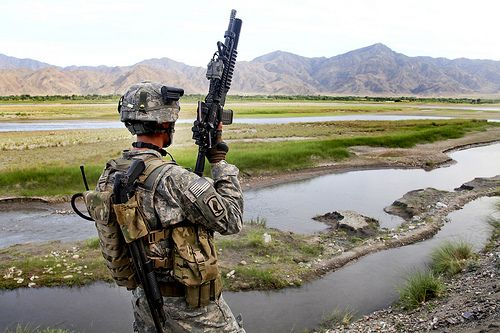
Photos by Flickr user Afghanisan (feature) and Troops Iraq (synopsis)



 MEDIA ROOTS — Earlier this month, Secretary of Defense Leon Panetta visited Manas Transit Center, located just outside of Bishkek. Panetta’s coterie
  MEDIA ROOTS — Abby and Robbie Martin grew up in
  MEDIA ROOTS — Organic farmers, seed growers, and seed businesses took
another step at reclaiming their land last month, as 83 plaintiffs representing over 300,000 farmers described Big Agribusiness
MEDIA ROOTS — Organic farmers, seed growers, and seed businesses took
another step at reclaiming their land last month, as 83 plaintiffs representing over 300,000 farmers described Big Agribusiness  MEDIA ROOTS — Marshall Curry and
Sam Cullman are the directors of the limited theatrical release documentary
film,
MEDIA ROOTS — Marshall Curry and
Sam Cullman are the directors of the limited theatrical release documentary
film, 