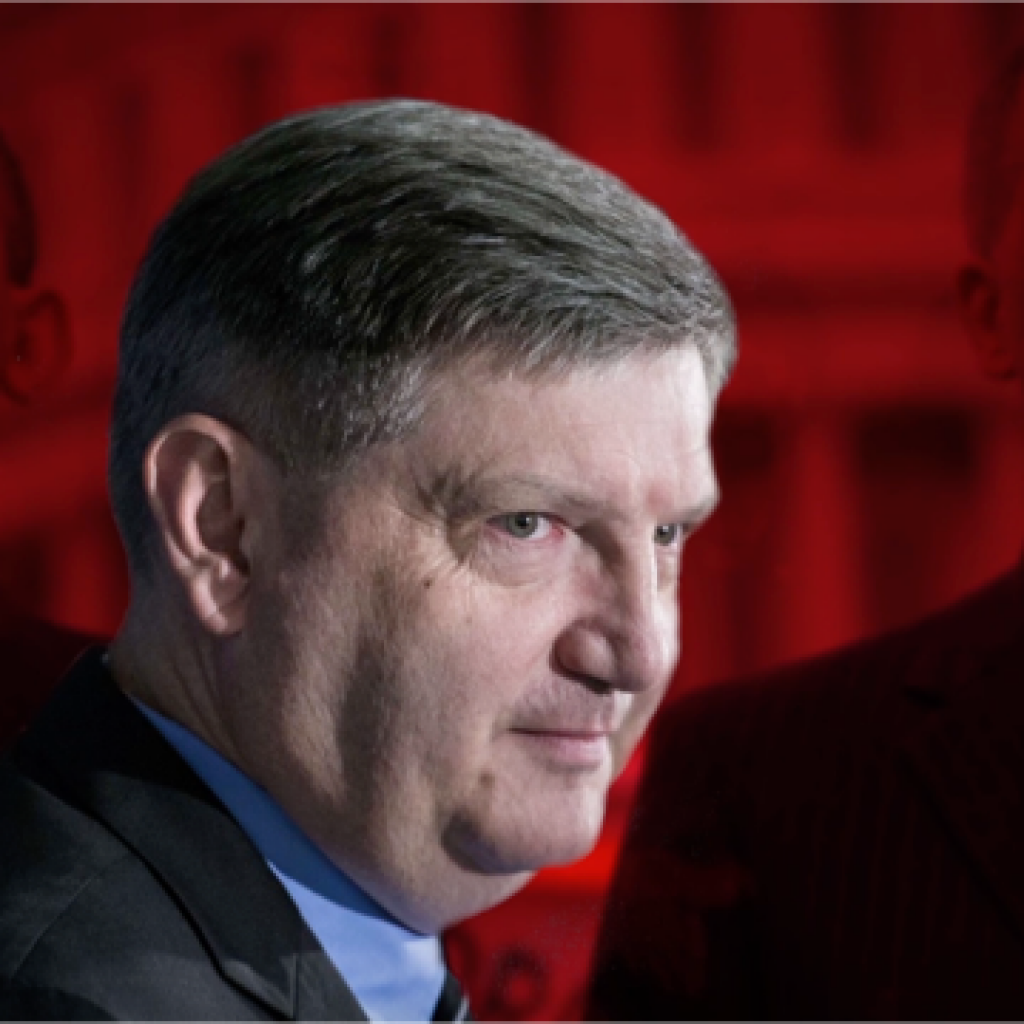
Few journalists know the cruelty of government censorship as well as James Risen, Pulitzer Prize-winning journalist at the New York Times, targeted for several major stories implicating criminality by the US war machine and its national security state.
Risen was not only relentlessly attacked under the Bush administration for his coverage of warrantless wiretapping but was subpoenaed by the Obama administration over his expose on a botched CIA sabotage operation in Iran.
He went rogue and published the story in his book after the US government got the New York Times to kill it. Threatened with jail time from the government, Risen went through seven years of legal battles to protect his source. In the face of this repression, He never compromised their identity.
Abby Martin sits down with Risen at the NYT DC bureau to talk about his experience being targeted, and what he’s exposed that’s put him in the crosshairs of the US Empire.
NYT’s James Risen on Fighting Censorship and Endless War
Robbie and Abby Martin talk about the Syria ceasefire, Black Lives Matter and the 2016 presidential election insanity: GOP unraveling over Trump, the Clinton campaign’s dirty tricks, Hillary’s endorsement by neocon warmongers and the reality of Bernie Sanders’ domestic/foreign policy on the latest Media Roots Radio.
**
Robbie follows up with a solo Media Roots Radio podcast about Super Tuesday: neocon panic and desperate GOP hysterics over Trump.
**
If you want to directly download the podcast, click the down arrow icon on the right of the soundcloud display.
This Media Roots podcast is the product of many long hours of hard work and love. If you want to encourage our voice, please consider supporting us as we continue to speak from outside party lines. Even the smallest donations help us with operating costs.
Listen to all previous episodes of Media Roots Radiohere.
When the Arab Spring started in 2011, the Empire decided which revolutions were “good” and which were “bad”, pouring arms and money into police state monarchies to crush legitimate protests, from Egypt to Bahrain.
But some movements were lauded by US politicians as great causes for freedom–conveniently in countries whose governments they had long hoped to overthrow–and rushed to their aid.
In Libya, the US was able to accomplish its plan for regime change in less than a year, thrusting the country deep into misery. But in Syria, the regime change plan hasn’t gone as smoothly–a list of changing rationales and goals have spanned the last 5 years.
Millions of dollars in cash and weapons flowed to the rebel forces fighting to overthrow the government. Once ISIS rose to dominance, US officials said it was no longer about toppling Assad, it was about defeating the terrorist group in Syria, without Syrian permission. But the administration still insists Assad must go in order to defeat ISIS.
Having gone far beyond an internal political struggle, the war is marked by a complex array of forces that the U.S. Empire hopes to command: Saudi Arabia, Turkey, Kurdistan, Iran, Lebanon, Iraq and more. There’s much at stake in a bloody war that has already taken the lives of 250,000 human beings.
To simplify this web of enemies and friends in the regional war, Abby Martin interviews Dr. Vijay Prashad, professor of International Studies at Trinity College and author of several books including “The Poorer Nations”, “A People’s History of the Third World” and “Arab Spring, Libyan Winter”.
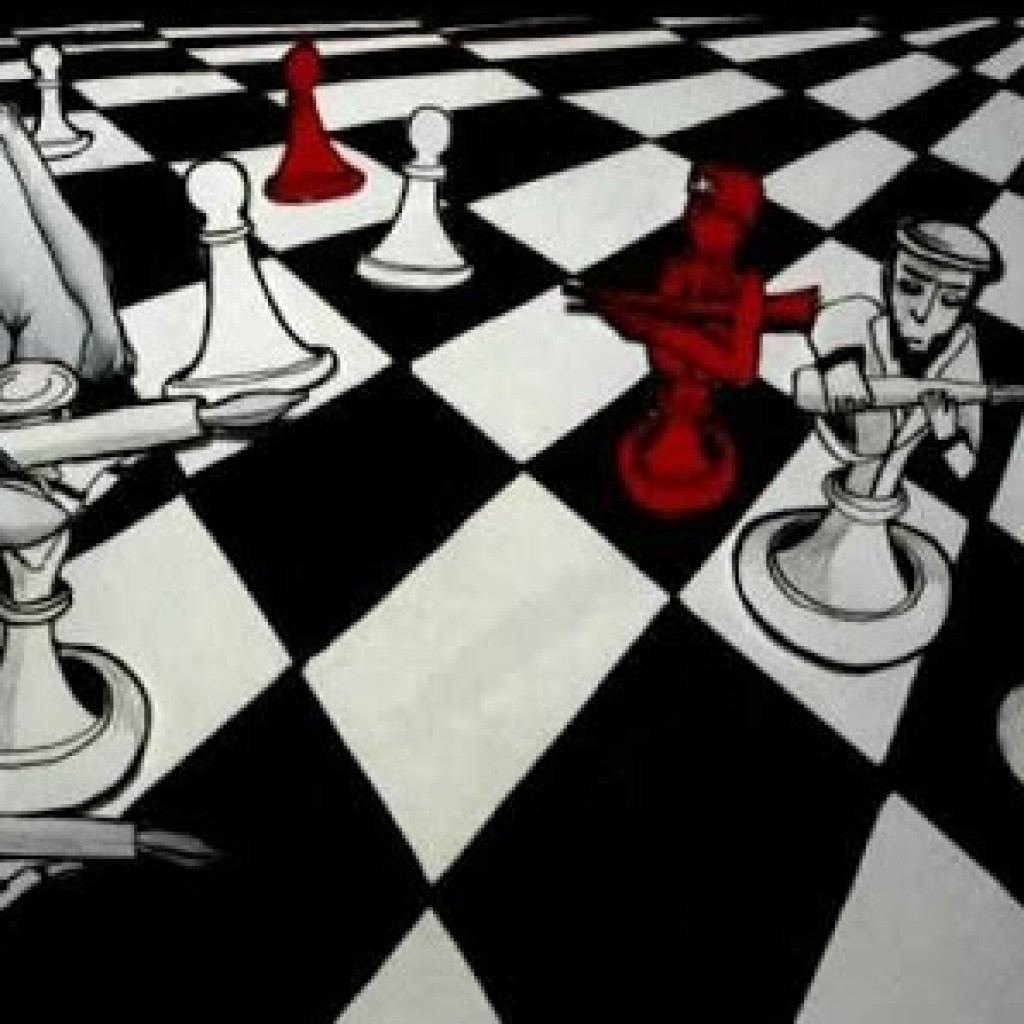
Unraveling the Syria War Chessboard
**
VIJAY PRASHAD: When the uprising broke out in Syria, when there was initial protests–at that moment the US ambassador Mr. Ford, Robert Ford, went to the sites of the uprisings. Now this is a very important thing to recognize. A foreign ambassador inside a sovereign country went to support uprisings which were for the overthrow of the government. This is a very important thing for people to remember. In other words, the United States government, by the presence of Robert Ford, was telling the people who were opposed to the Assad government, that we are going to deliver Damascus to you. In other words, the United States took a position in 2011 by allowing Ambassador Ford to go to these places. So there was no confusion. The idea, as part of the anti-Iran policy, the idea was that Damascus has to be delivered to other powers other than Iran, perhaps Saudi Arabia. This has been a clear position. But the Syrian opposition knew from the very first that unless the United States bombed Damascus to smithereens, this regime was not going to fall. So knowing that they were not going to provide the Libyan solution, they nonetheless wound up the opposition to expect US planes to come and bomb in Damascus, which the Americans knew was not going to happen. So this in a sense is where responsibility also lies for the hundreds of thousands of people killed in Syria. In other words, the US green-lighted a regime change scenario which they very well knew they could not follow through on. So I don’t actually see any confusion in American policy. The confusion simply came in that the Obama administration had to in a sense dance around the fact that they were not able to honor what Robert Ford had suggested by his presence at this demonstration. And it was never really about the Syrian people. It was always about Iran.
ABBY MARTIN: And it’s not just the Pentagon, it’s figures within the antiwar movement, the left actually making a main pillar of the demand for Assad to step down. What would this mean for the Syrian people?
VP: The Assad government is a government of a certain class of people. The Syrian government had made enormous advances, despite really quite ruthless prison policies against the opposition. Ruthless against anybody that stood up against the government. They nonetheless made some advances in human welfare, they created institutions of different kinds, etcetera. Bashar Al-Assad, when he in a sense inherited the regime, came at a completely different moment in world history. He was much more open to the Americans and the Europeans. He was very much open to what we consider neo-liberal development, new construction projects, etcetera. He made an alliance with the Turks. Turkey made so much money, in a sense, gentrifying northern Syria in the 2000s. This was a period where it created a sense of displacement among the population. There were real grievances in the country. Nonetheless, despite having these grievances, popular opposition was extraordinarily weak in Syria. There was no way they were going to be able to actually win against the government. And I don’t mean militarily. I mean even in terms of appealing to vast numbers of people who had yet supported the government. So you can’t create revolution by shortcuts. You have to take the protracted road. And, in a sense, the American offer to the Syrian opposition was a shortcut. By opposition what do we mean? You see, the people who were revolutionaries, the left inside Syria, which there was a section, were never the people that the Americans saw as the opposition. Who did they see as opposition? From the beginning they saw the proxies of Turkey, of Saudi Arabia, maybe of the Muslim Brotherhood. These were the people that they were talking to. They were not talking to the socialists on the ground. Those socialists on the ground are disposable for everybody. This term opposition captures too much. Some people when they hear opposition they mean the rebels who came from nowhere fighting on the ground. But actually when Western governments talk about opposition, they mean the people who were in exile in Turkey and formed these groups. This was a certain kind of elite similar to the transnational coalition created in Libya. Who were they? They were bankers. These are the people that the West sees as opposition. So you know, we should not fool ourselves that very early on the poor people had been discounted by the West who had become serious with these proxies. And these proxies as we know are not merely businessmen in suits. They morphed very quickly to the very worst kind of characters and were given free rein by Western backing. And of course Gulf Arab backing to create mayhem in Syria.
AM: It feels like déja vu because we just went through the same thing in Libya not too long ago, where the character of the uprising was secondary to the overthrow of Gaddafi. What lessons can be gleaned from Libya?
VP: It depends on who is going to learn which lesson. See, the West is learning no lessons. The West has believed that regime change against its adversaries is allowed. And by the way, there was so-called soft regime change in this period. In Honduras in 2009, the United States fully backed the overthrow of the legitimate government of the Honduran people. That was when Hillary Clinton was the Secretary of State. In Japan, the Japanese people actually voted a government to power which had a mandate to remove some – some, not all – US bases from Okinawa. Hillary Clinton lobbies the government and they, the United States, overthrows a legitimately elected government and brings another government power. This was barely mentioned in the US press. So at the same time as there’s this kind of regime change in the Middle East, there was a successful regime change in Honduras, successful regime change in Japan. Have you ever heard anybody talk about regime change in Japan? No. They will blame, say, what happens in Afghanistan, what happens in Syria, emergence of ISIS, Taliban –they blame it on somebody else. They’ll say it’s Assad’s fault that ISIS is created. I mean come off it. ISIS is a direct product of the chaos sown by the US overthrow of Saddam Hussein. When Saddam was captured in Iraq, he comes out of his hiding hole and he says to the American troops, “I am Saddam Hussein the president of Iraq, I want to negotiate a surrender.” They mocked him, laughed at him, humiliated him. Imagine if the government had actually said, “Okay, we want to accept the surrender.” In other words, we want to create a new Iraq, which we’ve illegally attacked and illegally destroyed, okay, but we want to bring the fedayeen, Saddam. Your people have to have a role in the future because they are Iraqis. We cannot simply excise them from Iraqi history. But no, they didn’t accept the surrender, they essentially turned him over to be lynched. Gaddafi – Gaddafi was killed by what? A NATO strike hits his car and then he was lynched on the street. There are right now in Sirte, which is Gaddafi’s home town, there ISIS has taken control of Sirte. Inside Sirte, it’s not merely the old jihadis but also people of Gaddafi’s green movement, who have been totally isolated again, and who have joined ISIS. Why? Because that’s the only avenue they have. You’ve marginalized… Why didn’t they arrest Gaddafi? Again, an illegal arrest, but at the time accept his surrender and say, “Your block of supporters will have a place in Libya.” No. They said none of you will have a place in Libya. You know there are tens of thousands of Gaddafi-era supporters who are in prison in Libya uncharged. This is a human rights violation. So when you conduct these regime-change operations and then tell a section of the population you are no longer relevant, you’re condemning them to social death, to political death, and in some cases to prison for life. And I think this is a lesson that nobody’s is thinking about. They’re saying, “I wish there was no war.” Well you’ve done these wars, you’ve destroyed these countries. You must, having done all that illegally, you must open yourself to the possibility that, you know what, an American should not decide what happens in Libya. Let all the Libyan people decide, including those who you now consider persona non grata. In Syria, the military is very well organized, it’s very disciplined. There hasn’t been defections. So to imagine that just because an American ambassador shows up in a square where there are fifty people standing there, that you’re going to somehow terrify the military, was an illusion. A very dangerous illusion. I don’t feel like there’s a need for anybody to say, “I support Assad. I don’t support Assad.” This is an irrelevant question. The question is, I believe in freedom of people, but I also believe that freedom is a protracted struggle. Freedom has to have a set of obligations upon human beings to win other people over. As I said, there’s no short-cut to these things, you can’t bomb your way to freedom. It’s a protracted struggle. And in a place like Syria, the government may not appeal to some people but it does appeal to others. The fact is, vacuums are the worst thing to create in any territory in the world. I think people have now understood that the Syrian Army is going to have to become one of the factors that fights the war against ISIS.
AM: The White House said part of its strategy is working with regional players on the ground. Of course, there’s several contradictory players here. First there’s Saudi Arabia. Is this a logical partner for peace when even Hillary Clinton has said that it’s the biggest exporter of Wahhabi terror worldwide?
VP: The United States government has one principal ally in the region. And that ally, apart from Israel – because Israel is not really consequential for some of this stuff. The principal ally the United States has is Saudi Arabia. The United States has on several occasions said the defense, not of Saudi Arabia, but of the royal family, is the obligation of the United States of America. Why is that so? It’s because of oil. Not because America buys oil from Saudi Arabia, but because the Saudis are able to control oil prices. Look at the recent situation. The Venezuelans fought to rebuild OPEC. They won new unity in OPEC. They raised prices of oil. In raising prices of oil, they were able to collect money and do it for regional transformation, to provide money to lesser countries with no resources, to build up the capacity of the countries, etcetera. Saudi Arabia jacked up oil production, brought down the price of oil deliberately, and did what? Brought to the knees the adversaries of the United States. Who are they? They were Venezuela, they were Russia, they were to some extent but not entirely Brazil, and eventually China. As all these countries went into free-fall, the strategy that the Chinese were building… The oil, the gas station of Saudi Arabia is a weapon against forces around the planet. So if there’s one thing the United States needs to – the people of the United States need to consider, is this unbending alliance with a theocracy that is not only brutal to its population, but is providing the material for counter-revolution around the planet. Saudi Arabia understands its region entirely through sectarian eyes. It sees the struggle in Yemen as a struggle of Shia versus Sunni, which the Yemeni people don’t see exactly like that. It sees Syria as a Sunni-Shia thing.
In Syria it’s much more complicated than Shia and Sunni, per se. So they are sectarian. They have a sectarian viewpoint. Since the 1960s, backed by the Americans, they have pushed this sectarian view on the world, not merely this region. If I asked you, Abby, let’s make a map of where Al-Qaida recruits from, one of the stunning things you’ll discover is that from the 1960s,the Saudi-backed group called the Word Muslim League, the WML, was funding groups in these exact places because Saudis were funding this from the sixties. They opposed Arab nationalism. This was their game. So this is the major American ally. There is a terrific WikiLeaks cable from 2005, again from Syria, where the Syrian political officer of the USembassy says, “We have to back the Saudi game of increasing Shia-Sunni tension.” Imagine this. This is a serious problem. I think now sober Western governments, not necessarily the United States, have understood that this is gotten out of hand. And something needs to be done to rein back this mad dog approach to domination in that region.
AM: Let’s expose another regional player, Turkey. How has Turkey made it possible for ISIS to thrive?
VP: They kept the border open. When Obama in 2014, August 2014, said ISIS is a threat to the world, the United States, etcetera, they could have invoked the NATO charter. Turkey as a NATO member could have been forced to close the border. But the United States didn’t invoke the NATO charter. So the border has remained porous. And so ISIS since August 2014 has continued to get recruits coming in. Look, the press picks it up here and there. They’ll say yes, the Paris attacker, the first time, the woman she is now in ISIS territory. She went through Turkey. How did she go through Turkey? She landed in Istanbul Airport, flew to Sirok, I mean to Gazientep, drove across the border. Are you kidding? Turkey is a sovereign … how can … The border is porous. Turkey has played a game which has set it in a destructive direction wherein in order to deflate the Kurdish balloon it has gone to war against the Kurds. Not only the Kurds inside Turkey, they’re bombing cities in Kurdistan, in Turkey, but they’re also bombing BKK and YPG bases in Iraq where these people are training to fight against ISIS. Understand now, if you are an American strategic planner, you are using Incirlik base inside Turkey to bomb ISIS. Meanwhile you’re providing ground support to the Kurdish militias. Meanwhile your ally, the Turkish Air Force, is bombing the Kurds. Now what is going on here? And why should people like you and I explain this? This is not for us to explain. This is a question that the United States State Department needs to explain, and the [Turkish] foreign ministry needs to explain.
AM: Can you provide any more context to why Turkey has this war against the Kurds?
VP: The point about the Middle East, or any part of the world, is they are complex cultural ecologies. If you travel in northern Iraq, for instance, the landscape is craggy and hilly and mountainous in such a way that from one valley to the next, you have language that can be slightly different. Religious traditions that differ. There is great diversity in the Middle East, it’s incredible. These people lived in various forms of fellowship for a long time. I’m not going to romanticize it. As I’ve said, various forms, there were tensions, whatever, a large Armenian population, etcetera. After the First World War, the Turkish government took a very hard republican Turkish nationalist view, led by Kemal Ataturk, the father of the Turks. They took a Turkish nationalist position, which made no or very little space for minorities. And in this of course is the killings of Armenians, a genocide of the Armenians. But also in this was the relation, the role of the Kurds. Kurds were told, “You are like us, not like the Christians.” They tried to make it about religion initially. But it was never really about religion. The attack on Armenians was not about religion, it was about difference. Are you going to be like us, are you going to assimilate fully or not? It was a very much an assimilative nationalism. And the Kurds therefore were told, “You have to assimilate to become Turks. There’s no such thing as a Kurd.” You know, that’s a very ruthless form of nationalism, and that’s been the history of modern Turkish nationalism. It has had to grapple with this very virulent strain in its nationalism, which doesn’t have space for minorities. And what’s interesting is in Turkish history, in the last twenty odd years, the Kurdish political movements have oxygenated Turkish politics. The HDP for instance is one of the few political parties that is totally socially progressive, and which is why it’s linked with the Turkish left. It’s provided the Turkish left with a mass movement.
In other words, the Kurdish nationalist movement, which surrendered its nationalism in 1993, you know they decided in ‘93 no longer to call for an independent Kurdistan, but to have rights within Turkey. You got a mass constituency for the Turkish left. And so the Kurds therefore are not some alien life form, you know, they’re part of Turkish society. The largest Kurdish city is Istanbul. There are one million Kurds that live in Istanbul. Kurds live all over the country. But they have provided through their struggle for self-determination an oxygenating space for the Turkish people, all the Turkish people. And so they are trying to revise the idea of this virulent Turkish nationalism, which Erdogan has now bizarrely come to represent. The Kurdish struggle is not a struggle of ethnicity, it’s a struggle of values. The HDP is not a Kurdish exclusionary party. It’s a party of a certain set of values, progressive values. So that’s available inside Turkey.
AM: There’s been a scholar that studied every suicide bombing since 1980, and found that 95% of them share one strategic motivation, which is the response to military intervention or occupation in their country. Given this, why do you think that the empire continues to respond with military intervention?
VP: Well there are many reasons. One of them is that if you have no other solution for the people’s problems, you utilize the hammer. If you no longer have the ability to propose a solution for poverty, starvation, desperation, etcetera… If you don’t have a solution in the United States, why talk about the world? Even in American cities you can’t provide jobs. You can’t provide schools. You provide police. You provide prison. This is the domestic cognate of imperialism overseas. Here they have no answer to people who are starving. They only know how to throw them in jail. There they have no answer to people’s demands. They only know how to bomb them. This has become a habit. Why? Because the very rich around the world have gone on strike. They refuse to pay taxes. They refuse to provide wealth for human betterment. They are happy to provide money to bomb people and build gated communities and things like that. They are happy to create dystopia. They are on strike when it comes to creating utopia. It is people who are well-meaning, well-thinking people who believe in the good side of history that have to fight for utopia. They have an end game. It is purely dystopic. We have forgotten that we need to fight for an end game. Our future is not merely resistance. Our future has got to be something beautiful.
Chris Hedges, New York Times best selling author, activist, and host of the new show on TeleSUR English Days of Revolt, joins Abby Martin to talk about war, propaganda, and the suppression of radical voices.
Hedges discusses US expansion of power by way of military force and the cultivation of indigenous elites, including supporting the rise of dictatorships—Mabutu Seke in the Congo, Somoza in Nicaragua, and the Shah in Iran. The protection of Western interests led to what Hedges calls the “heavy intrusion of Empire” which included things like the Reagan administration supporting military juntas and orchestrating a counter-revolutionary movement in order to combat Communist advances.
US interventionism hasn’t always been strictly undercover operations but has included unashamedly public use of lethal force, blatant surveillance, the destruction of the most basic of civil liberties, as well as the destruction of democracy – both at home and abroad. Hedges argues that since World War II, the US has masked how much has been spent on military bloc budgets, and that a massive amount of resources are being diverted towards maintaining imperial war, and the military establishment—the expansion of military power leads to catastrophic results for the world socially, economically, environmentally, and politically. And we are already seeing these consequences unfold.
War, Propaganda & the Enemy Within
**
Chris Hedges Destroys “New Atheist” Religious Fundamentalism
**
ABBY MARTIN: Chris, Eugene Debs, the famous socialist candidate back during WWI was sentenced to 10 years in prison for his opposition to the Sedition Act. It made it illegal for anyone to speak out in opposition to the war at that time. What does that say about the myth of democracy from that early on?
CHRIS HEDGES: Well, it says that if you challenge the structures of power, and particularly military power, you are at best marginalized, if not imprisoned. Those kinds of few radical voices that held fast–Randolph Bourne, Jane Adams, Eugene Debs–were excoriated in the press. Emma Goldman was eventually deported along with Alexander Berkman and others. Randolph Bourne said war is the health of the state. What you saw in WWI was the rise of the military corporate machine, which made war against these radicals through the Sedition Act, the Espionage Act and more importantly the Committee for Public Information Commission, or the Creel Commission, which created the system of modern mass propaganda, employing the understanding of crowd psychology pioneered by figures like Le Bon, Trotter and Sigmund Freud, that people were not moved by fact or reason. They were moved by the very skillful manipulation of emotion. And it worked, so Hollywood was making films like “Kaiser: the Butcher of Berlin.” The Creel Commission had its own news division.
You couldn’t even write anti-war editorials. It was against the law. It had speakers’ bureaus and you only had to use the Sedition Act and espionage on those kind of few figures who held fast to an anti-war stance, of which there were not many, and when you read people like Jane Adams, part of what they are most depressed about is how easily the intellectual class, even the reportedly left intellectual class, was seduced in the war effort. Then after the war the dreaded Hun becomes the dreaded Red and we enter what Dwight MacDonald calls this “psychosis of permanent war in the name of anti-communism”–the fusion of war and the war profiteers, the militarists and the war profiteers, which after WWII created a situation of total war.
After WWI, factories re-converted to produce domestic products. After WWII, they kept producing weapons, even though we had peace, so that we could obliterate every Soviet city ten times over with nuclear weapons. It was nuts, but with guaranteed cost overruns and guaranteed profits, that fusion of the militarists and the corporatists hijacked the country, disemboweled the country economically, and made war on all of those advances that had come under the New Deal. So it had both in an economic impact and a political impact. The USA is undoubtedly the world’s biggest, strongest empire in history, but it operates in a different way than empires past.
AM:How has the notion of empire changed over the last century?
CH: America’s unique in the sense that it colonized itself. European countries colonized India and Africa. The Spanish… the Americans… we destroyed through acts of genocide on our indigenous communities, and plundered their resources, so you had especially with the westward expansion, the US cavalry acting on behalf of the mining concerns, the railroad companies, the timber merchants. And once westward expansion was complete by the end of the 19th century, you began expansion beyond US borders. That’s when you had the Cuban-American war with the seizure of Cuba and the Philippines.
You began to see all sorts of gunboat diplomacy throughout the Caribbean and Latin America, in particular Central America. America expanded its power certainly through military force, and the threat of military force, but more by cultivating indigenous elites that would do our bidding, so you saw the rise of all sorts of dictatorships, whether it was Mobutu in the Congo or Somoza in Nicaragua, or the Shah in Iran. And of course we overthrew the Shah’s father then carried out a coup d’état to replace Mossadegh, the Prime Minister who was going to nationalize British Oil. That form of colonial power protected Western interests.
That’s why Allende was overthrown in 1973 and Pinochet was put in power to protect the copper industry from being nationalized. These elites were given tremendous resources. We saw the same thing in 1954 in Guatemala with Arbenz who wanted to challenge United Fruit’s huge acquisition of Guatemalan land to give landless peasants an ability to carry out subsistence farming, and when that happened the CIA raised a kind of black army. A huge propaganda effort run by Edward Bernays, the father of modern public relations, would come out of the Creel commission. Of course, Arbenz becomes a communist in the eyes of the press which they, through the manipulation of the press, are able to justify. So it’s a different kind of empire in the sense that, for instance, British troops actually occupied India (although many of those troops were Sikhs). We find venal elites who will do our bidding and when people rise up against those elites we provide those elites with the resources by which they can crush any form of rebellion.
AM: I wanted to talk about El Salvador in particular because you’ve seen and obviously covered extensively the horrors of US wars all over the region. What did this conflict in particular reveal about the length the empire will go to maintain economic hegemony?
CH: So its 1979 and the Sandinistas win in Nicaragua and this sets off all kinds of alarm bells because the Sandinistas–unlike Samoza who was the dictator of Nicaragua and was overthrown and later assassinated in Paraguay–were not going to protect US business interests and they did not want to see this spread throughout the region. And so I covered the war there from 1983 to 1988 and we saw the Reagan administration pump tremendous military, economic and intelligence resources into defeating the rebel group known as the Farabundo Martí National Liberation Front (FMLN). When I first got to El Salvador in 1983 the FMLN was winning the war.
They created–the Reagan administration–they brought in a huge helicopter fleet–70 Hughes helicopters that they put up in the air which made it hard for these guerrilla groups to mass in any kind of large formation. In 1983 I was able to go out with up to 700 or 800 rebels at a clip. That didn’t happen anymore. They created whole black armies that were recruited from Venezuela, Chile, Honduras and other places, that didn’t exist officially–they were ghosts armies. They called them cazador or “hunter battalions”–about 350 soldiers, very well trained, very well equipped. We would go up into Morazan and come upon the aftermath of tremendous fire, and yet there was no record of the Salvadoran army ever being there. They brought in all sorts of CIA, mostly ex-Cuban operatives, including Felix Rodriguez, who had been part of the effort to hunt down Che Guevara. Indeed he would show us Che Guevara’s wrist watch that he was wearing, taken off Che’s body. So there’s a kind of classic example of the heavy intrusion of empire to thwart… half of the population in El Salvador at the time was landless and most of the land was owned by these coffee barons–roughly ten families. They call them the Big Ten families. It was worse than serfdom. People living in tremendous poverty and deprivation and when they tried to organize peacefully in terms of building labor unions, they were literally gunned down in the streets. They put machine guns up on the rooves of buildings in the capital and then when people began to resist, the death squads, when I got to the country, were killing between 700 and 1,000 people a month. It was butchery which we funded and largely orchestrated.
You saw the same thing in Iraq, by the way. When things broke down in Iraq, they took James Steele–who I knew, a colonel, he had been the head of the military group in El Salvador who had worked with the death squads–they moved him to Iraq and he organized the Shiite death squads which carried out a reign of terror to break the Sunni resistance, and really, if you really want to look at it, create groups like ISIS. That’s how empire works and when you’re up close, as I was for twenty years, and you see the inner workings of empire, you understand how vicious and ruthless and brutal it is. But it’s very hard to penetrate within the heart of empire that reality, so that reporters such as myself who would report on these things were under constant attack, not only from the state department and from the government, but… eventually I was working for The Dallas Morning News on Central America and later for the New York Times… but from our own Washington bureaus that we’re being spun a fictitious narrative, and we were kind of demonized as being the fifth front of the rebel movement. And of course 22 reporters were killed in El Salvador, some of them assassinated by the death squads. The pressure that empire will put on those few reporters who attempt to go out and actually report is fierce and can even involve the loss of life.
AM: In reference to the Iraq war in 2003 and war as a force that gives us meaning, you said that the notion that the press was used in the war is incorrect. The press wanted to be used. Isn’t that the antithesis of what journalism should be: wanting to be used?
CH: Yeah, but you know journalists are careerists like anyone else and they know how to advance within the system. So let’s take for instance the first Gulf War which I covered with a very draconian press restriction. You could only be in a pool. I mean, I didn’t do it. I could speak Arabic, so I was out in the desert, then Cheney drew up a list of ten journalists he wanted expelled and I was top of the list, but they couldn’t find me because I was sleeping in a tent. You wouldn’t think I would be that hard to find in Saudi Arabia. No, the press goes limp in front of the military.
First of all, real war correspondents, people who really know the culture of war and have covered it… you’re talking a couple dozen. Most of them get sent over from their Washington bureau and I would literally watch them dress up in military uniforms and go sit in a five star hotel in Dhahran to hear Schwarzkopf, and sit in the front row, and they weren’t anywhere near a war, nor did they want to go near a war, and that’s true with every war I covered: only about ten or fifteen percent want to go near one. Photographers are a little more honest because they have to get out. They don’t really want to cover the war there, and covering war is a kind of insanity. I have a kind of even empathy for that, but then you shouldn’t be there. And the people who create these kinds of heroic narratives around their soldiers or their leaders and tell the story the way expected… They’re rewarded for it. They’re awarded for it by the institution. They’re rewarded by the military itself. In the first Gulf War, that whole pool system was not actually administered by the military. It was administered by fellow journalists. I used to call them Judenrat. It’s insane, but it coupled with the fact that they didn’t really want to get anywhere near the fighting, and that’s the truth of it. And secondly that they understood what was good for their career, and their career took precedence over the truth, and that’s not uncommon unfortunately.
AM: In 2003 you were booed at Rockford College and you were shamed offstage. I mean it’s just ironic because…
CH: I wasn’t shamed. I was forced offstage. I was willing to keep going. They cut my mic, and then campus security suggested that it was time for me to leave.
AM: The symbolism of that is so ironic because, of course, of the woman you were speaking of earlier, and her opposition to WWI and then we go to the New York Times’ response to this which is just hysterical because they’re saying you’re damaging the paper’s impartiality, meanwhile lauding people like Judith Miller at the time who just became literal stenographers. What was your reaction to that? Did you know at that time it had just become a complete farce? Or were you slighted?
CH: I’d been at the paper for fifteen years, so I knew the consequences for a news reporter. A columnist can say it, but of course columnists are selected by the establishment. I would never be selected as a columnist. You would select Thomas Friedman, or whoever who is not going to make those kind of statements. No, I was conscious of the game I was playing and the danger in terms of where I was going, but I had spent seven years the Middle East. I understood the folly of what we were doing. I felt that as an Arabist, I had a platform and a duty to speak because people I cared about would be and finally were killed in Iraq. Of course it deep-sixed my career, but on the other hand I really couldn’t have lived with myself, given the consequences of what has been done in Iraq: over a million dead, Iraq as a unified country is never coming back. What is it? Four million refugees and displaced, it had one of the most modern infrastructures in the Middle East. It’s been destroyed, and out of these failed states that we created or these failed enclaves we’ve seen the rise of groups like Al-Qaida in Iraq which has finally morphed into ISIS. I was aware of what I was doing, but nobody likes to lose their job, but I don’t think I could have looked back and done anything differently.
AM: Especially since you’re covering already the devastation of the Gulf War targeting of just crucial infrastructure at that point, and then followed by these harsh sanctions that took the lives of half a million children. How the hell can anyone support this continued military adventure over there?
CH: Well, because so much of it’s about natural resources. They always justify their intervention based on “bringing democracy” and “fighting barbarism” while everybody sort of turns their back on the Congo where atrocities are far worse.
AM: Cobalt.
CH: Yeah, I had written a column in which I said you can’t be a socialist unless you’re an anti-imperialist and anti-militarist because it’s really those forces, and we have to remember that the arms industry is a for-profit industry. We sell 40% of the world’s weapons. We have to break the back of empire, not only for what empire is doing to what Frantz Fanon calls “the wretched of the earth,” but for what it’s doing at home because as it disembowels the country, the harsh forms of control that empire uses on the outer reaches of empire migrate back to the homeland, so you get wholesale surveillance, militarized police, indiscriminate use of lethal force on our city streets. We’re in Baltimore where you don’t have to go very far to see that, and destruction of our most basic civil liberties.
This is the disease of empire. It goes all the way back to Thucydides who saw that as Athens expanded it destroyed its own democracy. Thucydides wrote, “The tyranny that Athens imposed on others it had finally imposed on itself.” We’re no exception and that’s what’s happening. We should be cognizant of the suffering of the Palestinians, and the Iraqis, the Afghanis, the Yemenis, the Pakistanis. We should be cognizant of the power of the industrial weapons, the missiles, the thousand-pound iron fragmentation bombs that we’re dropping. We are not. I think only those of us who’ve been near the receiving ends of these weapons understand how widespread this lethal force is–the power of these weapons, but it ultimately has reverberations for us which are already very, very extensive. The forms of power that empire uses to control subject populations abroad are now visible within America itself.
AM: Yet even the most “populist candidate today,” Bernie Sanders is widely popular among people who are so-called radical leftists. He has refused to confront the war industry and the crimes of empire, and continues to do so. You’ve pointed this out time and again. Why is this issue the most important thing to confront?
CH: Well, because what you had after WWII with the fusion of the so-called “defense industry” (the war machine, the arms industry, and the corporatists who profit off of war) is what John Ralston Saul correctly calls “a coup d’état in slow motion.” And you can’t challenge one weapon system. We used to, in the 1960s, Proxmire and others, challenge this weapon system, and that’s over. We mask how much we spend. Officially we spend a little more than 53 percent of discretionary spending on defense. Well, that’s just not true. It doesn’t count Veterans Affairs. It doesn’t count our nuclear weapons program, and it doesn’t count all of the black agendas, the black budgets that we’re not allowed to see. The best estimates are that we’re spending 1.6 to 1.7 trillion dollars a year, and you can’t talk about serious reform when you are diverting such massive amounts of your resources towards the war machine. That’s what Martin Luther King’s 1967 speech at Riverside Church understood: that we can’t build what Johnson called the new society, the great society and maintain imperial war. Bernie has voted for every military appropriations bill there is, to continue these wars. He doesn’t challenge the military establishment, either. Indeed he’s been quite welcoming of defense contractors into the state of Vermont because it provides jobs, and they try and divvy up ten billion dollars per state because they have the ability to do so. But if we don’t break the back of the war machine, if we don’t break the imperialist project, if we don’t terminate the for-profit arms industry, then any rhetoric about significant change is smoke in the wind.
AM: And interestingly enough that’s when Martin Luther King Jr. began to be obsolete. The mainstream media exiled him largely when he started talking about militarism.
CH: They took away his FBI protection, and both King and Johnson knew what that meant. Because of the number of death threats he received, it meant he was doomed.
AM: And you quoted Engels in one of your recent speeches on this point which said that it’s either barbarism or socialism.
CH: It’s often attributed to Luxembourg. She stole it, but it did come from Engels. It is really between barbarism or socialism. Either we reconfigure our relationship to each other and to the planet in a radical way or these forces, which in theological terms are forces of death, will extinguish what hope we have for life. It’s that dire. It’s that dramatic, as anyone who reads climate change reports understands. And this is the folly of empire. This is how empires destroy themselves and always have. It’s how the Roman Empire ended. You expand militarily beyond your capacity to sustain yourself and that’s precisely what we’re doing and what we’ve done, and the consequences of it politically, economically, socially, culturally and finally environmentally are catastrophic.
AM: We hear about revolution in the US like it’s some romanticized thing that can never happen here, something that only happens in other places. You’ve covered so many uprisings, some successful. What has it taught you about the potential for revolution here?
CH: Well, when a political system is seized by a tiny cabal, whatever it is–military, oligarchs–and the system seizes up and only serves the interests of that narrow elite, then there is always blowback. That blowback may not be good. If you go back to the 1930s, that blowback came in the form of fascism. In the 1930s, in the United States it came from an enlightened oligarchy led by Roosevelt, and Roosevelt writes about it quite openly, and in essence he says to his fellow oligarchs, “Either you give up some of your money or we really face the specter of revolution.” We still had the old communist party. We had movements, severely weakened after WWI, but they were still there–the Progressive Party and others–that were able to frighten the oligarchs into creating the New Deal: fifteen million jobs, public works, these kinds of things, many of which–the parks and the post offices (although they’re trying to sell off the post office as they did in Britain)–we still use today, but after WWII those forces set out to destroy the New Deal. Roosevelt used to say, “My greatest achievement is that I saved capitalism.”
AM: You just wrote a great essay that I encourage everyone to read titled “The Real Enemies Within,” in which you write, “The reality of empire is nearly impossible to see from the heart of empire. There can be no rational debate about empire with many desperate Americans who’ve ingested this as their creed. The distortion of neoliberalism has left them little else but the potent and dangerous force within the body politic, and it is growing.” Of course, those who point out the symptoms of a rotting empire are deemed heretics, traitors, just like they’ve been since WWI. What does this longstanding inability to counter this dominant narrative tell us about our society, where it is today, and how we can possibly combat this mythology?
CH: It’s a symptom of the sickness of the society itself, so as people are pushed… For instance, I was just not too long ago in the south and you have one Confederate memorial after another. I was walking through Montgomery with a great civil rights attorney, Brian Stevenson, who spent his life defending death row prisoners, most of whom were poor and black, of course, in Alabama, and he said all this stuff’s been put up in the last ten years. And I said to Brian, “This is exactly what happened in Yugoslavia.” As people reached such a point of despair they were treated into these mythical stories about themselves, and at that point you can’t connect because you’re not speaking about a reality that is defined by verifiable fact. You’re speaking about a myth, and I find the rhetoric against Muslims, and even the acts now that are carried out against Muslims, extremely frightening.
That kind of rhetoric is incendiary. I saw it in every war I covered. You get people to speak in the language of violence and then they carry out acts of indiscriminate violence. I think we’re entering a very frightening and dangerous moment in American history as the government is increasingly, of course, hostage to corporate power and military power, unable to respond to the citizenry, carrying out acts of austerity, stripping us of our civil liberties. We’re the most watched, spied-upon, photographed, monitored population in human history, and I covered the Stasi state in East Germany. You will ignite these proto-fascist forces and it will become sacrelized in the Christian religion. And it speaks in the gun culture and the language of violence, and it is a symptom of a dying civilization because in the end all this is magical thinking. It’s not real and I think the only way to save ourselves, which is why I’m a socialist, is to re-integrate these people into the economic system, and in essence give them hope, give them the possibility of a life, but, in fact of course, we’re doing the opposite. We’re pushing them further and further into extremism. As we do that, that will have very frightening political consequences and there is no shortage of examples throughout human history to prove that.
The prison system has become the established response to societal woes—from crime to mental health—and the private corporations that litter the globe have monopolized correctional facilities, amassing deep political influence in the process in order to further prison expansion and increase profits.
In the United States, where the human rights abuses of other countries are always on the agenda, the prison population is staggering. Though the U.S. has only 5% of the world’s population, it has a shocking 25% of its prisoners. Crime has dropped dramatically over the last 25 years, yet the number in prison has continued to increase at a dramatic pace.
Over 50% serving time in prison are non-violent, drug-related offenders, with about 30% locked up for marijuana only. The dehumanization of inmates, as well as those not yet convicted of any crimes, has led to extreme violence perpetuated by prisons guards and prison administration to go almost entirely unchecked, thereby leaving those most vulnerable to face normalized brutality with little to no recourse. In the windowless prison cells of the U.S. we also find racism and sexual violence existing in an almost customary fashion, pushing men and women of color deeper into the void of the criminal justice system.
Follow Abby Martin as she exposes the unsettling realities behind the prison industrial complex on The Empire Files.
Tortured & Enslaved: Enter the World’s Biggest Prison



 Few journalists know the cruelty of government censorship as well as James Risen, Pulitzer Prize-winning journalist at the New York Times, targeted for several major stories implicating criminality by the US war machine and its national security state.
  When the Arab Spring started in 2011, the Empire decided which revolutions were “good” and which were “bad”, pouring arms and money into police state monarchies to crush legitimate protests, from Egypt to Bahrain.
 Chris Hedges, New York Times best selling author, activist, and host of the new show on TeleSUR English Days of Revolt, joins Abby Martin to talk about war, propaganda, and the suppression of radical voices.
 The prison system has become the established response to societal woes—from crime to mental health—and the private corporations that litter the globe have monopolized correctional facilities, amassing deep political influence in the process in order to further prison expansion and increase profits.