MEDIA ROOTS — Doubtless, many have heard of the U.S. targeted killing of U.S. citizen Anwar al-Awlaki under Obama. But many may not know that al-Awlaki wasn’t the last U.S. citizen arbitrarily killed by the state, as investigative journalist Jeremy Scahill recently reported:
“You know, President
Obama authorised strikes that resulted in three U.S. citizens being killed
within less than a month in Yemen: Anwar
al-Awlaki, who was born in New Mexico; Anwar al-Awlaki’s 16-year-old son; and
then Samir Khan, who was another U.S. citizen from North Carolina and was the
editor of Inspire magazine, the
English-language publication of al-Qaeda in the Arabian Peninsula. All three of those U.S. citizens were killed
within one month.”
Obama drone strikes have arbitrarily killed hundreds of civilians worldwide including three U.S. citizens without conviction, trial or due process. One might expect more public outcry. Yet, in light of a recent Washington Post ABC News poll revealing that 77% of self-proclaimed liberal Democrats approve of Obama’s drone policy, it seems most progressives are prepared to re-elect Obama or sit idly by as he purchases a second term.
But
while we’re all indignant about the profoundly disturbing killings by the U.S.
under Obama in Yemen and elsewhere, we forget the U.S. establishment is killing many more in the U.S. Many U.S. citizens, such as Kenneth Harding and Oscar Grant, are gunned down daily by the state, igniting uprisings of a different sort in this country.
Jeremy Scahill recently joined Amy Goodman to discuss
U.S. intervention in Yemen and the arbitrary state killings of U.S. citizens. However, it seems important to broaden discussions to allow investigative journalists to reflect upon U.S. violence abroad as well as state violence domestically. The
state killings of Anwar al-Awlaki and Oscar Grant are related,
because they are all manifestations of the police state violence necessitated
by U.S. imperialism under capitalism.
Mickey Huff, of
Project Censored, has recently noted
how the rise of U.S. targeted killings stems from the rise of torture perpetrated by the U.S., as the citizenry becomes increasingly complacent toward its continued use in a post-9/11 sociopolitical climate. It may also be argued the rise of torture is,
really, a continuation of poorly reported domestic torture of U.S.
citizens, particularly people of colour and/or low-income.
The bold-faced tyranny of the state shows itself quite plainly, if we observe the historical record against labour, civil rights, and activists throughout U.S. history. As Naomi Klein noted, it’s important to look at history and roots to survive the shocks intended to derail nations. But then what are the people to do? Protest or petition our masters? Petitions are easily ignored, but also part of proving the futility of working through the system. Protests are ignored, downplayed, or distorted by the United States’ mostly corporate-owned media machine, which reaches the most U.S. minds. Protesters are intimidated, bullied, beaten, arrested, and worse for exercising their inalienable rights. Yet, they must endure.
Voltaire wrote:
“So long as the people do not care to exercise their freedom, those who wish
to tyrannise will do so; for tyrants are active and ardent, and will devote
themselves in the name of any number of gods, religious and otherwise, to put
shackles upon sleeping men.”
Something is glaringly amiss beyond the
Election 2012 hyperbole—our political discourse sorely lacks a culture
of resistance to the two-party electoral system underpinning U.S.
imperialism. Today, many seem to enjoy an apathetic stance toward electoral politics because the only two choices are owned by the same corporations. Yet, political parties rule this nation, in the Legislative and Executive branches, some would even say in the Judicial. And although the people need a grassroots people’s party to pose a serious Left challenge, U.S. progressives throw their lot in with their chosen political organisations, which may focus on advocacy but leave electoral politics in the unchallenged hands of Wall Street.
A serious debate about U.S. democracy must be undertaken. Virtually
everyone says they want democracy, but few vote and less do so from an
informed perspective. Progressives put their faith in the Democrat Party and get swindled every time. We lack a culture of reflection to learn from the past. Perhaps, new generations of progressives are fooled by Democrat Party promises because older generations do not own up to the consequences of supporting the two-party system. We have a captured political system or, perhaps, a
subservient and brainwashed body politic. Both yield similar results.
Observing the U.S. in its youth, Alexis de Tocqueville wrote:
“The instability of the administration has penetrated
into the habits of the people: it even appears to suit the general taste, and
no one cares for what occurred before his time. No methodical system is
pursued; no archives are formed; and no documents are brought together when it
would be very easy to do so.”
They say, in a democracy, the people get the government they deserve or allow. If one doesn’t like the choices one can work to change them, or open up the process to consider alternative candidates like Rocky Anderson of the Justice Party in 2012. Otherwise, how can one complain about the next Democrat’s policies when one supported, or acquiesced in, that candidacy? In the U.S., too many are more committed to their favourite celebrity or sports team, than they are to the political candidates or parties they choose or ignore and which impact their working lives.
Progressives must analyse this question of apathy towards electoral politics or leave the task of influencing electoral politics to the highest bidder, which always hedges its bets between either side of the same two-party coin.
MEDIA ROOTS — Yesterday, 500 fellow veterans and I marched in Washington, D.C. in support of Republican Congressman Ron Paul’s bid for Presidency. The Veterans for Ron Paul President’s Day event began with two hours of speakers and musical performances at the Washington
Monument and was followed by a well-organized march and military procession down 15th Street.
Upon reaching the
White House, we promptly did an about-face to symbolically turn our back on the
Commander-in-Chief and held a salute while organizer Adam Kokesh, of Adam vs. The Man, presented a folded U.S. flag to represent the death of a soldier. We held the salute for over
eight minutes—one second for every soldier that has committed suicide while
President Obama has been in office. For an additional ten minutes, our diverse company of men and women then stood at parade-rest to pray
for each soldier who has died while serving Obama’s so-called ‘War on Terror.’
The successful event pulled over a thousand supporters along with many in-town tourists who were able to witness
the historic spectacle. After the rally and march, there was a sold out after-party and concert with performances by Golden State and Aimee Allen.
RT was one of the few outlets to report on the Veterans for Ron Paul Event
Although the monumental event was a great success for all those in attendance, one glaring failure did occur yesterday,
a failure of coverage from the corporate media.
Most news outlets simply didn’t cover the event; and the outlets that did cover it marginalized its significance or
omitted important information. For example, ABC initially downplayed the number of attendees from hundreds who were
actually in attendance to only “dozens.” There was also no mention of event organizer Adam Kokesh in ABC’s report. Kokesh is a former Marine, Russia Today anchor and New Mexico Congressional
candidate, yet he was simply referred to as one “organizer.” Kokesh hosts the online news show “Adam
vs. The Man,” which garners thousands of viewers.
Fortunately, Ben Swann of WXIX is
expecting to cover the event in his weekly “Reality
Check” segment, in which Kokesh is scheduled to appear. Swann
has previously produced segments critical of the corporate media’s failure to cover Dr. Paul’s consistently strong anti-war campaign.
Oskar Mosco, who
participated in yesterday’s event, is a veteran of the U.S. Army and a producer at truth-march.
MEDIA ROOTS — Jonathan Turley, a professor of law at George Washington University Law School, discussed on C-SPAN his Washington Postarticle, “Are You Being Watched? It’s Your Fault,” “looking at the issues of surveillance and privacy and U.S. citizens’ loss of privacy protections,” as well as their own complicity in this crisis and related implications, such as the intergenerational erosion of privacy expectations.
One may be reminded of the U.S. public’s similar enculturation to a two-party system, for which they perpetually vote, but doesn’t represent their interests; instead, Democrats and Republicans collude to further corporate consolidation of power. But because of the intergenerational downward spiral of eroding public expectations, as in the loss of privacy protections, the public perpetually give up their rights.
Messina
***
Jonathan Turley on C-SPAN (19 December 2011)
***
WASHINGTON JOURNAL — “Jonathan Turley is law professor at George Washington University Law School. Thank you for being here.”
Jonathan Turley: “Thank you.”
“Also has the blog JonathanTurley.org, a legal blog, that goes over lots of issues, that are in the public eye, what’s going on in the legal world and their implications.
“You had a piece in the Washington Post recently called, ‘Are You Being Watched? It’s Your Fault.’ What does that mean?”
Jonathan Turley: “Well, what is often neglected in today’s, particularly presidential debate, but in all the overall debate in the country is that we have something of a crisis with regard to privacy. This country used to be distinguished, used to be defined by privacy. We have an innate sense of privacy, that you haven’t seen expressed in other countries to the same extent. Even close allies, like England, really don’t have the historic commitment to individual privacy the United States has had.
“But what has happened in a very short time is the erosion of privacy in this country, to the point of a crisis. I mean we’re fast becoming a fish-bowl society. I mean when you came here this morning, when you left your home, you were filmed on the roads, driving to the highways, on the highway, itself. If you stopped for coffee, you were filmed in the parking lot and in the 7-11. And then you got back in and you were surveilled inside your building. Most people’s businesses now have a hundred, video cameras, that run continuously. And you work in that environment. And then you turn around and you repeat that trip.
“And Americans are now used to being under surveillance all the time. I teach privacy at George Washington Law School. There’s a big sign in all of the classes, that says you are under surveillance.’ And I teach privacy with that sign right above my head.
“So, the question is: What’s happening to our society? What type of citizens are we producing when they grow up learning to expect, even be comforted by, continual surveillance?”
Libby Casey: “I wanted to read the last paragraph of this piece you wrote. It says:
“‘…the problem is not with the government, but with us. We are evolving into the perfect cellophane citizens for a new transparent society. We have grown accustomed to living under observation, even reassured by it. So much so that few are likely to notice, let alone mourn privacy’s passing.”
Jonathan Turley (c. 2:23): “That’s right. My students have a fraction of the privacy expectations that I had. And their children are likely to have even less. What we are not really discussing is what happens to a society where we expect, even want, to be under surveillance. That’s a completely different paradigm from what the framers [of the Constitution] believed was essential. What I think people miss is that the Constitution does protect privacy to a small extent, but not very much. What really protected privacy in the United States was the inability of the government to actually engage in surveillance for a lot of times. It would be a technological limitation. Those technological limitations are now gone. Government actually can engage in surveillance that the framers would never have imagined. And it’s coming at a time when people are no longer focusing on the loss of privacy because they are not used to having much privacy in this society.”
Libby Casey (c. 3:23): “You dig into the case Jones vs. the United States for the Supreme Court, which involves GPS tracking and putting a GPS tracking device in the vehicle of a suspect. Take us through your concerns about this case and what you think the implications are.”
Jonathan Turley (c. 3:37): “That’s perfectly Orwellian. In fact, that’s what Justice Kennedy said during oral arguments. He basically said, ‘Let me get this straight, you’re saying’—and this is the Obama administration is saying—‘that we should be able to put GPS devices on any citizen without a warrant, so, that we could follow them 100% of the time, know exactly where they’re going?’ And Justice Kennedy said, ‘Isn’t that pretty Orwellian that you would be able to do that?’ And the Obama administration’s argument is, basically, citizens have no expectations in terms of their travelling in public, even with a device, that shows every turn, every second, that they make. And that’s the reality.
“See? It’s strange, but we a cycle, like a 40-year cycle, where our privacy doctrines break down and we need a correction. The best example of that was in 1928, in a case called Olmstead. The Court created a truly ridiculous doctrine called the Trespass Doctrine. And that doctrine said that the government only needed a warrant if they physically trespassed on your property. Well, that, of course, is bloody ridiculous ‘cos what it did—it was actually one of the few cases where the Supreme Court actually forced technological changes. And, so, the market of surveillance immediately went to non-trespassory surveillance devices. And, so, the Supreme Court actually pushed the industry into developing ways to engage in surveillance, that didn’t involve trespassing, things like laser window pickups and parabolic mics.
“Well, the Trespass Doctrine was a huge failure. The government engaged in massive amounts of surveillance. Then, in 1967, the Supreme Court handed down Katz, which is a very elegant decision. And Katz was the decision, that said famously that the Fourth Amendment protects people not places. And that’s really great. I mean it really captured the moment. The test they created—”
Libby Casey: “Now, why is that important? Break that down for us.”
Jonathan Turley (c. 5:29): “Because the Trespass Doctrine treated your home, the physical outline of your home as what’s being protected. Well, that was ridiculous. What was really being protected is what the home represents, what’s within it, privacy.
“And, so, the Katz court handed down a test, that was really a major step forward for privacy. But it had within its seeds for its own destruction because what the Katz test said is that the government would now require a warrant to engage in surveillance whenever you have a reasonable expectation of privacy. Well, here’s the problem. It is that means that as your reasonable expectations of privacy fall, the government’s ability to engage in surveillance increases. And, as it increases, your expectations fall. And you have this downward spiral, which we’re in today.
“Most of my students today have very little expectation of privacy outside their immediate home or apartment. And that means the government have much more ability.”
Libby Casey (c. 6:27): “Do you think that the case, that’s now before the Supreme Court, Jones vs. The United States could be as significant in these privacy issues, as Katz was, as the earlier law was?”
Jonathan Turley: “It could. It’s coming around at the right time. We’re on the 40-year mark again. And the Court could correct its past problems. The problem, that we have, is that this is not the Court to do it. This is a very conservative court. There’s not a lot of privacy advocates on this court. It is the problem, that many Libertarians have with the conservative movement, that is many of the justices are conservative; they are not libertarian, in the sense that they tend to vote for the government on police and surveillance programmes. And they tend not to vote on individual rights and things like privacy.”
Libby Casey (c. 7:09): “Jonathan Turley is a law professor at George Washington University Law School.
“Here’s how you can join the conversation: Republicans can call 202.737-0002. Democrats: 202.737-0001. And independent callers: 202.628-0205.
“Let’s go to Nashua, New Hampshire. Hula is on our Independent line. Good morning.”
Hula from Nashua, New Hampshire: “Good morning, Mr. Turley. Actually, I have, both, sort of a question and a comment. I’ve heard a news that said now that we are no longer fighting a war, the drones, which were used in the war will be used to just fly over and see what’s happening. And, basically, then if they see any crime, they can go and get the warrant and, basically—speaking of Orwellian—this is really scary because this is an additional layer of erosion. And I would like your comments on that.”
Jonathan Turley (c. 8:05): “Well, it’s a very good question. And I’m afraid you’re absolutely right. We’re running out of wars abroad. And we’re bringing all that back to have a war in this country. And that war is going to be on privacy. And Congress, as usual, is not very protective. Congress has more often been the threat to privacy than its champion.
“And you are seeing drones being used now. We just saw a drone used in a minor case in Texas, where it was used involving what would have been a low felony. But they used a drone over this guy’s ranch. You’re gonna see a lot more of that.
“And I have to say I’m very critical of both sides. You know I wrote a column in the L.A. Times not long ago talking about how Barack Obama may have killed the civil liberties movement in the United States ‘cos he divided the movement. Some people just cannot break from Obama. But civil libertarians tend to be very angry with Obama.
“And the question you raised goes to that issue. It’s not just the drones. For example, President Obama is going to be signing this new law, that allows for citizens to be held indefinitely without trial, without access to courts. Civil libertarians oppose that. And then President Obama said he would veto it and then broke that promise.
“But we’re now seeing this shift, where many of the things, that were being done abroad—and citizens were always told, ‘Look, we do this to other people. We do this outside our country. Many citizens thought that was comforting.
“Well, now it’s coming home. And they’re bringing the technology and the practices back to the United States. And it’s a little bit late to get that cat to walk backwards when it comes to civil liberties.”
Libby Casey (c. 9:40): “Here’s that L.A. Times op-ed piece: Obama: A disaster for civil liberties, written by our guest, Jonathan Turley. And you write:
“‘Perhaps, the biggest threat to civil liberties is what President Obama has done to the movement itself. It has quieted to a whisper, muted by the power of Obama’s personality and his symbolic importance as the first Black president, as well as the liberal who replaced Bush. Indeed, only a few days after he took office, the Nobel Committee awarded him the Nobel Peace Prize without having a single accomplishment to his credit beyond being elected. Many times, Democrats were, and remain, enraptured.’
“Do you think there’s a feeling among liberals and privacy advocates and others that—as you mentioned the pendulum has swung from President George W. Bush and this is sort of the best, that can be done in this moment?”
Jonathan Turley (c. 10:27): “Well, that’s a big debate. That’s a debate we have on our blog almost every day. I mean at the blog, it’s a big civil liberties blog, and there are many people, that have said I can’t support President Obama. For one thing, many civil libertarians said that when Obama, basic-, well, he went to the CIA and said, ‘I will not allow you to be investigated or prosecuted for torture.’ He told that to the CIA employees, which had violated treaty obligations, that we had.
“And, so, for civil libertarians, many of them, simply cannot vote for Obama. In fact, the irony is the only guy talking about civil liberties today is Ron Paul. I mean it’s bizarre because Obama has taken most of the Bush policies and actually expanded them, didn’t even just maintain them.
“And, so, the result is that you have this division in the civil liberties community. Some civil libertarians say, ‘I just can’t ethically support Obama after what he’s done. Then others, I have to say, are caught up in this cult of personality. They can’t get themselves to vote against him. The Democrats are playing the same argument that, ‘Oh, yeah, he’s really bad, but those guys are worse.’ And that’s the type of bargain. It’s a Faustian bargain, that guarantees that you’re going to get someone bad. And many people are just saying, ‘I don’t want to do it anymore.’
Libby Casey (c. 11:42): “But the interesting thing about the Democrats is you have this Stockholm Syndrome for civil libertarians where they’re embracing Obama, even though he’s pretty much destroyed the civil liberties movement in the United States.
“A comment on Twitter: James writes, ‘I believe we have desensitized ourselves thru smartphone picture taking; youtube-facebook posts; and traffic/online security cams.’
“Well, that’s exactly right. And that’s the problem with Katz. That is—”
Libby Casey: “The case.”
Jonathan Turley: “—yes, the case—it’s that when you say that you’re desensitised, it means you don’t have as much of a reasonable expectation of privacy. And that become a self-fulfilling, you know, fact for Katz test.
“But the amazing thing is when you look at these children—I remember many years ago I was called by the head of a school district, of one of the largest school districts in the country, and he said, ‘I just wanted to ask your opinion about us putting videocameras on school buses.’ And I said, ‘Really!? Because that would mean you’d have thousands of tapes!’ This is back in the age of tapes, before digital. And he says, ‘Oh, no, no, no. We’re only gonna put a tape in one of the cameras. But the kids won’t know, which one.’ And I sort of fell back in my chair and thought, ‘That’s the chilling effect.’ That is the framers and Supreme Court have talked about the chilling effect, that what the Constitution is trying to prevent is not as much their surveillance of you, directly, but the chilling effect if you fear you may be under surveillance. And it’s the chilling effect, which changes who we are.
(c. 13:08) “Every year, I ask my students to do an exercise at George Washington around this time when they go home for the holidays. And I tell them to put a tape recorder on a table when they’re having breakfast with their relatives or out with their friends. And they have to say, ‘Look, this is for Turley. It’s an assignment from his class. No one’s gonna listen to this, but me. Can I just put this on? Pretend to put it on. It doesn’t even have tape in it. And watch what happens.
“Suddenly, your friends will start talking in complete sentences. They’ll be incredibly coherent and erudite. They’ll no longer talk about who’s fat or who’s sleeping with who. They’re gonna be talking about, you know, the future of the euro. There’s an immediate change.”
Libby Casey: “Is that so wrong?”
Jonathan Turley: “It is wrong, in the sense that the point is that even the fact that this person that you’re gonna talk to is the only person that’s gonna listen to it, it changes the way that we relate. That’s the chilling effect.
“And we’re becoming, not just a cellophane people, we’re becoming an inhibited people because we are cellophane citizens.”
“Let’s hear from Dom, a Democratic caller from South Carolina.”
Dom from South Carolina: “Hi, Libby.”
Libby Casey: “Hi.”
Dom from South Carolina: “Mr. Turley.”
Jonathan Turley: “Yes.”
Dom from South Carolina: “Uh, the chilling effect. I would tell you that the new generation, even some people in my—I’m a 55-year old guy—is kinda goin’ away because people display their lives on the social networks like it’s nothing. They tell all their dirty laundry. I’m amazed at the things they post on Facebook. And it seems that the only way to deal with the privacy is to specifically state what expectation of privacy means.
“Otherwise, the technology and the attitude of, especially, like, my kids and everything is doing away with, like you said, the goal post keeps slipping.
“Also, one question about the president’s expanded powers. I mean what, can’t the Supreme Court, can’t they enter in? I can’t believe that the president can come, pull me out of my house in the dark of the night, and whisk me away, and I have no action that I can take. I mean, what is that? Why isn’t the Supreme Court, uh, weighing in on this?! This is really, I’m a strong Democrat who backs Obama. But I’m thinking about not backing him because of this. And I’d really like to hear your opinion. I’ve enjoyed you over the many, many years, that I’ve seen you on TV.”
Jonathan Turley: “Thank you very much.
“First of all, let’s start with your second point. It’s actually worse than their coming in to your house. I hate to ruin your day, but President Obama just stated that he is going to maintain a policy that he can have any American citizen killed without any charge, without any review, except his own. If he is satisfied that you are a terrorist, he says that he can kill you anywhere in the world, including in the United States. Two of his aides were just at a panel a couple of weeks ago and they reaffirmed they believe U.S. citizens can be killed on the order of the president anywhere in the United States.
“That has left civil libertarians’, you know, head exploding because what’s amazing is that you’ve got a president who now says that he can kill you on his own discretion, he can jail you indefinitely on his own discretion, and the response of the American people is one big collective shrug and yawn. And I don’t think the framers would have ever anticipated that. They truly believed that citizens would hold their liberties close. And that they wouldn’t relax those fingers. But they are.
“And, now, the point that you had made about the question about privacy and the new generation, we’re not gonna get any help from Congress. Congress has never had a good record on privacy or Constitutional issues. But the only positive thing—and I wanna give you something positive, as you head to work this morning—that is the polls, we’ve had three polls in the last year and they all show the same thing. The American people say that they are more afraid of the government than they are of outside forces, like terrorists.
“So, there’s this disconnect. The majority of Americans are actually very concerned about the loss of rights, but Congress—both Democrats and Republicans—can’t move harder against privacy. They—and this is part of the cynical calculation—I think that President Obama made this calculation early on decided that no one would be to the right of him on terrorism and national security. And he has taken the Democratic Party with him on that.
“So, you have this remarkable disconnect where the majority of citizens are going, ‘We’re really concerned about this. We are fearful of our own government.’ And, yet, it’s just not translating on the Hill.”
Libby Casey: “Jon Turley writes in a recent op-ed piece called Are You Being Watched? It’s Your Fault. He talks about Congress. And you write:
“‘Congress has historically been indifferent, if not hostile, to individual rights. Few members are willing to pass laws to protect privacy over security demands, [leaving many arguing for small government while ignoring Big Brother that dwells within it].’
“And then you also talk about—jumping earlier in the piece—how privacy is under assault from private companies.”
Jonathan Turley: “Right. That’s something that a lot of people often don’t think about, is that the Fourth Amendment protects you against the government. And that creates this huge gap.
“The surveillance industry today is a multibillion dollar a year industry. Most of that is going to private companies. And they have become, really, exponential in terms of their growth, in terms of the surveillance they have of their employees with the support of Congress.
“So, most surveillance, that people are under is not by the United States government. Now, that’s dangerous because what happens is that the U.S. government, usually can get that surveillance. But the standard is non-existent. See, where the government needs a warrant, these private companies do not, in terms of much of the surveillance that they do.
“And you see that in England. England has become a true fish-bowl society, truly Orwellian. They’ve got ten of thousands of CCTV cameras, many of those are private. The government takes from those private feeds as well.
“Chicago—my hometown—just has about 10,000 cameras now, which is ironic. I wrote another column recently about citizens filming police officers in public. And one of the things I mention in that column is that the Chicago District Attorney, or the State’s Attorney, has actually gone to court to fight the right of citizens to film officers in public while the city, itself, has 10,000 cameras filming citizens every minute they’re on the street. So, the government loves to do surveillance, but they really don’t like citizens filming them.”
Mike from Mojave, Arizona: “Good morning, Mr. Turley. And good morning to you.”
Jonathan Turley: “Good morning.”
Mike from Mojave, Arizona: “Yes, I’d like to focus the attack away from the President and Congress for a second and just talk about whether the Supreme Court, itself, has made some rulings on what I call topically flawed warrants. For instance, a warrant, that is misaddressed, though the entry is made and some contraband is found, that being a mistake can, under certain circumstances, be a valid warrant where otherwise if the police fake a probable cause to gain entry into an establishment and it’s determined that it’s illegal. That’s found to be not good.
“Now, to me contradictory here is that the good warrant, that is done by mistake is allowed to be a good warrant, though that’s only statistically effective, where the illegal warrant, that’s made by police, ‘I’m going to enter an establishment,’ unless they think there’s something there. But [if] they don’t have enough probable cause, they’ll just make it. All those entries, more, are gonna be successful if they get away with it.”
Libby Casey: “Mike, let’s get a response from our guest.”
Jonathan Turley: “Well, you’re right. The Fourth Amendment area is a mess. When I’ve taught Constitutional Criminal Procedure, I feel like I’ve had to apologise to my students because they constantly are trying to say, ‘How are these consistent?’ You have to say, ‘They’re not.’
“The Supreme Court has, actually, done some pretty lousy work when it comes to Fourth Amendment. And even some of the justices have indicated that this is a field, that is inherently in conflict.
“Part of the problem for civil libertarians is that the Fourth Amendment is a beautifully written thing. It’s very, very clear. It’s to protect your person, your things, your homes. And it requires warrants. But what the Supreme Court did years ago is they decoupled two clauses. There’s the reference to warrants. And then there’s the reference to the term reasonable or unreasonable searches and seizures. They decoupled it. And that means that you can do reasonable searches and seizures without a warrant. And they started to create exceptions to the warrant clause. And those exceptions have now swallowed the rule. Vastly more surveillance today is conducted without a warrant than with a warrant. So, most surveillance today by the government is done without a warrant, without anybody looking at it. And the thing to remember with probable cause: The standard is incredibly low. The vast majority of warrants are granted. If a warrant is not granted, I gotta tell you, there is a serious problem. And the problem is probable cause does not require a lot to get a warrant. But most surveillance today is done without a warrant because of the slew of exceptions the Supreme Court has created.”
Libby Casey (c. 23:01): “Let’s got to our independent line, where Tom joins us from New Milford, Connecticut. Good morning.”
Tom in New Milford: “Good morning. Thanks for the discussion. I wanted to make a couple of points.
“Number one: The president [Obama] was a fairly low level law lecturer at the University of Chicago. So, I’m not sure he’s really even qualified on legal issues.
“Number two: I’m a part-time certified coin dealer. There have been a lot of coin dealers robbed this year. The surveillance equipment was substandard. And the police have nothing to go on. I think the police do need the tools do their job. And there’s a lot of tax evasion with the IRS needs better tools to do their job.
“How would you respond to those concerns?”
Jonathan Turley: “Well, they’re legitimate concerns, but I have to tell you the police have a lot of tools today. I stopped teaching the constitutional criminal law just because it went down where I could teach it from a pamphlet because every right seemed to be created with an exception or reduced.
“And, right now, we have a fraction of the protections in terms of citizens, that we had a decade ago. And they have a lot of these types of protections.
“The problem, that privacy advocates have, is we’re trying to sell an abstraction. One, that people hear the word privacy and they like it, but it’s still an abstraction where a politician will come forward and say, ‘Do you wanna nail the guy, that stole your coins?’ or ‘Do you wanna stop terrorists from a terrorist attack?’ That’s a very concrete thing. People can think of themselves in that circumstance.
“So, it’s always a false trade off. Privacy always loses. And that’s why we’re seeing a radical diminishment of privacy in our society, that’s changing who we are. And the question is: Can we really get that back?
“And what I’m trying to say is that it’s very easy to lose privacy; it’s much, much harder to get it back, that it’s one of those things in your life, that, once it’s gone, you have a hard time finding where you left it and an even harder time finding someone willing to give it back to you.”
Libby Casey (c. 25:16): “Jonathan Turley, a law professor at George Washington University Law School.
“Jody writes to us on Twitter: ‘Today’s youth want the opposite of privacy. In time, they will learn.”
Jonathan Turley: “Unfortunately, they will learn. That’s very insightful. And that’s the tragedy, that once you’ve lost it to such a degree that you’re left with, ‘who am I?’ Or who are we as citizens?
“There has become this detachment, this passivity. That’s why a talk about a collective yawn, that privacy is one of the most important rights to you, that you really enjoy. But you don’t associate those things with privacy. But once it’s gone and you find yourself living in a fishbowl society, as we increasingly do, then you realise—a bit too late—that it’s gone. And that requires us to educate people and to really prevail upon Congress. These people in Congress will do anything to keep their jobs. That, I think, we all agree on. If the public makes clear that they can mess around with a lot of things—they can ruin the economy; they can do anything they darn want—but they have to leave privacy alone, they’ll respond. But it’s gonna take us to save it.
Libby Casey (c. 26:31): “Tying in to this, one of our viewers writes an email and asks this question:
“‘In law, what’s the difference between ‘privacy’ and ‘anonymity’? As a young person, I can concede I don’t have the same privacy concerns as some of the older generations. It seems to me that when I get into discussions about this topic, many want to have the ability to do things anonymously versus privately. When I pick up a prescription, I have an expectation that my transaction remains private, but by no means anonymous. However, many people seem to squawk online that they can’t maintain their privacy when what they’re really trying to protect is their anonymity.’
Our viewer writes: ‘Anonymity can be dangerous, but privacy is essential.’”
Jonathan Turley (c. 27:09): “Well, first of all, it’s an incredibly insightful question. I’ve actually written on this, the difference between privacy and anonymity, and I take a rather dim view of this distinction because, first of all, it’s absolutely correct that people now more often talk about anonymity, rather than privacy. And the reason is really sad. As privacy has diminished in our society, people are grabbing on to anonymity, as the only way of retaining a small aspect or privacy.
“That’s why I take a rather dim view of it, because this is another Faustian bargain. That is: A society in a fishbowl, the only way to retain privacy is to pretend you’re a different fish. And that’s what people are doing. And, so, on the internet—like on my blog we have a complete anonymity rule. And some of my guest editors really question whether we should really have that because people abuse it. People become vicious when they are allowed to have anonymity.
“But anonymity has become the last recourse for people, that have no privacy, that are transparent to society. That is really sad. That’s basically saying, ‘When I go into society I’m going to wear a disguise because otherwise everyone will know what I’m doing what I’m saying and who I am.’ Think how that changes you.
“Think about schools, by the way, who now go through metal detectors, have cameras filming them all the time. What type of citizens are we creating? Where we’re actually raised in that fish bowl? They don’t even have an inkling to feel what it was like to feel like you could walk in the street or say something and not have it recorded or played back to you.”
Libby Casey (c. 28:59): “Jonathan Turley is a law professor at George Washington University. His legal blog is JonathanTurley.org. You can find guest commentators there and discussions about legal issues and their implications on society.
“Candidate [for U.S. President] Newt Gingrich has come out in the last couple of days talking a lot about the role of the judiciary. And this is a story from National Review. His comments over the weekend suggested that he would abolish whole courts to get rid of judges, whose decisions, he feels, are out of step with the country, that Congress has the power to dispatch the Capitol police or U.S. Marshalls to apprehend a federal judge who renders a decision broadly opposed.
“This topic came up yesterday when Michele Bachmann was doing a Sunday talk show circuit on NBC’s Meet the Press. Let’s hear how Michele Bachmann, a candidate for President, weighed in on judges.”
Michele Bachmann Clip: “The Constitution is set up how it should be. The problem is the Supreme Court, or other members of the court, have passed decisions, that aren’t in conformity with our constitution. That’s what we take issue with. That’s why it’s important that the people have representatives be able to pass laws, as the president would sign in conformity with their will. What’s wrong is when judges make laws in conformity with their own opinion. They can’t make laws. It’s the congress and the president, that make laws.”
Libby Casey (c. 30:24): “Michele Bachmann on Meet the Press. What do you make of this discussion right now about the power of the judiciary and whether or not it should be pulled back a little bit.”
Jonathan Turley: “Well, it’s the perfect storm, isn’t it? I mean we just talked about how the president’s acquiring unilateral authority to kill citizens without trial. We have a presidential campaign where people seem to have a race to the bottom of who can really devour more parts of our constitution. They seem to be running against the Constitution.
“You know, I’m a Madisonian scholar, so I’ll admit James Madison is like Elvis to me. But none of these people are James Madison. He was one of the most brilliant human beings this country has ever produced. And the necessity of an independent judiciary for a country like ours has proven itself over and over again.
“And, so, what I would encourage people to think about is where we would be if we didn’t have an independent judiciary. Everyone disagrees with opinions. I’ve had courts rule against me, that I thought were insane. But we all, as citizens, share a certain covenant of faith. That’s what the Madisonian system is. It’s a covenant of faith. And we make a commitment to each other. We may disagree with each other. We may even hate each other. But it’s a leap of faith. You have to trust the system. And what Gingrich and Bachmann are talking about is the height of demagoguery. And I don’t want to challenge them, personally. But they need to look at what they’re saying about this country and what we would be left with if an independent judiciary was replaced by the whim and will of Congress.
Libby Casey (c. 32:02): “Let’s hear from Fort Wayne, Indiana. Chris, Democrat’s line, welcome.”
Chris in Fort Wayne: “Yeah. He’s on the right track. But I wish he would put the blame for this where it belongs. And that’s with the conservatives on the Supreme Court. They’re the activist judges. For 30 years, they’ve eroded rights and given ‘em to the government and given ‘em to private business.
“Now, I just went through this stupid drug testing stuff. And I just cannot believe that private companies are allowed to get into my private business of what I do off the hours of work! In order to bring forward—in the Supreme Court, the Republicans on the Supreme Court have eroded the rights. Now, just because they’ve tied it to something else, kind of forced the [Democrat] President [Obama] to sign it, now you put all the blame on the president.
“Now, what scares me is the conservatives, if one gets in there, will actually use this power.”
Jonathan Turley (c. 32:59): “Well, first of all, I certainly agree with the Supreme Court’s fault in this. But I have to say that, if people are going to deal with the crisis we’re in, we have to be even-handed. And we can’t make excuses. There is no excuse for President Obama. If he signs a law, that says they can indefinitely imprison citizens, then he’s made an incredibly bad decision. There is no law. It doesn’t matter what it’s attached to. His decision to tell CIA employees that they would never be investigated or prosecuted for torture, that was an incredibly bad decision. It violated treaties. We can’t make excuses. The Democrats are equally at fault. You know we found out a few years ago that the Democratic leaders knew about the torture programme. They knew about the unlawful surveillance programme; the [Democrat] leadership knew about it.
“There is no red or blueissue here. It’s something of a chimera. We’ve gotten into this blue state/red state paradigm. We’ve bought it.And we’ve become a nation of chumps. They’re all lying to us. And, yet, when elections come around we put on our blue or our red scarves and go running off to support them. And what’s being lost is not just good government. We’re beginning to see our rights being lost.
“And, unfortunately, the system, the system, that Madison created—this is what, really, Benjamin Franklin said. You know, when a woman came up to him and said what have you created, in Philadelphia? And he said, ‘A republic, madam, if you can keep it.’ It’s pretty chilling words because if you’re a nation of chumps, you’ll lose the republic they created. And that’s what’s happening.
Cal in Ogden (c. 34:48): “Yeah, good morning, guys. Hey, Mr. Turley, I just wanna thank you for being one of the few law professors out there, I think, that actually believes in individual rights and freedoms and the privacy thing.
“And one of the things, that’s really disturbing to me is this latest National Defense Authorization Act allows for the detention of U.S. citizens on U.S. soil without due process. I, personally, called all of my representatives from Utah found out what their voting record was on it and congratulated the ones, that voted against it, and told the ones, that voted for it that I was going to personally campaign against them. And, you know, this thing about the president being able to decide who gets eliminated or not eliminated—and this coming from a guy, that would probably fight against the death penalty of people who have been tried and who have been found guilty of heinous crimes.
“But the thing you hit on about the collective shrug from the populace, I think the problem there is the American people are never ever told the truth. The mainstream media is so biased towards one side that they are not telling the truth. I wish with all my heart that—remember the movie with Jim Carrey, Liar Liar, about how he couldn’t lie for a period of time? If, for the next year, the mainstream media and all of our politicians could not lie and had to tell the truth, you would see a dramatic shift in this country like nothing that no one’s ever experienced before because the people, if they’re told the truth—and our ‘Founding Fathers’ knew this, too, that they could rely on the people, if the people had the truth. But they’re not getting the truth. Thanks, Mr. Turley.”
Jonathan Turley (c. 36:44): “Well, if that happened the silence would be deafening on The Hill if they had that condition. I would love to see that.
“You know, I just got back from Utah a couple of days ago. And one of the interesting things, that I found in speaking to groups from Utah to Massachusetts, is that there is this shared view. The citizens are out there. There is not a big difference between folks in Utah and folks in Massachusetts about their fear of the government, their resistance to all of the powers, that have been accumulated by the government. And you have this disconnect where the two [monopolistic] parties are advancing an interest, that is starkly opposed to them.
“And I think part of the [collective] shrug and part of that [collective] yawn is a sense of detachment, of helplessness, that people don’t feel that they count anymore, that they really have the ability to influence anyone. And, so, we have this blue state/red state, you know, thing, that people are buying, on one hand. But the majority of citizens look at that and say, ‘I don’t matter anymore.’ That’s the scariest thing of all because the framers really did believe that citizens mattered. And they believed that citizens could change the outcome in a representative democracy. I think that, perhaps, is the greatest crisis of all.”
Libby Casey (c. 38:03): “Tying in to that, Stella writes on Twitter, in her opinion, ‘we are a nation of suckers, as we’ve allowed this invasion of privacy. Now, what can we do to stop this?’
Jonathan Turley: “It’s gonna take a lot. I mean it may take a third party, quite frankly. I mean we have a political system, that is brain dead. I mean the EKG on this thing is flat. And everyone seems to agree on it. Congress is now about as popular as ebola. And, yet, most of those people are going to be returned and they know it. And these are people, that, by the way, it doesn’t bother them. It doesn’t really bother them that everyone thinks they’re clowns, as long as they get back.
“And, so, we have to do fundamental reforms. One would be, possibly, a third party. I wrote a piece about a year ago about how we could change our system. And part of it is to break the control of the [electoral] monopoly.
“I’ll give you an example. Many areas—let’s say Utah—are not likely, outside Salt Lake City, to elect a Democrat. But they sure would like to find someone other than their incumbent. But the way that these states run primaries is the incumbent always wins first party. And then the citizens feel they don’t have a choice. One approach, sometime’s called the Minnesota rule, is they have the top two vote getters from the primary, regardless of party, to run in the general. So, if this is a heavily reddistrict, then two Republicans will run against each other. It could break the hold of the incumbents.
“So, there are a lot of things we could do like that. What we have to do is rally the American people and say this is not what it’s supposed to be. That is, you’re not supposed to have the majority of citizens feel that they are detached and powerless in a representative democracy. And they have to get mad enough to demand serious [electoral] reforms. And they’ve gotta come up with it for themselves because we are not going to get them from the people in the building over to my left.”
Libby Casey (c. 39:55): “One last call from Valencia, California. Gary, independent line: Can you keep it brief, Gary?”
Gary in Valencia: “Well, I had a lot.”
Libby Casey: “Sorry.”
Gary in Valencia: “We don’t have a representative republic. In fact, in 1911 they capped the [lower] House of Representatives at 435. We now have more federal judges than we do representatives. And when people speak out against this they get punished. Professor Turley spoke about [this] in an article in an article about the Unites States v. Elena Ruth Sassower, who runs the Center for Judicial Accountability. She tried to hold the judges accountable. More important than an impartial/independent judiciary is an accountable judiciary. And we don’t have one because they are never impeached. Misconduct complaints against federal judges are dismissed to the tune of 100%. And there’s the doctrine of absolute judicial immunity, that judges have, that covers them for corrupt and malicious acts.”
Libby Casey (c. 40:55): “Let’s get a response from our guest.”
Jonathan Turley: “Well, I do think that judges—I have written, as you’ve noted—that judges can be imperial. And there should be more review of their conduct. I’ve been very disturbed by judges, who have been holding people in contempt for statements made in public about them, where lawyers have criticised judges and found themselves charged through the bar or through the court. And that’s a worrisome trend.
“But what I think we can agree on is that there’s something fundamentally wrong in our system now. And if you really believe in a patriotic purpose as a citizen, you have to stop listening to these people, these politicians, and organise, as a citizenry, to save the country, to return it. And I know that sounds pretty stark. But the crisis we’re in is a crisis of faith. People have lost faith in this country.And when people lose faith, it’s an invitation for strongmen, for authoritarian power. And that’s what’s happening. As citizens pull back, power is filling the void. And it’s very dangerous.”
Libby Casey: “Jonathan Turley, law professor at George Washington University. He also is the founder and executive director of the project for older prisoners. And he has a legal blog, JonathanTurley.org. Thank you.
Transcript by Felipe Messina for Media Roots and Jonathan Turley
MEDIA ROOTS — The 2012 GOP primary debates have given
people many things to make fun of—and worry about. Bill Maher, along with other comics, has poked
fun at GOP candidates’ risky remarks regarding foreign policy. Abby Martin, of Media Roots, joins RT in their DC studio to
discuss what this means for the U.S. people.
MEDIA ROOTS — As Republican Presidential Candidate Ron Paul seduces progressives, we take a look at some perspectives and analyses of Ron Paul’s rhetoric as well as Paul’s published political agenda, such as the $1 Trillion ‘Restore America‘ Austerity Plan— to cut the Pentagon 15%, but Food Stamps 63%, S-CHIP 44%, Medicaid 35%, WIC 33%.
Also, the Fed; militarism bait-and-switch question; opposition to Davis-Bacon Act and its impact on trade union movements; Taft-Hartley; union-busting right-to-work agenda; states’ rights contradictions; the gold standard reality; deflation; and tax policy.
Economic historian Webster Griffin Tarpley warns progressives may be misreading Ron Paul as a progressive with compatible ideals, such as the Occupy Movement. Recently, Tarpley offered a “Critique of Ron Paul’s Austerity Plan” on Guns & Butter. Tarpley also elaborated upon his critique of Ron Paul’s austerity plan during a visit on The Jeff Rense Program.
Messina
***
GUNS & BUTTER — “Critique of Ron Paul’s Austerity Plan with Webster Griffin Tarpley.” December 28, 2011. Ron Paul’s “Plan to Restore America” includes $1 trillion in cuts to the federal budget in one year. We take a look at what this would mean for the American people. Ron Paul is the Republican front-runner to win the Iowa Caucus on January 3rd, 2012.
“I think it’s fair to say Ron Paul’s economic policy is an immediate deflationary crash and the more severe the better. Everything should crash down. And then after this orgy of creative destruction, then there’ll be a recovery. And, of course, the problem with that is, what if you starve to death in the meantime? What if you don’t survive the creative destruction? What if you die?
To fight a depression, for the Austrian School, is a contradiction in terms. You can’t do that. You’ve gotta let the depression wash over you, play itself out. And then there’ll be a recovery. And, of course, if you ask where are the empirical examples, historically, of letting a depression burn itself out. They can’t give you any.” –Webster Tarpley
“I’m Bonnie Faulkner. Today on Guns & Butter: Webster Tarpley. Today’s show: Critique of Ron Paul’s austerity plan. Webster Tarpley is an economic historian, author, lecturer. He is author of Against Oligarchy, Surviving the Cataclysm, a study of the world financial crisis, 9/11 Synthetic Terror: Made In the USA, and co-author of George Bush: The Unauthorized Biography. His latest books are Obama – The Postmodern Coup: Making of a Manchurian Candidate and Obama: the Unauthorized Biography.
“On today’s programme, we discuss the Restore America budget proposal of current Republican front-runner Congressman Ron Paul, leading up to the Iowa Caucus, on January 3rd, 2012.
Bonnie Faulkner: “Webster Tarpley, welcome.”
Webster Tarpley (c. 2:37): “Thank you so much. It’s good to be with you.” Bonnie Faulkner (c. 2:40): “The next U.S. Presidential Election is November 2012. Obama doesn’t appear to have any serious challenge in the Democratic Primaries, but there are quite a few Republican Primary contenders. The Iowa Caucus is January 3rd. What exactly is the Iowa Caucus? And how important is it or isn’t it?” Webster Tarpley (c. 3:05): “Well, the Iowa Caucus, for Republicans, as distinct from Democrats, are that you show up at a caucus location, which really amounts for the Republicans to a polling place. And you indicate your preference on, I think, a paper ballot and then you walk out. It does not seem to imply for the Republicans the caucus building, like the horse-trading or negotiation or short speeches or other things that a caucus would suggest. So, that’s going to be the first Tuesday of the New Year. And it’s all very much front-loaded.
“And according to the polls, as we are recording this programme, Ron Paul seems to be the leading candidate for the Ohio Republican caucus. And, of course, he had run there before in 2008 when, I believe, he came in third. And now he has shown as likely to come in first. I would just like to caveat that in two senses. A caucus, even a Republican caucus, is not quite the same thing as an election. If you wanna go vote, you can usually get in and out within five or ten minutes, depending on where you vote and what time. The caucus takes a little bit longer. So, it may not be possible for the polling to predict what’s gonna happen in that way.
“The other thing is that the recent winners in a place like Iowa have included Pat Robertson, the televangelist, in 1998. And it included, preacher, Huckabee in 2008. So, there’s a very strong voting block of Christian fundamentalists and they may not like Ron Paul for some reason. But maybe we can go through at the end Ron Paul’s social policies.
“But I would suggest the following: People who consider themselves left of centre, or progressive or anti-war or civil libertarian, may have gotten a positive impression of Ron Paul over the years because he’s been certainly a gadfly in the Republican Party opposing the prevalent Bush/Cheney/neocon warmonger line, which is certainly a merit. And it remains, right? Those are things that he’s done that cannot be denied. He’s also pretty reliable, as a vote, against things like the P.A.T.R.I.O.T. Act and so forth. Although, I must say, he did vote for the 9/11 Resolution, which led to the war in Afghanistan. So, he’s not exactly a man for all seasons in opposing aggressive war. He went along with the post-9/11 hysteria to that extent.
“But I would suggest, now, that we take a look at the most detailed policy paper that he has put out for this Election Cycle, which is his Restore America programme, which is a fairly detailed economic programme, not as detailed as some, but certainly something to go on. It’s called Plan to Restore America. It was issued around the middle of October. And I noticed that, in the run-up to the Iowa Caucus, scant attention is paid to this. The news media, especially those that wanna oppose Ron Paul, are interested in his old newsletters from the 1990s and the various racist, anti-Black or other, remarks that are contained in there. I would simply say, Ron Paul really ought to say who wrote those. If he didn’t write them, then he should really be in a position to say who did.
“But I would say, ‘Put that aside. Let’s go on the basis of what he says he wants to do if elected President this time around.” Bonnie Faulkner (c. 6:57): “Now, Ron Paul is the front-runner at this point.”
Webster Tarpley: “22%”
Bonnie Faulkner (c. 7:01): “Yeah. And this caucus is gonna happen quite soon on January 3rd. Now, what is his Restore America budget proposal that he’s actually now saying what he would do.”
Webster Tarpley (c. 7:11): “Right. Well, let’s take a look at this. I think this is, by now, eminently fair game. And fairer to him than his newsletters, as disturbing that those certainly are. He starts off with a plan to cut $1 Trillion dollars out of the U.S. Federal Budget in one year. And I stress the idea of one year. You have perhaps heard during the course of the Super Committee, otherwise known as the 12 tyrants, that group of six Republicans and six Democrats I guess it was. This came down to cutting $1.2 Trillion. But that $1.2 Trillion was spread out over ten years. And at a certain point they talked about a grand bargain of cutting $4 Trillion or more. That was also spread out over 10 years.”
Bonnie Faulkner (c. 8:05): “That whole committee never came to any agreement, right?” Webster Tarpley (c. 8:08): “Thank god. They struck out. Now, obviously, we have the automatic guillotine, the sequestering. And it’s not clear when that will happen or if it will ever happen ‘cos the Congress may head it off.
“But, again, let’s focus on Ron Paul because this is gonna be the big news item, I think. He’s either gonna win the Iowa Caucus or he’s gonna come in second or third, I would think is a fair prognostication.
“Think of $1 Trillion dollars. That’s one thousand Billion U.S. dollars in one year. This is, again, it’s ten times more concentrated than what the Super Committee was talking about—right?—those twelve tyrants, bad as they were. We’re talking about something much more gradual. For Ron Paul, it’s cut $1 Trillion of spending during the first year of the presidency and balance the budget, bring the Federal Budget into balance by the end of the four-year term.
“Now, that’s already the most radical austerity plan of any candidate. And it’s also the most radical austerity that any modern industrial, or even post-industrial, society has ever experienced. If you want a comparison, I compared it to, sort of, the landmark austerity of the 20th Century—Chancellor Heinrich Brüning in Germany between 1930 and 1932. My estimate, just comparing these things in a kind of rough proportionality is that Ron Paul’s cut of $1 Trillion dollars of the U.S. Federal budget, which amounts to 27%, something like that, a little bit more than one-quarter in one year, that this is, on the whole, four times more severe than what Brüning did between 1930 and 1932. And Brüning did it over two years. And that’s included in my calculations.
“So, with Ron Paul, you’re getting something four times more severe than Brüning. And I think that ought to give us pause because I think it’s generally understood that, whether Brüning had alternatives or not, the net effect of his austerity programme was to destroy the German economy, with rising unemployment and falling tax revenue; and to destroy the political system, such that within about six months after Brüning left office, Hitler became Chancellor. So, this is basically what prepared the ground for the worst kind of fascism seen so far. So, I think that ought to get us to pause.
“27% austerity in one year, the Government in Britain—Cameron and Osbourne and Clegg—they had talked about cutting spending by 25% when they came in May of 2010. But they haven’t come anywhere near that. So, here we have Ron Paul saying that he’s actually gonna do it.
“Now, I think what people may be interested in is, ‘where did these spending cuts occur?’ So, 27% would be the norm across the board. Given the fact that Ron Paul has made his name as an opponent of militarism and foreign adventurism and foreign bases and so forth, we would certainly expect, I think, that if everybody’s gonna get cut 27% across the entire Federal budget, as a general rule, that the Pentagon would get cut at least as much or maybe more. But I’m afraid we find that’s not the case. The 27% across the board cut goes together with a 15% cut in the Pentagon. So, the Pentagon is asked to give up about half of what the Federal Budget is as a whole is being asked to give up—a 15% Pentagon cut, not very radical. That is not even radical compared to other proposals that are now going around.
“But I think you can also, then, look at certain social programmes that I think raise the relevant doubt concerning what Ron Paul is up to. Suppose we look at an area like child nutrition. This is largely the WIC programme, women, infants, and children. And it comes down to things like high-protein meals for pregnant women, nursing mothers, young mothers, and infants. And it’s a very, very effective programme. And the United States is spending all of $21 Billion dollars on that. Right? A few days of the Afghan War. $21 Billion dollars is spent on WIC. Ron Paul would cut one-third of that programme. That is a $7 Billion dollar cut—33%. So, again, Pentagon gets cut 15%. Women, infants, and children get cut 33%. And this comes down to things like cheese and dairy foods and things like this that are high-protein. The costs incurred with such a programme, I think, allow us to ask whether this is not a false economy because you’re talking about things like cognitive impairments due to insufficient protein consumption in infancy and early childhood. And I think that’s a very, very short-sighted cut to put it mildly.
(13:51) “And then let’s go on. S-CHIP, the State Children’s Health Insurance Program, one of the things that Senator Kennedy had championed, well, right now, the budget for that is $9 Billion dollars. Ron Paul wants to cut $4 Billion. That brings it down to $5 Billion. So, Ron Paul would cut 44% of the S-CHIP programme. And, again, Federal Budget as a whole, 27%, Pentagon gets cut 15%. But, for some reason, child health insurance gets cut 44%. Now, these are small amounts, but the effect of this, I think, is quite remarkable because with S-CHIP you are dealing with parents who are so poor that they can’t afford any healthcare for themselves. But they can get it for their children just about automatically if they meet the poverty tests for this, the means test for S-CHIP.”
Bonnie Faulkner (c. 14:48): “I’m speaking with economic historian and author Webster Tarpley. Today’s show: Critique of Ron Paul’s Austerity Plan. I’m Bonnie Faulkner. This is Guns & Butter.
“What other important programmes is he suggesting be cut?”
Webster Tarpley (c. 15:07): “The two big things that Ron Paul would cut are also very disturbing. One is Medicaid. This is not Medicare; this is not people over 65. This is Medicaid. And this is the health programme that is run through the states for poor people, basically. The current budget: $276 Billion. Ron Paul would cut $95 Billion out of that. So, that’s a 35% cut.
“Again, Pentagon cut 15%; Medicaid cut 35%, by comparison. And I think that is a very destructive cut because, what it goes to is, people who are on Medicaid are already at their last resort.
“The only thing that’s left after Medicaid is private charity, which may be there or may not be there, depending on where you are, and who are you are, and so forth.
“The other thing that Medicaid does is that it protects the resources, the property—and Ron Paul likes to talk a lot about property—the property of the U.S. middle-class in the age of Alzheimer’s and increasing cost for nursing home care. This actually protects. And I was at a party, just before Christmas, where a guy brought this up that his mother had passed away after a long illness. And part of the care for her was covered by Medicaid, although he was firmly in the middle-class, living in a home in Bethesda, Maryland. This protected him from going destitute with his wife and his son. So, it’s a very, very big cut for the health of poor people where, obviously, we still have 40 or 50 million uninsured unless, and until, something else kicks in, which we’re not sure of. And this protection for families who have an elderly parent, say, in a nursing home, so that doesn’t eat your entire asset pool that you’ve got.
“And then, probably the most extreme and maybe the most characteristic, food stamps: Now, food stamps have been used by, I’m afraid, Republican demagogues to characterise Obama. I think, Gingrich says, Obama is the food stamp president and Gingrich wants to be the jobs president. Well, I think the scandal is not that the programme exists, but that it’s actually needed. Right now about 50 million Americans live on food stamps. And this is not a generous benefit. If you’re one person, the maximum food stamp benefit is $180. And that’s the maximum. If you have a little bit of property or a little bit of savings, then it becomes less than that.
“So, Ron Paul wants to cut $50 Billion out of an $80 Billion dollar programme, in other words, a cut of 63%, almost two-thirds.
“So, again, Pentagon 15%, food stamps cut 63%. And if you just do the arithmetic, it means that the maximum benefit would not be in the area of $180 per person. It would go down to something like $60 a month or $15 a week. Now, try living, eating, anything that can keep body and soul together for $15 a week. I think if we look at, in particular, the inherent problems of the child nutrition and child health on one side. And then, if we look at the broad-based impact on the poor because the people who get Medicaid and the people who get food stamps are likely to be, quite a few of them, the same people. And they’re getting cut between one-third and two-thirds.
“I think you can see a tendency. And what I mean by that is this. We’ve been burned by Obama. Obama said vote for me, I’m not Bush. I’ll put an end to the wars and the abuses of the Bush Administration. And, instead, he basically starts a war with Pakistan, certainly starts a war with Libya, claims the right to assassinate U.S. citizens, carries that out in one case. He claims he can incarcerate you in Guantanamo Bay and, indeed, torture you if you have opinions that he considers dangerous. So, instead of what we were promised, we got something quite different.
“Now, if we look at the Republicans, Boehner, and the House Tea Party majority, they ran talking about jobs, jobs, jobs. But instead when they got in, it was tax cuts for the rich and their strange ideas about social policy. So, I think we have to ask: Is a bait-and-switch in progress here? Where Ron Paul talks about peace and opposition to dictatorship and totalitarianism on the home front, but instead seems to be getting a draconian, brutal series of budget cuts.
“And one or two other things about this: There is the Davis-Bacon Act, landmark legislation. And what it proscribes is if you have a Federal construction project, then that has to pay union wages. It’s called the Prevailing Wage Standard. Prevailing wage is interpreted to mean union wages, union pay scales. So, you’re not gonna get a Federal construction job and then be expected to work for the Federal minimum wage. It’s significantly higher.
“If you wipe out the Davis-Bacon Act, then this, essentially, destroys a whole series of trade unions. And the savings on this: $6 Billion dollars. But, at the same time, look at the social impact. The trade unions would cease to exist.
“The combination of Ron Paul, the father, and Senator Rand Paul, the son, Senator from Kentucky, what they both want to do is to change the Taft-Hartley law, which currently governs union policies, at least at the Federal level. They want to change that, so that instead of having a state’s right to choose to be a union state or, to put it the other way, instead of having some states that have chosen to be right-to-workstates where organising unions is almost impossible, this is the Southern belt, in general. Rand Paul and Ron Paul, too, they want to, essentially, have a compulsion at the Federal level that everybody has to be a right-to-work state.
“So, between the abolition of the Davis-Bacon Act and the universal right-to-work status there would be no trade union movement left. So, I wonder about this.
“First of all, Ron Paul talks about state’s rights all the time. But right now we have a state’s right to choose not to be a right-to-work state. And my interpretation of Ron Paul’s policy, and his son, is that they want to change that, so that you’re no longer allowed to be anything but a right-to-work state. So, a state’s rights in their interpretation goes out the window. Interesting contradiction, wouldn’t you say?
“The other thing is if you wanna have resistance to totalitarianism, and we saw this, for example, in the Occupy Wall Street Movement. Right? The point at which that took off was the moment when the Communication Workers of America, the Transport Workers Union, the American Federation of Teachers, and others, when they showed up to swell the ranks of the protesters there at Zuccotti Park, you could see the idea that if you had a some kind of a fascist coup or if some president went over the line, bonkers in terms of crushing civil liberties, the only hope for organising a general strike and other forms of resistance against that would be a union, would be a trade union movement, even such as it is, would be the starting point.
“But, somehow, between Ron Paul and Rand Paul, they wanna wipe out the only institutions that could mount a resistance against totalitarian measures of that sort. So, on the whole, rather strange, wouldn’t you say?
“The other thing here is if we look at Ron Paul’s tax policy that goes with this, and I’m now basically making the transition into the tax side of the ledger.” Bonnie Faulkner (c. 23:59):“Well, he wants to keep the Bush Tax Cuts, right? Permanently.”
Webster Tarpley (c. 24:04): “Absolutely, he wants to keep the Bush Tax Cuts. And he wants to add, well, he wants to keep these Bush Tax Cuts, which everybody knows inordinately favour the rich. He wants to keep the Bush Tax Cuts. And he wants to abolish the Capital Gains Tax.
“Now, if you look at the U.S. economy, you would have to say that the principal, one of the principal problems of the U.S. economy is this over-financialisation. The extreme emphasis on financial services, non-productive financial services, speculation, moving paper around, the $1.5 quadrillion or so of derivatives, much of it focused here in the United States. Ron Paul would, essentially, subsidise further parasitical speculation and related activities by simply abolishing the Capital Gains tax. But if you were a full-time speculator you would pay no taxes at that level, in terms of the capital gains. That money would be for you; you wouldn’t pay income tax on it. But if you were a worker, you would pay a tax.
“So, no Capital Gains Tax and no Estate Tax, he would call it ‘no Death Tax.’ So, it means that if you were a speculator that made out like a bandit in the Reagan bubbles of the ‘80s and the irrational exuberance of Greenspan in the ‘90s and into the current bubble economy of the wealth effect and so forth, that the last chance to have you contribute to the public treasury would be gone because Ron Paul wants to give you an absolute free ride.
“The interesting thing is he wants to cut the corporate income tax down to 15%. The Corporate Income Tax is, really, not paid by a whole lot of very large entities. Right? General Electric, notoriously on their…paid zero corporate income tax in the most recent year that I’m aware of. But Ron Paul says, even, bring that down. I think the current level is 35%. ‘Bring that down to 15%.’
“So, this is tax relief for speculators, tax relief for those who are already rich and who wanna inherit and tax relief for corporations, including banks. So, is there any tax relief for the average person? The answer is no. There is no proposal to cut anybody’s taxes beyond that. You could imagine somebody saying, ‘Well, I’d like to increase the size of the personal deduction. The standard reduction could go up. The personal exemption could go up. That would be the rising tide that would lift all boats from below. But with Ron Paul, there’s absolutely nothing like that. There’s no tax relief for anybody, except the speculator, if you are already rich, or a corporation.”
Bonnie Faulkner (c. 27:05): “Well, isn’t he also proposing to eliminate taxes on foreign profits?”
Webster Tarpley (c. 27:10): “Yes! Yes. Of course, in other words, he wants to, essentially, reward corporations that have horded money abroad, essentially, evading U.S. Taxes. He wants to, basically, have an amnesty allowing them to bring this home with no mechanism to be sure that this got invested in plant and equipment, as distinct from derivatives or speculation and no taxation of it. So, this would be in addition to all these other cuts.
“So, you’d have to look at this and say ‘If you’re the Koch Brothers, the richest man in New York City—Koch. Or Coke, as he likes to call himself, putting on airs. The Coke brothers, or the Koch Brothers, as I think it says in the spelling that I could see. They would be delighted.
“Soros would be delighted. Soros was also delighted with Ron Paul’s drug policy. We’ll maybe get to that later on.
“But, generally speaking, this is precisely what Wall Street demands. And there are, indeed, reports that in the 1990s, if not more recently, Ron Paul was financed by the Koch Brothers. Right? The Koch Brothers, the people who founded the Cato Institute, or who made important contributions at the beginning to make the CATO Institute. It’s possible that’s the leading Libertarian think-tank here in Washington, D.C., quite plausible that they would have given some money to a leading Libertarian candidate going back there—Ron Paul.” Bonnie Faulkner (c. 28:47): “I’m speaking with economic historian and author Webster Tarpley. Today’s show: Critique of Ron Paul’s Austerity Plan. I’m Bonnie Faulkner. This is Guns & Butter.
“What five cabinet departments is Ron Paul proposing to eliminate?” Webster Tarpley (c. 29:07): “Right. This is his fight with Rick Perry. Rick Perry wanted to eliminate three of them, but couldn’t remember the third. And Ron Paul said, no, that’s not enough. So, they had a bidding war. Who was going to destroy more departments of the Federal Executive?
“Well, it’s basically these. It’s the Department of Energy, goes to zero. The Department of Housing and Urban Development goes to zero. The Department of Commerce goes to zero. The Department of the Interior goes to zero. The Department of Education goes to zero.
“Now, I should also mention this is within the framework of what he wants, a 10% cut in the total number of Federal workers. I think the employees of the Federal Government are about four and a half million. So, if it’s 10%, we’re talking about half a million new unemployed, which would create severe depressed areas. Well, Washington, D.C. would certainly go. And Maryland, Virginia would all become a depressed area. And not just those, some other ones would, too.
“If you look at The Department of Energy, this has to do with, well, it has to do with maintaining all kinds of standards on, say, nuclear reactors, things like this. It has national laboratories in there. Housing and Urban Development, right? There’s not a lot of public housing being built. But what there is relies to some extent on subsidies coming from HUD, Housing and Urban Development.
“The Department of Commerce: That’s, among other things, the U.S. Weather Service and its intent to maintain U.S. exports abroad, in other words, to create jobs that way.
“The Department of the Interior: The National Parks. But also important things that have to do with Resource Management and part of that.
“The Department of Education: Now, here we’re talking about things like Pell Grants, the various student loans that are offered, which, unfortunately, people have to rely on too much. And then the Pell Grant side of it, in other words, if you’re a low-income student and you wanna go to college, virtually, you’re only hope is to get a Pell Grant, which is not generous. I forget what it is right now. It’s a couple of thousand dollars a year; you could check the amount. But it’s hardly enough to get by at a community college or a public institution. But that’s what there is.
“So, for all of that, for public housing, for Pell Grants, for poor kids to go to college, for various things to do with energy, the promotion of exports, weather forecasting, there’s nothing left. It all goes to zero. That would be a colossal impact on the Federal Government. He thinks that all of these, of course, are unconstitutional and so forth. And we’ll talk about his constitutional theories, too.
“The other thing that I would stress is all foreign aid in the State Department, the State Department takes a big hit because all foreign aid is terminated. Now, that’s about $50 or $60 Billion dollars. And, certainly, there are things in there. For example, we are told that the U.S. claims that they paid $10 Million dollars to try to hijack the latest Russian elections to get people to vote against Putin, to get them to vote for candidates, in some cases, who are national Bolsheviks, anybody but Putin seems to be the idea. Now, in reality, it’s more than $9 or $10 Million. It might be $100 Million.
“There are things in the foreign defence budget that are reprehensible and should be cut. But then let’s not throw the baby out with the bath water. If you look at emergency food in the world, emergency food aid, available on Planet Earth, the United States, in spite of everything, still provides 57%, well over half, of all the food aid in this world. And it comes down to, in particular, about two and a half metric tonnes of food aid, costing $2.6 Billion dollars a year.
“Now, in 44 countries, and you could think of some dramatic examples, in Somalia, in South Sudan, in Northern Kenya, across the Sahel Belt, go to some place like Mali where the Libyan food operations have now been destroyed by the attack on Libya where famine is presumably spreading. Places like Bangladesh, places like Pakistan in the recent flood, Haiti, to be sure, make a catalogue of all the disaster and famine areas across the world, and you will see that the U.S. is there. This is food for peace, as Kennedy called it. The Kennedy Food for Peace programme would simply cease to exist. Now, I don’t have statistics to back this up. But I would invite somebody to consider, to score this, not in terms of deficits, but in terms of human lives, as indeed all of these, everything we’ve talked about so far has implications for morbidity, mortality, longevity, all kinds of effects on human life, all of them generally negative.
“That if you simply take two and a half metric tonnes of food aid out of a world where there’s about 5 million metric tonnes of food aid. Or I should say a little bit less. People will die because of that. And maybe it’s not generally difficult to guess that more people can die through the economics of famine and epidemic that were related, than say through military operations. That’s generally a truism. Robert McNamara killed more people at the World Bank than he ever killed at Vietnam simply because that’s the power of economics. “Well, in Ron Paul’s case it’s not just the five Departments, but it’s also the entire USAID and it’s also the United States Department of Agriculture Food for Peace that would simply cease to exist. And I think this would shock the world.”
Bonnie Faulkner (c. 38:42): “Now, I read that Ron Paul wants to repeal Dodd-Frank and Sarbanes-Oxley. What are these?”
Webster Tarpley (c. 35:49): “Right. He wants to deregulate everything. This has to do with his ideology, the so-called Austrian School, which is that government intervention in any form in economic life is inadmissible. It’s wrong. He tries to argue that this is unconstitutional. I don’t think that he has any case at all for that, given U.S. history as well as just the U.S. Constitution as a document. But he wants to get rid of these things.
“Now, these are not good laws, in general. On the other hand, the wholesale deregulation is what got us where we are. Right? Just take two examples: deregulation and privatisation.
“Well, privatisation of what? The Republican debates, in general, say, ‘Oh, Fannie Mae and Freddie Mac and subprime lending to minority groups in rundown neighbourhoods, those people buying homes, that’s what caused the depression. Well, even if you want to take that seriously, which I don’t, you’d have to say, ‘How did Fannie Mae and Freddie Mac that were founded as Government organisations, agencies, back in the New Deal, or more recently, how did they become private entities? Well, they were privatised.
“So, you had the worst of all possible worlds. You had a private management, for-profit, but with an implicit guarantee from the Federal Government for the agency bonds that they put up, the Fannies and the Freddies. So, if you wanna know, even in terms of the reactionaries in an argument where the depression comes from, you’d have to say, number one, from privatisation.
“Now, of course, Fannie and Freddie are a tiny, tiny part of the real story. The real story is derivatives, in other words, that colossal edifice of credit-default swaps, collateralised debt obligations, structured investment vehicles, repos, and so forth, that immense castle of $1.5 quadrillion of derivatives built on top, in many cases of subprime loans, that’s what caused the actual depression.
“And where did that come from? Well, from 1936 through 1982 derivatives were strictly illegal in the United States under the Commodity Exchange Act of Franklin D. Roosevelt. And it was the deregulation of derivatives from 1982 to the Bush, the elder, Administration to Rubin and Greenspan and Summers, and these people in the late ‘90s. That’s what opened the door to the derivatives bubbles.
“So, we’re in a depression caused by deregulation and privatisation. And Ron Paul says we need more deregulation and privatisation, which I don’t think makes any sense.
“The other thing that’s worth pointing out is, in terms of economic policy, Ron Paul was against the bailout. And, certainly, it was a fine thing to be against the bailout proposed by Bush and Paulson back in October of 2008. But at the same time, Ron Paul is very much against doing anything to maintain economic growth or development or, really, any kind of government intervention into economics. And this is, once again, because of the Austrian School.
“I think it’s fair to say Ron Paul’s economic policy is an immediate deflationary crash and the more severe the better. This people probably recognise. This is Schumpeter’sCreative Destruction. It’s associated in American History with Andrew Mellon, the arch-reactionary Secretary of the Treasury under whom as we say Harding, Coolidge, and Hoover served. Andrew Mellon who’s litany was liquidate stocks, liquidate bonds, liquidate labour, liquidate the farmer, liquidate real estate, liquidate everything, in other words, everything should crash down. And then after this orgy of creative destruction, then there’ll be a recovery. And, of course, the problem with that is, what if you starve to death in the meantime? What if you don’t survive the creative destruction? What if you die?
“This is an argument that appeals to people who have money. And who believe that they will continue to have money because it allows them to say, ‘I’ll be sitting here with my stash of cash. And when everything else goes down, I can buy up everybody and everything at a small fraction of the current rates after the panic.’ And I think that this thinking is characteristic of Ron Paul’s inner circle.
“I think we could argue, based on some things that Peter Schiff talked about recently. Peter Schiff was the economics advisor for Ron Paul in the 2008 campaign. He then went to Connecticut or he went back to Connecticut where his hedge fund is located. And then he ran for Senate and he was defeated in 2010. And Schiff was on CNBC in the last six months or so seriously arguing that unemployment in the United States needed to go much higher, that the levels of unemployment reached in the U.S. are not enough. Again, this is the idea that the crisis has to play itself out, burn itself out. It has to bottom out and there’s nothing you can do about it.
“This is one of the features of the Austrian School is that it’s practically sacrilegious to try to fight a depression. To fight a depression, for the Austrian School, is a contradiction in terms. You can’t do that. You’ve gotta let the depression wash over you, play itself out. And then there’ll be a recovery. And, of course, if you ask where are the empirical examples, historically, of letting a depression burn itself out. They can’t give you any. The one that comes closest, I guess, is the Brüning one, once again, 1930 to 1932 in Germany.
“But you’ll see that under concrete social conditions, in the presence of some kind of a state, i.e., a government, that there’ll be some form of political development that will overtake this crisis before it reaches absolute bottom. It simply has to be that way. It’s hard to imagine it any other way.
“So, that’s what you’re dealing with. It’s nice to be against the bailout. But then to say I’m against the bailout and I’m against anything that might be done. I think this, for many people, this is maybe not so evident, but I think it is implicit in what Ron Paul is arguing.
“Austrianism basically says that it’s impossible to have a jobs programme. And I would point to this as maybe an element of pessimism in the entire thing. Scientific, technological, industrial progress cannot be fostered by any government activity, according to these Austrians. Right? It cannot be done. And, therefore, they would say, ‘You can’t have a jobs programme; all you can do is let the market go, in other words, let the market find its own way. So, that there’s really nothing you can do.
“And, indeed, when you ask these Republicans, in general, what’s your jobs programme? They’ll say, ‘tax cuts, deregulation, and cut government employment, and so forth, in other words, deflation and austerity. And you’d say, ‘Well, where’s the jobs programme in that?’ And they’d say, ‘Well, there can’t be a jobs programme because jobs created by government, in any form, are simply not allowable.
“So, it’s a very strange universe this Austrian School.”
Bonnie Faulkner (c. 43:44): “I’m speaking with economic historian and author Webster Tarpley. Today’s show: Critique of Ron Paul’s Austerity Plan. I’m Bonnie Faulkner. This is Guns & Butter.
“Now, is there anything else in Ron Paul’s Restore America budget that we should mention?” Webster Tarpley (c. 44:08): “Well, maybe deflation. This is another one of his, I guess that is fair to say, he wants a strong dollar. Sounds good, but if you think about that concretely, if you look at American history, the big social issue from about 1870 to about 1910 was deflation. Right? The cost of gold. Right? A gold-backed currency that turned out to be the worst possible thing for the farmers, for the South, for the Midwest, for the Far West, large parts of the U.S. were sacrificed on this cost of gold, as a result of the Specie Resumption Act and The Coin Act of the 1870s. So, that when farmers looked at the world, the prices they got were going down, down, down and the dollars they had to pay back were going up, up, up ‘cos the dollar was getting very strong. Is that really what you want?
“If you look at the United States today, what’s the first thing you see? The student loan debt of the current generation is about $1 Trillion dollars and its rising fast. And you have consumer credit card and related charge plate debt, another trillion. So, we got $2 Trillion dollars of debt plus mortgage debt plus all kinds of other things. You got a lot of American families underwater. So, that their net worth is actually negative and the main problem they have is debt.
“So, Ron Paul wants a strong dollar. He wants to have an international credit policy that would strengthen the dollar. Then I think that’s gonna be very bad for a lot of people because you will be paying back, ultimately, he doesn’t say he wants to make the transition to a gold standard in this programme. He’s talked about that, though. And, presumably, he’d like to strengthen the dollar to the point that a high dollar would have an easier transition into a gold standard.
“I think a gold standard for most people in the United States would be an unmitigated disaster. If you have a lot of debt or if you had really any debt, any significant debt at all, that would be very bad for you.
“The examples of returning back to a gold standard, just to get historical, too. After the Napoleonic Wars, the British went back on the gold standard. And that gives you the world of Dickensian cruelty that you’ve heard about during the holidays. The British then went back, again, on the gold standard in the 1920s and they had three to four million unemployed. It was the largest unemployment in any advanced, industrial country in all of history.
“The United States went back on the gold standard in the 1870s with the bad results that I’ve just said.
“So, the three examples of going back on a gold standard that we’ve had so far are bad, that deflation is bad, especially, if you do it that way. So, the other thing is you look and see, ‘what does Ron Paul say about things like corporate welfare? And he promises in the introduction that he will end corporate subsidies. So, then you’d say, ‘Alright, I’m gonna look and see where we change the tax laws to change these things like the oil depletion allowance to various subsidies given to Exxon mobile and things like that. You don’t find any details. So, I really wonder whether there’s anything serious in there about getting rid of corporate welfare, in particular some of the more egregious examples, like the oil company.” Bonnie Faulkner (c 47:39): “So, then who’s interests are served by the Ron Paul Restore America budget?”
Webster Tarpley (c. 47:45): “Well, I think you have to distinguish. There’s a certain ideological appeal. If you think that debt is the equivalent of original sin, and that what you’ve got do is somehow cleanse yourself of all debt as a matter of ideological purity. If you wanna define interest in those ways, I would say it’s about a 15% slice of the U.S. population who are in favour of these programmes. But I’m afraid that for most of them this would be destructive. They’re buying something where the implications go far beyond what they think and would actually be harmful to them.
“I guess the easiest way, in the current ideological climate, is to say this is a programme for the 1%, for sure. This is the interest of the 1%.
“Again, no Capital Gains Tax, no Estate Tax, Corporate Income Tax of 15%, keep the Bush Tax Cuts, but NO tax relief for working people, for the lower middle-class, the middle-middle.
“Taking away these important—what can we call them—subsidies, sure, subsidium. Right? Help. That’s all that means—help. For example, that poor kids can go to college with Pell Grants or that there might be some public housing going on. Right? All of that removed. So, you could say that this would hit the middle-class quite hard. And the beneficiaries would, really, be the 1%.
Bonnie Faulkner (c. 49:22): “How do you account for Ron Paul’s appeal? What is making him so popular among his supporters?”
Webster Tarpley (c. 49:30): “Well, it has to do with his track record, again, of being a gadfly and being very heretical concerning the orthodoxy of the Republican Party during 2007-2008 being anti-war during the era of Bush, Cheney, and the neocons. Ron Paul was anti-war.
“The problem with this is that we have to raise the question of election promises and then the delivery on those promises. I don’t see how you can talk about any politician without doing this. So, I would suggest looking into this.
“Concerning September 11, 2001, there’s a significant amount of Ron Paul’s base that somehow still have this idea that Ron Paul is the guy who’s gonna bring truth and clarity into the inside job of 9/11 Truth. Now, I’ve written a book about this myself. So, 9/11 Synthetic Terror: Made in USA, the Fifth Edition is pretty much my view of the subject.
“But when Ron Paul was running in 2007/2008, speaking off the record to small groups of supporters, he made, I think it’s fair to say, some significant promises about what he was gonna do to speak up about 9/11 truth or at least to speak up for a new investigation of some sort. And this carried on all through the 2007 season of the Republican Presidential Debates. Right? They had quite a few with all those candidates. And there was always this constant subtext that Ron Paul was the 9/11 Truth Candidate.
“Finally, in the South Carolina Debate, January 10, 2008, Fox News and I think this was Carl Cameron asked Ron Paul: ‘Many of your supporters call themselves 9/11 Truthers. They believe that the U.S. Government was in some way complicit with the 9/11 attacks or covered it up. Are you tonight prepared to either embrace that rhetoric or ask those supporters to abandon it or to divorce themselves from your candidacy?’
“And Ron Paul’s answer is: ‘I can’t tell people what to do. But I’ve abandoned those viewpoints. I don’t believe that and that’s all. That’s the only thing that’s important. So, I don’t endorse anything they say.’
“And then he goes on saying: ‘This kind of talk doesn’t do me any good. If they care about it they should stop,’ basically, implicit in the question. ‘I can only control what I say. I don’t endorse what they say. I don’t believe that. Can I please get back to the current debate now, rather than talking about this anymore.’
“So, that’s I think a pretty clear repudiation of any idea of 9/11 truth. And the thing that makes it significant is that he had made these promises, somewhat off the record, but some of them you can find in old YouTube clips made by individuals and smaller groups.
“And that goes together with some other things. He says that he’s against earmarks. Well, it turns out in 2009, you remember, after we had the Stimulus, we had the Supplemental. It was about $450 Billion dollars. Ron Paul, in the dead of night, inserted about $250 Million dollars for the renovation of the Port of Galveston, Texas. That’s the District he represents. So, he managed to insert that into the Supplemental, and then when the Supplemental came up, he voted against it. And the Supplemental passed with a Democratic vote. So, he inserted it. And then he voted against it.
“Now, I would certainly say, ‘Don’t go through all of that strange dance. Stand up and say, ‘the Port of Galveston is an American national interest. We need it. We need Mobile. We need New Orleans. And we need Galveston, Houston ‘cos that’s part of the economic viability of a huge hinterland. It’s a national interest to have that infrastructure up to date.’ Now, Ron Paul can’t say that because he doesn’t believe it. But, nevertheless, he goes ahead and does this thing with inserting the entitlements in the dead of night and then voting against them in the light of noon day.
“Another one is the Fed. He talks about ending the Fed. He’s written a book called End the Fed. Well, we look in the economic programme the Plan to Restore America programme and all we have in there about the Fed is to audit the Fed. Well, I think that’s pretty tame. I mean, is there some confusion that what the Fed is doing is wrong? I think that’s pretty clear. Right? The Trillions and Trillions of dollars that have been lent at very low rates to foreign banks, we don’t need to go through the whole list. This stuff has come out. It’s also, of course, outrageous that the Fed is not regularly audited. It should really be audited every evening by some competent authority.
“But you see that Ron Paul talks a good game about doing something about the Fed. But he’s not proposing any institutional change for the Fed. So, that’s, I think, one of the three points—and I guess we could add more points—that allow you to ask, ‘Is Ron Paul campaigning on an anti-war and anti-dictatorship programme? And is he gonna give you something that’s very different in the way that Obama did and Boehner did?”
Bonnie Faulkner (c. 55:22): “And then why do you think it’s so important to go over all of the things that Ron Paul stands for?”
Webster Tarpley (c. 55:30): “Again, because I think people need to know what they’re actually gonna get. He has said it. This is his programme. I think you have to be aware of what’s coming.
“We had those important polls that I think they were the NBC polls back in the springtime, which showed that despite everything, despite Obama, and despite Clinton, all the propaganda coming from the Koch Brothers and the Republicans, that the level of the support of the American population for the main New Deal, New Frontier, and Great Society programmes, in particular, Social Security and Medicare, that just about everybody sees themselves needing. The support for this is somewhere in the area of 65 to 70%. When you get down to specifics, do you support a surtax for millionaires? Which Ron Paul would, of course, oppose. That’s about 81% of the American people were in favour of that. So, you’d have to say this is New Deal America, in spite of everything. So, that Ron Paul’s ceiling, if we go by his economic programme, is really about 15 or, perhaps, 20% at the very, very most.
“But that, of course, doesn’t rule out bait-and-switch. That somebody would run for office saying: ‘I will end the wars. I will liberate you from being harassed in airports by these crazy transportation people.’ You might have a situation where, under conditions of breakdown, something very surprising might happen. A lot of people might vote for Ron Paul who really don’t favour the kinds of economic programmes that we were talking about. So, I think it’s important to make sure that people realise what they are getting because these things are never completely secret. They can hardly be. And in the case of Ron Paul, he has put out now The Plan to Restore America that tells us about these things.”
Bonnie Faulkner (c. 57:42): “Webster Tarpley, thank you very much.”
Webster Tarpley (c. 57:43): “Thank you.”
Bonnie Faulkner (c. 57:44): “I’ve been speaking with Webster Tarpley. Today’s show has been: Critique of Ron Paul’s Austerity Plan. Webster Tarpley is an economic historian, author, and lecturer. He is author of Against Oligarchy, 9/11 Synthetic Terror: Made in the USA, and co-author of George Bush: the Unauthorized Biography. His prescient economic work Surviving the Cataclysm: A Study of the World Financial Crisis is now out in paperback. Visit his website at www.tarpley.net Email him at [email protected]
“Guns & Butter is produced and edited by Bonnie Faulkner and Yara Mako. To make comments or order copies of shows, email us at [email protected] Visit our website at www.gunsandbutter.org ”
Transcript by Felipe Messina
***
TARPLEY.NET
— “Ron Paul’s $1 Trillion of Austerity Cuts Would Ravage US, Bust
Unions, but Cannot Balance Federal Budget” January 4, 2012. Webster G.
Tarpley on The Jeff Rense Program.



 MEDIA ROOTS — Doubtless, many have heard of the U.S. targeted killing of U.S. citizen Anwar al-Awlaki under Obama. But many may not know that al-Awlaki wasn’t the last U.S. citizen arbitrarily killed by the state, as investigative journalist Jeremy Scahill recently reported:
 MEDIA ROOTS — Yesterday, 500 fellow veterans and I marched in Washington, D.C. in support of Republican Congressman Ron Paul’s bid for Presidency. The
 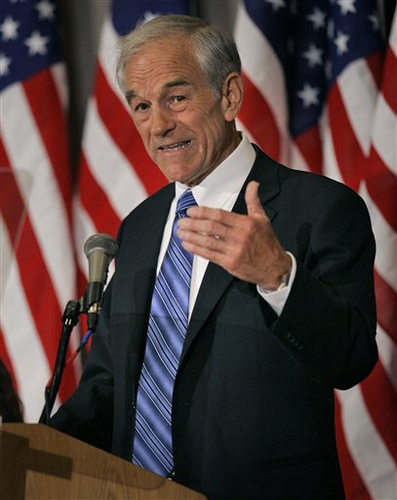 MEDIA ROOTS — As Republican Presidential Candidate Ron Paul seduces progressives, we take a look at some perspectives and analyses of Ron Paul’s rhetoric as well as Paul’s published political agenda, such as the $1 Trillion ‘Restore America‘ Austerity Plan— to cut the Pentagon 15%, but Food Stamps 63%, S-CHIP 44%, Medicaid 35%, WIC 33%.