 MEDIA ROOTS — When Naomi Klein’s seminal book The Shock Doctrine hit the scene, the U.S. political Left was forced to look beyond simply complaining about conservatives or Washington corruption and was stimulated to pay closer attention to the actions of Wall Street and the world of economics.
With the introduction of concepts, such as economic hitmen and disaster capitalism, and the rise of economists, such as Dr. Michael Hudson and Dr. Richard Wolff, economics has seen resurgence in the minds of the working-class, especially since the Great Recession and the advent of the OWS Movement. After witnessing ostensibly liberal Obama stuff his cabinet with Wall Street players and facilitate massive ‘bailouts,’ or legalised theft, we’ve become ever more compelled to understand how economics is mystified by elites in order to widen inequality.
One particularly compelling figure offering a critique of the world of business and finance is Catherine Austin Fitts. Fitts was likely the earliest proponent of moving one’s money out of monopolistic Wall Street banks to local credit unions and keeping community money as local as possible with a view toward even more progressive banking paradigms.
Recently, Catherine Austin Fitts visited KPFA Radio’s Berkeley studios to discuss a broad range of socioeconomic issues with Bonnie Faulkner, host of Pacifica Radio’s “Guns and Butter.”
Bonnie Faulkner began by asking Catherine Austin-Fitts about the Federal Reserve allowing BofA to dump $75 Trillion in derivatives on U.S. tax-payers.
In this engaging and far-ranging discussion, Austin Fitts parsed manifold topics, including the two-tiered financial system; corruption at the Department of Housing and Urban Development; collateral fraud leading up to the housing bubble; the mechanics of FHA collateral fraud; the evisceration of the U.S. educational system and shipping jobs overseas, leaving students encumbered with enormous school debt and dwindling employment prospects; and the ruling-class profiting from student loans, financial engineering and manipulation, and, ultimately, financial coup d’état.
Towards finding solutions, Austin Fitts described her work with Hamilton Securities, the concepts of the Popsicle Index and Community Wizard, prototyping community venture funds, and ideas for keeping capital within one’s local community. In telling this particular story, Austin Fitts exposed what the ruling-class establishment (via the Department of Justice) did with the prosecution of Hamilton Securities in retaliation to her efforts.
One may question capital itself, but en route to such questioning, Catherine Austin Fitts provides plenty of food for thought.
Messina
***
GUNS & BUTTER — Unpacking Mr. Global, Part 1
“You know, if you look at the black budget being financed out of HUD, one of my theories was it was really being managed from the National Security Council. And so I started to get involved for a variety of reasons, not just this, and 9/11. And Kyle Hence from 9/11 would invite me to speak on 9/11 in Washington. And every time I made an appointment to speak, the judge would announce a hearing at that time.” —Catherine Austin Fitts
Bonnie Faulkner (4:57): “I’m Bonnie Faulkner. Today on Guns and Butter: Catherine Austin-Fitts. Today’s show: ‘Unpacking Mr. Global, part 1.’ Catherine Austin-Fitts has been an investment banker, a government official, an entrepreneur, and an investment adviser. She was a Managing Director and Member of the Board of Wall Street firm Dillon, Read, & Company Incorporated, Assistant Secretary of Housing and Federal Housing Commissioner in the first Bush Administration, President of the Hamilton Securities Group (investment bank and financial software developer), and is currently Managing Member of Solari Investment Advisory Services and Sea Lane Advisory. Catherine’s experiences on Wall Street and in Washington D.C. are chronicled in Dillon, Read and the Aristocracy of Stock Profits. Today, we discuss the crisis in the financial system, fraud at the Department of Housing and Urban Development, collateral fraud, and a two-tiered economic system. Catherine Austin-Fitts, welcome.”
Catherine Austin Fitts: “It’s great to be back, Bonnie.”
Bonnie Faulkner: “Catherine, it’s great to have you right here in Berkeley in person.”
Catherine Austin Fitts: “I know, in the studio. It’s fabulous.”
Bonnie Faulkner (6:07): “In an article on Bloomberg, October 18th, entitled ‘BofA Said to Split Regulators On Moving Merrill Derivatives to Bank Unit,’ the Federal Reserve has allowed the Bank of America holding company (BAC) to transfer $75 Trillion of derivatives from its Merrill Lynch affiliate to the Bank of America, putting the Federal Deposit Insurance Corporation, the FDIC, on the hook to cover depositors’ losses in case of bank failure. It seems that the FDIC does not agree that this transfer should have taken place. Bank of America has over $1 Trillion dollars in deposits. Could these deposits be wiped out by their derivative exposure?”
Catherine Austin Fitts (6:54): “I think, in theory, yes, if the FDIC doesn’t basically make good on their deposit insurance. And I think the question is not will it wipe out the BofA deposits in the event of a BofA bankruptcy or default. The question is will it wipe out the FDIC. ‘Cos what you’re seeing is the FDIC guarantee being put behind the liquidity of those derivatives. And I’m assuming, if the Federal Reserve did this, and we don’t know the whys and wherefores, but if they did this, it’s because they were concerned about the liquidity of this book. And it’s a way of saying to the marketplace this book is strong and can maintain its contracts. But what it does mean, Bonnie, is that you’ve basically got the Federal credit now financing and funding the most speculative positions on the planet. And this gets back to the whole question of what didn’t get done in the Dodd-Frank Bill, which is ‘why are we giving Government guarantees to speculative investment activity?’ Now, I’m assuming, if the Fed did it, it was because they were afraid it could literally take the economy down. But what we’re watching throughout society is a class society that’s divided between the people who can use the Federal credit to do almost anything and people who have to earn credit in the marketplace the old-fashioned way. And it’s one of the reasons that we’re centralizing the economy because you have insiders being able to do unbelievable things with the Federal credit. And one of the reasons we got there is by chipping away at the historical rules that said, ‘if you got depositor credit, you only could do certain things with it.’ You certainly couldn’t engage in wild, speculative activity, let alone derivatives. But here we are.”
Bonnie Faulkner: “Right. Is there $75 Trillion dollars in the world?”
Catherine Austin Fitts (8:55): “Um, there is certainly $75 Trillion dollars of value in the world. When you look at the way derivatives price, the notational value can be much higher than the present value of the position. So, you get these numbers that look far greater, you know, you get something that’s worth a dollar and its notational value is $25 dollars, or many multiples of its value. There’s a tremendous amount of value in the world. And one of the problems is we’re basically reengineering that value over time to be used in certain ways through the derivatives market. It’s a way for insiders, literally, to rig forward how the world’s gonna be managed. You know, you lock in the future and then everybody has to go there because otherwise it’ll crash the global financial system.”
Bonnie Faulkner (9:46): “Now, are these derivatives mainly credit default swaps, that is, insurance on derivative bets made by other financial institutions, many of which are European banks?”
Catherine Austin Fitts (9:57): “There are many different kinds of derivatives. One kind is the credit default swap, which is: I do a transaction with another party, but I don’t want to accept their credit; so, I go out and I get insurance. And we saw that type of derivative be a very important part when the housing bubble crashed because so many players had bought credit default insurance, essentially, from AIG, and AIG was not able to stand by it. And that’s when the Government interceded. The biggest use of derivatives is also interest rate swaps. So, one of the reasons we see interest rates low and not going up in situations where you think there might is there’s such enormous positions being used to swap interest rates out in the future to keep interest rates down. A variety of us believe that that’s being engineered by the central banks and Government because it’s such a big position. And there’s really, you know, other than Government and the central banks, there’s nobody on the other side. So, I would say credit default and the interest rate swaps are the two primary kinds.”
Bonnie Faulkner (11:01): “Bank of America’s credit rating was downgraded a month ago. Do you think this is significant?”
Catherine Austin Fitts (11:07): “Yes, I think it’s significant. I think Bank of America is having a variety of problems. And I think what we’re watching, among other things, is the banks, both in Europe and the United States, struggling through huge debt positions that were never economic to begin with. So, that was a matter of policy. We decided to make a whole lot of loans, both for government and on mortgages and consumers that was, essentially, fraudulent inducement. So, I think that’s number one. Number two, though, I think that government has made a command decision, and I should really say the central banks and the government, to put the banks in a box. For the last 20 years we financed the Federal government with more and more debt being sold to the pension funds, more and more debt being sold to China. And I think we are now coming into a period when the banks are gonna be the new China. So, the banks are gonna be forced to raise deposits short and lend long to government. And be the intermediary that’s really reengineering how the sovereign government system works. So, I think the banks are kind of being put in a box. And Bank of America, if anybody in the United States right now, is number one on the hit list.”
Bonnie Faulkner (12:26): “What do you mean ‘the hit list’? Who’s the ‘hit list’?”
Catherine Austin Fitts (12:28): “Um, the hit list on a variety of players, but I would say, first and foremost, the regulators. I think the regulators are, uh, you know, we have excess capacity in the banking system. And when BofA bought Merrill Lynch, they took on a huge amount of contingent liabilities and legal liabilities. And I think they’re having to slug their way through that. And you also see BofA in California. California has the most underwater mortgages. And because it’s the biggest real estate market, um, big positions to work through. So, I think BofA is managing a huge amount of liabilities and legal liabilities within the system.”
Bonnie Faulkner (13:13): “Now, you mentioned regulators. Is the U.S. Government really regulating anything? It seems to me, from what I’ve been reading lately, they haven’t been doing much regulating.”
Catherine Austin Fitts (13:23): “Oh, I think, well, that’s because the regulation is political. You know, we have an official reality. And our theory is that regulators are supposed to implement that official reality. And because they’re not implementing that official reality we say they’re not regulating. And, instead, if you look at regulation as a political force to be used to get the system where it’s really wanted to go, I think they are doing that very well. So, I do think they’re constructing a structure where the banks will be the new Chinas, if you will. The banks will really, remember ‘cos the Government needs the banks to keep organising and managing the dollar system and the Government financing. And they’re putting more and more pressure on the banks to do it exactly as they wish, so that you have a little power struggle. And I think the regulators are doing that.”
Bonnie Faulkner (14:16): “Well, now when you say that the banks will become the new China are you implying that the banks have gotten money out of the Government, so that they’re in a position to lend to the Government?”
Catherine Austin Fitts (14:27): “Sure. Let me give you an example. Um, when I left the Bush Administration in 1991, you know, we had that crash, the crash of the last housing bubble. And what happened was you had a series of banks, including Citigroup, at the time who was underwater. So, they had negative equity and the question was would the regulators shut ‘em down. And instead what Alan Greenspan did at the time was he ran a sharply upward sloping yield curve, which means you could borrow short or raise deposits as a bank would CDs. And this gets back to the use of the Federal credit. So, he could raise your CD or my CD at, let’s say at the time, X% and then proceed to take that money and buy a Treasury Security at, you know, 5½%-plus of what he was paying to take the thing. And so you could run just a matched, you know, a matched book and make a fortune. You know, so for every $100 Billion dollars you made $5½ Billion dollars of pure profit. And if you levered it, it was even more. And if you added derivatives it was even more. And, you know, it was a money-making machine. Now, here’s the interesting thing. If the Federal government is gonna finance itself, why does it need to pay the bank $5½ Billion on every $100 Billion to do that? Why can’t, I mean, if eBay let’s us go directly to each other, why can’t the Treasury just create an eBay and instead of using the bank as an intermediary, just raise deposits directly from citizens, right?”
Bonnie Faulkner (16:00): “Right.”
“If you look at any picture of the U.S. dollar, what it shows is since the creation of the Federal Reserve System, American savers have lost, one estimate by the American Institute for Economic Research in Massachusetts, is, as of five years ago, we’ve lost $17 Trillion dollars through debasement.” —Catherine Austin Fitts
Catherine Austin Fitts (16:00): “Right. Why can’t it? Well, because that game, that ballooning of the banks’ balance sheet, provides it with tons and tons of credit. Okay? And it’s that ballooning of the balance sheet that creates more and more money that allows it to borrow more and more money. Now, it debases our savings. If you look at any picture of the U.S. dollar, what it shows is since the creation of the Federal Reserve System, American savers have lost, one estimate by the American Institute for Economic Research in Massachusetts, is, as of five years ago, we’ve lost $17 Trillion dollars through debasement. Okay? Because what you’re doing is you’re ballooning the Federal credit in certain places and allowing that money to be used in certain ways, you know, directed politically. And this gets back to, are we gonna allocate our credit as a society according to some criteria related to economic performance, which most markets will do reasonably well, or are we gonna direct it politically? And that’s why among my group there are those of us, among us, who say the Soviet Union won the Cold War because, if you look at our society, both Government spending and Government credit, it’s unbelievably, unbelievably governmentised. Okay? And let me step back and give you an example because it’s one of the reasons that we’re being overwhelmed with complex rules, Bonnie, I mean, we’re being regulated to the ground.
“I’ll give you an example. When I was Assistant Secretary of Housing, I got to HUD and I couldn’t figure out why things were so complicated. And then it took me a long time, you know, why does gridlock keep happening? And, finally, I figured it out. At the time, we were originating $5 Billion dollars of mortgage insurance a year for apartment buildings, so mortgages on apartment buildings. And we had about $25 Billion dollars of demand for that $5 Billion dollars. And the reason was we were charging way below market. If we had charged a mortgage insurance premium related to market, we would have had $5 Billion dollars of demand for $5 Billion dollars of mortgage. So, I said okay, well, if you have $25 Billion dollars of demand at a cheaper price, don’t you just set rules of who you want to get it? So, all pink apartment buildings west of the Mississippi get first crack and second crack go to polka dot apartment buildings, you know, north of Boston. You know, whatever your criteria is, you set a criteria and you’re clear. And then, you know, $5 Billion will get that. And what I discovered was if you had that clear criteria the problem was the criteria wasn’t to the people who were gonna donate the most money to the President’s re-election campaign. See what I mean? So, we had the official reality criteria and then everything would come in. And you made the underwriting process unbelievably complicated, so everything would gridlock. And then the ‘right’ lawyers would just channel the ‘right’ applications through, so that the $5 Billion who were gonna contribute to the re-election campaign were the ones who got it. Okay? So, complexity served a purpose.
“Now, let me step back and go back to the BofA/Merrill Lynch story, or the enforcement story. We’re just printing massive amounts of unbelievably low-priced, cheap, Federal credit to a variety of, sort of, insiders. And then we create millions and millions of complex rules, so that we can sort of allocate that cheap credit because it’s way below any kind of market price. And what we do in those rules is we make sure that, you know, the insiders get it. And the outsiders get regulated or enforced [to death]. It’s funny. I don’t know if you’ve read Matt Taibbi’s book, Griftopia. He does a wonderful job of going into how we have two groups of, you know, sort of, two classes of society. And one is drowning in rules. And the other is above the law. And every time the above-the-law people offend everybody else because they’re above the law, the political process says, ‘Oh, we’ll pass more rules!’ You know? And the guys who are being, you know the outsiders say, ‘Yeah! More rules!’ The problem is those rules only come back and give burden to the, the first-class doesn’t have to obey the rules. So, what we’re watching throughout society is the debasement of everything economic from this process of cheap Federal credit and this two-class society, one that doesn’t have to obey the rules or can afford to spend a fortune, you know, playing the rules and then the rest of us who are just dying. You know, small business, most small businesses just drowning and overwhelmed by these rules. The food safety rules are being used to destroy small farms, destroy small food businesses, on and on and on. So, it’s a two-tiered society and it’s a highly complicated game.”
Bonnie Faulkner (21:23): “There was a segment on the BBC that went viral. An interview with a trader named Alessio Rastani.”
Catherine Austin Fitts: “Yeah. Very funny.”
Bonnie Faulkner: “They were asking him about the Eurozone Rescue Plan. He said, ‘Get prepared. The governments don’t rule the world. Goldman Sachs rules the world. Goldman Sachs doesn’t care about this Rescue Plan. All the traders care about is making money, not how all of this is going to sort itself out.’ He said that ‘in less than 12 months the savings of millions of people are going to vanish.’ Do you agree with his assessment?”
Catherine Austin Fitts (21:55): “Um, I, you know, I think that we are in an unbelievably volatile environment. And I believe the chances of a collapse scenario of the kind that you would think he was talking about are relatively small. It’s feasible, but I think it’s relatively small. I do think the possibility of going through another 2008 kind of scenario is reasonably good. And the possibility of tremendous volatility is reasonably good. I just finished writing a new article. I don’t know if you’ve seen it. It’s called the William M. Diefenderfer: The Financial Hit Man of Student Loans and that’s a perfect example where, Peter Drucker once said that the greatest governmental investment we ever made was in the GI Bill. It was a massive investment in human and intellectual capital. And if you look at the impact that the GI Bill had on the, sort of, the population and therefore on the health of the economy, it was tremendous. Well, what was our equivalent of the GI Bill? We did the reverse. We basically took all the young people, all our potential innovators, all our potential human intellectual capital, and we made sure that, unless they were very wealthy, by the time that they got out of college, they were completely locked into a position of indebtedness, which in many cases could never be paid off. Because the thing that’s interesting about it was the person that I mentioned, the financial hitman of student loans, was somebody who had been on my Board at Hamilton. And so there was nothing he didn’t know about the fact that we were sending all the jobs abroad and we needed to help people find new ways of creating income because, otherwise, their incomes were gonna plummet. So, he was on the Board of Sallie Mae and was part of the group when all the changes were made further locking in this model that would enable people to make money on students not being able to pay back their student loan.
“I thought I’d seen the worst, including derivatives rigging us into a negative future. But this is the worst thing I’ve ever seen because when you destroy the ability of young people to build a future and to innovate, you destroy the future itself.” —Catherine Austin Fitts.
“So, literally, you’re creating a corporate model where people could make more money from students failing and not being able to pay back their student loans than being able to pay them back when they knew that many would never be able to pay it back because we were shipping the jobs abroad. So, it’s the worst form of fraudulent inducement, very, very ugly. Well, you know, it’s funny. I said to somebody, I worked with a wonderful person who helped me with the research and I said, ‘You know, I thought I’d seen the worst that financial fraud can do.’ I thought I’d seen the worst, including derivatives, sort of, rigging us into a negative future. But this is the worst thing I’ve ever seen because when you destroy the ability of young people to build a future and to innovate, you destroy the future itself. You destroy the future itself, not just their future, but our future, our whole society’s future. It was like, why don’t we just get together as a tribe and commit suicide? It’s like those, you know, everybody taking acid and dying. I mean, it was just, I, you know, I couldn’t believe that a human being that I used to think of someone that I respected would even do that. It’s kind of like, you know, we’ve all lost our minds.”
Bonnie Faulkner (25:04): “Now, how do they make money on student loans defaulting?”
Catherine Austin Fitts (25:07): “Well, because you set it up so that if there’s, you know, different kinds of technical defaults or other problems that you can raise the rates or raise the fees.”
Bonnie Faulkner: “Yes.”
Catherine Austin Fitts (25:19): “And on student loans they tightened up the provisions that mean you can’t extinguish them in bankruptcy.”
Bonnie Faulkner: “That’s right.”
Catherine Austin Fitts (25:23): “Right. So, here you have somebody who is struggling and can’t pay back their student loan and so the amount that they owe back, the more they can’t pay it back, the more it goes up. So, you have the ability to keep them in the box and just keep charging more and more money.”
Bonnie Faulkner: “Well, right, then they’ve got that noose around their neck for the rest of their life. Right? Oh, I see what you mean.”
Catherine Austin Fitts: “Right. It’s a combination of fraudulent inducement and predatory lending and the inability to extinguish it in bankruptcy. It’s the worst thing I’ve ever seen. We have two pieces. If you go to my homepage at Solari.com, we have two pieces. One is a review of a wonderful book by an engineer student who went to Cal Tech and got into the student loan trap and has written one of the best books on, sort of, the student loan scam. So, we write a review of that and go through some of the more detailed provisions. And then I wrote this other one called William M. Diefenderfer: The Financial Hit Man of Student Loans. And that was because I wanted to, I wanted to take the problem and make it intimate. ‘Cos I had been on the Board of Sallie Mae and then after I left, Bill, who had been on my board, joined the Board of Sallie Mae. And a lot of the people at Sallie Mae were people I had known as a Board Member. So, I’m looking at this fraud. And these are people, these aren’t strangers, these are people I knew, including people I liked and respected. So, part of it is an exploration of, you know, what happened? It was very, just as a personal search for me, I, you know, I left the Bush Administration [in ‘91], Bonnie, and I came out and I said, ‘The fascists are gonna kill us all,’ because one of the things I had seen in the Bush Administration, I had literally seen a combination of the power that technology was giving to what I now call ‘the Break-Away Civilisation.’ And I saw the ‘Break-Away Civilisation’ operant.
“There was one very famous story where I was in a meeting with the Secretary of HUD. And he was quite upset that day and quite frustrated and it was almost a manic episode. And one of the regional, we were meeting with all of the regional administrators from around the country, and one of the regional administrators, he was yelling at him, in fact it was the California Regional Administrator. It was always California, which is the outlier. So, he said, ‘But Mr. Secretary, I had to do it; it was the law.’ And the Secretary went nuts. He just turned bright red. He said, ‘The Law! The Law!? I’m above the law! I don’t have to obey the law! I report to a higher moral authority!’ It was like the veil opened and you were in the ‘Eyes Wide Shut’ world. You realise, they really didn’t think they had to obey the law. I’ll never forget. There was another meeting where the Secretary was promoting something, which really was illegal. And I was trying to stop it because it was really outside of the Constitution. So, he said to the General Counsel, ‘Well, can we do it?’ And the General Counsel said, he used the eff word, he said, ‘Eff them. So what if it’s a violation of the law? By the time they sue in court and win we’ll be gone.’ There was no, government was just a power to be used to reengineer things in the way they wanted. Have you ever seen Charlie Ferguson’s movie ‘No End in Sight’ about the Iraq—”
Bonnie Faulkner: “No.”
Catherine Austin Fitts (28:46): “Oh, I recommend it. It’s the same kind of demonic lawlessness. Anyway, so I came out of the Bush Administration [circa ‘91]. I said, ‘Well, we need a plan.’ And one of the things I had discovered was the power of the internet and technology to so enhance the learning speeds in a community and between communities. Then I said, ‘We don’t have to go through these central systems.’ We can go direct. So, we can, just as we cab do an eBay on the asset side of the balance sheet, we can do an eBay for equity or for loans, you know? There’s a way that we can network with this technology. We don’t need to be a captive of Wall Street or Washington. And so I created Hamilton Securities Group and for a couple of years it was that bright shining moment when you thought anything was possible. And one of the things we did was we created a software tool called Community Wizard. And the idea of Community Wizard was that if you go and you study how we’ve organised government and governance in the United States, one of the things you find is we vote for political representation. So, we vote for a senator. We vote for a congressperson. We vote for a governor. But we don’t have an annual financial statement that shows us what happened to our money. So, if I buy corporate stock by law I’m required to get an annual report. And there are quarterly reports that say, ‘Here’s what we’re doing with your money. And here’s how we’re doing.’ But we don’t get the equivalent for Government. Now, when you realise, with all the software tools and what software can do, why not? You know? So, if I’m gonna vote for my congressperson, I need to see a sources and uses contiguous to the area of political representation on what’s going on with the money. And one of the things I discovered when I worked in the [G.H.W.] Bush Administration is if every voter had that 90% of this fraud would just stop. It’s amazing.”
Bonnie Faulkner (30:41): “Because there would be transparency.”
Catherine Austin Fitts: “Because when I go in and I look at the budget or the financial reports of the U.S. Government, they say here’s what’s going on in transportation everywhere. Here’s what’s going on in housing everywhere. But they don’t say here’s what’s going on in your congressional district.”
Bonnie Faulkner (30:57): “Right.”
Catherine Austin Fitts (30:57): “It’s function based, not place based. Now, with relational databases, which I discovered in 1991, you know, there’s no reason why it can’t be both. Why you can sort back and forth ‘cos the software can do it all. And one of the things I discovered when I was Assistant Secretary of Housing, I would get these lists of foreclosures. And then when I would go fly some place, I’d say, ‘Oh, we have ten foreclosures on this block.’ And you’d fly there and it was like an empty lot.”
Bonnie Faulkner (31:24): “No houses there.”
Catherine Austin Fitts: “No houses there! That’s when I realised, if everybody could get this data, including with geographical information software, ‘cos most of us are graphical. We don’t relate to text. You know, a lot of this fraud could stop because the best internal financial control is the citizen watching the money in the world that they drive around in now. ‘Cos that’s how a lot of the waste, and if you look at the collateral fraud, we used to have homes, well, I’ll tell you the funny story. And in this happened in both the [G.H.W.] Bush Administration and then my company Hamilton was hired back in on competitive bid to serve as Financial Advisor to HUD during the Clinton Administration. So, I dealt with it in both Republican and Democrat, um, we found places, Bonnie, New Orleans was one, where the Government was spending $250 thousand dollars per unit to build or rehab apartments and $50 thousand would buy and rehab a single family home in the same four-block area.”
Bonnie Faulkner (32:26): “Wow.”
Catherine Austin Fitts: “So, I went to see the woman who was the assistant to the person running that programme. And I said, ‘Mindy, we could have four or five homes for the price of one.’ And she turned bright red and said, ‘But how would we generate fees for our friends?’ And this relates to everyone because we’ve had 50, 60 years of ‘fees for our friends.’ So, there’s tremendous opportunity, I found, through Community Wizard to re-optimise Government money. And it gets back to where we started about this two-class, so much money is being spent, Bonnie, to prop up corporate stocks and to prop up insiders and then to pay everybody else to shut up and go along with it.”
Bonnie Faulkner (33:25): “You’ve been talking about Hamilton Securities, the company that you started.”
Catherine Austin Fitts: “Uh-huh.”
Bonnie Faulkner: “What happened there? That says a lot about what happened to you and that company and then the lawsuit that you had to bring.”
Catherine Austin Fitts (33:41): “Well, we, it’s one of those long, shaggy dog stories. I once had a woman introduce me at a wonderful conference. She said, ‘Who here has seen the movie enemy of the state?’ Have you seen ‘Enemy of the State’?”
Bonnie Faulkner: “Oh, sure.”
Catherine Austin Fitts: “I love ‘Enemy.’ And she said, ‘This woman played Will Smith in real life.’ And it’s so funny ‘cos when the movie starts out it opens up in Will Smith’s office, law offices a block from where my, it was right next door, it was right across the street. It was funny that the guy who directed ‘Enemy of the State’ at one point told somebody, ‘Thank her for just keeping this movie on the front of everybody’s—”
Bonnie Faulkner (34:17): “No, it’s a great movie.”
Catherine Austin Fitts: “Oh, it is. It’s a great movie. And I hate to say it; it’s more true than you might think. Although, Will Smith managed to get it all figured out in about six days and it took me 12 years. Anyway, but, um, what happened was we were doing a series of things, which if they were successful would really shift the model, the economic model. So, we were promoting things that decentralised. They decentralised knowledge. They decentralised technology. They decentralised the economic activity.
“They were all lobbying me for something that would make their stocks go up. But their stocks were not organised on a place-based basis. So, it was gonna make their corporate stocks go up, but it was gonna hurt the value of places. Everybody had the Dow Jones Index of the S&P 500. But nobody had a simple, understandable description of community wellbeing. So, that’s where I came up with the Popsicle Index.” —Catherine Austin Fitts
“So, one of the things we were working on is community venture funds. Think of it as like a little mutual fund for your community. And what I was very interested in doing when I worked in the [G.H.W. Bush] Administration for the first 30 days, Bonnie, I had the most amazing feeling of free-floating anxiety. I’m a very intuitive person. And the homebuilders would come in and the realtors would come in. And they’re all lobbying me for stuff and I was feeling more and more uncomfortable and more and more uncomfortable. And I couldn’t tell why. And finally I realised they were all lobbying me for something that would make their stocks go up. But their stocks were not organised on a place-based basis. So, it was gonna make their corporate stocks go up, but it was gonna hurt the value of places. So, I came up with a name because everybody had the Dow Jones Index of the S&P 500. But nobody had a simple, understandable description of community wellbeing. So, that’s where I came up with the Popsicle Index.”
Bonnie Faulkner (33:53): “Oh, right.”
Catherine Austin Fitts: “So, the Popsicle Index is the percent of people who believe a child can leave their home, go to the nearest place to buy a Popsicle and come home alone safely. Now, when I was a little girl growing up, I grew up in a very modest neighbourhood in West Philadelphia, but the Popsicle Index was very high. It was unthinkable a child couldn’t go up to Spruce Street, play the pins, buy a Popsicle, and come home alone safely. So, I started to say, well, all these guys want the Dow Jones to go up, but there’s no constituency for the Popsicle Index. And I realised, um, a second thing happened was my staff, it was at the end of the last housing bubble bust in ’89, and my staff brought in a list of foreclosures. We had 50,000 foreclosed homes at that time and massive defaults in mortgages. And there was this one town in New Mexico where 70% of the mortgages were in default and owned by Freddie, Fannie, and FHA.”
Bonnie Faulkner (36:44): “Wow.”
Catherine Austin Fitts: “And I said, ‘Well, that town we don’t need to aggressively service. That town needs to reinvent itself. Why don’t you have the town buy the mortgages?’ And they said, ‘That town doesn’t have any money.’ I said, ‘I’m from Wall Street! We would buy the world without any money. We’d just create an entity and issue shares.’ So I said, ‘Tell the town to create a trust or a [read] or whatever the structure should be and we’ll swap them the mortgages for the stock.’ And they looked at me like I was nuts. But that’s when I realised, ‘Oh, we need to create the equivalent of a venture fund or a mutual fund for a neighbourhood because if everybody in a neighbourhood who wants to own stock, and that stock can finance the businesses and real estate in that place, then the higher the Popsicle Index, the more money they make. So, we’ll get the financial system organised so they can make money, not just on functional enterprises going up, but on places going up. And so we were prototyping community venture funds. And that’s when I discovered that, you know, if small business has access to the capital within that place, then that capital won’t go to Wall Street. Wall Street has a problem with that. They were centralising and so small businesses were failing and they were financing franchises to come in and take over the market. And so you literally had a hit on small business going on. And what I was doing was basically reversing the financial flows that were making that hit financially feasible because imagine if all the small businesses in a place, and it would never be all, but if some of the small businesses in a place are financed through a vehicle where, in my IRA or 401K, I can buy that vehicle and then the more I shop locally the more I make in my 401K or IRA, well that changes the politics. Okay? And it also changes the politics of government money because all of a sudden the local players have mechanisms to start to compete for money. I’ll give you an example. And this was one of the problems with Community Wizard. I have rarely seen a community where the Federal Government wasn’t paying somebody $100 to $150 dollars an hour to do something that somebody in that community would love to do for $20 to $25 dollars. So, have you ever heard my food stamp example?”
Bonnie Faulkner (39:05): “No.”
Catherine Austin Fitts: “Okay. In 30-plus states, I think it’s 37 states, including Tennessee, if you get food stamps and you call in on the hotline, you don’t get somebody in Tennessee or somebody in the United States, you get somebody in India working for JP Morgan Chase.”
Bonnie Faulkner (39:18): “Oh, that’s right.”
Catherine Austin Fitts: “Okay, so what that means is I’m paying somebody money to not work in the United States and I’m also paying somebody in India to do a job that that person could do.”
Bonnie Faulkner (39:28): “Right.”
Catherine Austin Fitts: “Now, that’s paying twice.”
Bonnie Faulkner: “That’s right.”
Catherine Austin Fitts: “That’s not financially efficient. But those are the kinds, when you start to look at data on a place-based basis, particularly tax-payer money, that’s when you start to see those, what I call, arbitrages. Those opportunities to save money for tax-payers that in fact enhance the incomes and the equity values in that place. And you give small business the ability to compete in that way against big business. And big business is gonna lose a lot of business.”
Bonnie Faulkner: “Yeah, but they’re sending those jobs overseas for their own reasons.”
Catherine Austin Fitts (40:08): “Right.”
Bonnie Faulkner: “They’re not trying to help communities.”
Catherine Austin Fitts (40:10): “Right.”
Bonnie Faulkner: “I mean there’s a bigger reason why they’re doing that, right?”
Catherine Austin Fitts: “Well, in that case I would say they’re trying to control the food systems. If you drive across Tennessee you see tremendous amounts of beautiful land lie fallow. And, in the meantime, we are shipping in a billion dollars of food a year from, you know, including hundreds of millions of dollars from Latin America. And that is facilitating the industrialisation of agriculture globally. And so they wanna use Federal money to kick start that process. And it’s funny because oftentimes you’ll hear someone say, ‘Oh, well, big business can do it cheaper.’ Well, no, no, no. When you look at the entire ecosystem of that thing, so if we take food and we look at what we’re spending on the people who are not working or the people who are getting sick ‘cos they’re not eating fresh food and you go ecosystem-wide, what you realise is the agricultural system can do this one process faster, cheaper. But when you look at the whole ecosystem, it’s not saving money at all. It’s creating a very dysfunctional system. That gives these players control. But it’s not economically healthy and there’s a much better system.”
Bonnie Faulkner (41:27): “Oh, well, of course.”
Catherine Austin Fitts: “Right.”
Bonnie Faulkner: “No, but it puts control into certain hands.”
Catherine Austin Fitts: “Right.”
Bonnie Faulkner: “Exactly.”
Catherine Austin Fitts: “Right.”
Bonnie Faulkner (41:32): “Well, what happened to you at Hamilton Securities? I know you—”
Catherine Austin Fitts: “Well, I’m still asking that question. What happened was we had our offices seized and all of our software, literally, taken. They wouldn’t give it back. It took six years to get it back. And when—”
Bonnie Faulkner: “And that included this Community Wizard.”
Catherine Austin Fitts: “Yeah, well, when we finally got it back the most valuable pieces had disappeared forever. It was gone. So they seized. I started litigating. Well, the litigation started in ’96, but I first filed my lawsuits in ’98 and there were twelve pieces of litigation that went from ’96 to 2006—so, ten years, and interspersed with a variety of smear campaigns and very serious physical harassment that got unbelievably serious. And it was one of those things, Bonnie, they tried to do a fishing expedition to find something that they could, you know, they accused us of all sorts of wrongdoing. And then they went on a fishing expedition, trying to find a parking ticket to prove it.”
“When I wrote this story, I wanted a case study that would really help people who are not financial people to go into the inner workings of the financial system and see how Wall Street and Washington rig these deals. What’s the financial engineering that allows all this financial manipulation and financial coup d’état to take place?” —Catherine Austin Fitts
Bonnie Faulkner (42:34): “And you’re talking about the Government went after your company.”
Catherine Austin Fitts: “Yeah, the Department of Justice. And so it’s a long, shaggy-dog story. And I should just say I wrote a story that tells a lot of it and then puts up hundreds, thousands and thousands and thousands of pages of legal documentation. So, if you wanna know the whole story, have at it. It’s called Dillon, Read & the Aristocracy of Stock Profits. And it’s about this two-tiered system and how it’s engineered and I use a case-study of a prison company that was financed by my old firm on Wall Street, Dillon Read. So, it’s Dillon, Read & the Aristocracy of Stock Profits and the URL is dunwalke.com, D-U-N-W-A-L-K-E-dot-com. And if you go into the resource section was, when I wrote this story, Bonnie, I wanted a case study that would really help people who are not financial people to go into the inner workings of the financial system and see how Wall Street and Washington rig these deals. You know, how does, what’s the financial engineering that allows all this incredible, sort of, manipulation and financial coup d’état to take place? So, we put a resource centre that documents every part of the story. I mean, it just goes on and on and on. The reader Resource Centre is much, much longer than the, it’s really an on-line book. So, if you want the documentation go under organisations, under Hamilton Securities. There’s thousands of pages of the litigation and explanations, so I don’t wanna tell the whole shaggy-dog story. But, essentially, what happened was they wanted to have a housing bubble. And you couldn’t have a housing bubble if the honest people were in charge of HUD. And so you had to kind of get the honest people out. And we were the lead contractor for some very fine Government officials. And they needed us gone.
“And we went into the court in 2004 and the judge kept postponing the night before. He kept postponing because he kept hoping we’d settle. I kept saying, ‘No, I won’t settle, I won’t settle.’ So, we get into court and there’s nothing. They have no evidence. They have nothing.” —Catherine Austin Fitts
“So, what they did was they had a phoney-baloney scan-, so, we were accused of wrongdoing. And they went on a fishing expedition and couldn’t find anything. So, they were trying to falsify evidence and I caught them and was able to doc-, it’s all up there on the website. I was able to document them falsifying evidence. And so that stopped that. And then what happened was, that was sort of ’99, they came to us and said, we’ll settle because we tried to frame you and we can’t find anything wrong. And I got, I, sort of, got my back up, which is funny ‘cos I’m a lover not a fighter. And I said, ‘You know something? No. I’m not gonna settle. You have to come into court and produce evidence of wrongdoing ‘cos I have to prove that it’s an empty suit.’ Well, that’s when it got really ugly because the litigation went on ‘til 2003. It came from twelve pieces of litigation down to three. And I won the very big one in 2003. That’s when the poisonings got really bad. Because then the Government was in a pr-, you know, they had no way out. They had no face saved. They had no excuse. What was this all about, if there was never any evidence of wrongdoing? Why had they spent tens of millions of dollars and made so much noise? And what was this about?
“Well, of course, it was about, you know, you can’t run a housing bubble with a kind of collateral fraud in it with someone like me saying what I was saying. So, let me, I’ll finish this and let me come back to the collateral fraud because that’s the important takeaway from what happened to Hamilton. So, we won the big case in 2003 and then went back into the, there were sort of two courts involved, and went back into the other court and battled it out since 2004 and then went to settlement in 2006. And one of the reasons I agreed to settle was having gone through the first process and all the courts, I had proof that they had no evidence. It was really funny. One of my attorneys just couldn’t believe that they had nothing. That it was an empty suit. And I kept saying, ‘It’s empty, it’s empty, it’s empty.’ And we went into the court in 2004 and the judge kept postponing the night before. He kept postponing because he kept hoping we’d settle. I kept saying, ‘No, I won’t settle.’ So, we get into court and there’s nothing. They have no evidence. They have nothing.
“So, you know, what happened, Bonnie, was when you have these kind of fights, there’s what you’re fighting about, really, and then there’s the pretence that’s used to play the game. So, what we were litigating about was the pretence. The fight was about something else. And it was interesting. One of the things I finally realised was that the only way I could really stop it, in the ‘90s, was to launch a website with all the documentation. And the major lawsuit against us had been brought under seal. And we were not allowed to see it. And we were not allowed to know who was accusing us of anything. But they would always leak to the press. So, I had to address the allegations, but I could never force them into court ‘cos I couldn’t even see them. So, this went on for years and years and years. And finally what I did was I launched the website against my attorney’s advice and the key [time] was unsealed in a week. So, then the investigation kept going on and on and on. So, I finally got a wonderful reporter, Paul Rodriguez, wrote a story in Insight magazine, got the investigation [side]. So, one of the things I discovered was there was no point in fight-, you know, I had to address the specifics of the litigation I was dealing with, but I had to attack them on the real issues.
“So, let me give you an example. When Paul wrote the story, it came up on Friday. On Saturday, WorldNetDaily picked it up. And on Tuesday the HUD Inspector General was fired, who was one of the lead enforcers coming after me. Insight magazine had written a story about all the money that was going missing in the Federal Government, including HUD, there was massive amounts of money just disappearing out the back door through HUD. And the reporter writing the story and I met the following week. And HUD’s new financial statements had just come out. And I spent, I don’t know, ten hours walking through them with a reporter and helping them design specific questions to ask about what was going on financially at HUD. Now, he would have had to be a very significant insider at HUD to be able to, you know, sort of, unpack the information and develop these questions. The reporter faxed in those questions at 12:30 in the afternoon to the HUD IG’s office. At 4:30 in the afternoon, my attorney’s got a fax saying the investigation of me was over. So, I was attacking them, not on, you know, the little game, we were playing. I was attacking them on the fact that, if you look at what was happening financially, billions of dollars was being stolen out the back door at HUD. And that’s why they wanted the clean team out.”
Bonnie Faulkner (49:44): “So, then as soon as you attacked them on the real political issues, then it stopped.”
Catherine Austin Fitts: “Well, it changed. That piece of it stopped. I still had to go to court. And I’ll tell you. I used to get into this dance because if you look at the black budget being financed out of HUD, one of my theories was it was really being managed from the National Security Council. And so I started to get involved for a variety of reasons, not just this, and 9/11. And Kyle Hence from 9/11 would invite me to speak on 9/11 in Washington. And every time I made an appointment to speak, the judge would announce a hearing at that time. And it was really funny. And, of course, I couldn’t talk to my attorneys about this. They just didn’t want to believe there was any connection. So, finally one day I said to Kyle, Kyle called me and all the families were coming to the national press conference for a conference and so I agreed that I would speak. And then, sure enough, our judge announced a hearing that afternoon at like 1:30. So, I called Kyle and I said, ‘Can I go on first? Because if I have a car waiting and I go on first, I can make it across town.’ And so Kyle let me go on first and, you know, all the cameras were there. We had all the big, major media. I jumped in a cab, got over, walked into court, sat down, and the judge walked, he was so angry. He was looking at me like [laughs], and that’s when I said, ‘This National Security Council thing is probably true.’
Bonnie Faulkner (51:21): “You know, I remember back in the early days after 9/11, the unanswered questions—”
Catherine Austin Fitts: “Yeah.”
Bonnie Faulkner: “—that you were a part of—”
Catherine Austin Fitts: “Right.”
Bonnie Faulkner: “—that you were talking about. I remember that.”
Catherine Austin Fitts: “Right. It was a very a very fascinating story because I, when I first got involved in, what happened to me is in 1997 I said, ‘Look, I, you know, I would not be, I’m in a political mess. And the reason I’m in a political mess was because I didn’t see the game around me. So, I need to look at all the covert money flowing in and out of HUD and I need to understand, you know, what’s really going on. And so that got me into talking and learning from a lot of people who were trying to research and understand the corruption. And one of the things I discovered was that they were really thinking too small. First of all, they were, they’d get a little piece of information and they’d try and horde it. So, they weren’t sharing information and collaborating. But the second thing was that they were trying to answer, you know, they’d get a little piece of information about something where they didn’t see the whole picture. And they’d try to answer what was happening instead of asking questions because the worst thing you could do is diagnose, for example, never operate until you know what the diag-, you know, until what’s really going on.”
Bonnie Faulkner: “Right.”
Catherine Austin Fitts (52:46): “So, I really felt we needed a new way of collaborating and we needed a way of keeping something open and not bringing certainty until we really had knowledge or evidence. One of the wonderful researchers on 9/11, I think his, somebody X, do you remember him? He was a Canadian who published a series of articles in Scoop Media. But he came up with this, sort of, idea of unanswered questions. And I said, ‘That’s it. That’s what we need to do. We need to just, we do not have the power to create evidence in a court of law ‘cos we’re not the Government, we don’t have subpoena powers. But what we can do as citizens is we can ask questions.’ And so Tom [Flaco], I’d known Tom through the suppression of precious metals market and that group, and he had come to our press conference at the National Press Club and that’s when we decided, okay, let’s do the same thing. And because I had been an Assistant Secretary of Housing, that gave us the entrée to have a, you know, something at the National Press Club. So, we did. And it was very, very successful because before the architects and scientists that really built up a formidable book of analysis, you know, you needed the time when people could say, ‘I don’t know, but something’s wrong’ and ask questions. And as that happened, and it was very collaborative, it was very global, it just kept the space open and it kept it alive. And then over time, people who had real powerful expertise came in and took it over. And I think that’s when it really went.”
Bonnie Faulkner (54:17): “Well, what did you want to finish up saying about collateral fraud?”
Catherine Austin Fitts: “Collateral fraud is as follows. Let’s say I have a house. Let’s say the house is worth a hundred thousand dollars. And let’s say the person in the house can afford to support an $80,000 dollar mortgage. If I’d lend them a hundred-thousand-dollar mortgage, that’s predatory lending or fraudulent inducement or something like that.”
Bonnie Faulkner: “Because they can’t afford to pay—”
Catherine Austin Fitts: “Because they can’t afford to pay a hundred thousand.”
Bonnie Faulkner: “Yeah. And you know it’s fraudulent inducement because you as the lender know they can’t before, right?”
Catherine Austin Fitts (54:52): “Well, it’s only fraudulent inducement if they don’t know. So, let’s say they’re a software developer in an area where I know as a financial institution I’m financing those jobs moving abroad, but they don’t know it. That’s fraudulent inducement.”
Bonnie Faulkner (55:09): “But the person you’re lending to can’t know this.”
Catherine Austin Fitts: “Right.”
Bonnie Faulkner: “I see.”
Catherine Austin Fitts: “My failure to disclose to them something about their financial system that I know that they don’t know, that’s fraudulent inducement. Per my understanding.”
Bonnie Faulkner: “Yeah.”
Catherine Austin Fitts: “Okay. Collateral fraud is, while I’m at it, if I create nine other mortgages on that home, but don’t tell them, but put it into a mortgage-backed securities pool, which I layer with derivatives on top. Okay? So, now I’ve got one home and ten mortgages.”
Bonnie Faulkner: “Now, how do you get the ten mortgages?”
Catherine Austin Fitts: “Uh, I just create the paper.”
Bonnie Faulkner: “Oh, I see. Yeah, okay.”
Catherine Austin Fitts: “I just, they’re fraudulent.”
Bonnie Faulkner: “Yeah. Right.”
Catherine Austin Fitts: “Now, the question is, how do I keep paying the debt service on the nine mortgages?”
Bonnie Faulkner: “Right.”
Catherine Austin Fitts (55:45): “And we used to see these communities. It used to happen a lot in Chicago where you’d see one house default five times a year. And you’d think, ‘How can a house default five times a year?’ And what you realise is they were churning those houses, I think, to generate the debt service to keep the mortgage debt service paid on the pools full of fraudulent mortgages. So, I think what happened was—”
Bonnie Faulkner: “Well, now wait a minute. When you say ‘they were churning’ the houses to raise the money to service the debt, how were they ‘churning’ them? What do you mean? They were loaning them out to more people?”
Catherine Austin Fitts (56:16): “So, let’s say I bring drugs into a community.”
Bonnie Faulkner: “Yeah.”
Catherine Austin Fitts: “Okay. And so now I’ve got a hundred thousand dollars of drug profits.”
Bonnie Faulkner: “M-hm.”
Catherine Austin Fitts: “But I need to launder it ‘cos it’s not clean.”
Bonnie Faulkner: “Right.”
Catherine Austin Fitts (56:29): “So, I buy a real estate property for a hundred thousand or let’s say I buy it for $80,000 and I do some slap-dash rehab for $20,000 dollars. Okay, so I’ve got a hundred thousand dollars in it. I turn around and sell it to a straw buyer. I get a phoney-baloney appraisal and I sell it to a straw buyer for $200,000. Okay, so now I’ve got $200,000 and it’s been washed by the sale. So, it’s clean.”
Bonnie Faulkner: “Okay.”
Catherine Austin Fitts: “So, my money’s laundered. I’ve doubled my money. I have to pay a couple of bribes, but let’s say I’ve got $180,000. Okay, that’s a quick profit. Um, you default. The straw buyer defaults immediately on the mortgage. It goes back into the FHA Fund. Okay, so now the FHA Fund owns the foreclosed property. I take $80,000 from my $180,000 and I buy the property again. And I keep doing it. And I can generate significant profits. Let’s say I do it five times. And let’s say I can generate $400,000 to $500,000 dollars in pure profit. I’m just pulling money out the back door of the Fund.”
Bonnie Faulkner: “You’d make a good criminal.”
Catherine Austin Fitts (57:30): “Yeah. [Laughs]”
Bonnie Faulkner: [Laughs]
Catherine Austin Fitts (57:30): “It’s really funny. One guy who’d do Iran-Contra frauds swore to me that Oliver North used to say that HUD was the candy store of covert revenues. And it’s funny because what happened was my lawyers got me to record history of my chronology, all the, sort of, problems I had dealing in the [G.H.W.] Bush Administration. And after I had recorded it, I listened to it and then through the process of doing the research on the litigation, I started to meet all sorts of people from the intelligence agencies who had done that kind of fraud. And they would explain to me how the different frauds worked. And then I would go back and look at what had, and I was like, ‘Oh, that’s what that was about! Oh!’ You know, finally, it all made sense. You know, until then I felt like I was living in a puzzle palace. So, I took a lot of the fraud back and sort of compared it, unpacked it. But my guess, Bonnie, is during the ‘80s we had a huge amount of fraud in the housing bubble in the ‘80s. And I was part of cleaning it up in ’89 and ’90, including the fraud at HUD. And I think what happened in the ‘90s is, given securitisation and then derivatives on top of it, I think the collateral fraud has been so enormous that you literally can’t mark-to-market ‘cos it’s too much.”
Bonnie Faulkner (59:00): “Right.”
Catherine Austin Fitts: “And we’re seeing a variety of things being done very surreptitiously and with the bailouts. ‘Cos, think about it, when the bailouts happened, $8 Trillion dollars would have paid out all the residential mortgages in the country.”
Bonnie Faulkner (59:14): “Is that right? $8 Trillion?”
Catherine Austin Fitts (59:14): “Right. So, the bailouts were $12 Trillion. They were 150% of all outstanding mortgages or supposed to be. And I think one of the reasons you saw bailouts so much greater was because of the collateral fraud in derivatives. And you know all this. You know, one of the things I always tell somebody who is negotiating on a foreclosure is, ‘Demand to see the note.’
Bonnie Faulkner: “Yes.”
Catherine Austin Fitts: “And in many cases you find these cases where people can’t get the note. And I think one of the reasons is ‘cos there’s not one note, there’s ten notes and the system has so much fraud. I think that’s one of the reasons they created the MERS System [Mortgage Electronic Registration System]. So, you didn’t have to go through the local courthouse. You could go through the local courthouse on one, but then you could do the rest of it behind MERS.”
Bonnie Faulkner: “And that’s a computer system, right?”
Catherine Austin Fitts: “Right. It’s a national computer system. And it’s funny because, you know, I started to tell people this in 1998 and told them all the way through to 2008. You know, it’s now 2011 and they’re still trying to grapple with it. And that is, you know, if outstanding mortgages are $8 Trillion, it wouldn’t surprise me if there’s another $2 Trillion of collateral fraud or more because the system got that completely out of hand and out of control. Or I shouldn’t say it got out of hand and out of control. It got that busy financing things that have nothing to do with the law or the official story as we know it. I don’t, in one sense I don’t think it was out of control, I think it was doing what it was supposed to be doing.”
Bonnie Faulkner: “I’ve been speaking with Catherine Austin Fitts. Today’s show has been ‘Unpacking Mr. Global, Part 1. Catherine Austin-Fitts has been an investment banker, a government official, an entrepreneur, and an investment adviser. She was a Managing Director and Member of the Board of Wall Street firm Dillon, Read, & Company Incorporated, Assistant Secretary of Housing and Federal Housing Commissioner in the first Bush Administration, President of the Hamilton Securities Group (investment bank and financial software developer), and is currently Managing Member of Solari Investment Advisory Services and Sea Lane Advisory. Catherine’s experiences on Wall Street and in Washington D.C. are chronicled in Dillon, Read and the Aristocracy of Stock Profits. Visit her website at Solari.com. That’s www.solari.com. ‘Guns and Butter is produced by Bonnie Faulkner and Yara Mako. To make comments or order copies of shows, email us at [email protected] . Visit our website at www.gunsandbutter.org.”
An audio archive of “Unpacking Mr. Global, Part 1″ may also be found here.
Transcript by Felipe Messina
Image by flickr user alancleaver_2000



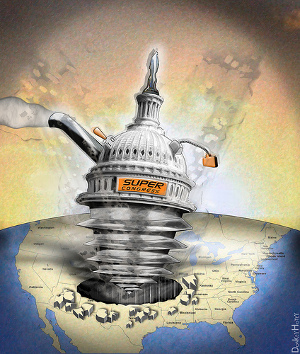 MEDIA ROOTS — With the Occupy Movement rightly putting
Wall Street and the ruling-class on blast, the Federal Reserve and the
mechanics of our national money supply in relation to our national economic
health and body politic, equally deserve scrutiny.
Despite the complexities of finance, the money supply, and Congressional
budgets, we must consider such questions of political
economy, and seek to understand them. In a recent article, Ellen Brown, author of Web of Debt: The Shocking Truth About Our Money System and How We Can Break Free, discusses the autocratic Congressional Super Committee.
MEDIA ROOTS — With the Occupy Movement rightly putting
Wall Street and the ruling-class on blast, the Federal Reserve and the
mechanics of our national money supply in relation to our national economic
health and body politic, equally deserve scrutiny.
Despite the complexities of finance, the money supply, and Congressional
budgets, we must consider such questions of political
economy, and seek to understand them. In a recent article, Ellen Brown, author of Web of Debt: The Shocking Truth About Our Money System and How We Can Break Free, discusses the autocratic Congressional Super Committee. MEDIA ROOTS — When
  MEDIA ROOTS— Recently, economic journalist Doug Henwood was interviewed on Pacifica Radio’s “
 NEW SCIENTIST
 THE WASHINGTON POST