MEDIA ROOTS — In a predawn raid this morning, under direct orders from Oakland Mayor Jean Quan, riot police stormed the Occupy Oakland
encampment at Oscar Grant Plaza in another coordinated multi-agency “mutual aid” operation
costing the City of Oakland upwards of half a million dollars in an attempt to
crush the peaceful Occupy Oakland (OO) movement once and for all.
Rioting cops beating students at UC Berkeley illegally wore no name tags to
hide their identities. Observers at Occupy
Portland have also reported similar violations by riot cops. We can thank Obama for the
Federalisation/militarisation of local police.
As with the ‘mutual aid’ repression of dissent at Occupy Oakland, riot
cops at Occupy Portland have consisted of Portland cops and other police
agencies from neighbouring forces.
Initially, Oakland Mayor Jean Quan appeared interested in co-opting OO through
photo ops with MoveOn.org, a tool of her Democrat political party. On October 15, 2011, during a MoveOn ‘Jobs
Not Cuts’ rally following a march from Laney College, widely misreported as an official
OO event, adjacent to Oscar Grant Plaza, Quan refused to abide by the horizontalist
ethic of OO when she refused to wait her turn to speak before the OO General
Assembly. Filmmaker Michael
Moore made note of this fact during his visit of solidarity to OO, noting Quan
“didn’t wanna wait in line.” MoveOn was
even asked by OO not to end their march at the plaza, which they disregarded.
After the failed attempt to attach establishment politics to OO and before conveniently skipping town to D.C., Quan gave
the green light to Oakland Police Chief Jordan’s militarised storm-troopers to
attack the OO encampment with chemical agents, flash-bang grenades, and ‘less-than-lethal’
projectiles.
Many were injured by the police assaults and at least one, Scott Olsen,
an Iraq War veteran, was sent to the hospital in critical condition with a fractured skull after being shot in the head at point-blank range by a police projectile. Quan attempted to
navigate the backlash against the police brutality by absurdly claiming the
police showed restraint and suffered abuse.
This absurd drama led up to the historic OO
General Strike earlier this month.
The following night, the Oakland City Council heard from an overflow crowd
of OO supporters, including 118 overwhelmingly supportive speakers, during public
comment. Public comment speakers pointed
out many demonstrators attempted to intervene to stop vandals during the
General Strike marches.
Quan, Oakland Police, and reactionary City Council Members were now fully determined
to smear and crush OO. Quan shifted to exploiting
pre-existing rat infestations, sanitation issues, and other persistent issues
in Downtown Oakland as pretexts for smearing OO.
One speaker before the Oakland City Council, seminarian Suzi Spangenberg, countered
the allegations against OO:
“If you’ve been to an Oakland Raiders game, you have seen people engaging
in violent acts. You do not hold everyone at that game responsible for the acts
of a few.”
Indeed, there were some 100 arrests late in the evening after the OO General
Strike shut down the Port of Oakland; we’re talking less than 1% of the
peaceful demonstrators. And most of those arrested were either unrelated ‘Black Bloc’ opportunists engaging in property damage or innocent bystanders corralled by the riot police. Aerial estimates
have confirmed the participants numbered in the tens of thousands. No, we cannot hold the 99% guilty for the
crimes of the 1%.
James Vann, a longtime Oakland housing advocate and a
central figure in Oakland Mayor Jean Quan’s election campaign, was one of the
first to speak during the Public Forum.
He spoke with KPFA radio, which covered the entire City Council meeting
live:
“Yes. I think it
was a beautiful day. For the most part
everything went beautifully, went well, went exceedingly well. And it was only late last night, and I guess
part of the march against the banks yesterday, where there’s a dissident group
among the occupiers who don’t respect law and order.
“I think last night this group pretty much identified
themselves, by taking over another building.
That was not part of the Occupy Oakland activity. And so that group, I think many of those in
that group, ultimately, were arrested last night. So, the City now, the police, can identify
most of those people in the dissident group.
“Yes, unfortunately there were some who broke
away. There were also members of the Occupier
contingent who attempted to try to control that and put themselves between
these dissidents and the rest of the march.
But they were intent on destruction.
So, this is a group that does not respect the general objectives of the Occupy
Movement.”
In the wake of today’s latest raid against OO, Quan has also claimed OO had
moved away from its original goals to further justify her actions. The claim
is baseless, but the Democrat Mayor was determined to smear and clear the encampment
by any means.
With Wall Street-driven elections coming up on the horizon, the ruling-class
cannot allow the Occupy Wall Street (OWS) Movement to continue to have the kind of impact its had
upon the national body politic and its discourse, which has forced local,
state, and Federal leaders to acknowledge the glaring problems with a socioeconomic
system run for the benefit of the ruling-class 1% of the population controlling
almost half of its wealth against the interests of the working-class, the 99%.
Instead of acknowledging the glaring timeliness of the global OWS Movement during the nation’s worst economic crisis since the Great
Depression and OWS’s historic significance as a political force that isn’t going
away, even in the face of police-state repression, local city governments
have treated OWS encampments as public nuisances to be swept under the rug. The nationwide crackdowns appear to be encouraged at the behest of a nation-wide Homeland Security-type repression of dissent in line with the P.A.T.R.I.O.T. Act.
In
the aftermath of the brutal police state crackdowns against OO on October 25, Oakland-based community organiser with the Oscar Grant Committee Against Police Brutality and State Repression, OO supporter, Rachel Jackson spoke with Pacifica Radio’s “Flashpoints” to contextualise the
militarisation of local police toward the repression of political organisation
and dissent:
“I
think it’s important, too, to remember that this is coming on the heels of what
we saw of three years now, of this ‘mutual aid’ being enacted in response to
uprisings against the murder of Oscar Grant ever since January of 2009. We’ve seen the people of Oakland, and really
a lot of the real base of Oakland and the [historic] section of Oakland, the
people of colour, and low-income communities have burst out onto the
scene. And it was that mass action that
forced the state and the [now-retired] District Attorney [Thomas Jensen
Orloff], in particular, to bring charges against Johannes Mehserle for the
murder of Oscar Grant in the first place.
“And,
so there was this, you know, we’re not confused about the fact that these
test-cases and these drills, operations, this sort of, this testing living
laboratories of police state is happening here in Oakland, not because we’re
weak, but, in fact, because we are strong.
And we know that the tear gas canisters, and the pepper spray, the
flash-bang grenades, the canister and concussion grenades that has put Scott
Olsen in the hospital with a fractured skull was fired by the Alameda County
Sheriffs Department acting under the OPD and, of course, with, as you pointed
out, with Federal oversight.
“And
these particular processes of enacting this ‘mutual aid’ and the acquisition of
these tools of repression, we know for a fact that these things were purchased
during the past, like since January of 2009, so that the police could prepare,
and the Feds and Homeland Security and the many, we had 33, some 33 or more
agencies just for the [Johannes Mehserle] verdict on July 8th, 2010
and the operation sentencing on November 5th [2010]. And we’ve gotten Public Records Act requests
and documentation. They have Power Points where they showed all of the stuff that they bought, including…many of the tear gas canisters and…many of the M84 concussion grenades.”
So,
the militarisation of local police has, indeed, been underway in post-9/11 U.S., ostensibly under the pretext of the ‘War on Terror.’ But it’s becoming increasingly evident the
sole purpose is repression of dissent, as done in Oakland under Quan.
And although OO has denied any correlation between the tragic murder of
Kayode Ola Foster in Downtown Oakland last Thursday, Mayor Quan has alleged the
peaceful encampment was to blame. Oakland has seen at least 70 murders
this year and 94 in 2010.
After authorising unsuccessful brutal police crackdowns to crush OO, Mayor
Quan also exploited the tragic murder of Foster as a pretext for moving to
dismantle the encampment. One of Quan’s legal advisers, Dan Siegel, resigned in protest over the clearing of the OO
encampment. Quan’s Deputy Mayor also resigned in protest a few hours later. Whilst some protesters moved to Oakland’s Snow Park a few
blocks away, at least one has begun a tree sit-in at Oscar Grant Plaza and
vowed to remain there indefinitely.
OO called a protest action convergence at the Oakland Library this afternoon
at 4:30pm. At presstime, OO reported:
“The occupiers began marching shortly before 5 pm with about 1000
marchers. The march reached the plaza at 14th and Broadway with over 2000
people and immediately convened a General Assembly. At first occupiers
used the human mic, repeating each phrase in waves across the crowd but within
the hour amplification was in place and as of 6:30 pm an assembly is
underway.”
Written by Felipe Messina
***
SF APPEAL— An early-morning police raid to break up the Occupy Oakland
encampment has left Frank Ogawa Plaza devoid of protesters today–except for
one lone holdout who is perched in a tree.
Zachary Running Wolf is sitting atop a small wooden platform, tied to the
tree, and is being largely ignored by police for the time being.
Police Chief Howard Jordan said at a morning news conference that police are
leaving him be as they look into what his legal rights are to be there.
This morning, he could be heard shouting from the tree, “This is native
land. I’m not coming down.”
Running Wolf is a familiar name in the East Bay, where he has run for City
Council in Berkeley and was involved in the lengthy tree-sit at the University
of California at Berkeley several years ago to protest the removal of a grove
of trees to make way for a new sports training center.
A protester on the ground nearby who identified himself as
“Fireball” said Running Wolf represents the encampment’s “best
defense” right now.
“The cops can’t get into the trees,” he said.
Fireball said Running Wolf has enough food and water to last several days.
Meanwhile, cleanup crews were quickly clearing the remnants of the
encampment from the plaza. The last tents had been taken down as of 11 a.m.
Oakland police Sgt. Christopher Bolton said those doing the cleanup are
trying to salvage anything that appears to be worth more than $100, and are
throwing out other objects.
City Administrator Deanna Santana said this morning that the city hopes to
have the plaza reopened for public use – camping excluded – by 6 p.m.
Thirty-two people were arrested when police raided the encampment early this
morning, most for illegal lodging, Bolton said.
MEDIA ROOTS – On Wednesday, November 2, 2011, the
Media Roots team was on the ground in the streets of Oakland witnessing some great energy and bringing you
first-hand coverage of the historic Occupy Oakland General Strike.
Although the corporate media tried to shift the focus from the crimes of the ruling-class to
petty vandalism by unrelated opportunists, for the tens of thousands in attendance, as this footage evidences, the daylong events were about solidarity and
peaceful protest against the obscene inequality borne of class warfare waged by
the 1% against the 99%. Various businesses closed in solidarity, as the Oakland City Administrator gave City workers the day off to participate.
Media Roots covered the day’s events from Oscar Grant Plaza
where a festive atmosphere of unions serving barbeque, speeches, arts, and
multicultural activities set the positive tone.
Participants included parents with children and teachers amongst the
diverse spectrum of people. As the day
progressed, the marches swelled to some 10,000 protesters with multiple marches
shutting down various Oakland banks, including Bank of America, Chase, Wells
Fargo, and Citibank. By that evening, tens
of thousands of peaceful protesters successfully shut down the Port of Oakland,
the nation’s fifth busiest port.
Messina
***
Media Roots delivers
first-hand coverage of Occupy Oakland’s historic General Strike.
MEDIA ROOTS— In 1946, Oakland was the last city in the U.S. to have a
general strike. Now, 65 years later, the people are going to shut the city
down again in another historic strike taking place tomorrow, November 2, 2011. Tomorrow’s strike was voted on last week at the Occupy Oakland General Assembly, where over 1,600 people voted in favor to “liberate Oakland and shut down the 1%.”
Media Roots will be on site in downtown Oakland during the strike doing real time coverage of the events and interviews with the participants.
Abby
***
SFIST– The proposed strike intends to close all banks and corporations for the
day, while calling on laborers, teachers and students to join mass gatherings at 14th and Broadway at 9 a.m, 12 noon and 5 p.m. on Wednesday. Support for the general strike extends beyond the protesters at Frank Ogawa Plaza, as the strike has also been endorsed by labor union SEIU Local 1021 and the the teachers of the Oakland Educational Association.
In addition to staging a walkout of businesses and schools, the protest intends to shut down the Port of Oakland by forming a picket line before the 7 p.m. night shift.
While we are calling for a general strike, we are also calling for
much more. People who organize out of their neighborhoods, schools,
community organizations, affinity groups, workplaces and families are
encouraged to self organize in a way that allows them to participate in
shutting down the city in whatever manner they are comfortable with and
capable of.
The whole world is watching Oakland. Let’s show them what is possible.
***
Occupy
Oakland held a press conference yesterday at Latham Square, the historic site of the
Oakland General Strike of 1946 at Telegraph & Broadway, to discuss the strike.
Occupy
Oakland General Strike Press Conference October 31, 2011
Among the speakers, Boots Riley (Oakland resident and
member of “The Coup” and “Street Sweeper Social Club”) read from an inter-office
memo from Oakland City Administrator Deanna Santana agreeing to SEIU’s call to
shield Oakland City workers from retaliation should they participate in
tomorrow’s historic Oakland general strike.
Clarence Thomas (of ILWU Local 10 and Million Worker
March Movement) is “a third-generation longshore worker” from the S.F. Bay
Area. Clarence Thomas spoke “as the Co-Chair
of the Million Worker March Movement:”
“The reason why I and other workers will be standing in
solidarity on Wednesday for the call for the general strike by the Occupy
Oakland Movement is because this is a movement about fighting corporate rule with
worker power. I’ll say it again, fighting
corporate rule with worker power, the 99%.
For the last 30 years, with the introduction of computer and othe
technology, American workers have been providing their employer with increased
production. At the same time, workers’
wages have remained stagnant. It looks
like this. That gap represents corporate
profits. The profits that the 1% have
been living off of, and participating in, to the detriment of the 99%. Today, only 7.2% of workers in the private
sector belong to a union. That is the
lowest percentage since the year 1900.
And one of the reasons for that is because of corporate rule run
amok. But we must be very clear about
something. This is not about a crisis on
Wall Street. This is capitalism run
amok. Capitalism has failed us.”
Elaine Brown (former Chair of the Black Panther Party,
now with SEUI/United Health Care Workers), Cat Brooks (of the Onyx Organizing
Committee), and School Teacher Javier Armas all joined Occupy Oakland occupiers
and others in this historic press conference.
Occupy Oakland features a growing list of endorsements
and statements of solidarity, including:
MEDIA ROOTS— On Friday, October 28, 2011, filmmaker Michael
Moore paid a visit to Occupy Oakland. He flew from Occupy Wall Street in New York to join in
solidarity with the current epicentre of the Occupy Movement in the wake of the brutal police-state
rioting on Tuesday night, which left 24-year-old Marine, Scott Olsen, in critical
condition after being shot in the head by a projectile fired by an officer of the
Alameda Sheriffs Department.
The Alameda County PD was just one of 17 police agencies involved in the
coordinated, riot-gear-equipped, raids against Occupy Oakland. In a press conference following the assaults, Oakland Police Chief Jordan has announced having taken unprovoked preemptive actions against the
peaceful protesters, which left Olsen in critical condition, left others with
broken bones, and terrorised the masses of Oakland with the tear gas laden shock-and-awe police-state tactics.
Michael
Moore calls attention to the militarisation of local police agencies, the
courageousness of Occupy Oakland protesters to peacefully assemble in the face
of police-state repression, and announces his hope of speaking with the
beleaguered Oakland Mayor Jean Quan, who, at presstime, has had a “change of
heart,” after authorising the police raids against Occupy Oakland and then
conveniently skipping town. Mayor Quan
has announced her sincere (or insincere) support for Occupy Oakland’s call for a
general strike November 2, 2011 in response to the police-state repression of Occupy Oakland’s
First Amendment rights.
“We’re
out there. We’ve been watching. Millions have watched it. And millions have been inspired by you
because the next night you didn’t go away!
You came back!!” – Michael Moore
After his speech, Michael
Moore made sure to speak with Pacifica Radio for a 15-minute interview (full
transcript below). Moore spoke in-depth
with Hard Knock Radio’s Davey D and Flashpoints’ Dennis Bernstein about a range
of topics, including Occupy Oakland, Mayor Jean Quan, the militarisation of
local police agencies, the brutal projectile-shooting of Scott Olsen (with
testimony from an eyewitness account), and the importance of a general strike
to the overall goals of the Occupy Movement spreading across the nation.
–Messina
***
Occupy Oakland Host: “ Mic
check one two. Can everyone, even in the
back, can hear me?”
Crowd:
“Yeah!!”
Host: “Okay,
great. It’s my pleasure to introduce
Michael Moore.”
Michael Moore: “Greetings,
Oakland! Occupy Oakland! Occupy Oakland! Occupy Oakland! Occupy everywhere!! I, I am honoured to be here, to be part of
this. Uh, to the media who are present, uh, let me stress to you, this movement has no spokesperson. Everyone here is a spokesperson. Everyone here, everyone here has a story to
tell. There are people here who have no
health insurance. There are people here
who do not have a job. There are people
here who are living in poverty. There
are people here who have jobs, but have been told to take less. And I invite you to interview the thousands
of other spokespeople who are here at Occupy Oakland. Someone asked me, ‘Who is the leader of this
organisation?’ [Guffaws] And I said, ‘We are all the leaders! Everyone here!’ We are all leaders. And we are all followers. We are all doing this together. The media and the power establishment is
having a hard time figuring this out. So,
be patient with them. They are used to
just a few people showing up with a few signs and then they go away and have a
meeting in the basement of the Unitarian Church. God bless the Unitarians, by the way. Those in charge in this country and the media
arm of Wall Street and corporate America were not prepared for this to be
happening in hundreds, hundreds of cities across this country right now! Hundreds! And it has, it has happened with no leaders, no organisation, no dues pay,
no dues to pay. It’s happened
organically from the grassroots, the true grassroots. And in my lifetime, I have never seen a movement
like this take hold this fast with this many people all across the
country. Thank you, everyone, all of us
for doing this. And there’s no turning
back, is there?”
Crowd: “No!!!”
Michael Moore:
“There’s no turning back!!”
Crowd: “No!!!”
Michael Moore: “I was
at Occupy Wall Street last night, in Zuccotti Park, Liberty Plaza, and I am
here to bring greetings from the original Occupy Wall Street. Thank you, Oakland! Thank you, Oakland!”
Audience Member (male):
“Power to the people! Power to
the people!”
Michael Moore: “I said,
I said, ‘What are we gonna do with winter coming?’ It was almost a freezing rain last night in
New York City. I said, ‘What are we gonna do with winter coming?’ And they
said, ‘There’s two guys over there right now who have flown in from Occupy
Anchorage.”
Crowd:
[Laughs]
Michael Moore: “And
they are here to consult with us on how to make it through the winter!”
Crowd:
[Laughs Cheers]
Michael Moore: “They
said there’s even an ice company in New Jersey that has offered large blocks of
ice to build igloos in Zuccotti Park.
The Mayor, and the Police, and Wall Street are hoping that the winter
will kill the movement in the same way that they don’t understand that this is
a leaderless organisation with tens of millions of spokespeople. They also don’t understand that weather is
not the problem facing us right now.
Climate change is facing us. But
the weather in New York City is not going to stop this incredible
movement. Let me just give you an idea,
uh, because I’ve been travelling the country, what I’ve seen. Uh, there’s a town about, maybe a hundred and
fifty miles east of here called Grass Valley, California. Are you familiar with it?”
Crowd:
“Yeah!!!” [Cheers]
Michael Moore: “Where
the hell is Grass Valley, right? No,
I know where it is. Nobody across the
country knows Grass Valley. And, of
course, the media doesn’t know Grass Valley.
But last weekend, in Grass Valley, there were 400 people participating in
Occupy Grass Valley. 400 people! There’s, there’s only a few thousand people
in the town. Alright? And, and everyone was there, old, young, out
of work, people with work, the spread of American society is at each of
these. You could see it right now. I can see it. I am sitting here looking at the mosaic that
this country is right now, right here in Oakland. This is—”
Audience Member (male):
“Hey cameraman, turn around and take a picture.”
Michael Moore: “We’ll
get the cameras to turn around here, just a sec-, you know, I don’t understand
it either. I’ve wondered this for a long
time. Uh, and I’ve tried to explain to
them that this is not what people want to be looking at while they’re eating
dinner and watching the six o’clock news.
So, I’m sorry. But I’m getting
healthy. And I’m now in my tenth month with
no red meat. [Guffaws]”
Crowd:
“Whoo!!!”
Michael Moore: “And
that will be the sound bite on the evening news.”
Crowd: [Laughs]
Michael Moore: “Now,
this is the first of these that I’ve spoken at where there’s an amplified sound
system. Um, what laws are we breaking
here?”
Audience Member (male):
“A lot.”
Michael Moore: “A lot
of laws? [Chuckles] Um—”
Audience Member (male):
“We set it up just for you!”
Michael Moore: “Thank
you! Thank you. Um, Mayor Quan is having a press conference
right now. Uh—”
Crowd:
“Boo!!!”
Michael Moore: “—upstairs. I sent her an email asking if we could, uh,
speak, um, while I was here. Uh, but I
have to tell you the other night, uh, both Tuesday and Wednesday night, um, not
being here and watching from afar, uh, what took place here, um, was really
horrifying, uh, to see this in this country.
Um, it made, it made, it made the rest of the people in the United
States aware of something that maybe many of you had been aware of for the last
decade and that is the militarisation of our local police departments.”
Crowd:
“Yeah!! [Cheers Applause]
Fuck the police!”
Michael Moore: “The
Congress is not allowed to tell the public how much is spent on Homeland
Security, but these local police departments all across the country over the
last ten years have sucked up, literally, billions of dollars to buy
sophisticated equipment, to buy armaments that you use in a warzone—”
Crowd: “Boo!”
Michael Moore: “—to buy
tanks, to set up spying systems.”
Audience Member (male):
“On our tax dollars.”
Michael Moore: “Yes, we
paid for this. And, um, and to prepare
for what they believe is the inevitable, which is the people, sooner or later,
aren’t going to take it any longer.”
Crowd:
“Whoo!!!”
Michael Moore: “Ten
years—”
Audience Member (male):
“Don’t protect the corporations!!!”
Audience Member (male):
“Fuck them!”
Crowd:
“Shhh. Shhh.”
Michael Moore: “Ten
years after 9/11, the majority of Americans realise who the real terrorists
are. They are the people who, who create
policies and who do things that literally do kill people. For instance, a Congressional Committee last
month released these figures. They wanted
to find out how many Americans die every year because, simply from the fact, that they
don’t have health insurance. They didn’t
go to the doctor ‘cos they didn’t have insurance. Nearly 45,000 Americans die every year simply
because they don’t have health insurance.
My friends, that is fifteen 9/11s every single year! A system, a system that is set up to harm our
own citizens! A profit-making insurance
system! Who said that it is morally
correct to make a profit off people when they get sick? Do ya, how, how sick is that? I can tell you—”
Audience Member (male):
“Neocolonialism!”
Michael Moore: “How
much money—”
Audience Member (male):
“Free America!”
Michael Moore: “—has
corporate America made from these two wars?
These two illegal, immoral wars?
How much have they made? We are
still spending over $2 billion dollars a week on these wars. What could we do with that money if it was
here in Oakland and Flint, Michigan and across the country? Somebody asked me, coming in here, ‘Who
organised this?’
Scattered Members of Crowd:
“We did!!”
Michael Moore: “Who
organised this? I know, I know, I know
you think we, the people, organised it, right.
[Laughs] Where is Wells
Fargo? I just passed it on the
street. If you want to know who
organised this, they organised it! The
people on Wall Street organised this!
Bank of America organised this! ExxonMobil,
BP organised this! They did more by
simply putting their boot on the necks of millions of Americans. And like any human being, like any human being,
how long can you keep a boot on your neck?”
Audience Member (male):
“Not one more second, we ain’t takin’ it no more!!!!”
Michael Moore: “Not
for one second with the boot on the neck.”
Crowd:
“Whoo!!!”
Audience Member (male):
“Go, ‘head, Mike.”
Audience Member (male):
“Oakland style, brotha.”
Michael Moore: “[Laughs] I know. He said, ‘It’s Oakland style. We’re doing this Oakland style.’”
Audience Member (male):
“Occupy!”
Michael Moore: “Let me
tell you something else I’ve discovered across the country. Um, and that is, um, America, contrary to
what maybe many here believe and the way it’s portrayed to us in the media,
America is not a conservative country.
Most Americans are actually quite liberal in their beliefs. They may not call themselves liberals, but if
you look at any of the polls, the majority of Americans, come down on the
liberal side of the issue on just about every single issue. The majority of Americans are against these
wars. The majority of Americans want
universal health care. The majority of
Americans believe women should be paid the same as men. The majority of Americans—”
Audience Member (female):
“That’s because they are the majority!”
Michael Moore: “—want
stronger environmental laws, not weaker ones.”
Audience Member (male):
“School closures! School
closures!”
Michael Moore: “And for
the first time last month, in a poll that was taken, for the first time 54%,
the majority of Americans, say they believe gay marriage should be the law of
the land.”
Audience Member (male):
“…legalise marijuana!”
Michael Moore: “That’s the country you live in. That’s
the, that’s the country you live in. And
I know to people in the Bay Area it may seem to get a little scary as you head
toward Richmond.”
Crowd:
[Laughs]
Michael Moore: “Did I
pick the right town?”
Crowd:
[Laughs]
Michael Moore: “I need another town. What? As
you head towards Walnut Creek!”
Crowd:
“Whoo!!!”
Michael Moore: “I was,
I was just trying to remember BART stops.
Um. Can I just put that down
there? (‘Yeah. I got you.’)
Um, but as you go, as you go across this country you see that that’s the
country you share, the people out there.
That’s why they’re int-, that’s why 72% last week said they believe
taxes should be raised on the rich, 72%.
So—“
Crowd: “Whoo!”
Michael Moore: “So, to
the media who are here, um, this is a few thousand people. But everybody here represents a few thousand
more, or a few ten thousand more, everybody here. That’s how large this is. That’s why it can’t be stopped. Too many people have been thrown out of their
homes. Too many people have had their schools
decimated to where their kids aren’t getting a proper education.”
Audience Member (male):
“Five schools are being shut down in Oakland!”
Michael Moore: “We now
live in a country with 40 million adults who are functional illiterates. How did that happen?”
Audience Member (male):
“We’re being oppressed!”
Michael Moore: “It
benefits, it benefits those in charge to have an ignorant population. To have a population with 40 million people
in it that cannot read and write above a fourth-grade level. Who benefits from that? It’s like they’ve set up the schools now to make
sure that you can operate the cash register at McDonald’s and you know how to
greet someone in a sentence with a noun and a verb in it as they come into
Walmart. Let me tell you, let me tell ya
who does know that this, that the people of this country have had it and that there’s
a very progressive thread and vein going through this country right now. That’s the other side, Wall Street, corporate
America, the right-wing, they know, they know this is a liberal country! All you have to do is turn on talk radio or
Fox News, they’re so angry, they’re so angry aren’t they? Let me ask you this. If this was a conservative, right-wing
country, wouldn’t, if you turned on Fox News every night, wouldn’t they just be,
‘Yip-a-dee-do-da, Yip-a-dee-day?’
They’re not that way, are they?
They’re like, ‘Aargh!’ Every
night, it’s ‘Raargh! Raargh!’ They’re, they’re just, they, there’s a reason
why they wanna suppress the vote next year.
There’s a reason why they’re passing laws throughout the country to make
it harder for poor people, for senior citizens, for people of colour to
vote. There’s a reason they’re doing
that. What’s the reason? They know, they know, no, it’s very simple, they
can do math. They know they’re in the
minority. They know they’re in the
minority. Otherwise, really, why would
you wanna suppress the vote if you thought America agreed with you? You wouldn’t do that, would you? No! If
you believed, if you believed that America was with you, you’d be setting up
voting booths in every aisle of every Walmart all across the country!”
Crowd: “Whoo!”
Michael Moore: “That’s
not what they’re doing. Um, I also want
to tell you, especially those of you who have been camping out here, um, thank
you for doing that. You are better; you
are better men and women than I am. Give
me another year without the red meat. ‘Wait, we’ve got our second sound bite.’ Um, but watching the other night, um,
[long pause] Scott Olsen.”
Crowd:
[Applause]
Michael Moore: “It is
absolutely criminal that this young man was willing to go and risk his life in
a war that he, once over there, didn’t agree with, that he would risk his life like
this and the only place he had to worry about was here in his own country, in
Oakland, California. Um, I think, um,
well one thing we can do for the media who are here is to let them know that we
are all Scott Olsen. We are all with Scott
Olsen! And we are all Scott Olsens! And we will not tolerate our fellow citizens
being treated that way by the people that we fund with our tax dollars. I don’t, I don’t pay people, I don’t pay
people to take a gun, or a tear gas gun and point it at me and hit me in the
head with their ammunition or their tear gas canister. That would be as crazy as me coming up to you
right now and saying to you, ‘Oh, by the way, would you just punch me in the
face?’ Why would I do that? Um, I think all of us want to send our best
wishes, our prayers, our good karma, everything that we could muster to Scott,
so that he is better and well. And,
yeah, and I think, I think that, uh, let’s have 30 seconds of silence in honour
of Scott Olsen and our hope that he will recover quickly from his
injuries. Um, I’m goin’ on too long here
and, uh, I—”
Crowd:
“Nah!!!”
Michael Moore: “Well,
well, yeah, but. No, no, but I—”
Audience Member (male):
“You gotta get to Richmond!”
Michael Moore: “I
know. Now that I’ve, now that I’ve
singled out Richmond, I’m going to have to go and participate in Occupy
Richmond.”
Crowd:
“Yeah! Whoo!!”
Michael Moore: “Or
Walnut Creek.”
Crowd:
[Laughs]
Michael Moore: “Walnut
Creek is where we need to be, right?
Isn’t that where the money is?
Alright.”
Crowd:
[Scattered shouts and appeals]
Audience Member (male):
“What would you tell Mayor Quan if you could talk to her?”
Michael Moore: “Um, I,
I, I understand that Mayor Quan is, uh, she’s finishing up her press
conference.”
Crowd: “Boo!”
Michael Moore: “And I am gonna try and, uh,
see if I can, uh, talk to her. Uh, you
know, I saw her—”
Audience Member (female): “Shes
gotta come out here and talk to us!”
Michael Moore: “I’m sorry, I’m sorry that when she came yesterday to talk that
she didn’t wait to speak at the General Assembly because I, I think—”
Audience Member (female):
“Let her speak.”
Michael Moore: “— the, uh—”
Audience Member (female):
“She tried to.”
Audience Member (male, standing next to Michael
Moore): “No, she didn’t. She left.”
Michael Moore: “Well, there’s a, there’s a process, we’re not in a General Assembly right now. But there’s a process at the General Assembly—”
Audience Member (male, standing next to Michael
Moore): “Be correct.
That’s right. That’s right. [Pats Michael Moore on the shoulder]
Michael Moore: “—where you sign up to speak and we’re all equals. And so—”
Audience Member (male, standing next to Michael
Moore): “That’s right! Whoo!”
Audience Member (male, standing behind Michael
Moore): “And she didn’t wanna wait in line.”
Audience Member (male, standing next to Michael
Moore): “No, she didn’t.”
Michael Moore: “—when I’ve, when I’ve been down, you know, I’ve been at New York, so I’ve
been at Occupy Wall Street and if I’m number 17 to speak, I’m number 17 to
speak. And it doesn’t matter if I’m
Michael Moore or Michael Schmoe. You
know. It doesn’t, and, and it’s the
spirit, that’s why this movement has built because it is a movement of
equals. Everybody has something to give
to this. We’re all in this together. We’re gonna sink or swim together. That’s our choice right now.”
Audience Member (female):
“The media is a propaganda control.
The media is a propaganda control.”
Michael Moore: “When, when they, when I was there last night,
somebody asked one of the people in the media tent, ‘What are the goals? What are you trying to accomplish?’ And he said, well, he said, ‘Our mission is
in our name, Occupy Wall Street,’ and then he said, ‘Period.’ I thought about that for a second. Occupy Wall Street, period. In other words, it isn’t just about these encampments;
it’s that we’re not stopping until we, the people, occupy our economy that runs
this country! This is our economy! It’s our country! We’re the ones that have
a say.”
Crowd: “Whoo!! [Applause]”
Michael Moore: “And, and when somebody says to me, ‘Well,’
you know, ‘What’s the goal? What’s the
end-game?’ And I say, ‘Well, let me tell
you somethin’ first of all, we’ve already had a number of victories in our
first six weeks. And let’s acknowledge
those victories. Alright? Number one, number one, we have killed
despair across the country. The despair that
people were feeling, that despair is dissipating right now. This movement has killed apathy. People have got up off the sofa! They’ve turned off Dancing with the Stars! And they’re out in the streets!”
Crowd: “Whoo!! Yeah!! [Applause]”
Michael Moore: “This is
a victory! There’s something very important we’ve
done. Six weeks ago, what was all the
media talking about? All the politicians
in Washington? All the pundits? What was the, what was the national
discussion that we weren’t part of that they determined? What were they talking about? The debt ceiling. The debt!
The debt ceiling!! The
deficit! We gotta reduce the
deficit!! We gotta reduce the
deficit!! Over and over and over all
summer long! The debt ceiling! The deficit!
The debt ceiling! The
deficit! Can I ask you, honestly? When’s the last time in the last few weeks
you heard them talkin’ about the debt ceiling?
Or the deficit? This movement has shook down that
bullshit discussion.”
Crowd: “Yeah!! Whoo!!!
[Applause]”
Michael Moore: “That
is a huge victory. You have altered the
national discussion. You have altered
it! This is what people are talking
about in every town and city and village across America. Occupy Oakland!! Occupy New York!! Occupy San Francisco!! Occupy Grass Valley!! Occupy Walnut Creek!! Occupy Flint, Michigan!!”
Audience Member (male, standing next to Michael
Moore): “Occupy the world!!”
Michael Moore: “Occupy
everywhere!!! This is the discussion we’re
gonna have!!! And we’re not ceding the
discussion to anybody else!!!”
Crowd:
“Yeah! Whoo!! [Applause]”
Michael Moore: “So, in
conclusion, in conclusion, um, I am—”
Audience Member (male):
“Move your seat!”
Michael Moore: “—did
you just yell at a disabled guy to move his cane?”
Crowd:
[Laughs]
Michael Moore: “They
told me there were plants here from the police.
Plain-clothes, plain-clothes officer, let me just remind you, when you yell
too loud at a disabled person, ‘Put down the cane,’ we know who you are. But welcome!
Welcome! Because police officers,
you’re part of the 99%, too! They’ll be
coming after you! They’ll be coming after
you and your home and your health care and your children. There’s a number of towns, there’s a number
of towns across this country, there’s a number of towns across this country
that are behaving differently than Oakland.
There are police departments and police unions, hang on, there are
police departments and police unions across the country supporting the Occupy
movements in their towns. Albany, New
York, a beautiful example, the Governor told them to remove the people and the
police said, ‘We don’t consider that part of police work.’”
Crowd:
“Yeah! Whoo!! [Applause]”
Michael Moore: “So,
the police do have a choice, even in Oakland.
It’s still America, Oakland P.D.
It’s a free country. You can join
us. You can join us. You don’t have to join them. You don’t have to be here defending Wells
Fargo and Bank of America and BP and everybody else! You can stand up for yourselves and everybody
else! Alright. Um, so, please keep this alive here. I know there’s gonna be a lot of snow this
winter.”
Crowd:
[Laughs]
Audience Member (male):
“Not here!”
Michael Moore: “I
wanna say one more thing about something I saw last week. Pete Seeger was, he had a conferen-, he did a
concert up on the corner, it was up in a theatre, and Arlo and Tom Chapin and a
few others. Um, he did a concert up at
the corner of 95th and Broadway at Symphony Space in New York. And afterwards, they decided to march from
Symphony Space down to Columbus Circle.
That’s 36 blocks. Pete is 92
years old on, on two canes. On two canes
he walked the entire way.”
Crowd:
[Applause]
Michael Moore: “And
when we got to Columbus Circle and he was leading everyone, thousands of
people, singing ‘This Land is Your Land.’
And he looked over and there were two New York City policemen singing
along.”
Audience Member (male):
“Fuck the police!”
Audience Member (male, with foreign accent):
“Fuck the police!”
Michael Moore: “Um,
right—[Michael Moore passes the microphone to man behind him: “There’s good and bad police just like
there’s good and bad people.]
Audience Member (male):
“Hey, you tell that to the SWAT team!?”
Crowd:
[Applause]
Michael Moore: “We are
stronger than any rubber bullet or bean bag or tear gas canister. There’s too many of us. And what are they defending in the first
place? A broken system in a country that
has benefited the few at the expense of the many. The time for that to end is right now. And when the history of
this—”
Background: [A
blast is heard in the distance, as Michael Moore flinches and turns around]
Audience Member (male):
“There go yo’ police right there.”
Michael Moore: “—when
the history—”
Audience Member: “We’re from Oakland!”
Michael Moore:
“[Laughs] You know how sad it is? He says, ‘We’re from Oakland we’re used to
that.’”
Crowd: [Laughs]
Michael Moore: “You
shouldn’t be used to it. You know if you
lived in any of the Weste-, other democracies, the one to the north of us, you
know, you would never say a statement like that, ‘Oh, we’re used to that.’ You know, other people in other countries have
decided to organise themselves differently.
We can do that, too. And, don’t worry. For those of you who aren’t quite sure, who
may just have stopped by to see this today and you’re wondering, ‘Yeah, but where’s
this goin?’ Or, ‘I need to know more. I gotta figure this out.’ Don’t, don’t approach this like other
movements from the past. Don’t approach
it like a term paper. Um, just join in
because the group itself, something will come out of this and it will be
good. It will be good and generous to
each other. So, everybody’s gotta come
into this on some level. And we could
make this happen. So, I just, the thing
I want to say, before the, uh, sound effects truck, um, was that when the
history of this movement, uh, is written about these first few weeks where—”
Audience Member (male):
“Or filmed.”
Michael Moore: “No,
it’s not going to fail.”
Crowd: “No,
filmed.”
Michael Moore: “The
what?”
Audience Member (female):
“Just let him talk.”
Michael Moore: “What
film? Oh, or filmed? Yes.”
Crowd:
[Laughs]
Michael Moore: “Yeah. Are you making a film? No, I’m not mak-, no, no, no, no. No way. No. No,
no. I’m sorry.”
Crowd:
“[Applause] Whoo!”
Michael Moore: “I’m
here as a citizen. By the way, haven’t I
made those films? I was, uh—”
Crowd:
“Yeah! Whoo!! [Applause]”
Michael Moore: “I’ll
tell you what I’m happy about and I have been a bit giddy and overjoyed these
past few weeks because at the end of my last film I was pretty dejected, uh, if
you did happen to see it. And I, and I
didn’t, and I said at the end of the film as I was wrappin’ the crime scene
tape around the New York Stock Exchange, um, that, uh, I just, really, I don’t
know if I could keep doing this. I don’t
know if I wanna make another film ‘cos I keep making these films and it’s, you
know, you wonder when’s this gonna happen? When’s
this gonna happen? And I said at the end
of the film, ‘Let me know, audience, or people, when you wanna, when you wanna
do something and I’ll do it with you.’ Um
because, um, it, uh, it’s a little rough being the poster boy on Rush
Limbaugh or Fox News, uh, everyday. And
they can get away with it when it’s just the Michael Moore and Naomi Klein or even
a number of great people that have been busy on this issue for many years. Um, but when there are a million Naomi Kleins
or ten million Michael Moores they won’t know what the eff to do.”
Crowd:
“Yeah! Whoo!! [Applause]”
Michael Moore: “So,
and that’s why they’re confused right now.
So, when the history of this movement is written this week in Oakland,
California will go down as a watershed moment.
People, people across America were disgusted by what they saw here, when
average Americans trying to stand up and peacefully assemble, to be brutally
savaged and attacked by the police department that they pay for! That, that, let me tell you, the footage,
you’re here. Okay? You’re here.
We’re out there. We’ve been
watching. Millions have watched it. And millions have been inspired by you
because the next night you didn’t go away!
You came back!!”
Crowd:
“Yay!! Whoo!! [Applause]”
Michael Moore: “You
came back!! You were supposed to go
away!!! You were supposed to go
away!!! What are you still doing
here??!! And then you came back
today!!! And you’ll be here tomorrow!!! And I’ll be with you!!! Thank you very much!!! Occupy Oakland, thank you!!!!
***
Following his speech to the Occupy Oakland crowd, Michael Moore made some comments to the press. Abby Martin of Media Roots was there to capture a minute with the filmmaker.
Michael Moore on Mayor Jean Quan’s resignation and his support for Obama.
Davey D: “Well,
right now we just heard the speech from Michael Moore. We’re gonna try and catch him, as he’s movin’
over here.”
[Organisers deliberate]
Davey D: “For
Pacifica. Michael—”
[Michael Moore moves through the crush-and-rush
of the crowd at Occupy Oakland]
[Organisers, to the crowd:
“Go ahead, give him some room.”]
Davey D: “Michael! (Hey, wussup, boss.) Michael, what do you wanna say to the
Pacifica audience right now?”
Michael Moore (circa 11:09 or 16:11 PDT): “I wish everybody, I wish everybody here,
listening to this, could be here. This
is an incredible moment. It’s an
incredible movement. And I am just
overwhelmed and overjoyed.”
Davey D: “Um,
last thing, where are you gonna go next?”
Michael Moore: “San
Francisco tomorrow, then later this week, we’ll go to Portland, Denver, Houston,
across the country.”
Davey D: “Are
you surprised at how resilient people in Oakland were?”
Michael Moore: “This
is an incredible moment that’s happening.
And this is an incredible movement.
And it’s amazing. And it’s only
going to spread.”
Unidentified Establishment Journalist:
“What’s your plan now? Are you
trying to meet with the Mayor?”
Michael Moore: “Yes,
I’m gonna, well, I emailed and I don’t want to interrupt her press conference. So, I’m gonna see if she’ll talk to me later
tonight, maybe tomorrow. I’ll be here.”
[Organisers, to the crowd:
“Let the man through. Let the man
through.”]
Michael Moore: “Um,
you know, I’m gonna trust that she has a good heart. I’m hoping that she does.”
[Organisers, to the crowd:
“Let the man through. Back up.”]
Davey D: “So,
there you have it. Michael Moore,
looking like he’s gettin’ ready to head towards City Hall.”
Dennis Bernstein: “This
is Dennis here with Davey D. It’s a bit
of a crush and a rush here, but hundreds of people just stood here, Michael
Moore. If you’re listening to the
broadcast, uh, you can understand that there are hundreds of people here in
Frank Ogawa Plaza [renamed Oscar Grant Plaza by Occupy Oakland] following
Michael out. And we wanna see if we can
come around the other edge and see what’s going on.”
[Organisers, to the crowd:
“Get back.”]
Dennis Bernstein: “ … And
I can tell you that is a very excited crowd.
And they are, hundreds of people, are following Michael Moore, uh, down
the walkway, out of the park, he’s on his way to City Hall. And we’re gonna have to leave it right there
for now. This is Dennis Bernstein and we
will, sort of, sit ourselves down at our [KPFA/Pacifica Radio] table, our KPFA
table here. And it is an extraordinary
scene here in Frank Ogawa Plaza [renamed Oscar Grant Plaza by Occupy Oakland],
as I said, I don’t know how many people do you think were here?”
Anita Johnson: “Well,
we’re looking at maybe, what, based on, based on the crowds, I would say
hundreds, maybe even a thousand people that have gathered here today.”
[KPFA/Pacifica speaks with various people at Occupy
Oakland following Michael Moore’s speech]
MICHAEL MOORE RETURNS TO THE KPFA/PACIFICA
RADIO TABLE AFTER DOING THE ROUNDS
Dennis Bernstein (circa 39:00 or 16:39 PDT): “Michael Moore, welcome.”
Michael Moore: “Sorry
about that, they just kind of, uh, lifted me over the crowd.”
Dennis Bernstein: “Not a
problem. We appreciate you coming down
and spending the time. Last time when
you just spoke here about a half-hour ago, there were no helicopters. Now, there are about four circling around
over head. This is, sort of, the, uh, a
regular part of the operation, so I think maybe they’re here to cheer for you
as well. I wanna say, here with Davey D—”
Michael Moore: “They’re
up, they’re up in the sky. They’re part
of the Occupy Helicopter Movement.”
Dennis Bernstein: “I’m
here, with Davey D—”
Michael Moore: “This
thing is not only happening on Earth.
It’s also happening up in the, uh, atmosphere.”
Dennis Bernstein: “In
space, on land, sea, space. Um, the
Mayor of Oakland said an amazing thing the other day. The Mayor of Oakland said that 99% of the police
were attacked, [‘took a lot of abuse’], she used that 99% [terminology]. Now, Davey, knows. He was at the press conference when the [Oakland]
Police Chief [Jordan] admitted that they actually opened fired on the
demonstrators.”
Davey D: “Not
even on the demonstrators, they were asleep, to, to catch him off guard. But with that being said, I guess, um, first
of all, how do you feel about those types of remarks? And are you seeing this type of pattern
everywhere, you know, in New York and other places with this militarised, um,
brutal police tactics against ordinary folks?”
Michael Moore: “I think,
uh, one thing that Oakland has got a lot of people talking about across the
country, is how since 9/11, um, untold billions of dollars have been spent on
so-called Homeland Security. We don’t
know how much because, by law, they don’t have to tell us how much. But what we do know is that local police
forces across the country have applied for, and received, an enormous amount of
money to buy armaments, tanks, uh, um, spying apparatuses, equipment, things we
don’t even know about. Um, and it is, on
some level, frightening, uh, that we have allowed this to get out of hand. And they’ve all done it under the guise of
9/11. You know, I, I, if I had had a loved
one die that day. And I did have a
friend in one of the planes, one of the, the plane from Boston was a producer
we worked with. Um, the fact that he and
the others who died, their deaths, their names have been used to create so much
harm, um, across, of the country, it’s really disgusting.”
Davey D:
“Definitely. You know, what about
the whole thing with New York? You have
the white-shirts police that are now being paid—”
Michael Moore: “M-hm.”
Davey D: “—by
Wall Street financial banks and institutions—”
Michael Moore:
“Right.”
Davey D: “—we’re
seeing a privatisation of police—“
Michael Moore: “Yes.”
Davey
D: “—and do you see that maybe
spreading, going to, uh, other cities.”
Michael Moore: “No,
actually, well, uh, it has spread. But
the spreading has stopped, is gonna stop because this movement is growing so
fast, so wide, so far, um, it is amazing.
If, and I’ve had the good fortune of being able to travel the country in
the last few weeks, so I have seen it with my own eyes. It would blow your mind if you just got on a
bus now or got in a car and just drove across the l-, the smallest of towns
having little Occupy Movements. There’s
a little town where I live called Niles [in Michigan], there’s only like 10,000 or
11,000 people who live there. They’ve
got a hundred people camping out there, demonstrating in Occupy Niles. Now, a hundred may not seem a lot here in
Oakland. But a hundred is one percent of
the population there. If one percent of
America showed up on the National Mall to a demonstration that would be over three
million people. So, a hundred people in
Niles is the equivalent of three million people showing up for a national
demonstration on the mall there in D.C. Now,
that’s never happened.”
Davey D: “Right.”
Michael Moore (circa 42:54 or 16:42 PDT): “Uh, just to give you an idea. And, again, there’s nobody organising at
Niles. Uh, there’s no, uh, uh, national
organisation that the belong to, they don’t pay dues. There’s no leaders, uh, it is just happening
organically. And it is just, it is an
amazing thing to see. It has, it has
lifted my spirits. Uh, it almost feels
like drugs. If I knew what drugs felt
like.”
Davey D: “Boots,
Boots Riley [of The Coup, Street Sweeper Social Club, and long-time
Oakland-based activist] just hit me up and he wants me to, uh, talk to you about
some sanitation workers and for you to accompany him tomorrow, if you’re in
town. But, also, the other thing that
Boots is reminding us of is that there’s a general strike going on in Oakland
next Wednesday [11/2/11]. And then on
the 5th, I guess there’s a national effort for people to start
switching banks. Your thoughts on that,
the fact that the City of Oakland is calling for a national strike.”
Michael Moore: “I
think that’s great. Ultimately, you
know, that’s what’s gonna have to happen.
Ultimately, people are just gonna have to say, ‘Sorry, we’re not
participating in this system any longer.
We’re, I, we are no longer cogs in this wheel. We are, we are resigning from that.’ And I think that, you know, I think,
eventually, this is one of the things that will happen. Um, and I don’t know when it’s gonna happen. I don’t know how it’s gonna happen, but—”
Davey D: “Well,
I know for us [in Oakland], next Wednesday we—”
Michael Moore: “Sounds
like in Oakland here, it’s gonna start here—”
Sellasie: “It’s goin’ on right now.”
Michael Moore: “—on
Wednesday”
Dennis Bernstein: “Michael
Moore, Dennis Bernstein here, with Davey D, a special on Pacifica Radio,
KPFA. Can I ask you, what was your gut
reaction when you heard, uh, this young, really very peaceful vet, Scott Olsen,
was hit hard at close range and, uh, sent to the hospital in critical condition
by a police action, in which 17 police departments were sent to arrest a
hundred sleeping people, with children, in the camp? What’s your response to that kind of
violence?”
Michael Moore: “Well,
at the level, at that level, obviously, apalling. But, it, it’s not just me. I mean, they, they, again, overplayed their
hand, just like Wall Street has overplayed their greed hand, the police here
overplayed their brutal fascistic hand because people, all kinds of people,
across the country saw what happened here in Oakland.”
Sellasie: “They did.”
Michael Moore: “And
were horrified by it. Nobody wants to
live in that country. Nobody wants to,
to see the police, that they pay taxes for, do this to fellow citizens. Uh, I mean, um, I think it, it, what happened
here, I’m, I feel really bad for the
harm that happened to those that were injured, and certainly to Scott Olsen,
who is sitting in a hospital here, um, who’s gonna probably take a long time
for him to go back to being normal, if ever.
Um, I just think about two, you know, these kids that, uh, you know, he
and his roommate were, or his roommate was talking on the TV the other night
about how when they were both in Iraq, they turned against the war. They saw first hand how wrong this war
was. And, um, that’s a very brave thing
to do when you’re a soldier, when you’re in the war zone and you become
anti-war.”
Sellasie: “Yeah.”
Michael Moore: “Um,
man, that’s, um, and, it, it’s already, you know, to be a soldier, first of
all, in a volunteer army, um, the implication is, is that if you sign up to go
into the army, you’re basically saying, ‘I am willing to give my life, so that
others can live.’”
Dennis Bernstein: “That’s
right.”
Michael Moore: “Assuming,
you know, if the military was actually used for what it should be used for, which
is pure self-defence.”
Unidentified
Man 1: “Yeah.”
Michael Moore: “Um,
you’re willing to die. What greater gift
can a human give to another human, than to be willing to give their life for another? So, that’s what these kids are. And to have had two tours over there. And to come back and want to tell his fellow
Americans, ‘I’ve been there. This war is
wrong.’ That takes a lot of courage on
top of the courage he already had. And
to find that the only people that were gonna harm him were the people here where
he lived in Oakland, California. And the
difference between Oakland and Iraq, in terms of what Scott Olsen had to face,
is this. In Iraq, uh, there, you’re
biggest threat driving down the road is in what they call an improvised
explosive device, an IED. Okay? Scott Olsen is in the hospital tonight
suffering from an un-improvised
explosive device. There was no
improvisation going on.”
Dennis Bernstein: “Yes,
that’s right.”
Michael Moore: “This,
these devices that were being fired are meant to control the people. This is really what Homeland Security is
about. They’re not worried about Al
Qaeda. Al Qaeda is just a, it’s a joke
right now. Even our own, our own CIA
says there’s only 50 Al Qaeda left in Afghanistan. Okay?
Alright, this is the bogeyman.
That’s the bogeyman that they want to create to try and get everybody
afraid, so that everybody will back a huge military budget and the
militarisation of the police forces.”
Dennis Bernstein: “17
police forces, 17 in the [S.F.] Bay Area.
But we don’t know who shot Scott Olsen because they’re all wearing the
same uniform.”
Sellasie: “I remember.”
Davey D: “Well,
they’re saying now it’s the Alameda Sheriffs that did.”
Sellasie: “Yeah.”
Michael Moore: “Well,
you know—”
Sellasie: “I remember what he looked
like. I was on the front line.”
Michael Moore: “Yeah.”
Dennis Bernstein: “But
they were all wearing Federal equipment.”
Michael Moore: “The
officer in New York who put the pepper spray in those girls eyes. They were able to find out who that was and
he’s had to go through a suspension and now he’s been removed to Staten
Island. Um, they will find who did
this.”
Sellasie: “Scott was next to me and the other
guy with the, with the hat that was the Marine.
And they hit him just a couple of minutes after we were all standing
there. You know what I’m saying? ‘Cos we was there, it was goin’ down. They shot three tear gas things. Boom!
Then they waited like another 30 seconds. Boom!
And then they did another one.
Boom! It was crazy! It was like we were in a war zone. There was old women, there was, the media
didn’t even report this! There was
people that were there—”
Michael Moore: “There
were children there.”
Sellasie: “—that couldn’t breathe! I’m a little bit healthy, so I was able to
run about three blocks up to 11th or 10th. But it was people that was on the ground that
was, aach, acch, that was to’ up!”
Michael Moore: “Right.”
Davey D: “And
those are the stories that aren’t being told.”
Michael Moore: ““Well,
they’re gonna get told. Well, they’re
being told here on Pacifica Radio.”
Sellasie: “Exactly.”
Michael Moore: “This
is where it starts. And then others will
start to cover it and, eventually, justice is going to start to happen. And the people that made the decisions to do
this to unarmed citizens who were acting peacefully—”
Sellasie: “Yeah.”
Michael Moore: “—they’re
going to have, there’s going to be justice here. And, um, ultimately, the buck does stop at
the Mayor’s desk, no matter how progressive she is, no matter how nice she is,
no matter how broken-hearted she is over what happened, or no matter how much
she had to interrupt her vacation, or whereever the hell she was, and had to
come back. The bottom line is the buck
does stop with her. And, uh, look, the
people of Oakland have had to suffer for long enough. For crying out loud, how
many years, how many times have I come to Oakland over the decades of what this
town has had to go through? And talk
about a town that’s been abused by the policies of corporate America and Wall
Street. It, it is amazing, though, the
life that is still here. And the
resistance that is still here, tht people are not giving up. And that, in some ways, I’m not surprised
that this watershed moment in this movement happened here in Oakland this
week.”
Sellasie: “Yeah.”
Michael Moore: “And,
and, and if it had to be here, then it was here. And, uh, it has inspired people all across
the country.”
Davey D: “Michael,
I know you have to go, so we appreciate you comin’ in. Is their any last words that you wanna pass
along before you leave?”
Michael Moore: “Yes. Um, everyone listening to this, who has been
participating in the Occupy Movement, please know that you have already changed
the national debate and discourse. We
have already a number of victories here.
You have killed apathy across the country. You have removed despair from people’s
hearts. So, many people sitting at home,
thinking they were all alone, ‘What can I do, I live in Dubuque? What can I do, I live in Boise? I live in Salt Lake. I live in Grass Valley, California. What can I do? What can I do? I can’t do anything. So, I’ll just sit here on the sofa.’ Well, ain’t no sittin’ anymore. No more sofa.
People’s ears are, are wide open, as are their eyes. And they are participating. This is gonna grow.”
Sellasie: “Yeah.”
Michael Moore: “And
you, Dennis, me, we don’t have to, nobody really has to do anything. We just have to just watch it happen. This is, these seeds have been planted by the
abuse of corporate America on its own people and, and it is just sprouting out,
no way to stop it. They, I, they must
rue the day they overplayed their hand and decided to kill the middle-class of
this country and give no hope to the poor.”
Sellasie: “Mm.”
Michael Moore: “They
must just completely rue that day. So,
have heart everyone that’s listening.
Uh, this is a movement. Uh,
already with a number of victories. And
there’s only going to be more to come because this thing is going to blossom
throughout the winter.”
Dennis Bernstein: “Michael
Moore, we wanna thank you very much for stopping by the Pacifica table, for
coming to Oakland, California. Davey D
and I, here, for Pacifica, appreciate the time.
And, uh, we hope you’ll come back soon.”
Michael Moore: “I
will. And, uh, thank you very much. This is amazing. I wish, I’m sorry we’re on the radio. No, I’m not sorry about radio.”
Dennis Bernstein: “Ha!”
Michael Moore: “But, if
you could see—”
Dennis Bernstein: “Pretty
good radio—”
Michael Moore: “No, we’re,
we’re sitting, we’ve got a little card table here set up in the middle of
Occupy Oakland, uh, there’s the Wells Fargo Bank over there—”
Sellasie: “Yeah.”
Michael Moore: “—and there
are thousands of people, all kinds of people, all kinds of people are here, um,
and this is the America we wanna live in, you know, what we see here right
now. This is, this is the democracy, as
the way it should be. And so, I’m very
hopeful, um—”
Dennis Bernstein: “It’s a
bit different of a thing than the peace marches of the ‘60s, isn’t it?”
Michael
Moore: “No—”
Dennis Bernstein: “It’s a
bit of a different crowd here.”
Michael Moore: “It’s,
it’s differenet and it’s, but, again, those things were well-organised. This wasn’t organised.”
Dennis Bernstein: “Ah! Yes.”
Michael Moore: “And,
and, and it’s so counter-intuitive that out of disorganisation [or anarchy]
came already one of the best movements I’ve seen in my lifetime, with no
structure, no discipline, no organisation.
And I’m sayin’ that, I mean, I’m not, I’m not like an anarchist or
anything. But there is something that it
does, it just appeals to my inner core of, of, and I think we’re probably all
this way. We wish that, you know, I said
at the end of my last movie. I refuse to
live in a country like this. And I’m not
leaving. So, I think that is shared by
millions of people. We refuse to live in
the way that they have constructed our America.
We’re not going anywhere.”
Sellasie: “M-hm.”
Michael Moore: “So,
that means it’s gotta change, end of story.
Thank you so much for having me on.”
Dennis Bernstein: “Thank
you, Michael Moore.”
Audience:
“Woo-hoo! [Applause]
Dennis Bernstein: “Uh,
you are listening to KPFA in Berkeley, KFCF in Fresno. Dennis Bernstein here with Davey D of Hard Knock
Radio. Michael Moore comes to visit us
here in Oakland, spoke earlier to a crowd of, probably, over a thousand, mayb two
thousand in Frank Ogawa Plaza [which Occupy Oakland has renamed Oscar Grant
Plaza]. You can hear the helicopters
circling overhead, wasting more fuel.
But we appreciate your time.
Thanks, Michael. Be careful.”
Davey D: “Thank
you. I just wanna remind everybody, um,
before we come back to you, Brooke, we appreciate you being patient wit’
us. Um, there will be a speak-out
against police brutality, um, or police violence right here at Oscar Grant
Plaza [a.k.a. Frank Ogawa Plaza] starting tomorrow, at six o’clock. It’s gonna be an open mic. Everybody’s invited to come down to speak,
listen, and act. So, again, there will
be a speak-out tomorrow at six o’clock against police violence in Oakland. And that is going on tomorrow night here at
Oscar Grant Plaza starting at six o’clock.”
[Davey D continues the prior interview with
Brooke Anderson, “one of the Occupiers who was arrested…”]
Davey D: “And we
got a lot more people comin’ up.”
Dennis Bernstein: “We got
a whole other hour of coverage, a collaboration with Hard Knock Radio. That’s Davey D. I’m Dennis Bernstein. We’re gonna break in at five, take a musical
break and then we’re gonna continue the dialogue here at, what did I say? Oscar Grant Plaza. Oscar Grant Plaza. It is Pacifica Radio, KPFA, again, Hard Knock
Radio, Flashpoints, in collaboration, bringing you live coverage of, among
other things, Michael Moore’s visit here to Oscar Grant Plaza, helicopters
flying above, some music from our good buddy, Francisco Herrera.”
MEDIA ROOTS — KPFA’s
Dennis Bernstein and Davey D broadcast their
analysis of the Occupy Oakland aftermath following the brutal police-state assaults
on Tuesday, October 25, 2011.
In this edition of KPFA’s “The Morning Mix,” we hear radical commentary of the ongoing Occupy Oakland sit-in and
encampment begun on 10/10/11 in solidarity with the Occupy Wall Street movement,
which blossomed in response to the economic terrorism and general class-warfare
facing the U.S. people.
The burgeoning OWS movement has been focusing
international attention upon the increasingly totalitarian, corporatocratic,
nature of our current state-repressed capacity for popular dissent in the U.S. Through direct action and popular horizontal
general assemblies, people in Oakland, as in San Francisco, New York City, and
elsewhere have been taking a cue from Egypt’s Tahrir Square and inspiring the
U.S. people to take their destiny into their own hands toward socioeconomic
justice. And, this week, this seems to
have made the ruling-class nervous, as they’ve launched brutal crackdowns
across the U.S. in an apparent coordinated national security operation in line
with the notorious P.A.T.R.I.O.T. Act.
On Tuesday night (10/25/11), rioting police shot Iraq War veteran and Occupy Oakland-supporter Scott Olsen in the head with a tear gas projectile at point blank range during this
anti-democratic, unconstitutional drama of police terrorism. Olsen was
hospitalised and initially reported to be in serious condition with a fractured
skull. At presstime, it’s being reported
his condition is improving, with Olsen regaining the ability to breathe on his
own. This is the response of the state
against the democratic exercise and expression of First Amendment rights.
While the corporate media, and even much of the public
media, are reporting the Occupy Oakland crackdowns by police as reasonable
police responses to violent protesters throwing bottles and rocks, we must look
to independent and citizen journalist sources to get the real story. Check out this excellent coverage of Occupy
Oakland, the OWS movement, the independent and citizen journalist perspectives,
the corporate-media distortions, and the police-state terrorism trying to crush
popular dissent and the spirit of the people uniting to take back the public
square.
[KPFA,
94.1 fm, Berkeley, CA, Free Speech Radio, Pacifica]
INTRODUCTION
Dennis Bernstein (circa 1:38):
“And you are listening to KPFA, KPFB in Berkeley, KFCF in Fresno. I’m Dennis Bernstein here with Davey D and a
crew of folks who are monitoring the situation on the ground in Oakland. We’re gonna be joined with, by Davey. He’s got some interviews fresh from the
street. We’re gonna be joined by a
lawyer who was there for the busts the night before, there last night and has
been a part of Occupy Oakland from the beginning, very interesting perspective there. And the most interesting perspective is gonna
come from you ‘cos we’re gonna open up the phone calls. We wanna know what you’re thinking about all
this, as Oakland goes on the national map with a police riot. Again, I’m Dennis Bernstein with Davey
D. Stay tuned for the KPFA News
Headlines and then we’ll be back.”
News
Headlines read by Aileen Alfandary.
AUDIO FROM THE AFTERMATH OF BRUTAL POLICE-STATE
ASSAULTS ON OCCUPY OAKLAND
Davey D (8:00): “Davey
D, hangin’ out wit’ you. We are down
here. It’s probably about 7:15 in the
morning. Um, people are still out
here. The only difference is now, if you
look at, uh, what was Occupy Oakland, you see that the tents are all gone. And they’re steam-cleaning it. Last night, um, a lot of tear gas was lobbed
out here. You don’t smell it as
much. But we wanted to talk with people
that are still out here this morning.
How you doin’?”
Occupy Oakland Observer (male):
“Not too bad.”
Davey D: “What
do you think about, uh, what do you think about what took place last
night? And what do you anticipate
today?”
Occupy Oakland Observer (male):
“Um, it was great, like, I, you know, I was in jail yesterday when they
were protesting in front of it. And I
could hear it from my jail cell. It was
real inspirational. And then when I got
out. I came straight down here and, um,
it was great. But every time it got
gassed, um, less, you know, more and more people stopped regrouping and just started
goin’ home. Um, I think it would have
been a lot better, we would have had a lot better turn out and lot more people
would come out if these rogue guys, um, would stop, you know, just throwing
bottles at the cops. Because, you know,
I understand your frustration with the police.
But, you know, what’s throwing a bottle gonna solve? Nothin.’
The only thing that it does is, as soon as it’s thrown, they gas
everybody. And, you know what, if we
could go one afternoon without gassing, we could fill up this three block
radius here.”
Davey D: “Let
me ask you this. You know, look around
this block. What do you notice?”
Occupy Oakland Observer (male):
“News, media everywhere.” [Chuckles]
Davey D: “Well,
none of the windows are broken.”
Occupy Oakland Observer (male):
“Yeah. There’s one over there,
but that was from a rubber bullet.”
Davey D:
“Right. And I bring this up only
to say that in the past the excuse used was that there were quote-unquote
anarchist people against the system and they were looting and destroying
Oakland. But I noticed that, and I’ve
been driving around this morning, that that has not been the case. And from talking with Occupiers, there was an
attempt, and a very good one, to, uh, break bread with the businesses. In fact, many of you all were supported by
that. Can you speak to that?”
Occupy Oakland Observer (male):
“Um, yeah, I’ve been camping, I camped out for about seven, eight days
before it got raided. And, you know, we,
we were definitely frowning upon people who were vandal-, you know, tagging,
um, people who were doing da-, you know, vandalising, in general because, you
know, that’s not what we’re about. You
know? You’re vandalising against the
99%, the same people we are fighting for.”
Davey D:
“Right. And that’s a good thing.
So, I just wanted to bring that up because, as you said, if there were
rogue folks, we know that yesterday there was a known police informant that was
out here, um, who was around during the Oscar Grant thing that was trying to
move people and lead them into, uh, a place where the police were in wait. And so we understand that those things are
happening. How are you all protecting
yourselves against that so that you don’t get, uh, you don’t get unfairly
blamed for something that you all, obviously, don’t have an intent on doing?”
Occupy Oakland Observer (male):
“Well, as of this morning, like, uh, I was talking to all the people
that were here all night. And as people
start showin’ up. We’re just gonna start
informin’ everybody, you know, just spread it, if you see people showin’ up,
keep an eye out for these guys that are out there to just start a riot. And when you see it confront them and
confront them with other people. Do it
peacefully. But make sure they know that
is not welcome. Just get that across.”
Davey D: “Do
you think the police are getting a message of any sort? Or do you think that they are knee-deep in
the kool-aid in supporting the state, the government, and seeing themselves
against the 99%?”
Occupy Oakland Observer (male):
“Uh, they—“
Davey D: “I
mean these are the people that have been losing their jobs.”
Occupy Oakland Observer (male):
“Yeah.”
Davey D: “What,
how do you, wha-, what’s your take on them being what they’re doing?”
Occupy Oakland Observer (male):
“Again, nothing against them, individually, for the most part. [Chuckles]
But, um, yeah, like, you said, you know, they’re just doing their jobs. Uh, they are part of the 99%. And, eventually, they are gonna see it that
way. Like in New York, I’m sure you
heard, there was a group of cops that refused to move on a crowd, despite
orders from their superior officer.”
Davey D: “Well,
many of them haven’t. But then they have
those white-shirts that have been out there.
I wonder if Oakland will get that.”
Occupy Oakland Observer (male):
“We’ll just sift through ‘em.”
Davey D: “And,
you know, lastly, you know, um, what lessons did you pick up from your eight
days of staying in Occupy Oakland. And
what, and what sort of lessons that you learned would you wanna impart on
people that are listening that may have not been talked about?”
Occupy Oakland Observer (male) (circa 12:33): “Be the change that you wanna see.”
Davey D:
“That’s real talk. And what
change do you wanna see?”
Occupy Oakland Observer (male):
“I wanna see equal taxation among everybody. I mean, there’s no reason that some people
who are making the most money, who can have the biggest effect on the, on, I
mean, the biggest impact on this deficit that we’re in, uh, you know, they’re
not paying anything. I’m sick of favouritism
in the social, I mean, in the justice system.
And, you know, I don’t know if you heard about Iceland? Iceland is a success. They’re officially rewriting their Constitution. And people who were formerly above the law
are being brought to justice.”
Davey D: “And
that’s what needs to happen here. We
appreciate it, man. Thank you so
much. Good luck to you.”
Occupy Oakland Observer (male):
“Thank you.”
Davey D: “[Turning
to another observer.] What’s, what’s
your name, man?”
Davey D (circa 13:20): “Anson.
Were you out here last night?
“Anson,” Occupy Oakland Observer (male 2):
“Um, no I was not.”
Davey D: “What’s
your thoughts on what’s goin’ on?”
“Anson,” Occupy Oakland Observer (male 2):
“Um, I think that people wanted to have a dialogue. This, this country, there’s too much of a,
um, big business running this country.
And there’s, all the government, there’s not enough transparency. For example, our mayor conveniently not be
here. And it’s part of not being transparency
of our government at a local level. And,
uh, I think of that, accumulates many people’s resentment of this injustice
system that’s shielded by not enough transparency. When there’s no transparency there’s no
democracy.”
Davey D: “I
think that’s real talk. What do you
think has led to us not being transparent?”
“Anson,” Occupy Oakland Observer (male 2):
“Oh, because the big money wanted to, just benefit few. Inherently, it has this non-transparency
built into it. And they have to in order
for them to scoop their huge amount of appetite for the profit. And, therefore, they need a government that
shield them. And, uh, government needed
them to shield themself, so they can continue ‘round the system that benefits a
few.”
Davey D: “What do
you think is the next step from here?”
“Anson,” Occupy Oakland Observer (male 2):
“Um, I’m from China. That reminds
me of the Cultural Revolution. The time
that everyone just write their opinion in a big, what they call the [Chinese
phrase: ???], which means big poster. They
just post it up all the public place.
Anyone, everyone have a right, have a Constitutional right, to express
their opinion. If that can happen here
in this very square, allow anyone, everyone to put their opinion. That will start a conversation or a dialogue
that maybe can do something about this non-transparency.”
Davey D: “You
know, oftentimes people look at China and in this country and they point to
China as, uh, being a violator of human rights and free speech. But it seems like, wit’ each passing day,
we’ve moved in that direction even more.
What’s your thoughts when you compare the two countries?”
“Anson,” Occupy Oakland Observer (male 2):
“Oh, you know, when I hear the airline to say they are, the world becomes
smaller, I sure agree the world becomes smaller. So, therefore, the people have money
certainly exchange their idea, meaning the Chinese government are more and more
look like the American government. And
my, the American government, vice versa, learning lots, experience from the
Chinese government. But until we break
down this transparency, there’s no amount of government where the, I don’t care
how good intentioned they are, they will have power. And, therefore, they will corrupt.”
Davey D (circa 16:34): “Well, that is, good words to live by. And remember, thank you so much. We appreciate it.”
Dennis Bernstein (circa 16:42): “And thank you, Davey D. You are, no doubt, listening to KPFA, the people’s
radio station, here in the [S.F.] Bay Area, Pacifica Radio. I’m Dennis Bernstein with Davey D [in the
studio]. [KPFA General Manager] Andrew
Phillips is in the studio. He’s been
rippin’ off Facebook and watchin’ the wires all night. Uh, Davey, amazing series of interviews. Let me just say, one of the things that I
think we’re seeing now in the way Oakland is being used. It’s a national story. And it’s a, it’s a national experiment
because what we saw with these 17 police departments is right out of the
P.A.T.R.I.O.T. Act—“
Davey D: “Yeah.”
Dennis Bernstein: “—in which, local police departments agreed to collaborate with the Feds. And, for that, they have unify meetings,
where they all come together and they get special equipment if they agree to
the programme. We saw that programme
being tested on a major city.”
Davey D (circa 17:39): “Right.
And for people who are just tuning in and don’t know, it’s The Morning
Mix. This is Davey D and Dennis
Bernstein and Andrew Phillips in the building.
Um, Dennis is referring to the fact that yesterday Chief [Howard] Jordan from the Oakland Police
Department counted off 17 different police agencies that were used to remove
less than 200 people at Occupy Oakland.
Not 17 people for the thousands that were out last night, but 17
different police agencies from as far away as San Jose and Vacaville (which is
a good, what, 15 minutes from here?), uh were used to remove folks. And I think it’s important to understand
what’s goin’ on because a narrative is being painted. When you sit up there and say, ‘We needed 17
police [agencies] and three helicopters and tear gas,’ and he admitted that
they shot tear gas without being provoked, um, in the press conference, then it
creates the situation where people start to believe that folks that are down
there are unruly. I thought it was real
important. Last night I drove
around. I was there. You know?
And I talked to a lot of people. None
of the buildings were boarded up. And
none of the buildings, none of the buildings, the businesses down there, were
broken. And that’s very key because in
the past that was always the excuse for having multiple police departments
there. ‘They are rioting in
Oakland.’ No, folks. There was no rioting in Oakland. What you saw were police tossing tear gas at
people over and over again. The last
batch of tear gas that I experienced came as people were actually dancing in
front of the police line saying, ‘Our streets, our streets.’ So, you know, all of a sudden you get these
tear gas that keeps coming so people disperse, they come back, they disperse,
they come back. They weren’t dispersing
and shooting. They weren’t dispersing
and fighting. They weren’t dispersing
and breaking businesses. They were
dispersing and coming back and saying, ‘We’re gonna take back the Occupy
Oakland site.’ And the big story was not
the sensationalism around what was goin’ on in terms of all this negative
stuff. It was the community that was
being built. It was the merging of the
homeless population and the activists.
It was the folks that didn’t have any sort of resource because of budget
cuts that were now getting fed, that were now getting clothes, that were now
getting put in tents. And then, the last
point, because people don’t really understand.
There was a children’s village there.
And what really got folks in Oakland upset was they shot that tear gas
into the Occupy Oakland [encampment] in the early morning hours at 4:30 in the
morning. And it, it shot it towards the
kids! Now folks are goin’, ‘Well, why
would you bring kids out there?’ [The]
people who say that don’t understand that kids are already down on 17th
and 14th and in Downtown Oakland because they’re homeless! There are homeless families out there.”
Dennis Bernstein: “Yeah. That’s it.”
Davey D: “So,
once again, folks who keep saying, ‘Why did they bring kids?’ kids are down
there in your cities. They’ve been down
there. They’ve been down there because
they’re homeless. In our population,
both the government and many of us who ask that question fail to realise that
when you drive around the City folks are living in cars! Why are they living in cars? Because many of the banks have foreclosed on
people’s homes and they have no place to go!
So, when, so the Occupy Oakland site was a welcomed change. It means you got food! You have a tent! I can put my kids in some sort of structured
activity. That’s why kids were down
there. And those kids are still down
there. I talked to a lo-, other people
and it’s like, folks is like, I, I’m still talkin’ to people, they’re like,
‘I’m still here.’ Like, we, one guy I
talked to, he’s crying! He doesn’t know
what he’s gonna do, because he had for two weeks a place to stay. And, so, I think folks really need to
understand that story. And then I’ll
just conclude by saying many of the corporate media ignored that was the story.”
Dennis Bernstein: “They
cheerleaded.”
Davey D: “They,
they cheerleaded the police and they ignored the fact that there was a sizeable
number of people out in Oakland that didn’t have a place just like in San
Francisco and other parts of the Bay Area where there are homeless folks living
in cars. Not everybody’s a drugged-out
schizophrenic, you know, uh, um, doesn’t know, out-of-their-mind type of
person. You have families that lost
everything and there’s no safety net.
There’s no safety net for people anymore, folks. And, so, Occupy Oakland became a de facto
safety net because people cared enough to not just make a political point, but
to actually try to merge the various populations of people in Downtown
Oakland. And that’s why they had the
support of the businesses. That’s why
people were cheering them on. That’s why
so many people came out. And that’s why
you don’t have no broken windows! And if
they’re broken, it’s because of police informants who were out there last night
and, or it’s because of the police. It’s
not because of those people. And that’s
an important story that needs to be underscored.”
Dennis Bernstein (circa 22:26):
“And, again, back to the national security aspect of this. Becau-, just what you’re outlining,
Davey. This connection between the
protesters, who may soon be homeless and not be, uh, sleeping as a matter of
choice, are uniting with the people who have already been cast out and that is
when the Federal Government gets nervous.
And that’s when they kick in with these national security directives
that are all in place and have, uh, been practiced by all these police forces,
who love to get together. This is
overtime. I guess we have to close 15
more schools to pay for these kinds of—“
Davey D: “Five
schools today, right in Oakland.”
Dennis Bernstein: “—activities. Five schools today.”
Davey D: “And
some people estimate $2 million dollars was spent, not for last night, $2
million dollars was spent on the operation to remove Occupy Oakland. That’s how many teachers’ salaries? That’s how many schools that could have been
used, that could use supplies? So, five
schools are closing today, elementary schools in Oakland, which people are
protesting. That’s a story that hasn’t
been covered as much. Um, and it’s, it’s
being done at the expense of 17 police departments from all around the [S.F.]
Bay Area coming in—“
Dennis Bernstein: “Practicing
their—“
Davey D: “—practicing,
yes.”
Dennis Bernstein: “—P.A.T.R.I.O.T.
Act and employing the weaponry. See
they, this is the new police employing their weaponry that was guaranteed them
if they participate in these national security exercises. So, Oakland becomes a major city test
case. And let me tell ya, Davey, it is,
Oakland is on, you know this now, it’s on the national map.”
Davey D: “Right.”
Dennis Bernstein: “Last
night on CNN, they got Michael Moore on there and while they’re, uh, dialoguing
with a live audience. They’re running
footage of what’s going on in the streets of Oakland last night.”
Davey D:
“Right. And it’s important that
people get the framing. That people are
running from the tear gas.”
Dennis Bernstein:
“Exactly.”
Davey D: “It’s
not a riot, in terms of people tearing up stuff.”
Dennis Bernstein:
“Right.”
Davey D: “People
kept going back over and over again. I
don’t know how people were able to stand in the tear gas that long, but they
were determined to go back and reoccupy the place that they were kicked
out. And people, again, who don’t know
better realise that there’s a population of folks that are down there, that are
still down there, um, some of them because they wanna reoccupy, but many
because they’re just homeless. And they
haven’t had a place. And that was home. That was h-, downtown was there home. You know?
Maybe they didn’t have a tent.
Now, they’ll be back in door alleys.
Maybe they’ll be back in bus-stops.
But that was their home, those streets.
And we gotta start to really come to grips with that and stop being very
comfortable and making judgments based upon media systems that are wholl-, that
are owned by the very banks that we are protesting, who are parroting a, a
corporate line that suggests that, if you can’t make it, it’s your own fault. There’s a lot of homeless veterans coming
back.”
Dennis Bernstein: “That’s
right.”
Davey D: “There’s
a lot of young families that are out there.
And then, lastly, as Rachel Jackson pointed out on ‘Democracy Now!,’
keep in mind that, while this was going on, it was goin’ on in Atlanta. You know?
They were removing people in Atlanta.
That they are doing these coordinated efforts nationwide.”
Dennis Bernstein: “National
security, again.”
Davey D: “But
they don’t cover it that way.”
Dennis Bernstein: “Exactly—“
Davey D: “So,
they make it seem like Oakland’s by itself.”
Dennis Bernstein: “—disparate,
like, little problems that different cities are having.”
Davey D:
“Right.”
Dennis Bernstein (circa 25:50): “It is a national security operation. It’s structured under the P.A.T.R.I.O.T.
Act. These police forces get empowered
and get new weaponry, as they participate in these coordinated meetings. This is a rehearsal for bigger things to
come.”
Dennis Bernstein (circa 26:08): “Alright this is a special on The Morning
Mix. That is Davey D. He’s been out there really doing an
incredible job reporting on this with lots of people, we all care a great deal
about what’s going on in our City. We
actually have on the line, Davey, a lawyer, Jesse Palmer, who was, has been a
regular participant in Occupy Oakland, has been sleeping there on and off, was
there the night before, as the raid began, was there in the streets last
night. Jesse Palmer, are you there?”
Jesse Palmer: “I am.”
Dennis Bernstein: “Alright,
why don’t you just talk a little bit about, uh, as an attorney, your impression
of what happened in the initial routing of the camp.”
Davey D: “Well,
first of all, I’m, I mean, that’s my day job, but I’m not there in any way as
an attorney.”
Dennis Bernstein: “Alright,
but—”
Jesse Palmer: “I’m
there—“
Dennis Bernstein: “—you
have some skills that we don’t have.”
Jesse Palmer: “—right. I’m there as an inhabitant of planet
Earth. I’m, I mean, I think we need to
redirect, you know, what specifically happened with the camp, with the police,
and talk a little bit more, I mean, you’ve already touched on it, about how valuable
the camp was while it was happening because there was a General Assembly every
night. And what was really distinctive
about these General Assemblies was that there were hundreds of participants
from all walks of life. It was extremely
diverse in terms of age, in terms of racial composition. And the level of discourse that was happening
at those General Assemblies was something that I’ve never seen before and was
incredibly impressive. And I think
what’s happening with the Occupy Movement (and, you’re right, that it’s not
just in Oakland, it’s not just at Wall Street, but this is happening in small
towns and big cities all over the whole country and all over the world) is
there is a discussion of class and there is a discussion of income equality. And there is actually a discussion of
capitalism, which is the discussion that has not been able to happen in this
country for decades. And now this is,
this is a discussion that’s happening everywhere. And, and this is the discussion that was
happening at Occupy Oakland every single hour and every single day, every night
at the General Assembly. But even more
than the General Assembly, the way that the Occupation worked was that anybody
could speak to anybody else. So, in
normal society, you, you know, most people don’t talk to other people. But at Occupy Oakland you could talk to
people who were very different from you.
And you did, every day. And it
was just this blossoming of discussion and dialogue about really important
issues that have not been discussed and that, you know, people have been
diverted with single-issue politics. But
the Occupy Movement is not going for single-issue politics. It’s, in fact, tackling the big issue, which
explains all of the single-issue politics, the environmental destruction, the
attack on wages, the attack on unions.
This, there is a big explanation for all of this.
“So, the
police came and cracked down and destroyed the encampment, as you know
yesterday. And they came with
overwhelming force. And as you said, you
know, we were on the streets, you know, early in the morning and people were
picking out all of the odd police forces, the Pleasanton police force and the
Union City police force. And I saw the
East Bay Regional Parks, um, police force there. And, um, they came in with overwhelming
force. And they, you know, there was,
um, there was no real, it, I mean, there was no way to resist that. But at that time the Camp was destroyed. But I think what you’re pointing out is, is
correct that we came back in a very strong, very focused way. Um, and we’re in the streets last night. And what I saw at the march was the police
were using the tear gas and the concussion grenades, and the, some kind of,
rubber bullets or bean-bag rounds were flying around. But people were not scared. And we, and we weren’t dispersed. What normally happens in that kind of
situation is people scatter and it’s disorganised. But we fell back, maybe a half a block and
then people would gather back up. And
this was a determined crowd. And, you
know, this was not mostly homeless people, by the way. I mean, the, this is a very diverse crowd
that involves mostly people who were going to work. The reason that, you know, I slept there some
nights, but everyday I was going to work, after the, you know, so, during the
day, and most of the people involved in the Occupation, in fact, were going to
work during the day and would be there in the evening or when they weren’t
working. And that was the same character
of that crowd last night. The crowd
included every kind of member of society, including the homeless, but also
mostly including working people who are seeing the share of the resources in
the country, you know, diverted, not ending up, you know, to the people who are
working for it. Um, and, you know, just
this morning in the New York Times there’s this article about the income
inequality, you know, doubling since 1975, that the Congressional Budget Office
released. So, those are the real
big-picture issues. And the, the
scuffles with the police that, you know, what’s happening is there’s a new kind
of dialogue out there and people are not gonna be deterred by the police. And we’re not gonna allow the police to
change the focus. The focus is on a
discussion of class, a discussion of capitalism, a discussion of priorities,
and where, where is this society gonna go forward. And the way we’re gonna figure that out is
with these discussions.”
Davey D: “I
think, uh, what you’re saying there is quite crucial. And it’s hard work that many who have grown
comfortable in a society where we have 30-second headlines. And we have things put in nice little
packages. Um, it’s hard for them to
understand. You know, the media, for
example, is always asking, ‘What’s the agenda?
What’s the agenda?’ Well, you
can’t really have an agenda when you’re doing these discussions. It doesn’t wrap up in a nice little headline
and a sound-bite.”
Jesse Palmer: “Yeah,
I completely agree.”
Davey D: “And I
think that’s the bigger story. That this
is work. That it’s the journey that
counts more than the actual goal, that if people start to know and appreciate
one another and become familiar, we start to grow in ways that we just never even
anticipated. And I think that was the
bigger story. And that’s why I got so
upset when I was at the press conference la-, yesterday and I saw many of these
mainstream media folks laughing at the fact that people were, were flash-bombed
and tear-gassed. These are the folks
that are reporting the news to the rest of the world. And to me it’s just like, ‘You are a
journalist; you know what you’re supposed to do.’ And, you know, they’re giving excuses, ‘Well,
they, uh, had these perimeters. They had
these parameters on what journalists could do.’
So did the Tea Party.”
Jesse Palmer:
“Right.”
Davey D (circa 33:17):
“So, did the police, like, yesterday.
The police were doing the same thing, like, uh, ‘Look, if you want to go
the camp,” um, they took us on a tour after the press conference. ‘You can’t, you can only walk here. You can’t
take pictures here. You only talk to these people here.’ Even if, you know, I can’t just talk to any
old officer. I had to talk to the
spokesperson. It’s public servants. But they have a spokesperson. And the point that I’m making is that
everybody has a protocol. And I think
the protocol that was established in Occupy Oakland was not only good, but it
was democratically derived. And it was
nothing wrong with that, only if you wanted to make an issue of it, which some
of these lazy, hundred-thousand-dollar-a-year reporters from these corporate
media types made a big to-do about it because they wanted to make the story
about them and not the thousands of people that are supporting this movement
and the hundreds that were down at the Occupy Oakland [encampment]. So, I’m glad that you were able to really
explain this to folks because there’s a lot of misconception out there, as
folks desperately look for dumbed-down 30-second sound-bite narrative versus
something that is a little bit more complex, but much more enriching.”
Dennis Bernstein: “Alright,
that’s Davey D. We have a guest on the
line. [Attorney] Jesse Palmer’s been
participating in Occupation Oakland, as a, uh, participant of the planet. And we are watching this unfold around this
country and around this world. And more
and more response to this equal distribution of wealth opportunity,
possibility. And, uh, people are
desperate. I do wanna emphasise and
underline that the thing that makes the powers that be very nervous is
when those already pushed and forced
into the streets begin to unite with those who, either are facing that or, are
very concerned and care a great deal about what’s going on and the world that
we’re living in.”
Jesse Palmer: “And,
and, can—“
Dennis Bernstein: “Yes.”
Jesse Palmer: “I saw
a lot of young people who do not feel like they have the kind of future that
they wanna see. I mean what, what’s
happening is people, you know, people are trying to work hard. But they realise that the system’s rigged in
a way that I don’t think people realised that maybe 10 or 20 years ago. And the, you know, the, it, there’s an income
distribution, but there, there’s also just the, there are, the priorities of
this system are so seriously wrong that, you know, I mean the environmental situation,
I actually think, is also part of this.
It hasn’t really been spoken about very much, but what people are seeing
is that the society is taking us off the cliff, environmentally, destroying the
environment. And, yet, what it’s giving
the people out of that is not the things that they need. So, and, so, it’s just this foolishness.”
Dennis Bernstein (circa 36:09): “Alright, Jesse Palmer, I wanna thank you for
being with us on this special Morning Mix dealing with, uh, the police riots
led by, actually, 17 police departments to come into this encampment in Oakland
and destroy it and criminalise this 99%, yeah, of the people, movement, very
extraordinary. Thank you, Jesse
Palmer. Uh, we’re gonna open the phones
now, Davey D is here. I’m Dennis
Bernstein. This is your people’s radio
station. And we wanted to come in and
bring you something very special about something very terrible that was done to
a bunch of beautiful people. We’re gonna
open up the lines, uh, and let me see if I can get my numbers straight. It’s 510.848, uh—”
Davey D: “4425
is the open line.”
KPFA FREE SPEECH RADIO PHONE LINES OPEN
Dennis Bernstein: “4425. 510.848-4425, uh, give us a call, especially,
interested for people who are in Oakland, who have been participating in this,
who have been eyewitnesses. Uh, please
give us a call. Andrew, you ripped
something, uh, Andrew Phillips is here in the studio. You ripped something off of Facebook.”
Andrew Phillips (KPFA General Manager) (circa 37:19): “I did, Dennis.
I just, before I read that I want to make sure I get this information
out because one of these questions brought up is schools. And JR Valrey who is usually here Wednesdays
[on The Morning Mix], asked me to remind people that today people are meeting
in Mosswood Park around about four o’clock to march to the Oakland Tech High
School to prevent school closings in Oakland.
That’s today at Mosswood Park, marching to Oakland Tech High School at
four o’clock from Mosswood Park.
“Yeah, I
got this off Facebook: ‘When the police
blocked us and we pushed forward, they began full force poking their batons
into our bellies. I didn’t take a hard
hit then, but during that scene all of a sudden this woman cop just gets off
the deep end. She goes off the deep
end. She switches her grip and starts
wailing on this kid baseball-style, young adult, she was. Then somebody else goes down. We’re surrounded. Five or seven cops, along with one poor, very
supportive woman strapped in her car within this mayhem she was protected
witness. We kept chanting, loudly, ‘Let
them go! Let them go!’ while the
struggle went on. Two punching bags
continued to get pummelled. An
opportunity presented itself for me to acquire a nightstick out of a cop’s
hands. So, I took it right out of his
hands. He flipped. I tossed it low behind me. People scooted it out of his reach. And he basically went through me to get
it. He knocked me to the ground.’ If you want to see that, that’s called ‘Thugs
Surround.’ That’s on YouTube.
“Another
one here, great: ‘Dan, can you please
transmit to them that from Japan and France and Vancouver we are with them and
we’re sorry that they are going through this war, this brutality. Thank you, Dan. Occupy France is sending messages of
solidarity. A friend in Japan and many
others. Thanks.’
“And I
just wanna quickly apologise. ‘Cos I
heard there were tanks on the street yesterday.
There weren’t. They were just
armed vehicles. So, I’m sorry to say
there were tanks. They were just armed
vehicles.”
Dennis Bernstein: “They
look a bit like tanks.”
Davey D: “That,
that’s how people described them.”
Andrew Phillips (KPFA General Manager) (circa 39:11): “Yes.”
Davey D: “You
know, um, and it’s important to understand that they’re designed that way, so
people go ‘tank.’ Even though, is it
technically a tank? No. But is it, it’s not you’re normal police
vehicle. And it’s not the normal vehicle
that you see on the street. And so
people’re like ‘tank!.’ You know,
because you have a phalanx of police in there.
You have this armoured thing that is specifically designed to send a
message out to the folks and it’s, in that show of, it’s part of that show of
military strength.”
Dennis Bernstein: “This
is the equipment they got from the Feds.”
Davey D:
“Right. This is, you know, they
have the helicopters flying over all night.
You know you have all these things goin’ on. For what reason? What was the point? What were you trying to, uh, do? Test them out? Were you trying to intimidate people? Because all you did was make the crowds grow
larger. You know? Were you trying to suppress this, so it
disappears? Or are you trying to bring
this to the national stage and make an example out of this city?”
Dennis Bernstein:
“Alright, we’ve got a couple of people on the phone. Kirsten, who do we have there? Bonnie, uh, welcome to this special on what’s
going on in Oakland. Were you there?”
Bonnie (listener-caller):
“Um, I’ve been in Occupy San Rafael, Dennis.”
Dennis Bernstein: “Okay.”
Bonnie (listener-caller):
“And I wanna thank you and Davey D for your passionate coverage. There are homeless people here in Marin,
too. But I have a question. Where is the Mayor of Oakland? Where is the City Council? Where is [Oakland Councilmember] Jane
Brunner? Um, where is Barbara Lee, who I
dearly love. Is this part of what you’re
talking about? The Homeland Security,
have they shut those people up? Where
are they? Please, please give me your,
uh, you and Davey, your opinions on this.”
Davey D: “That
was a big question everybody asked last night and nobody has an answer. Um—“
Dennis Bernstein: “’I was
out of town when the incident occurred.’”
Davey D: “You
know, nobody has an answer and in many ways it’s shockingly similar to the, uh,
lack of response we saw during the Oscar Grant situation seven days after he
was shot. Nobody was to be seen. And until people started to, uh, blow
up. Then everybody wanted to come in
and, you know, and start having these conversations. But it was only then. And I think when you have 17 police
jurisdictions, uh, to show up to remove something that is well-known and
supported, every-, all the key people better be on hand to have a conversation
with folks and answer the hard questions.
And they just weren’t. And, so,
that’s a shame.”
Dennis Bernstein: “Mary
Anne in Tiburon, you’re on.”
Mary Anne (listener-caller):
“Hi there! You’re doing a
fabulous job. I wanna know, um, wel-,
how, wha-, how are you guys outfitted to take as much video as possible of
this? Because I’m from the ‘60s
Generation. And I walked out in my
living room one time and I saw dogs and police beating on Black people. And I was livin’ up in New Jersey and I
thought to myself, ‘What is goin’ on?!
And when people see that they can’t deny what’s goin’ on with the bull
that they put over as news. It’s going
to come out. But get the, do whatever
you can. Have a designated video camera,
whatever you guys do. I’m not that hip
with all the technology. But that’s what
you’re gonna need. And just because,
when, look what Madison did, Madison, Wisconsin. I don’t know how they did it, but they did it
in the winter. They did it, you know,
people of every walk of life. Farmers
came in with their tractors. That is
gonna happen pretty soon.”
Davey D (circa 42:38): “Well, first, everybody out there has a camera
and many people see themselves as citizen journalists. Um, there, you know, there’s a lot of
independent media out there. I was out
there last night and, you know, everybody, uh, you name it, anybody who’s
independent media was out there. You
know, documenting what goes on. The
battle that we have is that we still have a large segment of the population
that clings to the narratives that are put by the news. For example, yesterday there was a big debate
because the mainstream media kept saying it was only 200 cops when it was very
clear in the press conference that Chief Jordan said ‘hundreds.’ And people had estimated that it was 500 to
600. And that’s what we were going off
of to get the price tag. That question
was directed to him with those numbers and he didn’t deny that they were, you
know, he didn’t say, ‘No, it’s not 500.’
He, he tried to answer the question.
The point that I’m getting at is that you had people going, ‘Well, look,
you know the New York Times and this one and that one, they only said 200, so
that must be the official story. But
this is the same people that were saying everybody down at the Occupy were
dirty hippies. These were the same
people that, first of all, tried to ignore it and say it was a fringe
thing. And, so, the point that I’m
getting at is that sooner or later, we’re gonna have to go to other resources. Maybe a place like this, other independent
media, the citizen journalists in your community to get the real story and stop
validating the agenda that is masquerading the economic and corporate agenda
that is masquerading around as news these days because that is misleading
people.”
Dennis Bernstein:
“Richard from Richmond, you’re on KPFA.”
Richard from Richmond (listener-caller) (circa 44:16): “Yeah, well, it’s interesting. I’m going off to, uh, do my class at
Osher. This is on American Political
Culture. And, uh, just preparing my
critique of American Capitalism for the morning. One short comment, I think this situation is
very different from the situation I lived through and taught through when I was
at Berkeley in the late ‘60s. Then, you
could intimidate students with the threat that they weren’t gonna get
jobs. Now, capitalism has determined for
itself that people are not gonna get jobs.
The threats are not the same. The
threats don’t have the same power they had.
As you pointed out also people are living in the streets. They’re living in the streets because
capitalism has taken away their supposed right to homes and so on. So, you got a group of people who are not
gonna be threatened and intimidated the same way they were 40 years ago when
they were looking forward to cushy jobs and the watch-word was, if you
remember, classist, or something of the sort.
Now, the watch-word is democracy and the failures of capitalism.”
Dennis Bernstein:
“Alright. Thank you very
much. We’re gonna go to Erica in
Oakland.”
Erica in Oakland (listener-caller) (circa 45:25): “Hi, um, yeah, I’ve been going to Oakland with
my kids to the Occupy on and off throughout the whole two, three weeks. And it was kind of interesting that on
Saturday the 15th when, um, Danny Glover was there. The Mayor was there and she was smiling and
picturing and everything. And, yet,
yesterday she’s disappeared, how convenient.
When it’s, now, no longer a photo-op she’s out of the picture. And I just wanna thank you for doing the
show.”
Davey D: “Thank
you. And that’s very true.”
Dennis Bernstein: “Well
put.”
Davey D: “That
was very true. She was—”
Dennis Bernstein: “Out of
the picture.”
Davey D: “Yeah.”
Dennis Bernstein: “She
took a lot of pictures of Danny Glover and then beautiful interview you did
with Danny Glover, Davey. They were all
there. And she’s gone. Uh, we’re, uh, joined by, um—“
Andrew Phillips (KPFA General Manager):
“I just want to point out, Dennis, also that Facebook, Occupy Oakland on
Facebook has some great stuff and a lot of citizen journalists are taking a lot
of really fantastic videos. So, there is
some amazing stuff out there and all over this country. People are out there with their cell phones
and doing amazing coverage. And some of
them streaming it live. I know that one
of them, Janet Kobren has been streaming it live. She’s one of our listeners. There is a lot of citizen journalist
information out there.”
Dennis Bernstein: “And a
lot of people who are engaged at many different levels. Remember the nurses, uh, here in California
and across the country have agreed to have a, set up stations to do health
care. I mean, to do basic medical care
and it may be, Davey, that this is the only time that many of these people who
are already, some of these people are already living on the street, get health
care.”
Davey D:
“Right. As one of the Occupy
folks said to me yesterday, uh, she said, ‘You know, there are a lot of people
that have been damaged already. They
were damaged way before Occupy. And this
has been boiling and boiling and now people who never thought that they would
be damaged are also damaged. And now
they’ve been forced to, you know, to have to grapple with, with this carnage
that has existed, as you have a few people that are determined to marginalise,
uh, entire populations and to gather as much as they possibly can with no end
in sight. This is what this 1% is
doing. Um, and then turn around and
blame people for their own, fault for not having safety nets.”
Dennis Bernstein: “Back
to the kids. You know, I spent a number
of years, as a special ed teacher, teaching very poor kids who were called
emotionally disturbed.”
Davey D: “M-hm.”
Dennis Bernstein: “They
were rightfully disturbed children who were right at the edge of falling over
the cliff into the cracks of extreme poverty and hunger. The, this is a troubled population. There are many kids suffering and it is
shocking. It is shocking to see these
kinds of resources being used by Liberal politicians in one of the cities, uh;
I guess it’s become a test city for this stuff, who’s supposed to be responsive
to the people. I have to think that maybe
they use this as a target because they wanna say, ‘Well, if we could do it
here, we could do it anywhere.’”
Davey D (circa 48:23): “And I think that’s the case. You know?
And also try to, uh, redirect people’s attention as to what this is
about. This is about dealing with the 1%. And we’re seeing various manifestations of
that battle. This time maybe with the
police. You know, maybe with a absentee
mayor. Uh, maybe with school
closures. But many of our problems go
right back to the doorsteps of these financial institutions that very
deliberately and very corruptively, um, dismantled and destroyed our
economy. We should never lose sight of
that. And even though we’re dealing with
individual and some immediate battles, keep coming back to that because that’s
where it all emanates from at the end of the day.”
Dennis Bernstein:
“Alright. We have, uh, who on the
phone? Somebody. Are you there? Oakland are you there?”
Joyce from Oakland (listener-caller):
“Yes. This is Joyce from
Oakland.”
Dennis Bernstein: “Hi,
Joyce.”
Joyce from Oakland (listener-caller):
“Hi! I may lose you. I’m running out of batteries on my
phone. I just wanted to say, I, I
appreciate what you’re doing so much.
And the way that you’re delivering real news to us underneath the milieu
of this corporate smokescreen that we have going on in the media. Um, I work as a priest in Downtown Oakland. And I just wanted to comment on one of the
things that you said about schizophrenics.”
Davey D: “M-hm.”
Joyce from Oakland (listener-caller):
“Uh—”
Dennis Bernstein: “What,
what was said? What exactly—”
Davey D: “No, I,
I, I said something about that.”
Joyce from Oakland (listener-caller):
“Yeah. And I think that’s part of
the narrative about the ‘dirty hippie homeless people.’ And that they’re also the quote ‘crazy
people.’ And I just want to say, as a
member of NAMI, which is the National Alliance on Mental Illness born in the
East Bay, that those are also marginalised victims of this, um, of this system,
which is that we don’t have, we never have had adequate mental health
care. And there are people that are
homeless partially because of that. And
so, yeah, there are people with mental health crises. They’re on the streets. They’re now having some kind of services, um,
because of this Occupy Oakland movement.”
Davey D:
“Right.”
Joyce from Oakland (listener-caller):
“And I think that it’s important to remember that they’re a part of the
homeless population, too. And they’re
part of the, um, those who are victimised by the current system.”
Dennis Bernstein: “A lot
of vets out there, too.”
Davey D:
“Yeah. I think you’re point is
well taken. And I didn’t mean to, and
that’s good to correct me on that, uh, lump folks who are dealing with mental
health challenges, um, in the same vein as quote-unquote ‘criminal
behaviour.’ So, you’re right on
that. And thank you for the
correction. And we should definitely
take your words to heart.
Dennis Bernstein: “But
there are many troubled people.”
Davey D: “Yeah.”
Dennis Bernstein: “Pushed
on to the streets for the same kinds of budget cuts. People who should be getting support and the
kind of help that they need. And they’re
out there. A lot of them were sent to
war, shredded by a war. And they are now
wandering the streets like, uh, being lost trying to figure out who they are in
this world.”
Davey D:
“Right. And the Occupy Movements
in many cities have serviced, you know, those people that the city and the
government hasn’t serviced, um, because they’re spending money on, you know,
getting 17 police jurisdictions to come down versus keeping schools and other,
much needed services available for the public.”
TRANSITIONING TO FUND DRIVE MODE (ON THE LAST
DAY OF THE KPFA FALL FUND DRIVE)
Dennis Bernstein:
“Alright, Davey. We wanna thank
the callers. I wanna thank you from the
bottom of my heart, Andrew, here, for making the space available at this
station for giving the kind of spotlight focus on this crucial, ongoing, you
have to say transformation, in which there is an uprising of communities coming
together, uniting with the, those who are already left out, who are already
being marginalised, who have already been forgotten, uh, with people who are
facing that plight and others who care a great deal about what’s going on. We, I have to give out that phone number
because anybody who’s been listening to this station and can compare it to,
even KQED, the last thing I heard from the announcer there is ‘Police responded
to violent protesters throwing bottles and rocks.’ That was both locally and nationally. The big lie perpetrated by the corporate
media, the corporate military-industrial media.
That’s where we are right now.
So, this network, Davey, and this radio station remains vital in this
kind of battle. And I think what we need
to ask people to do [during our KPFA Fall Fund Drive], we have a $600 dollar
matching fund, is to reach down, um, without ev-, you know, knowing that the
premium is the open flow of information, reach down, stand up and say, ‘We
support this. And we’re gonna put our
money where our beliefs are.’ We have a
phone number. And if you heard something
that moved you, that was meaningful to you, if you heard something that
distinguished this network and this radio station, if Davey D’s work means
something to you, be making sure he is out on the street taking notes, pointing
out incredible things like, ’No damage here; we got 17 police forces, but
there’s no dangerous people around here.’
What in the hell is goin’ on? If
you support what you are hearing, you’re joining the one person, we, by the
way, we need, we’ve got about seven minutes, Davey, to get 50 people to call.”
Andrew Phillips (KPFA General Manager):
“Let’s give the phone number here.”
Dennis Bernstein: “Even
if it’s just for $20 bucks. 510.848-5732. I say ‘just $20 bucks’? $20, $25 dollars is a great deal of money for
many, many people. 1.800.439-5732. If you care about this kind of
reporting. If you care what you’re
hearing on this station, I wanna go shake the light board because I see one
beautiful person on the li-, oh, here we go.
1.800.439-5732.
510.848-5732. We’ve got six
people on the line. 510.848-5732. 1.800.439-5732. Won’t you please stand up now? Speak out and support free-speech radio. 1.800.439-5732. There’s a line bouncing there. I hope somebody’s gonna answer it soon. 510.848-5732.
There’s a line, somebody please pick it up. Davey.”
Davey D: “Well,
I just wanna say that, um, now more than ever, now that we understand that, uh,
wit’ each step the 1%, those in power, are trying to corrupt and hold and
redirect those who are supposed to be accountable to us. We’ve seen it with our political
parties. We’ve seen it with
politicians. We’ve seen it now with
media. You know, many of the big media
chains are owned by investment banks.
Many of them are owned by Wall Street.
And, so, the agenda of Wall Street is, ultimately, going to be reflected
by those, um, those institutions that are supposed to be covering our
stories. They’re gonna always cover it
with that bias. We are accountable to
you. Those who call up 510.848-5732,
those who call up 1.800.439-KPFA, this is your chance, this is your opportunity
to underwrite this radio station. When
you go up and down the dial you got big oil supporting one set of radio chain. You got Wall Street financial
institutions. They are underwriting
another set of media outlets. You have
big businesses, um, that have politicians in their pocket that will underwrite
another type of media institution. And,
so, when they get on the airwaves and they come across your TV screen, what you
get is something that doesn’t even reflect your reality. You have hundred-thousand-dollar pundits,
people who get paid $50,000 dollars just to make a speech, who will talk to you
and say that they’re down with you. But
never reflect the hardships that you’re going through. So, their analysis of a problem never really
includes your day-to-day reality. That
is not the case here on KPFA. We try to
make sure to bring to you that on-the-ground perspective that you understand
and that you are dealing with because we’re dealing with it. 510.848-5732.
1.800.439-KPFA. You have to now
resurrect those institutions that are around you, that reflect your reality,
and that will give you a platform to combat the ongoing assaults that are now
taking place on American citizens with media.
And, just to understand, and then I’ll just close, Dennis, remember
media, oftentimes, media from this country is used to disrupt, and to
marginalise, and to put to death countries and leaders all around the
world. ‘South of the Border,’ Oliver
Stone’s movie shows how that took place right there. Look around the world and you’ll see the,
that our media is used as propaganda machines and weapons to demonise and then
lead folks into war, and to lead folks into taking of resources, and to lead folks
into believing that maybe an entire country must somehow be quote-unquote
‘corrupt,’ or less than human. So,
therefore, whatever we do to them they deserve.
That is how we operate around the world.
But don’t be mistaken, folks.
That’s being used on us, right now, the 99%”
Dennis Bernstein: “And we
have two minutes. 1.800.439-5732. If you heard something in this hour, in this
day, in this 48-hour period that meant something to you, that really
distinguished this station from what you hear from the corporate media, we’re
asking you to speak up for it. We’re
asking you to stand up and put your money where your beliefs are. We’re asking you to take that risk, to do
that action that nobody watches you do.
You do it on your own because your mind and your heart and every cell of
your body tells you it’s the intelligent, right thing to do to support a
non-corporate network that is here for you, that you are a part of, that you
are a people’s producer. We are in the
99%. This is a station that’s on the
front line of that movement, if you make it so, if you make sure that we remain
viable and strong, and that we are powerful at the base, that we can fight back,
that we can do what we need to do to represent this kind of uprising. Yes!
This people’s uprising around the country, people uniting, people who
are already homeless, with people who are frightened, people who are losing
their houses, and those of us who care.
We may not be on the edge, but we care.
And we can’t turn our backs. We
can’t turn our eyes away. We can’t turn
our consciousness off. We believe in
this work. We wanna use this network and
this radio station, which is really an electronic leaflet for the people. 510.848-5732.
1.800.439-5732.
1.800.439-5732. 510.848-5732. If you care that you have an alternative and
you wanna make that alternative stronger, you wanna guarantee that this free
speech [going into next programme’s time-slot]
the First Amendment. If you want to
stand for that, for the First Amendment, then we’re asking you to stand up,
right now. 1.800.439-5732. 1.800.439-5732. 510.848-5732.
Davey D, I wanna thank you for being out there. Final word.”
Davey D: “I just
wanna say that right now. It’s all about
us recognising the humanity in one another.
And this station, I think, is going to always uphold its very principles
that founded us. We see the humanity in
you. Hopefully, you see the humanity in
us. And we support each other. And, so, give us a call as we close out. 510.848-5732.
1.800.439-KPFA. I wanna thank all
the people that have called in. I wanna
thank all the folks that helped us out, Rachel Jackson, Joseph from Berkeley,
uh, JR, a lot of folks were on the street giving us a lot of information. And, of course, you know, the rest of the
staff, from Mitch and Brian and you name it.
A lot of folks are still out there on those streets, gathering that
information and it will be reflected on our airwaves throughout the day and the
weeks to come.”
Dennis Bernstein: “Alright.”
Davey D: “We’re
out.”
Dennis Bernstein: “Davey
D, thank you. We’re out of here.”
***
Transcript by Felipe Messina
Photo 1 by flickr user Newtown graffitti, photo 2 by flickr user SWARM GALLERY OAKLAND, Photo 3 by flickr user dignidadrebelde.



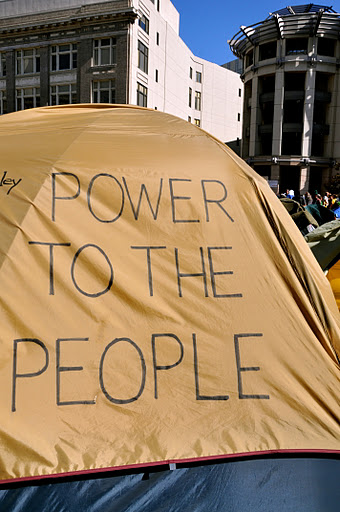 MEDIA ROOTS — In a predawn raid this morning, under direct orders from Oakland Mayor Jean Quan, riot police stormed the Occupy Oakland
encampment at Oscar Grant Plaza in another coordinated multi-agency “mutual aid” operation
costing the City of Oakland upwards of half a million dollars in an attempt to
crush the peaceful Occupy Oakland (OO) movement once and for all.
MEDIA ROOTS — In a predawn raid this morning, under direct orders from Oakland Mayor Jean Quan, riot police stormed the Occupy Oakland
encampment at Oscar Grant Plaza in another coordinated multi-agency “mutual aid” operation
costing the City of Oakland upwards of half a million dollars in an attempt to
crush the peaceful Occupy Oakland (OO) movement once and for all. 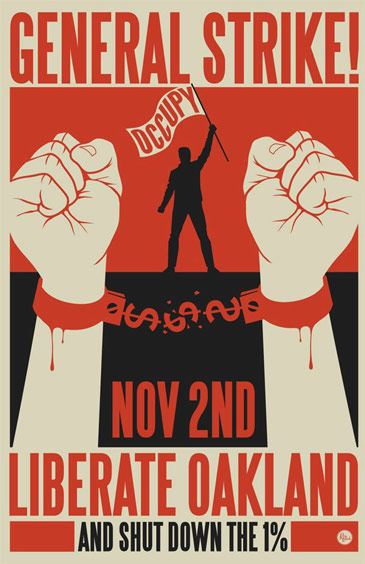 MEDIA ROOTS— In 1946, Oakland was the last city in the U.S.
 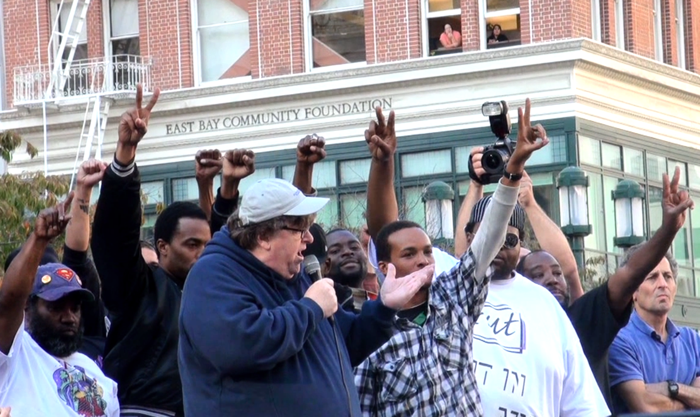 MEDIA ROOTS— On Friday, October 28, 2011, filmmaker Michael
Moore paid a visit to Occupy Oakland. He flew from Occupy Wall Street in New York to join in
solidarity with the current epicentre of the Occupy Movement in the wake of the brutal police-state
rioting on Tuesday night, which left 24-year-old Marine, Scott Olsen, in critical
condition after being shot in the head by a projectile fired by an officer of the
Alameda Sheriffs Department.
MEDIA ROOTS— On Friday, October 28, 2011, filmmaker Michael
Moore paid a visit to Occupy Oakland. He flew from Occupy Wall Street in New York to join in
solidarity with the current epicentre of the Occupy Movement in the wake of the brutal police-state
rioting on Tuesday night, which left 24-year-old Marine, Scott Olsen, in critical
condition after being shot in the head by a projectile fired by an officer of the
Alameda Sheriffs Department.  MEDIA ROOTS — KPFA’s
Dennis Bernstein and Davey D broadcast their
analysis of the Occupy Oakland aftermath following the brutal police-state assaults
on Tuesday, October 25, 2011.
MEDIA ROOTS — KPFA’s
Dennis Bernstein and Davey D broadcast their
analysis of the Occupy Oakland aftermath following the brutal police-state assaults
on Tuesday, October 25, 2011.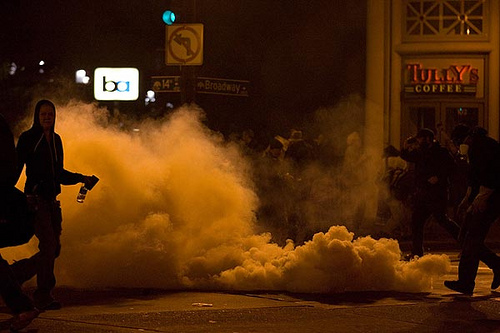 Davey D (8:00): “Davey
D, hangin’ out wit’ you. We are down
here. It’s probably about 7:15 in the
morning. Um, people are still out
here. The only difference is now, if you
look at, uh, what was Occupy Oakland, you see that the tents are all gone. And they’re steam-cleaning it. Last night, um, a lot of tear gas was lobbed
out here. You don’t smell it as
much. But we wanted to talk with people
that are still out here this morning.
How you doin’?”
Davey D (8:00): “Davey
D, hangin’ out wit’ you. We are down
here. It’s probably about 7:15 in the
morning. Um, people are still out
here. The only difference is now, if you
look at, uh, what was Occupy Oakland, you see that the tents are all gone. And they’re steam-cleaning it. Last night, um, a lot of tear gas was lobbed
out here. You don’t smell it as
much. But we wanted to talk with people
that are still out here this morning.
How you doin’?”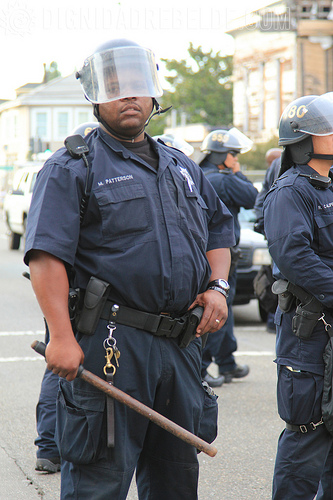 Dennis Bernstein (circa 16:42): “And thank you, Davey D. You are, no doubt, listening to KPFA, the people’s
radio station, here in the [S.F.] Bay Area, Pacifica Radio. I’m Dennis Bernstein with Davey D [in the
studio]. [KPFA General Manager] Andrew
Phillips is in the studio. He’s been
rippin’ off Facebook and watchin’ the wires all night. Uh, Davey, amazing series of interviews. Let me just say, one of the things that I
think we’re seeing now in the way Oakland is being used. It’s a national story. And it’s a, it’s a national experiment
because what we saw with these 17 police departments is right out of the
P.A.T.R.I.O.T. Act—“
Dennis Bernstein (circa 16:42): “And thank you, Davey D. You are, no doubt, listening to KPFA, the people’s
radio station, here in the [S.F.] Bay Area, Pacifica Radio. I’m Dennis Bernstein with Davey D [in the
studio]. [KPFA General Manager] Andrew
Phillips is in the studio. He’s been
rippin’ off Facebook and watchin’ the wires all night. Uh, Davey, amazing series of interviews. Let me just say, one of the things that I
think we’re seeing now in the way Oakland is being used. It’s a national story. And it’s a, it’s a national experiment
because what we saw with these 17 police departments is right out of the
P.A.T.R.I.O.T. Act—“ Dennis Bernstein: “4425. 510.848-4425, uh, give us a call, especially,
interested for people who are in Oakland, who have been participating in this,
who have been eyewitnesses. Uh, please
give us a call. Andrew, you ripped
something, uh, Andrew Phillips is here in the studio. You ripped something off of Facebook.”
Dennis Bernstein: “4425. 510.848-4425, uh, give us a call, especially,
interested for people who are in Oakland, who have been participating in this,
who have been eyewitnesses. Uh, please
give us a call. Andrew, you ripped
something, uh, Andrew Phillips is here in the studio. You ripped something off of Facebook.”