Media Roots TV – OO Police State Raid Redux

MEDIA ROOTS — On Monday, November 14, 2011, Abby Martin of Media Roots went to Occupy Oakland (OO) at 4 am to cover the second police state raid on the peaceful OO encampment.  Under direct orders from Oakland Mayor Jean Quan, over 500 riot cops in another coordinated, increasingly fascistic, multi-police agency operation stormed the peaceful OO encampment at Oscar Grant Plaza (aka Frank Ogawa Plaza) in an attempt to crush the OO movement once and for all. 

Mayor Quan’s legal adviser resigned at 2 am in protest to the heavy police repression at OO.  Quan’s Deputy Mayor also resigned in protest a few hours later.

Media Roots documents the intensity in the air leading up to the police raid, as the peaceful protesters brace themselves for another show of force by the heavily militarised riot platoons.  This footage evidences the insane level of militarised police presence, which showed up to crackdown and destroy the camp in yesterday’s predawn raid. 

Meanwhile, similar raids occurred this weekend with mass arrests against Occupy Movement encampments across the nation.  This morning in another predawn raid, Occupy Wall Street at Zuccotti Park in NYC was ordered cleared under the pretext of sanitation concerns.  Mass arrests were carried out at OWS, involving police beating arrestees with batons and the use of pepper spray.  And now, OWS protesters have been told they will not be allowed to return with tents or tarps as the winter chill approaches. 

One may wonder if notions of America, land of the free, still carry any meaning in Obama’s post-P.A.T.R.I.O.T. Act/anti-First Amendment political climate.  If they do anywhere in the U.S., it’s at the fiercely idealistic Occupy encampments across the nation.

Messina

***

Abby Martin of Media Roots covers the latest police state raid against Occupy Oakland.

Occupy Oakland Faces Another Police State Raid

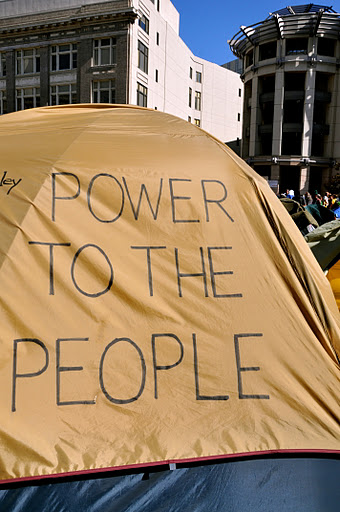
110211PowerToThePeopleTentbyAbbyMEDIA ROOTS — In a predawn raid this morning, under direct orders from Oakland Mayor Jean Quan, riot police stormed the Occupy Oakland encampment at Oscar Grant Plaza in another coordinated multi-agency “mutual aid” operation costing the City of Oakland upwards of half a million dollars in an attempt to crush the peaceful Occupy Oakland (OO) movement once and for all. 

Similar raids occurred this weekend with mass arrests against Occupy Movement encampments, including in Eureka, California; Portland, Oregon; Salt Lake City, Utah; Denver, Colorado; and Albany, New York, as well as the brutal police state beatings by riot police of student protesters attempting to establish an Occupy encampment at UC Berkeley on Wednesday to exercise their First Amendment rights at the birthplace of the Free Speech Movement.

Rioting cops beating students at UC Berkeley illegally wore no name tags to hide their identities.  Observers at Occupy Portland have also reported similar violations by riot cops.  We can thank Obama for the Federalisation/militarisation of local police.  As with the ‘mutual aid’ repression of dissent at Occupy Oakland, riot cops at Occupy Portland have consisted of Portland cops and other police agencies from neighbouring forces.

Initially, Oakland Mayor Jean Quan appeared interested in co-opting OO through photo ops with MoveOn.org, a tool of her Democrat political party.  On October 15, 2011, during a MoveOn ‘Jobs Not Cuts’ rally following a march from Laney College, widely misreported as an official OO event, adjacent to Oscar Grant Plaza, Quan refused to abide by the horizontalist ethic of OO when she refused to wait her turn to speak before the OO General Assembly.  Filmmaker Michael Moore made note of this fact during his visit of solidarity to OO, noting Quan “didn’t wanna wait in line.”  MoveOn was even asked by OO not to end their march at the plaza, which they disregarded.

After the failed attempt to attach establishment politics to OO and before conveniently skipping town to D.C., Quan gave the green light to Oakland Police Chief Jordan’s militarised storm-troopers to attack the OO encampment with chemical agents, flash-bang grenades, and ‘less-than-lethal’ projectiles.  Many were injured by the police assaults and at least one, Scott Olsen, an Iraq War veteran, was sent to the hospital in critical condition with a fractured skull after being shot in the head at point-blank range by a police projectile.  Quan attempted to navigate the backlash against the police brutality by absurdly claiming the police showed restraint and suffered abuse.

This absurd drama led up to the historic OO General Strike earlier this month.

The following night, the Oakland City Council heard from an overflow crowd of OO supporters, including 118 overwhelmingly supportive speakers, during public comment.  Public comment speakers pointed out many demonstrators attempted to intervene to stop vandals during the General Strike marches.

Quan, Oakland Police, and reactionary City Council Members were now fully determined to smear and crush OO.  Quan shifted to exploiting pre-existing rat infestations, sanitation issues, and other persistent issues in Downtown Oakland as pretexts for smearing OO. 

One speaker before the Oakland City Council, seminarian Suzi Spangenberg, countered the allegations against OO:

“If you’ve been to an Oakland Raiders game, you have seen people engaging in violent acts. You do not hold everyone at that game responsible for the acts of a few.”

Indeed, there were some 100 arrests late in the evening after the OO General Strike shut down the Port of Oakland; we’re talking less than 1% of the peaceful demonstrators.  And most of those arrested were either unrelated ‘Black Bloc’ opportunists engaging in property damage or innocent bystanders corralled by the riot police.  Aerial estimates have confirmed the participants numbered in the tens of thousands.  No, we cannot hold the 99% guilty for the crimes of the 1%.

James Vann, a longtime Oakland housing advocate and a central figure in Oakland Mayor Jean Quan’s election campaign, was one of the first to speak during the Public Forum.  He spoke with KPFA radio, which covered the entire City Council meeting live:

“Yes.  I think it was a beautiful day.  For the most part everything went beautifully, went well, went exceedingly well.  And it was only late last night, and I guess part of the march against the banks yesterday, where there’s a dissident group among the occupiers who don’t respect law and order.

“I think last night this group pretty much identified themselves, by taking over another building.  That was not part of the Occupy Oakland activity.  And so that group, I think many of those in that group, ultimately, were arrested last night.  So, the City now, the police, can identify most of those people in the dissident group.

“Yes, unfortunately there were some who broke away.  There were also members of the Occupier contingent who attempted to try to control that and put themselves between these dissidents and the rest of the march.  But they were intent on destruction.  So, this is a group that does not respect the general objectives of the Occupy Movement.”

In the wake of today’s latest raid against OO, Quan has also claimed OO had moved away from its original goals to further justify her actions.  The claim is baseless, but the Democrat Mayor was determined to smear and clear the encampment by any means. 

With Wall Street-driven elections coming up on the horizon, the ruling-class cannot allow the Occupy Wall Street (OWS) Movement to continue to have the kind of impact its had upon the national body politic and its discourse, which has forced local, state, and Federal leaders to acknowledge the glaring problems with a socioeconomic system run for the benefit of the ruling-class 1% of the population controlling almost half of its wealth against the interests of the working-class, the 99%.

Instead of acknowledging the glaring timeliness of the global OWS Movement during the nation’s worst economic crisis since the Great Depression and OWS’s historic significance as a political force that isn’t going away, even in the face of police-state repression, local city governments have treated OWS encampments as public nuisances to be swept under the rug.  The nationwide crackdowns appear to be encouraged at the behest of a nation-wide Homeland Security-type repression of dissent in line with the P.A.T.R.I.O.T. Act.

In the aftermath of the brutal police state crackdowns against OO on October 25, Oakland-based community organiser with the Oscar Grant Committee Against Police Brutality and State Repression, OO supporter, Rachel Jackson spoke with Pacifica Radio’sFlashpoints” to contextualise the militarisation of local police toward the repression of political organisation and dissent:

“I think it’s important, too, to remember that this is coming on the heels of what we saw of three years now, of this ‘mutual aid’ being enacted in response to uprisings against the murder of Oscar Grant ever since January of 2009.  We’ve seen the people of Oakland, and really a lot of the real base of Oakland and the [historic] section of Oakland, the people of colour, and low-income communities have burst out onto the scene.  And it was that mass action that forced the state and the [now-retired] District Attorney [Thomas Jensen Orloff], in particular, to bring charges against Johannes Mehserle for the murder of Oscar Grant in the first place. 

“And, so there was this, you know, we’re not confused about the fact that these test-cases and these drills, operations, this sort of, this testing living laboratories of police state is happening here in Oakland, not because we’re weak, but, in fact, because we are strong.  And we know that the tear gas canisters, and the pepper spray, the flash-bang grenades, the canister and concussion grenades that has put Scott Olsen in the hospital with a fractured skull was fired by the Alameda County Sheriffs Department acting under the OPD and, of course, with, as you pointed out, with Federal oversight.

“And these particular processes of enacting this ‘mutual aid’ and the acquisition of these tools of repression, we know for a fact that these things were purchased during the past, like since January of 2009, so that the police could prepare, and the Feds and Homeland Security and the many, we had 33, some 33 or more agencies just for the [Johannes Mehserle] verdict on July 8th, 2010 and the operation sentencing on November 5th [2010].  And we’ve gotten Public Records Act requests and documentation.  They have Power Points where they showed all of the stuff that they bought, including…many of the tear gas canisters and…many of the M84 concussion grenades.”

So, the militarisation of local police has, indeed, been underway in post-9/11 U.S., ostensibly under the pretext of the ‘War on Terror.’  But it’s becoming increasingly evident the sole purpose is repression of dissent, as done in Oakland under Quan.

And although OO has denied any correlation between the tragic murder of Kayode Ola Foster in Downtown Oakland last Thursday, Mayor Quan has alleged the peaceful encampment was to blame.  Oakland has seen at least 70 murders this year and 94 in 2010. 

After authorising unsuccessful brutal police crackdowns to crush OO, Mayor Quan also exploited the tragic murder of Foster as a pretext for moving to dismantle the encampment.  One of Quan’s legal advisers, Dan Siegel, resigned in protest over the clearing of the OO encampment.  Quan’s Deputy Mayor also resigned in protest a few hours later.  Whilst some protesters moved to Oakland’s Snow Park a few blocks away, at least one has begun a tree sit-in at Oscar Grant Plaza and vowed to remain there indefinitely.

OO called a protest action convergence at the Oakland Library this afternoon at 4:30pm.  At presstime, OO reported:

“The occupiers began marching shortly before 5 pm with about 1000 marchers. The march reached the plaza at 14th and Broadway with over 2000 people and immediately convened a General Assembly.  At first occupiers used the human mic, repeating each phrase in waves across the crowd but within the hour amplification was in place and as of 6:30 pm an assembly is underway.”

Written by Felipe Messina  

***

SF APPEAL— An early-morning police raid to break up the Occupy Oakland encampment has left Frank Ogawa Plaza devoid of protesters today–except for one lone holdout who is perched in a tree.

Zachary Running Wolf is sitting atop a small wooden platform, tied to the tree, and is being largely ignored by police for the time being.

Police Chief Howard Jordan said at a morning news conference that police are leaving him be as they look into what his legal rights are to be there.

This morning, he could be heard shouting from the tree, “This is native land. I’m not coming down.”

Running Wolf is a familiar name in the East Bay, where he has run for City Council in Berkeley and was involved in the lengthy tree-sit at the University of California at Berkeley several years ago to protest the removal of a grove of trees to make way for a new sports training center.

A protester on the ground nearby who identified himself as “Fireball” said Running Wolf represents the encampment’s “best defense” right now.

“The cops can’t get into the trees,” he said.

Fireball said Running Wolf has enough food and water to last several days.

Meanwhile, cleanup crews were quickly clearing the remnants of the encampment from the plaza. The last tents had been taken down as of 11 a.m.

Oakland police Sgt. Christopher Bolton said those doing the cleanup are trying to salvage anything that appears to be worth more than $100, and are throwing out other objects.

City Administrator Deanna Santana said this morning that the city hopes to have the plaza reopened for public use – camping excluded – by 6 p.m.

Thirty-two people were arrested when police raided the encampment early this morning, most for illegal lodging, Bolton said.

Read more about Tree Sitter Remains In Frank Ogawa Plaza After #OccupyOakland Raid.

© 2011 Appeal Media, LLC

Photo by Abby Martin

Last updated 11/15/11 0755 PDT

Media Roots TV – Occupy Oakland General Strike

MEDIA ROOTS – On Wednesday, November 2, 2011, the Media Roots team was on the ground in the streets of Oakland witnessing some great energy and bringing you first-hand coverage of the historic Occupy Oakland General Strike. 

Although the corporate media tried to shift the focus from the crimes of the ruling-class to petty vandalism by unrelated opportunists, for the tens of thousands in attendance, as this footage evidences, the daylong events were about solidarity and peaceful protest against the obscene inequality borne of class warfare waged by the 1% against the 99%. Various businesses closed in solidarity, as the Oakland City Administrator gave City workers the day off to participate.

Media Roots covered the day’s events from Oscar Grant Plaza where a festive atmosphere of unions serving barbeque, speeches, arts, and multicultural activities set the positive tone.  Participants included parents with children and teachers amongst the diverse spectrum of people.  As the day progressed, the marches swelled to some 10,000 protesters with multiple marches shutting down various Oakland banks, including Bank of America, Chase, Wells Fargo, and Citibank.  By that evening, tens of thousands of peaceful protesters successfully shut down the Port of Oakland, the nation’s fifth busiest port.

Messina

***

Media Roots delivers first-hand coverage of Occupy Oakland’s historic General Strike.

Check out our live Media Roots Radio two hour coverage of the strike here.

Check out Abby Martin’s photojournalism from the day of the strike here.

MR Exclusive – Mickey Huff, Director of Project Censored

MEDIA ROOTS– Mickey Huff, Director of Project Censored, speaks at Moe’s Books in Berkeley, CA on May 19, 2011. He discusses different concepts of censorship and how the top down corporate media censors and manages news in the US. Mickey also speaks about the evolution and organizational mission of Project Censored and goes over some of the top stories from their 2011 book.


During the Q & A session Mickey comments on how 9/11 and election fraud are two subjects that are heavily censored among alternative and progressive media outlets.

http://www.ProjectCensored.org

Filmed and edited by Abby Martin

MR Original – Change Starts With the Heart

MEDIA ROOTS- Recently, a man walking by my car inquired about my anti-war bumper sticker. After a short conversation, I learned that this 81 year-old peace activist, Chuck, spends every Friday evening on a high school street intersection protesting the wars. With a solid handshake and fist bump, he was on his way.

Weeks later, I spotted Chuck at an anti-war rally down the street. When I approached him, a big warm smile greeted me, followed by another solid fist bump. Having developed a curiosity about his background and anti-war stance, I asked him for an interview to which he happily agreed.

As Chuck sat on my couch over a cup of coffee, it became clear that he is a slightly shy man, not seeking recognition. “I just care about people”, he exclaimed. This is how our conversation went down.

***

MR: Tell me a little about your background so people get an idea who you are and where you come from.

C: I was born in 1930 at my home in Diamond, Washington, which is the eastern part of the state. There were seven of us kids, and my parents owned a 206 acre farm. I worked really hard as a kid, and by my early teenage years I was already running heavy equipment and had quite a bit of responsibility.

MR: Have you always been politically aware or socially active?

C: I’d always been interested in politics, but something happened during the Great Depression that opened my eyes to the ideas of fairness and greed. My father’s mortgage on the farm was $1,735. A neighbor, Mr. Rock, owned the mortgage. When it became impossible to pay, he told my father “If you can just pay one dollar, I won’t foreclose on you.” His compassion and kindness enabled us to keep the farm, but a few months later when Mr. Rock passed away, his son took over the property, foreclosed immediately and started plowing our land. Thankfully, the Federal Land Bank under Roosevelt took over the mortgage and essentially saved our farm.

MR: Was your family always politically minded?

C: We didn’t have television back then, but we listened to the radio. My parents paid attention to what was happening in the world, and liked to help others. There was a train that would come through once a week and drop off food, coal and ice. We would save some of the coal for these four homeless people who migrated during the winter. They stayed in our shed, and the bits of coal we had saved over the course of the year supplied them with enough heat to get through the cold winter months. Without a refrigerator, we’d hang our meat on the windmill outside in the winter and the hobos would come slice pieces off to cook. They never bothered anybody or asked for much, we just liked to help them out. I was always impressed with how my parents recognized that some people need help– not everyone is as fortunate as the rest of us.

I was definitely inspired by my parents, but I’ve always been socially active. In school I always stuck up for the kids who were bullied, even though I was smaller. For example, this one kid in my high school had MS or was somehow disabled. I did whatever I could to stick up for him when he was picked on, which was often. His family had an orchard down on the Snake River, and would can hundreds of quarts of peaches and apricots to sell every summer. They would always tell my family “You guys don’t pay”.

[Chuck tears up as he tells me this]

MR: That’s how the world should work– we need to help each other out. When did you become an activist? Was there a specific time or event that inspired you to start protesting?

C: I was in the Army during the Korean War, but luckily I never had to go overseas. Instead I was sent all around the country on various assignments and even ended up working at the Pentagon in Washington DC. I was one of only a handful of guys from my squad who didn’t end up dead. Being in the military never really settled with me. I didn’t understand what I was doing and why, and it felt very unorganized. After serving I became aware of our military actions, and became an outspoken critic. I suppose that evolved into physically protesting.

MR: How long have you guys been protesting on the corner?


C: We have been protesting for about four and a half years, rain or shine. I’ve only missed about three meetings. It’s not part of a larger established organization– it’s just a few of us, but we are a committed group of concerned citizens. It’s all volunteer, but it’s not a political thing. Well, it’s somewhat political, but it’s really about doing what’s right.

MR: Do you align yourself with a paticular political party?

C: Yes– I’m a Democrat.

MR: Historically, Democrats are known for being a bit more compassionate, but what do you think about the idea that maybe the lines are blurring between the two, and that both parties are just spokespersons for Big Business and private interests?

C: I still feel that Democrats are much more “tuned in” to people. It is unfortunate though, what these corporations are getting away with. It’s a damn crime. At one point I had a small construction company. I thought I was smart and had a couple hundred dollars and grew that into a labor-union based company about 200 strong. Supporting union labor gave people a voice and enabled them to make enough money to feed their families. Sometimes I would get out of bounds, and they would kick me back into shape, but it was a good relationship.

MR: I’m sure you still ended up paying a vastly larger chunk of taxes than these corporations are doing nowadays. You say that your anti-war stance is not a political thing, but you have to admit that war and politics are intertwined– they’re almost inseparable. What do you see as the main problem with America’s current political system?

C: Simple: too much greed. It’s all about the dollars. Unless you have money or political clout, you don’t have a voice. But you must still protest, because maybe you’ll be heard.

MR: Or at least make somebody think critically on their way home from work. What do you see as the main reasons why we are in Iraq and Afghanistan?

C: Oil and greed, no doubt about it. We need to get out of their countries. War creates hate and animosity. You don’t make people love you by killing them.

MR: Do you see the US trend of aggressive war over resources slowing down anytime soon? We’ve basically achieved what we went over there for: the regions are in turmoil, and US-backed governments are being implemented. Do you think that the regions will eventually be restructured?


C: I don’t think it will be effectively restructured. We just have to get the military industrial complex out of the way. The biggest thing we have in America is guns: half of our budget goes to the military.

MR: Which makes it hard to slow down. Do you think it’ll take a long sequence of events, like getting the right people in office and slowly chipping away at it, or do you think it’ll take an overnight revolution?


C: I think it’ll take the chipping away approach. We have to protest. We can’t continue to have a military presence in 130 countries. We have to slowly get those troops out of there.

We also need to write our Senators and Congressmen. Don’t send an email– write a letter or send a fax. They read those things, and it could make a difference. But you have to recruit others to do the same thing. Talk about things, spread news and hand-write lots of letters.

The key is to get the next wave of young policy makers in office. The young people are so much more progressive and open-minded. We need young leaders and we need more of what’s happening  in Wisconsin. I think that peaceful protesting is really working.

MR: Once these people get into office, how realistic is it to expect them to do the things they set out to do?

C: I think it’s very difficult. They have to be concerned with re-election, and to do so you have to know where your boundaries are.

MR: When I talk to friends who support Obama, they think I have some sort of personal agenda against him. But for me it’s not personal I’m sure he’s a compassionate person who genuinely wanted change. But after getting into office, he really has limited control over what happens.

C: I saw something similar happen with Roosevelt. In the election of ’38, he was politically stymied. It’s exactly the same thing that’s happening now: I think Obama really wants to do the right things, in his mind and his heart. But he needs to be much more vocal.

MR: What were some of the similarities between Obama and Roosevelt?

C: He got Social Security to go through the Supreme Court and pushed for labor rights and public works projects. It was all about groups, like the Works Progress Administration. He also helped establish the idea of a minimum wage, and Washington state was the first to adopt one. These things gave people dignity. Also, back then we had these supposed enemies, the “Commies” and “Fascists” and the worker’s parties that corporations demonized. We see the same sort of fear-mongering now, but it’s “terrorists” and “Muslim extremists”. Our leaders need to make a stronger effort to push for green jobs, which could be a critical path for us.

MR: As far as Obama needing to be more vocal– He seemed to genuinely want to go in there and instigate change. So what happened? He has an opportunity every single day to get up in front of the podium in the Rose Garden and say “This needs to stop”. But he doesn’t. Is is because he’s powerless or is he trying to play it safe to ensure his re-election?

C: I think he has great intentions, and has the potential to become very powerful if he can get into another term. But for now he has to go along with the pundits because there’s so much chaos and thing going on.

It’s a difficult job, and his hands are pretty much tied. As an individual, he is respected. But it’s really difficult to get things done in Washington, all they do is talk. But I definitely agree that he could be doing a much better job.

MR: What is the key to getting this country back on track?

C: I don’t think it’ll be one specific thing. What’s happening in Wisconsin is the beginning of the revolution. We need more of that and we need to keep the pressure on ‘em. We can’t let up. And we have to offer solutions, we can’t just bitch and moan.

MR: How would you respond to people who say that protesting won’t make a difference?

C: I would say “You’re noticing, arent’ you?” We’re pressuring all the time– you have to be consistent. All those little grains of sand, the seemingly small voices, all those bodies really does make a difference.  I’m seeing more activists now than ever, and it’s encouraging. I care about people, David. I built an orphanage in Honduras, and did work with Habitat for Humanity in the Philippines. We have to throw the balance in favor of the people. Change– it needs to start with the heart.

***

Interview conducted, article written by David Solmes

Photo by Abby Martin