Global Surveillance – Media Roots on Russia Today

Abby Martin of Media Roots is featured in this RT article and video report.

RUSSIA TODAY– As the scandal over voicemail and phone-hacking by the Murdoch media empire rages, public and political fury has focused on ruthless tabloids out of control. But some say in this day and age, the whole concept of privacy is falling apart.

News International chairman James Murdoch has been accused of trying to mislead British MPs by saying he was unaware of the true extent of phone-hacking by reporters. His testimony was challenged by two former executives, Colin Myler and Tom Crone, who say Murdoch was informed three years ago that the illegal practice went beyond just one rogue journalist.

And as the scandal continues to grow, critics believe the issue is just the tip of the iceberg in a society that no longer values the privacy of the people.

“Everybody just clicks through, agreeing to the terms and conditions. Well those terms and conditions are very, very heavily weighted against you and your privacy interest,” says Dave Saldana, the communications director of Free Press.

“We see breaches of privacy by corporations happening all across America, all across the world really, in every sector. Surveillance is rampant. But really this is all a microcosm of the biggest surveillor of all – that is, the state,” journalist Abby Martin believes.

There is little Americans can do with the state having sweeping access to their private information – access that followed the 9/11 terrorist attacks, under a new law known as the Patriot Act.

The privacy of Hasan Elahi, who is an associate professor at the University of Maryland, was taken away from him in 2002, when he was detained by the FBI for absolutely no reason he says, and scrutinized for months, without charge.

His response? For nine years he has voluntarily documented nearly every waking hour of his life on the web. He has subsequently even turned it into an art-form.

“These are all the toilets that I’ve used. You know that on Sunday, November, 24, 2007 I used this toilet, for example,”
he explained pointing at a wall of pictures on his website.

He posts copies of every debit card transaction, so you can see what he bought, where, and when. A GPS device in his pocket reports his real-time physical location on a map.

Hasan says his extraordinary abandonment of his own privacy stems from the ignorance of the authorities.

“In fear they decided: ‘well that guy looks like an Arab, so he must be an Arab. If he’s an Arab them he must have explosives, everyone knows that.’ That’s the logic where we’re operating. You realize how ridiculous that logic sounds. But when your own country takes that as the basis for national policy… Ignorance as the basis of your national policy is a pretty scary situation. And that’s how I got caught up in it,” he told RT.

For Hasan, privacy has become a relic of the past, and he says he’s not surprised that journalists or anyone else really, would use the same surveillance tactics as the state.

In that sense, it might be of no surprise that the chief architect of the Patriot act, the lawyer who put it together, happens to be one of Murdoch’s hand-picked News Corp board directors. Viet Dinh served as assistant attorney general in the Bush administration, and was described by some as the purveyor of the most sweeping curtailment of freedom in the US since the McCarthy era.

At a time when corporations and the government can easily hack into people’s private lives, it does not come as a surprise when social networks give your personal information to ad companies, or when other industries live off breaching people’s privacy.

In the US it is so widespread, and people have gotten so used to it, that Rupert Murdoch seems to be a perfect part of the system rather than some special villain, whose corporation has been undertaking some unique unlawful practices.

Because in America they are not so unique.

© 2011 RT
Interpol Used to Pursue Political Dissenters

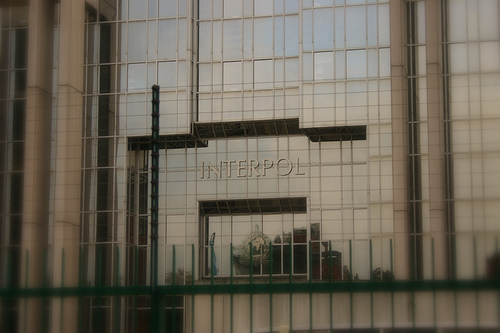
IWATCH– Interpol’s primary purpose is to help police hunt down murderers and war criminals, child sex offenders and wildlife poachers.  But a five-month investigation by the International Consortium of Investigative Journalists shows a little-known side to Interpol’s work:  In cases from countries such as Iran, Russia, Venezuela and Tunisia, Interpol Red Notices are not only being used for legitimate law enforcement purposes, but to round up political opponents of notorious regimes.

For countries that want to abuse Interpol, “it’s a way to extend their arm to harass opponents – political or economic,” said Kyle Parker , policy director of the U.S. Helsinki Commission, a human rights body of the U.S. Congress.

ICIJ analyzed a snapshot of Interpol’s Red Notices, published on December 10, 2010. It includes 7,622 Red Notices issued at the request of 145 countries. About a quarter of those were from countries with severe restrictions on political rights and civil liberties. About half were from nations deemed corrupt by international transparency observers.

The Islamic regime of Iran’s use of Interpol stands out not just because of the Mazrae episode, but also because of people like Shahram Homayoun.

He fled Iran in 1992 after the mullahs took over. After he settled in Los Angeles, Homayoun started a satellite TV station to beam a message of civil resistance into the homes of Iranians.

His audience has scribbled his slogan in Farsi, Ma Hastim – “We Exist” – on walls and bridges around the country. In 2009, he called on Iranians to gather at the tomb of the ancient Persian ruler Cyrus the Great. That’s all. Just show up at his tomb, like a flash mob. That fall, he prompted Iranians to show up at their local bakery every Thursday and ask for bread.

He’s definitely a troublemaker.

 “Apparently, the Interpol thinks so too,” Homayoun said, laughing at a reporter’s quip.

In December 2009, Iran charged him with inciting “terrorism against the Islamic regime such as writing slogans [on walls] and resisting the security forces,” and, at Iran’s request, Interpol issued a Red Notice and put Homayoun on its global most-wanted list.

Now officially an Interpol fugitive because of the Red Notice, Homayoun can’t leave the United States. He’ll probably never again see his parents in Iran. Fortunately for Homayoun, the U.S. won’t arrest him, let alone send him to Iran.

Read more about Interpol’s Red Notices Used By Some To Pursue Political Dissenters, Opponents

© 2011 Center for Public Integrity

Photo by Flickr user billigwein

Tibet, China, and America: Towards The Light?

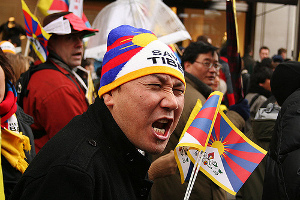
ECONOMIST– On the topic of Tibet, Xi Jinping, the man widely expected to be the next leader of the Chinese Communist Party, sounds much like his predecessors. Speaking on July 19th in the capital, Lhasa, in front of the Potala Palace, former residence of the Dalai Lamas, Tibet’s spiritual leaders, he celebrated the way Chinese rule had led Tibet “from the dark toward the light”. 

In material terms, he has an obvious point. Tibet is far better-off than in 1951, when a young Dalai Lama reached a “17-point agreement” ceding Chinese sovereignty over the territory. He also has a point that, before 1951, Tibet was not some idyllic Shangri-La of tinkling temple bells, lowing conch shells and smiling people, but a highly stratified society relying on mass monasticism and serfdom.

The difficulty Mr Xi and his predecessors face, however, is that large numbers of Tibetans resent Chinese rule. Many are still loyal to the Dalai Lama, who fled into exile with some 80,000 of his followers after the crushing of an anti-Chinese uprising in 1959. Since then the region has been scarred by periodic riots, including a bloody outburst of anti-Chinese violence in Lhasa in 2008.

This year has seen a confrontation at the Kirti monastery in a part of historic Tibet now incorporated in the Chinese province of Sichuan, after a young monk burnt himself to death in March. Hundreds of monks have been taken off for “patriotic education”. This year has also seen a heavy security crackdown to prevent any unrest to mark the 60th anniversary of the 17-point agreement, or the Party’s 90th birthday on July 1st.

China, in public at least, blames the Dalai Lama for the continued Tibetan disaffection. So its spokesmen fume when he is received by foreign leaders, especially America’s. On July 16th Barack Obama met the Dalai Lama in the White House. After the meeting, the White House emphasised that, besides underlining America’s support for Tibetans’ cultural identity and human rights, Mr Obama also repeated America’s acceptance of Chinese sovereignty over Tibet. 

Nevertheless, the People’s Daily called the meeting “an unscrupulous trick of pragmatism” that undermined the United States’ position as a great world power. Mr Obama has partly himself to blame for the accusation of pragmatism. In 2009 he postponed a meeting with the Dalai Lama in order not to sour the atmosphere for his trip to China a few months later—in effect conceding that such meetings are not matters of pure principle.

Read more about Tibet, China, and America: Towards The Light?

© 2011 The Economist

Photo by Flickr user Tanya Nagar

Philippines Extrajudicial Killings Continue

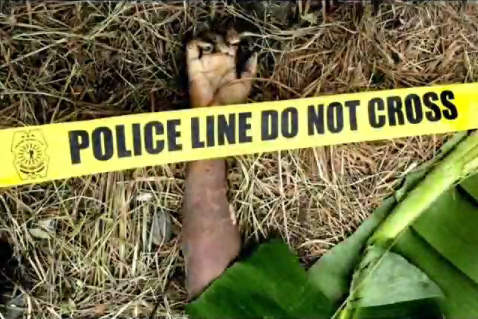
BBC– Human Rights Watch says activists in the Philippines are still being killed with impunity, despite the president’s campaign pledge to end such violence.

In a new report, the campaign group says it has evidence that the military was involved in seven killings and three enforced disappearances.

Each of these occurred since President Benigno Aquino took office last year, the group says.

When President Aquino came to power, he promised a change from the old regime.

The administration of his predecessor, President Gloria Macapagal-Arroyo, had been accused of turning a blind eye to the deaths and disappearances of hundreds of people.

But according to Human Rights Watch, these abuses are still continuing.

Most of the victims – now as before – are left-wing activists and outspoken journalists.

Their families often blame the military or police of involvement.

The security forces deny the claims or say those who died were communist rebels.

Read more about Philippines Extrajudicial Killings Continue

© 2011 BBC

Photo by Flickr user The Philippine Online Chronicles

Thousands Join Hong Kong Protest

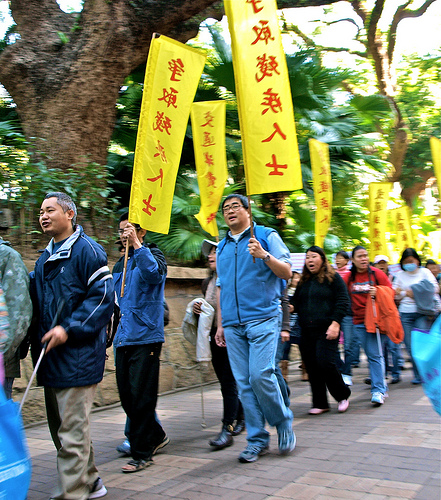
IRISH INDEPENDENT NEWS– Tens of thousands of people have voiced anger over Hong Kong’s skyrocketing property prices and government policies at an annual march marking the former British colony’s return to Chinese rule.

People blew whistles, beat drums and banged metal cups, and many waved flags calling for improved voting rights while others chanted “down, down with property tycoons” and called for chief executive Donald Tsang to step down.

Since the territory was handed back to China on July 1, 1997, Hong Kong has largely retained its Western-style civil liberties, including press freedom and the right to hold public protests.

But its people still cannot directly elect the city’s chief executive or all legislative members.

One of the big themes of the march marking the 14th anniversary is the growing rich-poor divide in Hong Kong, where soaring property prices have left many homes unaffordable and forced out small shopkeepers.

Some protesters carried large signs depicting Mr Tsang and billionaire Li Ka-shing, Hong Kong’s richest man whose business empire includes a major property developer, with devil horns and vampire fangs. They chanted slogans accusing the government and developers of colluding to establish a monopoly.

Citizens are also upset over a recent government proposal to scrap by-elections and instead fill vacant legislative seats based on previous results.

“The proposal to get rid of by-elections to fill vacancies in the Legislative Council is a crazy idea and insulting to the intelligence of the people of Hong Kong,” said veteran democracy activist Martin Lee.

Hong Kong is the only place in China that enjoys a degree of Western-style adversarial parliamentary politics.

Read more about Thousands Join Hong Kong Protest.

© 2011 Irish Independent News

Photo by Flickr user yip667