
Dismantling Our Right-Wing World

(A quick note to US readers: left and right in this piece do not refer to the American liberal-conservative spectrum – both of which are considered neoliberal – but to the broader left-right spectrum as traditionally conceived, ranging from far-left communism/socialism to far-right fascism.)
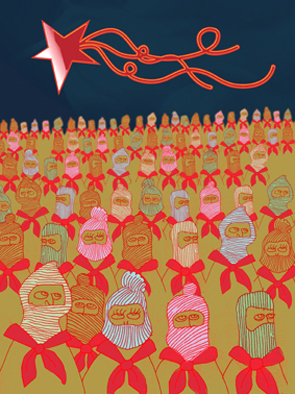
zapatistas flickr aeneastudioIt’s been an eventful few weeks for the Zapatista Army of National Liberation (EZLN), also known as the Zapatistas, midway through their 20th anniversary year.

First, Jose Luis Solís López, also known as “Compañero Galeano”, was murdered by a paramilitary group with ties to the Mexican government, which also injured fifteen other Zapatistas and destroyed a school, clinic and water system in the same attack. The attack then prompted the Zapatistas to change strategies, with well-known spokesperson Subcomandante Marcos stepping down.

These developments serve to remind us of the EZLN’s status as, in the words of Chris Hedges, “the most important resistance movement of the last two decades” – important enough to warrant the rather violent attention of the Mexican government and its paramilitary associates.

The EZLN, a group based in the state of Chiapas in southern Mexico, launched an armed rebellion against the Mexican government on January 1, 1994 as an act of protest against the North American Free Trade Agreement (NAFTA), which entered into effect on the same day. However, instead of attacking the Mexican state and society and causing endless bloodshed, the Zapatistas set up a system of self-governance in the territory it controlled, creating autonomous communities each with its own health clinic and schools to fill the void that the Mexican government had actively sought to widen in the interests of US and Canadian multinational corporations.

What the Zapatistas demonstrate is a vision of the notion articulated in the motto of the World Social Forum: another world is possible. They provide evidence that contradicts the belief that the status quo under neoliberal capitalism, in which the haves have it all and the have-nots are left to fend for themselves, is not only the best system but indeed the only viable system. The Zapatistas represent a victory for the oppressed peoples of the world over the powerful political and economic interests that rule over them. But more importantly, they represent a victory for the values of egalitarianism, compassion and solidarity – what I call the left-wing ethos. A victory over the idea that those who rule have the divine right to further their own interests, regardless of the consequences for the rest of humanity – an attitude that epitomizes what it means to be “right-wing”.

Marko Attila Hoare boils down the left-right spectrum to a simple distinction: that “the left supports the redistribution of wealth from the rich to the poor while the right opposes it”. But we can remove the entire spectrum from politics entirely to expose the values that underlie them: lefties value social equality, whereas righties value social hierarchy. Why, though? The answer lies in our individual worldview. As a self-identified lefty, I consider it more than possible for all of us to peacefully coexist in the world and have all of our common needs met, if (and only if) that’s the goal that we all work together to try to achieve. In a left-wing worldview, it’s therefore neither necessary nor ethical for us to undermine others in order to benefit ourselves. In other words: compassion, not competition. Without claiming complete objectivity, a right-wing worldview revolves around the idea that we live in a dog-eat-dog world in which the best we can do is fend for ourselves and get our share before someone else takes it.

Human history has been almost entirely dominated by the right-wing worldview. It’s been an endless cycle in which privileged groups have taken turns dominating each other in a seemingly eternal battle between the powerful and the powerless. From the imperial conquests of the ancient world through European colonialism, the two World Wars and Soviet communism to modern neoliberal capitalism, it’s always been the same story, flowing through different chapters but reaching the same inevitable conclusion: Oligarchy. It’s a story familiar to the Zapatistas as well as countless other sites of confrontation between the haves and the have-nots in recent years. The hierarchical, conflict-ridden relationship today between those who rule the world and those who are ruled, between corporate bosses and workers, between autocrats and their citizens, between the rich and the poor, is a continuation of this cycle of domination.

The right-wingers among us will assert that history simply reflects human nature, that it is in our nature to be maliciously selfish rather than compassionate, that this is the best we can do, or even that there’s nothing wrong with the world we’ve created. But their argument fails to acknowledge that the dominant worldview of the past has created the world we know today. As an example, the domination of the indigenous populations of the Americas, Africa, Asia and Oceania by European invaders and colonizers was not an inevitable result of human nature, but rather a product of widespread extreme right-wing beliefs such as Manifest Destiny and the white man’s burden. Similarly, the dominant worldview of the present will determine the world of tomorrow. A child raised in a society that values getting ahead at all costs is encouraged is far more likely to act accordingly than one raised in a society that values empathy and compassion. The dominant worldview in a society is therefore not inherent in human nature but in fact reinforces itself.

Right-wing theorists have a crucial role to play in promoting their worldview, too. “Realist” international relations scholars, capitalist economists, or simply those at the top of the social hierarchy love to tell us how it’s in our nature to always act in self-interest. They tell us that “greed is good” and that we all collectively benefit from constantly undermining each other, as ludicrous as that may sound. Yet, for the most part, even despite their contempt for those below them in the social hierarchy, even right-wingers behave in an incredibly left-wing manner towards those closest to them. And that’s because humans organized themselves into what we nowadays call “societies” precisely so that we could all benefit from being interdependent. That interdependence required us to develop compassion to allow us to survive in a society. The “savage” who undermines and betrays everyone he or she comes into contact with doesn’t survive for very long and, sociopaths aside, doesn’t find much happiness either. Surely we as a species are capable of applying that same logic to our everyday actions in today’s world so that we can all thrive at the same time instead of striving to be the “last man standing”?

Roman Krznaric couldn’t have put it any better: we need an empathy revolution. We need to turn the right-wing world that we live in into a left-wing one in which we recognize our fellow human beings as worthy of a livelihood and worthy of happiness and, in return, receive the same recognition. As the economic crisis in Greece goes to show, humans are capable of compassion even in the most desperate of situations: rather than stealing from each other, many Greeks are stepping in to provide the services that their government has failed to deliver and those that some of their compatriots can no longer afford, from food to medical services to street lighting – all for free. Similar systems have been devised in Serbia as well as in Macedonia, where numerous bakeries have introduced “solidarity baskets” to allow customers to buy an extra bun or piece of bread to leave to those who can’t afford to eat. And many customers indeed comply.

But showing empathy on our part only does half the job. While it spares those around us from our own potential malice, what it doesn’t do is liberate ourselves from those who have their hands around our necks. That involves critically examining and rethinking the false ideologies and pseudo-theories invoked by the powerful for the sole purposes of justifying their own dominating behaviour. After all, ideologies are all too often used as pretenses to mask the hidden agendas of those who assert them rather than a reflection of the values that they truly believe – in other words, purposeful bullshit. We mustn’t forget how the left-wing idea of communism was employed by self-described revolutionaries to justify right-wing oligarchic tyranny. Similarly, we can’t afford to look away when libertarians cite the dogma of enriching big businesses at the cost of everyone else, or when rich countries proclaim free trade to justify infiltrating the economies of developing countries. We’ve been raised to regard Soviet-style communism as tyranny and Western capitalism as freedom, but we need to recognize both for what they are: systems of oppression backed up by pseudo-theories that have no empirical basis and only serve those who preach them.

The empathy revolution needs a theoretical and social component. Neither pacifism nor confrontation can do the job alone. We need to channel our discontent into action by adopting the autonomist ethos of the Zapatistas to build the society we want. We need to form cooperatives and make use of cryptocurrencies, local currencies, open source, open knowledge, peer-to-peer practices, the sharing economy and countless other methods of grassroots social and economic organization the mainstream media doesn’t want us to hear a word about. What these methods all have in common is that they’re all built on the basis of cooperation and collaboration rather than malice and treachery – exactly what society needs and what the oligarchs don’t want.

Modern society is diseased and needs treatment. It’s only when we renounce one-upmanship in favour of cooperation and collaboration that we’ll be able to construct a society not for the few at the top, but for all of us. After all, isn’t fulfilling our mutual needs the whole point of even living in a society? It’ll require a good deal of empathy and creativity, as well as plenty of critical thinking to distinguish truth from pseudo-theory and other purposeful bullshit. Left-wing and right-wing are no longer a question of politics, but a question of social values and social justice. The right-wing worldview has failed us, and as the Zapatistas have shown, another world is certainly possible. It’s time to recognize that, for the purposes of redeeming ourselves from perpetual oligarchy, left is right.

Written by Ming Chun Tang, photo by flickr user aeneastudio

http://clearingtherubble.wordpress.com/

**

Jacobin Magazine’s Bhaskar Sunkara on Breaking the Set

How the Zapatistas’ Success Threatens Global Status Quo

Immortal Technique: A Revolutionary Artist Fusing the Lyrical & the Political

ImmortalTechniqueFrom its inception, hip hop has always been an art form to foment resistance among the oppressed. This tradition is no more apparent than in the lyrics of Felipe Coronel, also known as Immortal Technique.

Confronting the crimes of empire head on, Technique stands out from the mainstream corporate-friendly hip hop that’s commonplace in American society. With politically potent anthems like “Bin Laden” and formidable albums like Revolution Vol. 1 and The Martyr, Technique’s passionate and critically engaged music is emblematic of the creativity necessary to strike a blow against the oppressive structures of privilege and power.

Defending the rights of the oppressed through a microphone, Technique offers a forceful rebuttal to the elite consensus built on myths of control and domination. These qualities and more come through in this hard-hitting and insightful interview with Breaking the Set.

“I make rap about lyrics, not beats and marketing.” – Immortal Technique

Xavier for Media Roots

**

Immortal Technique on Conspiracy Facts, Money as God & the Two-Party Dictatorship

**

AM: Just one of your albums carries the same punch as an entire Howard Zinn book, what is your music making process like?

IT: I had a room in my house where I wrote all over the walls and it literally looks like a madman lives there–literally everywhere on the wall. One side of the wall is The Martyr and the other side is The Middle Passage and it’s just written ideas that don’t mean anything to anybody else except me. It’s like shorthand writing, you know? So I think it’s a complicated writing process. There’s sometimes when I’ll write a song like for example Caught in the Hustle which took me about an afternoon or Bin Laden. Those songs took me about an afternoon. And then there’s a song like You Never Know which took me a couple of years to write or Dance with the Devil which took around the same time.

AM: In your song Akir I want to read some lyrics for our audience: “Capitalism’s a religion that makes Satan a god/ And teaches self-righteous people to embrace a facade.” I wanted you to expand on what you meant by that.

IT: Well I think I was making a reference to the fact that when you think that everything in this world revolves around money and that you can monetize anything or that everything’s for sale, then it’s hard for me to look at you as a person of faith. I think that people hide behind faith so that they can get their economic agenda completed but it strikes me as very difficult to consider a person that has love and god in their heart where every single action of theirs is built on trying to monetize something, not so people can get paid but so they can make money from things like water, air. And I think that what’s difficult for people to process is that this is going on within their soul right now or their life or however they choose to see their spiritual struggle or their physical struggle. This is going on within all the people that are watching this program now. Everyone has some sort of choice to make. I think the difference is that when people in power are making choices it affects people differently.

AM: Iraq’s elections were this week. Barely anyone noticed. You traveled to another country ravaged by war that no one else pays attention to anymore: Afghanistan. You mentioned that you helped build an orphanage there. After talking to local Afghans on the ground and getting that perspective what message do you think that they would want to send and relay to the US government and the people here?

IT: Well I mean I went there in 2009 when there were a huge amount of civilian casualties. There were drone operations. There were a lot of people very dissatisfied with the US role. They feel like they did the exact same thing anybody else did when they came there, that they came there under the guise of stabilizing the region, stabilizing the country, the same way the USSR backed the government of Dr. Najib and “oh we’re going to have reforms. We’re going to do this,” and little-by-little the people notice the reforms benefit corporations that you’re making money with that you’re taking natural resources out the country. You want to control more and more things about our lives. Go harass your own citizens. Leave us in peace. And you know if you’re not going to leave us in peace we’re not going to fight you because we’re the Taliban, we’re going to fight you because you’re in our country. We don’t want you here anymore and it’s not your decision whether you want to stay here or not. There’s no threat here anymore. Bin Laden has been annihilated.

The threat that we have now is an inner threat. See, I think this is the part that people don’t understand. We have a new Star Wars movie coming out and I always remember this one scene from Return of the Jedi–I’m sorry The Empire Strikes Back–where he’s like “I don’t want the emperor’s prize damaged. You’ll test this machine on someone else,” and I feel that that’s what Americans don’t realize is happening, that we’re testing this machine on other people. Human rights, civil rights: let’s test it on immigrants that way people will say “they’re illegal human beings it doesn’t matter what we do to them. We can put them in these internment camps. We can put them in these FEMA camps as long as well-to-do white American citizens are there for no reason other than speaking against the government .” Oh, it’s okay for someone who works like a slave to do that then have all their money confiscated, thrown into prison, apart from their family. I don’t think you see it. That’s what my message is. You don’t see what they are doing. They are testing it on people that aren’t the perfect candidates, you know. People forget that Rosa Parks was not the first person to be ripped off the bus or to have that sort of incident. There were some before but think that–the NAACP didn’t think that she was the “perfect candidate.”

AM: Rosa Parks. Of course she wasn’t the first person but the establishment wants you to believe revolution is not a process. That it’s just a moment in time. And Rosa Parks was that moment in time. Of course rejecting the years of struggle that went on before that moment, Felipe. Of course the pretext for US intervention in Iraq and Afghanistan : 9/11, hunt for Bin Laden. I want to talk about your song Bin Laden because it really impacted me, Felipe. It says: “They funded al Qaeda, and now they blame the Muslim religion/ Even though Bin Laden, was CIA tactician/ They gave him billions of dollars, and they funded his purpose/Fahrenheit 9/11, that’s just stratchin’ the surface.” What is your biggest question in regards to what we’ve been told about that entire story. 

IT: I’ll have to get back to you on that one because it’s not just one. I mean there’s way too many. But overall I think people feel like they got their tooth capped. That’s it. There was some problem and that somehow it got fixed and now this bad guy has gone away, Ayman Zawahiri M.I.A.  It’s funny to see how seriously we took al Qaeda and how much of a threat they were to global stability that we needed to in some shape or way or form to hunt each and every single one of those cells down and destroy them and yet we had no problem when those cells existed in Syria to get rid of somebody that we didn’t like. Now obviously it became a PR nightmare for the administration, for the country, for everyone that we were giving people that were connected to that organization money but at the same time it’s very exemplary of the length–not just this country because I won’t single out America–but that any country willing to go to.

When we talk about internal struggles it has to be spoken on that the United States is not the only empire that’s had that. You don’t know how many times I’ve had to talk to people Abby and tell them “hey listen, the war against Chechnya was not a handful of Muslim extremists against these poor white Russian people who were victimized.” No, it was like as if the United States declared war against Florida and said “hey, we’re going to invade you,” and everybody in high school and college in Florida said “I don’t want to be invaded. I’m going to join a military. We’re going to fight.” Yeah, and then we had a gigantic clash of people in which a hundred thousand people died. I think that this is a story that keeps getting told again and again and again. It’s not just one system. It’s not just one group of people.

I think it’s just the whole idea that some men are more fit to rule over others and that we have to conform all ourselves to that agenda. That only some cultures are acceptable and others are deemed as savage and primitive when we live in a very civilized and yet primitive society. We live in a very civilized and technologically advanced yet barbaric society. So I think unless we address those issues. Music is one way to do that. Bin Laden is the song that I wrote when Green Lantern came up with the most electrifying hook that we possibly could. Got Mos [Def] in the studio and said “just fill the bars with nothing but facts,” and that’s what we did. We talked about how Saddam Hussein was the worst thing in the world unless it was the time when Reagan was giving him weapons fight against Iran. I think that these things, these hypocrisies, when you point them out give humanity a little bit more perspective and give them the ability to become more self aware. And that’s what we need. 

AM: It definitely does and what’s unfortunate is that simply pointing out things that you just outlined I’ve been attacked as a conspiracy theorist. I mean simply mentioning the fact that the Grand Chessboard existed as Zbigniew Brzezinski’s book, I was called a conspiracy theorist in the mainstream media. And I know you been called one too and I think it’s really important to address this pejorative term and get your response to it.

IT: Okay, I was called a conspiracy theorist because on Revolutionary Vol. 2 I made a series of claims and I’m going to tell you them right now Abby so we can both laugh. I claimed that the federal government on volume 2 was tapping all your phones and that they were listening–

AM: [Laughter]

IT: Listen to me, I’m serious.

AM: It’s already funny.

IT: My album came out in 2004. I said the federal government is tapping your phone. People said “no they’re not. He’s a conspiracy theorist.” Okay, idiot number one check. Number two: I went out and I said I didn’t believe the government’s full story behind 9/11 and that they were holding something back and it came out that they were holding something back, that they weren’t telling people about the quality of air to breathe and what chemicals were in the building so countless numbers of first responders died of some pulmonary disorder or another, a very, very tragic situation. So that’s another precedent I told people would be set and it was set. I told them that the war in Iraq was under false premise and false circumstances. The only person who still denies that to this day is Dick Cheney. He’s the only one that thinks there were weapons of mass destruction there. And that’s probably, as the old joke goes, is because him and Reagan have the receipts.

I don’t know. I don’t know what the issue is when people who don’t like conspiracy theorists only because they’re afraid of what they’re saying might actually be true. I think that’s because those people that hate us the most are the people that really want change, that want to do something but they feel powerless and they would feel even more powerless if they found out that what you were saying was actually true because then not only their suspicions about what’s actually really going on be confirmed but the other thing that would be confirmed is that they’re too much of a coward to do anything about it or that they’re not capable of doing anything about it or that they have all the courage in the world but are physically incapable, or believe themselves to be physically incapable of doing anything about it. But they’re wrong on every account. It’s not that you’re a coward. Everyone’s afraid of the odds when they seem insurmountable but when you face those odds and when you’re unwilling to just hang up your hat and say “it’s too complex, it’s too hard,” that’s when you face your fears. When you say “okay, this government’s taking away rights from people. If I stand up for those people I might lose my rights too.” When you say “it’s worth it because if one of these people loses their rights I know that I’m next. I know that my family’s next. I know that other people who speak out against injustice are next.” And if it’s not down outright it’s done subtly first until it’s done outright.

AM: Absolutely man. I love this country and that’s why I’m here fighting. I’ll be here in the streets until I die trying to make it better. Telling the truth is not a conspiracy theory. It’s such a cheap shot to shut down debate and critical thinking.

IT: I always told people. They made it into a kind of meme of Instagram. I said “don’t call me a conspiracy theorist because I know more about this country’s history than you do.”

AM: I love it. Felipe, we have one minute left. I wanted to say we’re both going to be at United We Stand Festival. It’s this amazing festival bridging together the left and the right to provide an alternative to the two-party system. Why do you feel passionate about breaking the dictatorship of Democrats and Republicans. 

IT: Well, I would say that all those people are not bad people. I just think that the system needs to understand that we won’t allow two parties that work for the same person to feed us the same lie again and again. Also I met people from the Democratic Party and people who are marginal Republicans who are very, very good people and they do good things in terms of their service and  they’re pro-immigrant. They’re pro-civil rights but at the same time I think that the country needs an alternative to just one gigantic system funded by corporations or another gigantic system funded by corporations. I think that we need a voice of our own, a people’s tribune, so to speak. Unfortunately we don’t have that.

AM: We really don’t. Thank you so much. Felipe Coronel. Immortal Technique. Amazing to have you on man.  

**

Transcript by Xavier Best, Photo by Flickr User Kieran Ferguson

LIKE Breaking the Set @ http://fb.me/JournalistAbbyMartin
FOLLOW Abby Martin @ http://twitter.com/AbbyMartin

Chris Hedges: The Collapse of Industrial Civilization & the Antidote to Defeatism

Chris Hedges flickr theNerdPatrolPine Ridge is one of the poorest counties in the US, and its conditions are comparable to developing countries. This is partly why Pulitzer Prize-winning journalist and brilliant social critic, Chris Hedges, has referred to places like Pine Ridge as capitalism’s “sacrifice zones.”

Although this systemic subjugation is as old as civilization itself, the oppression of people in far away lands is now backed with an unprecedented amount of military force. Society’s toxic perpetuation of the “Military Mind” causes profound destruction, both domestically and internationally.

As 21st century capitalism thrives on an unsustainable model of endless growth, Hedges discusses the inevitable collapse of industrial civilization, analyzes cult-like behavioral patterns that rise out of desperation and explores the antidote to defeatism in an enlightening interview series with Breaking the Set.

“I don’t fight fascists because I’ll win. I fight fascists because they are fascists.” – Chris Hedges

Abby

 **

 Chris Hedges Part I: Crisis Cults and the Collapse of Industrial Civilization

**

Chris Hedges Part II: The Military Mind and the Antidote to Defeatism

**

AM: Why are places like Pine Ridge so susceptible to extreme poverty?

CH: These are places where unfettered capitalist forces – backed by force on behalf of the railroad companies, timber merchants, and the people who profited from decimating the buffalo herds – minding concerns, came in and seized the land of Native Americans and killed most of them. Not only that, but after herding them into what—in essence—were prisoner of war camps set out to destroy their culture, their religion, their language. That’s why Indian children were taken from their parents and put in Christian boarding schools where they were not allowed, for instance in Pine Ridge, to speak Lakota. What’s happening now with the late end of the industrial age and capitalism is that the reservation; that environment that Native American people have endured and suffered under is being extended and growing in greater and greater areas. We’re all being sacrificed as the residents of Charleston, West Virginia were sacrificed when their water was poisoned by coal companies, and it’s still poisoned. Although they’ve been told to drink it, people and children are coming home from school sick. This is not something that is unknown to Native Americans. I think that whole demented project of ceaseless exploitation, expansion, and violence. The template for that was set in the Westward expansion.

AM: You discuss how the world is globally integrated under an unsustainable form of capitalism, but America positions itself atop the totem pole justified by the notion of American exceptionalism. How do you think that that notion plays into the global collapse?

CH: Well, corporations are preying on the United States in the way that they prey on all nation’s states. They are in this essence super-national. They owe no loyalty to any one nation. That’s how you have seen the decimation of the American manufacturing base; that is how you’ve seen the transference of capital overseas where it lies beyond the reach of taxation. You have seen the rise of the decimation of the working class, and the rise of tremendous numbers of poor, whether they are listed as ‘in poverty’ or a category called ‘near poverty’. We’re now talking about half the country. The myth of America is still there; the idea of if you work hard, you can make something of yourself; the idea that we have a right to travel the globe and impose our virtues—supposed virtues—on other countries by force, which is what we are doing and attempting to do throughout the Middle Easy, although it’s not going very well for us.

Imperialism has always been a mask for trade, for business, for control of natural resources. That has been true since the United States began its imperialist expansion with the conquest of the Philippines, Cuba, the control of the Caribbean for sugar and bananas, into the Middle East for oil. So, what we are seeing is a clash between the myths that America once used to identify itself. Let’s not forget that many of the most fervent supporters of imperialist expansion came from labor unions. I mean, GOMPers was at the Versaille Treaty. All segments of this society are complicit. But these forces, which in essence kind of cannibalize both the natural environment and exploit human labor and have been doing this on the outer reaches of empire for decades, are now being done internally just as it was done in the original conquest of the United States against Native Americans.

AM: You talk about the impending environmental catastrophes, and also the severe economic uncertainty on the horizon—why do you think there is no sense of urgency on a large scale to address these troubling trends?

CH: Because they’re not reported. The commercial media is about bread and circus. It’s about spectacle. It’s about celebrity gossip. It’s about the Super Bowl. I mean, every week it’s something new. If we had a responsible media, especially a broadcast media, we would understand that climate change at this point is an emergency; that at this point the effects of climate change are unstoppable, and if we don’t radically configure our relationship with the ecosystem, very, very quickly the human species itself is in jeopardy. You can look at the World Bank report on climate change, turn up the heat, the World Bank can hardly be accused of being a radical organization and they speak at the end of that report in utterly apocalyptic terms. So, scientists—especially people who study climate change—they know very well what’s happening, and yet we are not hearing their voices.

We are mesmerized by electronic hallucinations, and that’s of course how corporations want it. When forty percent of the summer Arctic Sea ice melts, companies and corporations, like Shell Oil, look at the death throes of our planet as a business opportunity and they’ll run up and drop a half a billion dollar drill bits down into the Arctic Sea. I think what we have seen is a kind of iron control of the systems of information by corporate power who are determined to exploit, and exploit, and exploit until collapse, and now we’re about to see—in all likelihood—the President approve the northern leg of the Keystone XL Pipeline. So, it’s an uninformed public. It’s a public which has been diverted. They’re emotional and intellectual energy has been invested into spectacle, coupled with a ruthless corporate totalitarianism that thinks only in terms of quarterly profit and has absolutely no concern for the common good or sustenance of the ecosystem that might provide some kind of decent and acceptable living standards for future generations.

AM: Chris, but on the flip side you’ve also said that as collapse become palpable, humanity will retreat in what anthropologists call ‘crisis cults’. What is a ‘crisis cult’ and why does our psychological hardwiring always revert back to these modes of groupthink?

CH: When things become so desperate, human societies retreat into forms of magical thinking. At the end of the Indian Wars and the latter part of the 19th Century, you saw the rise of the Ghost Dance which swept through the remnants of native communities. These communities believed that the Great Spirit, the warriors would come back; the buffalo herds would come back; they would get their lands back; the white colonizer would disappear. That is replicated, as anthropologists have studied, throughout societies that collapse.

Now, the way we express our crisis cult, is through the radical Christian right, again, a form of magical thinking which denies evolution, which believes in the rapture; that those believers, when Jesus returns, will be raptured up into heaven. That’s a classic example of a crisis cult, so that when things become desperate you gather in a church, you pray, you carry out Christian ritual, you tend to lash out at a society to purge. You see it in the rhetoric. Whether it’s against homosexuals; whether it’s against undocumented workers, Muslims, a long list of contaminants that will somehow make the society right—all of that has within it the makings of a crisis cult. But crisis cults are what societies do when despair reaches such a level—and we’re certainly headed in that direction—when you are unable in a real way to affect the environment of the world around you, then you wrap yourself in these cocoons of fantasy.

AM: In the article The Myth of Human Progress, you write in reference to truth that people quote, ‘get as close as they can before the flames and heat drive them back. This intellectual and moral honesty, Nietzsche wrote, comes with a cost. Those singed by the fire of reality become ‘burnt children’, he wrote, eternal orphans in empires of illusion. Chris, if this is the way it has always worked, and those who seek truth are constantly ostracized, is humanity just doomed to be subject to empires of illusion?

CH: Well, I’m quoting Nietzsche there about looking down that only artist and philosophers have the capacity to look into what he calls the ‘molten pit of reality’, and when they come back out they find that the wider populous which is unable to look can’t deal with it. So, I depart a little bit from Nietzsche there. Nietzsche, like Plato, says that you create illusions, myth in order to explain a reality or help people cope with a reality. Unfortunately, the role of truth tellers in distraught or disturbed societies, and we have our own examples of that whether it’s Noam Chomsky, or Ralph Nader, or Cornell West—all of them, for getting up and speaking an unpleasant truth, have been pushed to the fringes of society.

The Liberal class is guilty, maybe even guiltier than the stations like MSNBC, which are utterly subservient to the Democratic Party and to the cult of Barack Obama, have kept those voices form us. So it’s not just the right, it’s the left, too; they are both trading in a false reality and that’s very dangerous, because when you can’t confront reality, when your society shuts out those voices that seek to describe what reality is and how it works, then you can’ talk about hope and you can’t talk about change because all hope and change is essentially redirected into a dead political process, or redirected in phantasm, in the idea that Barack Obama is going to save us from Wall Street or from the drone wars, or from environmental degradation. It’s a bit like those poor prisoners in the Gulag were writing letters to Uncle Joe Stalin. That is symptomatic and I think the United States would be probably a good example of an empire in serious decay and decline. These are qualities that are symptomatic of a society that no longer has the intellectual and moral health to face hard facts, readjust and carry out forms of self-criticism and self-correction.

AM: Let’s talk about that new Oxfam study that recently came out that shows how eighty-five people control the equivalent of the bottom half of the World’s wealth. What’s your response to people that say, “We just have to remove those eighty-five people”?

CH: Well, it’s a system of corporate power which is not necessarily driven by individuals so much as driven by corporate interests. Exxon Mobil, Citibank, Goldman-Sachs. So, you can arrest and imprison the head of Golman-Sachs, Lloyd Blankfein—which is where he belongs—but somebody will take his place. What has to happen is we have to break the back of corporate power which is now global, and break the logic whereby everything is about profit; that nothing has value beyond its monetary value. That’s an extremely dangerous moment for any society to live in, because when nothing has an intrinsic value, whether that’s water, air and human beings, then the ruthlessness of those corporate forces mean that you will squeeze every ounce of potential profit. Everything becomes a commodity and you squeeze those commodities until there’s nothing left and that’s exactly what’s happening. So, it’s not individuals, it’s the rise of corporate power which is a species of totalitarianism. Different; it differs from past systems of totalitarianism but it is no less totalitarian than fascism or communism, or totalitarian forces.

AM: Right. The system is a machine at this point. If those people died today, it would still grind on. In a recent article you discuss the menace of the military mind and how only devotion to establish forms of behavior result in individual success. How do you think this concept applies to the director of National Intelligence, James Clapper, and his feelings towards journalists who have exposed NSA documents?

CH: Well, I speak as a former war correspondent who spent twenty years covering conflicts around the globe—Latin America, the Middle East, the Balkans, Africa—so, I know the military really well and blind obedience, aggressiveness resort to violence.  All of these things; you know, destruction of individuality, all of these things work really well on a battlefield. They don’t work very well in a peacetime society. So, when Clapper made this comment that Edward Snowden and his quote-unquote ‘accomplices’—and he was clearly referring to journalists such as Laura Poitras and Glen Greenwald—should be prosecuted, I understood exactly what he was saying. He was a former Lieutenant General; he comes out of this military culture which detests the press, and has always made war on an independent press. Their vision of journalism are all the little lackeys who sit through their press conferences and follow them around and write glowing tributes to their heroism, or whatever they’re directed to write in press pools.

But actual journalism is something that within the military culture they’re deeply hostile, too, and the triumph of military values is—again—symptomatic of a civilization in decline; the rigidity, the celebration of hyper-masculinity, the lack of empathy, the belief that every problem should be dealt with by force both internationally and domestically, militaristic hyper-masculine regimes speak exclusively in the language of force, and then you see within popular culture, subsequently, a celebration of those hyper-masculine military values. I’ve been in enough combat to tell you those values are quite useful in a firefight, but they will destroy a civil society. I think that is a window into how tattered our civil society has become, and how we have shifted our allegiance from an open society, from empathy, from a capacity to embrace various opinions and outlooks and political stances to this increasingly rigid militaristic society, and Clapper is a figure who exemplifies precisely this sickness.

AM: Chris, in a recent speech you gave, you said quote, ‘I do not know if we can build a better society. I do not even know if we will survive as a species. But I know these corporate forces have us by the throat. And they have my children by the throat. I do not fight fascists because I will win. I fight fascists because they are fascists.” Chris, Glen Greenwald recently spoke about how one man, Edward Snowden, has changed the world, and that singular capacity is the antidote to defeatism. What do you regard as the antidote to defeatism?

CH: You can’t talk about hope if you don’t resist, and Edward Snowden has certainly resisted. Heroically. We must carry out the good, or at least the good so far in as we can determine it, and then we have to let it go. The Buddhists call it ‘karma’. I come out of the seminary; that’s what faith is. It’s the belief that it goes somewhere even if empirically everything around you seems to point in the other direction. Once we give up, once we stop resisting, then we’re finished. Not only finished in a literal sense, but finished spiritually and morally. So, I fall back in moments of distress like this on that belief, which is one that I learned in seminary; that we have a capacity and an ability and a moral duty to fight against forces of evil even if it looks almost certain that those forces will triumph.

Transcript by Juan Martinez, Photo by flickr User theNerdPatrol

***

LIKE Breaking the Set @ http://fb.me/BreakingTheSet
FOLLOW Abby Martin @ http://twitter.com/AbbyMartin

Media Roots Radio – Corporate Violence and the 3D Printing Revolution

On this edition of Media Roots Radio, Robbie and Abby Martin discuss the notion of structural violence within the corporatocracy and the pipe dream of the ‘free market’ when it comes to the idea that deregulation results in corporate accountability. They also outline the latest developments in 3D printing, and talk about how the technology could be as revolutionary as the Internet by democratizing production and manufacturing, leveling the playing field for innovators all over the world.

***

The above timeline is interactive. Scroll through it to find out more about the show’s music and to resources mentioned during the broadcast. To see a larger version of the timeline with clickable resources go to the soundcloud link below the player.

If you would like to directly download the podcast click the down arrow icon on the right of the soundcloud display. To hide the comments to enable easier rewind and fast forward, click on the icon on the very bottom right.

This Media Roots podcast is the product of many long hours of hard work and love. If you want to encourage our voice, please consider supporting us as we continue to speak from outside party lines. Even the smallest donations are appreciated and help us with our operating costs.

Thanks so much for your support!

Listen to all previous episodes of Media Roots Radio here.


Inside the Zeitgeist Revolution with Peter Joseph

Some of you may already be familiar with Zeitgeist, a controversial documentary film trilogy that challenges everything you think you know about the world. If you aren’t, do yourself a favor and get acquainted.

The first movie release, Zeitgeist, analyzes the social constructs that keep humanity’s consciousness stunted; Zeitgeist: Addendum dissects the unsustainability of the current economic system; The epilogue, Zeitgeist: Moving Forward, outlines the notion of structural violence, mechanization and the blueprint for a new system – one that can exist harmoniously with nature.

The viral film series has since spawned a global collective called The Zeitgeist Movement or TZM, an international initiative of activism and awareness pushing the notion that the current social and economic structure is inherently flawed, and must be transformed in order to ensure a sustainable future for all.

The Zeitgeist trilogy, as well as its follow-up Culture in Decline series, have challenged many of my preconceived paradigms as well as greatly inspired my activism, so it was awesome to sit down with Peter Joseph, founder of The Zeitgeist Movement Global, for an in-depth interview. Whether or not you agree with his philosophy, it’s undeniably thought-provoking and deserves to be heard.

Abby 

***

Peter Joseph Breaks the Set on The Zeitgeist Movement

***

LIKE Breaking the Set @ http://fb.me/BreakingTheSet
FOLLOW Abby Martin @ http://twitter.com/AbbyMartin