BofA Dumps $75 Trillion In Derivatives on U.S. Taxpayers

HundredBillFlickrGtorellyMEDIA ROOTS— Recently, economic journalist Doug Henwood was interviewed on Pacifica Radio’s “Against the Grain” to dispel various myths he and his interviewer tied to the Occupy Wall Street Movement.  One of which was about the Federal Reserve being the source of all evil.

The Federal Reserve System is the private U.S. central bank which controls our monetary policy.  And although Federal Reserve Banks are “privately owned and locally controlled corporations,” run by ruling-class elitists, we’d be worse without it, claimed Henwood.

The interviewer associated OWS concerns over the Fed with conspiracist quackery, but avoided all of the real perils of the Fed in its current structure.  Henwood’s main arguments in favour of the Fed included assuring, contrary to popular belief; it wasn’t nefariously hatched up at some secret meeting on Jekyll Island, but that it was instead “a project of many decades undertaken by the ruling-class.”  Gee, that makes me feel much better…

The scale of our modern economy, per Henwood, necessitates a central bank capable of injecting liquidity into the system swiftly in times of crisis, something the gold standard could not do.  Henwood also cited Bernanke regarding the virtues of stimulus, despite the fact that stimulus is rigged for the 1% to horde capital whilst the 99% pray for crumbs and sink deeper into debt.

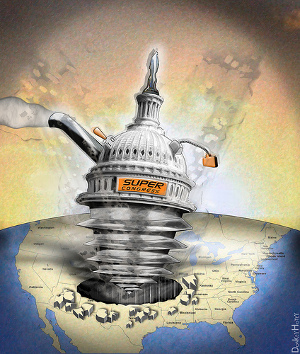
The biggest problem is that the Federal Reserve system works above the law, which is why Bank of America has gotten away with dumping $75 Trillion of derivatives on U.S. taxpayers with Federal approval.  With the Fed having to answer to no one, why wouldn’t its ruling-class drivers horde profits whilst shifting liabilities onto taxpayers?  It’s unlikely to be due to the benevolence of their hearts.

Messina

***

SEEKING ALPHABloomberg reports that Bank of America (BAC) has shifted about $22 trillion worth of derivative obligations from Merrill Lynch and the BAC holding company to the FDIC insured retail deposit division. Along with this information came the revelation that the FDIC insured unit was already stuffed with $53 trillion worth of these potentially toxic obligations, making a total of $75 trillion.

Many big banks, including Bank of America, issue derivatives because, if they are not triggered, they are highly profitable to the issuer, and result in big bonus payments to the executives who administer them. If they are triggered, of course, the obligations fall upon the corporate entity, not the executives involved. Ultimately, by allowing existing gambling bets to remain in insured retail banks, and endorsing the shift of additional bets into the insured retail division, the obligation falls upon the U.S. taxpayers and dollar-denominated savers.

Even if we net out the notional value of the derivatives involved, down to the net potential obligation, the amount is so large that the United States could not hope to pay it off without a major dollar devaluation, if a major contingency actually occurred and a large part of the derivatives were triggered. But, if such an event ever occurs, Bank of America’s derivatives counter-parties will, as usual, be made whole, while the American people suffer. This all has the blessing of the Federal Reserve, which approved the transfer of derivatives from Merrill Lynch to the insured retail unit of BAC before it was done.

The FDIC opposed the move, but there is nothing the FDIC can do, except file a petition for a writ of mandamus in court, against the Federal Reserve, seeking a declaration that the approval was illegal. But, the FDIC would lose, because Congress has given the Federal Reserve Board ultimate power to do whatever it wishes.

So, the bottom line is this: When something bad happens, and the derivative obligations are triggered, the FDIC will be on the hook, thanks to the Federal Reserve. The counter-parties of Bank of America, both inside America and elsewhere around the world, will be safely bailed out by the full faith and credit of the USA. Meanwhile, the taxpayers and dollar denominated savers will be fleeced again. This latest example of misconduct illustrates the error of allowing a bank-controlled entity, like the Federal Reserve, complete power over the nation’s monetary system. The so-called “reforms” enacted by Congress, in the wake of the 2008 crash, have vested more, and not less, power in the Federal Reserve, and supplied us with more, rather than less instability and problems.

This is not an isolated instance. JP Morgan Chase (JPM) is being allowed to house its unstable derivative obligations within its FDIC insured retail banking unit. Other big banks do the same. So long as the Federal Reserve exists and/or other financial regulatory agencies continue to be run by a revolving door staff that moves in and out of industry and government, crony capitalism will be alive and well in America. No amount of Dodd-Frank or Volcker rule legislation will ever protect savers, taxpayers or the American people. Profits will continue to be privatized and losses socialized.

Read more about how Bank Of America Dumps $75 Trillion In Derivatives On U.S. Taxpayers With Federal Approval.

© 2011 Seeking Alpha
Posted in Uncategorized | 1 Reply

Obama Still Flush with Cash from Financial Sector

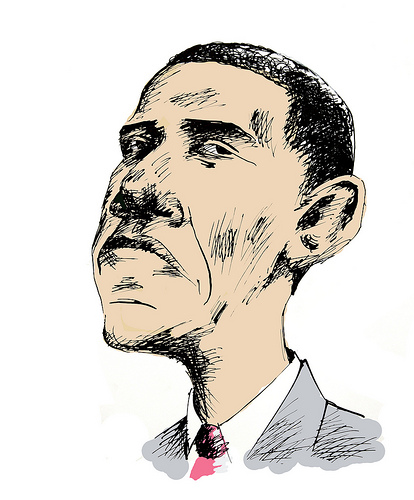
MEDIA ROOTS— Rhetoric aside, Obama continues to be the darling of Wall Street. In 2008, President Obama racked up $750 million dollars for his Presidential campaign, and is projected to take in roughly $1 billion dollars for 2012. Although the President appears to commiserate with the Occupy Wall Street movement and its dissatisfaction of Wall Street’s influence over politics, Obama has raised far more money this year from the financial and banking sector than any other GOP candidate combined. With such astronomical figures with which Obama’s been bought by the ruling-class, it’s no surprise he has broken virtually every campaign promise.  With this kind of financial sway, it must be fully expected he will do it again, should mass cognitive dissonance persist in 2012 granting him another four years.

MR

***

THE WASHINGTON POST Obama has brought in more money from employees of banks, hedge funds and other financial service companies than all of the GOP candidates combined, according to a Washington Post analysis of contribution data. The numbers show that Obama retains a persistent reservoir of support among Democratic financiers who have backed him since he was an underdog presidential candidate four years ago.

Channeling ‘Occupy’ anger

Obama’s ties to Wall Street donors could complicate Democratic plans to paint Republicans as puppets of the financial industry, particularly in light of the Occupy Wall Street protests that have gone global over the past week.

In response to the protests, the Obama campaign and other Democrats have stepped up their attacks on Romney and other Republicans for their opposition to Wall Street regulations.

One top banking executive who raises money for Obama, discussing fundraising efforts on the condition of anonymity, said reports of disaffection with the president “are exaggerated and overblown.” He said a strong contingent of financiers in New York, Chicago and California remains supportive of Obama and his economic policies, even as some have turned on him.

But, this donor added, “it probably helps from a political perspective if he’s not seen as a Wall Street guy.”

Limits on GOP candidates

Obama retains a core group of supporters on Wall Street who are central to his fundraising efforts. About a third of his top 40 fundraisers, who have helped bundle together $500,000 or more in contributions, hail from the finance sector, including big names such as former New Jersey governor Jon S. Corzine of MF Global, hedge-fund manager Orin Kramer and UBS executive Robert Wolf.

Obama’s chief of staff, William M. Daley, was also vice chairman at J.P. Morgan Chase before coming to the White House this year.

Read more about Obama still flush with cash from financial sector despite frosty relations.

© 2011 The Washington Post Company

Photo by flickr user Osipowa

Wall Street Donated $41 Million to Supercommittee

MEDIA ROOTS- It’s not very comforting to know that Wall Street lobbyists have been paying off members of the very committee in charge of finding $1.5 trillion worth of deficit measures. Can’t count much on “shared sacrifice” from the banks with bribery like this taking place on the hill.

Abby

***

TRUTHOUT– Wall Street has given $41 million in campaign contributions to the members of the Congressional “supercommittee” charged with finding $1.5 trillion worth of deficit reduction measures, according to a report released today by two watchdog groups.

The finance, insurance and real estate sector spent $3.7 billion on lobbying and campaign contributions from 1999 to 2008, according to the report, and the 12 members of the bipartisan Joint Select Committee on Deficit Reduction have all reaped the benefits.

Congressional veterans Sen. John Kerry (D-Massachusetts) and Sen. Max Baucus (D-Montana) top the list, having each received about $6 million in contributions from the financial sector during the course of their careers in Washington. The top GOP recipient on the committee, Sen. Jon Kyl (R-Arizona), has received $5.2 million from the sector.

Donations from the political action committees and executives of Bank of America, JPMorgan Chase and Wells Fargo – banks that received $95 billion in federal bailout funds – account for one-fifth of the $4.3 million in campaign cash donated by commercial banking interests to the 12 supercommittee members.

The report also identifies 27 former or current aides to supercommittee members who have worked as lobbyists for the financial industry. Manny Rossman, for example, was Kyl’s chief of staff before landing a position at the Breaux Lott Leadership Group, where his clients include Citigroup, Goldman Sachs and Prudential Financial.

“Wall Street bought the deregulation that led to our economic collapse and the American public has paid the price,” said Nick Nyhart, president and CEO of Public Campaign, the group that co-authored the report. “The supercommittee should not give Wall Street and big banks another free ride because of their campaign cash.”

Wall Street has given $41 million in campaign contributions to the members of the Congressional “supercommittee” charged with finding $1.5 trillion worth of deficit reduction measures, according to a report released today by two watchdog groups.
The finance, insurance and real estate sector spent $3.7 billion on lobbying and campaign contributions from 1999 to 2008, according to the report, and the 12 members of the bipartisan Joint Select Committee on Deficit Reduction have all reaped the benefits.
Congressional veterans Sen. John Kerry (D-Massachusetts) and Sen. Max Baucus (D-Montana) top the list, having each received about $6 million in contributions from the financial sector during the course of their careers in Washington. The top GOP recipient on the committee, Sen. Jon Kyl (R-Arizona), has received $5.2 million from the sector.
Donations from the political action committees and executives of Bank of America, JPMorgan Chase and Wells Fargo – banks that received $95 billion in federal bailout funds – account for one-fifth of the $4.3 million in campaign cash donated by commercial banking interests to the 12 supercommittee members.
“Wall Street bought the deregulation that led to our economic collapse and the American public has paid the price,” said Nick Nyhart, president and CEO of Public Campaign, the group that co-authored the report. “The supercommittee should not give Wall Street and big banks another free ride because of their campaign cash.”

Read more about Wall Street Donated $41 Million to Supercommittee Members

© 2011 Truthout

Photo by Flickr user DonkeyHotey


Prisons Lobby Millions to Keep People in Jail

THINK PROGRESS– Yesterday, the Justice Policy Institute (JPI) released a report chronicling the political strategies of private prison companies “working to make money through harsh policies and longer sentences.” The report’s authors note that while the total number of people in prison increased less than 16 percent, the number of people held in private federal and state facilities increased by 120 and 33 percent, correspondingly. Government spending on corrections has soared since 1997 by 72 percent, up to $74 billion in 2007. And the private prison industry has raked in tremendous profits. Last year the two largest private prison companies — Corrections Corporation of America (CCA) and GEO Group — made over $2.9 billion in revenue.

JPI claims the private industry hasn’t merely responded to the nation’s incarceration woes, it has actively sought to create the market conditions (ie. more prisoners) necessary to expand its business.

According to JPI, the private prison industry uses three strategies to influence public policy: lobbying, direct campaign contributions, and networking. The three main companies have contributed $835,514 to federal candidates and over $6 million to state politicians. They have also spent hundreds of thousands of dollars on direct lobbying efforts. CCA has spent over $900,000 on federal lobbying and GEO spent anywhere from $120,000 to $199,992 in Florida alone during a short three-month span this year. Meanwhile, “the relationship between government officials and private prison companies has been part of the fabric of the industry from the start,” notes the report. The cofounder of CCA himself used to be the chairman of the Tennessee Republican Party.

Read the full article about Private Prisons Spend Millions On Lobbying To Put More People In Jail.

© 2011 Think Progress

Photo by Flickr user maistora

Ralph Nader: Why Obama Will Get Second Term

BLOOMBERG– The stars are aligned for Barack Obama’s re-election in November 2012. He won’t join Jimmy Carter to be the second Democrat in 120 years to lose a second term.

Five things are playing in Obama’s favor.

First, the Republicans — driven by their most conservative members in Congress — will face a primary with many candidates who will advance harsh ideological positions. Michele Bachmann, Newt Gingrich, Donald Trump and others might as well be on the Democratic National Committee payroll. House Budget Committee Chairman Paul Ryan’s reverse Robin Hood plan to cut more than $6 trillion in spending over a decade will provide the outrage, stoked by a sitting president possessed of verbal discipline.

The field of Republican weaklings is already getting smaller. This week, Mississippi Governor Haley Barbour dropped out of the race for the presidency.

Second, the Republican governors’ attacks on unions are turning off the swing voters and Reagan Democrats in Ohio, Florida, Pennsylvania and Wisconsin. Imagine the voter reaction if millions of workers lose their right to collective bargaining, and the impact that cuts in benefits and wages will have on their lives.

Democratic governors, such as Jerry Brown of California, Pat Quinn of Illinois and Andrew Cuomo of New York, are cutting — but not taking away — workers’ bargaining rights. This is a politically useful contrast for Obama. Reagan Democrats, who have won many elections for the Republicans, are a big plus for Obama in the contested states.

No Challenge

Third, no candidates are emerging to challenge Obama in the primaries. A discussion of Obama’s forgotten campaign promises and record would have public support among Democrats. Even so, the liberal base has nowhere to go to send a message about war, free-trade agreements, raising the minimum wage or union membership.

Nor does a third party or independent candidacy pose a threat, given the winner-take-all, two-party system.

Fourth, Obama has neutered much of the big corporate lobby’s zeal to defeat him. He decided from the beginning not to prosecute executives from Wall Street banking, brokerage and rating firms. Multinational companies are pleased with Obama’s position on trade, on not disturbing the many corporate subsidies, handouts and giveaways, such as the corn-ethanol subsidy.

Read the full article about Why Obama Will Get Second Term in White House: Ralph Nader.

© 2011 Bloomberg

Photo by Flickr user JHF