In Iraq’s Bloodiest Day of 2010, Attacks Kill 100

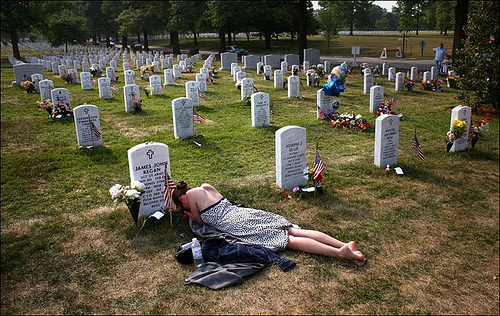
YAHOO NEWS– A man with explosives strapped to his body blew himself up in a crowd, bombers struck a southern city and gunmen sprayed fire on security checkpoints in attacks Monday that killed at least 100 people — most of them in Shiite areas — in Iraq’s deadliest day this year.

Officials were quick to blame insurgents linked to al-Qaida in Iraq for the shootings in the capital, saying the militants were redoubling efforts to destabilize the country at a time of political uncertainty over who will control the next government.

Shiite Vice President Adel Abdul-Mahdi stressed the importance of quickly forming a government that does not exclude any major political group to try to prevent insurgents from exploiting Iraq’s fragile security.

“The terrorist gangs perpetrated new assaults today on our people and armed forces,” he said. “We call on all political blocs to work seriously for the benefit of the country and … start to form a national partnership government including all political parties without marginalizing any one.”

More than two months after the March 7 election, Iraq’s main political factions are still struggling to put together a ruling coalition. Prime Minister Nouri al-Maliki‘s Shiite bloc has tried to squeeze out election front-runner Ayad Allawi — a secular Shiite who was heavily backed by Sunnis — by forging an alliance last week with another religious Shiite coalition. The union, which is just four seats short of a majority in parliament, will likely lead to four more years of a government dominated by Shiites, much like the current one.

Sunni anger at Shiite domination of successive governments was a key reason behind the insurgency that sparked sectarian warfare in 2006 and 2007. If Allawi is perceived as not getting his fair share of power, that could in turn outrage the Sunnis who supported him and risk a resurgence of sectarian violence.

The relentless cascade of bombings and shootings — hitting at least 10 cities and towns as the day unfolded — also raised questions about whether Iraqi security forces can protect the country as the U.S. prepares to withdraw half of its remaining 92,000 troops in Iraq over the next four months.

Continue reading about Iraq’s Bloodiest Day.

Associated Press Writers Saad Abdul-Kadir and Qassim Abdul-Zahra contributed to this report.

Photo by Flickr user Peyman

© YAHOO NEWS, 2010
Al-Qaeda Blames 9/11 on US Support for Israel

ISRAEL NATIONAL NEWS– American support for Israel was the reason for the 9/11 terrorist attacks on the United States in 2001, according to an audio message purported to be from Osama bin Laden, the leader of the international Al-Qaeda terrorist organization. The whereabouts of Bin Laden are not known, and the video image accompanying the audio featured only a still picture of him.

The title of the audio was, “Message to the American People.” and was released two days after the eighth anniversary of the multiple aerial attacks on the U.S.

“If you think about your situation well, you will know that the White House is occupied by pressure groups,” the speaker on the audiotape said. “Rather than fighting to liberate Iraq – as Bush claimed – it (the White House) should have been liberated.”

Bin Laden added that U.S. President Barack Obama does not have enough power to change American policies. “The bitter truth is that the neo-Conservatives continue to cast their heavy shadows upon you,” he continued. “All we will do is to continue the war of attrition against you on all possible axes, like we exhausted the Soviet Union for ten years until it collapsed with grace from Allah the Almighty and became a memory of the past.”

Continue reading about Al Qaeda Blaming 9/11 on US Support for Israel.

Photo by Ron Almog

© ISRAEL NATIONAL NEWS, 2009

No Ties Between al Qaeda and Iraq, Pentagon Says

CNN– The U.S. military’s first and only study looking into ties between Saddam Hussein’s Iraq and al Qaeda showed no connection between the two, according to a military report released by the Pentagon.

A U.S. soldier in front of a bus hit by a roadside bomb near Nasiriyah, southeast of Baghdad, Iraq, on Tuesday.

The report released by the Joint Forces Command five years after the U.S.-led invasion of Iraq said it found no “smoking gun” after reviewing about 600,000 Iraqi documents captured in the invasion and looking at interviews of key Iraqi leadership held by the United States, Pentagon officials said.

The assessment of the al Qaeda connection and the insistence that Hussein had weapons of mass destruction were two primary elements in the Bush administration’s arguments in favor of going to war with Iraq.

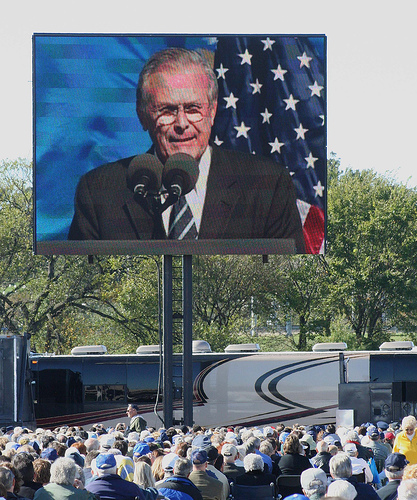
The Pentagon’s report also contradicts then-Secretary of Defense Donald Rumsfeld, who said in September 2002 that the CIA provided “bulletproof” evidence demonstrating “that there are, in fact, al Qaeda in Iraq.”

Although other groups, like the September 11 commission, have concluded that there was no link between Hussein and al Qaeda, the Pentagon was able to analyze much more information.

The documents cited in the report do reveal that Hussein supported a number of terrorists and terrorist activities inside and outside Iraq.

“The Iraqi regime was involved in regional and international terrorist operations prior to Operation Iraqi Freedom. The predominant targets of Iraqi state terror operations were Iraqi citizens, both inside and outside of Iraq,” according to the report. Read excerpts from report (pdf)

Most of the terrorism was aimed at keeping Hussein and his Baath party in power, according to Pentagon officials.

“State sponsorship of terrorism became such a routine tool of state power that Iraq developed elaborate bureaucratic processes to monitor progress and accountability in the recruiting, training and resourcing of terrorists,” according to the report.

The report cited such examples as training for car bombs and suicide bombings in 1999 and 2000, both of which U.S. and Iraqi forces have struggled to contain since the rise of the insurgency in summer 2003.

Photo by flickr user DBKing

© COPYRIGHT CNN, 2008

Senior al Qaeda Leader in Iraq a Myth, According to US Military

REUTERS– A senior operative for al Qaeda in Iraq who was caught this month has told his U.S. military interrogators a prominent al Qaeda-led group is just a front and its leader fictitious, a military spokesman said on Wednesday. Brigadier-General Kevin Bergner told a news conference that Abu Omar al-Baghdadi, leader of the self-styled Islamic State of Iraq, which was purportedly set up last year, did not exist.

“The Islamic State of Iraq was established to try to put an Iraqi face on what is a foreign-driven network”, Bergner said.

“The name Baghdadi means the person hails from the Iraqi capital. Bergner said the information came from an operative called Khalid al-Mashadani who was caught on July 4 and who he said was an intermediary to Osama bin Laden.” He said Mashadani was believed to be the most senior Iraqi in the Sunni Islamist al Qaeda in Iraq network.

“In his words, the Islamic State of Iraq is a front organization that masks the foreign influence and leadership within al Qaeda in Iraq in an attempt to put an Iraqi face on the leadership of al Qaeda in Iraq,” Bergner said.

“U.S. military officials in recent weeks have been pressed to explain the link between al Qaeda in Iraq and bin Laden’s global network given the military’s heightened focus on al Qaeda in Iraq as the biggest threat to the country.” The military blames al Qaeda in Iraq for most of the major bombings in Iraq, saying the group is trying to spark all-out civil war between majority Shi’tes and minority Sunni Arabs.

Bergner said Mashadani served as an intermediary between the al Qaeda in Iraq leader, Egyptian Abu Ayyab al-Masri and bin Laden and also the Egyptian cleric Ayman al-Zawahri, who is the global network’s No. 2 commander. The Islamic State of Iraq was set up in October, comprising a group of Sunni militant affiliates and tribal leaders led by Baghdadi. In April, it named a 10-man “cabinet”. The Islamic State of Iraq has claimed many high-profile acts of violence.

But Bergner said Mashadani and Masri had co-founded a “virtual organization in cyberspace called the Islamic State of Iraq in 2006 as a new Iraqi pseudonym for AQI.”

“To further this myth, Masri created a fictional head of the Islamic State of Iraq known as Abu Omar al-Baghdadi,” he said.

“To make al-Baghdadi appear credible, al-Masri swore allegiance to al-Baghdadi and pledged to obey him, which is essentially pledging allegiance to himself since he knew Baghdadi was fictitious and a creation of his own,” he said. “The rank and file Iraqis in AQI believe they are following the Iraqi al-Baghdadi. But all the while they have been following the orders of the Egyptian Abu Ayyab al-Masri.”

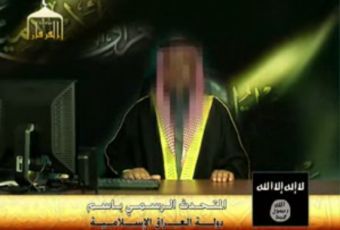
Voice recordings purporting to be from Baghdadi have appeared on the Internet, although Bergner said he had been played by an actor. He did not refer to any video clips. Bergner said Mashadani was al Qaeda’s “media emir” for Iraq. He said the operative was “providing significant insights into the nature and circumstances of al Qaeda in Iraq”. The U.S. military has always said al Qaeda in Iraq was run by foreigners.

© REUTERS, 2007