General Petraeus Goes to Media War

August 16,2010

COMMON DREAMS– It’s already history. In mid-August 2010, the U.S. commander in Afghanistan launched a huge media campaign to prevent any substantial withdrawal of military forces the next summer.

The morning after Gen. David Petraeus appeared in a Sunday interview on NBC’s “Meet the Press” to promote the war effort, the New York Times front-paged news of its own interview with him — reporting that the general “suggested that he would resist any large-scale or rapid withdrawal of American forces.”

In fact, the general signaled that he might oppose any reduction of U.S. troop levels in Afghanistan a year from now. During the NBC interview, the Times noted, “Petraeus even appeared to leave open the possibility that he would recommend against any withdrawal of American forces next summer.”

On Monday, the Washington Post also published the twisty line of the suddenly interview-hungry Petraeus, reporting that “he remains supportive of President Obama’s decision to begin withdrawing troops next July, but he said it is far too soon to determine the size of the drawdown.” The newspaper observed that “the general’s presence in Kabul, as opposed to the U.S. Central Command headquarters in Tampa, could make him a far more forceful voice for attenuating the drawdown if he chooses to make that case.”

“Attenuating the drawdown” means keeping the war machinery at full throttle.

Let’s be clear about what’s happening here. The top U.S. military commander in Afghanistan, with the evident approval of the White House, has launched a fierce media blitz to cripple the policy option of any significant military withdrawal a year from now. Riding high in what is supposed to be a civilian-run military, Petraeus is engaging in strategic media operations to manipulate what should be a democratic process on matters of war and peace.

Who bears ultimate responsibility for this manipulative, anti-democratic behavior? The commander in chief.

Ominously, the Petraeus media offensive got underway just days after presidential spokesman Robert Gibbs picked a fight with the progressive wing of the Democratic Party — a wing that has been strengthening its opposition to the war in Afghanistan.

More than four decades after President Johnson used the term “nervous Nellies” to disparage the growing number of Democrats who voiced dissent about the war in Vietnam, the Obama White House is now disparaging progressive dissenters with terms like “the professional left.”

Every week, President Obama is sacrificing billions of dollars and uncounted lives in the service of what Martin Luther King Jr. called — at a time of another horrific war effort — “the madness of militarism.” Then, as now, a Democrat in the White House augmented the momentum of the Pentagon’s war train, boosting it with eagerness to appear tough and avoid Republican charges of weakness.

While history is not exactly repeating, it is rhyming. Like a dirge.

Now, as in the era of Dr. King’s final years, war is escalating while the lures of silence or equivocation are widely viewed as prudent. Rationales for muting dissent keep pitching for complicity.

The immediate problem is one of political acquiescence. Right now, it’s time to speak up against the efforts by a top general to stampede this country into more war. No matter who is willing to go along with the madness of militarism, we must not.

Norman Solomon is a journalist, historian, and progressive activist. His book “War Made Easy: How Presidents and Pundits Keep Spinning Us to Death” has been adapted into a documentary film of the same name. His most recent book is “Made Love, Got War.” He is a national co-chair of the Healthcare NOT Warfare campaign. In California, he is co-chair of the Commission on a Green New Deal for the North Bay; www.GreenNewDeal.info.

ISAF Photo By U.S. Air Force Staff Sgt. Bradley Lail
US Supersizes Afghan Mega-Base as Withdrawal Date Looms

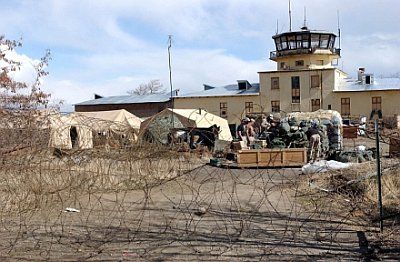
COMMON DREAMS– Anyone who thinks the United States is really going to withdraw from Afghanistan in July 2011 needs to come to this giant air base an hour away from Kabul. There’s construction everywhere. It’s exactly what you wouldn’t expect from a transient presence.

Step off a C-17 cargo plane, as I did very early Friday morning, and you see a flight line packed with planes. When I was last here two years ago, helicopters crowded the runways and fixed-wing aircraft were — well, if not rare, still a notable sight. Today you’ve got C-17s, Predators, F-16s, F-15s, MC-12 passenger planes … I didn’t see any of the C-130 cargo craft, but they’re here somewhere.

More notable than the overstuffed runways is the over-driven road. Disney Drive, the main thoroughfare that rings the eight-square-mile base, used to feature pedestrians with reflective sashes over their PT uniforms carrying Styrofoam boxes of leftovers out of the mess halls. And those guys are still there.

But now the western part of Disney is a two-lane parking lot of Humvees, flamboyant cargo big-rigs from Pakistan known as jingle trucks, yellow DHL shipping vans, contractor vehicles and mud-caked flatbeds. If the Navy could figure out a way to bring a littoral-combat ship to a landlocked country, it would idle on Disney.

Expect to wait an eternity if you want to pull out onto the road. Cross the street at your own risk.

Then there are all the new facilities. West Disney has a fresh coat of cement — something that’s easy to come by, now that the Turkish firm Yukcel manufactures cement right inside Bagram’s walls.

There on the flightline: the skeletons of new hangars. New towers with particleboard for terraces. A skyline of cranes. The omnipresent plastic banner on a girder-and-cement seedling advertising a new project built by cut-rate labor paid by Inglett and Stubbs International.

I haven’t been able to learn yet how much it all cost, but Bagram is starting to feel like a dynamic exurb before the housing bubble burst. There was actually a traffic jam this afternoon on the southern side of the base, owing to construction-imposed bottlenecks, something I didn’t think possible in late summer 2008.

Perhaps the most conspicuous change of all: fresh concrete T-walls fortifying the northern and southern faces of the base. Insurgents have launched a number of futile attacks on the base recently, mostly inaccurate small-arms fire and the odd rocket-propelled grenade. They’ve mostly irritated their targets instead of killing them.

But a definite legacy is the abundance of huge barriers at the most-obvious access points to Bagram. Much of the eastern wing remains surrounded by chicken fencing topped with barbed wire, but the more sensitive points of entry are now hardened.

So, apparently, are the sentiments of local Afghans nearby. Troops here told me of shepherd boys scowling their way around Bagram’s outskirts, slingshotting off the occasional rock in hopes of braining an American. Again, something else I wouldn’t have believed two years ago.

By next year, the detention facility that’s spirited away on a far corner of Bagram is supposed to revert to Afghan control. And maybe someday the Afghan National Army will inherit the entire base.

But two years ago there were about 18,000 troops and contractors living here. Now that figure is north of 30,000, all for a logistics hub and command post that the United States didn’t ever imagine possessing before 9/11.

In 2011, the U.S. military probably won’t be thinking about turning over the keys to a new, huge base. It’ll be thinking about how it can finish up the construction contracts it signed months ago — if not some it’s yet to ink.

Written by Spencer Ackerman for Wired Magazine

Photo by the US Army

© COPYRIGHT WIRED, 2010

Endgame in Afghanistan

GUARDIAN– As the war in Afghanistan enters its final chapter, Sean Smith’s brutal, uncompromising film from the Helmand frontline shows the horrific chaos of a stalemate that is taking its toll in blood.

Warning: contains distressing scenes and strong language

Read Sean Smith’s extraordinary diary of his time on the Afghanistan frontline.


July Marks Deadliest Month for Afghan War

EXAMINER– Three more U.S. troops fighting for their country were killed Friday, raising the death toll to 66 in July – the deadliest month in the 9-year war in Afghanistan.

The previous monthly high was in June when 60 were killed. In June there were a total of 102 U.S. and allied deaths, the first time NATO monthly fatalities reached triple digits. That number went down to 89 in July.

In the latest incidents that occurred Thursday and Friday, a U.S. service member died in an insurgent attack, two others were killed by a roadside bomb in southern Afghanistan, and three U.S. troops were killed in the south in two separate roadside bombings.

On Friday a NATO SUV driven by two U.S. contractors was involved in a traffic accident that killed four Afghans.

This led to Afghans rioting outside the American embassy in Kabul. They threw stones, set two vehicles on fire, and chanted “death to America.”

Police fired their weapons in an effort to disperse the crowd. The crowd burned two foreigners’ vehicles, causing heavy black smoke to rise from the scene.

“It is our right to raise up our voice and protest when innocent Afghans are harmed,” said Azizullah, a 25-year-old student, who like many Afghans uses one name.

He said foreigners were in the vehicle that struck the car, killing the Afghan civilians.

Continue reading about July Marking the Deadliest Month for the Afghan War

© COPYRIGHT EXAMINER, 2010

Photo by Abby Martin

90,000 Classified War Logs Revealed by Wikileaks

(Video below)

TELEGRAPH– Tens of thousands of secret American military documents have been leaked disclosing how Nato forces have killed scores of civilians in unreported incidents in Afghanistan.

The classified memos also reveal the secret efforts of coalition forces to hunt down and “kill or capture” senior Taliban and al-Qaeda figures.

And they document growing evidence that Iran and Pakistan is supporting the insurgency. Although many of the claims in the documents, of which there are more than 90,000, have been aired previously, the leak to the website Wikileaks is highly embarrassing. It was condemned by the White House last night, which said the information could threaten the safety of coalition operations.

The Ministry of Defence said it was still studying the leaked documents.

The most damaging allegations surround the killing of civilians by coalition troops. The documents claim that 195 civilians have been improperly killed and 174 wounded. Many were innocent motorcyclists or drivers shot after being suspected of being suicide bombers.

In one incident, a US patrol machine-gunned a bus, wounding or killing 15 passengers. Incidents involving British troops killing civilians in Kabul are also detailed.

Several civilian deaths were thought to have been caused by remote-controlled drones commanded from Nevada, thousands of miles away.

Many of the incidents have never previously been disclosed.

The memos also reveal the operations of a secret special forces “black unit” that is charged with the “kill or capture” without trial of Taliban leaders.

There are said to have been 2,000 civilians killed by Taliban roadside bombs.

The suspected influence of foreign governments in the insurgency is revealed. Pakistan receives $1billion a year from the US to help fight the insurgents, but the documents suggest that members of its security services, the ISI, have met Taliban leaders to organise resistance against US forces and even kill US-supported Afghan leaders.

Continue reading about the 90,000 Classified War Logs.

© COPYRIGHT TELEGRAPH, 2010