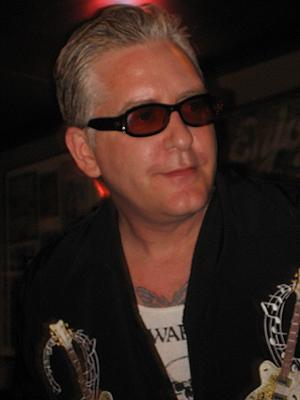
MEDIA ROOTS — Earlier this week on Deadline Live, radio host Jack Blood interviewed our very own Abby Martin. The beginning of the conversation gravitates around Abby’s incident with Rand Paul, where Rand tried to intimidate Abby for confronting him on his Romney endorsement. This leads into a discussion on many topics including how putting your faith and energy behind any politician (even ones who say things you agree with) will ultimately lead to disappointment.
Jack Blood is unique in the ‘liberty movement’ because he was practically black balled by the reigning leader of said movement back in 2010. Jack and Abby discuss how the alternative media movement has been taking over by ‘fear porn’ and a lock step ideology that is based on sensationalism instead of facts. They explore the trap of idealizing yourself as a critical thinker and rejecting mainstream media, but then replacing your intake of information with just another alternative media establishment narrative.
Overall, it’s refreshing to hear a discussion inside this ‘movement’ which isn’t afraid to be critical of certain aspects of it, like its rampant racism (important fixtures in the movement referring to Obama as a ‘spear chucker’) and homophobia. Or, why so many people in the movement keep making excuses for both Pauls, even going so far as claiming he is being held hostage. Bohemian Grove and Bilderberg are also discussed as potential distractions away from where the seeds to actual documented public policy is formed. The conversation finishes up with how art is a vehicle for reflecting our times, and how an artist has a responsibility to inject something into the zeitgeist of culture.
Robbie Martin for Media Roots
***
Jack Blood Interviews Abby Martin on Deadline Live
“Jack Blood welcomes Abby Martin (www.abbymartin.org and www.mediaroots.org) TV Host on Russia Today…. We discuss Rand Paul’s censorship of her and RT, Art as a vehicle for truth, Bilderberg’s Alt media Red carpet, No difference between Alt media and MSM, and what is Russia Today? Abby swears, and denies she is “Toyko Rose” and basically kicks ass all through the entire first hour…. Breaking news from www.deadlinelive.info”
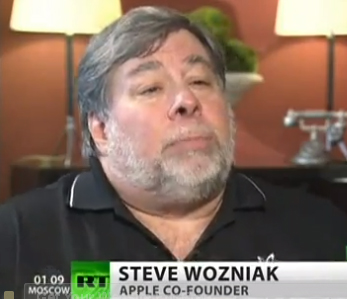
MEDIA ROOTS — When I think of the most prolific innovators of our generation, there are a couple names that immediately come to mind. The founders of Apple, Steve Jobs and Steve Wozniak, are definitely at the top of the list. There’s no denying that Apple computers have aesthetically designed the world in which we all know and live in today–by simplifying technology to the point where everyone can use and access the internet, Apple products have changed the course of social interaction in the world.
I had the great pleasure of sitting down with the co-founder of Apple, Steve Wozniak, last week in downtown DC. Truthfully, I was a little worried that someone worth billions of dollars would be pretentious and aloof. Instead, I was pleasantly surprised to see how down to earth and open he was to share his perspective.
It was a refreshing and enlightening experience to hear from such a visionary on issues like MegaUpload’s Kim Dotcom, Net Neutrality, WikiLeaks, and government legislation that curbs our internet freedoms.
Abby
***
RT’s Abby Martin sits down with Steve Wozniak, co-founder of Apple,
to speak about net neutrality and his fear that freedom on the Web might become a thing of the past.
***
RT — “Well, we begin today taking a close look at cyber-legislation and the aim to regulate the internet. With the failure of the most recent cyber bill in the Senate and a possible Obama Executive Order, it seems the government is looking for ways to beef up internet protection.
“The head of cyber command General Keith Alexander, also head of the NSA, has come out asking the administration to review the rules when it comes to cyber-attacks. Currently, the Pentagon is only allowed to defend against attacks inside its own boundaries. But they are hoping now to expand that power to outside of their own computer networks and within foreign countries.
“Now, this comes days after Kaspersky Labs identified another apparent state-sponsored virus with links to Stuxnet and Flame. So, as heavy as speculation swirls around the future of the internet, we, here at RT, sat down with someone who had a clear hand in creating our current cyber climate. Steve Wozniak, co-founder of Apple, speaks to RT’s Abby Martin about net neutrality, his fear that freedom on the internet could become a thing of the past. He also weighs in on the Kim Dotcom case against him.”
Abby Martin (c. 1:05): “So, Steve, as co-founder of one of the largest companies in the world, do you think that you have a responsibility to speak out about internet issues like internet regulation?”
Steve Wozniak: “I don’t think anyone comes with a responsibility just because their company is really big. Especially, since I’m not the one who wanted to run a company, just be a great engineer to help start it. I don’t feel that anybody has a responsibility. However, I do like it when well-known people, that are in the public eye, speak out on social issues and give their opinion.”
Abby Martin: “What do you think about legislation SOPA and PIPA? And why do you think they were so unpopular?”
Steve Wozniak: “It turns out that the, well, the internet, when it first came, it was a breath of fresh air. It was so free. Nobody owned the internet space. Countries didn’t own it; they didn’t control it. It was worldwide. It was people to people. It was like we, little people of the world, all of a sudden had this incredible resource. And we didn’t have to go through other people selling it to us and delivering it to us. That has changed a lot. But, still, those were items, that were kind of against just being able to use the wires to send whatever you thought of to somebody else who’s a friend or whatever sharing data.
“So, a lot of people had done that sort of thing. They had freely shared maybe a song with a friend. Or maybe they shared another file with another good friend and they just don’t want interference. Now, sure, it’s illegal to share copyrighted material. Fine, there are laws in place. But these were new laws, that were gonna just totally try to put up roadblocks to services, that had other very good purposes in our life.
“For example, I might make a promotional video for an interview like this and then I’ll email it to you. Well, it’s too big to email. So, I’ll upload it to a little site. It may be Dropbox, maybe it’s my Apple iDisk, maybe it’s Megaupload. I’ll upload it to a site and send you the URL and now you can download it.
And I do that regularly.”
Abby Martin (c. 2:52): “I heard you previously talking about Kim Dotcom’s case. And you mentioned that the charges against him were pretty much phony. Elaborate more on what you mean by that.”
Steve Wozniak (c. 3:04): “Yes, first of all, he ran one of the largest file-sharing services in the world. So, the most movies and all were being exchanged by people through that site. It’s not a site where you could link to it and connect to it and say, ‘Search for Avatar.’ There was no searching. Somebody could upload a file and then pass out a URL on their own. And they are violating the law, if it’s copyright material, like a movie. And the person, who downloads it, is violating the law, too.
“But what Kim Dotcom ran is just a service that’s like the post office. He was the post office it was being mailed through. Why do you shut down the post office, thinking that’s where the problem is? It’s not. So, that was a phony charge.
“They tried to charge him with a copyright violation, himself, for uploading 60 songs or something. But they had come up off of CDs he had purchased.
“So, you see, it was all these attempts, that I call phony. Then they had to figure out a way to extradite him. They needed a crime, that would get him five years in prison to meet the law, the New Zealand law, for extradition.
“So, they made up phony charges of racketeering, like he’s some big mobster connecting, you know, a big financial empire in these countries. I mean Apple does that. But Kim Dotcom is just a nice soft little sweet guy when you meet him, who tells the truth openly. You know when somebody’s being truthful when you’re with them, personally. And he does hide things. He doesn’t harry. He doesn’t have concocted lines to tell. He’s not a racketeer.
“They charge him with mail fraud because he said, ‘I deleted some files.’ And what he had done was delete the links to them. Like, if you have a computer and you take a file and you throw it in the trash. The file is still on your hard disk. It didn’t really get erased. The link is gone. You can’t find it anymore by that link. So, that’s a phony charge. He really had got rid of the one part, that you could have gotten rid of to make it look as though it was deleted.
“The phony charges just indicate that they’re gonna, they’re doing everything they can to make the public think they, the prosecutors, are in the right. You know? But you don’t do phony things when you’re in the right—you have an open and shut case—no. They’re having to go beyond the bounds of what’s right to try to convict him.”
Abby Martin (c. 5:06): “What kind of precedent do you think this sets for, just, government overstepping?”
Steve Wozniak: “I’ve read a lot about how they confiscated his data files, actually, took them to the United States and they didn’t have the right to do that.
“It’s, yeah, the trouble is we’ve developed what sort of rights you have to have against accusers, meaning the police and the prosecutors. They are the accusers. The presumption of innocence means the burden of proof is on the accuser. They have to prove that. You have the right to be notified of what you’re being charged of. You have the right to, you know, a lot of different rights, that make sure you’re being treated fairly. And prosecutors and governments have found every way they can to get around those rights. And that’s what bothers me. It’s that, if they want to convict you of something you didn’t do, they have an awful lot of techniques to do it. A lot of ways to do it.”
Abby Martin (c. 5:51): “You founded the Electronic Frontier Foundation to protect free speech. Should the principles of the First Amendment be protecting something like WikiLeaks?”
Steve Wozniak: “Free speech is not absolute in my mind. It’s a very important right. It has to go through considerations of, ‘Did you violate it in ways, that might be, hurt somebody else?’ Some free speech could actually trigger harmful events. It could trigger even murders.
“So, does murdering an abortion doctor count as free speech? No. There are limits to free speech.
“I don’t know in the case of WikiLeaks. Um, I don’t know where that’s going to fall out.”
Abby Martin:“So, you think there are limitations, in terms of, kind of, opening or protecting free speech online, the war on whistle-blowers?”
Steve Wozniak (c. 6:35): “Well, yeah, free speech online. I was brought up with the belief that the First Amendment was such a good thing. Every one of our Bill of Rights was so crucial to my heart, the way my dad taught me. But free speech meant you could say something bad about the president, even. You could say something bad about your government. You had that right. And we were taught you don’t have that right in Communist Russia. So, I believe in that right very strongly.
“As far as WikiLeaks, you know, I wish I knew more about the whole case. On the surface, it sounds to me like something, that’s good. The whistle-blower blew the truth. The people found out what, they, the people paid for. You know? And the government says, ‘No, no, no! The people should not know what they paid for.’”
Abby Martin (c. 7:15): “You’ve grown up in a generation where you’ve seen the internet proliferate into something so massive where political and social movements are birthed online now. What do you think about the evolution of the internet and how Apple has played a role in expanding that to people?
Steve Wozniak: “You know, when we started the company—I always go back to that point. We have a vision of computers being prolific and in everybody’s hands throughout society. Did we have the idea that it would lead to, you know, the incredible connection that the internet would come on board, that broadband would come on board for almost everyone who wants it and that that would lead to all these, basically, the way we live life and the way do things, everything political, everything social, the way we do things with other people is all done with your computer, on the internet, with your iPhone or mobile devices now. And it’s a totally different world than it was when, well, we had powerful computers, but they weren’t a part of your life as much as now. And I’m just as happy as everyone else to see it having turned out this way.”
Abby Martin (c. 8:17): “And how do you see it going? Do you think it will still continue? Or do you think we’ll see, kind of, a curb. I mean with the political and social movements now where everything is integrated, everything is being homogenised in the entire world and we are seeing the Arab Spring, the Occupy Wall Street movement, really, because of social interaction.”
Steve Wozniak: “Yes. I think that a lot of social interaction will be curbed. I, I—let me take that back. I fear it. I fear it will be. The gatekeepers, those who can turn on and off switches, allow certain things, disallow other things, allow who gets to send me data about a new movie, rather than everyone having equal say so of reaching me. Yeah, I fear that very strongly. Especially, net neutrality, issues like that, internet freedom is being interfered with in major ways. And it shouldn’t.
“I think the internet should, from day one, a country of its own, that isn’t bound by any individual county’s laws. Maybe we could have had an internet government. But it didn’t happen, just like world government doesn’t happen. You know? Space doesn’t belong to anyone. The moon doesn’t belong to anyone. These are really beautiful principles in life. And then, as soon as a country figures out a way to get control of them, it disappears.
“I’m an optimist. I think we can move more and more towards net neutrality. The trouble is a lot of it has to be, um, enforced by the government and conservative types and libertarian types say, ‘Government shouldn’t have any say and control over that! That takes away our freedom!’ Wrong. It takes away the freedom of the companies, that are taking away the freedom from us.
“Every freedom we have in the United States—every one of them—was given to us by Congressional regulation. It’s called the Bill of Rights. That is what gives us our freedom. And, yet, it was from the government. It was government regulation.
“No, there are times when government regulation says, ‘You will not impede with the internet neutrality of the users.’
Abby Martin (c. 10:05): “What do you think about this whole hacktivist movement, that’s come out of, kind of, the war on whistle-blowers, Occupy Wall Street, Anonymous, and you have the take-downs of government websites. And then you see legislation, like CISPA, the Cyber Intelligence Security Protection Act, that, kind of, puts a stop to these things. Do you think that that’s, kind of, working as a guise and using the hacktivism and the hacktivists [as a pretext] for regulating the internet even more?”
“Well, I really think that there are means for legitimate discourse. And trying to bring attention, um, with activist acts is wrong. On the other hand, I believe very strongly that legitimised marches and that sort of stuff, with the approval of the authorities, there’s room in our society to go out and have a microphone, to have a say and be heard by many others, especially, in this day of the internet.
“So, there are a lot of avenues. It’s just trying to, you know, grab some to get on the news, I don’t think that’s the way to, maybe it’s a start, it puts ideas into people’s heads, but I really, um, I, I don’t think that’s the right way to solve things.”
“I know you said before that no one really has the responsibility to speak out about anything. But why do you, Steve, speak out? And why do you think so many others don’t about these issues?”
“You know what? The whole world is very conflict-oriented. We want to take a side and fight for my side. My side might be my country. It might be my computer platform. It might be which browser I use. And I take my side and everybody else is bad. And I want to fight. And I only want to look at the world one way. And I’m the, I try to be so wide and open and just, you know, accept everything and judge it. That’s the logical scientific approach. Don’t take a side. Don’t be, like, for one religion against others, that sort of thing.”
Abby Martin: “Thank you so much for your time.”
Transcript by Felipe Messina for Media Roots and RT
MEDIA ROOTS — Life in modern USA is increasingly polarised. A false two-party system, designed and executed by the elite class, erodes democracy and allows elites to continue to swim in money whilst public institutions, such as schools and parks and post offices, cease to operate. Public purpose is often distorted and the social contract is undermined, as families are dispossessed.
In communities around the country, many working-class Americans know about class repression and resistance while many academics often seem to operate in a detached, parallel universe. This is primarily why independent media, along with its popular support, must continue to honestly articulate the searing indictments of our supposed democracy.
Free speech is an American tradition, which must always be protected. Often times, it’s difficult to question the decisions of contemporary politicians without catching the full belligerence of the state apparatus behind them. The USA’s War on Kids signifies our march to render a free-thinking citizenry, a notion of the past.
“Punishment and fear have replaced compassion and social responsibility as the most important modalities mediating the relationship of youth to the larger social order,” reminds cultural studies professor Dr. Henry Giroux. “And as the War against Poverty is transformed into [a War against the Poor and] a War against Crime, young people are often subjected to intolerable conditions, that inflict irreparable harm on their minds and bodies. Many youth have to now endure drug tests, surveillance cameras, invasive monitoring, random searches, security forces in schools, and a host of other militarising and monitoring practices, typically used against suspected criminals, terrorists, and other groups represented as a so-called threat to the state.”
Messina is a guest contributor to Media Roots (Additional comments below)
***
AGAINST THE GRAIN— “And this is Against the Grain on Pacifica Radio and online at kpfa.org. My name is C.S. Soong.
“Ideally, young people grow up to be engaged, critical, and politically aware participants in a robust public sphere. Is this in fact happening? Or is it even possible, given this nation’s political and cultural systems and priorities? Henry Giroux has many things to say about what’s happened to democratic possibility in the U.S., about the rise of what he calls the punishing state, and about how market fundamentalism infects how we’ve come to treat and educate young people.
“In a wide-ranging talk at Eastern Michigan University, the veteran author, educator, and outspoken social critic connected the history and ideology of neoliberal policies to trends in education, incarceration, and social control.
“Henry Giroux is a professor of English and Cultural Studies at McMaster University in Ontario Canada. His books include Against the Terror of Neoliberalism: Politics beyond the Age of Greed, and Schooling and the Struggle for Public Life. Let’s go now to Professor Henry Giroux speaking at Eastern Michigan University in Ypsilanti, Michigan.”
Dr. Henry Giroux (c. 8:52): “As the current financial meltdown reaches historic proportions, free market fundamentalism or neoliberalism, as it’s called in some quarters, appears to be losing, neither, its claim to legitimacy, nor its claims on democracy. As the recent healthcare debate made clear, the decades-long conservative campaign against the alleged abuses of ‘big government‘ is far from over. In the 1980s, when Ronald Reagan insisted that government was the problem not the solution, he unleashed what was to become a neoliberal juggernaut against, both, the welfare state and the concept of the public good.
“Reagan’s conservative ideological stance revealed a kind of smouldering market-driven disdain for any form of governance, that assumed a measure of responsibility for the education, the health, and the general welfare of the country’s citizens. He also helped launch a political era, in which consumerism and profit-making were defined as the essence of democracy, and freedom was redefined as the unrestricted ability of markets to govern economic relations, free of government regulation. Even worse, the obligations of citizenship, if not agency, itself, were reduced to the never ending need to consume goods, buy into market-driven services, and fashion public needs according to the protocols of celebrity culture. (I’m just sick of it. He-heh. Do I really need to hear about breast implants anymore?) (Audience Laughs)
(c. 10:42) “For over 30 years, the American public has been reared on a neoliberal dystopian vision, that legitimates itself through the largely unchallenged claim that there are no alternatives to a market-driven society, that economic growth should not be constrained by considerations of social cost or moral responsibility, and that democracy and capitalism were virtually synonymous. At the heart of this market rationality is an egocentric philosophy and culture of cruelty, that sold off public goods and services to the highest bidders in the corporate and private sectors, while simultaneously dismantling those public spheres, social protections, and institutions serving the public good. And as economic power freed itself from traditional government regulations, a new global financial class reasserted the prerogatives of capital and systematically destroyed those public spheres advocating social equality and an educated citizenry as a condition for a viable democracy.
(c. 11:55) “At the same time, economic deregulation merged powerfully with the ideology of unregulated self-interest, effectively evading any notion of social and corporate responsibility, while undercutting any sense of corporate accountability to a broader public. And, as a result of the triumph of corporate sovereignty over democratic values, the supervisory authority of the state was reconfigured into a disciplinary device, largely responsible for managing and expanding the mechanisms of control, containment, and punishment over a vast number of American institutions.
“And as the social contract came under sustained attack, the bridges between public and private life have been dismantled and the market has become a template for structuring all social relations. And with the devaluing of public goods, public values and public institutions, the model of the prison has begun to emerge as a core institution and mode of governance under the neoliberal state.
“Democracy has suffered a major hit. And the list of casualties is long and includes the ongoing privatisation of public schools, health care, prisons, transportation, wars, the public airwaves, the public lands, and other crucial elements of the commons along with the undermining of some of our most basic civil liberties.
(c. 13:38) “At the same time, those institutions, that once offered relief and hope to people, were now replaced by the police and other vestiges of the criminal justice system.
“The legacy of casino capitalism, with its reckless gambling and corruption, has contributed to the loss of trillions of dollars and the undermining of the most basic of American values. Making a mockery of an aspiring American democracy, the economic neo-Darwinism of the last 30 years has given reign to a society, that ‘celebrates fraud, theft, and violence.’
“The holy trinity of deregulation, privatisation, and commodification has produced vast inequities in wealth, income, and power, exemplified by the fact that ‘at the start of the recession, the collective wealth of the richest 1% of Americans was greater than the bottom 90% combined.’
“But the regime of neoliberal capitalism has, not only, produced ‘the biggest concentration of income and wealth since 1928,’ it’s also caused enormous hardship and suffering among those populations now considered redundant and, increasingly, disposable.
“Undeniably, the social and economic collapse we are now experiencing was preceded by a moral and political collapse, largely caused by a political class and a formative culture deeply insensitive to its ethical and social responsibilities. The renowned historian Tony Judt has insisted that, since the 1980s, we have inhabited what he calls the ‘Age of Pygmies—
“(Did somebody say the vice president’s name? The former vice president? No? Okay.) (Audience Laughs)
“—a time largely consumed by locusts‘ and characterised by an ‘uncritical admiration for unfettered markets, a disdain for the public sector, the delusion of endless growth, and an obsession with the ‘pursuit of material wealth, while indifferent to almost everything else.’
“The dreamscape of neoliberalism has ushered in a long period of social and economic revenge against those populations marginalised by race and by class. The new government of insecurity has reshaped welfare through punitive policies, that criminalised poverty, push people into workfare programmes, so as to force them into menial labour, and, where that failed, made incarceration the primary tool for making such populations disappear. [As Loic Wacquant has argued, ‘Poverty has not receded, but the social visibility and civic standing of the trouble-making poor have been reduced.’ Moreover, we have witnessed in the last few decades the rise of a punishing state, that ‘offers relief not to the poor, but from the poor, by forcibly ‘disappearing’ the most disruptive of them, from the shrinking welfare rolls on the one hand and into the swelling dungeon of the carceral castle on the other.]
“Populations, that were once viewed as facing dire problems in need of state interventions and social protections, are now seen as a problem threatening society. This becomes clear when the War on Poverty is transformed into a War Against the Poor, when young people, to paraphrase W.E.B. Dubois, become problem people, rather than people who face problems, when the plight of the homeless is defined less as a political and economic issue in need of social reform, than as a matter of law and order, or when the state budgets for prison construction eclipses the budgets for education.
“The reach of the punishing state is especially evident, in the ways in which many public schools now use punishment as the main tool for control. Just as neoliberal logic extends well beyond the economic realm, we must also consider at a deeper level how we dismantle permanent war, fear, and cruelty, how we learn to think beyond the narrow dictates of instrumental logic, how we decriminalise certain identities, how we depathologise the concept of democracy and recognise how we force a culture of questioning and shared responsibilities, and how we reclaim the public good, and how we reconstitute, in short, a viable and sustainable democratic society. What are the implications of theorising education pedagogy and the practice of learning as essential to social change? And where might such interventions take place? It seems to me, one such place to begin is with the current state of young people in the United States.
“While youth have always represented an ambiguous category, young people are under assault today in ways, that are entirely new because they face a world far more dangerous than at any other time in recent history. As Jean-Marie Durand points out, as war and the criminalisation of social problems becomes a mode of leadership, a mode of governance, youth is no longer considered the world’s future, but is a threat to its present. For youth, there is no longer any political discourse, except for a disciplinary one.
“This intensifying assault on young people can be more fully grasped through the related concepts of, what I call, the soft war and the hard war. The soft waranalyses the changing conditions of youth within the relentless expansion of a global market society, that devalues and exploits all youth by largely treating them as markets and commodities. This low-intensity war is waged by a variety of corporate institutions, through the educational force of a culture, that, both, commercialises every aspect of kids’ lives and uses the internet, cell phone, and various social networks, along with the new media technologies, to address young people as markets and consumers in ways that are more direct and expansive than anything we have ever seen in history.
“The reach of the new screen electronic culture on young people is disturbing. For instance, a recent study by the Kaiser Family Foundation found that young people ages 8-18 are spending more than seven and a half hours a day with smart phones, computers, televisions, and electronic devices, compared with less than six-and-a-half hours five years ago. When you add additional time youth spend texting, talking on their cell phones, watching TV, updating Facebook, the number rises to eleven hours of total media content each day outside of school.
“There’s more at stake here than what we would call attention deficit disorder. There’s also the issue of how this new media is being used to create a new generation of consuming subjects. Corporations have hit gold with the new media. They can inundate young people directly with their market-driven values, desires, and identities, all of which are removed from the mediation and watchful eyes parents and adults. This is not to suggest that there aren’t other ways to use this media. This is to suggest something about the way in which the media is controlled, who has ownership. This is not simply about being inventive. This is not simply about being able to use this media in marvellously political and in some way socially useful ways. It’s about questions of ownership. It’s about questions of what happens to that media when it’s owned by very few corporations.
“The hard war is more serious and dangerous for young people and refers to the harshest elements and values and dictates of a growing—what I call—youth crime complex, that increasingly governs poor minority youth through the logic of punishment, surveillance, and control.
“For example, the imprint of the youth crime complex is evident in the increasingly popular practice of organising schools through disciplinary practices that subject them to constant surveillance through high-tech security technologies, while imposing on them harsh and often thoughtless zero-tolerance policies, that closely resemble the cultures of prisons.
“Poor minority youth have not just been excluded from the American Dream, but have become utterly redundant and disposable, waste products of a society, that no longer considers them of any value. And such youth, subjected to a form of racial and class dumping, now experience a kind of social death, as they are pushed out of schools, denied job training opportunities, subject to rigorous modes of surveillance and criminal sanctions, viewed less as chronically disadvantaged than as flawed consumers or worse, civic felons.
“And as the social safety net unravelled in the last 30 years, as they unravel, the cultural and administrative apparatus of the prison, operating within the narrow registers of punishment and crime management, has become a core institution of American society. In part, this is evident in the fact that over 7 million people are now under the jurisdiction of some element of the criminal justice system. And within this regime of harsh disciplinary control, there is no moral or political vocabulary for, either, recognising the systemic, economic, social, and educational problems, that young people face, or for addressing what it means for American society to invest seriously in the future of its young people.
“What are we to make of a society, that allows the police to come in to a school to arrest, to handcuff, to haul off, a twelve-year old student for doodling on her desk?
“Even worse, where is the public outrage over a school system, that allows a five-year old kindergarten pupil to be handcuffed and sent to a hospital psychiatric ward for being unruly in a classroom?
“What does it mean when a society looks the other way when 25 Chicago middle schoolers, ranging in age from eleven to 15, are arrested for a food fight and held for eleven hours in a police station, charged with misdemeanour reckless conduct, and later suspended from school for two days? Or when an eleven-year old autistic and cognitively-impaired is repeatedly abused in school by, both, teachers and security guards?
“Where’s the public outrage when two police officers, called to a day care centre in central Indiana to handle an unruly ten-year old, Tasered the child and slapped him in the mouth?
“Sadly, this is but a small sample of the ways in which children are being punished instead of educated in American schools.
“The suffering and hardship, that many children face in the United States have been greatly amplified by the economic crisis. And current statistics paint a bleak picture for the nation’s young people—1.5 million unemployed, which marks a 17-year high. 12.5 million without food and a number of unsettling reports, that indicate that the number of children living in poverty will rise to 17 million by the end of 2010. In what amounts to a national disgrace, one out of every five kids live in poverty. It gets worse.
Mark R. Rank, Ph.D. on Poverty in America
(c. 25:36) “Mark [Rudd] Rank, a sociologist at Washington University in Saint Louis reports that nearly half of all US children and 90%—90%!—of Black youngsters will be on food stamps at some point during their childhood, and that the fallout from the current recession could push these numbers even higher. An entire generation of youth will not have access to decent jobs, to material comforts, or the security available to previous generations. These children are a new generation of manchilds, who have to think, act, and talk like adults, worry about their families, which may be headed by a single parent, or two out of work, and searching for a job, wondering how they’re gonna get the money to buy food and what it will take to pay a doctor in case of illness.
“What does it say about a society, that can put trillions of dollars into two politically and ethically dubious and, likely, unwinnable wars, while offering generous tax cuts for the rich and bails out corrupt banks and insurance industries, but cannot provide a decent education and job training opportunities for the most disadvantaged youth?
(c. 26:45) “We can’t take 1/10th of what that war budget is for Afghanistan and for Iraq and build, for instance, completely rebuild the infrastructure of the schools in this country? We can’t do that? And the Republicans say that’ll drive the deficit right through the roof. (They’ve been drinking the wrong Kool-Aid.) I mean, if I remember correctly, they drove the deficit through the roof. They started the war in Iraq. And they gave away two trillion dollars away to the rich. (Hello? Are you still here?) But all of a sudden when we talk about using money for the social state, when we talk about using money to invest in people, when we talk about using money not to benefit the rich, when we talk about using money not to benefit the bankers and the insurance companies, when we talk about using money in ways that would expand the common good we hear it’s bad for the deficit. That’s not hypocrisy. It’s more than that. It’s criminal. It’s not simply an injustice. It’s degrading. It undermines democracy. And it doesn’t speak to what a democracy should be. I don’t recognise myself in that discourse and neither should America.”
C.S. Soong (c. 27:58): “That is Henry Giroux. And we have more portions of this talk to present to you. But this is, listener-sponsored, KPFA. […] Henry Giroux is Professor of English and Cultural Studies, at McMasters University in Ontario, and the author of many acclaimed books, including Against the Terror of Neoliberalism, Politics beyond the Age of Greed, […]
“Henry Giroux is one of the most important and influential thinkers on the Left. He has been called such. He’s an outspoken and passionate advocate for a democratic practice. He is an astute social critic. And, of the book we are offering, Against the Terror of Neoliberalism, one reviewer said, ‘Giroux thinks and writes with an unrelenting urgency rigor and clarity, that provides us with critical tools for thinking hard about the world.’ And another review said, ‘this book showcases why Henry Giroux is one of the most important and influential thinkers on the cultural Left. It makes an incontrovertible demonstration of the ways that education is at the centre of, both, how the forces of oppression gain ascendance and how the forces of dissent need to think about the future of opposition. […]
“Henry Giroux; he has so much to tell you about neoliberalism, about democracy, about ideology, about citizenship, about new forms of citizenship, about market fundamentalism, about casino capitalism, about speculation, about cultural consciousness. […]
“Henry Giroux is society’s teacher and conscience. And you can understand why someone would say that about him, which they did, based on what you’ve been hearing about the, sort of, the moral force and the dynamism, that undergirds everything that Giroux has to say. He’s a very effective speaker. He’s a passionate speaker. He’s a provocative speaker. He tells the truth. He speaks truth to power. And that’s what KPFA is all about. […]
“We return now to more of Henry Giroux, Professor at McMaster University, giving a talk at Eastern Michigan University.”
Dr. Henry Giroux (c. 34:36): “Punishment and fear have replaced compassion and social responsibility as the most important modalities mediating the relationship of youth to the larger social order. And as the War against Poverty is transformed into a War against Crime, young people are often subjected to intolerable conditions, that inflict irreparable harm on their minds and bodies. Many youth have to now endure drug tests, surveillance cameras, invasive monitoring, random searches, security forces in schools, and a host of other militarising and monitoring practices, typically used against suspected criminals, terrorists, and other groups represented as a so-called threat to the state.
(c. 35:25) “I mean there is a thoughtlessness in education, that has emerged with this emphasis on testing and stripped-down pedagogy and teacher-proof curriculums. This is an assault on teachers. It’s an assault on everything that is decent and basic about education. It’s an assault on creativity. It’s an assault on kids. And that method may be good for measuring the heights of trees, but it has nothing to do with education! Nothing. [Audience Applauds]
(c. 35:55) “You know we live in a country where we’ve confused training with education. We live in a country where we no longer understand education is providing the formative culture, that actually can enable people to become real engaged citizens, to look beyond themselves, to have some sense of community, to bring back words like social responsibility, democracy, sensitivity, moral values. And I’m not talking about Newt Gingrich. You know? I’m just talking about the formative culture, that makes democracy possible, that makes a culture of questioning possible, the kind of formative culture, that insures that each generation will fight for the very conditions, that gave it the opportunities to struggle in the first place.
(c. 36:50) “But, no, this is a country, that believes in short-term investments, quick profits, fast turnarounds. How about the language? Don’t you love the language? I now walk into universities and somebody says, ‘Oh, I want you to meet the head of the university. This is CEO Jones.’ [Audience Chuckles] CEO Jones? Do you remember when university presidents used to be intellectuals? None of you are old enough, are you? [Audience Laughs] Well, actually, they used to be intellectuals. They had ideas. You know? They took stands on important issues. They didn’t refer to faculty as the entrepreneurial vanguard in the war for, I don’t know, profits. They didn’t say your scholarship is worthless unless you write grants. [Audience Moans] They believed that people could cooperate with each other. There was a space to think. The notion that students mattered was somehow taken seriously. They actually had recess, art, gym. They did other things than prepare for tests.
(c. 38:00) “Schools mattered because there was a vocabulary that said they were a public right, rather than a private right. They were a public good and not simply a source of investment. I mean what happens when you turn over schools to these companies. Why shouldn’t they money go back into kids, rather than their coffers? Why shouldn’t the money go into hiring more teachers? Why shouldn’t the money go into putting lobbyists together who can go to Washington and say, ‘Hey, look, you really wanna in initiate reform in this country? Let’s make teachers the highest paid professionals in this country.’ [Audience Applauds]
(c. 38:38) “Let’s give them schools that count. Let’s talk about democracy, and the formative culture, and the infrastructure, and the economic resources, for the most part, that will allow it to flourish. But we don’t get that. You know? Instead we get Every Child Left Behind. [Audience Laughs] You know? And now we get Race to the Top and Jump off the Building. [Audience Laughs] Instead of getting wise, philosophical, in some way, understanding intellectuals, instead we get Arnie Duncan. [Audience Laughs] He doesn’t know if he’s on a basketball court or if he’s in a classroom. He can’t tell. He has no sense of what it means to link the language of democracy and the public good to schooling.
“And Obama is completely confused. Obama’s a lovely man, personally. But that doesn’t count. You judge Obama by his policies. And you judge his rhetoric next to his policies and his practices. [Audience Cheers, Applauds]
“And it seems to me, that if you’re gonna do that, you have to ask yourself, take three areas; in what ways is he expanding the discourse of democracy in his policies, expanding the possibilities for young people, and in what ways is he reclaiming those democratic values that are capable of criticising the very values that got us into this financial crisis and into this culture of greed in the first place. I give them a D, a D, on all three.
(c. 40:07) “First of all, we still have preventive detention. We still have military commissions. We still have state secrecy laws. We still have people being held in Afghanistan, who all of a sudden disappear.
“We have an educational policy at work, under [Obama’s] administration, that seems to me, is Bush-like. But actually it’s worse. It’s worse because, once he institutionalises these policies in a second administration, they’ll be more difficult to get rid of.
(40:31) “Let me just say three things, in summing this up. Look, when I say that the struggle of a language is central to the struggle of a politics, what I’m really arguing is that the struggle of a language and the struggle of a consciousness is what is central to schooling itself. And that is the struggle over agency.
“There are people who will say to you, schools are not political. But they are political because they decide, they intervene, they direct, they form, they produce, they engage, they set the setting for how students understand themselves, their relationship to other people, and the future. That’s political.
(c. 41:07) “The future we provide for young people, often, is provided in those schools. And it seems to me until we rethink what kind of language we wanna use and what kind of education we want, and what kind of future we want, we’re in big trouble. Schools have got to be seen as democratic public spheres, not as testing factories.
“Secondly, teachers are public intellectuals. That’s what they are. They are public intellectuals. They are people who work with ideas in public education and higher education. And to work with ideas and to be creative means you need autonomy. It means that education cannot be abstracted from questions of governance, from questions of power. We’ve got to get away from these hierarchically organised, top-down, CEO, neoliberal, market-driven, business oriented structures, that do nothing, but violence to people. They don’t work in schools. We don’t produce products. We create the possibilities for people to be in the world. That’s a different vocabulary. That shouldn’t be in the schools. [Audience Applauds]
(c. 42:17) “Thirdly, we need to find ways to finance schools, that are not tied to a set of class and racist policies, that allow kids to walk into schools and find themselves taking a dip in an Olympic swimming pool at lunch, while they carry their math computers around and other kids who are writing on toilet paper because they don’t have adequate resources to work. And then to say that those kids who failed because they don’t pass the test, they’re ultimately responsible for that and the teachers who teach them, ultimately, should be fired. That’s an injustice. [Audience Applauds]
(c. 43:02) “That leads people to believe that you can talk about excellence without talking about equity. And you can’t do it. You can’t do it.
“Fourthly, it seems to me, you need a social movement, in which questions of youth and their rights—one might say—become a reference point for organising people around building all those institutions, modes of community, and modes of interaction, in which kids could really have a future. National healthcare, excellent quality public education, a minimised war machine, right? To see money in the richest country in the world be put into children and not being put into drones.
“So, it seems to me once the dreamscape of democracy is illuminated, once we have a reference for linking it to that, once we see schools and teachers as absolutely central to that democratic vision, hopefully that’ll mobilise a different generation, your generation of young people, because it seems to me that these fights, they can’t be privatised. These are fights that are gonna have to be waged collectively, not alone. You don’t just go in the classroom and close your door. You don’t just go home and watch TV and say I’m sick of this stuff. I can’t stand it. You have to find ways to organise collectively because the future is too important to let it go, to turn it over to the Cheneys, to turn it over to the investment bankers, to turn it over to all those people who, for the most part, don’t even have an allegiance to the country anymore. They don’t even have an allegiance. They just go where the money goes.
(c. 44:47) “But on that note let’s hope, as Hannah Arendt once said, ‘These may be dark times, but the future is open.’ Thank you. [Audience Applauds]”
Transcript by Felipe Messina for Media Roots and Pacifica Radio
Photo by Flickr user Maistora
***
THE USA’S WAR ON KIDS
This particular speech by Dr. Giroux holds great value in its ability to encapsulate the myriad problems facing our society today. Dr. Giroux doesn’t hold back any punches, including devastating critique of Obama, stripping away the misguided false hopes of many progressives and activists, which, tragically, disable riled up generations of dissidents from being able to form a genuine opposition party. The failure of our great activist movements to recognise and denounce the wholly corrupt nature of the Democrat Party has been the failure of our great activist movements to seize political power.
The false left/right paradigm is a crucial concept for progressives to grapple with and overcome. This speech by Dr. Giroux helps shed light upon such critical questions of our time.
Did you know that “in 1998, the U.S. Supreme Court ruled that schools may censor student newspapers”?
Or that teachers and administrators are routinely allowed to bully students?
Or that in “1977, the U.S. Supreme Court ruled that due process is not required prior to physically beating a child as punishment in school?”
Or that one report found 97% of student suspensions per Zero-Tolerance policies initiated against weapons possessions did not involve weapons of any kind.
Striking facts like these are illuminated in the 2009 documentary film (now available online), in which Dr. Giroux, among others, is featured, The War on Kids. Students’ rights have always been vulnerable, but the ruling-class struggle against education has made vast strides. As Michael Haas, president of the Political Film Society, has noted, “only two nations have refused to sign the Convention on the Rights of the Child, Somalia and the United States.” The film exposes a wide range of police state repression being imposed upon our young and developing students at school. Many working-class parents are often too busy or disempowered to participate meaningfully in their kids’ lives within the school system machinery.
Film Trailer, The War on Kids
I’ll never forget driving past an Oakland school one morning and seeing innocent primary schoolers queud at a gate before entering a metal detector and submitting to invasive searches. We are really going down as a society, I thought. As if it wasn’t bad enough in my day.
The state, under Democrats and Republicans, has an often repressive grip on our young people within our schools, but parents aren’t empowered to participate. And PTAs are, unfortunately, something of a joke, as they are only designed to impose regressive taxes on themselves by going home and selling fundraisers to their own families, friends, and neighbours. So, what funds are raised by PTAs for schools come from the families and communities themselves. This amounts to further regressive taxation subsidising school budgetary deficits when working-class families are already taxed by the state, ostensibly, to honour the social contract, which includes quality public education.
Lacking adequate advocacy, our students are too often mired in schools increasingly modelled after prisons, which means, of course, our children are increasingly being viewed by school officials as prisoners. And as school officials’ criteria for running afoul of Zero-Tolerance policies becomes broader and vaguer, school staff are increasingly deferring disciplinary authority to cops being called into schools.
Stratford High School in South Carolina made global news in 2003 when the world was given a glimpse of what schools are like when police state terrorism ossifies into the norm. Stratford High in Goose Creek, SC, became an example of schools as prisons. Anne Brick, a staff attorney with ACLU, observed:
“The problem with what happened in Goose Creek or the use of drug-sniffing dogs in schools, in general, is (a) it creates a police state atmosphere in the school, no matter how cute and cudly those dogs may be. And, second, it teaches kids the wrong lesson. It teaches them that you are guilty until proven innocent.We are going to assume that all of you have drugs. And, therefore, we need to bring these drug-sniffing dogs—instead of requiring schools to have reasonable suspicion that a particular student has broken school rules or broken the law. And then engage in that sort of intrusive search.
“And there’s a third thing, by the way, that’s wrong with these drug-sniffing dogs. And that is they have a really high false positive rate. So, often, the dogs will alert and then the student is subjected to a very intrusive search, somebody’s going through their backpack, they have to empty their pockets, their car is searched. When in fact, the dog alerted to the kid’s bologna sandwich.”
“If students go to school in an atmosphere, in which school officials get to control what they read, what they say, and what they can put in their school newspaper, they’re going to grow up thinking, ‘Well, gee, that’s the way it is.’ And when they become adults and government tries to control what they read, what they say, or what they put in their newspaper, they’re going to shrug their shoulders and say, ‘Well, that’s the way it is.’
“And that’s how we lose our freedom.”
Laurie A. Couture, M.Ed. is author of Instead of Medicating and Punishing:
“Public schooling is the antithesis to democracy. We live in a democratic society. Our society is built on freedoms and personal liberties.
“And, yet, it’s like we take our children and we lock them up in a prison for 13 years of their life. And we regiment every aspect of their physical bodies, of their emotions, of their social contacts, and, most importantly, their minds—what they can and can’t learn, and how they learn it.
“And then when they’re 18 years old and we open the key and we release them into society, suddenly, they are now supposed to know how to think for themselves and be self-starting, innovative, creative, imaginative individuals, who are supposed to take part in a democratic process. It’s impossible! It’d be like sending the kids over to a fascist nation for 13 years and having them come back and explain what democracy is all about. And, yet, that’s what we do each and every generation since compulsory schooling was instituted in the 1800s.”
Morgan Emrich, a public school teacher, notes:
“The curriculum comes down, now, from the state. That was different 20, 25 years ago when I was a kid. Now it’s decided by the state. And, in there, you will not find anything that is critical of governments, of institutions—and I teach history.”
John Taylor Gatto is an author and NYC, NY State Teacherof the Year:
“If you wanted to simplistically say what is the one purpose of schooling, it’s to psychologically indoctrinate into their proper social class their proper relation to authority. They’re laboratories of psychological indoctrination. Everything else is trivial.”
Couture:
“Children don’t have any say in being able to debate the validity of the curriculum. They can’t say, ‘you know what, teacher? I heard otherwise. Or, ‘you know what? This is my opinion. Or, ‘this is my thought.’ Or, ‘wait a minute. I read a book, that told me something different.’ If you do that, you know—I’ll see you after school, mister. Your name is on the board. One more outburst like that and you’re mine after school today.”
“Kids are burned out on having their minds force fed facts all the time and being told what they have to do and what they should be doing and never having it asked of them, what are your opinions, what are your curiosities, what are your hopes, dreams, needs, wants?”
“That’s what marks the War on Kids,” says Dr. Giroux. “I think that what’s taking place is that we have an educational discourse, that’s become dominant in shaping our traditional policies and practices that’s really about controlling kids, rather than investing in them, that’s real about containing them, rather than supporting them. And it’s really about making them silent and drugging them, rather than listening to them.
“When any form of behaviour, that isn’t utterly adaptive, is now treated with a medical prescription or viewed as a police infraction, clearly, something has tipped over. Right? I mean we’ve crossed some kind of line where the only way in which we could deal with students is to either treat their problems like a medical problem or to treat their problems as a criminal practice.”
MEDIA ROOTS — The 1980s anti-communist film Red Dawn is a favorite among the liberty movement and any paleo-convervatives whom support big government. The cult film portrays a youthful resistence movement that formed in response to a full-scale military invasion of the United States by a communist nation.
Thirty years later, the upcoming independent film Gray State has recently released a concept trailer which puts a fresh spin on the martial law scenario featured in Red Dawn. In this scenario, militas form in order to fend off the U.S. military and other federal agents from taking advantage of declared martial law. As the trailer progresses, the savior against Big Brother becomes a rag-tag group of thirty-something, gruff-looking, alpha-male milita fighters organized to take on American “peacekeepers.”
The movie intends to shed light on the impending power of the federal government and many facets of an increased domestic police state, but it seems to fall into the fantasy pipe dream that with the citizenery armed, it can defend itself against the most technologically-advanced military force in the world.
Most three-act films end on some kind of cathartic or happy ending, one where the protagonist prevails and the viewer leaves the theatre fufilled–so I understand why the filmmakers didn’t end the film with a more realistic outcome. However, if the scenario portrayed in Gray State were to actually occur, there would be little room left for happiness. The most realistic ending would leave one possibly very helpless for guns alone will not save American society.
Regardless, the trailer has a lot of high quality visuals and special effects. We hope the filmmakers complete the project with a strong script and in the end don’t force in a happy ending. Check it out below as well as a mini documentary featuring interviews with activists and journalists explaining the concept behind the film.
Robbie Martin for Media Roots.
***
The film Gray State recently released its first concept trailer and is scheduled for release later this year.
Abby Martin, along with other independent journalists, discuss the scope and importance of the film Gray State.
MEDIA ROOTS – For five days in July, the Occupy Wall Street movement held its first national gathering since the inception of the movement. Hundreds of “delegates” from OWS groups across the world came to Philadelphia to coalesce the first official vision for the future and determine what nonviolent strategies could be used to achieve it. I reported for RT America about the events.
On Independence Day, I was interviewed at the National Gathering by Amadon DellErba of Spiritualution. We discuss the OWS movement: the police state crackdowns, the spirit of dissent, the global awakening and humanity’s evolution of spiritual consciousness.



 MEDIA ROOTS — Earlier this week on Deadline Live, radio host Jack Blood interviewed our very own Abby Martin. The beginning of the conversation gravitates around Abby’s incident with Rand Paul, where Rand tried to intimidate Abby for confronting him on his Romney endorsement. This leads into a discussion on many topics including how putting your faith and energy behind any politician (even ones who say things you agree with) will ultimately lead to disappointment.
  MEDIA ROOTS — When I think of the most prolific innovators of our generation, there are a couple names that immediately come to mind. The founders of Apple, Steve Jobs and Steve Wozniak, are definitely at the top of the list. There’s no denying that Apple computers have aesthetically designed the world in which we all know and live in today–by simplifying technology to the point where everyone can use and access the internet, Apple products have changed the course of social interaction in the world.
 MEDIA ROOTS — Life in modern USA is increasingly polarised. A false two-party system, designed and executed by the elite class, erodes democracy and allows elites to continue to swim in money whilst public institutions, such as schools and parks and post offices, cease to operate. Public purpose is often distorted and the social contract is undermined, as families are dispossessed.
 MEDIA ROOTS — The 1980s anti-communist film Red Dawn is a favorite among the liberty movement and any paleo-convervatives whom support big government. The cult film portrays a youthful resistence movement that formed in response to a full-scale military invasion of the United States by a communist nation.