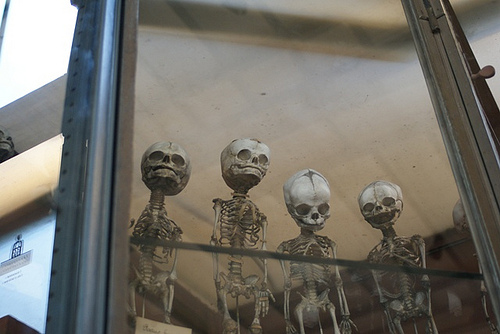
3D X-Rays Piece Together the Evolution of Flight

SCIENCE DAILY – Three-dimensional X-ray scanning equipment is being used to help chart the evolution of flight in birds, by digitally reconstructing the size of bird brains using ancient fossils and modern bird skulls.
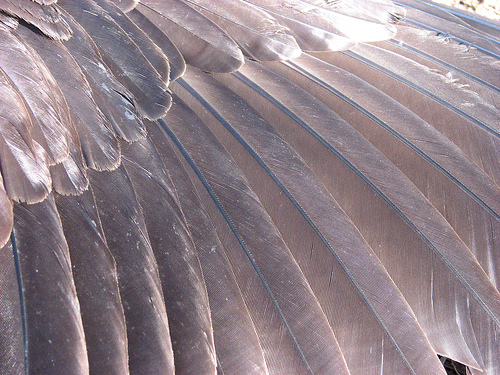
In a collaborative project between National Museums Scotland, the University of Abertay Dundee, and University of Lethbridge, Canada, researchers are using an incredibly sensitive CT (computerised tomography) scanner at Abertay to analyse whole skulls and fossilised fragments and recreate accurate 3D models of extinct birds’ brains.

Bird skulls grow to a fixed size before they leave the nest, with the brain then growing to almost completely fill the cavity space. This means that bird skulls can be used to accurately calculate the size and shape of the brain.

By working this out, the size of part of the brain called the flocculus can be established. This small part of the cerebellum is responsible for integrating visual and balance signals during flight, allowing birds to focus on objects moving in three dimensions while they are flying.

Continue reading about 3D X-Rays Piece Together the Evolution of Flight.

© Science Daily, 2011

Photograph by flickr user BotheredByBees
Solar-Powered Hornet Found

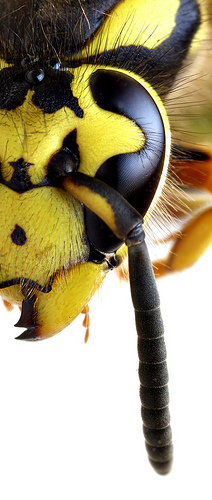
NATIONAL GEOGRAPHIC – The oriental hornet has built-in “solar cells” that generate electricity from sunlight—a first in the animal kingdom, according to a new study.

Scientists already knew that the hornet species, for unknown reasons, produced electricity inside its exoskeleton, according to study leader Marian Plotkin of Tel-Aviv University.

Plotkin’s late mentor Jacob Ishay made the discovery after observing that the insect is active when the sun is most intense—unusual for hornets.

Plotkin and colleagues recently went a step further by examining the structure of the hornet’s exoskeleton to find out how the electricity is produced.

Their research revealed that pigments in the hornet’s yellow tissues trap light, while its brown tissues generate electricity. Exactly how the hornets use this electricity is still not entirely understood, Plotkin noted.

“When I was running my experiment, people told me it was never going to work,” she said. “I’m so happy at the results.”

While solar cells using human-made substances are usually 10 to 11 percent efficient at generating electricity, the hornet’s cells are only 0.335 percent efficient. For instance, the hornet still gets the vast majority of its energy from food.

But that’s hardly the point, Plotkin said.

“We’ve seen solar harvesting in plants and bacteria, but never before in animals.” 

Continue reading about Solar-Powered Hornet Found.  

© National Geographic, 2010 

Photograph by flickr user AMagill

Other Types of Ancient Humans Interbred with Us

BBC– Professor Chris Stringer: “It’s nothing short of sensational – we didn’t know know how ancient people in China related to these other humans”

Scientists say an entirely separate type of human identified from bones in Siberia co-existed and interbred with our own species. The ancient humans have been dubbed “Denisovans” after the caves in Siberia where their remains were found.

There is also evidence that this population was widespread in Eurasia. A study in Nature journal shows that Denisovans co-existed with Neanderthals and interbred with our species – perhaps around 50,000 years ago.

An international group of researchers sequenced a complete genome from one of the ancient hominins (human-like creatures), based on nuclear DNA extracted from a finger bone.

Continue reading about Other Types of Ancient Humans Interbred with Us.

© BBC, 2010

Photo by flickr user David_C_1977

Posted in Uncategorized | 1 Reply

Probability of Finding Aliens Is Now Three Times Higher

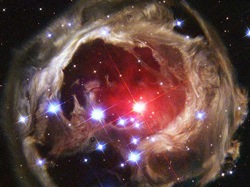
universeGIZMODO– The total number of stars in the Universe “is likely three times bigger than realized.” Yale University astronomer Pieter van Dokkum says there are “possibly trillions of Earths orbiting these stars,” dramatically increasing the possibility of finding alien civilizations.

According to the new study just published in Nature, new observations on the red end of the optical spectrum at the W. M. Keck Observatory in Hawaii show an overwhelming population of red dwarfs in eight massive nearby elliptical galaxies. The team has discovered that these galaxies hold twenty times more red dwarfs than the Milky Way.

Van Dokkum says that “there are possibly trillions of Earths orbiting these stars” which are “typically more than 10 billion years old.” According to him, that’s long enough for complex life to evolve, which is “one reason why people are interested in this type of star.” In fact, astronomers discovered the first exoplanet similar to our own Earth—and therefore capable of harboring complex life—orbiting the Gliese 581 red dwarf star system, 20.3 light years from our home planet.

Carl Sagan explains why this discovery has a dramatic impact in our search for intelligent life in the Universe, using the Drake Equation:


Continue reading about Probability of Finding Aliens Is Now Three Times Higher.

© Gizmodo, 2010

Photo by flickr user Temari 09

NASA Finds New Life in Mono Lake

GIZMODO– Hours before their special news conference today, the cat is out of the bag: NASA has discovered a completely new life form that doesn’t share the biological building blocks of anything currently living in planet Earth. This changes everything.

photo by satosphere/flickrAt their conference today, NASA scientist Felisa Wolfe Simon will announce that they have found a bacteria whose DNA is completely alien to what we know today. Instead of using phosphorus, the bacteria uses arsenic. All life on Earth is made of six components: carbon, hydrogen, nitrogen, oxygen, phosphorus and sulfur. Every being, from the smallest amoeba to the largest whale, share the same life stream. Our DNA blocks are all the same.

But not this one. This one is completely different. Discovered in the poisonous Mono Lake, California, this bacteria is made of arsenic, something that was thought to be completely impossible. While she and other scientists theorized that this could be possible, this is the first discovery. The implications of this discovery are enormous to our understanding of life itself and the possibility of finding beings in other planets that don’t have to be like planet Earth.

No details have been disclosed about the origin or nature of this new life form. We will know more today at 2pm EST but, while this life hasn’t been found in another planet, this discovery does indeed change everything we know about biology. I don’t know about you but I’ve not been so excited about a bacteria since my STD tests came back clean. And that’s without counting yesterday’s announcement on the discovery of a massive number of red dwarf stars, which may harbor a trillion Earths, dramatically increasing our chances of finding extraterrestrial life.

Continue reading about NASA Finds New Life in Mono Lake.

© Gizmodo, 2010

Photograph by flickr user satosphere

Page 15 of 24<<...1314151617...>>