Media Roots TV – DEA & IRS Raid on Oakland Pot Clinic

MEDIA ROOTS – The IRS and DEA came to downtown Oakland this afternoon to aggressively raid multiple medical marijuana dispensaries as well as Oaksterdam, an educational facility that teaches plant cultivation to medical marijuana patients.

Robbie Martin of Media Roots ran to catch the raid and captured an intense standoff between the people and the federal officials. He also confronts an ABC 7 news reporter after he hears them tell the police they are doing an ‘amazing job.’

Abby

***


Robbie Martin of Media Roots films the IRS & DEA Raid on Oaksterdam, Oakland

***

Photo by flickr user NeetaLind

BZ and Secret U.S. Government Experimentation

March 9, 2012

MEDIA ROOTS — “In this same dream I had a girl waiting for me down the hall. I wanted to go out and see her but the nurse wouldn’t let me so after trying to fight my way out and failing I called the MP’s who promptly arrested them. After that I found out that they were going to beat me up so I tried to make friends with the one who appeared to be the leader. It must have worked because I don’t remember a beating.”  —unknown male soldier volunteer at Edgewood 1963, dose: IM 7.0 ug/kg 

When the movie Jacob’s Ladder came out in 1990, many people were probably not aware that it was loosely based on 1968 military experiments conducted in lab and field exercises at the Edgewood Arsenal proving ground in Maryland.  Even though Jacob’s Ladder ends with a brief description of 3-quinuclidinyl benzilate (BZ) and its effects, Adrian Lyne, the film’s director, has denied the powerful and dangerous hallucinogenic compound was ever used on human test subjects.  However, there is evidence to suggest otherwise.  In a recent lawsuit against the U.S. government, a document showing BZ’s solubility in human blood has been uncovered.

A lawsuit was filed last week by eight U.S. military veterans against, virtually, every branch of the Defense Department, including Veterans Affairs and even Attorney General Eric Holder.  The veterans were guinea pigs in a massive military-funded and controlled human drug experiment program, which shows that, among other drugs like Mescaline, LSD, and amphetamines, they also subjected people to a drug which lasts 80 hours and creates a fever-like dream of reality, better described as a waking, walking nightmare called BZ.  

At least one other account exists apart from the one excerpted above from an unknown soldier at Edgewood Arsenal as well as another from a military scientist, Dr. James Moore, who was accidentally exposed trying to synthesize the compound.  In Dr. Moore’s instance, he administered himself with acridine, as an antidote for BZ’s effects.  In the unknown soldier’s case he had over three days of waking nightmares, imagining fights with hospital staff and MPs, and having hour-long imaginary conversations with an ex-girlfriend about her surprise pregnancy announcement.  Beyond this, Media Roots has been unable to locate additional verified first-hand accounts.

BZ was modeled after atropine, an active chemical found in Datura.  Indigenous North and South Americans have used Datura and other similar plants which contain atropine (e.g., Belladona, Brugmansia) in ancient spiritual rituals up until the present day.  Besides psilocybin, and n,n-DMT, atropine-containing medicinal plants are proliferated globally around the world’s ecosystem more than any other hallucinogenic psychoactive drug.  Unlike DMT and psilocybin, Datura never caught on recreationally because of its dangerous and unpredictable nature.  In the wild, Datura plants (or pretty much any plant containing the active ingredient) contain huge differences in potency, making it almost impossible to give someone an accurately measured or safe dose of the plant extract.  Even administering a pure chemical ‘psychedelic’ dosage of atropine can lead to heart failure or stroke.

This didn’t stop the US government during the height of its drug experimentation days from trying to harness its power and re-tool the active chemical in Datura into a powerful weaponized gas to be used on the U.S. military battlefields. 

It’s not hard to guess what the effects were like beyond the trip reports we have based on its similarity to a Datura.  On Erowid.org’s Datura ‘effects’ section, they list delirium capable of bringing about auditory, visual, and tactile hallucinations indistinguishable from reality.  This waking dream-like state can lead to unconscious violent behavior much like a drunken ‘black-out.’  It’s also reported uncommonly large doses can cause hallucinations lasting for two to three days.  This mirrors available data regarding the duration of BZ’s effects.

If the U.S. government in 1968 was willing to go as far as attempt to weaponize, which essentially means aerosolizing it or making it airborne, a more concentrated form of the world’s most terrifying and unpleasant hallucinogen, who can say whether or not they also toyed with doing the same to another more recently discovered hallucinogen, Salvinorin A? The effects of Salvinorin A are just as unpredictable as Datura but far shorter lasting.  We know that in the late ‘90s the Russian government attempted to use a gaseous form of Fentanyl, one of the most powerful opiates—more powerful than oxycontin, heroin or morphine—to diffuse a hostage crisis.  The end result was the tragic, accidental deaths of many of the hostages, by overdose. 

The effects of what BZ would do to a group of armed soldiers would be completely unpredictable and most likely dangerous—what’s depicted in the film Jacob’s Ladder would be a worst-case scenario.  No one really knows the extent to which—or in what situations or environments—the U.S. government actually tested hallucinogenic drugs on its soldiers, which is part of the reason why similar lawsuits in the past have been dismissed.  Only in the last decade has the military declassified enough information that these Guinea pig soldiers have been allowed to tell their health-care providers what took place at Edgewood Arsenal.  It’s unfortunate that, since they volunteered, the U.S. government can pass off responsibility.  But these experiments were done at a time when the general public had no idea what these hallucinogens did, making informed consent unlikely.

Ethically, it would be hard to make the case that these soldiers knew what the consequences would be to their physical and mental healths. 

Written by Robbie Martin, co-host of Media Roots Radio

***

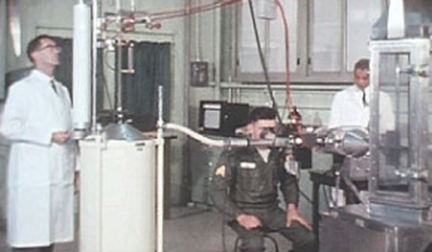
UPDATED NEWS — There were no warnings about side effects or potential long-term health risks, according to Wray’s deposition.  Although he wasn’t forced to take the drugs, he was “given an option of not taking the test, but with innuendos — with the option of bad punishment if we did not participate,” he says in the deposition transcript…..Of all the events that took place during Wray’s time at Edgewood, Kathryn says one disturbing memory he told her about that stuck with him for more than three decades:

Wray and eight others were taken to a clinic room and told to lie on cots, where they were hooked up to IVs and left alone, Kathryn says. Within 5 minutes he was so high he could not find his legs, he told her. “Then he said it felt like the bed was floating off of the floor — and then the pain hit.” He described it as a “terrible, terrible headache, so bad he could not open his eyes, so bad he was just screaming in pain,” making him throw up several times. A man in a nearby bunk was “trying to claw his own eyes out” — until Wray and another volunteer managed to get out of their bunks, crawl over to the panicking man and stop him, he told her.

“And while all of this going on, there was a nurse standing in the corner — she was taking notes. She made no attempt to aid this gentleman,” says Kathryn. For days afterward, he was “completely disoriented and terrified the pain would begin again,” Kathryn says.

Read more about Widow blames VA for spouse’s death.

***

Photo from US Defense Department Edgewood stock footage

Posted in Uncategorized | 1 Reply

The U.S. Government’s Panopticon State

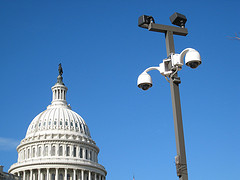
allseeingeyeMEDIA ROOTS — The U.S. Government’s raging paranoia regarding terrorism has now led to a high-octane obsession with perpetual and complete surveillance of its citizens in every manner conceivable

“The thought police would get him just the same. He had committed—would have committed, even if he had never set pen to paper—the essential crime that contained all others in itself.  Thoughtcrime, they called it.  Thoughtcrime was not a thing that could be concealed forever.  You might dodge successfully for a while, even for years, but sooner or later they were bound to get you.”  —George Orwell, 1984 (Book 1, Chapter 1)

Each day, we move closer to Orwell’s dystopic vision.  The latest addition to U.S. domestic surveillance is the National Security Agency’s (NSA) new data mining facility behemoth in San Antonio, Texas.  More worrisome, a Microsoft data centre is located just a few blocks away, so the NSA will be able to tap into the massive stores of data without a warrant being necessary, only a simple fibre optic cable.

The NSA’s hulking complex raises any number of serious questions, such as the large numbers of people arbitrarily placed on watch lists.  Does data mining even justify the ends?  Catherine Austin Fitts has long described the Data Beast, data mining apparatus, “the reality was you had Lockheed Martin and their subcontractors owning and controlling the data and you couldn’t get it.”

“And if you look at all the other databases that IBM and their subcontractors have access to government-wide, the question is if you integrate those databases what you’re talking about is a complete control system ‘cos you’ve got the mortgages, you’ve got the IRS payments, on and on and on and on and on.  So, if you watch the movie ‘Enemy of the State’ or you watch the movie ‘Listening,’ you’re talking about an intelligence capacity that can basically manage and manipulate the economy at a very detailed level, whether it’s manipulation of the stock in the financial markets or manipulation of households.” 

With so many lumbering and uncoordinated security agencies engaged in electronic surveillance, how can all this information be shared and correlated?  What risk does the U.S. run should it fall prey to a tyrannical despot with a fully functioning and devastatingly intrusive surveillance system already in place?  These questions and more must give U.S. citizens pause to reflect on the swiftness with which our privacy evaporates before our eyes.

The concept of the CIA project Total Information Awareness has now migrated over to the NSA, which is determined to turn that vision into reality.  The NSA wants to know every detail about our lives:  what we eat, where we travel, what books we read, what movies we watch, every iota of our lives.  But with very little progressive legislation emanating from the regressive two-party system to harness this rapid data grab for electronic omnipotence, is it too late for U.S. voters to pull their lives out from underneath the microscope of the state?

MR

***

SAN ANTONIO CURRENT “Eisenhower warned of the military-industrial complex, but now it’s mostly the security, industrial complex; it’s these people that build all the hardware and software for Homeland Security and Intelligence and all that,” says Bamford. “As far as I can see, nobody has a handle on how many contractors are out there, what they’re doing, how much money’s going to them, how much is useful, how much is wasted money.”

Cate says the NRC committee is not necessarily opposed to data-mining in principal, but is concerned about how it’s carried out. “The question is can you do it and make it work so that you don’t intrude unnecessarily into privacy and so that you reach reliable conclusions.”

Bamford writes in the Shadow Factory of how the NSA’s Georgia listening post has eavesdropped on Americans during the Iraq War, including journalists, without a warrant or any indication of terrorism. He also reports on NSA eavesdropping on undecided members of the United Nations Security Council in the run-up to the vote on the Iraq War resolution, with the Bush regime seeking information with which to twist the arms of voting countries. The spying was only revealed due to British Parliament whistleblower Claire Short, who admitted she’d read secret transcripts of UN Secretary-General Kofi Annan’s confidential conversations.

“The UN people have been aware of [NSA eavesdropping] for a long time, but there’s not much they can do about it,” says Bamford.

A common response to concerns about data surveillance is that those who keep their noses clean have nothing to worry about. But the reach of the NSA’s surveillance net combined with lack of oversight and the political paranoia escalated by the 9/11 attacks means that almost anyone could wind up on the terrorist watch list.

“The principal end product of all that data and all that processing is a list of names — the watch list — of people, both American and foreign, thought to pose a danger to the country,” writes Bamford. “Once containing just twenty names, today it is made up of an astonishing half a million — and it grows rapidly every day. Most on the list are neither terrorists nor a danger to the country, and many are there simply by mistake.”

Read more about the NSA’s long arm of surveillance

© 2012 San Antonio Current

***

Photo by Flickr user satanoid

Bloomberg Defends Secret NYPD Muslim Spying Program

MEDIA ROOTS NYC Mayor Michael Bloomberg stood up for the police state in a recent radio interview, where he defended the NYPD’s targeted discriminatory surveillance of Muslim communities in New York and New Jersey. 

He cites rhetoric from the 9/11 Commission Report as justification to ignore constitutional protections of free speech as outlined in the Handschu agreement of 1985.  In the 1985 federal court decision, police were allowed to obtain a warrant to monitor political activity only if there was a previous suspicion of criminality.  However, in 2002, under Bloomberg and NYC Police Commissioner Raymond Kelly, the post-9/11 NYPD requested that this decision be suspended, claiming it hindered them from preventing future terrorist attacks.

“We’re not going to make the mistakes we made after the 1993 bombing,” Bloomberg preached yesterday. “We cannot let our guard down again. We cannot slack in our vigilance. The threat was real. The threat is real. The threat is not going away.’’

Newark Mayor Corey Booker adamantly rejected the practice, stating that he was unaware of the NYPD’s widespread spying operation.  “If anyone in my police department had known this was a blanket investigation of individuals based on nothing but their religion, that strikes at the core of our beliefs and my beliefs very personally, and it would have merited a far sterner response,” Booker exclaimed.

Police Director Samuel DeMaio underscored this sentiment. “We want to be clear: This type of activity is not what the Newark PD would ever do.”

Rutgers-Newark hosted a rally yesterday to address the increased Muslim surveillance in the community. “We’re here to put a human face on it,” explained Nadia Kahf, chairwoman of New Jersey’s Council on American-Islamic Relations. Muslim student associations, referred to as MSAs by the NYPD, are of particular suspicion by the agency whose secret surveillance was created with the help from the CIA.

The practice even goes beyond the scope of the FBI, according to special agent Bryan Travers, a public affairs officer of the Newark Division. “The FBI follows strict guidelines and cannot open any investigation based simply on First Amendment activity.”

The issue gained momentum last week after the Associated Press published an article on Monday exposing the extent of the NYPD’s secret Muslim surveillance. The AP also posted a copy of a leaked NYPD report.

***

Oskar Mosco is a writer for Media Roots and producer at truth-march.

Photo provided by Flickr user Boss Tweed.

MR Original – State Tyranny and Two-Party Apathy

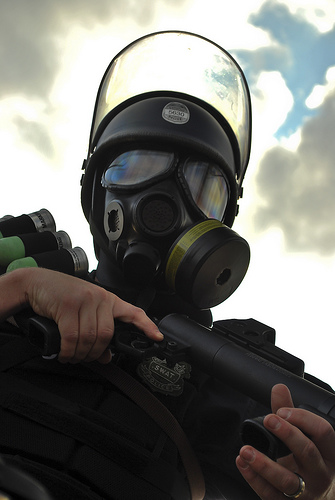
tear gas outfit by flickr mark zMEDIA ROOTS — Doubtless, many have heard of the U.S. targeted killing of U.S. citizen Anwar al-Awlaki under Obama.  But many may not know that al-Awlaki wasn’t the last U.S. citizen arbitrarily killed by the state, as investigative journalist Jeremy Scahill recently reported:

“You know, President Obama authorised strikes that resulted in three U.S. citizens being killed within less than a month in Yemen:  Anwar al-Awlaki, who was born in New Mexico; Anwar al-Awlaki’s 16-year-old son; and then Samir Khan, who was another U.S. citizen from North Carolina and was the editor of Inspire magazine, the English-language publication of al-Qaeda in the Arabian Peninsula.  All three of those U.S. citizens were killed within one month.” 

Obama drone strikes have arbitrarily killed hundreds of civilians worldwide including three U.S. citizens without conviction, trial or due process.  One might expect more public outcry.  Yet, in light of a recent Washington Post ABC News poll revealing that 77% of self-proclaimed liberal Democrats approve of Obama’s drone policy, it seems most progressives are prepared to re-elect Obama or sit idly by as he purchases a second term. 

But while we’re all indignant about the profoundly disturbing killings by the U.S. under Obama in Yemen and elsewhere, we forget the U.S. establishment is killing many more in the U.S.  Many U.S. citizens, such as Kenneth Harding and Oscar Grant, are gunned down daily by the state, igniting uprisings of a different sort in this country. 

Jeremy Scahill recently joined Amy Goodman to discuss U.S. intervention in Yemen and the arbitrary state killings of U.S. citizens.  However, it seems important to broaden discussions to allow investigative journalists to reflect upon U.S. violence abroad as well as state violence domestically.  The state killings of Anwar al-Awlaki and Oscar Grant are related, because they are all manifestations of the police state violence necessitated by U.S. imperialism under capitalism.

Mickey Huff, of Project Censored, has recently noted how the rise of U.S. targeted killings stems from the rise of torture perpetrated by the U.S., as the citizenry becomes increasingly complacent toward its continued use in a post-9/11 sociopolitical climate.  It may also be argued the rise of torture is, really, a continuation of poorly reported domestic torture of U.S. citizens, particularly people of colour and/or low-income.

The bold-faced tyranny of the state shows itself quite plainly, if we observe the historical record against labour, civil rights, and activists throughout U.S. history.  As Naomi Klein noted, it’s important to look at history and roots to survive the shocks intended to derail nations.  But then what are the people to do?  Protest or petition our masters?  Petitions are easily ignored, but also part of proving the futility of working through the system.  Protests are ignored, downplayed, or distorted by the United States’ mostly corporate-owned media machine, which reaches the most U.S. minds.  Protesters are intimidated, bullied, beaten, arrested, and worse for exercising their inalienable rights.  Yet, they must endure. 

Voltaire wrote:

“So long as the people do not care to exercise their freedom, those who wish to tyrannise will do so; for tyrants are active and ardent, and will devote themselves in the name of any number of gods, religious and otherwise, to put shackles upon sleeping men.”

Something is glaringly amiss beyond the Election 2012 hyperbole—our political discourse sorely lacks a culture of resistance to the two-party electoral system underpinning U.S. imperialism.  Today, many seem to enjoy an apathetic stance toward electoral politics because the only two choices are owned by the same corporations.  Yet, political parties rule this nation, in the Legislative and Executive branches, some would even say in the Judicial.  And although the people need a grassroots people’s party to pose a serious Left challenge, U.S. progressives throw their lot in with their chosen political organisations, which may focus on advocacy but leave electoral politics in the unchallenged hands of Wall Street. 

A serious debate about U.S. democracy must be undertaken.  Virtually everyone says they want democracy, but few vote and less do so from an informed perspective.  Progressives put their faith in the Democrat Party and get swindled every time.  We lack a culture of reflection to learn from the past.  Perhaps, new generations of progressives are fooled by Democrat Party promises because older generations do not own up to the consequences of supporting the two-party system.  We have a captured political system or, perhaps, a subservient and brainwashed body politic.  Both yield similar results.

Observing the U.S. in its youth, Alexis de Tocqueville wrote:

“The instability of the administration has penetrated into the habits of the people: it even appears to suit the general taste, and no one cares for what occurred before his time. No methodical system is pursued; no archives are formed; and no documents are brought together when it would be very easy to do so.”

They say, in a democracy, the people get the government they deserve or allow.  If one doesn’t like the choices one can work to change them, or open up the process to consider alternative candidates like Rocky Anderson of the Justice Party in 2012.  Otherwise, how can one complain about the next Democrat’s policies when one supported, or acquiesced in, that candidacy?  In the U.S., too many are more committed to their favourite celebrity or sports team, than they are to the political candidates or parties they choose or ignore and which impact their working lives. 

Progressives must analyse this question of apathy towards electoral politics or leave the task of influencing electoral politics to the highest bidder, which always hedges its bets between either side of the same two-party coin.

Written by Felipe Messina for Media Roots

Photo by Flickr user Mark Z

***

Page 35 of 82<<...3334353637...>>