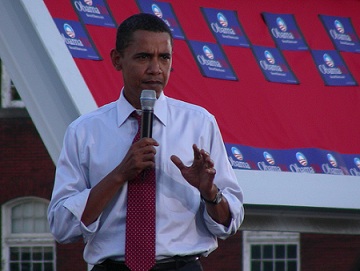
MEDIA ROOTS — Obama delivered his 2013 State of the Union Address this week. And his banal Address is unsurprising, in the sense it’s largely a continuation of policy trajectories we’ve seen during his previous term, which, in turn, have largely been a continuation of Bush policies. But for Obama’s fans, who tend to hear what they want, he, doubtless, talked a good game. But let’s take a look at what he really said (and didn‘t say).
Obama made some promises Tuesday night, some similar to past unfulfilled promises, such as jobs, economic growth, and immigration reform, for example.
Obama discussed the federal budget and the economy, climate change, housing, education, immigration, women’s rights, the minimum wage, and the so-called Global War on Terror (which economist Dr. Michel Chossudosvky refers to as the GWOT). Obama’s speech may be described as a ‘laundry list’ speech, which seemed to touch on every single issue conceivable, but largely superficially, along the lines of vague generalities.
Obama also discussed nuclear proliferation and “cyberattacks,” but not the kind which boosts user fees for anti-virus software, nor did Obama mention the cyberattacks against innocent citizens by his administration’s warrantless wiretapping and worsening domestic surveillance state. Obama definitely did not mention, Fukushima, nor Hiroshima, nor Nagasaki, nor Harrisburg, nor Chernobyl, nor US/NATO nuclear proliferation.
Obama did touch upon trade in the Asia-Pacific Rim and the EU, as well, before mentioning voting reform and gun violence. But Obama did not mention his violent drone strikes, nor his targeted assassinations of US citizens, nor the the Pentagon’s targeting of China, nor Obama’s geopolitical pivot, as Dr. Chossudovsky and others inform us.
“First of all, the U.S. Asia strategy has changed and even interrupted the process of mutual adaptation of China and other Asian countries. Although the Obama administration has only voiced the strategy in its political rhetoric, the shift is enough to amplify Asian countries’ expectations for U.S. support. Thinking that the U.S. will invest huge resources to confront China as it did against the Soviet Union during the Cold War, these countries, especially the ones which have maritime boundary disputes with China, have chosen to side with the U.S. Although China’s response to the U.S. strategy has been largely defensive, it is still enough to prevent its relations with these countries from developing further.
“Secondly, the U.S. pivot has shifted the priority in Asia from economic policy to strategic policy. This has occurred, in part, due to U.S. perception of its own strengths. After the onset of the financial crisis, U.S. economic dominance weakened, but its military remains the most powerful in the world. During the Cold War period, economic and military presence had the same weight in the U.S.’s foreign policy. But with its pivot, the U.S. is re-introducing strategic competition into Asia. This change has forced China to begin to move its focus from the economy to military strategy.”
Yet, Obama’s 2013 State of the Union Address was almost identical to his first three State of the Union Addresses. There have been lofty goals, but once we cut through all of the promises, hopes, and urging Congress to do this or that task, the actual policies are scant with minimal effect on existing conditions of unemployment, recession, and expanding militarism.
“It is also likely that a host of deep and disturbing systemic problems will be ignored entirely in Obama’s speech. Addressing these deeper problems, and even mentioning them in public, is very difficult in a Washington environment steeped in a culture of corruption, high-powered lobbying by vested interests, and elite indifference to the problems and aspirations of ordinary people. But the problems don’t disappear just because the politicians are too embarrassed or aloof to discuss them.”
Republican Senator Marco Rubio was elected to deliver the Republican Party response. In keeping with the political barriers to entry of our de facto two-party dictatorship, alternative political parties, such as the Peace & Freedom Party and Green Party, were not given the same platforms to offer their analysis or perspectives.
Rubio’s response to Obama’s Address, predictably, spoke against government intervention, if not against government, generally, and asserted “free enterprise economy is the source of our middle class prosperity.” Rubio conveyed an Ayn Randian, Virtue of Selfishness, every-man-for-himself, pull-yourself-up-by-the-bootstraps ideology.
Rubio also accused Obama of being opposed to free enterprise:
“[Obama] believes it’s the cause of our problems, that the economic downturn happened because our government didn’t tax enough, spend enough and control enough. And, therefore, as you heard tonight, his solution to virtually every problem we face is for Washington to tax more, borrow more and spend more.”
Okay, we get the general idea: Obama’s, supposedly, more into social spending since he’s perceived as a socialist. Yet, Rubio’s statements distorted the way the monetary system operates. Rubio presented logical fallacies, from which Obama also suffered, in comparing the federal budget to a household budget, because the US doesn’t borrow dollars, as it’s the sovereign currency issuer of the US dollar, routinely makes good on its bonds, and is facing no “solvency risk.” (See W. Mosler, S. Kelton, L.R. Wray, M. Forstater, et al.)
“Deadly Innocent Fraud #1:
“The federal government must raise funds through taxation or borrowing in order to spend. In other words, government spending is limited by its ability to tax or borrow.
“Fact:
“Federal government spending is in no case operationally constrained by revenues, meaning that there is no ‘solvency risk.’ In other words, the federal government can always make any and all payments in its own currency, no matter how large the deficit is, or how few taxes it collects.” —Warren Mosler, Seven Deadly Innocent Frauds of Economic Policy (Also see L. Randall Wray, Ph.D., Modern Money Theory.)
Rubio went on to blame government for the housing crisis:
“This idea—that our problems were caused by a government that was too small—it’s just not true. In fact, a major cause of our recent downturn was a housing crisis created by reckless government policies.”
Rubio did not specify which “reckless government policies” led to the housing crisis. But we know fraud and deregulation were major factors, as was easily falsified appraisals, which incentivised banks and lenders to inflate housing prices to profit from higher loans. (See Catherine Austin Fitts, William K. Black, et al.)
Obama scolded the nation to pay “our [government] bills on time and always uphold the full faith and credit of the United States of America.” The implication here served to further the deficit dove position regarding deficit spending. Yet, one is hard-pressed to think when the U.S. federal government has ever had difficulty paying its bills on time. Clearly, whenever a U.S. federal obligation is due, it’s routinely paid with interest, like clockwork. As Warren Mosler reminds us:
“Federal government checks don’t bounce:
“Right now, China is holding some $2 trillion of U.S. Treasury securities. So what do we do when they mature and it’s time to pay China back? We remove those dollars from their savings account at the Fed and add them to their checking account at the Fed, and wait for them to say what, if anything, they might want to do next.
“This is what happens when all U.S. government debt comes due, which happens continuously. The Fed removes dollars from savings accounts and adds dollars to checking accounts on its books. When people buy Treasury securities, the Fed removes dollars from their checking accounts and adds them to their savings accounts. So what’s all the fuss?
“It’s all a tragic misunderstanding.
“China knows we don’t need them for ‘financing our deficits’ and is playing us for fools. Today, that includes Geithner, Clinton, Obama, Summers and the rest of the administration. It also includes Congress and the media.” —Warren Mosler, Seven Deadly Innocent Frauds of Economic Policy
Obama also invoked the fallacy of US debt:
“Yes, the biggest driver of our long-term debt is the rising cost of health care for an aging population. And those of us who care deeply about programs like Medicare must embrace the need for modest reforms—otherwise, our retirement programs will crowd out the investments we need for our children, and jeopardize the promise of a secure retirement for future generations.”
“Deadly Innocent Fraud #2:
“With government deficits, we are leaving our debt burden to our children.
“Fact:
“Collectively, in real terms, there is no such burden possible. Debt or no debt, our children get to consume whatever they can produce.” —Warren Mosler, Seven Deadly Innocent Frauds of Economic Policy
Now, as in the past, Obama has invoked the US debt fallacy by perpetuating the misperception the US federal budget is like a household budget:
“Now, the final critical step in winning the future is to make sure we aren’t buried under a mountain of debt.
“We are living with a legacy of deficit spending that began almost a decade ago. And in the wake of the financial crisis, some of that was necessary to keep credit flowing, save jobs, and put money in people’s pockets.
“But now that the worst of the recession is over, we have to confront the fact that our government spends more than it takes in. That is not sustainable. Every day, families sacrifice to live within their means. They deserve a government that does the same.” —Obama, 2011 SOTU
Obama has consistently delivered a Paul Krugman-style neoclassical (or “theoclassical,” to quote Prof. Black) economic perspective of a deficit dove. The last two sentences in that statement reflect, upon Obama’s part, either, deception or ignorance of the reality of how the USA’s modern, post-1971, post-Gold-Standard, monetary system operates, with the US being a sovereign currency issuer, which doesn’t borrow dollars from China or anywhere else. As Dr. Stephanie Kelton, Chair of the Economics Department at the University of Missouri-Kansas City, articulates, the US can spend without fiscal constraints, whilst the economy is operating under capacity. The only economic constraints are real resource constraints, or self-imposed political constraints, which is precisely what Obama prescribed in 2011:
“So tonight, I am proposing that starting this year, we freeze annual domestic spending for the next five years. Now, this would reduce the deficit by more than $400 billion over the next decade, and will bring discretionary spending to the lowest share of our economy since Dwight Eisenhower was President.
“This freeze will require painful cuts. Already, we’ve frozen the salaries of hardworking federal employees for the next two years. I’ve proposed cuts to things I care deeply about, like community action programs. The Secretary of Defense has also agreed to cut tens of billions of dollars in spending that he and his generals believe our military can do without.”
Obama didn’t put the minimal cuts to military spending into perspective by reminding us current military spending is on the order of about a trillion dollars per year.
Notably, Obama and Rubio didn’t disagree on US militarism (or imperialism). And both agreed on continued exploitation of petrochemicals, dirty fuels, “balancing” the federal budget, and deeper social spending cuts.
And further cuts to social spending is what Obama prescribed in this year’s Address.
Indeed, Obama insisted so-called “deficit cuts” aren’t enough, as an economic growth strategy is also needed to “attract more jobs to our shores,” “equip” workers, and yield prosperity. Although, one is hard-pressed to imagine what manufacturers other than high tech industry, which do not employ the working-class majority, would prefer to pay US minimum wages, rather than pennies on the dollar abroad.
Obama padded his promises of economic growth by boasting about his JOBS bill. Yet, experts, such as University of Missouri-Kansas City Professor William K. Black, a former regulator, have described the criminogenic dimensions of Obama’s JOBS Act. Prof. Black is a leading expert on control fraud, whereby trusted elite institutions, who wield powerful business and economic controls, get away with fraud precisely because they are so trusted and unregulated.
Expert white-collar criminologist, Dr. Black, says Obama’s JOBS Act allows erosions of important financial regulations resulting from an international race-to-the-bottom dynamic where US financial regulators lower their standards to compete with foreign capital markets. Here’s how Dr. Black describes Obama’s JOBS Act:
“The JOBS Act is something only a financial scavenger could love. It will create a fraud-friendly and fraud-enhancing environment. It will add to the unprecedented level of financial fraud by our most elite CEOs that has devastated the U.S. and European economies and cost over 20 million people their jobs. Financial fraud is a prime jobs killer. […]
“This bill will kill millions of jobs because financial frauds are weapons of mass financial destruction. It will start an international fraud-friendly deregulation race to the bottom and will become the basis for further criminogenic U.S. Congressional actions.”
We recall Obama’s 2011 State of the Union Address:
“To reduce barriers to growth and investment, I’ve ordered a review of government regulations. When we find rules that put an unnecessary burden on businesses, we will fix them.”
Obama emphasised prioritising further deregulation of firms, despite the rampant unchecked criminogenic environment among business and banking elites, which experts, such as Dr. Black, have warned about. Indeed, Dr. Black has explained how Obama’s financial reform bill won’t prevent another economic crisis, leaving us with the same fundamental systemic issues. The same failings, or, as Dr. Black puts it, “betrayal,” apply to Obama’s health care reform.
What’s striking is Obama is presenting a humanising face on inhumane policies of regressive social spending cuts and allowing only scant and passing mention of minimal DOD cuts. Military spending now accounts for the single-biggest piece of the federal budget pie. As the old adage goes, a nation cannot have guns and butter.
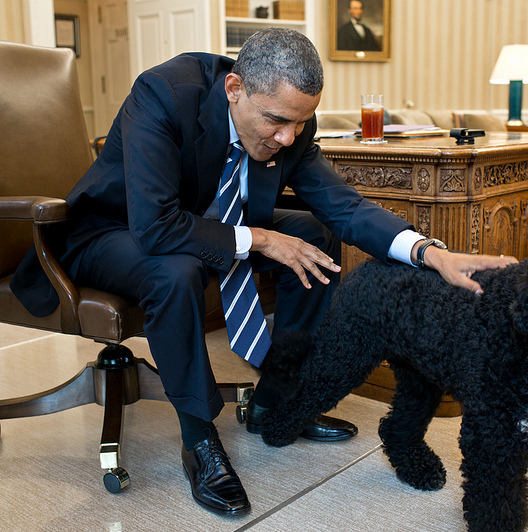
MEDIA ROOTS – “Protect Whistle blowers: …Such acts of courage and patriotism….should be encouraged rather than stifled. Barack Obama will strengthen whistle blower laws to protect federal workers who expose waste, fraud and abuse of authority in government. Obama will ensure that federal agencies expedite the process for reviewing whistle blower claims and whistle blowers have full access to courts and due process.” – from the official Obama / Biden campaign website posted in 2008.
In 1917, during World War I, the Espionage Act was passed in the United States. Since the inception of the Espionage Act up until 2012, this law has been used on 9 people, 6 of whom were charged between 2008-2012, all under the direction and oversight of President Obama.
How has something so seemingly draconian and Bush-like been used so excessively by an administration that promised change and an end to “Scooter Libby justice”? Is the Obama administration simply trying to ‘plug all the leaks’? After all the research for Media Roots’ series of ‘Obama’s normalization of neoconservatism,’ it is clearer than ever that Obama has gone above and beyond any other president in US history to protect a prior administration from investigations, repercussions and criminal punishment.
Amidst the Watergate scandal, Nixon resigned after being faced with criminal charges and impeachment. He was later pardoned by Gerald Ford, who ascended unelected to the presidency in the wake of Nixon’s resignation before he went to trial. A president, even an unelected one, always has the legal right to pardon someone for any reason he deems necessary. In the case of Obama, he would not and could not allow the justice system to function organically as he put up road blocks at every opportunity so that no one from the Bush administrations could face prosecution or charges. Worse and even more insulting to the law than even a pre-emptive pardon was blanket retroactive immunity for any and all blatant crimes committed by Bush and his administration
In a few of the cases against whistle blowers, the government has dropped most of the charges long after making a public spectacle of the event. One might think that the government was simply trying to get to the bottom of the the matter and dropped charges in certain instances once no evidence of guilt was found. Studying each whistle blowing investigation individually, it becomes clear that intimidation was the primary goal regardless if the charges stuck or not. Sucking mainstream journalists into a vortex of potential litigation and prosecution, the government sends a message to all interested in true investigative journalism in the United States.
The writer of the infamous NSA wiretapping story in the NY times was subpoenaed over three times in an effort to reveal his sources. The delay in the NY times releasing the article (almost a year after they got the scoop) could possibly be explained by their fear of disrupting the 2004 election results with negative press. Perhaps if they caused too much of a ruckus, the governments’ intimidation would have been much worse, possibly resulting in the journalist’s arrest. Interestingly, this scandal was leaked four years before Obama came into office. When Obama took office and the investigation went into full force, his Justice Department went after the journalists and government employees involved in the leak.
The US government claimed that former Justice Department lawyer, Thomas Tann, was the source of the leak, and was under investigation for over five years until the charges were eventually dropped. One may say ‘no harm no foul’ without taking into account that during this investigation the US government made a point to drag his name through the mud in the form of a public smear campaign.
Thomas Drake is another NSA employee who found out about an NSA no bid contract of 1.2 billion dollars when the same services could be provided in house for merely 2 million. When he leaked this information, he was fired and investigated then subsequently charged with espionage. “It is now apparently a federal crime to report illegalities, malfeasance, broad waste and abuse perpetrated by our own government, but now government is making whistle-blowing a crime. They are making dissent a crime, especially when it embarrasses the government and calls the government to account.”…”speaking truth to power makes one the enemy of the state” – Thomas Drake. Under Obama’s new law, reporting extreme government waste is seen as one of the highest threats against national security, espionage. Eventually all charges were dropped except “exceeding authorized use of a computer” for which he pleaded guilty and received a misdemeanor.
Jeffery Sterling is a former CIA agent who is alleged to have told the New York times about the identity of an ‘asset’ who was involved in an embarrassing botched covert attempt to thwart Iran’s nuclear program. The reporter who wrote the article, James Risen, was subpoenaed to reveal his source. Risen refused to give up his sources and later revealed in court via his lawyers that the US government under the authority of Eric Holder and Michael Mukassey (effective continuity between Bush’s and Obama’s Justice Department) spied on him and gained personal information such as bank records and airline travel schedules. For what purpose? The government will not say. Acts like this, regardless of the official reasoning, can again be seen as acts of intimidation. If a journalist knows a whistle blower wanting to reveal a juicy story about government negligence, crimes, waste or just outright ineptness, they should be very careful because the government might start spying on them if they even consider publishing the information. The Espionage Act was also used against dual US-Israeli citizen and FBI translator, Shamai Leibowitz, who was sentenced to twenty months in prison for leaking information to a blogger about a proposed disastrous Israeli strike on Iran. The blogger in response to the charges told the New York Times that Leibowitz was an “American Patriot”.
John Kiriakou is the CIA’s former director of counter terrorism operations in Pakistan who was charged under the Act for allegedly leaking to reporters the names of two agency operatives involved in the interrogation of terrorism detainees under the George W. Bush Administration. Besides evoking state secrets and squelching potential investigations into one of the most egregious Bush war-crimes, torture, Obama’s Justice Department was willing to use the Espionage Act to stop one of it’s own from going public with even more incriminating information about Bush law breaking. Eventually a reporter or a blogger might need to proxy to escape criminal prosecution, just like the whistle blower in which he is basing his story. Twenty-four year old US soldier Private First Class Bradley Manning thought he had a proxy in the form of Wikileaks when he allegedly smuggled out of military intelligence thousands of diplomatic cables and classified videos, one in particular showing the US military killing two unarmed journalists and injuring a small girl from an Apache helicopter. The video later named Collateral Murder’ by Wikileaks is chilling. As the soldiers in the helicopter realize they’ve shot a young child, they callously scoff “shouldn’t of brought your kids to battlefield.”
Of all the whistle blowers under the Obama administration, Manning was the subject of the loudest public smear campaign initiated by none other than hip technology magazine Wired after an FBI informant, Adrian Lammo, turned him into the authorities for his supposed role in leaking the famous “Collateral Murder” video. Before Manning was even charged with a crime (which would later officially be the Espionage Act), President Obama proclaimed Manning’s guilt on national television. Regardless if he were guilty of the leak or not, the message was clear. A person will be thrown in jail and never heard from again if they leak something of this magnitude and the most powerful man in the country will deem you guilty to hundreds of millions of Americans. Private Manning has been kept in solitary confinement on ‘suicide watch’, forced to strip naked daily with no bed sheets for the first 200 days of his detention. To date, he has spent over 850 days in a tiny jail cell, at least 730 days longer than legally allowed in the united states. The normal legal limit is four months or 120 days until you are required to face a judge and go to trial.
Bradley Manning was inspired by the International organization Wikileaks to do what he was alleged to have done. Wikileaks is headed by an Australian citizen, Julian Assange, who up until recently has managed to continue the organization’s work unscathed. Assange argues, as does Wikileaks supporters, that to punish Wikileaks itself would be the equivalent to punishing actual mainstream journalistic outlets like the NY times or Washington Post. The reason being that once wikileaks publishes information handed over to them from insider whistle blowers, the information becomes public domain over the internet. What is technically the difference between Wikileaks publishing information given to them by whistle blowers and the NY Times for instance publishing the same information? The answer is none, that the distinction between the two acts does not exist. The real difference is that an outlet like the NY times would be far more careful in upsetting the status quo in order to be equally as unfiltered of an outlet like Wikileaks.
In a government CIA document titled “Wikileaks.org – an online reference to foreign intelligence services, insurgents or terrorist groups” (which was ironically leaked by Wikileaks itself) it states, “Web sites such as Wikileaks.org use trust as a center of gravity by protecting the anonymity and identity of the insiders, leakers, or whistle blowers. The identification, exposure, termination of employment, criminal prosecution, legal action against current or former insiders, leakers, or whistle blowers could potentially damage or destroy this center of gravity and deter others considering similar actions from using the Wikileaks.org Web site.” “The possibility that a current employee or mole within DOD or elsewhere in the US government is providing sensitive information or classified information to Wikileaks.org cannot be ruled out. Wikileaks.org claims that the leakers or whistle blowers of sensitive or classified DOD documents are former US government employees. These claims are highly suspect, however, since Wikileaks.org states that the anonymity and protection of the leakers or whistle blowers is one of its primary goals.”
The heat against Wikileaks peaked in late 2010 when the ‘Collateral Murder’ video made them a household name in the United States. Many independent civil liberties focused media outlets and reporters such as Glenn Greenwald (one of wikileaks earliest and most high profile supporters) encouraged people who strongly believed in freedom of the press and the 1st amendment to donate money to Wikileaks using Paypal or credit card. The next noteworthy leaks by Wikileaks included thousands of internal diplomatic cables from the Afghanistan and Iraq wars. Again Wikileaks was dominating the news and Julian Assange had become so well known at this point that they parodied him on Saturday Night Live. Then the government unexpectedly announced that they have a suspect who they knew provided the classified snuff film about the Iraq murders to Wikileaks, namely Bradley Manning. At this point, the reality of the situation was undeniable, that Wikileaks was generating a serious threat against the PR apparatus of the United States. As clearly stated in US government documented about Wikileaks, “The disclosure of sensitive or classified information involving a foreign government or corporation will eventually result in the increased accountability of a democratic, oppressive, or corrupt the government to its citizen.” Shortly after Bradley Manning was arrested, Wikileaks’ web host suddenly discontinued service. Amazon.com, their web provider, pulled the site within 24 of hours of an apparent phone call from the chairman of the Senate Committee on Homeland Security, Joe Lieberman. The day after Amazon pulled the plug, its domain-name service provider, EveryDNS, stopped resolving WikiLeaks.org, after the DNS provider was battered by the DOS attacks.
On December 7th, 2010, Forbes Magazine wrote that Visa suspended payments to WikiLeaks… MasterCard told Cnet that it would also attempt to block payments to WikiLeaks, arguing that its “rules prohibit customers from directly or indirectly engaging in or facilitating any action that is illegal.” And only one day later Readwrite.com writes, “In the latest in a series of blows to Wikileaks, PayPal says it will no longer support money transfers to the whistle blower site.” Although these companies have said that their terms of service forbid the support or facilitation of illegal activity, such pronouncements about Wikileaks are debatable. While it is a crime to leak classified information, receiving and publishing it is not.
Whether it was actually a crime or not was of no consequence to the State Department and apparently not to the corporations who strategically blocked Wikileaks’ efforts. Over 95% of all online payments are in the form of Visa, Mastercard or Paypal. This was a genuine conspiracy of government and corporations to squelch Wikileaks from receiving funding from a now exponentially growing supportive group of donors. The US government effectively intimidated journalists, whistle blowers and now private corporations into submission. Julian Assange found ways around these problems, switching web hosts and encouraging people to donate with American Express and Bitcoin. These companies, luckily did not cave to US pressure.
If there was any doubt left that corporations and government work together to suppress the free flow of information, there is no longer. It was now right out in the open that once the US government felt threatened by a force who are technically breaking no laws, they will do anything and everything to lessen and suppress that threat. This all came to a head when Julian Assange was wanted for questioning in Sweden on suspicion of rape charges. At this point in time, it became clear to Julian that the US was going to try and find a way to take him back to the US and detain him. Mainstream media outlets were suspicious about the rape accusations and Julian Assange agreed to go in for questioning if Swedish authorities promised they would not extradite him to the US. They could not make such a promise, so he refused to go in for questioning. He now stays indefinitely inside the Ecuadorian embassy inside the UK and has been there for over 4 months. If he leaves the UK, authorities will immediately arrest him, and after that the US will do everything in their power to take him into custody. Legally speaking they would use the Espionage Act and he would suffer the same fate as Private Manning most likely never seeing the light of day in his lifetime. Most legal experts warn that if Assange can be charged under the act, that any US journalist who also shared Wikileaks information could be charged as well. This is a legal slippery slope that sends an immense chilling effect to working journalists. It sends the message if sensitive information is published, even information available publicly on the internet, criminal charges could proceed.
Most average citizens might feel totally unaffected by the US government’s battle to stop whistle blowers and journalists from revealing embarrassing information, just as most Americans feel unaffected by the marginalization of Muslims and Arabs in this country in the wake of 9/11 but there is a dangerous trickle down effect as a result of these intimidation tactics. When the US government goes after suspicious Muslims, whistle blowers, journalists, activists or political radicals, it affects us all whether we realize it or not. The next time a journalist receives private information that might be in the public interest, they may not want to act on it out of fear of aiding a criminal. The next time someone wants to say something controversial on the internet about the US government, they might think twice out of fear. If someone feels compelled to donate to Wikileaks or another outspoken human rights organization like the ACLU, they might think twice out of concern of ‘showing up on some government list’. This is the chilling effect which insidiously sneaks up on all Americans. Unfortunately, this has been historically the best deterrent for keeping a populace in check, stopping citizens from even thinking about challenging the power structure. The strategy is to eliminate potential challenges to the power structure through the power of fear and intimidation. Since the war on terror has already been waged for over a decade, and the recently revealed ‘disposition matrix’ reveals it will go on for at least another two decades, is there a chance that American journalists, activists and average citizens will stand up and seize whatever power the 1st amendment still grants them? Let us all hope so.
***
Written by Robbie Martin for Media Roots
Photos provided by Dick Swanson, White House photographer used under public domain based on works by the US government
MEDIA ROOTS – As cloaks of legal strategy currently shield President Obama from investigation, criminals of the previous administration remain legally unscathed after having clearly flaunted international law.
In the United Kingdom, Australia, Canadian, Italy, and Spain, lawsuits were filed by citizens of those countries who claimed that their country worked with the U.S. to rendition them. Many settlements and pay-outs were issued by countries abroad who admitted complicity in a violation of that person’s rights. Not only were lawsuits filed outside of the U.S., but actual criminal proceedings moved forward in Spain, Italy, and the United Kingdom. However, in the U.S., no such payouts or settlements have occurred due to the continued legal shielding and censorship that has taken place.
In April 2009, Spanish courts decided to move forward with a criminal investigation of Alberto Gonzales and others who were complicit in the torture regime including John Yoo and Jay Bybee, authors of the torture memos. The case revolved around five Spanish citizens who were tortured at Guantanamo Bay. Spain made clear in public statements that they would cease their investigation immediately if the United States decided to launch an inquiry of their own. But the U.S. has no intention of doing so.
After a Wikileaks diplomatic cable leak showed that after the fact, the U.S. had issued a veiled threat of intimidation saying the investigation “would not be understood or accepted in the U.S. and would have an enormous impact on the bilateral relationship,” Spain caved and dropped the case. The Spanish government made a compromise to remain allies with the United States, not wanting any disruption in the relationship between the two nations.
In November of 2009, a court in Italy found twenty two CIA agents guilty of the 2003 kidnapping of an Italian citizen. He was sent to Egypt by the CIA, after being essentially kidnapped to be tortured by Egyptian authorities, infamously referred to as the art of ‘rendition’ aka exporting torture. One CIA agent in particular was sentenced to an eight year prison term by the Italian judges. The United States refused to extradite any of the CIA agents who were found guilty, and instead the White House expounded with “we are disappointed by the verdicts against the Americans”.. “for their alleged involvement”. Currently in Italy the subpoenas are still legally viable, so surely none of the accused CIA agents will ever be safe stepping foot into Italian territory.
In mid 2009, Binyan Mohammed of Great Britain spent six years at Guantanamo. He claims to have incurred genital mutilation among other forms of physical abuse, and was successful in appealing to a British court to hand over documents proving his claims; documents that were in the possession of UK intelligence that showed notes taken by British authorities detailing his ‘enhanced interrogations.’ Right before the British court was to publicly release a summary of the notes in question, they were threatened by the British government not to do so. It was learned later that the British government received a direct threat of sanction from the US government under Obama. The U.S. specifically told them that if the notes were released and the trial was allowed to move forward, the U.S. would withhold vital intelligence information to the UK that could harm their national security. The British judges released a statement saying, “we did not consider that a democracy governed by the rule of law would expect a court in another democracy to suppress a summary of the evidence contained in reports by its own officials or officials of another state where the evidence was relevant to allegations of torture … politically embarrassing though it might be.”
According to the Obama / Biden campaign website, they claim to have a Plan to Change Washington in which “the Bush administration has invoked a legal tool known as the ‘state secrets’ privilege more than any other administration to get cases thrown out of court.” Surprisingly, during Obama’s first years as president, his lawyers evoked the state secret privilege just as much if not more than the previous administration to get cases (mostly involving torture and law breaking under George W. Bush) thrown out of civilian and criminal courts.
Since the NSA wiretapping scandal, the only legal immunity on paper was for the private corporations that took part in it. They could not be sued due to Obama’s ‘telecom immunity‘ bill. However, this still left open the possibility that the U.S. government could still be sued for its illegal surveillance activities, so the Electronic Frontier Foundation, an online activist group, brought forward a lawsuit. The first response to the lawsuit from Obama’s lawyers amounted to a duplication of the Bush evocation of state secrets. To what can only be described as Kafka-esque circular logic, they said the entire NSA program was a vital state secret that could not be examined in a court and that no government officials could be held accountable even if the spying was knowingly illegal because they would have to willfully disclose what they know.
In reaction to Obama throwing the EFF’s lawsuit out of court, the EFF wrote “Obama’s DOJs new arguments are worse than Bush.”
Indeed, Obama’s use of the State’s Secret Privilege has not just been to continue covering up Bush crimes, but also to his own ‘bending’ of U.S. law. In September of 2010, Anwar Alwaki’s father, when he was informed that his son was due for ‘extra judicial’ assassination tried to file a lawsuit against the US government with the help of the ACLU. Obama once again evoked the states secret privilege and had the case thrown out of court on the grounds that it would “require the disclosure of highly sensitive national security information concerning alleged military and intelligence actions overseas.”
A little over a year later, Anwar Awlaki was unlawfully assassinated in a drone strike along with his 16 year old son.
Since Obama took office, two courts ruled that the NSA policy of wiretapping without a court order was illegal. When the cases gained notoriety in the press, the Obama administration evoked state secrets yet again. In one instance, the court rejected the excuse. Regardless, the Obama administration’s Justice Department refused to hand over documents in violation of a court order.
While writing this article, oral arguments were heard in Clapper v. Amnesty, a new Supreme Court case that involves the ACLU vs the U.S. government NSA program that removes the need for a court order previously required to conduct surveillance. Good news has come out of the proceedings so far, where many Justices have spoken out against the circular logic the government has used in its defense. The argument being that the ACLU and no American citizens have ‘standing’ since they cannot prove they have been the target of NSA surveillance. The inherent problem with this logic is that nobody can prove it since the government keeps it completely secret. This is the very point Justice Sotomayor raised when she interrupted Solicitor General Donald Verril by asking “General, is there anybody who has standing?”
The answer is technically no, since no one can get the government to admit its role in said surveillance even if asked to do so by a court. The case goes back into court on December 14th, and Media Roots will be in the thick of it to report on the verdict once it’s announced.
***
Written by Robbie Martin for Media Roots
Photos provided by Dick Swanson, White House photographer used under public domain
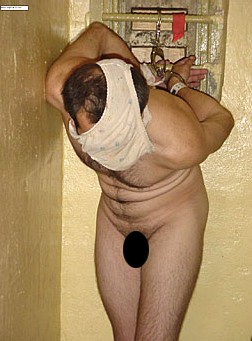
MEDIA ROOTS – With eight years of scandal, contempt and two illegal ground wars deep, a strong anti-bush sentiment was pervasive among American citizens leading up to the 2008 presidential elections. During Obama’s campaign for President, he made it clear that water boarding was torture, and that Bush administration officials broke the law with their counter terrorism torture strategies.
But if there’s one thing that’s clear from the last four years, it’s that talk is cheap. And as the 2012 Presidential elections inch closer, Media Roots takes a look back at the Bush administration’s illegal torture program, its exposure to the public with the Abu Ghraib scandal and what Obama’s subsequent cover-up of Bush era war crimes did to erode the fabric of our society.
The torture program was not some US foreign policy fluke gone awry. Instead, ‘enhanced interrogation techniques’ was architecture that was systematically instituted by the Bush administration at the highest levels.
The policies that the Obama administration has been under fire for can be seen as trivial when compared to the ongoing coverup of blatant war crimes by the former administration. Now that torture and war crimes have been normalized, both 2012 presidential candidates will be sure to continue the same trajectory of utter impunity for the rule of law.
ABU GHRAIB TORTURE
If US Army Staff Sergeant Sabrina Harman didn’t take any pictures while serving as a guard at Abu Ghraib prison, it’s possible that the world would have never known the extent to which our military and CIA implemented torture on a systematic level in their interrogations of suspected ‘terrorists’. The ensuing witch hunt resulted in charges pressed against only low level military personnel, which backed up the White House’s claim that they were ‘bad apples’ who went above and beyond ‘standard operating procedure.’ From the words of many who served sentences as a result of the leak, it was indeed ‘standard operating procedure’ to employ these techniques as a means of ‘softening up’ the prisoners.
As a brutal prelude to CIA interrogations, inexperienced 20-something soldiers were paired up with mostly innocent Iraqi males swept off the streets, and encouraged to do whatever they could to ‘get them to talk.’ What the Bush administration instructed the military to carry out was essentially a real life version of the Stanford Prison Experiment. The CIA would later torture these detainees, sometimes resulting in grave injury or death. The difference is that no video or photos have surfaced that depict what was in store for those detainees once they were in the custody of the CIA.
Was this violence truly, as the White House claimed, the isolated work of a few ‘bad apples’ at Abu Ghraib? Did low-level soldiers independently conspire to dehumanize and torture detained suspects in the heat of battle? Looking at all of the available information makes it nearly impossible to accept the validity of the White House’s claims. Taken together with statements and supporting legal documentation, it appears to illuminate a widespread policy of psychological and physical torture for supposed ‘intelligence gathering.’ At least two other scenarios outside of Iraq imply that it was an official policy, and the claims of ‘gitmo-izing’ other prisons also imply that Guantanamo Bay was a sort of testing ground for the implementation of these extra-legal policies.
While also conceivable that these practices were institutionalized long before the ‘War on Terror’ began, only after 9/11 were they put on paper in such vivid detail and validated by internal lawyers. It seems clear that it was never intended to be revealed to the public, but the torture memos enabled an internal military PR campaign to give the green light for allowing anything “short of killing them” (Army Reservist Lyndie England). In the end, since this is now public knowledge, the fear of potentially being detained without due process and tortured for being radically against American foreign policy (especially if you are a Muslim, or in the wrong place at the wrong time) is a realistic and valid fear that can no longer be minimized or attributed solely to anti-American paranoia.
“Torture didn’t happen in those photographs, that was humiliation, that was softening up, torture happened during interrogations, guys going into interrogation and they’re dead, and they were killed, and they died, that’s where the torture happened and we don’t have photographs of that.” (Sgt. Javal Davis)
As described by the American personnel involved, these photographs do not depict ‘torture’ per se, but rather ‘softening up’. If this kind of extreme violence and humiliation was only an orientation phase for detainees, one can only imagine the horrors that awaited them behind closed doors after they were turned over to CIA interrogators. Firsthand accounts of so-called ‘softening up’ included both physical and psychological torture. Physically, detainees were subjected to the following, among other acts: simulating sexual positions (often nude), being handcuffed to one another, being handcuffed or bound into stress positions, being bitten by dogs, being dressed in women’s undergarments, crawling and dragging their genitals along a freezing, wet concrete floor, being burned with cigarettes, repeated cold showers. Psychological stress was also increased by combining stress positions with threats: soldiers would have prisoners hold onto a set of overhead wires and instruct them to stand on a chair to the point of exhaustion. They were informed that the floor was electrified and that they would receive a deadly shock if they fell out of position. Bear in mind, this is not an exhaustive list of ‘techniques’.
“If they want us to keep him up that’s what we do, they say i want him to be awake, they say he’s dirty i want him to shower a lot.” (Specialist Megan Ambuhl)
“Did any of this seem weird to you?” (Errol Morris)
“Not when you take into account that its helping to save lives, and you see people coming in from the other side of the wire with their body parts missing, and they need to see who’s doing it so they can stop it, and these are your battle buddies.” (Specialist Megan Ambuhl)
It’s not as simple as hoping people would ‘follow orders’ to start committing torture on their own. They used the propagandistic trick of implying that you’re literally doing this for your survival and the survival of your companions so the apathy and amorality seeds are planted easily, their literal will to survive flight or flight instinct is overriding their normal moral compass.
“You could kill people off camera, you can shoot people you can blow their heads off, if it’s on camera you’re done.” (Sgt. Javal Davis)
In one horrifying case, the CIA placed a hooded individual, Manadel al-Jamadi back into his prison cell after a prolonged session of beatings. He was already deceased, and the official cause was recorded as a heart attack and many years later deemed a homicide (the investigation is still ongoing). The corpse was transferred to another room, put on ice and left for low level military personnel to deal with. A level of desensitization could be easily heard in the words of Sabrina Harman in a letter home after she took photographs of herself giving a thumbs up near the body, remarking “how fucking gross, he’s been defrosting for 24 hours.”
She was brought up on charges of evidence tampering, but they were quickly dropped, possibly because “they didn’t want to bring up the dead guy” … “they didn’t want anyone to find out they covered up a murder.”
Faced with public outrage over the leaked photos, the American government had no choice but to promise it would hold accountable those responsible for abusing detainees. The shameful fulfillment of that promise was a handful of inexperienced young soldiers becoming scapegoats and serving sentences for carrying out what overwhelmingly appears to have become standard operating procedure. Punishing soldiers at the lowest levels is the absolute minimum response possible, and was likely intended to quell public anger and outrage over the incidents while protecting the lawyers, advisers and officials higher up in the chain of command, those who deserve investigation for authorizing and encouraging these practices of systematic abuse.
“Sacrifice the little guys, thats how they cover it up.” (Sgt. Javal Davis)
GITMO TORTURE
Even before the Abu Ghraib scandal, rumors poured out of Guantanamo Bay that revealed the extreme and bizarre tactics used by the US military to ‘break down’ prisoners. British journalist Jon Ronson investigated the lengths to which US interrogators and military guards would psychologically torture prisoners via sensory deprivation and overload, e.g., opaque hoods, blackout goggles, solitary confinement boxes, and loud music repeated 24 hours a day. 60 Minutes, CBS news and the outlets later revealed that the prisoner abuses went much further than that. Coined ‘sexing-up’, Muslim prisoners were sexually humiliated by being forced to watch female personnel simulate masturbation and grope their own breasts.
In one instance red dye was placed in the underwear of a female interrogator who proceeded to rub it on the face of a detainee, claiming it was menstrual blood. Since being used as a prison camp for ‘enemy combatants,’ at least 9 fatalities have occurred at GITMO, all deemed suicides or from natural causes, reminiscent of the ‘heart attack’ suffered by Manadel al-Jamadi in Abu Ghraib. And unlike Abu Ghraib, GITMO was staffed by a dedicated group of military personnel that were more hardened, experienced and loyal to their commanding officers. They were not inexperienced enlisted privates, suddenly thrust into a foreign warzone in a makeshift prison camp, but prepared and trained to deal with their difficult environment. Nevertheless, an alarming rate of suicides happened at Gitmo, in one instance three in one day. This seasoned climate and strong esprit de corps at Gitmo would also help explain why no embarrassing leaks in the form of photographs or video have been revealed.
The practice of ‘waterboarding,’ wherein a detainee is subjected to simulated drowning, was made infamous through its use at Gitmo. It was admitted by authorities that Khalid Sheik Muhammad was water-boarded over 183 times. All of these ‘interrogations’ were videotaped by CIA personnel, though none have been made public. Do these videos only show ‘water-boarding,’ a technique already classified as torture, or do they show other horrendous acts, or possibly murder? Unfortunately there is no way of finding out, since the CIA has admitting to destroying these records, albeit with no explanation given.
A familiar story was told by former Gitmo Commander Erik Saar, who worked there during many of the interrogation sessions. He said to 60 minutes:
Echoed by Brigader General Janis Karpinski who served as overseer to prisons in Iraq who speculated that the interrogations she was shown were staged to give the appearance that everything was normal and that no abuse was regularly taking place. When a relief organization like the Red Cross made a scheduled visit to check the prison’s conditions, the environment was also artificially improved and normalized
Medical personnel who worked at Gitmo are also complicit in the cover-up of detainee abuse and torture. Glaring symptoms of physical abuse like bone fractures, internal bleeding and contusions were never explained in medical reports, nor were psychological symptoms of psychosis due to prolonged isolation and mental abuse. If the medical staff itself was helping to coverup what went on, how can we trust any of the internal reports of official causes of death for the 9 detainees who died while in US custody?
Detainees who have been released from Gitmo have also described being drugged and sedated before interrogations with unknown substances via forced injection. While this has long been banned by the US in regards to treatment of POWS, infamous “torture memo” author John Yoo wrote that drugs could be used as long as they did not inflict permanent or “profound” psychological damage. U.S. law “does not preclude any and all use of drugs,” in essence rejecting the US ban of mind altering substances on prisoners, but more likely hinting that they should be used, basically an encouragement of the practice.
Accounts like this explain a lot of the possible impetus for the CIA to destroy video of interrogations.
Jay Bybee, author of another torture memo under Bush, wrote “Certain of the techniques [that we condemn other countries for] bear some resemblance to some of the CIA interrogation techniques.” Bybee also describes in detail in his OLC memo that almost every suggestion could be directly compared to the torture regime of different dictatorships’ gulag practices.
No official internal investigations have ever been performed regarding the detainee abuse at Gitmo, probably because there isn’t any glaring and embarrassing photographic evidence of abuse taking place. Abu Ghraib was unique in the sense that the military had to do an internal investigation to save face in light of the leaked photos.
The most direct admission in the case of Gitmo comes from Susan J Crawford, the Bush appointed convening authority over military commissions at Gitmo.
“We tortured Mohammed al Qahtnai.”
“His treatment met the legal definition of torture and that’s why i did not refer the case for prosecution.”
You could dismiss the first hand account of Qahtani if one needs more evidence, but his statements hold even more impact when you take into account Susan Crawford’s admission, that they couldn’t even prosecute the guy because his torture was so extensive.
Later in 2010, two years after Bush left office, a rather candid and startling revelation was made by Colin Powell’s chief of staff Colonel Lawrence Wilkerson who asserted “many of the detainees were innocent of any substantial wrongdoing, had little intelligence value and should be immediately release.” Quickly after he signed an affidavit attesting under oath that:
“George Bush, Dick Cheney and Donald Rumsfeld covered up that hundreds of innocent men were sent to Gitmo prison camp because they feared that releasing them would harm the push for the war in Iraq and the broader war on terror.”
To add insult to injury, not only were most of the inmates at Gitmo subjected to inhuman treatment, but hundreds of them were ‘innocent’ according to a former high ranking Bush official. As of the date of the release of this article, Gitmo holds 167 prisoners.
BUSH ADMINISTRATION ADMISSION OF LAWBREAKING
Normalizing Torture, my appearance on Breaking the Set with Abby Martin
When the photos of Abu Ghraib leaked to the press, the Senate reacted by forming a public hearing committee to get to the bottom of the scandal. Bush-appointed Secretary of Defense Donald Rumsfeld’s appearance before the committee was the most anticipated of all, due to rumors and information that had came to light indicating that he had had a direct hand in ‘enhanced interrogations,’ AKA prisoner abuse up to and including torture.
A White House memo leaked which described the legal limits the military would have to operate under if they modified the traditional Army Field Manual on Interrogations that had been in use since before 9/11. As the highest ranking member of the US military, Rumsfeld officially authorized its implementation. On the document, in Rumsfeld’s own handwriting, he circled and enhanced the wording with vague, hinting statements such as “I stand 8-10 hours a day, why is standing limited to 4 hours?” in reference to time limits on the use of stress positions. Rumsfeld later stepped down, most would say as a result of the scandal that tarnished his reputation and effectively ended his military career (in combination with his role in the Patt Tilman death cover-up).
John Ashcroft , Attorney General at the time of White House discussions of ‘enhancing’ our interrogation techniques, said in response to the discussions “Why are we talking about this in the White House? History will judge this kindly.” He resigned not long after these enhancements were decided upon, and many say his resignation was due at least in part to his disagreement with the Bush administration for authorizing torture.
Alberto Gonzales was his replacement, and he quickly became deeply involved in the quasilegal framework that the special team of Bush-appointed lawyers, Jay Bybee, John Yoo, and Steven G. Bradbury attempted to use to shield illegal torture from the official definition of a crime. In other words, these lawyers were specifically charged with the task of creating a series of elaborate arguments as to why committing torture under specific circumstances was ‘legal’. Despite their valiant attempt, most law professors and lawyers agree that the arguments were highly flawed. John Yoo has become the public face of this scandal in part due to his de facto role as PR chief in charge of defending these memos on television and at conferences. In one instance he was asked:
Cassel: “If the President deems that he’s got to torture somebody, including by crushing the testicles of the person’s child, there is no law that can stop him?”
Yoo: “No treaty…”
Cassel: “Also no law by Congress — that is what you wrote in the August 2002 memo…”
Yoo: “I think it depends on why the President thinks he needs to do that.”
While Cassel’s vivid example is not directly from the text of the torture memos, several sections of those same arguments imply that psychologically torturing someone by feigning the rape or death of a family member or friend to gain intelligence was within the law since it did not produce ‘prolonged mental harm’. The focus of much of these memos is on creating arguments for redefining extant terms, e.g., ‘prolonged pain’, which falls under the definition of torture in American law, applied only to pain that lasted months and years, rather than days or weeks. Under these newly defined terms, the now-notorious practice of simulated drowning, better known as ‘water-boarding,’ creates no prolonged physical or mental harm because the subject ‘will experience relief as soon as the process stops,’ even though the repeated triggering of one’s fight or flight instinct can cause psychosis or other severe mental impairment.
The memos themselves are legally very flimsy, and if they were ever used by the government to defend their use of practices water-boarding or sexual abuse there isn’t much chance that wouldn’t be convince a court of law. However, as time went on it become very clear that no cases would actually be heard, and that these memos would be never used by a government defendant. This is because none of the cases have proceeded to trial, usually blocked by the government’s claim that it would compromise national security. The government maintains that releasing classified evidence in order to conduct a thorough investigation and trial would put us in danger. We need to protect them from litigation for our own safety and ensured success in the ongoing War on Terror.
These memos were not created in a vacuum, but rather they were assignments from the highest level Bush White House officials. Based on the evidence that is now public, Bush, Rumsfeld, Rice, Cheney, Ashcroft, CIA director George Tenant and Paul Wolfowitz incepted this policy of enhanced interrogation. From there, it was passed on to lawyers who examined each suggestion and provided the legal jargon deliberately aimed at justifying each practice, one by one. The Bush White House wanted and needed a legal shield, on paper and argued by lawyers, to get away with the crimes that he knew he and his administration had committed.
Long after Bush left office, he openly admitted“Yeah, we water-boarded Khalid Sheikh Mohammed,” and when asked if he would do it again, responded, “Damn right.” “I’d do it again to save lives.”
Around the same time period, a pale and gaunt Dick Cheney said in reference to the torture memos and the policy “I was aware of the program, certainly, and involved in helping get the process cleared.” Clearly the former President and VP were admitting their actions with impunity, unafraid of any future repercussions.
But rational voices came out in the form of two of the highest-ranking US government officials, now retired, who admitted on national television that they had indeed committed a felony by authorizing the use of water-boarding when they were well aware that it had been previously defined as torture and made illegal by the US government. Antonio Taguba, the retired 4 star General appointed to formally investigate the abuse at Abu Ghraib, stated that “after years of disclosures by government investigations, media accounts and reports from human rights organizations, there is no longer any doubt as to whether the current administration has committed war crimes” and that “the only question that remains to be answered is whether those who ordered the use of torture will be held to account.”
To most civil libertarians, it seemed like quite a risk to admit such a crime had occurred, and so publicly, even so long after the event. Still, as years passed with no progress, it became clear that neither Bush, nor Cheney, nor Rumsfeld, nor any other upper echelon official would ever face an investigation or criminal charges for their role in a systematic torture regime, regardless of how much they openly mocked the rule of law on the news with their criminal admissions.
As the Bush administration did not seem concerned about the statements of Antonio Taguba or others, they remained equally unfazed by the new Obama-led administration arriving into office on campaign promises of substantive investigations and repeated condemnations of the former for violating the rule of law and the US constitution.
OBAMA’S IMMUNIZATION OF TORTURERS AND BUSH POLICY MAKERS
One of Obama’s most powerful campaign messages in 2008 was that he felt that the Bush administration systematically broke the law in regard to not only torture but also NSA wiretapping. Quotes from his 2008 campaign include:
“No more ignoring the law when it’s inconvenient that is not who we are”…”We will again set an example for the world that the law is not subject to the whims of stubborn rulers, and that justice is not arbitrary.” (August 1, 2007, CSPAN)
Obama did not shy away from referring to water-boarding as torture during his campaign speeches, and directly implied that an institutionalized torture regime took shape on Bush’s watch. Progressives were disappointed by Obama’s overall lukewarm anti-war message, wherein he objected to the Iraq war only on the grounds that it had been waged as a ‘dumb war’ but did not fundamentally challenge the ‘War on Terror.’ In spite of this, his stance against the lawless rhetoric of Bush gave many hope and excitement that he would investigate the Bush crimes in a substantial way. It logical to assume that a constitutional law professor would carry over into his presidency some of those principles.
As soon as Obama was elected, his message about Bush’s law breaking softened, and in various interviews when asked about his campaign message he responded with quotes like:
“What I would want to do is to have my justice department and my attorney general immediately review the information that’s already there and to find out are there inquiries that need to be pursued…”
“I would want to find out directly from my attorney general having pursued having looked at what’s out there right now – are there possibilities of genuine crimes?”
“If crimes have been committed they should be investigated if i found out that there were high officials who knowingly consciously broke the laws engaged in cover-ups of crimes with knowledge.” (April 2008, in response to Will Bunch for The Philly)
Constitutional experts and civil liberties activists were encouraged by this message because illegal water-boarding inarguably constitutes torture, and high level officials like Cheney had admitted to ordering the practice. Legally, a president is not supposed to decide the outcome of a trial or investigation, so someone well versed in the law would know that this is as far as the president can go in condemnations without taking action to initiate an investigation. Obama’s Attorney General Erik Holder made even stronger statements to this end. Having the head of the justice department echo the need for an investigation likely alarmed many of Obama’s handlers, as well as the neoconservatives in the Bush administration, while simultaneously exciting civil libertarians all over the country.
“Unfortunately in the last few years we have quite frankly lost our way with respect to the this commitment to the constitution and to the rule of law.” …. “Our government authorized the use of torture … secretly detained American citizens without due process of law denied the writ of habeas corpus to hundreds of accused enemy combatants and authorized the use of procedures that both violate international law and the united states constitution.” (June 2008 in a speech to the American Constitution Society)
Nine days before Obama’s inauguration, the New York Times published an article titled Obama reluctant to look into Bush programs and from thereon Obama was not inclined to pursue these matters upon which he had campaigned.
“Will you appoint a Special Prosecutor — ideally Patrick Fitzgerald — to independently investigate the gravest crimes of the Bush Administration, including torture and warrantless wiretapping?”
Evidently, most of the people who voted on issues at Change.gov felt that investigating Bush’s blatant lawbreaking was the most important issue. This was Obama’s response:
“We’re going to be looking at past practices, and I don’t believe that anybody is above the law… On the other hand, I also have a belief that we need to look forward as opposed to looking backwards, and part of my job is to make sure that, for example, at the CIA you’ve got extraordinarily talented people who are working very hard to keep Americans safe, I don’t want them suddenly feel like they’ve got to spend all their time looking over their shoulders and lawyering up.”
Carefully wording his next statements, he continued with:
“[It] doesn’t mean if somebody has blatantly broke the law that they are above the law…” “…My instinct is for us to focus on how do we make sure that moving forward we are doing the right thing” … “My orientation’s going to be to move forward.”
The best case scenario is that somewhere along the line Obama decided, perhaps based on internal pressure, not to investigate the blatant lawbreaking because of the political fallout that it would cause. Or, a more sinister scenario that implies a more direct continuity that defies democracy itself. Blanket immunity between an administration that committed war crimes regularly and one that promised, during its campaign to punish people who thought torture memos written by lawyers would shield them from the law.
Defying the course of events this far into Obama’s presidency, he declassified OLC (Presidential Office of Legal Counsel) torture memos in April 16th 2009 in response to an FOIA request. The release of these four memos reignited the debates in America over whether or not Obama should prosecute the Bush torture crimes. Perhaps the timing of this release produced an opportunity to reinforce the oft-repeated talking point that “we need to look forward, not backward.’ Investigations are defined by a critical ‘look backward’ to determine whether or not a crime was committed, and by whom. Crimes that are not punished must be considered more, and not less likely to occur again. ‘Looking forward’ without investigation into past actions acts as if no crimes were committed at all. To do this, the Obama administration attempted to sidestep the black mark on our history that the Bush torture crimes had left.
Upon the release of the OLC memos, Obama reiterated this ‘look forward, not backward’ mantra in this speech:
“This is a time for reflection not retribution At a time of great challenges and disturbing disunity nothing will be gained by spending our time and energy laying the the blame for the past. Our national greatness is embedded in Americas ability to right its course in concert with the our core values and to move forward with confidence. That is why we must resist the forces that divide us, and instead come together on behalf of our common future.”
It seemed as if Obama was directly challenging previous statements by Eric Holder. Any chance of America getting its sought after ‘reckoning’ evaporate as the final words of Obama’s speech were uttered.
It was in August 2009 that Erik Holder was to deliver the final verdict on who would be investigated and how high up the chain it would go. He had already cut a deal with a prominent senate Republican (and probably by proxy the Republican establishment) wherein he promised not to investigate any high level officials in the Bush administration. His first historically important act as Attorney General was to make a speech echoing the ‘look forward, not backward’ rhetoric of Obama. In the end, the only red meat he could offer the American pubic was in the form of 12 open investigations (now closed leaving only two remaining open) targeting low ranking military personnel who had physically carried out the torture. To this day, only insignificant people were brought to justice, and those responsible at the highest level escaped scrutiny and punishment.
This is moment in time when the narrative, the propaganda, and the marketing that got Obama into office needed to shift. It had served its purpose and was no longer useful to drum up anti-Bush sentiment. It was time to change to a new narrative, one that would under the cover of state secrets and prosecution of whistleblowers would serve the Bush neoconservative legacy. While it would be fun to imagine Bush and Cheney in hand cuffs and orange jump suits, they shared a goal with the new administration: how to maintain continuity for the escalating military moneymaker that is ‘War on Terror.’ Obama’s promise of ‘transparency of government’ was craftily extinguished, as this new and nebulous war was re-branded and continued under a new cloak of secrecy.
Obama is now complicit in war crimes by covering them up. In 1988 Reagan had signed into law the convention against torture, which was ratified in the senate in 1994. This US law states that knowledge of torture taking place, in the past or in the present, and refusing to investigate it is a crime unto itself and can be prosecuted. This is Obama’s law and the normalization of neoconservatism. In the next installment, we will discuss how his war on whistleblowers and continued blocking of court proceedings has used the states secret privilege to erode our rights even further.
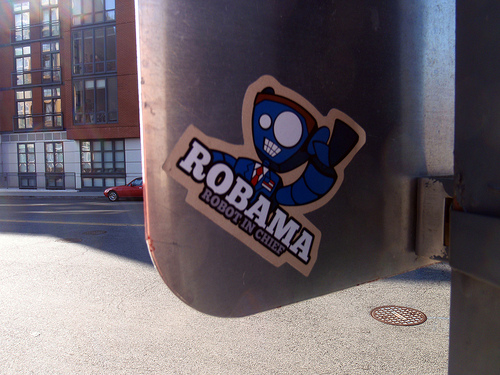
MEDIA ROOTS – With the second of three presidential debates now over, democracy continues to be victimized by the campaigns of establishment candidates referred to colloquially as “Obamney” or “Robama.” However, viewers of corporate media would not understand this for throughout the coverage, very little was reported on events occurring just outside the spectacle.
Since the historic Kennedy-Nixon debate of 1960, televised presidential debates have been a primary tool for American voters to learn about candidates for office. Over 70 million Americans tuned-in for that first televised debate as well as last night’s orchestrated charade. But while it is widely agreed that Kennedy won the debates because of his favorable on-camera presence, the winner of last night’s debates was more nebulous. For never have these televised debates featured more than the two major candidates nor have additional voices ever been needed more in a presidential election.
Yesterday Dr. Jill Stein and her running-mate, Cheri Honkala, attempted to alter the two-party paradigm by attending the debates without “credentials.” They were promptly arrested after not refusing to leave only to be later released, without charge, shortly after the debates concluded. “We think [the Commission on Presidential Debates] is entirely illegitimate,” Dr. Stein mentioned just prior to their arrest. The physician, author, teacher, and mother continued “that if democracy truly prevailed there would be no such commission, that the debates would still be run by the League of Women Voters, that the debates would be open.”
– “The candidates may not ask each other direct questions during any of the four debates.”
– “The candidates shall not address each other with proposed pledges.”
– “At no time during the October 3 First Presidential debate shall either candidate move from his designated area behind the respective podium.”
– For the October 16 town-hall-style debate, “the moderator will not ask follow-up questions or comment on either the questions asked by the audience or the answers of the candidates during the debate….”
– “The audience members shall not ask follow-up questions or otherwise participate in the extended discussion, and the audience member’s microphone shall be turned off after he or she completes asking the questions.”
– “[T]he Commission shall take appropriate steps to cut-off the microphone of any…audience member who attempts to pose any question or statement different than that previously posed to the moderator for review.”
– “No candidate may reference or cite any specific individual sitting in a debate audience (other than family members) at any time during a debate.”
– For the town-hall debate: “Each candidate may move about in a pre-designated area, as proposed by the Commission and approved by each campaign, and may not leave that area while the debate is underway.”
***
Photo provided by Flickr user Daquella manera.
Dr. Jill Stein and Cheri Honkala, surrounded by law enforcement officers,
explain to the American people yesterday how the presidential debates are illegitimate and
offers insight into what an appropriate presidential debate would look like.



 MEDIA ROOTS — Obama delivered his 2013 State of the Union Address this week. And his banal Address is unsurprising, in the sense it’s largely a continuation of policy trajectories we’ve seen during his previous term, which, in turn, have largely been a continuation of Bush policies. But for Obama’s fans, who tend to hear what they want, he, doubtless, talked a good game. But let’s take a look at what he really said (and didn‘t say).
 MEDIA ROOTS – “Protect Whistle blowers: …Such acts of courage and patriotism….should be encouraged rather than stifled. Barack Obama will strengthen whistle blower laws to protect federal workers who expose waste, fraud and abuse of authority in government. Obama will ensure that federal agencies expedite the process for reviewing whistle blower claims and whistle blowers have full access to courts and due process.” – from
  MEDIA ROOTS –
  MEDIA ROOTS – With eight years of scandal, contempt and two illegal ground wars deep, a strong anti-bush sentiment was pervasive among American citizens leading up to the 2008 presidential elections. During Obama’s campaign for President, he made it clear that water boarding was torture, and that Bush administration officials broke the law with their counter terrorism torture strategies.
 MEDIA ROOTS – With the second of three presidential debates now over, democracy continues to be victimized by the campaigns of establishment candidates referred to colloquially as