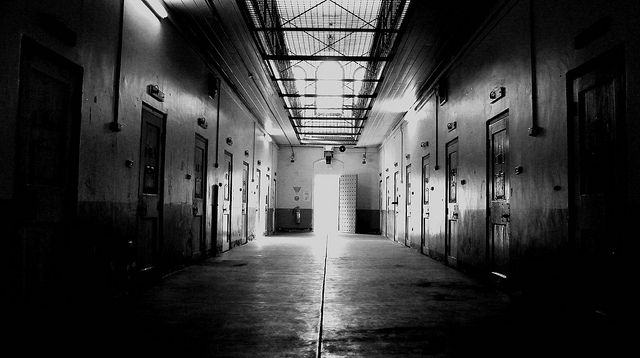
 When you hear the words indefinite detention, Guantanamo Bay prison probably comes to mind.
But perhaps it’s time to add Scott County, Mississippi to the list.
Recently, the ACLU filed a class action lawsuit against the county on behalf of 50 prisoners who have been detained for months on end without being charged nor provided a lawyer.
One man named Joshua Basset, for example, has spent the last eight months in prison and has yet to speak to a lawyer. Another man who can’t afford bail, Octavious Burks, was arrested in November of 2013 and has not been charged nor appointed counsel.
The men are caught in a vicious catch-22, where no one will pay attention to their cases unless they have legal representation, yet they can’t receive a lawyer until they’re formally indicted by a grand jury. Grand juries only convene in Scott County three times a year, and if a prosecutor isn’t ready to present a case, several more months can pass before an inmate get can due process.
Despite several Supreme Court cases that ensure legal representation and the right to a speedy trial, the backwards judicial system in Mississippi has gone virtually unchallenged. What’s more disturbing is that Scott County isn’t unique – a full seven states don’t have to file charges against a defendant for up to six months after an arrest.
There are countless prisoners in a state of legal limbo, proving further why the prison industrial complex must be dismantled.
Breaking the Set
**
MINT PRESS NEWS – Approximately 600 prisoners have been under intermittent lockdown since late December at North Carolina’s Scotland Correctional Institution, according to Keith Acree, the communications officer at North Carolina’s Department of Public Safety. Prisoners have responded to the heavy-handed measures by writing to a prison advocacy website and legal advocates in the state to describe the conditions.
Lockdown involves confining prisoners to their cells for 22 to 24 hours a day and restricting privileges, such as outdoor recreation time and access to visitors.
In a letter to Solitary Watch, a website dedicated to advocating on behalf of prisoners under solitary confinement conditions, one of the inmates at Scotland described the current situation:
“While on lockdown, we’ve been through different stages. Stage one, we were on lockdown for 24 a day hours without being allowed to shower. It was like this for a month. Then the officers started taking us to the shower one day out of the week with handcuffs on so tight that it made it difficult for us to wash. Stage two, they let 12 of us out of our cells to rec in the dayroom for one hour. Next, they let 24 of us out for two hours. We haven’t had any outside rec since December 28, 2013, and our skin and health is showing that.”
Acree told MintPress News that the prison has “tried several times over the months to step that lockdown down.” The lockdown has continued, he said, because “every time we’ve stepped down we’ve had more incidents of disturbances and fights.”
In a follow-up email to MintPress after he was interviewed for this story, Acree wrote:
“At this point, the lockdown for close custody regular population (RPOP) has stepped down to a point that we call ‘managed observation.’ Close custody RPOP inmates are now allowed about 4 hours of out-of-cell time daily (compared to about 8 hours before the Dec. 28 fights that began the lockdown).”
He also noted that other privileges, such as visitation, outdoor recreation time and telephone use, have resumed, but he did not specify when. He added that, “Religious services have not yet resumed.”
One inmate at the prison wrote that the incident which started the massive lockdown in December consisted of two fights. “No one was stabbed or cut, and no staff was hurt.”
Another said in a letter to Solitary Watch, “We’ve been asking why they are punishing 600 inmates for something four people were involved in. Those inmates were put in segregation, found guilty of their charges and punished for them.”
The Laurinburg Exchange, which covered the incident in January, quoted Acree as saying that the lockdown started because of a “series of fights between inmates and minor assaults on staff members.” Indeed, Acree told MintPress the same thing over the phone.
However, the Laurinburg Exchange quoted him as saying that the incident was “nothing serious,” which does raise questions about why 600 inmates have been kept under such harsh conditions for so long.
Torturous Conditions & Loopholes in Punitive Law
“The idea that there were some incidents between guards and prisoners and that they’ve got everybody locked down from December to September is pretty remarkable,” exclaimed John Boston, director of the Prisoner’s Rights Project of the New York City Legal Aide Society at the American Civil Liberties Union, while speaking with MintPress.
He said it sounds like everybody in the unit was being subjected to “punitive segregation” without trial. When an individual is accused — even in prison — of doing something unlawful, he or she would normally have the right to due process before spending nine months in segregation (solitary confinement).
The prisoners at Scotland, however, have not been sent to segregation and, thus, do not have a right to due process. Instead, they’ve been locked in their cells alone in solitary confinement-like conditions and had their access to normal amenities restricted — presumably, all at the whims of the superintendent of the prison — a position held by Sorrell Saunders until he retired in August, and Katy Poole is now the acting administrator.
Approximately 80,000 prisoners in the U.S. are held in solitary confinement-like conditions, as of 2012. “The conditions of confinement are far too severe to serve any kind of penological purpose,” according to Craig Haney, a professor in the psychology department at the University of California, Santa Cruz.
Haney has investigated the psychological effects of solitary confinement on prisoners for years, visiting penitentiaries throughout the U.S. and interviewing staff and inmates. He concludes that the practice causes “grave risk of psychological harm.”
At a Senate Juiciary Subcommittee hearing on the Constitution, Civil Rights and Human Rights in 2012, Haney testified that “for some prisoners … solitary confinement precipitates a descent into madness.” The American Psychological Association, which reported on the hearing, said that prisoners in solitary often “experience panic attacks, depression and paranoia, and some suffer hallucinations.”
Five Omar Mualimm-ak, a prison reform activist who spent 12 years in a New York state prison, including 2,054 days in isolated conditions, claims that solitary confinement is torture. He wrote in The Guardian, “After only a short time in solitary, I felt all of my senses begin to diminish.”
“Everyone knows that prison is supposed to take away your freedom. But solitary doesn’t just confine your body; it kills your soul,” he continued.
The United Nations Human Rights Council’s Special Rapporteur on Torture, Juan E. Méndez, called for a global ban on prolonged solitary confinement because it violates the U.N.’s Convention against Torture. He told the U.N. General Assembly in 2011 that, “Segregation, isolation, separation, cellular, lockdown, Supermax, the hole, Secure Housing Unit… whatever the name, solitary confinement should be banned by States as a punishment or extortion technique.”
The practice is “contrary to rehabilitation, the aim of the penitentiary system,” he said. The U.N. News Centre also reported that he explained that holding someone in solitary confinement conditions for more than 15 days should be absolutely prohibited because studies have concluded that “lasting mental damage is caused after a few days of social isolation.”
The ACLU states that long-term “solitary confinement is cruel, expensive and ineffective.” It says that solitary confinement exacerbates prisoner mental illness and jeopardizes public safety when inmates are reintroduced into society. The organization released a report on youth in solitary confinement in the U.S. in 2012, asserting that the practice “can cause serious pain and suffering and can violate international human rights and U.S. constitutional law.”
The state of Maine has made great improvements in regards to solitary confinement. It has cut isolation time in half and improved the treatment of prisoners, according to a case study by the ACLU titled, “Change is Possible.” The report says that “through a combination of will, skill, and luck, reforms [in the state] began to take hold,” and touts the state as an example for other prisons that want to reform.
Instead of using solitary confinement as a punitive technique, the report says, staff have been given “new training and skill-building opportunities for managing difficult prisoners and challenging situations.” They have been trained to de-escalate situations and “removed incentives for supervisors to send difficult (but not dangerous) prisoners to the SMU [special management units a.k.a. solitary confinement].”
It remains to be seen whether other states might follow suit.
Budget Cuts and State Resources
“I wonder… if there’s a lack of resources there?” inquired Mary Pollard, executive director of North Carolina Prisoner Legal Services, while speaking with MintPress about the ongoing lockdown at the Scotland facility.
Her organization, which provides legal assistance to inmates in the state, had its budget cut by about 30 percent from last year. As a result, prisoners in North Carolina have no resources to advocate on their own behalf. She told MintPress, “When we had more funding we did more on conditions work. Folks would write in on negligent use of force or inability to protect themselves from other inmates, or inadequate medical care, deprivation of their religious liberty, the sorts of things we still hear from inmates [even at Scotland], we just don’t have the resources to really address it at the moment.”
She speculated that the Scotland facility must have a resource issue “because if they’re having to lockdown 600 people because of the actions of presumably many fewer than that,” and doing so for such an extensive period of time, it means they lack the resources needed for staff to properly do their jobs.
She explained that funding has been cut in many departments throughout the state and many facilities are contending with limited financial resources. Similar testimony was given by one of the inmates in the Solitary Watch letters: “They tell our families that they are understaffed, but that isn’t our problem. We are imprisoned inside a prison. . . We have been on lockdown since December 28, 2013, and enough is enough.”
When asked whether the prison has any budget, policy or staffing problems, Acree, of the Department of Public Safety, said he was “not aware of any issues like that.”
Scotland Correctional Institution currently holds 1,663 inmates. The approximately 600 prisoners currently under lockdown are located in the close-custody restriction unit of the prison, which means they are classified as having the highest public safety risk.
Written by Sean Nevins, photo by flickr user Les Haines
**
Another recent ACLU report details the shockingly high number of people serving life sentences without parole for non-violent crimes. Breaking the Set explains why mandatory sentencing laws are corrupt and criminal, while calling out state laws that leave judges without other options.
Life in Prison for Shoplifting Under Three Strikes Law
**
Follow me @AbbyMartin



 Visits from high-profile public figures are somewhat of a rarity at Hamilton College in upstate New York, so it wasn’t a surprise many students snatched up tickets to see Hillary Clinton last October. And after a talk which may have cost the school up to $300,000 (at her “discounted” student rate), the presidential endorsements quickly echoed across campus.
 On September 11th, 2001, the Bush administration started inoculating themselves with Cipro, the antibiotic to prevent anthrax infection. Several journalists were also told to take Cipro by government officials, yet the precautionary advice wasn’t provided to the American public.
 In January of 2014, a UN surveillance drone
  When you hear the words indefinite detention, Guantanamo Bay prison probably comes to mind.