Annual AC for US Wars Costs More than NASA Budget

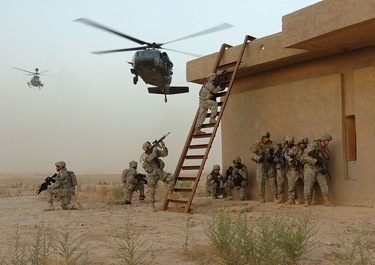
NPR– The amount the U.S. military spends annually on air conditioning in Iraq and Afghanistan: $20.2 billion.

That’s more than NASA’s budget. It’s more than BP has paid so far for damage during the Gulf oil spill. It’s what the G-8 has pledged to help foster new democracies in Egypt and Tunisia.

“When you consider the cost to deliver the fuel to some of the most isolated places in the world — escorting, command and control, medevac support — when you throw all that infrastructure in, we’re talking over $20 billion,” Steven Anderson tells weekends on All Things Considered guest host Rachel Martin. Anderson is a retired brigadier general who served as Gen. David Patreaus’ chief logistician in Iraq.

Why does it cost so much?

To power an air conditioner at a remote outpost in land-locked Afghanistan, a gallon of fuel has to be shipped into Karachi, Pakistan, then driven 800 miles over 18 days to Afghanistan on roads that are sometimes little more than “improved goat trails,” Anderson says. “And you’ve got risks that are associated with moving the fuel almost every mile of the way.”

Anderson calculates more than 1,000 troops have died in fuel convoys, which remain prime targets for attack. Free-standing tents equipped with air conditioners in 125 degree heat require a lot of fuel. Anderson says by making those structures more efficient, the military could save lives and dollars.

Listen to the NPR report and continue reading about the Annual cost of air conditioning for US war soldiers greater than NASA budget.

© 2011 NPR

Photo by Flickr user US Army

Defining ‘Withdrawal’ From Afghanistan

COMMON DREAMS– Barack Obama’s June 22 announcement of a phased troop withdrawal from Afghanistan was often portrayed as a major step towards ending the war, with many outlets neglecting to accurately explain the pace of escalation that has happened under his watch.

When Obama took office in 2009, the U.S. had about 34,000 troops in Afghanistan. Obama has initiated two major troop increases in Afghanistan: about 20,000 additional troops were announced in February 2009, followed by the December 2009 announcement that an another 33,000 would be deployed as well; other smaller increases have brought the total to 100,000. Much of the media conversation portrays the announced withdrawal schedule as a removal of all the surge troops–“the withdrawal of the entire surge force by the end of next summer,” as the New York Times put it (6/23/11)–which ignores the initial escalation.

News accounts over how many troops might leave should account for the total U.S. military presence in Afghanistan, in historical context. As ThinkProgress noted (6/22/11), if the reductions are carried out as planned, the United States would still have far more troops in Afghanistan than it did when Obama came into office and more than at any point during former president George W. Bush’s administration. This means that the troop reduction would not put us much closer to actually ending the war by the end of 2012.

That was not the impression many in the media were giving; coverage often made it sound as if the war was ending. “Obama Moves Toward Exit from Afghanistan” read one Reuters headline (6/22/11). USA Today reported (6/23/11), “President Obama heralded the beginning of the end of the nation’s 10-year war in Afghanistan on Wednesday.”

Reporting also nearly universally excluded any mention of the 100,000 Pentagon contractors currently in Afghanistan, which double the U.S. military commitment there. Given the full context, it’s hard to read a phased pullout of 30,000 out of 200,000 over the course of an entire year as a “rapid” withdrawal (Los Angeles Times, 6/23/11). Nor is it clear how this withdrawal, which conforms to Obama’s promise to begin to pull out troops from the second surge within 18 months of their deployment, merits a headline like the New York Times‘ “Obama Will Speed Military Pullout From Afghan War” (6/23/11).

Instead, the pace of the withdrawal, and the remaining U.S. presence in the country, reveal that the Afghan War is a long way from being over. A Washington Post headline before the speech (6/22/11) was: “Obama’s Challenge: Leaving, But Not Too Quickly.” Given the public’s anti war sentiment, the real challenge might be exactly the opposite: leaving too slowly.

***

FAIR, the national media watch group, has been offering well-documented criticism of media bias and censorship since 1986. We work to invigorate the First Amendment by advocating for greater diversity in the press and by scrutinizing media practices that marginalize public interest, minority and dissenting viewpoints.

Amy Goodman on Democracy Now explains how President Obama’s Afghan drawdown will leave the US occupation at his pre-surge levels.

 

Obama Rejects Top Lawyers’ Legal Views on Libya

SALON– The growing controversy over President Obama’s illegal waging of war in Libya got much bigger last night with Charlie Savage’s New York Times scoop.  He reveals that top administration lawyers —  Attorney General Eric Holder, OLC Chief Caroline Krass, and DoD General Counsel Jeh Johnson — all told Obama that his latest, widely panned excuse for waging war without Congressional approval (that it does not rise to the level of “hostilities” under the War Powers Resolution (WPR)) was invalid and that such authorization was legally required after 60 days: itself a generous intepretation of the President’s war powers.  But Obama rejected those views and (with the support of administration lawyers in lesser positions:  his White House counsel and long-time political operative Robert Bauer and State Department “legal adviser” Harold Koh) publicly claimed that the WPR does not apply to Libya.

As Savage notes, it is, in particular, “extraordinarily rare” for a President “to override the legal conclusions of the Office of Legal Counsel and to act in a manner that is contrary to its advice.”  Just imagine if George Bush had waged a war that his own Attorney General, OLC Chief, and DoD General Counsel all insisted was illegal (and did so by pointing to the fact that his White House counsel Alberto Gonzales and a legal adviser at State agreed with him).  One need not imagine this, though, because there is very telling actual parallel to this lawless episode:

In 2007, former Bush Deputy Attorney General James Comey testified to the Senate Judiciary Committee about an amazing event.  Bush’s then-Attorney General, Alberto Gonzales, had blocked Comey from testifying for two years — once Democrats took over Congress, that obstruction was no longer possible — and it quickly became apparent why Gonzales was so desperate to suppress these events.

Comey explained that, in 2004, shortly after he became Deputy AG, he reviewed the NSA eavesdropping program Bush had ordered back in 2001 and concluded it was illegal.  Other top administration lawyers — including Attorney General John Ashcroft and OLC Chief Jack Goldsmith — agreed with Comey, and told the White House they would no longer certify the program’s legality.  It was then that Bush dispatched Gonzales and Andy Card to Ashcroft’s hospital room to try to extract an approval from the very sick Attorney General, but, from his sickbed, Ashcroft refused to overrule Comey.

Read full article about Obama Rejects Top Lawyers’ Legal Views on Libya.

Written by Glenn Greenwald

Theft of Funds – $6.6 Billion Missing in Iraq

RAW STORY– Approximately $6.6 billion in cash was likely stolen after being flown to Iraq during the months that followed the U.S.-led invasion, Pentagon officials said recently.

Stuart Bowen, the U.S. Special Inspector General for Iraq Reconstruction, told The Los Angeles Times that the sum just might be “the largest theft of funds in national history.”

The cash was part of a series of shipments totaling more than $12 billion, taken largely from the U.N. “oil-for-food” program and the sales of Iraqi oil. Officials in the Bush administration had hoped the massive pallets of cash would help calm Iraq’s civilian population following the chaotic and violent invasion and toppling of Saddam.

The funds — which were separate from a $53 billion appropriation Congress approved for Iraqi reconstruction efforts — were cobbled together by the Federal Reserve Bank of New York before being flown to Baghdad and distributed to interim Iraqi ministers, who U.S. officials see as the most likely culprits in the theft: an allegation that’s not officially been leveled.

Read the full article about Billions Missing in Iraq May Be ‘Largest Theft of Funds in National History’.

© 2011 Raw Story

Photo by Flickr user

US Intensifies Secret Yemen Airstrike Campaign

NY TIMES– The Obama administration has intensified the American covert war in Yemen, exploiting a growing power vacuum in the country to strike at militant suspects with armed drones and fighter jets, according to American officials.

The acceleration of the American campaign in recent weeks comes amid a violent conflict in Yemen that has left the government in Sana, a United States ally, struggling to cling to power. Yemeni troops that had been battling militants linked to Al Qaeda in the south have been pulled back to the capital, and American officials see the strikes as one of the few options to keep the militants from consolidating power.

On Friday, American jets killed Abu Ali al-Harithi, a midlevel Qaeda operative, and several other militant suspects in a strike in southern Yemen. According to witnesses, four civilians were also killed in the airstrike. Weeks earlier, drone aircraft fired missiles aimed at Anwar al-Awlaki, the radical American-born cleric who the United States government has tried to kill for more than a year. Mr. Awlaki survived.

The recent operations come after a nearly year-long pause in American airstrikes, which were halted amid concerns that poor intelligence had led to bungled missions and civilian deaths that were undercutting the goals of the secret campaign.

Read full article on US Intensifying a Secret Campaign of Yemen Airstrikes.

©2011 NY Times

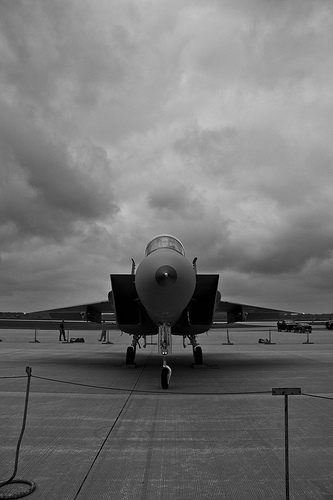
Photo by flickr user NicStage-F15

Page 51 of 79<<...4950515253...>>