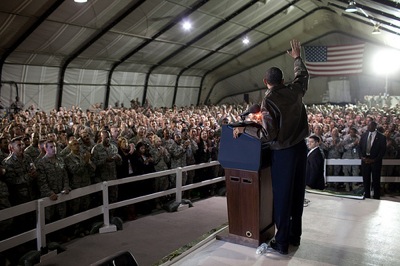
 COMMON DREAMS– Barack Obama’s June 22 announcement of a
phased troop withdrawal from Afghanistan was often portrayed as a major
step towards ending the war, with many outlets neglecting to accurately
explain the pace of escalation that has happened under his watch.
COMMON DREAMS– Barack Obama’s June 22 announcement of a
phased troop withdrawal from Afghanistan was often portrayed as a major
step towards ending the war, with many outlets neglecting to accurately
explain the pace of escalation that has happened under his watch.
When Obama took office in 2009, the U.S. had about 34,000 troops in
Afghanistan. Obama has initiated two major troop increases in
Afghanistan: about 20,000 additional troops were announced in February
2009, followed by the December 2009 announcement that an another 33,000
would be deployed as well; other smaller increases have brought the
total to 100,000. Much of the media conversation portrays the announced
withdrawal schedule as a removal of all the surge troops–“the
withdrawal of the entire surge force by the end of next summer,” as the New York Times put it (6/23/11)–which ignores the initial escalation.
News accounts over how many troops might leave should account for the
total U.S. military presence in Afghanistan, in historical context. As ThinkProgress noted (6/22/11), if the reductions are carried out as planned, the United
States would still have far more troops in Afghanistan than it did when
Obama came into office and more than at any point during former
president George W. Bush’s administration. This means that the troop
reduction would not put us much closer to actually ending the war by the
end of 2012.

That was not the impression many in the media were giving; coverage
often made it sound as if the war was ending. “Obama Moves Toward Exit
from Afghanistan” read one Reuters headline (6/22/11). USA Today
reported (6/23/11), “President Obama heralded the beginning of the end
of the nation’s 10-year war in Afghanistan on Wednesday.”
Reporting also nearly universally excluded any mention of the 100,000
Pentagon contractors currently in Afghanistan, which double the U.S.
military commitment there. Given the full context, it’s hard to read a
phased pullout of 30,000 out of 200,000 over the course of an entire
year as a “rapid” withdrawal (Los Angeles Times, 6/23/11). Nor is
it clear how this withdrawal, which conforms to Obama’s promise to
begin to pull out troops from the second surge within 18 months of their
deployment, merits a headline like the New York Times‘ “Obama Will Speed Military Pullout From Afghan War” (6/23/11).
Instead, the pace of the withdrawal, and the remaining U.S. presence
in the country, reveal that the Afghan War is a long way from being
over. A Washington Post headline before the speech (6/22/11) was:
“Obama’s Challenge: Leaving, But Not Too Quickly.” Given the public’s
anti war sentiment, the real challenge might be exactly the opposite:
leaving too slowly.
***
FAIR, the national media watch group, has been offering well-documented
criticism of media bias and censorship since 1986. We work to
invigorate the First Amendment by advocating for greater diversity in
the press and by scrutinizing media practices that marginalize public
interest, minority and dissenting viewpoints.
Amy Goodman on Democracy Now explains how President Obama’s Afghan drawdown will leave the US occupation at his pre-surge levels.



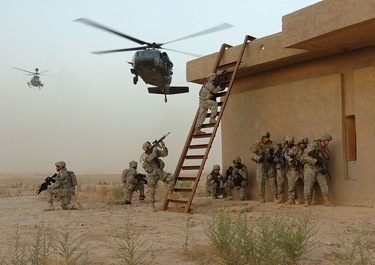 NPR– The amount the U.S. military spends annually on air conditioning in Iraq and Afghanistan: $20.2 billion.
 COMMON DREAMS
 RAW STORY
 NY TIMES