In this sequel to The Empire Files’ report on trafficked Filipina domestic workers, Damayan’s Linda Oalican provides a deeper context to the epidemic of human trafficking by guiding us through the history of colonialism, resistance and US domination of the islands.
From the centuries of Spanish rule and decades of US brutality, through the evisceration of the Philippine economy, this episode is a must-watch primer on why human beings are now the nation’s top export.
The Roots of the Philippines Trafficking Epidemic
Human trafficking is a multi-billion dollar industry that entraps millions of people across the globe. The majority of victims are abused– living and working in shockingly inhumane conditions. Particularly horrifying is the fact that, in the Philippines, humans have become the number one export. But what has led to this disturbing trend? Why do so many Filipinos flee their home country for work and subject themselves to such harsh and inhumane conditions?
“Our country was ruined primarily by the U.S.” –Linda Oalican
The Philippines has suffered the consequences of occupation and colonization for hundreds of years with the effects still being seen today in the form of poverty, job shortages, a human trafficking epidemic and more.
The Philippines was first claimed by the Spanish in 1525. The indigenous Filipino people engaged in over 300 armed revolts over the next three hundred years, eventually securing their independence after a two year long war of independence. At the time, Spain was also engaged in the Spanish-American war. Upon losing that war, Spain negotiated the sale of the Philippines to the United States, behind the backs of the Filipino people, for a total sum of $20 million in the Treaty of Paris.
This began a many decade-long hostile relationship between the Filipino people and their new occupiers from the United States. With such a volatile relationship, conflicts occurred frequently resulting in the deaths of numerous Filipinos. In one such conflict, the Moro Crater Massacre, only six out of 1,000 Filipinos survived. Shockingly, in the first 15 years of colonization, more Filipinos were killed by the U.S. than during the entire three hundred years of Spanish occupation.
As the violence decreased, the occupation took on a new form– economic destruction and experiments in neocolonialism. There quickly became a dependence on U.S. patronage for survival of the now fragile Philippine economy and the U.S. began focusing it’s efforts and attention on the elite of the Filipino people– training and educating them to be vehicles of U.S. colonization.
This led to the granting of Philippine independence in 1946 but that independence was only in name. With the puppets of neocolonialism now in charge of the country, the U.S. continued to have a direct line of control, only now it was slightly obscured. Also in 1946, the United States Congress passed the Rescission Act, stripping Filipinos who fought in defense of the U.S. against the Japanese during World War II of the benefits they were promised for doing so, yet another damaging blow to the Philippine people.
Tensions between the Filipino people and the U.S. backed ruling class have continued to this day, with the Philippine economy continuing to suffer and a successful government propaganda campaign encouraging workers to seek employment elsewhere via the Philippine Labor Migration Policy continuing to grow. In this episode, Abby Martin details the history of the colonization of the Philippines, starting with the Spanish in 1525 and ending with the present day situation, leading to an exodus of able-bodied workers from the Philippines to all corners of the globe– often ripping families apart and damaging relationships for years to come.
“The history of the Philippine resistance is an unbroken chain– from it’s first hand-to-hand battles against colonizers wearing armor and swords to it’s organizing against today’s exploiters who wear three piece suits, the poor and oppressed of the Philippines are much more than victims of the system, but are indeed the force that will change it.”
Today in the corporate media, Venezuela’s economic problems are used to paint the country as a failed state, in need of foreign-backed regime change.
To get the Bolivarian government’s side of the crisis, Abby Martin interviews Venezuela’s Minister of Economic Planning, Ricardo Menéndez. They discuss shortages, oil dependency, the role of the US-backed opposition movement and more.
The Empire Files joined him in Cojedes, Venezuela, where he was speaking to mass community meetings, organizing the population to fight against what he calls an economic war.
Venezuela Economy Minister – Sabotage, Not Socialism, is the Problem
Prominent members of the right-wing Venezuelan opposition, including professors and journalists, are spreading blatant lies about U.S. journalists, inciting violence and subjecting them to a torrent of extreme death threats.
As the price of oil has plummeted, Venezuela has seen growing inflation and goods shortages. The South American nation’s right-wing opposition — which has long been backed by the United States government, and which in 2002 briefly carried out a coup, with U.S. support — has exploited this crisis to launch a borderline insurgency against the democratically elected socialist government.
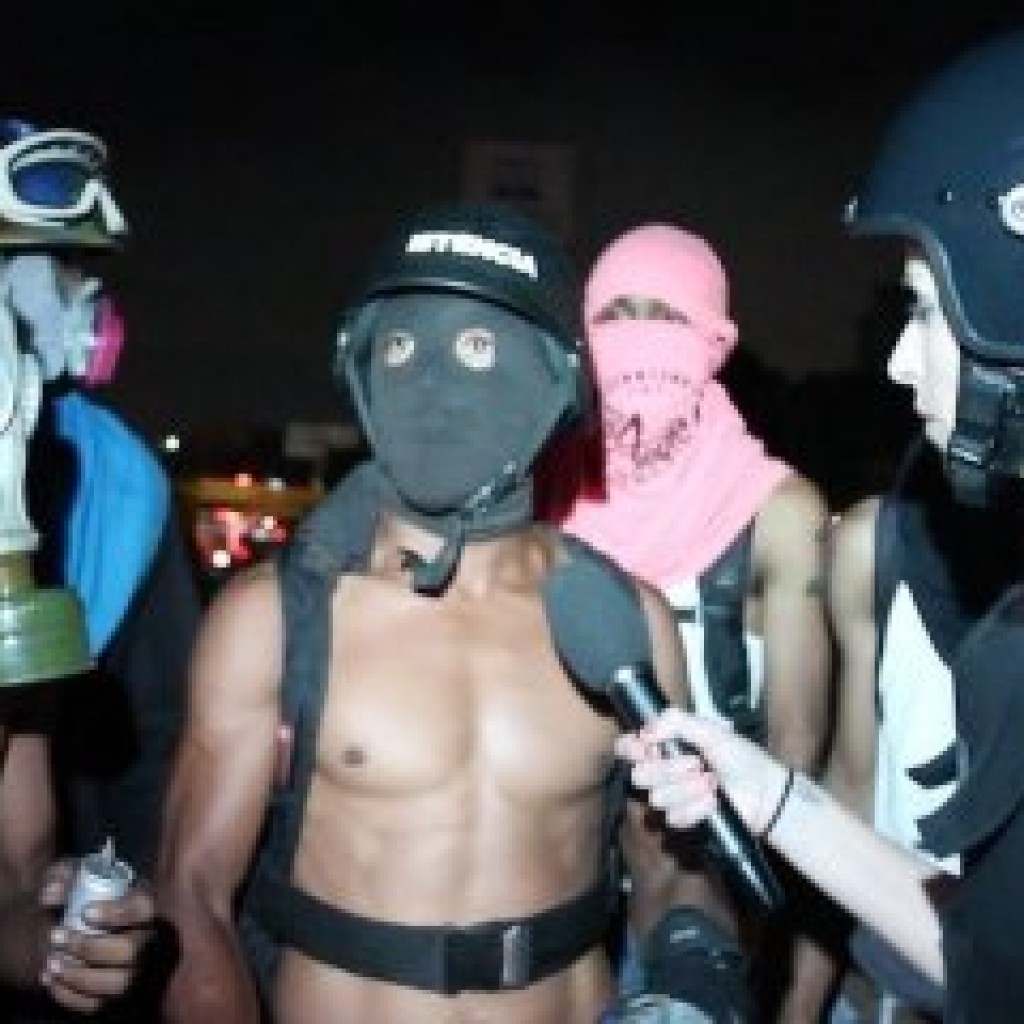
In response, Venezuelan security forces have cracked down on the violent protests. Dozens of people have been killed, on both sides. Some academic experts have suggested that the opposition is intentionally provoking a violent response, in hopes of attracting international media attention.
Reporters Abby Martin and Mike Prysner, co-producers of the political television show The Empire Files, traveled to Venezuela in May to report on the ongoing violent protests, and to provide an independent perspective often ignored in Western corporate media outlets.
In the midst of these bloody protests, several influential voices in the Venezuelan opposition have circulated lies about Martin and Prysner, accusing them of being “spies” for the country’s intelligence agencies, without presenting a modicum of evidence. They have also shared the journalists’ private information, and even appeared to have incited violence against them.
“For doing my job –– for interviewing government officials, protesters at los guarimbas, average Venezuelans and peaceful marchers –– I am called a spy who should be killed by the same people called ‘peaceful freedom fighters’ by Western press,” Martin told AlterNet in an interview.
“These unsuccessful attempts to intimidate us reveals how much they really fear accurate reporting that might undermine their narrative.”
Abby Martin has established herself as one of the most influential independent journalists in the U.S. A staunch critic of the mainstream corporate media, Martin was also a popular former host of the daily program Breaking The Set, on the television network Russia Today.
Her current show, The Empire Files, is hosted by TeleSUR, a pan-Latin American news network that is collectively funded by several South American governments, including Venezuela’s. Martin’s and Prysner’s program is editorially independent, however, and they produce it themselves.
“The show is totally independent of TeleSUR,” Martin explained. “We merely sell them the content; they have zero control over anything we do.”
Extreme, Unsubstantiated Smears
When opposition forces learned that Martin and Prysner had been in Venezuela reporting, multiple right-wing opposition journalists took to social media to accuse the two of being paid “spies” for the Venezuelan National Guard (GNB). None of the accusers provided any proof whatsoever for the extraordinary allegation.
Martin and Prysner stressed that this accusation completely false — a baseless lie that amounts to libel. They told AlterNet that they are considering legal action both inside and out of the U.S. based on the fabricated claims.
Jose Vicente Carrasquero Aumaitre, a professor of political science at Venezuela’s Simon Bolivar University and opposition activist, was one of the first key figures to spread unsubstantiated rumors about Martin and Prysner. On May 31, he claimed on Twitter that the reporters “infiltrate opposition protests in order to collect intelligence for the GNB.” (All translations were done by AlterNet.)
Despite the fact that Carrasquero did not provide any proof, his rumor was echoed, and even further exaggerated, by several ostensible journalists.
Prominent opposition journalist Manuel Malaver spread more uncorroborated accusations. He claimed on Twitter that Martin and Prysner “spy” for the government and are collecting information for SEBIN, Venezuela’s intelligence service.
Estos sapos gringos, Abby Martin y Michael Prysner, espian las marchan para el gobierno y portan carnet de Telesur — Manuel Malaver (@MMalaverM) May 31, 2017
Angie Perez, an opposition activist who describes herself as a journalist and says she is an Emmy Award winner, amplified the unsubstantiated claims. On her popular Twitter and Instagram accounts, Perez stated, without providing a shred of evidence, that Martin and Prysner are “paid spies of the GNB.”
Taking things even further, Perez also asked her Instagram followers, in reference to Abby Martin, “Who wants to greet her on our behalf?” In follow-up tweets, Perez doubled down, sharing the private information of Mike Prysner, and even posting the address of an event at which he was scheduled to speak. She also openly called on her followers to protest the event, writing, “Invite ALL your friends,” using the hashtag #Escrache.
Martin and Prysner accused Perez and others of inciting violence against them with these comments that effectively implore their followers to take action.
Unlike some of the other prominent Venezuelan opposition figures spreading lies about Martin and Prysner, Perez is based in the U.S. According to her social media accounts, Perez lives in Miami, Florida. She also studied at the University of Miami, her LinkedIn account says.
Perez was not the only Venezuelan opposition activist based in the U.S. to spread the unconfirmed rumors, however.
Roberto Olivares, another opposition activist and self-described journalist based in Miami, claimed on Twitter that Martin and Prysner had falsely claimed to be working for CNN, and are “spies” and “infiltrators.” Martin and Prysner said Olivares also appeared to incite violence against them, using the phrase, “Candela con ellos!”
In lieu of any proof, these opposition activists simply shared contextless photos of Martin and Prysner in Venezuela. One photo, Martin explained, shows Prysner posing with two mall security guards who had asked him for a photo because they were a fan of his show. Another photo shows Martin with a government official whom she had just interviewed.
AlterNet reached out to Perez, Oliveras and Carrasquero with a request for comment. In multiple emails, AlterNet inquired if they had any evidence at all for their accusations. None of them replied.
Incredibly Violent Death Threats
A torrent of extreme death threats followed the unsubstantiated accusations made by the Venezuelan opposition figures — many of whose tweets and Instagram posts garnered thousands of likes and shares.
UPDATE: Demonstrators set man on fire during violent Venezuela protest (Warning: Graphic)
In scores of tweets and other social media posts, right-wing Venezuelan activists threatened in excruciating detail to brutally murder and rape Martin and Prysner.
Opposition activist @Alejandrojx wrote, “The next time we see you, we’re gonna kill you, motherfucker whore.” He added, “We’re gonna crush your fucking face and rape you the next time we see you, motherfucker bitch. Were gonna beat you to death.” Magno then told his Twitter followers, “KILL THEM. Their throat need to be cut.” (His account was later suspended.)
Several opposition activists openly called for Martin and Prysner to be lynched. A Twitter user with the name @GregCornilliac wrote, “We will lynch them.” (This account was also suspended.) One man with the handle @Carlos_DC said, “Lynching them is the minimum that they deserve, miserable whores.”
Another opposition activist, @Marifletasp, wrote, “We already know what to do with them. The same with other infiltrators” — a reference to the multiple people who have been burnt alive by right-wing Venezuelan protesters.
Abby Martin voiced concern about the threats in an interview with AlterNet. “Based on our experiences on-the-ground in Venezuela, we are not surprised at the lynching threats from an opposition movement defined by violence and right-wing ideology,” she said.
“However, we are shocked that such an inciteful disinformation campaign would be spread by major media outlets, academics and other figures without question,” Martin added.
Patricia Villegas, a Colombian journalist and the president of TeleSUR, said the media network is looking into how it will respond to the threats. She wrote on Twitter, “We demand respect for the journalist work of our teams and we are considering relevant action before these threats that are exposing us to danger.”
Spreading Disinformation
This is not the first time false claims have been widely circulated about Abby Martin. In January, the Director of National Intelligence released a report alleging that Russia “interfered” in the U.S. election, while providing almost no evidence. In lieu of solid proof, the DNI cited Russia Today, and specifically Martin’s previous program Breaking the Set.
In its report on the DNI allegations, the New York Times spread demonstrably false claims about Martin, which she corrected in a public statement.
Martin has traveled to numerous countries throughout the world to report on issues often overlooked and whitewashed by corporate media outlets. Before visiting Venezuela, Martin and Prysner went to Palestine and Ecuador for reports on the Israeli military occupation and oil pollution in the Amazon.
Reflecting on her time in Venezuela, Martin said, “With the US government giving tens of millions of our tax dollars to regime change efforts in the country, open calls for US intervention and a corporate media promoting one-sided imperial propaganda, we felt it was imperative as US journalists to put ourselves in harm’s way in order to get the truth from all sides of the conflict.”
“Journalists working for state and left media in Venezuela are viciously attacked and threatened by the opposition on a regular basis,” she told AlterNet. “With this recent incitement campaign, we fear for the lives of the teleSUR correspondents still in Caracas who heroically put their lives on the line every day and could be targeted as a result.”
“We call on all media and figures who have spread this dangerous libel to retract, correct and apologize — and uphold the democratic values of a free press they so fervently espouse.”
This article was originally posted on AlterNet by Ben Norton.
Human trafficking is a hidden industry that brings in $150 billion in illegal profits every year. In the United States, tens of thousands are trafficked annually—the biggest clients being major hotel chains and foreign diplomats.
The Philippines is one of the largest labor exporters in the world. 6,000 Filipinos—mostly women—leave the country every single day to work, because of mass unemployment and poverty. Tricked by placement agencies, thousands end up living as virtual slaves.
Damayan, a New York-based organization led by Filipina domestic workers, is fighting this underground crisis. Abby Martin speaks to several members of the organization about how this exodus of women has devastated a generation of families, and how they are fighting back.
Buying a Slave – The Hidden World of US/Philippines Trafficking
The Philippines has a long and unfortunate history of colonization and being used by the superpowers of the world. The Filipino people are now suffering the consequences of such a challenging legacy- underdevelopment, high unemployment, and constantly worsening poverty. This legacy has led to an unusual phenomenon- a shocking 10% of the Philippine population must leave the country in order to seek employment in hopes of sending money back to their families. An estimated 6,000 people, mostly women, leave the Philippines daily to seek work.
Most of these migrant workers leave the Philippines for the United States, the United Kingdom, Saudi Arabia and Japan where they work in low-wage jobs. In fact, 21 million people are working in forced labor situations worldwide- many of them right under the noses of the average citizen of these countries. Unfortunately, through this process, many of these migrant workers have become victims of human trafficking and have found themselves stuck in a seemingly endless cycle of abuse and neglect.
There are currently 2 million migrant domestic workers working in the United States in industries such as in-home childcare and the hotel service. According to the recent report The Human Trafficking of Domestic Workers in The United States, over 80% of these workers have experienced their pay being withheld or having been paid under minimum wage, 81% live in abusive conditions and 73% work excessive overtime.
Abby Martin interviews Linda Oalican, the executive director of Damayan, the 8,000 member strong New York City based organization created and led by Filipino women domestic workers. Damayan provides much needed legal assistance to migrant workers and human trafficking victims. Abby also speaks with Linda’s daughter, Riya, about the experience of losing her mother at the age of 8, eventually leading to a diagnosis of complex post-traumatic stress disorder years later, as well as other women who have experienced the dark side of migrant employment.
Out of the periphery of most online users, there’s a vast, hidden space used by people who want to remain anonymous, which filmmaker Alex Winter explores in his documentary Deep Web. The film focuses on the Silk Road, a black market hosted on the Darknet using bitcoin cryptocurrency, and the trial of Ross Ulbricht, who was given a double life sentence without the possibility of parole for creating and hosting the site.
Abby Martin and Alex Winter discuss more about the Deep Web, the Drug War, and why encryption on things like signal still matter in light of the Wikileaks’ Vault 7 release.
Privacy, Control & the Darknet
Do you think you know how the internet really works? Do you have an understanding of how to keep yourself safe in the age of mass surveillance and data mining?
The internet that most users are aware of is vast and seemingly limitless. But beyond this everyday space is an expansive dark space never seen by the ordinary world and utilized by users who wish to remain anonymous for a host of reasons. This mysterious space is not indexed by search engines and only seen by internet users who have the tools and knowledge to access it.
This often misunderstood space is referred to the Deep Web, Dark Web, and Darknet though these names have different meanings and are often misused. Think of the World Wide Web as the tip of the internet iceberg. Below that is the Deep Web– the vast space hidden beneath the surface that is largely meaningless to most people. Within the Deep Web is where private networks not accessible to search engines and users without permission are located and where things such as banking data and administrative code are found. Conversely, the Darknet is much smaller– it is an encrypted network requiring specific tools to access it. This is where the Tor network is and thus where the Silk Road was found.
Not everything happening on the Darknet is illegal. Tor allows users to browse the internet anonymously as well as access hidden places that are unique to the Darknet. While it’s true that the Silk Road was accessed via the Tor browser, not all of the content in the Darknet is illegal and not every Tor user has criminal intent. Within the Darknet is where many political dissidents, journalists and others who value their anonymity can be found.
In fact, Tor was funded by the U.S. government and created for the U.S. Navy as a means for the intelligence community to have a specific place for encrypted communication. In order for that encrypted communication network to be practical, the network needed additional users and more traffic, so it was introduced to the public. Only a small percentage of the activities taking places on the Darknet are actually nefarious.
Filmmaker Alex Winter’s documentary, Deep Web, explores the history of the Silk Road. Ross Ulbricht created the Silk Road, garnering the name from the ancient trade route across Asia. Eventually Ulbricht was given a double life sentence without the possibility of parole for his involvement in the Silk Road, the anonymous community that facilitated the sale of numerous illegal items and services, namely illicit drugs. Winter’s previous documentaries also focus on government persecution of web pioneers.
In Deep Web, Winter highlights what the Silk Road was– including the unique and unusual anonymous community that it fostered and the obvious bias against the activities taking place on, as well as the users of, the Darknet. Despite having been created by the U.S. government, the empire pushes a negative narrative of the space, perceiving the existence of a drug community in direct opposition to their Drug War and the use of cryptocurrency like Bitcoin, as direct threats.
In this illuminating interview, Abby Martin and Winter also discuss the need to remain safe in the digital age by keep data and communications private in an ever increasingly surveilled world. As Winter explains, anyone saying that privacy is not necessary and that encryption is only for criminals is doing a major disservice. Winter adds that privacy is a must in the digital space just like it is needed in the physical space.
***
Abby Martin: It’s hard to imagine life without the internet. But for a technology so pervasive in our lives, we know surprisingly little about how it works, or more importantly how to protect ourselves in the digital space, in the age of mass surveillance and data mining. Out of the periphery or most online users, there’s a vast hidden space in the ether used by hacktivists, drug dealers and anyone else who wants to remain anonymous. It’s called the Dark Web, a sub-sect of which filmmaker Alex Winter explores in his new documentary, Deep Web.The film focuses on the philosophy and trial of the Silk Road, a black market using bitcoin crypto-currency hosted on the Dark Net. Adopted from the famous drug route across Asia, the Silk Road was created by young computer prodigy Ross Ulbricht, who called himself Dread Pirate Roberts. Ross started the Darknet project with the intention to radically confront the power establishment by circumventing the drug war, but ended up being made a public example of. Given a double life sentence without the possibility of parole.With such an unprecedented punishment, obviously there was more to the story. Alex Winter, also an actor and privacy advocate attended Ross Ulbricht’s trial. Winter’s a longtime internet activist who has documented government persecution of web pioneers in multiple films included Downloaded about Napster, Relatively Free about Barrett Brown and now Deep Web, exploring the many precedents set by the Silk Road case.I sat down with Alex Winter to discuss more about the Deep Web, the Silk Road and why encryption on things like signal still matter in light of the Wikileaks vault seven release. So your film Deep Web obviously covers so much ground in telling the story of Silk Road. It was also narrated by Keanu Reeves, which was really cool. Your counterpart in Bill and Ted’s Excellent Adventure.
Alex Winter: Yeah.
AM: Let’s start with the basics, because this is a really hard topic for someone to delve into who doesn’t know anything about the Deep Web. What is the Deep Web? What’s on it? How big is it?
AW: Okay, that’s a really good question, because there’s a lot of misinformation around it like there is around anything involving cryptography and people who want privacy and anonymity in the digital space. So the Deep Web only refers to essentially technical gack. It’s just what’s under the hood of the internet. It’s un-indexed content. So it’s stuff that people aren’t interested in indexing, which mostly means banking data, the flotsam that flies around the internet that needs to exist there, but does not need to be indexed for any reason, code, that type of thing. And that’s gigantic. It’s just noise.What happened was, there was an area called the Darknet. The Deep Web is very, very big, right? There’s an area called the Darknet that’s very, very small. And that’s where people actually commune. And so what cryptographers did over the years, is they drilled their way into this little space and they created tools like a browser called Tor, which has its own hidden service within the Darknet. And you can use Tor, that’s where the Silk Road black market showed up. And you can use it to communicate with other people. And it has an onion suffix instead of a .com suffix. And that’s essentially hidden away from public viewing.That was initially created, even Tor itself was funded initially by the US government, the navy. But it was initially created mostly for intelligence communication that they wanted to be encrypted. But the way encryption works, if you’re the only one on the wire, then everyone knows you’re on the wire. Right? So the intelligence community didn’t want to be the only ones in the Darknet, the only people talking. If two guys with a styrofoam cup and a string, and there’s no one else there, they’re like, “Oh, that’s where the two guys from the NSA are, because there’s no one else there.”They let that technology go out into the public. They wanted to populate that space, because then they can live amongst the noise. So it’s the simplest way I can put it. It’s a little complicated. But Deep Web is big and vast and meaningless for the average person. Darknet is teeny weeny and has things going on in it like intelligence people, people who just want to have privacy online. And people selling drugs and contraband and things like the Silk Road.
AM: Dissidents, journalists use it for these reasons too, so it’s not this nefarious criminal enterprise.
AW: Oh, not at all.
AM: A lot of good things happening-
AW: Not only is it not just nefarious, but it’s like looking at Manhattan and saying that Manhattan is a haven for drugs because there’s an alleyway where someone’s selling drugs. The large percentile of what’s going on on the Darknet isn’t crime related. It’s journalism, intelligence community communications. It doesn’t get publicized, because those people want privacy. So there was a very loud, and still to some degree is, noisy bias against the Darknet saying, “Oh, it’s all bad. It’s all drugs. It’s all guns.” But it ignores the fact that the people that are not doing those things don’t want to advertise. So they’re not making noise about being there.
AM: What was different about Silk Road when it first came into fruition, because it certainly wasn’t the first online marketplace for drugs and et cetera.
AW: No. I mean the internet has been driven by porn and drugs since there was an internet. And so there were drugs online at the very beginning of the internet, pre-web. The Silk Road was watershed. This was why I wanted to make a movie about it, because as far as the public or the DOJ or the government waking up to it was concerned, it was watershed because when it was created, it was combining Tor, which was this way to get into Tor hidden services with bitcoin, which was viewed as anonymous form of currency. By combining those two things, it attracted an enormous user base. So people started using it like crazy. And that’s why it scaled in a technical terms. That’s why it caught the eye of the DEA and places like that. And it also started to get press.I think Adrian Chen in Gawker did a big article on it. It grew because it got press. And people started saying, “Oh, there’s this crazy community where people are exchanging drugs and all kinds of stuff.” So that made the government take notice. There are many reasons why the government took notice that are not obvious, which is what I wanted to get into in my film. And there are also many things about the Silk Road that are not obvious, which is what I wanted to get into in the film. So, to the public, the Silk Road was watershed, because, oh my god. You could buy heroin online, which you always could, but now it’s much easier, click of a button, whatever. To me what was watershed about the Silk Road was it was the first time in history that you had a large scale anonymous online community. And that matters. And that changed a lot permanently.I had made a movie before Deep Web called downloaded about Napster. And my perspective on Napster was similar, which was that Napster was the first time in history that you had the first large scale online community period. It was the first time that you had 50-100 million simultaneous users moving through one central database, which again, it changed the world.So I was very interested in the Silk Road when I learned about it, because when I got on the Silk Road before it got shut down. I didn’t care about drugs. I was there seeing that there were tens of thousands of people with anonymous user names in an anonymous community communicating about politics, philosophy, literature, drugs, whatever. There had never been anything really quite like that before and an anonymous environment. And that was, to me very striking.
AM: Your movie really, really does depict that other side of it that you obviously don’t hear in the press. It’s painted as this crazy, criminal conspiracy with Ross was a murderous scumbag who deserves to be locked away for life. But really your movie paints it as this beautiful organic thing that, especially in today’s day and age, good god. I mean nothing’s anonymous. So I could see the attraction of course. I wanted to talk more about these founding principles that Dread Pirate Roberts had and the site had, because I really do think that is the underpinning threat to the empire.
AW: Yeah, it’s threatening on a number of levels. The thing for me is that I first got interested in the internet in the late ’80s. And I got interested because A, I knew my way around technology. And I found this community there. And the community was very fascinating. It was what was called the BBS era, so you had all these different, all newsgroups. And you had what was called the alt section, which was like alt rec book, alt rec philosophy, alt rec art, alt rec drugs, alt rec sex. Everything you could possibly imagine, everyone was using anonymous user names and communicating and sharing data and media and all kinds of stuff. It was an amazing community. It was small. It was tens of thousands of people, but it was not millions of people.And I found that really striking then. And it seemed like the beginning of something. There was a movement. For me, Napster was this huge boulder in the water, because now it was like, “Okay, now this is the democratization of culture. And what I noticed about Napster, which is why I sought out Shawn Fanning and wanted to make a movie about him then, which I did. I actually sought him out in 2000. The pushback against Napster was mythologized and I could tell that then, because I was a Napster user. So every time someone went on TV and said, Napster bad, you’re just pirates. Whatever. And I was thinking, “Well, I’m not a pirate. And most people that I know on Napster aren’t pirates. That doesn’t mean there aren’t pirates there.” Right? But the majority of the people I knew in the community were not there to pirate.I started scratching my head going, “What is this pushback about?” And then you started investigating the RIA, the Record Industry Association and their relationships in DC and the threat. And it’s a funny thing, because like you said about the Silk Road. Yes, you have drugs, and you have bitcoin. You have all this stuff. And libertarians and anarchists and they’re openly talking about dismantling the system. That’s an obvious threat, but Napster was a huge threat to the power structure. And you weren’t getting that kind of blatant discourse. But they were terrified of it. And they were going to exterminate these guys to the fullest extent that they could and brand them in the public as evil, pirate people, an image I think they still have not really been able to shake.When I saw the Silk Road, I realized it was the same thing, that whatever Ross’ motives were, and this is not to exonerate him. But whatever his motives were, clearly in his political views, in his own personal history, he was looking to create a massive safe haven online anonymous community where all of these ideas could be discussed. Whether people’s motives got corrupted, whatever, the reality of it is is the Silk Road was, at it’s heart a community mostly of pretty radical political thinkers and not of one stripe. Ross has libertarian leanings. Other people had hard core anarchist leanings. It was a genuinely democratized community. And it was an amazing place to wade around in. The conversations, these were really bright people.
AM: Yeah.
Alex Winter: And then you just had people there that would just buy weed or whatever. I mean that existed too obviously.
AM: No, I mean it’s incredible because like the documentary mentions, even though you had all these people, different radical political bents, everyone galvanized around the idea that the drug war is horribly detrimental to the society and that drugs should be obviously decriminalized at the very least.
AW: In the Silk Road case, the Silk Road was immediately built up as this much bigger thing, right? It immediately struck me that something was rotten in Denmark when it was like, billions of dollars in sales. Well that’s not true. This amount of users. That’s totally not true. I mean it had made an impact, but it was, in the scheme of things, a little weeny website and this very tiny section of the internet that nobody goes to and most people couldn’t figure out how to use even if they wanted to go there. And all the numbers were getting super inflated. But then you look at the drug war and you look at the existential existence of the DEA and the FBI and the amount of money, the prison system. And you’re dealing with a massive amount of power that is threatened by, not just the idea of what the Silk Road represents, which is the democratization, as you said, of people who want to talk against the drug war.But what’s worse, I think what was scarier for them, which is what happened with Napster, was they saw the future. Obviously, the internet is going to be where drugs were sold. Obviously, the drug war is all about criminalization and not about medical help and treatment. Obviously, these people’s budgets are funded on the basis of this continuing and they would lose their funding if it stopped continuing. So the threat level was on so many different levels. Then you get Ross, moved from San Francisco to the southern district of New York. And when that happened, we all knew he was screwed, because then you add on to that the financial regulation concerns around bitcoin, which is all centered around the southern district, that’s Wall Street. That’s their beat.So Ross just found himself jammed in the middle of surveillance operatives. He was breaking the cryptography rules and bitcoin, people were terrified on Wall Street about where bitcoin was going, especially in those days, they thought it was going to upend Wall Street, which is absurd. But they were going after him, you had the drug war people. They are going after him. And so it was just a perfect storm.
AM: The media floated around murder for hire theories that convicted Ross in the court of public opinion before the trial even happened. Yet, as Alex notes, he was never charged for them. Thoroughly demonized in the public, he was swiftly convicted of every crime committed by everyone on the site. The judge handed down a double life sentence without the possibility of parole. The FBI sting agents themselves were using the Silk Road to steal money during the operation. Shawn Bridges stole $800,000 in bitcoin, while informant Carl Forest siphoned $50,000. They also broke the law by hacking Ross’ computer without a warrant and using that evidence to arrest him.
AW: The idea that they just gave him that sentence because they were thinking of the children, which is how it was presented, the children, the children, is absurd. The Silk Road was a honey pot almost from the beginning. The feds were all up inside it. An enormous amount of the hard drugs that were being sold were being sold by federal law enforcement, both corrupt and straight up law enforcement. So a lot of the deaths that they were attributing to Ross were really directly attributable to different people of law enforcement agencies. So the hypocrisy was just staggering.And for me, what was cut and dried was very simple which was, and this is the way I looked at it for the film, even if Ross was guilty of every single thing they claimed he had done, including the murders for hire scam. None of those charges merit a double life sentence without the possibility of parole. They just don’t. So it was somewhat of what I watched happen with Napster. It was a successful spin job in the sense that enough stuff got waved around and the children and all of that stuff that they always pull out, that the general public sentiment was like, “Screw them.” Basically, just whatever. And to me, that was a very strong indication of the politics of the case, of what they had at stake, what they felt an example they needed to make of him, how threatened they are by cryptography and anonymity and privacy and bitcoin and whatever. The over severity of the sentence to me was a tipping of their hand.Honestly, when I went to the sentencing, even though I wouldn’t have agreed with it, had they given him 8-10 years based on drug kingpin charges, which is what the heaviest charge was, which was …Silk Road didn’t have drug kingpins. It was tiny. But it’s a little hard to argue with that given the potentiality of what the crimes were even though I may not have agreed with it.But the double life sentence was just a tipping of the hand. It was so absurd and so completely unfair, that it makes you have to ask why they felt the need to hang him in that way.
AM: And also circumvent the law several times doing so.
AW: Completely.
AM: Amazingly, like you said, there’s other Silk Roads resurrected. You can’t kill the idea. Aaron Swartz is another computer genius who posed a serious threat to corporate and government control. As a passionate activist for net freedom, Swartz believed that information should be free, especially when it’s paid for by the taxpayer. His so called crime was simply downloading academic journals out of reach to most people who don’t pay hundreds of dollars in fees to universities they fund with their taxes. The empire tried to crush him for it. He faced $1 million dollars in fines and up to 35 years in prison, essentially a life sentence. Exasperated and depressed, Aaron took his own life. According to Swartz’s dad, Aaron was killed by the US government. Let’s move on to Aaron Swartz, because this is another prodigy who helped create open source technology. I wanted you to comment on that, because this is another person that the hammer came down so hard. Of course, we know what happened to him, the tragic suicide. Why was he such a threat? Why is open source technology such a threat?
AW: The words open source are terrifying to controlling interests whether it’s business or government. And there are some bad actors in those communities that will do anything to maintain control in a world where it’s very difficult to maintain control. There’s always this need to try to hang a label on something and then hammer it into the ground publicly. And Swartz, that’s what happened to him was he was not just an open source guy. He was one of the heads of a big activism organizations. He was a very charismatic leader. He was very well spoken. He was very articulate. He was very effective. He was a trifecta of threat. He was technologically adept. He was aggressively effective in his activism. And he was forward thinking in terms of politics and the machinery of, he was big into campaign fraud and voter/election fraud and the corruption. And what became the post-citizens united world.So he would have been on many lists for those reasons. Then eventually, you’re looking at these lists going, “Wow, he’s on this list, and he’s on this list.” So he’s like, this is a bad person. This is someone that is a threat to us. It would be helpful for us to, if not put him in jail for a little bit of time, at least scare the shit out of him by coming at him with an enormous charge of prison time. And that’s a very common DOJ tactic.
AM: The Wikileaks recent Vault 7 release. I’m sure that you have been following it closely. The CIA has its own NSA style apparatus, totally unaccountable to everyone that it can do direct hacking into peoples devices, turn on microphones and turn into listening devices. What do you think this means? And also what will it do to the cryptography movement?
Alex Winter: If you’re using signal for instance. If you’re not a CIA target or whatever government target, because it’s obviously not just the US. That intelligence community have not hacked your phone. And it takes a lot to be a target on that level. Bt if they’ve hacked your phone, the way encryption works, if they own your box, as they say, it doesn’t matter what technology you’re using, because they’re sucking down your data before you encrypt it. And they’re reading the stuff that you get after you encrypt it, because they’re sitting on your shoulder watching what you’re doing through your technology.That’s different than encryption. Encryption, if you’re not owned, which is a far greater of population of people who want to remain anonymous, journalists, dissidents, whoever, my kids for instance. I try to tell them to use this stuff. And you’re not owned, then that encryption is absolutely working and there is no evidence today that that has been broken. There is no evidence that suggests that they can read my signal communications or even some of my iMessage communications if they don’t own the box itself, either my phone or my laptop.However, that being said, Snowden warned about this years ago now. I think many of us who deal with encryption or who are dealing sometimes with sensitive material have always taken it at face value that if somebody really wanted to get our material, they could. It’s negligent to assume, whether US state, actors or other intelligence operatives from other countries. I think it’s naïve to assume that if you are really a hard target that they’re not going to be getting into your system somehow. And you look at like what happened to Podesta whether you’re a tinfoil hat wearer or not, there’s a basic phishing scam. Operational security is really hard. And there’s no easy fix for it. There’s no app that just suddenly makes you secure. It’s a mindset.
AM: Well, it’s a fascinating schism right now. And it’s kind of like, where do we go from here, because you have the government that created these technologies. Of course, they’ve gotten so out of control out of their hands. And they don’t understand them anymore, like you said. It’s basically like hackers are on the forefront and on the edge of the technology and one step ahead of the government, whether it be Snowden or Barrett Brown or Aaron Swartz. Where do you see it going from here especially in light of the Russia hacking hysteria? Because on one hand, you can have just a claim based on nothing and we don’t have to prove it because it’s all in the ether. On the other hand, it’s almost like the faith of the world is put into the hacking community to try to save us from ourselves.
Alex Winter: Thankfully, the large percentage of the hacking community functions from a basic, there’s a reason you drive down the highway and people aren’t just constantly shooting each other and smashing into each other and driving into the median. We have to take it at face value that the large part of people who are brilliant enough to be very, very good at hacking have some form of moral compass. And if they don’t, that they’re going to get outmatched by those that do. Cryptography keeps getting better. I think that the Snowden revelations were such an important and necessary thing for the public to start to wrap its head around, because it’s not, as you said earlier, it’s exactly right. If you don’t allow people to go dark, if you penetrate the citizens’ ability to protect themselves, you are making them vulnerable and yourself vulnerable to bad actors. You are weakening the security of the internet. So it was vitally important that the average person has some understanding that they’re being surveilled and that they need some form of privacy.There’s no doubt, we’re going to have to move into the world that includes the ability to go dark. That’s very scary to law enforcement. I understand why. If I’m in law enforcement, yes. I want to be able to open anyone’s door. And I don’t want anyone to have blinds on their windows, because they could be committing a crime. My job’s a lot easier if I can watch them do everything.Unfortunately, it falls on the average citizen to know a little bit more about how their technology works than they may want to. Or a little bit more about what this stuff means. I think that for me, it’s a philosophical mindset. I think that if your government or your corporation or your mom or your kid or whoever is telling you that privacy is unnecessary and encryption is for people who are criminals are doing you a disservice. I think it’s more, really a shift of mindset. I think it’s understanding that you must have privacy in the digital space just like you demand it in the physical space. And I would say moreso.I would say, we’re not all Emma Watson or people who literally have all their naked pictures hacked. It’s funny, but the reality of it is, is it’s just as easy to get your stuff as it is to get their stuff. And you don’t know whose hands that stuff’s going to end up in. You don’t know who’s going to end up with pictures of your kids. You don’t know what they’re going to do with those pictures of your kids. There are very bad people out there. Your banking information, your entire medical history. We just got this, I think most of us can agree, a fairly wonky political administration at the moment, right? A few years ago, people were like, “Well, why do I care about my government?” And now a lot of those people are going, “Oh, holy … I don’t want this administration coming after me because they have anti-Islamic tendencies or whatever crazy prejudices they have. Now suddenly, I’m a target.” It’s like all the people who voted for Trump now whose husbands and wives are being deported. We didn’t think we were the ones that were going to get … Right?
AM: Right. That’s the bad guys.
Alex Winter: Yeah. Exactly. The digital space is the same where you can suddenly, if your information is all freely there, you don’t know what someone is going to do with it. And what administration is going to do with it. So people, it’s a mindset, have to think a bit more prudently about how they protect themselves online.