suppose you were to know, all those lies you’ve been told. then maybe this shock, this latest disaster, might break your dis belief.
i came across an editorial photo capturing a woman, hand to cheek, eyes venetian, at the scene of some unfortunate event. she was unable to believe that the horror before her was real. but her eyes partially covered ensured that her eyes were witness to the events unfolding.
i then thought of all the truth and reality we experience on a daily basis and the lack of disbelief at what is happening in front of us. i wanted to know where the anger, frustration, shock and sense of justice was in my fellow americans.
i’m still looking for that disbelief, that critical thinking combined with the collective consciousness to bring us beyond the current paradigm of exploitation, division and atomization.
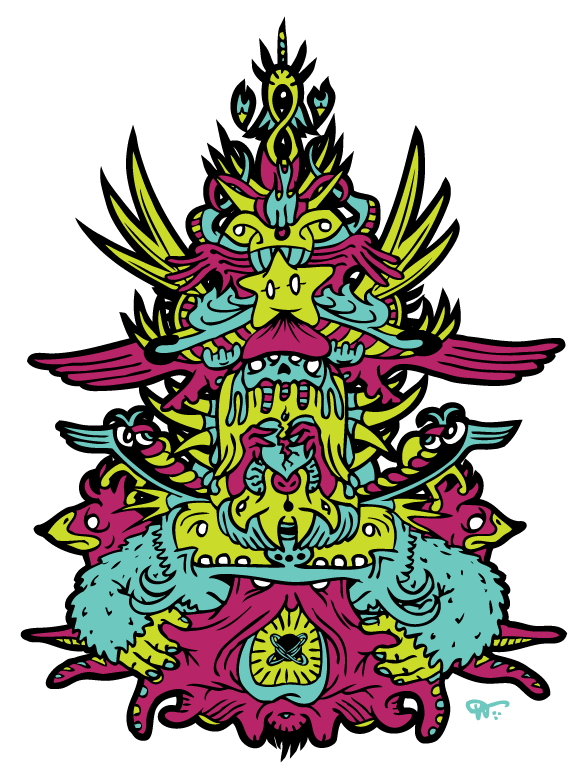
MEDIA ROOTS – Coming from the Northwest, I was exposed to Native American totem poles early in childhood. I always loved the caricatures of beasts, man and gods; bold cuts into monolithic tree trunks with colorful paint made these sculptures come alive.
My own ‘totem’ pole, “Tree of Life” draws its inspiration from our country’s caretakers before us. I wanted to capture the thorny, the soft, the grotesque and the beautiful sentiments that make our world. From an atom in the womb, to the infinitesimal speck of existence exiting above, one travels through life feeling comfort, heart break, strength and fragility and during this transit, complexities and the unknown surround us.
ANTIQUIET – Music does not exist in a vacuum. As a tool of protest, of affection,
of the myriad complexities of the human condition, music plays just an
important role now as ever before in its ability to connect, inform and
find grounds of empathy in a world of increased personal isolation as
“social networking” becomes a term of digital prowess rather than
genuine human interaction.
Some of those responsible for delivering personal-revolution street
philosophy through song often have far more to say than even the
malleable, undefined borders of music will allow, as we learned with Serj Tankian
last Summer. In these moments, we excitedly set the music aside to dig
into the heart of what drives the artist, with unfailingly fascinating
result.
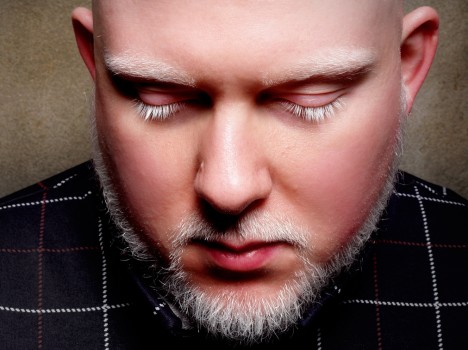
This was the case in our latest interview with Brother Ali.
Over the span of six remarkable albums and an archive of underground
material, Brother Ali’s one-love sermonizing has relentlessly rejected
posturing and self-aggrandizing lyricism, opting instead for a unifying
theme that’s delivered as a survivalist mandate in a world of
championed disconnect.
The Minneapolis rapper and Rhymesayers crew’s spiritual anchor has had a metamorphic year on the heels of his landmark Us album,
with the loss of dear friend and label mate Michael Larsen, aka Eyedea,
his pilgrimage to Mecca and a barrage of new changes, both personally
and professionally. Almost two years after our last interview
we caught up with the man to discuss the American perception of Islam,
government seizures of music-site domains, the power of propaganda and
much more.
In America, the broad-stroke perception of Islam and its
practitioners is still held in a deeply unfavorable light. How does one
counter the Fox News narrative with your own truth, when the other side
is excitedly stoking the fires of anti-Muslim extremism?
There’s a propaganda machine that exists in our society. If you look
at World War II times, the way that Japanese and German people were
vilified in the media, all the way down to kids cartoons. Any group of
people that were considered to be enemies of the society they would
demonize, through news and movies and kids programs. Whether it’s
Native Americans or Japanese, or the Russians in the ’80s, there was
always a caricaturization built around an agenda. And then immediately
after the Cold War, they started preparing us through the media to
attack a new target. Suddenly Arnold Schwarzenegger’s onscreen going up
against these terribly cold Arab Muslims who are taking hostages and
all that stuff, creating this atmosphere where suddenly these are the
new Hollywood bad guys. These are the new face of evil to Americans,
and it’s a picture that’s deliberately painted.
Then 9/11 happened, and the line of reality and truth began to blur.
Then you have this obviously terrible, tragic event of 9/11. The
unbelievable sadness to it, the loss of life and love, and there’s so
much questionable stuff around it. I’m not one of these people who
pretends to know what happened or didn’t happen, but there’s definitely
a lot of seriously questionable circumstances around the whole thing.
There’s clearly a campaign underway, that’s been going on for a while
by the people in power, to negate Islam and Muslims. Usually that’s
used to justify some type of injustice they’re planning, whether it be
taking over Muslim countries and occupying them, taking control of
their politics and their resources. That’s a really unfortunate reality
in the world.
How is that negating impression countered, when the
narrative’s already written and enthusiastically parroted by the
biggest news outlet in the nation? Passivity rules the day…
Being good people, having a responsibility to look for and spread
truth in every way, not just our own. Progressing a community by caring
about truth and justice and fairness. Part of the social decline we’re
facing is that we’re very, very passive about everything. It’s been by
design. We’ve been bred to be very passive about the things that we
eat, the things that we buy and the things that we use. It comes down
to the way that we live, the information we take in. We don’t actively
seek out information, we just allow whatever’s the loudest to dictate
the narrative. In most major cities we’re down to one or two major
newspapers, which are owned by the same conglomerates. Radio stations
are all owned by the same parent companies, news stations are owned by
two or three companies. It’s just really unfortunate, but that’s just
one of a plethora of topics where we’re all just deeply uninformed on
all of it, and it’s causing something of a subconscious bridge where we
get all this information that Muslims are bad, and Islam is against us
and our way of life, and Muslims hate our freedom and all that. It’s
diametrically opposed to America’s values, they’re not the same kind of
people we are, so on and so forth. It causes an unconscious acceptance
of treating people bad, of denying people justice and due process and
all these things that we say we believe in as Americans.
Now you see it on our soil too, where Muslims that are citizens of
America aren’t granted the same basic rights of faith. But that’s
nothing new, that’s something they did when they came and called the
native people Indians and savages and did everything in their power to
establish dominance. Then the slaves came over and they had ugly names
for them too. Every group of people, it seems, falls into a necessary
place or role when the power structure decides to prepare us mentally
and spiritually to adjust to this injustice. To be okay with these
things being done in our name, this oppression contracted out in the
name of American values.
Given the government and media’s campaign of bullshit on the
Wikileaks ordeal, it’s frightening how well that model of behavior
commutes to other areas of focus. We’re in an amazing time in history,
where the unification of the media seems so big and so scary, but
public awareness is hitting an all-time high, and people are
increasingly questioning the margin of truth in the reality being
served to us. What’s your perspective on selective free speech, like
the fact that Mastercard will still do business with the KKK, yet cuts
ties with Wikileaks, people bringing the real light of truth to some of
the most important world affairs – and lies – of our time?
Obviously I support people’s rights to speak and have access to the
truth, and to promote it. There’s a really big fight going on with the
net neutrality bill, and we’re facing the potential of control over the
internet where everyday people don’t have the same platform on the
internet as corporations. It’s interesting, with this whole thing
there’s been a big sweep of websites by the Department of Homeland
Security for those they consider to be criminal. With no warning, no
communication, no due process. They seized their domains and shut down
their sites, and it’s interesting that it happened to three major
Hip-Hop blogs. It had nothing to do with anything political or anything
like that, but the RIAA had them shut down because they helped artists
leak materials and videos and such that’s not released yet. So the
Department of Homeland Security, which is supposed to protect us from
terrorism, seized a website called OnSmash.com. They leaked a new 50
Cent song and the new Joel Ortiz record, but what does that have to do
with homeland security? How is that terrorism? The precedent that’s set
by that is really amazing, really terrifying.
That’s terrorism in its own right.
Right. I had to file with the Department of Homeland Security when I
went to Australia on tour. Our Australian show promoter wire
transferred money for our shows to our bank accounts in Minneapolis,
and the Department of Homeland Security froze that bank account and
stopped the transfer. I had to register with them, give them my
information, who I am & what I was doing, everybody that worked for
me, my schedule, social security numbers, addresses, bank accounts,
more things than you could believe. The froze everything up.
They told me that it was random. That the words Brother and Ali were
red flag words, but I was made aware at the end of the whole ordeal
that they were aware of the Uncle Sam Goddamn video.
Right around the time that video hit a million views, after I
performed it on TV, that’s when that happened. I got kicked off a tour
for that song, because it was sponsored by a big company. Got a lot of
hate mail from guys named Chad, writing private MySpace messages back
in the day. Guys with no shirts on and white baseball hats on backwards
telling me “I’m gonna come to your show tonight and beat your ass.” I
got a lot of that for probably about a year. And at my shows I’m always
at the merch table… no ass kickings ever happened.
The thing is, nothing I say is really even that dangerous. I’m not even saying shit compared to like…
Zach De La Rocha, Immortal Technique…
Yeah, not to mention Dead Prez, people who have bigger platforms and
say a lot more than I do. I don’t consider myself a political artist, I
haven’t made that my mission. I just have a few songs where I stated
some things.
Speaking of statements, Cornel West made a comment that I’d
like to expand on: “To embark on a quest for wisdom, one has to be open
to the voice, viewpoint, and vision of others.” In a world geared more
than ever to the me me me society, how does one not only lean against that tide, but radiate that to others?
It’s interesting, that’s something that’s actually been on my mind a
lot lately. One of the people that Eyedea put me up on was this this
philosopher Krishnamurti, who really dealt a lot with putting the ego
aside to truly experience things. When you listen through the lens of
your ego you’re not really listening, you’re not really experiencing.
And that’s huge to me… it ties in well with Cornell West’s quote. I
love Cornell West. I think with what I’m doing, I just try to
communicate that way and listen that way, especially on the Us album.
That was the first album that really wasn’t about me, it was more about
the people that I know, and trying to tell their stories.
Religious individualism and the art of people truly listening to each other is dying.
A major problem, as you pointed out, is that we are not actively participating in solutions.
Everything is passive in our society. For the majority of people,
there’s a few activist, but even the majority of them may not be as
informed or as pure in direction as they would have us believe. Like
the Tea Party scene. It appears to be a group of activists, but there’s
two brothers that essentially own that movement…
The Koch brothers…
Yeah. They’re funding the movement, and these Tea Party activists
are just sheepishly repeating this narrative that somebody’s given
them, talking points meant to mislead and start fires of anger. Not
very much is active in our society – we’re very passive, very inactive.
I definitely agree with what you’re saying, in social media being a
platform for people to narcissistically splatter out whatever feelings
they have in that moment, and really feel like something’s being done
with a Facebook update or a tweet.
That’s the problem with clicktivism – it creates a dangerous
false sense of contribution, a momentum based on parroting points for
social status rather than planting a real flag of truth and living the
truth you’re seeking. That stifles progress on all meaningful fronts.
We’ve been programmed that way over the last few generations. That’s
not a mistake and that’s not a coincidence. It’s not something that’s
happened on its own. It was a very deliberate effort on behalf of those
who really control things. And it’s undoubtedly an intimidating factor
when you can watch the sponsorship money and general attention will
shift away, go elsewhere when there’s any sign of going against that
tide.
You tweeted about the Best MCs argument, saying “Best For
who? Best for the people is Chuck D.” That’s one musical revolutionary
who’s paved the way for bands like Rage Against The Machine, helped set
the groundwork for people like you and Immortal Technique. In a very
real way, he’s passed the torch on to you on record by doing the
introduction track on Us. Do you see the direct lineage between Public Enemy’s activist mentality and your own?
Definitely. Being fortunate enough to become friends with him gave
me confirmation of that. I got to hear him say “You’re doing what you
can to continue what we were doing.” Those men are the ones that made
me serious about this music and made me realize what the possibilities
it held were. Not that I went into this thinking that I was going tobe
a part of some social movement, but I know that they affected the way
that I thought, the way I wanted to live, my aspirations and what kind
of person I am.
I remember being a kid in a 99% white Michigan suburb, getting absolutely floored by Public Enemy’s Can’t Truss It
song. That one track blew the doors open for me in terms of what it
means to tell a truly powerful, incendiary story through song and apply
it to real social issues. The way Chuck draws a direct line between the
injustice and oppressed rage of slaves from long ago and the racial
struggles that still exist today was an inspiring and humbling
eye-opener about the real power of music.
That’s what it’s about, connecting just like that and giving people
new eyes on something they might only have a certain familiarity with
at the moment. Chuck, KRS-One, even people I look back on as an adult,
these other guys who were on something really deep and special back
when I was 14. Back then it was just kind of a bunch of cool words. But
those words hit me, they made me want to know what they were talking
about. It made me read, it made me research, it inspired me to dig
deeper. That stuff showed me the real power of what this culture can be
and what this art form can be.
“Given that men are free and that tomorrow they will freely decide what man will be, i can not be sure that, after my death, fellow-fighters will carry on my work to bring it to its maximum perfection. Tomorrow, after my death, some men may decide to set up Fascism, and the others may be cowardly and muddled enough to let them do it. Fascism will then be the human reality, so much the worse for us.
Actually, things will be as man will have decided they are to be. Does that mean that I should abandon myself to quietism? No. First I should involve myself; then, act on the old saying, ‘Nothing ventured, nothing gained…’ Suppose I ask myself, “Will socialization, as such, every come about?” I know nothing about it. All I know is that I’m going to do everything in my power to bring it about. Beyond that I can’t count on anything. Quietism is the attitude of people who say “Let others do what I can’t do.” The doctrine I am presenting is the very opposite of quietism, since it declares, ‘There is no reality except in action.’ Moreover, it goes further, since it adds, ‘Man is nothing else than his plan; he exists only to the extent that he fulfills himself; he is, therefore, nothing else than the ensemble of his acts, nothing else than his life….. A man is involved in life, leaves his impress on it, and outside of that there is nothing.”
Jean-Paul Sartre, in Existentialism is a Humanism
This passage has been the inspiration behind the drive I approach life with. Constantly seeking justice can feel dauntingly hopeless amidst humanity’s struggle over the meanings and implications of ‘right’ and ‘wrong.’ We listen as people turn their backs on issues and events in their communities, giving the excuse that they have no power, or that awareness comes at the cost of depression. Jean-Paul Sartre urges an end to this ineffective mentality as he reminds us that no good can come from pitying our uncertain future or hedonistically reveling in our own ignorance. His words send out a call not to hesitate out of fear of the unknown, or to slide into apathy, relying on the strength of others to make up for your own dispassionate weakness. We hold the capacity to empower ourselves and so we must, by becoming involved. Our lives are nothing more than what we create. In the end, each of us is nothing more than the actions we take. Only action carries with it true words and meaning.
It is up to us to create the world that we want to see, up to us to live our lives as we feel they should be lived. And if a model that ressonates with justice does not already exist, it is up to us to create one, to pave that path, putting forth the utmost effort to overcome any challenges and to demonstrate that a life of harmonious ideal is possible, that the establishment and systems in place do not need dictate the capacity and reach of our dreams and actions.
MEDIA ROOTS- Check out some promo music videos for new releases from independent bay area record
label RecordLabelRecords. The videos feature a variety of electronic
music overlayed to old school cartoons and other dope footage. RecordLabelRecords is putting out two
complimentary sister compilations in early 2011 titled Electric Carpets and Drinking the Goat’s Blood. Each one is designed to display a particular
side of RecordLabelRecords various musical styles. When asked what message the compilations are trying to convey, Robbie
Martin, founder of RLR said “It’s like a DMT trip during a Free Masonic
ritual.”
Mysterious synthesizer act Senryl from Santa Cruz, California
released only one self titled cassette tape in 1984 and then vanished. Most of their
recordings feature appearances of the rarely heard Emu
Modular Synthesizer system. Robert Martin of Record Label Records was given a copy of this self
released tape by an associate of the band, who worked at EMU corp with a
member from Senryl. Both members, Gunnar Cubbins and Lionel Dienza, are now
deceased. This video was made posthumously by Robert Martin in their
honor. This track will be making it’s first appearance on the newest RecordLabelRecords compilation Drinking The Goat’s Blood.




 ANTIQUIET
 MEDIA ROOTS- Check out some promo music videos for new releases from independent bay area record
label RecordLabelRecords. The videos feature a variety of electronic
music overlayed to old school cartoons and other dope footage. RecordLabelRecords is putting out two
complimentary sister compilations in early 2011 titled Electric Carpets and Drinking the Goat’s Blood. Each one is designed to display a particular
side of RecordLabelRecords various musical styles. When asked what message the compilations are trying to convey, Robbie
Martin, founder of RLR said “It’s like a DMT trip during a Free Masonic
ritual.”
MEDIA ROOTS- Check out some promo music videos for new releases from independent bay area record
label RecordLabelRecords. The videos feature a variety of electronic
music overlayed to old school cartoons and other dope footage. RecordLabelRecords is putting out two
complimentary sister compilations in early 2011 titled Electric Carpets and Drinking the Goat’s Blood. Each one is designed to display a particular
side of RecordLabelRecords various musical styles. When asked what message the compilations are trying to convey, Robbie
Martin, founder of RLR said “It’s like a DMT trip during a Free Masonic
ritual.” 

