

Hedges vs. Obama’s Indefinite Detention

ObamaPentagonFlickrUSArmyMEDIA ROOTS — Pulitzer Prize-winning journalist Chris Hedges has filed suit against Obama and Panetta to challenge the legality of the NDAA (S. 1867), which includes totalitarian provisions authorising the activation of U.S. Military within U.S. borders to imprison anyone within the U.S., or the world, without charge or trial.  Hedges, alongside his attorney, sharply articulates what’s wrong with the Levin/McCain provisions cynically inserted into this year’s NDAA.

MR

***

Chris Hedges on Democracy Now

DEMOCRACY NOW! — Pulitzer Prize-winning journalist Chris Hedges has filed suit against President Obama and Secretary of Defense Leon Panetta to challenge the legality of the National Defense Authorization Act, which includes controversial provisions authorizing the military to jail anyone it considers a terrorism suspect anywhere in the world, without charge or trial. Sections of the bill are written so broadly that critics say they could encompass journalists who report on terror-related issues, such as Hedges, for supporting enemy forces. “It is clearly unconstitutional,” Hedges says of the bill. “It is a huge and egregious assault against our democracy. It overturns over 200 years of law, which has kept the military out of domestic policing.” We speak with Hedges, now a senior fellow at the Nation Institute and former New York Times foreign correspondent who was part of a team of reporters that was awarded the Pulitzer Prize in 2002 for the paper’s coverage of global terrorism. We are also joined by Hedges’ attorney Carl Mayer, who filed the litigation on his behalf in the U.S. District Court for the Southern District of New York.

DN:  “During Monday night’s debate in South Carolina, Republican candidates sharply disagreed over a new policy to indefinitely detain American citizens. President Obama approved the measure as part of the National Defense Authorization Act, or NDAA, which includes controversial provisions authorizing the military to jail anyone it considers a terrorism suspect anywhere in the world without charge or trial. President Obama added a signing statement when he signed the NDAA, stating, quote, ‘I want to clarify that my administration will not authorize the indefinite military detention without trial of American citizens.'”

Well, last night, Republican front-runner Mitt Romney defended Obama’s approval of the bill, saying he would have done the same.

Audio of Kelly Evans:  “Governor Romney, as president, would you have signed the National Defense Act, as written?”

Audio of Mitt Romney:  “Yes, I would have. And I do believe that it’s appropriate to have in our nation the capacity to detain people who are threats to this country, who are members of al-Qaeda. Look, you have every right in this country to protest and to express your views on a wide range of issues, but you don’t have a right to join a group that has challenged America and has threatened killing Americans, has killed Americans and has declared war against America. That’s treason. And in this country, we have a right to take those people and put them in jail.”

DN:  “That was Republican presidential front-runner Romney, talking about the controversial indefinite detention provisions in the NDAA.

“Meanwhile, Rick Santorum said a U.S. citizen who’s detained as an enemy combatant should have the right to a lawyer and to appeal his case before a federal court. And Ron Paul said holding American citizens indefinitely is a breach of the U.S. judicial system.

“When President Barack Obama signed the NDAA, sections of the bill were opposed by key members of his administration, including Defense Secretary Leon Panetta, FBI Director Robert Mueller and Director of National Intelligence James Clapper. Many civil liberties activists believe the law is unconstitutional.

“Well, today, an announcement is being made in New York, filing a complaint in the Southern U.S. District Court against Barack Obama and Secretary of Defense Leon Panetta to challenge the legality of the NDAA. Their plaintiff is none other than veteran war correspondent and Pulitzer Prize winner Chris Hedges.

“For more, we’re joined by Chris Hedges himself, senior fellow at the Nation Institute, who recently wrote a piece for TruthDig called “Why I’m Suing Barack Obama.” Chris Hedges is a former foreign correspondent for the New York Times, was part of a team of reporters who won the Pulitzer Prize in 2002 for the paper’s coverage of global terror. He is author of a number of books, including Death of the Liberal Class and The World As It Is: Dispatches on the Myth of Human Progress.

“And we’re joined by Chris Hedges’ attorney Carl Mayer, who filed the litigation on his behalf.

“Chris Hedges and Carl Mayer, welcome to Democracy Now!”

Chris Hedges:  “Thank you.”

DN:  “Chris, why are you suing President Obama?”

Chris Hedges:  “Because it’s clearly unconstitutional, for starters. But secondly, it is a huge and egregious assault against our democracy. It overturns over 200 years of law, which has kept the military out of domestic policing. And even that passage that you read from the White House, I think, is deeply disingenuous, because Dianne Feinstein had a resolution by which, within that bill, Americans would be exempted from this, and the Democratic Party and Barack Obama rejected it. All of the debate with Carl Levin, who, with McCain, sponsored the bill, was a struggle between the White House so that they would assume—they would have the right to assume which Americans would be detained by the military without due process and held indefinitely until the end of hostilities, this kind of endless war on terror. It’s an extremely frightening step backwards for American democracy. And as someone who’s spent 20 years overseas and has lived in countries where the military has that kind of power, I have friends who have disappeared into these military gulags. We have unleashed something that I think is truly terrifying.

“And as discontent grows, of course, the criteria by which people can be investigated in this country are so amorphous, even bizarre—I mean, somebody who is missing fingers on a hand or somebody who has more than seven days’ worth of food. It’s a very seamless step to include in that list some of the obstructionist tactics of the Occupy movement. And I think that for those of us who care about civil liberties, the right of dissent and freedom, we have to stand up. And that’s why Carl and I have decided to do this.”

DN:  “Carl Mayer, how does this—how does this litigation work?”

Carl Mayer:  “Right, well—”

DN:
  “And why not a class action lawsuit, where many people file?”

Carl Mayer:  “Right. Well, the purpose of the litigation is to have a federal court declare this act unconstitutional. And that would apply to everyone.

“Chris is an important plaintiff in this, because—you just showed the clip from Mitt Romney. I’m not sure that Mitt Romney has read this bill. The act is so broad and vague that it covers, in its writing, any persons who give, quote, “substantial support to al-Qaeda, the Taliban, or,” quote, “associated forces,” which are incredibly broad, nebulous terms and could capture, within those—their terms, journalists like Chris Hedges, who courageously has gone around the world to interview members of opposition parties, to interview members of terrorist groups, to report the truth. And so, when Mitt Romney says these are people who are in terrorist organizations, that’s not how the bill is written. It’s written so broadly that it could encompass a journalist like Chris Hedges. It could encompass people who are engaged in free speech and in all sorts of activities that have nothing to do with what Mitt Romney, etc., are talking about.

“And so, we filed this action. I filed it in conjunction with my colleague Bruce Afran, who’s a professor of constitutional law at Rutgers Law School, another veteran public interest attorney. And what we’re asking the court to do is to declare that this law violates not only the First Amendment rights of citizens like Chris to report and to speak about these issues, but also the Fifth Amendment right to due process, because what this—what this bill does is it sends people to military tribunals, and it allows for the indefinite detention of these people. It even allows for the rendition of covered persons, which is not defined in the act, to render these people to foreign countries.

DN:  “And explain what you mean by that. This is extraordinary rendition.”

Carl Mayer:  “Right. And so, what the act permits is that if someone is deemed under the act to be giving, quote, “substantial support” to, quote, “associated forces” that are associated with terrorists, they could be sent overseas at the determination of the American military, or they could be held in a military prison here indefinitely, or they could be tried in a military court. And as Chris Hedges, who is courageously bringing this as a plaintiff, pointed out, there is a longstanding Supreme Court decision called ex parte Milligan, which dates to the Civil War period, in which several people were held by the military for plotting to overthrow, during the course of the Civil War, the governments of Indiana and Ohio. And they were sentenced to death. The Supreme Court ruled, after the Civil War, that as long as there are civilian courts operating, you cannot try these people in military courts, even people who are—whose avowed purpose was to overthrow the civilian governments of Ohio, Indiana, etc. So, it is that level of protection that is built into the Constitution. And that’s what our ancestors fought for, is to uphold the Bill of Rights, due process rights, right to a trial by jury. And all of this is being abrogated by this legislation.”

DN:  “I wanted to bring in what Rick Santorum said last night at the Republican debate in South Carolina about a U.S. citizen detained as an enemy combatant having the right to a lawyer to appeal their case before a federal court.”

Audio of Rick Santorum:  “First off, I would say this. What the law should be and what the law has been is that if you are a United States citizen and you are detained as an enemy combatant, then you have the right to go to federal court and file a habeas corpus petition and be provided a lawyer. That was the state of the law before the National Defense Authorization Act, and that should be the state of the law today. You should not have—you should not have—if you’re not an American citizen, that’s one thing. But if you are a citizen and you’re being held indefinitely, then you have a right to go to a federal court. And again, the law prior to the National Defense Authorization Act was that you had the right to go to a court and for that court to determine, by a preponderance of the evidence, whether you could continue to be held. That is a standard that should be maintained, and I would maintain that standard as president.”

DN:  “Chris Hedges, Rick Santorum versus President Obama?”

Chris Hedges:  “He’s not a politician I usually have much in common with, but this is right. I mean, this is about the egregious destruction of the rule of law. I mean, we have to remember that under the 2001 Authorization to Use Military Force Act, some of this was already happening. José Padilla, for instance, was picked up by military courts, held without trial, access to due process—again, a U.S. citizen—went to the Supreme Court, and by that time, they handed him over to civilian court to—and the Supreme Court never made a ruling on it. But I think that this essentially codifies this very extreme interpretation of this 2001 act into law.

“And more importantly, it expands the capacity by the state in terms of defining who is, quote/unquote, ‘not only a terrorist, but somebody who is,’ in their terms, ‘associated forces’ or substantially supports people defined as terrorists. And, of course, the reason for that is that many of these groups that are being attacked in Yemen and other places had nothing to do with 9/11—they didn’t even exist when 9/11 happened—and to expand this into the civilian population of the United States. And I think, Amy, one of the most sort of disturbing aspects of this is that the security establishment came out against it—the CIA, the FBI, the Attorney General, the Director of National Intelligence. None of them wanted it.

DN:
  “President Obama said he was going to veto it.”

Chris Hedges:  “President Obama said he was going to veto it, but we now know from leaks out of Levin’s office that that’s because the executive branch wanted to decide. They wanted the power to decide who would be tried, who would be granted exemptions. It wasn’t actually about the assault against due process.

And I think we have to ask, if the security establishment did not want this bill, and the FBI Director Mueller actually goes to Congress and says publicly they don’t want it, why did it pass? What pushed it through? And I think, without question, the corporate elites understand that things, certainly economically, are about to get much worse. I think they’re worried about the Occupy movement expanding. And I think that, in the end—and this is a supposition—they don’t trust the police to protect them, and they want to be able to call in the Army. And if this bill goes into law, and it’s slated to go into law in March, they will be able to do that.

DN:  “I wanted to ask you a quick question about a comment Texas Governor Rick Perry made last night, in a related, but not exactly the same thing as what you’re talking about. He said on Sunday the Obama administration has gone “over the top” in criticizing marines who were videotaped urinating on Afghan corpses.”

Audio of Gov. Rick Perry:  “What bothers me more than anything is this administration and this administration’s disdain all too often for our men and women in uniform, whether it is what they’ve said about the Marines—now, these young men made a mistake. They obviously made a mistake.

Audio of Bret Baier:  “You’re talking about urinating on the corpses?”

Audio of Gov. Rick Perry:
  “They made a mistake that the military needs deal with, and they need to be punished. But the fact of the matter—the fact of the matter is this. When the Secretary of Defense calls that a despicable act, when he calls that utterly despicable—let me tell you what’s utterly despicable: cutting Danny Pearl’s head off and showing the video of it, hanging our contractors from bridges. That’s utterly despicable.”

DN:  “That was Rick Perry, Texas governor. Chris Hedges, you were a longtime war correspondent.

Chris Hedges:  “Well, you know, when people are killed on a battlefield, and those who are deemed the enemy are, at best, treated like human refuse. But usually they’re treated like trophies. They’re often dismembered. I mean, one of the first things you do after you kill an enemy combatant is go through their pockets. And in war after war that I covered, the desecration and mutilation of corpses was extremely common. So, I think that what we saw was a window into the reality of war, one that has essentially been censored from public view.”

DN:  “I want to thank you both for being with us, Chris Hedges, Carl Mayer.”

The original content of this program is licensed under a Creative Commons Attribution-Noncommercial-No Derivative Works 3.0 United States License.

***

Photo (feature) by flickr user JBrazito
Posted in Uncategorized | 1 Reply

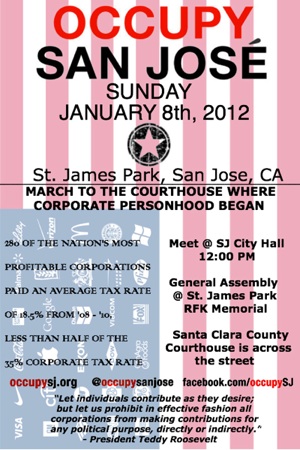
Occupy San Jose March and GA on Sunday, January 8, 2012

MEDIA ROOTS – The following is a press release from Occupy San Jose promoting a march and GA happening tomorrow, if you are in the area come show solidarity!

***

FOR IMMEDIATE RELEASE
CONTACT: Occupy San Jose

Occupiers, Activists and Friends:

SAN JOSÉ, CA – Occupy San José will hold a general assembly in St. James Park against corporate money in politics, following a march from San José City Hall at 200 E. Santa Clara Street to the Santa Clara County Courthouse at First and St. James Street where, 126 years ago, a judge started our nation down the path to corporate personhood. The march to the Courthouse (St. James Park) will feature leaders from the community, government officials in solidarity with the movement, various unions, and others speaking on the dangers inherent in corporations controlling public policy.

We look forward to seeing you tomorrow, Sunday, January 8, 2012 at our first big march of the new year. At noon we will be meeting at San Jose City Hall before marching to  St. James park for the general assembly.

There will be food provided from Food Not Bombs, music by Sagehart, and love from NextGen. We will be taking direct action against the historic Courthouse, where 126 years ago, a Judge set the precedent of corporate personhood used in the infamous Citizens United case.

If you haven’t done so, please RSVP for this event. We promise a fun and productive day!

RSVP: https://www.facebook.com/events/255352567855919

Event: Occupy San José march to the Santa Clara County Courthouse

Location: Meet at San José City Hall, march over to the Courthouse

Time: January 8, 2012, 12:00 p.m.

HELP TAKE BACK OUR COUNTRY!

***

Collaborative Film 99% Documents Occupy Protests

MEDIA ROOTS – I’m very excited to announce that an extensive lot of our footage from Occupy Oakland is going to be used to represent the S.F. Bay Area in the upcoming 99% Collaborative Film Project!  The film is unique in its collaborative fashion and is geared to represent an honest portrayal of the ongoing Occupy Movement.  At 2:18, the film trailer gets slightly sinister with our footage of Oakland’s police state crackdown.  Check it out and donate, so this epic film can be made!

Abby

***

WIREDMost documentaries involve months of planning before the first frame of film is shot, but the creators of an in-the-works Occupy Wall Street documentary didn’t have that luxury. The protest movement was happening around them when they decided to make the film.

Now the filmmakers behind 99% — The Occupy Wall Street Collaborative Film are looking to raise funds to complete the project. They have footage from 75 filmmakers who captured imagery at various Occupy events across the country, but to finish the project, producers Audrey Ewell and Aaron Aites are looking to raise $17,500.

“It’s the amount we need to buy the hard-drive storage and editing space that will allow us to begin the massive process of sorting and editing,” the filmmakers say on the 99% Kickstarter page. “This will get us to the point that we can, at the very least, put together a promo reel to bring in additional funding.”

To drum up additional cash, the filmmakers will be holding an online screening. For $3.99, viewers can buy a ticket to watch early footage. The Jan. 7 screening will be hosted by Ewell and Aites, as well as producer Williams Cole, and will be followed by a question-and-answer period with some of the film’s contributors.

“To my knowledge, this is the first film about a current, ongoing event that’s been made in this collaborative fashion,” Ewell said in a press release announcing the screening. “And the process is devastatingly hard, rewarding and exciting.”

The Kickstarter campaign for 99% ends Jan. 13. Check out the trailer for the documentary above and head over to the 99% website to learn more.

© 2011 Wired

Native Americans & OM: Potential Power Partnership


decolonizewallstreet-615x734MEDIA ROOTS — For some of us who either have indigenous roots in the Americas going back to pre-Columbian times or have strong consciousness of colonisation and occupation, we know the terms occupy and occupation are loaded terms.  On one hand, we can understand contemporary Americans attempting to appropriate a term of oppression in defiance of the ruling-class, the 1%.
The fact that Occupy Wall Street caught on and evolved into the national then global Occupy Movement (OM) seems to reflect the popular desire of the U.S. working-class to do to their oppressors what has been done to them and to the proletariat the world over.  Yet, as Nietzsche has noted in Beyond Good and Evil, “Whoever fights monsters should see to it that in the process he does not become a monster. And when you look into an abyss, the abyss also looks into you.”  

This resonates with the importance of the OM to develop its consciousness beyond its dominant culture.  Indeed, the OM has been as progressive as its participants.  Yet, indigenous consciousness, class consciousness, consciousness of White privilege, consciousness of racism and imperialism, all these factors must be incorporated and studied by OM general assemblies, especially as it goes mobile following Obama’s federalised police state crackdowns and dismantling of encampment sit-ins.  At this point, the die is cast.  The OM is here.  What’s in a name?  As it’s always been, the strength and character of a movement, even one aspiring toward horizontalism, is dependent upon the level of consciousness of its rank and file.

Thus, blogger Colin Donoghue provides a synthesis of thought considering Indigenous consciousness and Native American participation within the Occupy Movement.  Similarly, Morning Star Gali of the Achumawi band of the Pit River Nation and the Bay Area Native American Indian Network recently discussed efforts to decolonise Occupy Oakland.  (See transcript below.)

Messina

***

COLIN DONOGHUE — What is now called the United States was founded on occupations of Native land, and in a sort of ironic way, the urban Occupy Wall St. campers being evicted from city parks across the country are getting a first-hand experience of what’s it’s like to be violently forced off the land, out of their small dwellings, dissolving their communities.  Of course the Occupy camp evictions and the police-brutality that has come with it (and preceded it), though inexcusable, is still nothing compared to the indiscriminate killing of Native Americans that occurred on this continent not too long ago, yet it would be productive to consider where similarity between the two events does exist, and what that means as far as understanding what the root cause of social-injustice really is, and what the most effective strategy against it is.

Many of the Occupy activists today seek to “evolve” the same imperial powers that committed genocide against Native Peoples around the world and have since gone on to massacre millions of other innocent women, men and children in other acts of mass-violence.  They believe the existence of these governments can still actually advance liberty & justice, they believe it is just a matter of somehow making these so-called democracies actually live up to that promise, like through more protest.  However, if the Occupy activists look at their nation’s history more through the eyes of Indigenous women & men, they would get a better understanding of what they are really fighting against, and therefore what their focus and plan of action should be.

In America during the past two centuries, activists have tried to reform this institution of extreme violence over and over, without understanding that this government, like all governments, not only tends to be extremely violent and destructive, it was founded on violence and destruction, and in fact continues to be violent and destructive on a daily basis, just by its very existence.  What do I mean by that?  We are actually always experiencing the violence and destruction of an ongoing eviction, an eviction from the Earth, an eviction from a natural way of life that harmonizes with Nature and each other.  These current Occupy camp evictions make partly visible once again how the 99% have all been prevented from living in harmony with Nature and each other, through the existence of social-systems, and the taxes and land costs that come with those systems of human farming.  Two excellent documentaries that also visually show this root injustice repeating are “Broken Rainbow” (about the Navajo in the Southwest) & “The Garden” (about community gardeners in South Central Los Angeles); in both you see the state bulldozing the gardens of low-income people trying to live more self-sufficiently and naturally….

“We no longer see ourselves within the webs and cycles of nature.  The loss of a direct relationship to the world terminates a once universal human understanding of our oneness with the natural world.  The principle of relatedness is at the heart of indigenous wisdom: traditional intimacy with the world as the immanent basis of spirituality. This understanding is an essential and irreplaceable foundation of human health and meaningfulness.”

Twilight of the Machines” by John Zerzan,” p.124

Indigenous wisdom is desperately needed by those who think of themselves as citizens rather than humans, by those who are exploited and indoctrinated by social-systems, systems that are supposedly run by representatives who “serve” the masses.  The truth is a rearranging of those letters; they don’t serve us, but sever us, from the Earth and from each other, through taxation, land control/cost, hierarchy and division of labor.  Seeing through the deceitful promises of government, modern technology and industrialized society, we can reclaim our humanity and base our way of life on principle, on non-violence, equality and true freedom.

So yes, Occupy, but not to petition false masters to treat their slaves better, Occupy to break away the chains to the lie of so-called “representative” democracy.  Then we can unite and harmonize with the Earth, our true nurturing parent, and reject the false parental overlords who continue to deceive the masses into believing that they are better off with their “care.”

Read more about Native Americans & the Occupy Movement: Potentially a Powerful Partnership.

© 2011 Colin Donoghue

***

THE MORNING MIX WITH TARA

Tara Dorabji (c. 45:12):  “You’re tuned in to The Morning Mix on KPFA.  I’m Tara Dorabji.  And those are the sounds of Los Guaraguao, some of our revolutionary freedom fighters, music makers, from El Salvador.  And right now I have with us in the house, in-studio, Morning Star Gali.  She’s a movement maker, human rights warrior, freedom fighter, mother, radio producer, friend, and compañera.  Welcome to KPFA.

Morning Star Gali (c. 45:41):  “Thank you so much for having me this morning.”

Tara Dorabji (c. 45:43):  “Yeah.  Thanks for being with us.  And, you know, just breaking down what’s going on with the Movement to Decolonise Occupy Oakland.  There was a big movement to actually have a name change.  And that was shot down.  So, break it down for us.  What’s going on?  How are folks working to decolonise the Occupy Movement?”

Morning Star Gali (c. 46:05):  “Yeah, definitely.  That’s a lot.  So, I’ll start first with October 10th when Occupy Oakland was first set up.  It was on Indigenous People’s Day.  And there was an effort made; on that day we have the annual Sunrise Gathering that takes place on Alcatraz Island and we had organised a protest that day over at Nady Electronics, at the headquarters there.  And so there was an effort made to insure that the timing would workout where we went to the Alcatraz Sunrise Gathering.  We protested at Nady Headquarters over on Shellmound Street in Emeryville.  And then later that afternoon was the kick-off for Occupy Oakland.  

“And from day one, recognising that on Indigenous People’s Day, you know, having Corrina Gould, who is Chochenyo Ohlone, and other Ohlone representatives there, really, blessing the area and giving their blessing to the Occupy Movement and also recognising from day one that there is this effort being made to decolonise these movements and that we really have an issue with the word occupy.  Our lands are occupied.  And we want them unoccupied.  And, so, there’s that effort being made to decolonise [Occupy] Oakland.  

“On October 31st, there was a declaration of Solidarity with Indigenous Peoples that was passed with a vote of 97% by the General Assembly of Occupy Oakland.  And some of the text of that stated that there was an effort being made to decolonise [Occupy] Oakland.  So, the proposal that was submitted on December 4th was just the next step forward with it.  

“We knew that it was going to be a contentious issue.  We knew most likely that it wouldn’t pass.  But it was really about bringing the conversation to light for people and to talk about why we weren’t comfortable with occupation and with the term occupy being used.  And, really, that it was very nauseating to many of us to continually sit through the general assemblies and hear these claims made about, ‘we need to occupy everything’ and ‘we need to continue the occupation on lands that have been occupied for over 500 years.’  And, so, it didn’t pass just by a slight margin.  It was 1 ½% that was needed to make the friendly amendments that would have changed it to Unoccupy Oakland or Liberate Oakland or Coexist.  There were, really, a number of great suggestions.  

“So, we do plan in the future to bring it up in the future again.  And, at the time, there were also indigenous solidarity teach-ins that were taking place.  And there’s a number of them that are coming up as well.  So, we’re asking folks to get engaged and kind of plug in.  

“There was a really successful action that was held this past weekend by a number of folks involved with the Decolonise Oakland efforts and also the efforts to protect Rattlesnake Island up in Elem Pomo territory.  So, that was really beautiful ‘cos we really reached out to the Decolonise Occupy Oakland folks and really had the support of a lot of folks where we marched up to the territory of the one-percenters, up to [millionaire developer] John Nady’s home.”

Tara Dorabji (c. 49:40):  “We’re talking with Morning Star Gali.  She’s here with us in-studio about the efforts to, really, decolonise the Occupy Oakland Movement.  The Occupy Movements across the Americas and, you know, one of the things, I mean, it struck me—Occupy.  When I hear the word Occupy, I see the soldiers.  There’s a sense of occupation.  And, so, how do you see?  I think that there’s a real difference, like, people who have never been occupied, people who have never lived in an occupied land, people who have had a certain privilege, perhaps, perspective like that word.  It’s gonna resonate, perhaps, differently.  

“And, so, how do you see within the Occupy Oakland Movement; how are you seeing a shift taking place within the organising?  Is it happening?  Are people becoming more aware of the intensity of that word and its impact on folks?  How do you see that dialogue continuing to move forward?”

Morning Star Gali (c. 50:42):  “I definitely think that it’s moving forward in a very positive way.  We have seen even over the past weeks where people’s emotional attachment to the word occupy and what that looks like in terms of branding and people really felt like, ‘Oh, if we change the name then what does that look like in terms of us distancing ourselves from the movement? And people won’t recognise, you know, people are very familiar with Occupy Oakland.’  

“But there have been name changes.  Sedona, Arizona, they did change their name to Decolonise Sedona.  Albuquerque, New Mexico changed to Unoccupy Albuquerque.  And their initial proposal was to decolonise.  Up in Seattle, they also had a proposal put forth to decolonise Occupy Seattle.  And it also didn’t pass up there.  But the QPOC Caucus up there decided that they were gonna go forth and call themselves.  And that they didn’t need permission.  They didn’t need anybody’s permission in what they wanted to name themselves.  And, so, since then they’ve been Decolonise Occupy Seattle.”  

Tara Dorabji (c. 51:57):  “We’re talking with Morning Star Gali about the Movement to Decolonise.  And, so, is the main thrust then in people’s resistance to changing the name, really, the branding?  Is that, sort of, the central impetus for keeping the occupy word in there?”

Morning Star Gali (c. 52:15):  “I feel like that’s definitely one of the stronger arguments that they have, which is interesting because it’s only here in the U.S. where the term Occupy is being used.  And there was argument that over in Egypt and in Tahrir Square that the connection’s made with what’s going on.  And we’re like, ‘No, wait a minute. They’re not calling themselves Occupy.’  You know?  And what would that look like in Palestine, over Gaza, a huge banner that read Occupy Palestine?  And the colonialism here is deep, that entrenched, that people don’t see that it’s problematic.  

“But I do feel like we’re making those steps forward.  I mean four to five years ago, even, if we were to put it out there.  The first day of the Occupy Movement there were those big banners that said ‘Welcome to Oscar Grant Plaza on Ohlone Land.’  And, so, just even that recognition, that’s, really, a huge step forward.  You know?  And, really, calling that out and letting folks know that this isn’t something that’s in the past, that these cultures are no longer alive.  We are here and we are very much present as California Indian people.  There are struggles that are currently taking place, as far as the desecration of our sacred sites and the effort to protect them.  So, I feel like we’ve really been able to bring those conversations into light and to talk about the fact that, as indigenous peoples, we are the original 99% resisters, that we are here and this is what we’ve been experiencing and, so, to really connect those struggles across the board.”

Tara Dorabji (c. 54:02):  “We’re talking with Morning Star Gali about the shift, the need, the Movement to decolonise the occupiers.  And in our last couple of minutes, you know, this is, sort of, a watershed, in a way, of activism and a different wave of resistance coming up right now in the U.S.  And from your perspective as a mother, as an indigenous woman, as someone that has really come up and done a huge amount of organising on the ground in all the spots—I know I can always call on Morning Star, she’ll be there—what do you think is the most strategic thing for the movement to do right now?  Where do you see the pulse?  Where do you see the need to go?  And where do you see the place to strike?”

Morning Star Gali (c. 54:44):  “Well, it’s interesting because a lot of the kind of resistance with the name change was, ‘Why now? Why are you bringing this up now? It’s not the time. Why are we wasting our time focusing on this?’  And we were just like, ‘Wait a minute. Wait a minute. You need to hold up because if now is not the right time, when is it?’  You know?  This is a conversation that’s long overdue.  And, so, where is the movement going from here?  If we’re talking about being inclusive of all the 99%, when recognising that indigenous peoples feel that they can’t participate and a number of people feel they can’t participate in this movement under the label of occupation, we need to have that conversation of what that looks like and how to be inclusive across the board, especially to the First Nations People, whose land that this is.

“And, so, as I mentioned this past weekend there was a really successful action that took place in marching on [millionaire developer] John Nady’s house in Piedmont.  I feel like that’s a really great direction of where we’re going, whether with the Port Shutdowns, which I heard was like a 5% loss to Goldman Sachs, making those connections that with indigenous peoples that are on the front lines here, this is what we’re experiencing on an everyday basis.  So, we need to make those connections and have those further dialogues and conversations.  And that’s what Decolonisation Movement is about.”

Tara Dorabji (c. 56:19):  “Great.  Thank you so much for joining us and coming in the casa this morning.”

Morning Star Gali (c. 56:22):  “Thank you.”

Tara Dorabji (c. 56:23):  “And today’s Morning Mix was produced by, myself, Tara Dorabji with help from Anthony Fest.  Just a heads up that next Monday, December 26th, we’ll be airing a special from the most densely militarised land on Earth, Kashmir.  So, tune in for that next Monday on The Morning Mix.

“I just want to say happy solstice to you all out there.  It’s been an honour being with you on the airwaves over this last year.  If you have any feedback for me, you can hit me up at [email protected].  You are listening to KPFA, 94.1 FM, 89.3 KPFB in Berkeley, 88.1 KFCF in Fresno, online all the time, KPFA.org.  Up next is Democracy Now!.”     

Transcript by Felipe Messina

Point of information:  Morning Star Gali says it’s only in the U.S. that the term Occupy is being used.  Yet, we are mindful of Occupy Toronto, Occupy Montreal, Occupy Jamaica, Occupy Amsterdam, Occupy Bucharest, etc.

***

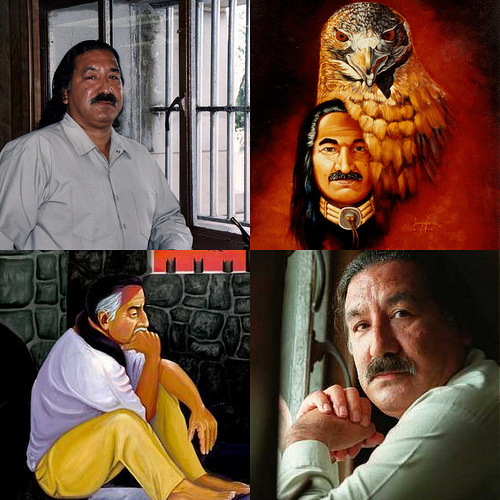
AIM: Leonard Peltier Freedom Walk for Human Rights


PeltierFlickrPeta-de-AztlanMEDIA ROOTS —
After the band Rage Against the Machine released their song “Freedom,” new generations became aware and sympathetic to the appeals for freedom of political prisoners, such as Leonard Peltier, Native American activist and member of the American Indian Movement (AIM).  

Rage’s “Freedom” video notes:

“On June 26th 1975, two unmarked cars drove onto Jumping Bull property.  A fire fight began.  Two FBI Agents and one Indian male were killed.  One of the largest manhunts in the history of the FBI followed.  Three AIM members were arrested.  The first two were acquitted, but after illegal extradition from Canada Leonard Peltier was found guilty.  All key Indian prosecution witnesses claimed they had been coerced by the FBI.  

“‘State and government authorities were concerned less with Law and Order than with the obstacle to Black Hills mining leases that A.I.M. insistence on Indian sovereignty might represent.’

“Later, numerous contradictions came to light in FBI evidence.  Proof of Peltier’s innocence was ignored or witheld from Appeal Courts.  6,000 pages of documents about the case remain CLASSIFIED for reasons of NATIONAL SECURITY.”

Peltier has now been imprisoned for over 34 years.

Dennis Banks, a founding member of AIM, is co-organising the Leonard Peltier Freedom Walk for Human Rights, which kicks off today at Alcatraz Island, San Francisco.  Dennis Banks recently spoke with Dennis Bernstein, host of Flashpoints, on Pacifica radio about the historic action calling for freedom for Leonard Peltier and all dissident political prisoners being unjustly held.  (See transcript below.)

Messina

***

AIMWEST — The Leonard Peltier Walk for Human Rights is an effort to raise attention regarding political prisoner Leonard Peltier, imprisoned for over 35 years, to seek his freedom, and to encourage President Obama to assert his authority by providing an Executive Clemency.  (All my relations can also call the White House comment line at 202-456-1212 and express freedom now for Leonard!)

The youth, academia, veterans for peace, prison rights networks, unions, and the inter-faith community are especially invited to come and participate in solidarity with those who seek freedom and executive clemency for Leonard Peltier, imprisoned already over 35 years!  Enough is enough!  FREEDOM NOW!

A Sunday morning ceremony on The Rock (Alcatraz Island) will be held to announce and initiate a spiritual walk across North America entitled “The Leonard Peltier Walk for Human Rights.”

There will be drummers and singers, fire and tobacco offerings. All our friends, supporters and allies are welcome to attend this Sunday Morning Prayer Circle. The gathering is also to offer strength to the volunteers who have committed themselves to walk across the USA for Leonard Peltier and for all political prisoners, from The Rock to Washington D.C., arriving May 18, 2012.

Read more about Leonard Peltier Freedom Walk for Human Rights.

© 2011 aimwest.info

***

FLASHPOINTS

Dennis Bernstein (c. 1:35):  “We wanted to bring you this exclusive interview with American Indian Movement founder Dennis Banks having to do with a walk that will begin at Alcatraz over the weekend, be kicked off across the country to save the life of Leonard Peltier…  

“You’re listening to Flashpoints on Pacifica radio.  We’re really delighted and honoured to be joined by Dennis Banks.  He’s one of the founding members of the American Indian Movement.  There’s a very important walk for life starting this weekend from Alcatraz here in the San Francisco Bay Area.  This is a walk across the country by the American Indian Movement to save the life of Leonard Peltier, political prisoner in solitary confinement, brutalised for all these many years.  And we’re fighting to bring him out, so that they don’t force him to die inside the prison.  

“Dennis Banks, good to have you with us on Flashpoints, welcome.  Tell us what is in store, what the walk is about, and why it’s important to fight for Leonard Peltier’s life.”

Dennis Banks (c. 1:55):  “Well, thank you very much for inviting me on.  There’s gonna be a gathering at Alcatraz this coming Sunday.  There is gonna be two boats going out there—8am and 9:10 am.  If anybody wants to come on out there, they’re certainly welcome to come out there.  

“But it’s a humanitarian walk for Leonard Peltier who has been in prison over 34 years.  When you count all the time when they were looking for him, it’s over 35 years.  But he has been proven that he was not the shooter.  Even the prosecution admitted that before the Ninth Circuit Court of Appeals in St. Paul, Minnesota.  And we thought that he was gonna be home free, but there was a technicality that prevented him from walking out a free man.  So, now he’s been in over 34 years.  And he has four years of good time, which, when he was in for 31 years, they should have let him out.  The sentencing guideline in the Federal System is:  a life sentence is 17 years, 8 months, and 23 days.  That’s a life sentence.  And he’s done twice that amount.  So, he’s done two life sentences.  

“So, [the walk] is humanitarian.  And it’s also to say all around that what we’ve said in the American Indian Movement, that he’s innocent.  They didn’t prove he was the shooter in the original court.  But the prosecuting attorney kept saying that he was the shooter.  And then 16 years later, they admitted that they didn’t know who killed those FBI agents.  This was a time when the turmoil was very heavy on the Pine Ridge Reservation and AIM was out there at the request of the elders.  We came out there and we helped them.  We assisted the elders for almost three years.  And then there was a lot of shooting going on during that time.  A lot of people got killed.  62 AIM members were killed during that three year period of time, including very respected elders were gunned down and shot.  But this is a humanitarian walk for Leonard Peltier, who for humanitarian reasons, for health reasons, he should be out.  And for even serving that lengthy time he should be out, with all the good time that he’s collected, over four years.

“Down through the years with the political system, our leaders have always been jailed.  Geronimo was in jail.  He spent over 40 years confined to an area, 25 years in prison and then the rest of his time was spent away from his homeland.  But he was restricted.  He could not go back to his home.  Chief Joseph and everybody, they were tracked down by the military.  And Geronimo was killed inside the Federal Prison in South Dakota, so, all of our leaders past, Tecumseh, everybody.  It seems to me, when the Government is wrong, they’ll send the Military in there, you know, to quiet the Natives, so to speak.  And that’s what they were trying to do, sending the FBI to quiet the Natives.  And that’s what happened.

Dennis Bernstein (c. 6:57):  “We’re speaking with Dennis Banks.  He is one of the founders of the American Indian Movement.  We’re talking about a walk for life, a human rights walk for life, and focusing on Leonard Peltier and other issues.  I can’t help but ask you to respond to what appears to be profound racism.  We see they wanna let Hinckley out, the guy who shot Reagan.  Squeaky Fromme; they wanna set the Charlie Manson cheerleaders free.  But somehow Leonard Peltier, who was obviously set up, the incredible violations of due process is on the record.  Your response to that.”

Dennis Banks (c. 7:43):  “It is absolutely one of the worst cases of racism that we saw against the American Indian Movement.  They targeted somebody in AIM to be a scapegoat.  They targeted Peltier who, at that moment, was like a soldier.  He was one of our top organisers.  He was working to help set up crops in Oglala gardens, and stuff like that.  You know?  It was that kind of a vendetta against the American Indian Movement from the FBI ‘cos we beat ‘em in court.  We beat ‘em on the battlefield at Wounded Knee.  We had them scared; they were running.  And it was, just, the worst case of a racist judicial attack against us.  And they used the courts; they used their courts to keep us confined and restricted.  It was a bad use of the Government’s power, the long arm of the law.  And that’s what they did.  So, here we are, some 35 years later, walking down.  You know, we did The Longest Walk in 1978 and Brenner’s name was on the list of issues.  And here we are, you know, some 33 years later saying the same thing, saying the same thing.”  

Dennis Bernstein (c. 9:19):  “Dennis Banks, we know that you’re busy and you’ve got much to do.  But I do wanna come back and underline the importance and the urgency here.  We, of course, wanna remind people that the kind of support he’s had from around the world, includes Archbishop Desmond Tutu, Nelson Mandela, 50 Congressional Representatives.  You name it; they have called for his freedom.  

“And I want you to underline the urgency.  His health is deteriorating.  He’s in trouble.  This is urgent.  This has to be now.”

Dennis Banks (c. 9:58):  “He’s going blind.  Of course, he doesn’t have a white cane [yet].  But his eyesight, you know, he’s an artist, he paints and his eyesight is going.  [Peltier’s] been denied a lot of medical treatment in these facilities that he’s had, you know, proper medical facilities of medical treatment, been denied that.  He is a diabetic.  Just, you know, I would hate, really hate to see that Peltier would die in prison.  That would be, really, a dark chapter of American justice.”  

Dennis Bernstein (c. 10:37):  “Alright.  Again, Dennis Banks, I wanna let people know that this is happening on Sunday [12/18/11].  People can get to the [S.F.] docks and catch one of those horn-blower boats from downtown San Francisco at 8am or 9am.  Get there early.  Be a part of this significant kick-off of this walk to save the life of Leonard Peltier and to call attention to other major and massive human rights violations that are still being levied against the Native American community.  And we wanna thank you very much for being with us and alerting us to this.”

Dennis Banks (c. 11:13):  “Thank you.  Thank you so much.”

Dennis Bernstein
(c. 11:15):  “Alright.  You take care now bye-bye.”

Dennis Banks
(c. 1:17):  “Okay.  Bye-bye.”

Transcript by Felipe Messina

***

Photo by flickr user Peta-de-Aztlan

Page 21 of 36<<...1920212223...>>