
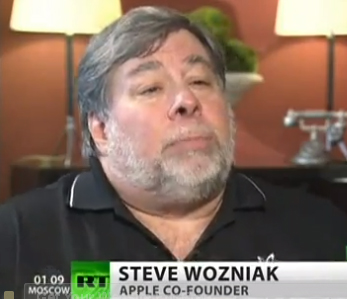
Apple Founder Steve Wozniak on Internet Democracy

MEDIA ROOTS — When I think of the most prolific innovators of our generation, there are a couple names that immediately come to mind. The founders of Apple, Steve Jobs and Steve Wozniak, are definitely at the top of the list. There’s no denying that Apple computers have aesthetically designed the world in which we all know and live in today–by simplifying technology to the point where everyone can use and access the internet, Apple products have changed the course of social interaction in the world.

I had the great pleasure of sitting down with the co-founder of Apple, Steve Wozniak, last week in downtown DC. Truthfully, I was a little worried that someone worth billions of dollars would be pretentious and aloof. Instead, I was pleasantly surprised to see how down to earth and open he was to share his perspective.

It was a refreshing and enlightening experience to hear from such a visionary on issues like MegaUpload’s Kim Dotcom, Net Neutrality, WikiLeaks, and government legislation that curbs our internet freedoms.

Abby

***

RT’s Abby Martin sits down with Steve Wozniak, co-founder of Apple,

to speak about net neutrality and his fear that freedom on the Web might become a thing of the past.

***

RT — “Well, we begin today taking a close look at cyber-legislation and the aim to regulate the internet. With the failure of the most recent cyber bill in the Senate and a possible Obama Executive Order, it seems the government is looking for ways to beef up internet protection.

“The head of cyber command General Keith Alexander, also head of the NSA, has come out asking the administration to review the rules when it comes to cyber-attacks. Currently, the Pentagon is only allowed to defend against attacks inside its own boundaries. But they are hoping now to expand that power to outside of their own computer networks and within foreign countries.

“Now, this comes days after Kaspersky Labs identified another apparent state-sponsored virus with links to Stuxnet and Flame. So, as heavy as speculation swirls around the future of the internet, we, here at RT, sat down with someone who had a clear hand in creating our current cyber climate. Steve Wozniak, co-founder of Apple, speaks to RT’s Abby Martin about net neutrality, his fear that freedom on the internet could become a thing of the past. He also weighs in on the Kim Dotcom case against him.”

Abby Martin (c. 1:05)“So, Steve, as co-founder of one of the largest companies in the world, do you think that you have a responsibility to speak out about internet issues like internet regulation?”

Steve Wozniak“I don’t think anyone comes with a responsibility just because their company is really big. Especially, since I’m not the one who wanted to run a company, just be a great engineer to help start it. I don’t feel that anybody has a responsibility. However, I do like it when well-known people, that are in the public eye, speak out on social issues and give their opinion.”

Abby Martin“What do you think about legislation SOPA and PIPA? And why do you think they were so unpopular?”

Steve Wozniak“It turns out that the, well, the internet, when it first came, it was a breath of fresh air. It was so free. Nobody owned the internet space. Countries didn’t own it; they didn’t control it. It was worldwide. It was people to people. It was like we, little people of the world, all of a sudden had this incredible resource. And we didn’t have to go through other people selling it to us and delivering it to us. That has changed a lot. But, still, those were items, that were kind of against just being able to use the wires to send whatever you thought of to somebody else who’s a friend or whatever sharing data.

“So, a lot of people had done that sort of thing. They had freely shared maybe a song with a friend. Or maybe they shared another file with another good friend and they just don’t want interference. Now, sure, it’s illegal to share copyrighted material. Fine, there are laws in place. But these were new laws, that were gonna just totally try to put up roadblocks to services, that had other very good purposes in our life. 

“For example, I might make a promotional video for an interview like this and then I’ll email it to you. Well, it’s too big to email. So, I’ll upload it to a little site. It may be Dropbox, maybe it’s my Apple iDisk, maybe it’s Megaupload. I’ll upload it to a site and send you the URL and now you can download it.

And I do that regularly.”

Abby Martin (c. 2:52):  “I heard you previously talking about Kim Dotcom’s case. And you mentioned that the charges against him were pretty much phony. Elaborate more on what you mean by that.”

Steve Wozniak (c. 3:04):  “Yes, first of all, he ran one of the largest file-sharing services in the world. So, the most movies and all were being exchanged by people through that site. It’s not a site where you could link to it and connect to it and say, ‘Search for Avatar.’ There was no searching. Somebody could upload a file and then pass out a URL on their own. And they are violating the law, if it’s copyright material, like a movie. And the person, who downloads it, is violating the law, too.

“But what Kim Dotcom ran is just a service that’s like the post office. He was the post office it was being mailed through. Why do you shut down the post office, thinking that’s where the problem is? It’s not. So, that was a phony charge.

“They tried to charge him with a copyright violation, himself, for uploading 60 songs or something. But they had come up off of CDs he had purchased.

“So, you see, it was all these attempts, that I call phony. Then they had to figure out a way to extradite him. They needed a crime, that would get him five years in prison to meet the law, the New Zealand law, for extradition.

“So, they made up phony charges of racketeering, like he’s some big mobster connecting, you know, a big financial empire in these countries. I mean Apple does that. But Kim Dotcom is just a nice soft little sweet guy when you meet him, who tells the truth openly. You know when somebody’s being truthful when you’re with them, personally. And he does hide things. He doesn’t harry. He doesn’t have concocted lines to tell. He’s not a racketeer.

“They charge him with mail fraud because he said, ‘I deleted some files.’ And what he had done was delete the links to them. Like, if you have a computer and you take a file and you throw it in the trash. The file is still on your hard disk. It didn’t really get erased. The link is gone. You can’t find it anymore by that link. So, that’s a phony charge. He really had got rid of the one part, that you could have gotten rid of to make it look as though it was deleted.

“The phony charges just indicate that they’re gonna, they’re doing everything they can to make the public think they, the prosecutors, are in the right. You know? But you don’t do phony things when you’re in the right—you have an open and shut case—no. They’re having to go beyond the bounds of what’s right to try to convict him.”

Abby Martin (c. 5:06):  “What kind of precedent do you think this sets for, just, government overstepping?”

Steve Wozniak:  “I’ve read a lot about how they confiscated his data files, actually, took them to the United States and they didn’t have the right to do that.

“It’s, yeah, the trouble is we’ve developed what sort of rights you have to have against accusers, meaning the police and the prosecutors. They are the accusers. The presumption of innocence means the burden of proof is on the accuser. They have to prove that. You have the right to be notified of what you’re being charged of. You have the right to, you know, a lot of different rights, that make sure you’re being treated fairly. And prosecutors and governments have found every way they can to get around those rights. And that’s what bothers me. It’s that, if they want to convict you of something you didn’t do, they have an awful lot of techniques to do it. A lot of ways to do it.”

Abby Martin (c. 5:51):  “You founded the Electronic Frontier Foundation to protect free speech. Should the principles of the First Amendment be protecting something like WikiLeaks?”

Steve Wozniak:  “Free speech is not absolute in my mind. It’s a very important right. It has to go through considerations of, ‘Did you violate it in ways, that might be, hurt somebody else?’ Some free speech could actually trigger harmful events. It could trigger even murders.

“So, does murdering an abortion doctor count as free speech? No. There are limits to free speech.

I don’t know in the case of WikiLeaks. Um, I don’t know where that’s going to fall out.”

Abby Martin:“So, you think there are limitations, in terms of, kind of, opening or protecting free speech online, the war on whistle-blowers?”

Steve Wozniak (c. 6:35): “Well, yeah, free speech online. I was brought up with the belief that the First Amendment was such a good thing. Every one of our Bill of Rights was so crucial to my heart, the way my dad taught me. But free speech meant you could say something bad about the president, even. You could say something bad about your government. You had that right. And we were taught you don’t have that right in Communist Russia. So, I believe in that right very strongly.

“As far as WikiLeaks, you know, I wish I knew more about the whole case. On the surface, it sounds to me like something, that’s good. The whistle-blower blew the truth. The people found out what, they, the people paid for. You know? And the government says, ‘No, no, no! The people should not know what they paid for.’”

Abby Martin (c. 7:15): “You’ve grown up in a generation where you’ve seen the internet proliferate into something so massive where political and social movements are birthed online now. What do you think about the evolution of the internet and how Apple has played a role in expanding that to people?

Steve Wozniak: “You know, when we started the company—I always go back to that point. We have a vision of computers being prolific and in everybody’s hands throughout society. Did we have the idea that it would lead to, you know, the incredible connection that the internet would come on board, that broadband would come on board for almost everyone who wants it and that that would lead to all these, basically, the way we live life and the way do things, everything political, everything social, the way we do things with other people is all done with your computer, on the internet, with your iPhone or mobile devices now. And it’s a totally different world than it was when, well, we had powerful computers, but they weren’t a part of your life as much as now. And I’m just as happy as everyone else to see it having turned out this way.”

Abby Martin (c. 8:17):  “And how do you see it going? Do you think it will still continue?  Or do you think we’ll see, kind of, a curb. I mean with the political and social movements now where everything is integrated, everything is being homogenised in the entire world and we are seeing the Arab Spring, the Occupy Wall Street movement, really, because of social interaction.”

Steve Wozniak:  “Yes. I think that a lot of social interaction will be curbed. I, I—let me take that back. I fear it. I fear it will be. The gatekeepers, those who can turn on and off switches, allow certain things, disallow other things, allow who gets to send me data about a new movie, rather than everyone having equal say so of reaching me. Yeah, I fear that very strongly. Especially, net neutrality, issues like that, internet freedom is being interfered with in major ways. And it shouldn’t.

“I think the internet should, from day one, a country of its own, that isn’t bound by any individual county’s laws. Maybe we could have had an internet government. But it didn’t happen, just like world government doesn’t happen. You know? Space doesn’t belong to anyone. The moon doesn’t belong to anyone. These are really beautiful principles in life. And then, as soon as a country figures out a way to get control of them, it disappears.

“I’m an optimist. I think we can move more and more towards net neutrality. The trouble is a lot of it has to be, um, enforced by the government and conservative types and libertarian types say, ‘Government shouldn’t have any say and control over that! That takes away our freedom!’ Wrong. It takes away the freedom of the companies, that are taking away the freedom from us.

“Every freedom we have in the United States—every one of them—was given to us by Congressional regulation. It’s called the Bill of Rights. That is what gives us our freedom. And, yet, it was from the government. It was government regulation.

“No, there are times when government regulation says, ‘You will not impede with the internet neutrality of the users.’

Abby Martin (c. 10:05): “What do you think about this whole hacktivist movement, that’s come out of, kind of, the war on whistle-blowers, Occupy Wall Street, Anonymous, and you have the take-downs of government websites. And then you see legislation, like CISPA, the Cyber Intelligence Security Protection Act, that, kind of, puts a stop to these things. Do you think that that’s, kind of, working as a guise and using the hacktivism and the hacktivists [as a pretext] for regulating the internet even more?”

Well, I really think that there are means for legitimate discourse. And trying to bring attention, um, with activist acts is wrong. On the other hand, I believe very strongly that legitimised marches and that sort of stuff, with the approval of the authorities, there’s room in our society to go out and have a microphone, to have a say and be heard by many others, especially, in this day of the internet.

“So, there are a lot of avenues. It’s just trying to, you know, grab some to get on the news, I don’t think that’s the way to, maybe it’s a start, it puts ideas into people’s heads, but I really, um, I, I don’t think that’s the right way to solve things.”

“I know you said before that no one really has the responsibility to speak out about anything. But why do you, Steve, speak out? And why do you think so many others don’t about these issues?”

“You know what? The whole world is very conflict-oriented. We want to take a side and fight for my side. My side might be my country. It might be my computer platform. It might be which browser I use. And I take my side and everybody else is bad. And I want to fight. And I only want to look at the world one way. And I’m the, I try to be so wide and open and just, you know, accept everything and judge it. That’s the logical scientific approach. Don’t take a side. Don’t be, like, for one religion against others, that sort of thing.”

Abby Martin: “Thank you so much for your time.”

Transcript by Felipe Messina for Media Roots and RT

***

Posted in Uncategorized | 1 Reply

Abby Martin Reports at Occupy National Gathering

MEDIA ROOTS – For five days in July, the Occupy Wall Street movement held its first national gathering since the inception of the movement. Hundreds of “delegates” from OWS groups across the world came to Philadelphia to coalesce the first official vision for the future and determine what nonviolent strategies could be used to achieve it. I reported for RT America about the events.

On Independence Day, I was interviewed at the National Gathering by Amadon DellErba of Spiritualution. We discuss the OWS movement: the police state crackdowns, the spirit of dissent, the global awakening and humanity’s evolution of spiritual consciousness.

Abby

***

Interview by Spiritualution — http://spiritualution.org/

***

Occupy National Gathering: Brings Vision for OWS?

 ***


Rand Paul’s Intimidation Against Abby Martin

Two months ago, Luke Rudkowski of WeAreChange and I confronted Senator Rand Paul at the Capitol building as he was leaving a public press conference. We asked him why he endorsed war mongerer Mitt Romney for President if he stands for so many things that Rand Paul is against.

A week after the video went viral, my workplace received multiple threatening phone calls from a staffer representing the Media Relations Committee at the Capitol. The representative said I could be arrested and charged with trespassing and harassment for my actions. He also threatened to strip me of my press credentials. It was confirmed to me that Senator Rand Paul had directly filed the complaint.

I proceeded to meet with the Media Committee of Bureau Chief heads of all the major mainstream outlets in the Capitol building to explain my side of the story. They told me that they had worked extremely hard to “get access” to Congress and that they can’t have people like me set it back.

After a month of silence on their end about what the final charges would be against me, I decided to come out with the story for the sake of providing the public the truth.

I was interviewed about the incident via WeAreChange:


I explain the full Rand Paul incident to WeAreChange (transcript below)

**

UPDATE: 10 AUGUST 2012 13:32 PDT

WE ARE CHANGE — “This is Luke Rudkowski here, reporting on another incident of the suppression of the free press. This time it’s of a US Senator trying to get a journalist fired for asking him tough questions. I’m joined by the one and only Abby Martin of MediaRoots.org and RT.

“Now, if you remember, myself and Abby Martin collaborated together on questioning U.S. Senator Rand Paul on his endorsement of Goldman Sachs/Bilderberg puppet Mitt Romney for the 2012 Elections.”

Luke Rudkowski (on the street):  “Hey, Senator [Rand] Paul. My name is Luke of We Are Change. We had an interesting conversation before about the Bilderberg group. And, knowing what you know, how can you support Romney when The Guardian reported he was at the Bilderberg meeting?”

Abby Martin (walking into the building):  “Hey, Rand. Abby Martin from Media Roots. I just wanted to ask you one quick question. You know, your endorsement for Mitt Romney. People had a lot of questions about it.”

Luke Rudkowski:  “Now, the video was a really big hit online. But the most interesting part of the story happened after the video was already up. Abby, can you tell us exactly what happened to you after that video went online?”

Abby Martin:  “After that week passed, the next week I went into the studios, I went into RT America. My boss said, ‘Come in to our office. We need to talk to you.’ And they just said, you know, ‘What did you do last week? And why are we getting threatening phone calls from the Capitol police and also the Senate Media Relations Committee at the Capitol Building?’

“And I just told them exactly what happened. I showed them the video. I said that it was totally unaffiliated with RT America. And they said this guy was calling them, threatening them, saying they were gonna send the Capitol police down to arrest me, threatening to strip, not only, me of my press credentials, but everyone at the station of their press credentials.”

Luke Rudkowski:  “This is just for asking a question, asking U.S. Senator Rand Paul.

“And can you tell us who these phone calls came from and where they originated?”

Abby Martin:  “They were originated from the Senate Media Relations Committee. I’m not gonna say the guy’s name because I don’t, it’s Mike something; I forget his last name. But he oversees that entire committee. And, so, he was calling to threaten me on behalf of him coming from, directly from, the Senator. So, this was confirmed to me later. And I’ll tell you what happened after that.

“I, actually, had to go meet with them in the Capitol Building. And it was really intense and an intimidating experience. But, yeah, they called RT America, were threatening to arrest me, threatening to strip me of my press credentials and of the entire office.

“So, once I explained to my boss and producers what exactly happened, they were just like: It doesn’t sound like you did anything wrong. If I were you I would definitely get a lawyer or just meet with him. Because he kept following up saying that he wanted to meet me, so he can hear my side of the story. And I didn’t know how to respond; like, should I get a lawyer involved?

“And, so, finally I just wrote him back. And I said, ‘Alright. I’ll meet with you. So, I had to go to the Capitol Building and meet with this guy, and in a small room, like an interrogation room. And it wasn’t just him. It was the Bureau Chief of Al Jazeera, the Bureau Chief of CNN, Fox News, MSNBC. All these Bureau Chief heads sat at a table and just, basically, confronted me about what had happened and wanted to get my side of the story. They said, you know, ‘Did you sneak Luke [Rudkowski] in?’ Like, ‘How do you get in there?’ And I was just like, ‘No. We were registered independent press. All we did was just go into the metal detector and go into the Capitol Building. I mean no one even checked our, no one even checked. It was like so lax. I mean you remember what happened. We walked in there. We even told the woman at the front desk, we’re here for this press event down the way. And she was like, ‘Just go ahead.’

Luke Rudkowski:  “They weren’t that lax when they found my cookies and water and all the snacks I had in my book bag and made me throw everything out, made me a little bit mad.

“But people also need to know we were registered press inside the Senate Building. We hold different press credentials because, Abby, you have a Senate press pass. I have a different press pass, that I won’t mention or name. But I do have that magic piece of laminated piece of paper, that grants me some access and leeway to get into different places.

“But we were registered for an event inside the Senate Building. Nobody sneaked in. We walked in through security. We were walking towards the event. We saw Rand Paul and we asked him a question. There’s no other way to go around it. We have to ask these guys serious questions. The mainstream media doesn’t do it. And these people came at you with full litigious might, verbal and email jujitsu trying to attack you and scare you and intimidate you for simply asking a question.

“I mean it must’ve been a very scary feeling because I remember you telling me they were very vague in the beginning about what they were gonna do. They threw out all these options, possible jail, possible losing your credentials, possibly hurting the entire RT office. And just because they didn’t pick on me shows you that they were looking for any reason to respond, any reason to try to intimidate and harass and they found a reason. It was because you were working for RT. And that’s the only reason they did this. It wasn’t a threat. It wasn’t nothing. They did it just to intimidate and scare you.”

Abby Martin:  “There was a very scary, it was very, very scary. And I was in contact with you the whole time saying, ‘What should I do? Should I come out with this story? This story is huge. I mean Rand Paul is trying to get me stripped of my press credentials for what happened. I mean that is insane.”

Luke Rudkowski:  “Or fired, or arrested for simply asking him a question.”

Abby Martin:  “Yeah. And I remember telling my boss, ‘Just have them come arrest me. This is outrageous. This is completely unfounded.’ And, as you know, now there was no charge that they could really do. It was totally baseless. It was completely empty threats. It was very underhanded intimidation tactics against journalism. You know, D.C. is just really scary like that.

“I just had no idea that that would happen for what we did. I mean if we went up to Rand Paul and we were just like, ‘Hey, man. We really like you. Thank you for what you do.’ I mean just the fact that we asked him something he didn’t like he ran away like a coward with his head down, didn’t want to answer the questions.

“He was having a public press event in that room and we were there registered. I was there registered. I was registered under Media Roots to ask him questions. I mean that’s why we were there. That’s why he was having a public press event there, which is why they were having a press conference there. And that’s why we went there.

“So, yeah, it was just really intense, really scary, intimidating. And, you know, at this point, I’m just gonna come out with this story ‘cos I think people need to know, who still think that Rand Paul is somehow, you know, has to make deals for him to play the long game, so he can do good things later. No. I mean he’s sold out. Like, he’s a sell-out to the Republican establishment. And he’s underhandedly trying to intimidate journalists who confront him about his selling out.”

Luke Rudkowski:  “This is a U.S. Representative of the people trying to arrest and fire a journalist for asking questions. I mean the story is huge. It’s unprecedented. I never; I mean I’ve worked the Senate beat many times. And I go out to the Senate Building. And I ask all these hard questions to all the senators. And I never experienced or I never went through something that you went through. And it’s pretty insane to have Rand Paul, Mr. Libertarian, himself, use the full might of any rules and regulations, that he could throw at you, throw at you to try to intimidate you.

“But, luckily, knowing you for a while now, I definitely know you will not be intimidated. I know this will only embolden you. And I know you also have new plans and you also have a new show, that you’re gonna be working on. Can you update us on what’s next for you?”

Abby Martin:  “Yeah. It certainly won’t intimidate me. In fact, I would love to see him again. In D.C., there’s politicians running around. It’s absurd.

“I won’t be going into the Capitol Building anymore to do it. But I think they’re everywhere. So, you can find out where these people are and talk to them. But, yeah, I mean I want to also clarify one point. He also, the guy who called RT, said that I can be charged with harassment as well. That was another charge that they were throwing out there, kind of blanketly, without any foundation whatsoever.

“But coming up on RT, actually, I haven’t been anchoring for the last two weeks and I won’t be all of August because I’m preparing to take over the Alyona Show. But I’m not gonna take over her show. I’m gonna make a whole new show undercutting the left/right paradigm, corporate/top-down media establishment where I’m talking about Big Brother Watch, surveillance issues, government expansion. I’m talking about things, that are censored in the mainstream media, that get a back-page story. And also talking about heroes in journalism, like Luke, highlighting grassroots activists, people who are out there doing awesome things, that need to be highlighted and are not given enough exposure, and also highlighting the villains, the corporate CEOs and the politicians, that are doing really messed up stuff, so, kind of putting them on the spotlight. And that’s the idea, for the show right now. So, stay tuned for that.”

Luke Rudkowski: “Well, if you need me to question Rand Paul, I can definitely do it. As a matter of fact, I will do it. But I wanna congratulate you on your new show. I hope people tune in. Check out Abby on Twitter @AbbyMartin.

“You’re an amazing human being. Keep up the great work. And I’m very happy to see you not afraid, not intimidated, emboldened and only strengthened by this attack. It will not stop us. The more you try to stop us, the more we grow, the more unstoppable we become.”

Luke Rudkowski:  “Anything else we didn’t get into that you wanted to get into, Abby?”

Abby Martin:  “Yeah. I mean when the corporate media doesn’t ask these questions, then who else can? And when people say this is ambush journalism, that’s unfounded as well because—people who are like, ‘Oh, how come you couldn’t get in a meeting with him? He said he had a meeting with you.’—they don’t have meetings with people who are not already totally funded by the top-down establishment. I mean that just doesn’t happen. So, sometimes they need to be confronted and about legitimate things. I mean that’s just the way it has to happen.

“And, yeah, just once again, you know, the people who say, ‘Get an appointment! This is ridiculous! Why would he answer you?’ Well, he was happy to talk to Luke before about Bilderberg before he was in the establishment.”

Luke Rudkowski (street footage with Rand Paul):  “For people who don’t know what’s going on, can you tell people who are the Bilderberg group? If you feel comfortable doing so.”

Luke Rudkowski:  “Yeah. He talked about how bad the Bilderberg group is, how they want a world government, how we need an audit of Goldman Sachs. But then when I was talking to him it was just complete silence, which made the video very awkward.”

Luke Rudkowski (street footage with Rand Paul):  “I’m just trying to get answers. And that’s why I’m here talking with you. And that’s why I’m persistent the way I am.  I know you can hear me.”

Abby Martin:  [Laughs]

Luke Rudkowski:  “He didn’t say a single word at all.”

Luke Rudkowski (street footage with Rand Paul):  “I know you’re trying to ignore me. But the video will play for itself. It will be on YouTube.”

Luke Rudkowski:  “Nothing.”

Luke Rudkowski (street footage with Rand Paul):  “We could have explained everything to our audience. They are only gonna have more questions about you, Mr. Rand. And you’re only hurting yourself by not answering the question.”

Luke Rudkowski:  “At all.”

Luke Rudkowski (street footage with Rand Paul):  “Before you became Senator, you talked about the Bilderberg group and auditing Goldman Sachs. But right now you’re supporting Romney. A lot of your supporters are let down. And I’m let down by your reaction, which I think pretty much made the video as popular as it is because of that, because of that awkward kind of silence, that we went through there.

“And I did try many times when I first started covering the Senate and Congress, I’ve tried to get little sit-down interviews and I call them ahead of time. And after 30 failed attempts and 30 failed responses, this is the only way to really get answers. And we’re also gonna be releasing another video this week showing me being very polite to a politician, asking him for an interview, and him just walking away and going in his car and not talking to anyone. So, the only way to really get answers is not from the corporate mainstream media. It’s to go out there and to ask the damn questions. That’s the only way. Don’t ask for permission. Ask for the truth and ask for accountability. That’s the only way you could really do it. And that’s the only way to be independent fully.”

Abby Martin (c. 12:17):  “And these people work for us. These people, we pay their salary. I mean they are public servants to the people. So, if we want answers on why they do shady stuff and are endorsing warmongerers who want to invade Iran and start World War III, I mean, we have the right to do that.”

Luke Rudkowski:  “Yeah. We have at least the right to question them on their abuse of authority and their horrible actions. And the free press, pretty much, is the most important thing in this country. And we don’t have one. And that’s why we’re living in the world we’re living in now.

“And I applaud people like yourself, Abby. And other brave, independent journalists out there who were willing to take the risk, who were willing to face arrest, persecution for just asking the right questions. And I appreciate your guts. And I know you’re gonna continue on an amazing journey. You’ve got a great career ahead of you. And full-speed ahead. Thank you for everything you do.”

Transcript by Felipe Messina for Media Roots and We Are Change

***

Cenk Uygur on Obamacare for RT TV

MEDIA ROOTS — On June 28, 2012, the Supreme Court upheld the controversial Affordable Healthcare for America Act, which will enact an individual mandate forcing Americans to buy health insurance or face a fine. In a tight 5-4 decision, the Supreme Court rejected the argument that mandated healthcare is legal under the Commerce clause. Instead, the Court rested its decision on the fact that any fine assessed for non-compliance is a tax and therefore the federal government’s authority to tax is upheld.

Abby Martin of Media Roots and RT interviews Cenk Uygur, host of The Young Turks, concerning the mainstream media rush to erroneously report the decision and the practical merits of the Affordable Healthcare Act ascension to law.


Abby Martin Interviews Cenk Uygur on Obamacare


Cenk Uygur provides a sober and honest evaluation of the Act better known as ‘Obamacare.’ He focuses in on the conservative nature of an individual mandate, mentioning how its origin stems from the ultra-conservative Heritage Foundation think tank. Uygur hammers this idea home by clarifying the bill does not do enough as it provides no public option outside of private insurers.

Hats off to Cenk Uygur for sharing an honest and unique perspective on the Affordable Healthcare Act that you will not find anywhere in the mainstream.

Chris Martin for Media Roots

Photo by flickr user Texas GOP Vote

The War on Drugs: Which Side is America on?

MEDIA ROOTS — In recent months, the Drug Enforcement Agency (DEA) has been performing deadly operations in Honduras to combat the War on Drugs.  Abby Martin of Media Roots and RT interviews Professor Adrienne Pine of American University about the most recent DEA slayings in the region.  They discuss the complete disregard for sovereignty, due process and rules of engagement.  

Professor Pine points out that America’s War on Drugs is enhanced by stunting the roots of democracy in Honduras.  She cements this assertion by sharing, “The police and the military forces in Honduras were the forces responsible for carrying out a coup in 2009 and then for violently enforcing it.”  Professor Pine goes on to explain that the U.S. financially supports the Honduran police and military, despite the State Department’s own warnings of widespread corruption among the agencies.  Rather than pulling back from the overt sanctioning of corruption to promote an undercurrent of civilian led democracy, the U.S. continues to fan the flames by inserting military and DEA assets.


DEA Agents out of Control in Honduras


Professor Pine focuses on the origins of the disastrous American foreign policy in Latin America with the Plan Columbia incentives where civilians were murdered and dressed like guerillas to collect U.S. taxpayer funded bounties.  She then compares the U.S. sanctioned murders on foreign soil to the streets of America, where impoverished African-American and Latino-American populations pay a disproportionate price for the failed policies of the Drug War.  

Drawing a correlation from the War on Terror to the War on Drugs, the professor explains how America’s brutal imperial policies are now coming full-circle as the Iraq model is being adopted across Central and South America.  The interview takes an interesting turn as the discussion turns to U.S. government complicity in drug trafficking.  

The total cost of the DEA from 1972 to 2009 exceeds $536 billion.

Chris Martin for Media Roots

Photo by HonCOAwikiMpubdom

Page 38 of 55<<...3637383940...>>