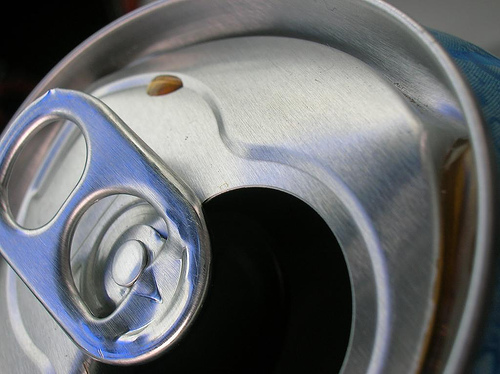
GRIST– “Coca-Cola goes green,” announced a 2010 Forbes article. Indeed, the beverages giant maintains partnerships with Big Green groups like Conservation International and World Wildlife Fund. It recently even completed its takeover of Honest Tea, an organic bottled-tea company. It would clearly like to be seen as a paragon of “green capitalism” — the idea that doing good and doing well go hand in hand.
Let’s put aside questions over what can possibly be “green” about a business model geared to sucking in huge amounts of drinking water, blasting it with what are probably toxic sweeteners and other dodgy substances, and then packaging it in little aluminum cans and plastic bottles and sending them far and wide, to be chilled (using fossil energy) before consumption.
OK, so within those tight constraints, Coca-Cola says it wants to be a “green company.” So … WTF? Last week, Coca-Cola shareholders voted by a 3-to-1 margin to continue using BPA, a toxic industrial chemical, in the lining of its soft-drink cans.
According to an account in Food Production Daily, a company executive assured shareholders that “if we had any sliver of doubt about the safety of our packaging, we would not continue to use [BPA].” So, we’re supposed to believe that Coke execs have weighed the evidence and found BPA to be safe — and that they will immediately banish it if they decide otherwise.
NATURAL NEWS– Twelve million New Yorkers, 8.4 million of which live in
New York City (NYC), continue to involuntarily consume fluoridated water
regularly, despite a report issued from the New York State Department
of Health (DoH) back in 1990 which warned that the chemical additive is
toxic. To this day, many officials not only deny this report, but also
falsely insist that “water fluoridated at the optimum level poses no
known health risks.”
The original report, entitled Fluoride: Benefits and Risks of Exposure, provided a sharp warning to officials that fluoride chemicals are especially harmful to kidney disease
patients, diabetics, and those who are hyper-sensitive to the chemical.
It also warned that because fluoride puts incredible toxic pressure on
the kidneys, those with weaker kidneys are at an increased risk of developing skeletal fluorosis, a severe bone disease marked by symptoms of pain, tenderness and bone fractures.
The
toxicity of fluoride is so great that in 2007, the National Kidney
Foundation (NKF) withdrew its endorsement for fluoride as a beneficial water additive. The group has stated that “individuals with chronic kidney disease (CKD) should be notified of the potential risk of fluoride exposure.”
FOOD CONSUMER– Dr. Paul Connet, Ph.D. of St. Lawrence University in Canton, NY
offers 50 reasons to oppose fluoridation as listed below and the
statements are slightly edited.
1. Humans don’t need fluoride to have good teeth.
2. Fluoridation is unnecessary. Most Western European countries are
not fluoridated and they have experienced the same decline in dental
decay as the U.S. where a majority of cities are fluoridated.
3. Fluoridation’s role in the decline of tooth decay is in serious doubt.
4. Where fluoridation has been discontinued in communities in
Canada and other countries, dental decay has not increased but actually
decreased.
5. Dental crises were reported to have occurred in U.S. cities
where fluoride has been added to drinking water for over 20 years; Tooth
decay is more correlated with income than fluoride levels in water.
6. A decline in tooth decay had been already seen before
fluoridation was introduced; Some studies suggested increased levels of
fluoride in drinking water was associated with elevated risk of tooth
decay.
7. The Centers for Disease Control and Prevention acknowledges
findings by many leading dental researchers that fluoride does not have
to be ingested to have a protective effect, which is topical, but not
systemic. Since swallowing fluoride is unnecessary, no reason exists to
force people (against their will) to drink fluoride in their water
supply.
8. The FDA has never approved any fluoride product designed for ingestion as safe or effective.
9. Fluoridation does not help reduce dental decay rates. A major
survey has found 30 percent of children in fluoridated areas had dental
fluorosis on at least two teeth while the purpose of fluoridation is to
limit the rate below 10 percent.
10. While fluoride is a known risk factor for dental fluorisis, other factors also affect the dental condition.
11. The level of fluoride put into drinking water at 1 ppm is not
what nature intended. Fluoride presented in mother’s milk is 200 times
lower than 1 ppm. No benefits but only risks come from this level of
fluoride.
12. Fluoride is a cumulative poison, and only 50 percent of this mineral ingested daily can be excreted through the kidneys.
13. Fluoride actively interferes with hydrogen bonding and inhibits a great number of enzymes.
14. Together with aluminum, fluoride interferes with G-proteins
leading to further interference with many hormonal and some
neurochemical signals.
15. Fluoride is mutagenic and can damage DNA and interfere with enzymes that help DNA repairs.
16. Fluoride can form complexes with other metals or minerals causing a variety of problems.
17. Animal studies show exposure to 1 ppm of fluoride in the form
of sodium fluoride or aluminum fluoride in drinking water for a year
resulted in morphological changes in kidneys and brains of rats,
increased uptake of toxic metal aluminum in the brain and the formation
of beta-amyloid deposits, which increases the risk of Alzheimer’s
disease.
18. Aluminum fluoride used to fluoridate water is toxic to the
brain; the U.S. government recommended this chemical should be tested
for its toxicity.
19. Fluoride accumulates in the brain and alters mental behavior in a manner like a neurotoxin.
20. Five studies in China revealed fluoride exposure was linked lower IQ in children.
21. Fluoride also accumulates in the pineal gland to a very high
level and reduces melatonin production and leads to an early onset of
puberty.
22. Fluoride was prescribed in Europe to patients with
hyperthyroidism. Water fluoridation essentially forces people to use a
thyroid-depressing drug. The Department of Health and Human Services
reported fluoride exposure in fluoridated communities is estimated at
the range of 1.6 to 6.6 mg per day, which covers the dose range from 2.3
to 4.5 mg per day that decreases the thyroid functions.
23. Some early symptoms of skeletal fluorosis, which is caused by fluoride, mimic the symptoms
of arthritis, a fact that leads to misdiagnosis of skeletal fluorosis.
Because of this, incidence of skeletal fluorosis can be underestimated.
24. High doses of fluoride up to 26 mg per day were tried to treat
people with osteoporosis in hopes that their bones can be hardened and
fracture rates can be reduced. Exposure to such high levels, in fact,
increased the rate of fractures, particularly hip fractures. The level
of exposure can be easily reached in people who live in fluoridated
areas during their lifetime.
25. Many studies have linked exposure of fluoride with increased
risk of fractures, particularly hip fractures, which are serious health
problems.
YAHOO NEWS– The Environmental Working Group released a report
Monday indicating that millions of Americans are regularly drinking
hexavalent chromium, made famous in the film “Erin Brockovich” as a
carcinogen, through their tap water.
The group — whose study was first reported in a story Sunday by the Washington Post’s Lyndsey Layton
— tested water from 35 U.S. cities and found that samples from 31
cities contained hexavalent chromium. The highest concentrations were
found in Norman, Okla.; Honolulu; and Riverside, Calif. The substance
had been a widely used industrial chemical for decades and has evidently
leached into the groundwater in many areas.
The EWG report states:
“Despite
mounting evidence of the contaminant’s toxic effects, the U.S.
Environmental Protection Agency (EPA) has not set a legal limit for
chromium-6 in tap water and does not require water utilities to test for it. Hexavalent chromium is commonly discharged from steel
and pulp mills as well as metal-plating and leather-tanning facilities.
It can also pollute water through erosion of natural deposits.
“The
authoritative National Toxicology Program (NTP) of the U.S. Department
of Health and Human Services has said that chromium-6 in drinking water
shows ‘clear evidence of carcinogenic activity’ in laboratory animals,
increasing the risk of gastrointestinal tumors. Just last October, a
draft review by the EPA similarly found that ingesting the chemical in
tap water is ‘likely to be carcinogenic to humans.’ Other health risks
associated with exposure include liver and kidney damage, anemia and
ulcers.”
THE MEDIA CONSORTIUM– It won’t be long before the world has to confront its diminishing supply of clean water.
“We’ve had the same amount of water on our planet since the beginning of time, ” Susan Leal, co-author of Running Out of Water, told GritTV’s Laura Flanders. “We are on a collision course of a very finite supply and 7.6 billion people.”
What’s worse, private industries—and energy companies in
particular—are using waterways as dumping grounds for hazardous
substances. With the coal industry, it’s an old story; with the natural
gas industry, it’s a practice that can be nipped in the bud.
In many cases, dumping pollutants into water is a
government-sanctioned activity, although there are limits to how much
contamination can be approved. But companies often overshoot their
pollution allowances, and for some businesses, like a nuclear energy
plant, even a little bit of contamination can be a problem.
Business as usual
Here’s one troubling scenario. At Grist, Sue Sturgis reports
that “a river downstream of a privately-owned nuclear fuel processing
plant in East Tennessee is contaminated with enriched uranium.” The
concentrations are low, and the water affected is still potable. The
issue, however, is that the plant was not supposed to be discharging
any of this sort of uranium at all. One researcher explained that the
study had “only scratched the surface of what’s out there and found
widely dispersed enriched uranium in the environment.” In other words,
the contamination could be more widespread than is now known.
Nuclear energy facilities must take particular care to keep the
waste products of their work separate from the environment around them.
But in some industries, like coal, polluting water supplies is routine
practice.
The dirtiest energy
In West Virginia, more than 700 people are suing infamous coal company Massey Energy for defiling their tap water, Charles Corra reports at Change.org.
In Mingo County, tap water comes out as “a smooth flow of black and
orange liquid.” Country residents are arguing that the contamination is
a result of water from coal slurries, a byproduct of mining that
contains arsenic and other contaminants, leaking into the water table.
Residents believe the slurries also cause health problems like learning
disabilities and hormone imbalances, as Corra reports.
Newfangled notions
Even so-called “clean coal,” which would inject less carbon into the
atmosphere, is worrisome when it comes to water. The carbon siphoned
from clean coal doesn’t disappear; it’s sequestered under ground. For a
new clean coal project in Linden, NJ, Change.org’s Austin Billings reports, that chamber would be 70 miles out to sea. As Billings writes:
The plant would be the first of its kind in the world,
so it should come as no surprise that the proposal is a major cause for
concern among New Jersey environmentalists, fishermen, and lawmakers.
According to Dr. Heather Saffert
of Clean Ocean America, “We don’t really have a good understanding of
how the CO2 is going to react with other minerals… The PurGen project
is based on one company’s models. What if they’re wrong?”
In this case, it wouldn’t only be human communities at risk (“Polluted Jersey Shore,” anyone?), but the ocean’s ecosystem.
Frack no!
Coal communities in West Virginia have been dealing with water
pollution for decades. But a another source of energy
extraction—hydrofracking for natural gas—has only just begun to
threaten water supplies. Care2’s Jennifer Mueller points to a recent “60 Minutes” segment that explores the attendant issues: it’s a must-watch for anyone unfamiliar with what’s at stake.
Fortunately, some of the communities at risk have been working to
head off the damage before it hits. In Pittsburgh this week, leaders
banned hydrofracking within the city, according to Mari Margil and Ben Price in Yes! Magazine. They write:
As Councilman [Doug] Shields stated after the vote,
“This ordinance recognizes and secures expanded civil rights for the
people of Pittsburgh, and it prohibits activities which would violate
those rights. It protects the authority of the people of Pittsburgh to
pass this ordinance by undoing corporate privileges that place the
rights of the people of Pittsburgh at the mercy of gas corporations.”
Environmentalists in other municipalities, in state government, and in Congress would do well to follow Pittsburgh’s lead.
This simply isn’t true. As McGuire explains, “The estrogen found in
birth control pills, patches, and rings (known as EE2) is only one of thousands of
synthetic estrogens that may be found in our water, and the
contribution of EE2 to the total presence of estrogen in water is
relatively small.” Where does the rest of the estrogen come from?
Factory farms, industrial chemicals like BPA, and synthetic estrogen
used in crop fertilizer. So, yes, the water is contaminated, but, no,
your birth control is not to blame.
Greening the US
Stories like these, of environmental pollution by corporations, seem
to come up again and again. They’re barely news anymore and so easy to
ignore. But it’s more important than ever for environmentalists to
fight back against these challenges and push for a green economy that
minimizes pollution. The American Prospect’s Monica Potts recently sat down with The Media Consortium
to explain the roadblocks to a green economy. If green-minded people
want to stop hearing tales like the ones above, these are the obstacles
they’ll need to overcome. Watch the video:
This postwas written by Sarah Laskow, Media Consortium Blogger, and features links to the best independent, progressive reporting about the environment by members of The Media Consortium.



 GRIST– “Coca-Cola goes green,” announced a 2010 Forbes article. Indeed, the beverages giant maintains partnerships with Big Green groups like Conservation International and World Wildlife Fund. It recently even completed its takeover of Honest Tea, an organic bottled-tea company. It would clearly like to be seen as a paragon of “green capitalism” — the idea that doing good and doing well go hand in hand.
 NATURAL NEWS
 YAHOO NEWS
 THE MEDIA CONSORTIUM