Alarms Sound Over Trash Fires in War Zones

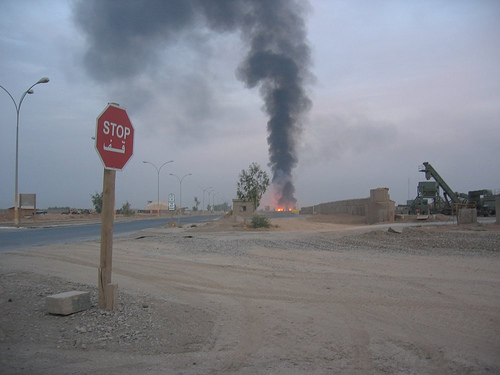
WASHINGTON POST– Hundreds of military service members and contractor employees have fallen ill with cancer or severe breathing problems after serving in Iraq and Afghanistan, and they say they were poisoned by thick, black smoke produced by the burning of tons of trash generated on U.S. bases.

In a lawsuit in federal court in Maryland, 241 people from 42 states are suing Houston-based contractor Kellogg Brown & Root, which has operated more than two dozen so-called burn pits in the two countries. The burn pits were used to dispose of plastic water bottles, Styrofoam food containers, mangled bits of metal, paint, solvent, medical waste, even dead animals. The garbage was tossed in, doused with fuel and set on fire.

The military personnel and civilian workers say they inhaled a toxic haze from the pits that caused severe illnesses. Six with leukemia have died, and five are being treated for the disease, a cancer of the blood and bone marrow. At night, more than a dozen rely on machines to help them breathe or to monitor their breathing; others use inhalers.

“You’d cough up black stuff, and you couldn’t seem to catch your breath. And your eyes were burning,” said Anthony Roles, 33, a father and Air Force retiree from Little Rock, who was told that he had a blood disorder shortly after returning from Iraq in 2004. “I can still smell it to this very day.”

Read full article HERE.

Photo by flckr user Octal

© COPYRIGHT WASHINGTON POST, 2010

Posted in Uncategorized | 1 Reply

BP Using Prison Labor for Oil Cleanup

AOL NEWS– BP is hiring prison labor for its oil cleanup efforts, and newly unemployed coastal residents are expressing their outrage, according to a magazine article released this week.

“Hiring prison labor is more than a way for BP to save money while cleaning up the biggest oil spill in history,” reports The Nation’s Abe Louise Young. “By tapping into the inmate workforce, the company and its subcontractors get workers who are not only cheap but easily silenced — and they get lucrative tax write-offs in the process.”

Young writes that BP would not confirm that it had hired inmates. Most prison officials would also declined to answer her questions, though a few did back up what she described as an “open secret” along the Gulf Coast: “A different warden, of a privately owned center, admitted on condition of anonymity that inmates from his facility had been employed in oil cleanup, but declined to answer further questions. … A lieutenant in the Plaquemines Parish Sheriff’s Office told me that three crews of inmates were sandbagging in Buras, Louisiana, in case oil hit there. ‘They’re not getting paid, it’s part of their sentence,’ she said. ‘They’ll work as long as they’re needed. It’s a hard job because of the heat, but they’re not refusing to work.'”

In the course of her investigation, Young also personally saw one prison work crew in Louisiana:

“I drove up the gravel driveway of the Lafourche Parish Work Release Center jail, just off Highway 90, halfway between New Orleans and Houma. Men were returning from a long day of shoveling oil-soaked sand into black trash bags in the sweltering heat. Wearing BP shirts, jeans and rubber boots (nothing identifying them as inmates), they arrived back at the jail in unmarked white vans, looking dog tired.”

Young argues that Louisiana’s work-release program for inmates — up to 12 hours a day and six days a week and earning zero to 40 cents an hour — is inhumane. But a staffer with an organization that advocates community-based responses to the spill makes another case against BP’s use of prison crews. “Community members should be hired in the planning stages and paid for their expertise,” she told the magazine. “The local people are the true experts here.”

Read more about BP Hiring Prison Labor at The Nation.

© AOL NEWS, 2010

Posted in Uncategorized | 1 Reply

Fishing Families Turn to Fast Food, ‘Grind Meats’

MSNBC– Grow up on the water, the children of southern Louisiana learn, and you’ll never go hungry. As long as you can toss a line, a net or a trap, you can eat — and eat well.

Or you could, until now.

Millions of gallons of oil from the April 20 explosion of the Deepwater Horizon rig have fouled some of the world’s richest fishing grounds from Florida to Texas, and even though BP stopped the leak for the first time Thursday, more than a third of the Gulf of Mexico remains closed. For thousands who feed their families from the water, what once seemed like a never-ending, free buffet of high-protein, low-fat shrimp, crabs, oysters and fish is off limits.

It’s not that people are starving. With compensation checks from BP and the help of charities such as Second Harvest Food Bank, they’re able to stock their pantries with staples — rice and beans, grits and cereal, peanut butter and jelly.

But they’re forced to pay for protein they used to get for free. And not the kind they want.

June Demolle ate seafood every night when husband James was harvesting oysters from Black Bay and American Bay. Now, like many in Plaquemines Parish, she struggles to recall her last piece of fish.

“Been at least three weeks,” she finally decides.

Instead, the couple cooks up what Demolle derisively calls “grind meats,” hot dogs and hamburgers, in a Pointe a la Hache trailer park populated entirely by relatives. She wrinkles her nose, complaining she feels less healthy already.

“I love my fish and my kids love fish,” says Demolle, a 58-year-old grandmother who also feeds her daughters and 11 grandchildren. “Every night for dinner. Any kind of fish. All the time.”

She refuses to buy it in a store; it’s expensive, and it’s not local.

Read full article HERE.

© MSNBC, 2010

Photo by Abby Martin

The Killing Fields of Multi-National Corporations

COMMON DREAMS– The Bhopal gas tragedy was the worst industrial disaster in human history. Twenty-five thousand people died, 500,000 were injured, and the injustice done to the victims of Bhopal over the past 25 years will go down as the worst case of jurisprudence ever.

The gas leak in Bhopal in December 1984 was from the Union Carbide pesticide plant which manufactured “carabaryl” (trade name “sevin”) – a pesticide used mostly in cotton plants.

It was, in fact, because of the Bhopal gas tragedy and the tragedy of extremist violence in Punjab that I woke up to the fact that agriculture had become a war zone. Pesticides are war chemicals that kill – every year 220,000 people are killed by pesticides worldwide.

After research I realised that we do not need toxic pesticides that kill humans and other species which maintain the web of life. Pesticides do not control pests, they create pests by killing beneficial species. We have safer, non-violent alternatives such as neem.

That is why at the time of the Bhopal disaster I started the campaign “No more Bhopals, plant a neem”. The neem campaign led to challenging the biopiracy of neem in 1994 when I found that a US multinational, W.R. Grace, had patented neem for use as pesticide and fungicide and was setting up a neem oil extraction plant in Tumkur, Karnataka. We fought the biopiracy case for 11 years and were eventually successful in striking down the biopiracy patent.

Meanwhile, the old pesticide industry was mutating into the biotechnology and genetic engineering industry. While genetic engineering was promoted as an alternative to pesticides, Bt cotton was introduced to end pesticide use. But Bt cotton has failed to control the bollworm and has instead created major new pests, leading to an increase in pesticide use.

The high costs of genetically-modified (GM) seeds and pesticides are pushing farmers into debt, and indebted farmers are committing suicide. If one adds the 200,000 farmer suicides in India to the 25,000 killed in Bhopal, we are witnessing a massive corporate genocide – the killing of people for super profits. To maintain these super profits, lies are told about how, without pesticides and genetically-modified organisms (GMOs), there will be no food. In fact, the conclusions of International Assessment of Agricultural Science and Technology for Development, undertaken by the United Nations, shows that ecologically organic agriculture produces more food and better food at lower cost than either chemical agriculture or GMOs.

Continue reading about the Killing Fields of Multi-National Corporations.

Vandana Shiva is an Indian feminist and environmental activist.  She is the founder/director of Navdanya Research Foundation for Science, Technology, and Ecology.

© 2010 Asian Age

Is BP Rejecting Skimmers to Save Money on Gulf Oil Cleanup?

TRUTHOUT– From Washington to the Gulf, politicians and residents wonder why so few skimming vessels have been put to work soaking up oil from the Deepwater Horizon catastrophe.

Investment banker Fred D. McCallister of Dallas believes he has the answer. McCallister, vice president of Allegiance Capital Corp. in Dallas, has been trying since June 5 to offer a dozen Greek skimming vessels from a client for the cleanup.

“By sinking and dispersing the oil, BP can amortize the cost of the cleanup over the next 15 years or so, as tar balls continue to roll up on the beaches, rather than dealing with the issue now by removing the oil from the water with the proper equipment,” McCallister testified earlier this week before the U.S. Senate Committee on Commerce, Science and Transportation. “As a financial adviser, I understand financial engineering and BP’s desire to stretch out its costs of remediating the oil spill in the Gulf. By managing the cleanup over a period of many years, BP is able to minimize the financial damage as opposed to a huge expenditure in a period of a few years.”  

A BP spokesman from Houston, Daren Beaudo, denied the allegation emphatically. He said, “Our goal throughout has been to minimize the amount of oil entering the environment and impacting the shoreline.”

A report released Thursday by the U.S. House Committee on Oversight and Government Reform included a photo depicting “a massive swath of oil” in the Gulf with no skimming equipment in sight. The report concluded: “The lack of equipment at the scene of the spill is shocking, and appears to reflect what some describe as a strategy of cleaning up oil once it comes ashore versus containing the spill and cleaning it up in the ocean.”

McCallister’s experience in trying to win approval for the Greek vessels, along with the frustrations others have expressed in offering specialized equipment, contradicts the official pronouncements from BP and the federal government about the approval process. For foreign vessels, that process is complicated by a 1920 maritime law known as the Jones Act.

Coast Guard Rear Adm. James Watson, who oversees the Unified Command catastrophe response in New Orleans, determined in mid-June an insufficient number of U.S. skimming vessels is available to clean up oil, essentially exempting from the federal Jones Act foreign vessels that could be used in the response, said Capt. Ron LaBrec, a spokesman at Coast Guard headquarters in Washington.

The Jones Act allows only vessels that are U.S. flagged and owned to carry goods between U.S. ports.

To further clarify, Coast Guard Adm. Thad Allen, the national incident commander, promised expedited Jones Act waivers for any essential spill-response activities. “Should any waivers be needed,” Allen said at the time, “we are prepared to process them as quickly as possible to allow vital spill response activities being undertaken by foreign-flagged vessels to continue without delay.”

LaBrec said 24 foreign vessels, two of them skimming vessels, have operated around the catastrophe site, in federal waters with no need for Jones Act waivers. He also said Watson has the authority to approve operation of foreign-flagged vessels near shore, where the Jones Act comes into play because of the port restrictions.

Says Fred D. McCallister, Vice President, Allegiance Capital Corporation:

 “If the unified area commander (Watson) decides that it’s a piece of equipment he needs, either BP would contract for it or he can do that himself,” LaBrec said. “If it’s something he decides is absolutely needed, he can get it in here without BP approval.

“The equipment that has been offered — the foreign equipment that has been offered that is useful for the response — has either been accepted or is in the group of offers that is currently in the process of being accepted. That has been occurring since early in the response and will continue to occur.”

Dealing with BP

McCallister said none of his dealings have been with the Coast Guard. He submitted requests for Jones Act waivers to Unified Command, but said questions about the skimming vessels have come from BP.

BP spokesman Beaudo said McCallister was notified his offer of skimming vessels has been declined because the vessels will not pick up heavy oil near shore. Beaudo said he did not know when McCallister was informed. McCallister said he received communications from BP on Thursday that indicated his proposal was still under review. In fact, he sent supplemental material Thursday, which was accepted, to show the skimming vessels will pick up heavy oil like that bombarding Mississippi’s coastline. The 60-foot vessels, he said, can skim high-density crude up to 20 miles offshore. Equipment on board separates the oil from water.

Desperate for skimmers

All the Gulf states dealing with oil have pleaded for more skimming vessels. The Deepwater Horizon Web site indicates 550 “skimmers” were at work before bad weather suspended operations.

Mississippi Gov. Haley Barbour’s office has ordered private shipyards to build skimming vessels because so few have been working in state waters. George Malvaney, who heads the Mississippi Coast cleanup effort for BP subcontractor U.S. Environmental Services, said offers of skimming vessels and other equipment take time to review. He believes Mississippi will have a “substantial skimming effort” by late next week.

“Just because it’s a skimmer doesn’t mean it’s effective,” Malvaney said. “There’s a lot of people out there saying, ‘We’ve got skimmers.’ Some are effective, some are not. That’s what we’re trying to wade through right now.”

More than Meets the Eye?

As the catastrophe reaches Day 73, McCallister, who grew up in Mississippi and has family on the Coast, believes there is just more to it.

“Looking at it from a businessman’s perspective,” he said, “if I am BP, assuming I don’t have a conscience that would steer me otherwise, the best thing I can do for my shareholders, my pensioners, and everybody else, is to try to spread the cost of this remediation out as long as I can.

“I am concerned it is seen by BP as being the most pragmatic financial approach. But they’re playing Russian roulette with the Gulf, the marine life in the Gulf and the people in the Gulf region.”

Written by Anita Lee for McClatchy

© COPYRIGHT TRUTHOUT, 2010