MEDIA ROOTS- Abby Martin from Media Roots reports the news for Project Censored’s KPFA morning show about the Verizon worker strikes and the role that multinational corporations have in Israel’s occupation of Palestine.
The segment features an interview with Dalit Baum, founder of “Who Profits from the Occupation”, an activist research initiative of the Coalition of Women for Peace in Israel that provides information about corporate complicity in the occupation of Palestine. She also directs Economic Activism for Palestine, which aims to support existing corporate accountability campaigns in the US.
ENDOFTHEAMERICANDREAM– Have you heard about the new “smart meters” that are being installed
in homes all across America? Under the guise of “reducing greenhouse
gas emissions” and “reducing energy bills”, utility companies all over
the United States are forcing tens of millions of American families to
accept sophisticated surveillance devices in their homes. Currently,
approximately 9 percent
of all electric meters in the U.S. have been converted over to smart
meters.
It is being projected that by 2012, the number of smart meters
in use will rise to 52 million,
and the federal government is spending a lot of money to help get these
installed everywhere. Eventually the goal is to have these smart
meters in all of our homes and if that ever happened
there would essentially be no more privacy. Once installed, a smart
meter monitors your home every single minute of every single day and it
transmits very sophisticated data about your personal behavior back to
the utility company.
So can’t we just tell the utility companies that we don’t want these stupid things?
Unfortunately, in many areas of the country you can’t. For example,
one outraged resident of California contacted the utility company and
was told that if he did not consent to taking a smart meter he would
receive no service.
So unless you want to live “off the grid”, what are you going to do?
Can any of us really survive without electricity these days?
The sad truth is that these things are being forced upon us.
It is happening in Europe too. The European Parliament has set a goal of having smart meters in the homes of 80 percent of all electricity consumers by the year 2020.
Sadly, as these smart meters have gone in there have been reports all
over the country of electricity bills increasing dramatically. There
have been mountains of complaints about these things and yet their use
keeps spreading.
But of course the biggest issue with smart meters is how they will strip us of our privacy.
The concern is that the incredibly detailed data that these
surveillance devices collect will be given or sold to a vast array of
third parties.
For example, smart meters are already being used by police to bust marijuana growers.
It is also feared that insurance companies, credit agencies, lawyers,
marketing firms and even criminals will be able to get their hands on
this data as well.
“Without strong protections, this information can and
will be repurposed by interested parties. It’s not hard to imagine a
divorce lawyer subpoenaing this information, an insurance company
interpreting the data in a way that allows it to penalize customers, or
criminals intercepting the information to plan a burglary. Marketing
companies will also desperately want to access this data”
For law enforcement officials, these surveillance devices are a dream come true. According to the Columbus Dispatch,
police in central Ohio have been filing at least 60 subpoenas every
single month for the energy-use records of those that they suspect are
growing pot in their homes.
Well, it turns out that sometimes police are raiding homes that are
using a lot of energy and they don’t find any marijuana at all.
Instead, sometimes these raids reveal others kinds of activities….
Sometimes, high electricity use doesn’t lead
investigators to drugs. A federal investigation in the Powell area
turned into a surprise for detectives.
“We thought it was a major grow operation … but this guy had
some kind of business involving computers,” Marotta said. “I don’t know
how many computer servers we found in his home.”
So do you want police raiding your home if you start using a little bit too much electricity?
PROPUBLICA– Since 2008, an Ohio-based company, White Hat Management, has
collected around $230 million to run charter schools in that state. The
company has grown into a national chain and reports that it has about
20,000 students across the country. But now 10 of its own schools and
the state of Ohio are suing, complaining that many White Hat students
are failing, and that the company has refused to account for how it has
spent the money.
The dispute between White Hat and Ohio, which is unfolding in state
court in Franklin County, provides a glimpse at a larger trend: the
growing role of private management companies in publicly funded charter
schools.
Contrary to the idea of charters as small, locally run schools,
approximately a third of them now rely on management companies — which
can be either for-profit or non-profit — to perform many of the most
fundamental school services, such as hiring and firing staff, developing
curricula and disciplining students. But while the shortcomings of
traditional public schools have received much attention in recent years,
a look at the private sector’s efforts to run schools in Ohio, Florida
and New York shows that turning things over to a company has created its
own set of problems for public schools.
Government data suggest that schools with for-profit managers have
somewhat worse academic results than charters without management
companies, and a number of boards have clashed with managers over a lack
of transparency in how they are using public funds.
AL JAZEERA– Has America become a nation of psychotics? You would certainly think so, based on the explosion in the use of antipsychotic medications. In 2008, with over $14 billion in sales, antipsychotics became the single top-selling therapeutic class of prescription drugs in the United States, surpassing drugs used to treat high cholesterol and acid reflux.
Once upon a time, antipsychotics were reserved for a relatively small number of patients with hard-core psychiatric diagnoses – primarily schizophrenia and bipolar disorder – to treat such symptoms as delusions, hallucinations, or formal thought disorder. Today, it seems, everyone is taking antipsychotics. Parents are told that their unruly kids are in fact bipolar, and in need of anti-psychotics, while old people with dementia are dosed, in large numbers, with drugs once reserved largely for schizophrenics. Americans with symptoms ranging from chronic depression to anxiety to insomnia are now being prescribed anti-psychotics at rates that seem to indicate a national mass psychosis.
It is anything but a coincidence that the explosion in antipsychotic use coincides with the pharmaceutical industry’s development of a new class of medications known as “atypical antipsychotics.” Beginning with Zyprexa, Risperdal, and Seroquel in the 1990s, followed by Abilify in the early 2000s, these drugs were touted as being more effective than older antipsychotics like Haldol and Thorazine. More importantly, they lacked the most noxious side effects of the older drugs – in particular, the tremors and other motor control problems.
The atypical anti-psychotics were the bright new stars in the pharmaceutical industry’s roster of psychotropic drugs – costly, patented medications that made people feel and behave better without any shaking or drooling. Sales grew steadily, until by 2009 Seroquel and Abilify numbered fifth and sixth in annual drug sales, and prescriptions written for the top three atypical antipsychotics totaled more than 20 million. Suddenly, antipsychotics weren’t just for psychotics any more.
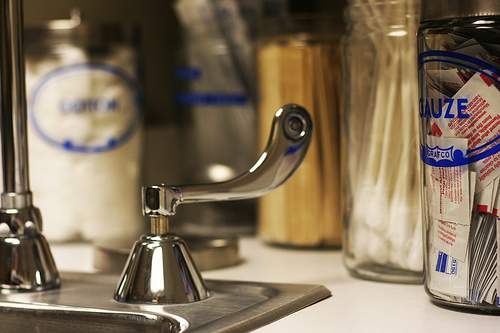
PR WATCH– On October 23, 2009, Harrison “Harry” Kothari celebrated his second birthday by blowing out candles on a cake decorated with a giant airplane. At age two, Harry could ride a tricycle, stack blocks, and say words like “mama,” “airplane,” and “thank you.” A month earlier, surgeons at a Houston hospital had removed a benign cyst from Harrison’s head without problems. In follow-up visits, nurses drained cerebrospinal fluid to test for infection, and following normal protocol, wiped the area around the drain with what they assumed were sterile alcohol wipes. On December 1, Harry was dead, his tiny brain swollen by a Bacillus cereus infection apparently caused by contaminated alcohol wipes.
According to the Milwaukee Journal Sentinel, the wipes were produced by the Hartland, Wisconsin corporation Triad Group and its manufacturing subsidiary, H&P. Employees had long complained of hygiene and safety problems; one former quality control inspector told the newspaper that “we were told to keep things running at all costs,” and after one employee cut her finger when packing alcohol wipe packets, the wipes were nonetheless shipped with blood inside and outside the box. And for years, the Food and Drug Administration FDA) –- the regulatory agency tasked with protecting public health — had noted sanitation and manufacturing problems at the plant, but did not take serious action until it was too late.
Harry’s family has sued Triad for killing their baby boy with its negligence. Triad states its products met FDA regulations. Under a bill promoted by the American Legislative Exchange Council (ALEC), the Regulatory Compliance Congruity with Liability Act, Triad’s “regulatory compliance” might be enough to absolve Triad from any and all responsibility to Harry’s family.
The Regulatory Compliance Congruity with Liability Act is part of a set of “tort reform”
bills from ALEC that limit corporate responsibility at the expense of
average Americans. ALEC, the corporate-funded national organization that
lets Big Business hand state legislators “model bills” to introduce in
their state, has been pushing “tort reform” since about 1986, with the support of Big Tobacco, the insurance industry, and other major corporations.



 ENDOFTHEAMERICANDREAM
 PROPUBLICA
 AL JAZEERA
 PR WATCH