The Capitalist Network That Runs the World

MEDIA ROOTS- In an empirical study using complex systems analysis models, mathematical theorists in Zurich have revealed the architecture of transnational corporations’ (TNCs) interconnectedness. The report bolsters the charges made of late by the Occupy Wall Street Movement touting society’s obscene inequality—1% of the population owns almost half of all U.S. wealth.  This study’s findings, an uncanny correlative of the individual TNC to the individual ruling-class elitist, reveal that less than 1% of all TNCs essentially control 40% of the global economy. 

Messina

***
CapitalistNetworkPLoSOneNEW SCIENTIST— AS PROTESTS against financial power sweep the world this week, science may have confirmed the protesters’ worst fears. An analysis of the relationships between 43,000 transnational corporations has identified a relatively small group of companies, mainly banks, with disproportionate power over the global economy.

The study’s assumptions have attracted some criticism, but complex systems analysts contacted by New Scientist say it is a unique effort to untangle control in the global economy. Pushing the analysis further, they say, could help to identify ways of making global capitalism more stable.

The idea that a few bankers control a large chunk of the global economy might not seem like news to New York’s Occupy Wall Street movement and protesters elsewhere (see photo). But the study, by a trio of complex systems theorists at the Swiss Federal Institute of Technology in Zurich, is the first to go beyond ideology to empirically identify such a network of power. It combines the mathematics long used to model natural systems with comprehensive corporate data to map ownership among the world’s transnational corporations (TNCs).

“Reality is so complex, we must move away from dogma, whether it’s conspiracy theories or free-market,” says James Glattfelder. “Our analysis is reality-based.”

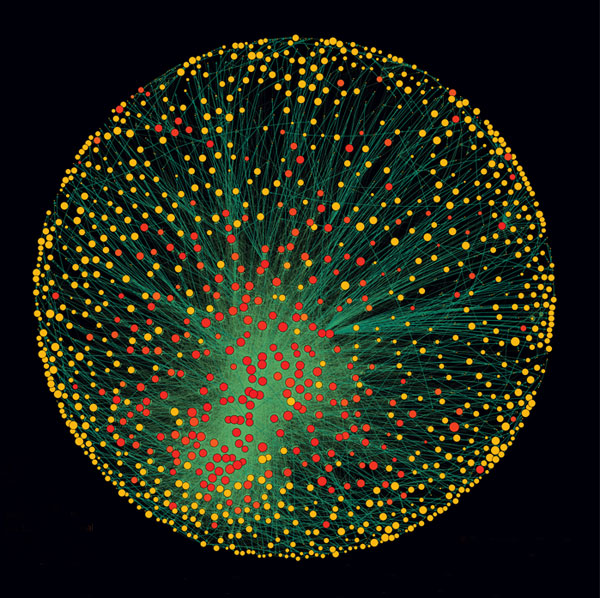
The work, to be published in PLoS One, revealed a core of 1318 companies with interlocking ownerships (see image). Each of the 1318 had ties to two or more other companies, and on average they were connected to 20. What’s more, although they represented 20 per cent of global operating revenues, the 1318 appeared to collectively own through their shares the majority of the world’s large blue chip and manufacturing firms – the “real” economy – representing a further 60 per cent of global revenues.

When the team further untangled the web of ownership, it found much of it tracked back to a “super-entity” of 147 even more tightly knit companies – all of their ownership was held by other members of the super-entity – that controlled 40 per cent of the total wealth in the network. “In effect, less than 1 per cent of the companies were able to control 40 per cent of the entire network,” says Glattfelder. Most were financial institutions. The top 20 included Barclays Bank, JPMorgan Chase & Co, and The Goldman Sachs Group.

Read more about the capitalist network that runs the world.

© 2011 Reed Business Information Ltd.

Image by PLoS One
Parkinson’s Treatment Could Work For OCD, Too

NPR– The letters O-C-D have become a punch line to describe people who make lists or wash their hands a lot. But for some people with obsessive-compulsive disorder, the intrusive thoughts and rituals are severely disabling and don’t respond to drugs or behavioral therapies.

So doctors have been trying a new treatment for OCD: deep brain stimulation.

Deep brain stimulation is best known as a way to reduce the tremors of Parkinson’s disease. A surgeon places wires deep in the brain that carry electrical impulses from an implanted device a bit like a pacemaker.

In 2009, the FDA approved the treatment for some adults with really bad OCD. Since then, about 50 OCD patients have been treated. One of them is “Mike,” a man in his late 40s who agreed to talk if his real name wasn’t used.

A lot of Mike’s compulsions involve cars. Before he gets in one, he says, he feels compelled to check the doors, the brakes, the tires — sometimes more than once. And once he’s on the road, Mike says every bump can make him wonder if he’s just hit something.

One night, Mike’s OCD actually made it impossible for him to drive through a quiet neighborhood.

For nearly three decades, Mike tried the usual treatments: prescription drugs for depression and anxiety, and a type of behavioral therapy called exposure response prevention. But he was still constantly checking faucets so the house wouldn’t flood, and light switches so there wouldn’t be a fire. He couldn’t hold a job. He was living with his parents.

‘My Mind Was Free’

Greenberg offered Mike a chance to take part in a study of deep brain stimulation — something that’s been tried on only about 50 OCD patients in the U.S.

Read more about Parkinson’s Treatment Could Work For OCD, Too

© 2011 National Public Radio

Photo by Flickr user moujemouje

Early Man Walked Upright 2 Million Years Earlier?

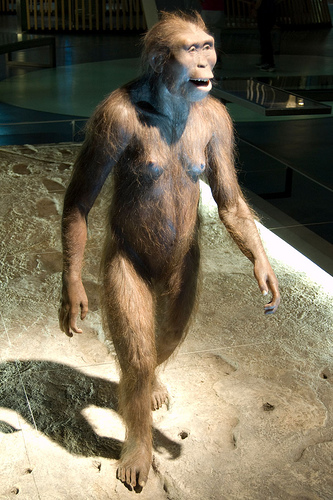
POPULAR SCIENCE– A lot of the debate about when modern humans became modern humans has to do with the head–when our brains evolved into the functional equivalent of that of modern mankind. But while that particular argument continues, a team of UK researchers using a new kind of statistical technique have analyzed ancient footprints at a site in Tanzania and found that if our feet are allowed to tell the tale, our early ancestors were becoming human-like as much as two million years earlier than we previously thought.

The study relies on eleven well-preserved footprints at the Laetoli site in Tanaznia that the researchers subjected to a new statistical technique derived from methods used in functional brain imaging. Using this technique, they created 3-D average of the 11 prints there, comparing them with data obtained from the study of modern humans and living great apes.

The researchers also used computer simulations to model a variety of gaits–and the footprints they would have produced–for the likely maker of the Laetoli prints, a species known as Australopithecus afarensis. It was previously thought that this ancestor walked crouched over, putting pressure on the side of the foot and pushing off from the middle, like a modern ape.

Read more about Early Man Walked Upright 2 Million Years Earlier Than We Thought, Says New Analysis

© 2011 Popular Science

Photo by Flickr user Grabthar

Recent Discovery: Wild Fish Uses Tool

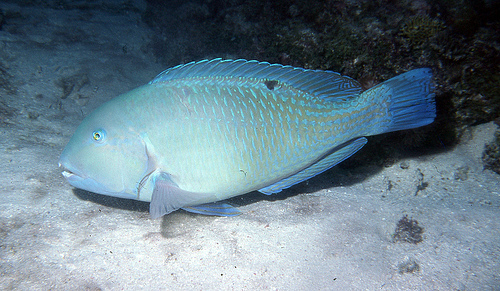
NATIONAL GEOGRAPHIC– A blackspot tuskfish off Australia has its mouth full as it carries a cockle to a nearby rock, against which the fish was seen repeatedly bashing the shellfish to get at the fleshy bits inside.

A recent study in the journal Coral Reefs says the picture—snapped at a depth of nearly 60 feet (18 meters) in Australia’s Great Barrier Reef in 2006—is the first ever taken of a tool-using fish in the wild.

Professional diver Scott Gardner was just about out of air and swimming back to the surface when he heard an odd cracking sound nearby. Swimming over to investigate, he spotted the foot-long (30-centimeter-long) fish at work.

“When Scott showed me his photos, I said ‘Wow, this is quite amazing,'” said study co-author Alison Jones, a coral ecologist at Central Queensland University in Rockhampton, Australia.

Read more about Wild Fish Uses Tool.

© 2011 National Geographic

Photo by flickr user Wadjin

Largest, Oldest Water Mass Discovered in Universe

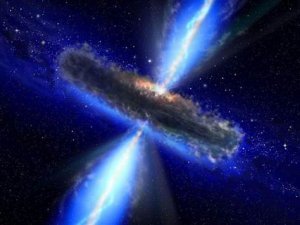
MSNBC– Astronomers have discovered the largest and oldest mass of water ever detected in the universe — a gigantic, 12-billion-year-old cloud harboring 140 trillion times more water than all of Earth’s oceans combined.

The cloud of water vapor surrounds a supermassive black hole called a quasar located 12 billion light-years from Earth. The discovery shows that water has been prevalent in the universe for nearly its entire existence, researchers said.

“Because the light we are seeing left this quasar more than 12 billion years ago, we are seeing water that was present only some 1.6 billion years after the beginning of the universe,” study co-author Alberto Bolatto of the University of Maryland said in a statement. “This discovery pushes the detection of water one billion years closer to the Big Bang than any previous find.” 

Read more about the Largest, Oldest Water Mass Discovered in Universe.

© 2011 MSNBC

Photo by NASA/ESA

Posted in Uncategorized | 1 Reply