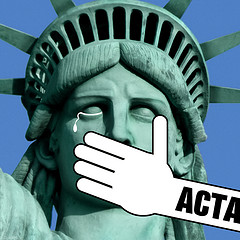
SOPA/PIPA/ACTA: Censorship’s Digital Hydra

ACTAMEDIA ROOTS — With governments, citizens, and activists worldwide increasingly relying on the internet, the environment the internet fosters is a hotly contested issue.  Last summer, the United Nations declared that disconnecting people from the internet was a human rights violation and against international law.  Considering internet access as a human right and witnessing the vital contribution it has played in the Arab Spring and Occupy Movements, the sanctity of preserving a free and open internet, or net neutrality, can’t be understated.  Even the U.S. military recently acknowledged the critical role of cyberspace by including the digital domain in its latest concept of “full spectrum dominance.” 

As humanity’s relationship with the burgeoning information age matures, threats to a free and open internet continue to proliferate.  Indeed, when the printed press, radio, TV, and every other technological innovation, which have promised to revolutionize public access to a diversity of information, were developed, they’ve faced consolidation, monopolization, and the resultant transferences of power and control into few hands.  Now, potential predators stalk the digital realm; and they have been revealed as SOPA, PIPA and ACTA.

SOPA, PIPA and ACTA all generally share the same goals which are to ostensibly protect trademarks and intellectual property, while fending off counterfeiting and pirating.  SOPA and PIPA are U.S. pieces of legislation, while ACTA is a transnational agreement.  After recent public outcries, internet users defeated an attempt to pass SOPA and PIPA on Capitol Hill.  However, SOPA will be resurrected soon.  Meanwhile, countries around the world vigorously protest the enactment of ACTA.  What’s the significance of these acronyms on our digital routines?  Let’s break each one down individually and have a closer look.

PIPA: Protect IP Act – Preventing Real Online Threats to Economic Creativity and Theft of Intellectual Property

PIPA’s stated goal would have given the U.S. government and copyright holders additional capabilities to restrict access to websites involved in copyright infringement and the distribution of counterfeit goods.  Senator Patrick Leahy (D-VT) originally introduced Senate Bill 968 on May 12, 2011, but the motion to proceed with the legislation was withdrawn January 23, 2011. 

The most controversial aspect of the bill would have enabled Domain Name System (DNS) blocking and redirection.  DNS serves as the virtual yellow pages of the internet.  By blocking and redirecting DNS, this essentially tears entire pages out of the phone book, creating an incomplete version, no longer compatible with the rest of the world.  In this scenario, a simple search for a site would yield a message stating the site no longer exists. 

SOPA: Stop Online Piracy Act

SOPA (H.R. 3261) is the sister bill to PIPA in the House of Representatives.  SOPA was introduced by U.S. Representative Lamar Smith (R-TX).  Its legal aim was to provide law enforcement agencies greater online jurisdiction to prevent violation of copyrighted intellectual property and the creation of counterfeit goods. 

According to OpenCongress.org,

“This bill would establish a system for taking down websites that the Justice Department [DoJ] determines to be dedicated to copyright infringement. The DoJ or the copyright owner would be able to commence a legal action against any site they deem to have ‘only limited purpose or use other than infringement,’ and the DoJ would be allowed to demand that search engines, social networking sites and domain name services block access to the targeted site. It would also make unauthorized web streaming of copyrighted content a felony with a possible penalty up to five years in prison.”

The bill’s inherent dangers would have allowed the U.S. government and private companies to arbitrarily incapacitate websites, thus threatening freedom of speech.  Furthermore, thousands of websites would have been jeopardized based on their user-generated content, which in turn, frequently relies on copyrighted material.  Following the SOPA Blackout Day on January 18th, Senate Majority Leader Harry Reid (D-NV) rescinded H.R. 3261’s vote on January 24, 2012. 

This brief video offers a concise explanation of SOPA.

The battle for online freedom plows ahead, in light of a new bill originating in the Senate Homeland Security and Government Affairs Committee.  Senator Joe Lieberman (I-CT), who chairs the Committee, is engineering the latest attempt to widely expand authority by Executive Branch departments over the internet.  The debut of this new cybersecurity bill is expected today, February 16, 2012.  Details of the cybersecurity bill have not been revealed, a result of the legislation’s crafters meeting behind closed doors.  Theories abound that the bill, which has benefited from bipartisan support, would grant the Department of Homeland Security expansive new powers to regulate and stake out the internet under the pretext of cybersecurity.  However, the persistent attempts to pass such legislation adversely impacting free speech and the flow of information must be questioned.  Large amounts of financial contributions to politicians, as well as dubious connections, may indicate that a broader agenda is at work.

Supporters of SOPA and PIPA will likely vigorously lobby for the new cybersecurity bill to be passed.  Backers of this type of legislation read like a who’s who list of Hollywood industry bosses.  From the MPAA (Motion Picture Association of America) to the RIAA (Recording Industry Association of America), major Hollywood power brokers angle to protect their interests.  A total of 161 entities have stumped for the passage of SOPA and PIPA.  Besides the MPAA and RIAA, they include the AFL-CIO, the International Brotherhood of Teamsters, Comcast, Disney, and Sony.  Based on some of the groups in favor, the entire matter appears to be a pet project of the Democrat Party.  This comes as no surprise when considering who the vanguard of Hollywood intellectual property has historically been.

Chris Dodd has made it his mission to crusade in Washington D.C. on behalf of Hollywood under the pretext of copyright protection legislation.  Dodd is the perfect bridge between Hollywood and the Beltway.  On March 1, 2011, Dodd was chosen as chairman of the MPAA.  On the side, he also lobbies for an organization called Creative America

According to Creative America’s website:

“…everyone in the community recognizes what a grave threat content theft poses to our livelihood and creativity – that thieves are making millions of dollars trafficking in stolen film and television while our jobs, pensions and residuals continue to decline.”

Some of the groups involved with Creative America include the CBS Corporation, NBC Universal, the Screen Actors Guild, Twentieth Century Fox, Viacom, and Warner Bros. Entertainment.  A simple search into Dodd’s previous career uncovers much cozier ties to D.C.

Dodd has enjoyed over three decades as a senator and has the distinction of being Connecticut’s longest serving senate member.  He’s one of the most recognizable Democratic senators of years past, with posts on the Committee on Foreign Relations, the Committee on Banking, Housing and Urban Affairs, and the Committee on Health, Education, Labor and Pensions.  However, his post-political career has proven quite lucrative.  According to sources, Dodd rakes in a $1.5 million salary as chairman of the MPAA.  The appointment of Dodd to head the MPAA might be the biggest coup Hollywood has had in years. 

Further evidence from Dodd himself reinforces this as he threatened to cut off financial contributions from Hollywood to politicians who did not support SOPA and PIPA.  The pipeline of sizeable contributions from Hollywood going to politicians is a healthy one most on Capitol Hill would prefer to preserve.

Democrat Senator Harry Reid has also asserted himself a champion of SOPA and PIPA legislation.  He has brought various versions of the bill to the Senate floor and may be bound to three and half million vested interests to pass the legislation; Reid was the beneficiary of $3.5 million from SOPA and PIPA advocates during the last campaign cycle.  Although donations to Reid stand out by far, other elected officials supporting the legislation have received contributions, too:  Democrat Chuck Schumer ($2.6 million), Democrat Kirsten Gillibrand ($2 million), Democrat Barbara Boxer ($1.4 million), and Republican Michael Bennet ($1 million).  Clearly, millions of reasons jeopardize maintaining a free and open internet.  One of those reasons is another piece of little known legislation, called ACTA.

ACTA: Anti-Counterfeiting Trade Agreement

ACTA protests have flashed across Europe over recent weeks.  Anti-ACTAvists have sprung up from the Netherlands to Germany to Poland and many other countries throughout Europe.  The contentious nature of ACTA attempts to normalize an international legal framework that enforces intellectual property rights, but also endeavors to target counterfeit goods and even generic medications.  On October 1st, 2011, Australia, Japan, Canada, Morocco, New Zealand, Singapore, South Korea, and the United States signed the agreement.  At the start of 2012, the European Union and 22 of its member states ratified ACTA, bringing the total signatories to 31. 

Battle lines have been drawn and two organizations are standing toe to toe—the MPAA and the Electronic Frontier Foundation (EFF).  According to the EFF, “[…] copyright industry rightsholder groups have sought stronger powers to enforce their intellectual property rights […] to preserve their business models.”  This sentiment essentially drives to the heart of the debate, one which also includes SOPA and PIPA.  Those opposed to restricting the internet view these efforts as a veiled and desperate attempt at trying to preserve an atrophying business model, being rendered obsolete by the age of digital file sharing.  This sentiment has galvanized many who sense that the true reason the public digital domain is under siege is in attempts to undermine free speech and democracy.  Due to what’s at stake, emotions have run high.  U.S. Rep. Darrell Issa (R-CA) has called it “more dangerous than SOPA.”  Popular opinion likely agrees with Issa, but is the truth harder to discern?

A lot of misinformation swirls around ACTA.  The hacktivist group Anonymous shares some of the blame.  A popular video produced by the amorphous, hacktivist collective shines light on ACTA’s pitfalls.  But is the hit piece video accurate?  According to ArsTechnica.com, there are four dubious claims that Anonymous makes:  ISPs will monitor all your data packets, ACTA obliges its member countries to assent to the worst features of SOPA and PIPA, generic drugs will be banned and seeds will be controlled via patents, and ISPs will be constantly required to scour their servers for even the smallest bits of copyrighted material.  The Anonymous video, which includes a qualifying disclaimer at the outset, has been widely embedded in articles online and reached nearly one million views.  Anonymous noted, “This video may not reflect the recent changes within the ACTA text.  However, it will give you an idea of what ACTA is about and why the internet should fight it.”  And, of course, after sorting any conflicting claims, ACTA still deserves a thumbs-down verdict.  We also bear in mind internet censorship, freedom of speech restrictions, loss of net neutrality, domestic surveillance, and civil rights erosions and police state repression have already been ongoing issues plaguing the U.S.  ACTA would simply codify existing repressive policies for people in the U.S. under the pretext of opposing counterfeiting.

ACTA is a poorly crafted agreement and simply bad.  ACTA’s basic criticisms are threefold:  the agreement’s designers are not democratically elected nor accountable, the ACTA negotiations were held in secret, and there was no discussion held in a public forum.  ReadWrite Enterprise does a fine job laying out ten reasons why ACTA fails.  Furthermore, even though ACTA probably won’t change U.S. law, it would lock us into a constrictive legal space in an area of law that changes rapidly.  Much like activists around the world can now respond more quickly to police brutality and government tactics of repression thanks to the internet, file sharing enthusiasts are finding new ways to circumvent internet censorship just as quickly.

The Internet Can’t Be Bound and Gagged

Already the hive mind of the internet has developed a solution to undercut potential censorship attempts.  Many people are unaware the internet exists similarly to an iceberg; only a small portion of it is visible to the average user.  A significant amount of the internet lies hidden in an area called the deep web.  The deep web lies obfuscated to the armchair web surfer due to an inability to access it by simply typing it into a search engine and accessing it.  For example, the deep web does not employ the use of meta tags or DNS and blocks search engines, among other characteristics, making navigation there challenging.  In this secretive environment, hackers have been diligently working on a new protocol called Tribler.

Tribler works in a similar fashion to other BitTorrent clients except that when search results are produced, they aren’t procured from a central index, rather they are directly produced from other peers.  According to TorrentFreak,

“Downloading a torrent is also totally decentralized. When a user clicks on one of the search results, the meta-data is pulled in from another peer and the download starts immediately. Tribler is based on the standard BitTorrent protocol and uses regular BitTorrent trackers to communicate with other peers. But, it can also continue downloading when a central tracker goes down.”

This type of decentralized structure would allow users to create ‘channels’ amongst themselves and make Tribler an indomitable force, making neutralization by censors extremely difficult.  Tribler will make it “impossible to shut down unless the whole Internet goes down with it.”  This will come as excellent news to millions of people witnessing attempts to stifle internet freedom with ACTA, SOPA, PIPA, and ongoing attacks on net neutrality. 

The race to control the internet rages on, but developments like this beg the question:  Does the internet adapt and evolve too quickly for elected officials to harness it?  This brings to mind Wile E. Coyote and the Roadrunner.  Some things can just never be caught.  However, U.S. voters continue to support the two-party system, which continually abandons them whilst representing corporate interests.  Time will tell.

Written by Adam Miezio for Media Roots

Photo by Flickr user DonkeyHotey

Posted in Uncategorized | 1 Reply

Hedges vs. Obama’s Indefinite Detention

ObamaPentagonFlickrUSArmyMEDIA ROOTS — Pulitzer Prize-winning journalist Chris Hedges has filed suit against Obama and Panetta to challenge the legality of the NDAA (S. 1867), which includes totalitarian provisions authorising the activation of U.S. Military within U.S. borders to imprison anyone within the U.S., or the world, without charge or trial.  Hedges, alongside his attorney, sharply articulates what’s wrong with the Levin/McCain provisions cynically inserted into this year’s NDAA.
MR

***

Chris Hedges on Democracy Now

DEMOCRACY NOW! — Pulitzer Prize-winning journalist Chris Hedges has filed suit against President Obama and Secretary of Defense Leon Panetta to challenge the legality of the National Defense Authorization Act, which includes controversial provisions authorizing the military to jail anyone it considers a terrorism suspect anywhere in the world, without charge or trial. Sections of the bill are written so broadly that critics say they could encompass journalists who report on terror-related issues, such as Hedges, for supporting enemy forces. “It is clearly unconstitutional,” Hedges says of the bill. “It is a huge and egregious assault against our democracy. It overturns over 200 years of law, which has kept the military out of domestic policing.” We speak with Hedges, now a senior fellow at the Nation Institute and former New York Times foreign correspondent who was part of a team of reporters that was awarded the Pulitzer Prize in 2002 for the paper’s coverage of global terrorism. We are also joined by Hedges’ attorney Carl Mayer, who filed the litigation on his behalf in the U.S. District Court for the Southern District of New York.

DN:  “During Monday night’s debate in South Carolina, Republican candidates sharply disagreed over a new policy to indefinitely detain American citizens. President Obama approved the measure as part of the National Defense Authorization Act, or NDAA, which includes controversial provisions authorizing the military to jail anyone it considers a terrorism suspect anywhere in the world without charge or trial. President Obama added a signing statement when he signed the NDAA, stating, quote, ‘I want to clarify that my administration will not authorize the indefinite military detention without trial of American citizens.'”

Well, last night, Republican front-runner Mitt Romney defended Obama’s approval of the bill, saying he would have done the same.

Audio of Kelly Evans:  “Governor Romney, as president, would you have signed the National Defense Act, as written?”

Audio of Mitt Romney:  “Yes, I would have. And I do believe that it’s appropriate to have in our nation the capacity to detain people who are threats to this country, who are members of al-Qaeda. Look, you have every right in this country to protest and to express your views on a wide range of issues, but you don’t have a right to join a group that has challenged America and has threatened killing Americans, has killed Americans and has declared war against America. That’s treason. And in this country, we have a right to take those people and put them in jail.”

DN:  “That was Republican presidential front-runner Romney, talking about the controversial indefinite detention provisions in the NDAA.

“Meanwhile, Rick Santorum said a U.S. citizen who’s detained as an enemy combatant should have the right to a lawyer and to appeal his case before a federal court. And Ron Paul said holding American citizens indefinitely is a breach of the U.S. judicial system.

“When President Barack Obama signed the NDAA, sections of the bill were opposed by key members of his administration, including Defense Secretary Leon Panetta, FBI Director Robert Mueller and Director of National Intelligence James Clapper. Many civil liberties activists believe the law is unconstitutional.

“Well, today, an announcement is being made in New York, filing a complaint in the Southern U.S. District Court against Barack Obama and Secretary of Defense Leon Panetta to challenge the legality of the NDAA. Their plaintiff is none other than veteran war correspondent and Pulitzer Prize winner Chris Hedges.

“For more, we’re joined by Chris Hedges himself, senior fellow at the Nation Institute, who recently wrote a piece for TruthDig called “Why I’m Suing Barack Obama.” Chris Hedges is a former foreign correspondent for the New York Times, was part of a team of reporters who won the Pulitzer Prize in 2002 for the paper’s coverage of global terror. He is author of a number of books, including Death of the Liberal Class and The World As It Is: Dispatches on the Myth of Human Progress.

“And we’re joined by Chris Hedges’ attorney Carl Mayer, who filed the litigation on his behalf.

“Chris Hedges and Carl Mayer, welcome to Democracy Now!”

Chris Hedges:  “Thank you.”

DN:  “Chris, why are you suing President Obama?”

Chris Hedges:  “Because it’s clearly unconstitutional, for starters. But secondly, it is a huge and egregious assault against our democracy. It overturns over 200 years of law, which has kept the military out of domestic policing. And even that passage that you read from the White House, I think, is deeply disingenuous, because Dianne Feinstein had a resolution by which, within that bill, Americans would be exempted from this, and the Democratic Party and Barack Obama rejected it. All of the debate with Carl Levin, who, with McCain, sponsored the bill, was a struggle between the White House so that they would assume—they would have the right to assume which Americans would be detained by the military without due process and held indefinitely until the end of hostilities, this kind of endless war on terror. It’s an extremely frightening step backwards for American democracy. And as someone who’s spent 20 years overseas and has lived in countries where the military has that kind of power, I have friends who have disappeared into these military gulags. We have unleashed something that I think is truly terrifying.

“And as discontent grows, of course, the criteria by which people can be investigated in this country are so amorphous, even bizarre—I mean, somebody who is missing fingers on a hand or somebody who has more than seven days’ worth of food. It’s a very seamless step to include in that list some of the obstructionist tactics of the Occupy movement. And I think that for those of us who care about civil liberties, the right of dissent and freedom, we have to stand up. And that’s why Carl and I have decided to do this.”

DN:  “Carl Mayer, how does this—how does this litigation work?”

Carl Mayer:  “Right, well—”

DN:
  “And why not a class action lawsuit, where many people file?”

Carl Mayer:  “Right. Well, the purpose of the litigation is to have a federal court declare this act unconstitutional. And that would apply to everyone.

“Chris is an important plaintiff in this, because—you just showed the clip from Mitt Romney. I’m not sure that Mitt Romney has read this bill. The act is so broad and vague that it covers, in its writing, any persons who give, quote, “substantial support to al-Qaeda, the Taliban, or,” quote, “associated forces,” which are incredibly broad, nebulous terms and could capture, within those—their terms, journalists like Chris Hedges, who courageously has gone around the world to interview members of opposition parties, to interview members of terrorist groups, to report the truth. And so, when Mitt Romney says these are people who are in terrorist organizations, that’s not how the bill is written. It’s written so broadly that it could encompass a journalist like Chris Hedges. It could encompass people who are engaged in free speech and in all sorts of activities that have nothing to do with what Mitt Romney, etc., are talking about.

“And so, we filed this action. I filed it in conjunction with my colleague Bruce Afran, who’s a professor of constitutional law at Rutgers Law School, another veteran public interest attorney. And what we’re asking the court to do is to declare that this law violates not only the First Amendment rights of citizens like Chris to report and to speak about these issues, but also the Fifth Amendment right to due process, because what this—what this bill does is it sends people to military tribunals, and it allows for the indefinite detention of these people. It even allows for the rendition of covered persons, which is not defined in the act, to render these people to foreign countries.

DN:  “And explain what you mean by that. This is extraordinary rendition.”

Carl Mayer:  “Right. And so, what the act permits is that if someone is deemed under the act to be giving, quote, “substantial support” to, quote, “associated forces” that are associated with terrorists, they could be sent overseas at the determination of the American military, or they could be held in a military prison here indefinitely, or they could be tried in a military court. And as Chris Hedges, who is courageously bringing this as a plaintiff, pointed out, there is a longstanding Supreme Court decision called ex parte Milligan, which dates to the Civil War period, in which several people were held by the military for plotting to overthrow, during the course of the Civil War, the governments of Indiana and Ohio. And they were sentenced to death. The Supreme Court ruled, after the Civil War, that as long as there are civilian courts operating, you cannot try these people in military courts, even people who are—whose avowed purpose was to overthrow the civilian governments of Ohio, Indiana, etc. So, it is that level of protection that is built into the Constitution. And that’s what our ancestors fought for, is to uphold the Bill of Rights, due process rights, right to a trial by jury. And all of this is being abrogated by this legislation.”

DN:  “I wanted to bring in what Rick Santorum said last night at the Republican debate in South Carolina about a U.S. citizen detained as an enemy combatant having the right to a lawyer to appeal their case before a federal court.”

Audio of Rick Santorum:  “First off, I would say this. What the law should be and what the law has been is that if you are a United States citizen and you are detained as an enemy combatant, then you have the right to go to federal court and file a habeas corpus petition and be provided a lawyer. That was the state of the law before the National Defense Authorization Act, and that should be the state of the law today. You should not have—you should not have—if you’re not an American citizen, that’s one thing. But if you are a citizen and you’re being held indefinitely, then you have a right to go to a federal court. And again, the law prior to the National Defense Authorization Act was that you had the right to go to a court and for that court to determine, by a preponderance of the evidence, whether you could continue to be held. That is a standard that should be maintained, and I would maintain that standard as president.”

DN:  “Chris Hedges, Rick Santorum versus President Obama?”

Chris Hedges:  “He’s not a politician I usually have much in common with, but this is right. I mean, this is about the egregious destruction of the rule of law. I mean, we have to remember that under the 2001 Authorization to Use Military Force Act, some of this was already happening. José Padilla, for instance, was picked up by military courts, held without trial, access to due process—again, a U.S. citizen—went to the Supreme Court, and by that time, they handed him over to civilian court to—and the Supreme Court never made a ruling on it. But I think that this essentially codifies this very extreme interpretation of this 2001 act into law.

“And more importantly, it expands the capacity by the state in terms of defining who is, quote/unquote, ‘not only a terrorist, but somebody who is,’ in their terms, ‘associated forces’ or substantially supports people defined as terrorists. And, of course, the reason for that is that many of these groups that are being attacked in Yemen and other places had nothing to do with 9/11—they didn’t even exist when 9/11 happened—and to expand this into the civilian population of the United States. And I think, Amy, one of the most sort of disturbing aspects of this is that the security establishment came out against it—the CIA, the FBI, the Attorney General, the Director of National Intelligence. None of them wanted it.

DN:
  “President Obama said he was going to veto it.”

Chris Hedges:  “President Obama said he was going to veto it, but we now know from leaks out of Levin’s office that that’s because the executive branch wanted to decide. They wanted the power to decide who would be tried, who would be granted exemptions. It wasn’t actually about the assault against due process.

And I think we have to ask, if the security establishment did not want this bill, and the FBI Director Mueller actually goes to Congress and says publicly they don’t want it, why did it pass? What pushed it through? And I think, without question, the corporate elites understand that things, certainly economically, are about to get much worse. I think they’re worried about the Occupy movement expanding. And I think that, in the end—and this is a supposition—they don’t trust the police to protect them, and they want to be able to call in the Army. And if this bill goes into law, and it’s slated to go into law in March, they will be able to do that.

DN:  “I wanted to ask you a quick question about a comment Texas Governor Rick Perry made last night, in a related, but not exactly the same thing as what you’re talking about. He said on Sunday the Obama administration has gone “over the top” in criticizing marines who were videotaped urinating on Afghan corpses.”

Audio of Gov. Rick Perry:  “What bothers me more than anything is this administration and this administration’s disdain all too often for our men and women in uniform, whether it is what they’ve said about the Marines—now, these young men made a mistake. They obviously made a mistake.

Audio of Bret Baier:  “You’re talking about urinating on the corpses?”

Audio of Gov. Rick Perry:
  “They made a mistake that the military needs deal with, and they need to be punished. But the fact of the matter—the fact of the matter is this. When the Secretary of Defense calls that a despicable act, when he calls that utterly despicable—let me tell you what’s utterly despicable: cutting Danny Pearl’s head off and showing the video of it, hanging our contractors from bridges. That’s utterly despicable.”

DN:  “That was Rick Perry, Texas governor. Chris Hedges, you were a longtime war correspondent.

Chris Hedges:  “Well, you know, when people are killed on a battlefield, and those who are deemed the enemy are, at best, treated like human refuse. But usually they’re treated like trophies. They’re often dismembered. I mean, one of the first things you do after you kill an enemy combatant is go through their pockets. And in war after war that I covered, the desecration and mutilation of corpses was extremely common. So, I think that what we saw was a window into the reality of war, one that has essentially been censored from public view.”

DN:  “I want to thank you both for being with us, Chris Hedges, Carl Mayer.”

The original content of this program is licensed under a Creative Commons Attribution-Noncommercial-No Derivative Works 3.0 United States License.

***

Photo (feature) by flickr user JBrazito

Posted in Uncategorized | 1 Reply

Immigrant Rights Group Challenges Referendum

JURIST– The Casa de Maryland immigrant rights group filed a challenge Monday to a public referendum over a Maryland law providing in-state tuition to undocumented college students. The group filed the challenge in the Maryland Circuit Court for Anne Arundel County after opponents of the Maryland DREAM Act collected enough signatures to put the law to a public referendum. Casa de Maryland and eight other individuals are challenging the referendum for two main reasons.

First, they argue that the DREAM Act will result in state tax money going to fund the tuition breaks making it an appropriations measure not subject to repeal by referendum. Second, they argue that over 57,000 signatures on the petition for the referendum are invalid because of the computer system used to collect them. Many of the signatures were submitted through MDPetitions.com, which downloads and prints a “Pre-Filled Petition” that only needs to be signed and mailed in. The website prints out the form with the voters’ information exactly as it appears in their voter registration, necessary for the signature to be valid. But the plaintiffs argue that such a system is invalid because the petitions do not have sufficient verification to be valid under state law:

There are sound policy reasons for requiring … the petitioner signer to fill in his or her own information on the form, rather than allowing that information to be filled in by someone else. Anyone—including someone other than the voter—could have the website generate a “Pre-Filled Petition Form” with that voter’s information pre-printed, both in the signing block and the circulators affidavit. The user (who is not the voter) could then print out the form, sign the voter’s name in the signature space and in circulator’s affidavit and mail the form to MDPetitions.com for submission to the Secretary of State and State Board.

Supporters of the referendum collected over 100,000 signatures [Baltimore Sun report] with broad bipartisan support: 63,487 Republicans, 32,397 Democrats and 12,628 independents. The DREAM Act narrowly passed the Maryland legislature in the final hours of the spring session.

The Maryland DREAM Act is currently suspended pending the public referendum. In order to be eligible for in-state tuition, undocumented residents would have to have attended at least three years of high school in Maryland and show their parents had filed tax returns to the state. The US Congress has considered a similar but more far-reaching bill [legislative materials; text], also entitled the DREAM Act, that would provide a path to permanent resident status for some high school graduates who enter the military or enroll in a college degree program.

Read more about Immigrant Rights Group Challenges Public Referendum to Overturn Maryland’s DREAM Act.

© 2011 Jurist

Photo by Flickr user DreamActivist

Students, Workers Protest Cuts, Corporate Profits

UNITE HERE– As University of California Regents prepare to vote for another tuition hike next week, students and workers gathered July 8, to protest drastic higher education cuts, while corporations like Disney win generous tax breaks.

Students and workers targeted their protest at media CEO Monica Lozano, who is the publisher of La Opinion newspaper and a University of California Regent. As a UC Regent, Lozano has approved seven recent tuition hikes, while simultaneously serving on the Disney corporate board, which last year won millions in potential tax breaks.

One such tax break, an Enterprise Zone distinction in Anaheim, could bring Disney more than $1 million in tax savings just by hiring 100 employees throughout the year, including student summer hires.

Students called on Lozano to reject the latest UC tuition hike. UC tuition and fees will top $11,000 per year this fall.

“As a UC Regent Monica Lozano is assisting in the devastation of California higher education, while getting paid by Disney, which is getting huge tax breaks,” said Joe Silva, a UCLA student. “Disney made $4.4 billion in net profit last year — does it really need a tax break?”

Disney paid Lozano $246,911 in 2010 to serve on its board.

Gov. Jerry Brown had proposed the repeal of the Enterprise Zone program, which costs the state roughly $465 million a year in tax revenue, but doesn’t create jobs, according to a study by the nonpartisan California Budget Project.  However, in the final budget deal passed on June 28, the Enterprise Zone tax breaks were left in tact, while $650 million was cut from the UC system, $650 million cut from CSU system and $400 million cut from community colleges.

Read more about Students, Workers Protest Higher Ed Cuts, Corporate Profits

© 2011 Unite Here! Local 11

Photo by Flickr user Jim DeLa

Corporate Control? Not in These Communities

YES! MAGAZINECan local laws have a real effect on the power of giant corporations?

Mt. Shasta, a small northern California town of 3,500 residents nestled in the foothills of magnificent Mount Shasta, is taking on corporate power through an unusual process—democracy.

The citizens of Mt. Shasta have developed an extraordinary ordinance, set to be voted on in the next special or general election, that would prohibit corporations such as Nestle and Coca-Cola from extracting water from the local aquifer. But this is only the beginning. The ordinance would also ban energy giant PG&E, and any other corporation, from regional cloud seeding, a process that disrupts weather patterns through the use of toxic chemicals such as silver iodide. More generally, it would refuse to recognize corporate personhood, explicitly place the rights of community and local government above the economic interests of multinational corporations, and recognize the rights of nature to exist, flourish, and evolve.

Mt. Shasta is not alone. Rather, it is part of a (so far) quiet municipal movement making its way across the United States in which communities are directly defying corporate rule and affirming the sovereignty of local government.

Since 1998, more than 125 municipalities have passed ordinances that explicitly put their citizens’ rights ahead of corporate interests, despite the existence of state and federal laws to the contrary. These communities have banned corporations from dumping toxic sludge, building factory farms, mining, and extracting water for bottling. Many have explicitly refused to recognize corporate personhood. Over a dozen townships in Pennsylvania, Maine, and New Hampshire have recognized the right of nature to exist and flourish (as Ecuador just did in its new national constitution). Four municipalities, including Halifax in Virginia, and Mahoney, Shrewsbury, and Packer in Pennsylvania, have passed laws imposing penalties on corporations for chemical trespass, the involuntary introduction of toxic chemicals into the human body.

These communities are beginning to band together. When the attorney general of Pennsylvania threatened to sue Packer Township this year for banning sewage sludge within its boundaries, six other Pennsylvania towns adopted similar ordinances and twenty-three others passed resolutions in support of their neighboring community. Many people were outraged when the attorney general proclaimed, “there is no inalienable right to local self-government.”

Bigger cities are joining the fray. In November, Pittsburgh’s city council voted to ban corporations in the city from drilling for natural gas as a result of local concern about an environmentally devastating practice known as “fracking.” As city councilman Doug Shields stated in a press release, “Many people think that this is only about gas drilling. It’s not—it’s about our authority as a municipal community to say ‘no’ to corporations that will cause damage to our community. It’s about our right to community, [to] local self-government.”

What has driven these communities to such radical action? The typical story involves a handful of local citizens deciding to oppose a corporate practice, such as toxic sludge dumping, which has taken a huge toll on the health, economy, and natural surroundings of their town. After years of fighting for regulatory change, these citizens discover a bitter truth: the U.S. environmental regulatory system consists of a set of interlocking state and federal laws designed by industry to serve corporate interests. With the deck utterly stacked against them, communities are powerless to prevent corporations from destroying the local environment for the sake of profit.

Enter the Community Environmental Legal Defense Fund, a nonprofit public interest law firm that champions a different approach. The firm helps communities draft local ordinances that place the rights of municipalities to govern themselves above corporate rights. Through its Democracy School, which offers seminars across the United States, it provides a detailed analysis of the history of corporate law and environmental regulation that shows a need for a complete overhaul of the system. Armed with this knowledge and with their well-crafted ordinances, citizens are able to return to their communities to begin organizing for the passage of laws such as Mt. Shasta’s proposed ordinance.

The Community Environmental Legal Defense Fund is collaborating with Global Exchange, an international environmental and workers’ rights organization, to help supporters of the Mt. Shasta ordinance organize. In an interview for this article, I asked Shannon Biggs, who directs Global Exchange’s Community Rights Program, if she expected ordinances of this type to be upheld in court. Biggs was dubious about judges “seeing the error of their ways” and reversing a centuries-old trend in which courts grant corporations increased power. Rather, she sees these ordinances as powerful educational and organizing tools that can lead to the major changes necessary to reduce corporate power, put decision-making back in the hands of real people rather than corporate “persons,” and open up whole new areas of rights, such as those of ecosystems and natural communities. Biggs connects the current municipal defiance of existing state and federal law to a long tradition of civil disobedience in the United States, harkening back to Susan B. Anthony illegally casting her ballot, the Underground Railroad flouting slave laws, and civil rights protesters purposely breaking segregation laws.

But the nascent municipal rights movement offers something new in the way of political action. These communities are adopting laws that, taken together, are forming an alternative structure to the global corporate economy. The principles behind these laws can be applied broadly to any area where corporate rights override local self-government or the well-being of the local ecology. The best place to start, I would suggest, is with banning corporations from making campaign contributions to local elections.

The municipal movement could provide one of the most effective routes to building nationwide support for an Environmental and Social Responsibility Amendment to the U.S. Constitution. In fact, the movement is already expanding. In Pennsylvania, people are now organizing on the state level and similar stirrings have been reported in New Hampshire.

What about your community?


Allen D. Kanner, Ph.D., is a cofounder of the Campaign for a Commercial-Free Childhood, co-editor of Psychology and Consumer Culture and Ecopsychology, and a Berkeley, California child, family, and adult psychologist.

This article originally appeared in © Tikkun.

Photography by ThreadedThoughts

Posted in Uncategorized | 1 Reply