
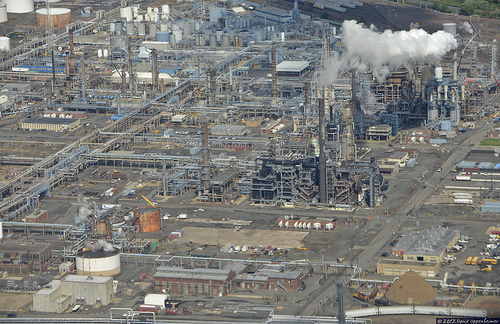
Big Oil is More Than Big Trouble for the Environment

MEDIA ROOTS – The global petroleum industry has long been the antagonist for environmental and animal-rights advocates. But more recently, “Big Oil” has emerged as a literal threat to democracy for its vast political influence and ability to contrive wars for profit. A report released last month by the National Wildlife Federation exposed to what extent the oil industry, along with coal, affect elections in America.

Speaker of the House John Boehner tops the list of congressman receiving financial aid from the energy industry. Many of these donors stand to benefit from the proposed construction of the Keystone XL pipeline, an ecologically-damaging project that would send diluted bitumen – a tar-like substance – to American oil refineries, and the congressman has repeatedly castigated the president for delaying its permit. If that wasn’t bad enough, the congressman actually owns investments in some of these companies. Congress is exempt from various trade-laws and last year 60 Minutes highlighted Boehner’s record of insider-trading.

More recently, Congress passed a bill referred to as the “Stop the War on Coal Act.” Congressman Johnson, also a Republican from Ohio, authored the bill and explained the bill wasn’t about climate change as much as it was about public health and safety. But dissenters of the bill argue it actually endangers millions of Americans and virtually declares war on public health. Furthermore, the bill could possibly pave way for a similar bill that would further secure the stature of the petroleum industry.

Big Oil should be considered a big country

Seven of the top ten highest-grossing corporations in the world, as ranked by Fortune magazine earlier this year, are of the oil industry. Royal Dutch Shell, the list’s top revenue-generator, is on par with the gross domestic product of Iran. But if it was its own country, it would be the twenty-fifth highest-grossing country in the world.

When considering these seven corporations together, they are the sixth highest-grossing entity worldwide – government or corporate. And because these entities are private corporations, and considered persons by the Supreme Court, they are not subject to the same level of public scrutiny or congressional oversight. While it may not be surprising that over three-quarters of all petroleum refined in the United States produces gasoline, diesel, and jet fuels, it may be news to some just who is consuming these fuels the most.

The petrodollar war, not the terror war

Purchasing over one percent of the world’s refined oil – by far more than any other single entity – is the U.S. Department of Defense. Over half of this consumption is used to fuel jet engines with the Air Force being the branch of greatest oil demand. The department consumes nearly double the amount of fuel annually as the Republic of Ireland and, during the height of battle in Iraq just a half-decade ago, American troops were consuming well over one million gallons of fuel daily making them the highest oil-consuming soldiers in world history. This past year, the military handed taxpayers a $20 billion energy bill which roughly equates to the cost of an automobile tank for every man, woman, and child in the country.

Less than a month after 9/11 several news outlets were reminding readers that oil was actually more of an issue than terrorism. L.A. Weekly pushed the envelope of sensitivity by offering “it’s the oil, stupid” just eight days after terrorists allegedly hijacked four airplanes. These claims are based on the fact that Big Oil has been vying for an Afghan pipeline for decades.

During the Bush-Cheney era, both of whom are previous oil executives themselves, Big Oil lobbied the federal government over $393 million, with nearly a million dollars diverted to Senator Obama during his 2008 campaign for the White House. But as the majority of Americans of all political backgrounds continue to favor renewable energy options, this Congress continues to turn a blind eye and instead demonizes governments – such as those of Iran and Venezuela – that refuse to trade crude oil in U.S. Dollars. “Petrodollar warfare” is the true reason why the U.S. invaded Iraq in 1990, and again in 2003, and is why Iran continues to remain in the military’s crosshairs.

Corporate media complicity

Meanwhile, the corporate media establishment has yet to connect the dots of history for the general public or sound the alarm on the true cause of this grim outlook. In fact, many of these outlets outright support the industry as reported in a Media Matters study earlier this year regarding the coverage of the Keystone XL pipeline. The report showed that while only a quarter of Keystone XL coverage featured the massive demonstrations of people speaking out against the project, the media continued to parrot industry job estimates even though these predictions had already been widely discredited.

Starting in 1980, the FCC began deregulating the media industry which resulted in over 90% of media outlets being owned by just six corporate entities. Already this year over $153 million oil industry dollars have been spent in the corporate media establishment – mere pocket change for this influential group of executives. The result is a misguided society concerned more by the threat of terror than the more realistic threat of economic collapse.

Embedded below is an episode of FTM Daily, a radio program hosted by economist Jerry Robinson, which further explores the extent of the petrodollar system, its influence on the value of the U.S. dollar, and reveals who the major players are.

Oskar Mosco is the managing editor for Media Roots.

Photograph: © 2013 David Oppenheimer – Performance Impressions

***

Earlier this year on FTM Daily, Jerry Robinson features an examination of the

Petrodollar system that is what the now-volatile U.S. Dollar is based on.
Posted in Uncategorized | 1 Reply

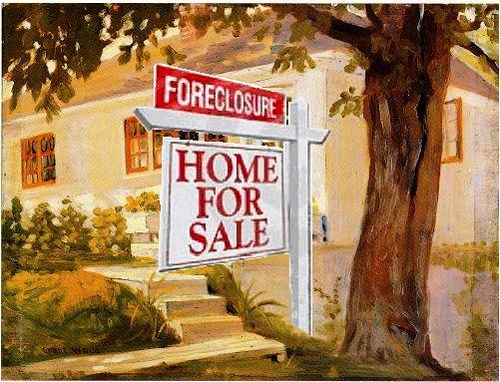
MR Original – Freddie Mac Bets Against Homeowners

foreclosure by mike licht_flickr

MEDIA ROOTSFreddie Mac, aka the Federal Home Loan Mortgage Corporation, is one of America’s largest mortgage-insurance companies, chartered in 1970 by the federal government “to provide liquidity, stability and affordability to the U.S. housing market.”  However, the mortgage giant recently invested $5 billion in complex securities that pay when mortgage holders are unable to refinance and take advantage of the current record-low interest rates, effectively betting against U.S. homeowners. 

If Freddie Mac’s declared corporate mission is to make it “easier for consumers to afford a decent house or apartment,” then why is the company profiting from U.S. homeowners’ inability to refinance and reduce interest rates on their mortgages?  These investments constitute a clear conflict of interest, particularly since Freddie Mac also determines which homeowners are eligible to refinance.  Freddie Mac is essentially betting that homeowners will not be approved to refinance at lower interest rates, and meanwhile, creating new regulations, restrictions, and fees to limit eligibility, which a Federal Reserve paper qualified as “difficult to justify.”

Following the subprime mortgage crisis and a taxpayer-funded government bailout of over $200 billion, Freddie Mac, along with fellow GSE Fannie Mae (aka the Federal Home Loan Mortgage Corporation), were taken over by the U.S. Government and placed into conservatorship under the Federal Housing Finance Agency (FHFA) in September 2008, an agency created under Bush.  The FHFA is, therefore, responsible for overseeing and regulating the lenders’ business practices.  However, recent reports of these unsavory transactions by NPR and nonprofit newsroom ProPublica raised the question of whether the FHFA’s interest is to help U.S. homeowners, or simply to ensure the companies’ financial success. 

Indeed, Catherine Austin-Fitts, former Assistant Secretary of Housing and Federal Housing Commissioner, has described collateral fraud in the housing market contributing to the 2007 housing bubble collapse and economic meltdown of 2008:

“It’s funny how few people need to be involved [to enable this level of fraud], particularly when you’re hiding behind the Federal credit.  So, if you’ve got control in the right places at Fannie, Freddie, and FHA, particularly, through the systems.  It’s a surprisingly few people.  What you do need is for everybody in 3,100 [U.S.] Counties involved in real estate to just shut up.  So, for example, you saw appraisers who knew that the appraisals were just, you know, going out of control and made no sense.  And if you had an appraiser who wouldn’t play ball, he’d kind of be dealt with.  So, you had this sort of five to ten percent who objected to the corruption and would try and do something and would be dealt with in a variety of ways.  But what you needed was for everybody to just play along and not ask questions.”

Today, some in Congress are asking a few questions about Fannie and Freddie, but will that be enough to protect the public interest?  Republican Senator, Johnny Isakson, of Georgia said, “We have a situation that’s obviously, at best, unsavory and, at worst, immoral.”  Democrat Senator Barbara Boxer argued, “They’re actually, in my view, turning against their mission.  And I truly blame the regulator here, Mr. DeMarco, because he had to approve this instrument.”  Notably, both stop short of questioning legality.

In response to allegations of conflict of interest, FHFA Director Edward DeMarco responded that the investments, known as inverse floaters, were “in the class of normal business transactions” and he is “completely puzzled at the notion that something immoral went on here.”  FHFA regulators maintain that a “firewall” separates the investment portion of Freddie Mac from the regulatory branch, which creates rules that make it difficult for homeowners to refinance.  The Inspector General of the FHFA is conducting an “open evaluation on capital markets, which encompasses this issue.”  The investments have drawn some scrutiny from members of Congress.  And the Senate is holding a hearing today on Capitol Hill to question Freddie Mac’s investment practices.

The current situation with Freddie Mac’s dubious investments in inverse floaters brings to mind the housing crisis caused by the breakdown of credit default swaps and the mortgage-backed securities they insured, which caused millions in the U.S. to lose their homes through foreclosure, often with rushed robo-signing, through threats and intimidation, particularly in immigrant communities, and without being able to provide appropriate documentation.  For example, Wells Fargo, which profits from private prisons housing entire immigrant families, has been linked with also targeting immigrant families to force them out of their homes and expedite foreclosures.

Ultimately, mortgage companies like Freddie Mac and Fannie Mae essentially granted bad loans, often predatory loans, and bet that borrowers would default.  Now that mortgage interest rates have dropped, Freddie Mac, a government-controlled, taxpayer-owned company, has chosen to deny homeowners lower interest rates, once again putting profits before people, and betting against U.S. homeowners.  If the American Dream is in fact dead, then it’s corporate greed enabled by political corruption that killed it.

Written by Noelle Giambalvo Bortolai for Media Roots

Photo by Flickr user Mike Licht

Posted in Uncategorized | 1 Reply

Documentary: The Shock Doctrine

MEDIA ROOTS — Film director Michael Winterbottom has adapted best-selling author Naomi Klein’s book Shock Doctrine in an excellent feature documentary.  Winterbottom, who has directed such films as Welcome to Sarajevo, The Road to Guantanamo and Code 46, produces a compelling treatment of Klein’s book.

The shock doctrine thesis maintains elites have taken draconian shock therapy ‘treatments’ (inflicted upon individual psychiatric patients during the 20th century) and applied them economically, politically, and psychologically to nations where leaders have exploited crises in order to push through elite policies against the interests of the people.  

The film also takes a look at U.S. imperialism and its consequences for humanity.  If you haven’t heard of it, it’d be no surprise.  This is not the kind of film corporate America loves to promote.

Messina

***

The Shock Doctrine directed by Michael Winterbottom

“The thesis of the shock doctrine is that we’ve been sold a fairy tale about how these radical policies have swept the globe, that they haven’t swept the globe on the backs of freedom and democracy, that they have needed shock.  They have needed crises.  They have needed states of emergencies. 

“Milton Friedman understood the utility of crisis.  ‘Only a crisis, actual or perceived, produces real change.  When that crisis occurs, the actions that are taken depend on the ideas that are lying around.’Naomi Klein

***

Photo by Flickr user david_shankbone

Posted in Uncategorized | 1 Reply

Occupy Oakland Video: The Battle of Oakland

MEDIA ROOTS — On January 28th, 2012, Occupy Oakland moved to take a vacant building to use as a social centre and a new place to continue organising.  This is the story of what really happened that day as told by the participants.  The video features raw footage of police brutality and interviews with Boots Riley, David Graeber, Maria Lewis, along with several other witnesses to the events.

MR

The Battle of Oakland by Brandon Jourdan

***

Photo by Abby Martin

Doug McKenty Speaks With Economist John Perkins


MEDIA ROOTS — Doug McKenty of KZYX interviews economist John Perkins, author of Confessions of an Economic Hitman, The Secret History of the American Empire, and Hoodwinked about the politics of economic hitmen, predatory capitalism, banksters, and much more.  Perkins also discusses his experiences with the Peace Corps, indigenous consciousness, socioeconomic solutions, and why the 99% are Occupying.

MR

***

Posted in Uncategorized | 1 Reply
