
Scientists ‘Trap’ Anti-Matter for Record 16 Minutes

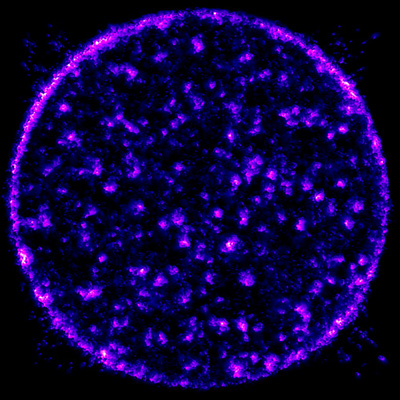
RAW STORY– Scientists said Sunday they had trapped and stored antihydrogen atoms for a record 16 minutes, a stunning technical feat that promises deeper insights into the mysteries of antimatter.

Particles and anti-particles annihilate each other in a small flash of energy when they collide.

At the moment of the big bang, nearly 14 billion years ago, matter and antimatter are thought to have existed in equal quantities. If that balance had persisted, the observable Universe we inhabit would never have come into being.

For unknown reasons — and fortunately for us — Nature seemed to have a slight preference for matter, and today antimatter is rare.

This asymmetry remains one of the greatest riddles in particle physics.

Ongoing low-energy experiments with hydrogen atoms could be a key step toward solving it.

“We can keep the antihydrogen atoms trapped for 1,000 seconds. This is long enough to begin to study them — even with the small number that we can catch so far,” said Jeffrey Hangst, spokesman for the ALPHA team conducting the tests at the European Organisation for Nuclear Research (CERN) in Geneva.

In the study, published in the journal Nature Physics, researchers report trapping some 300 antiatoms.

Scientists used CERN’s high-energy accelerator to create the antihydrogen atoms, and then chilled them to near-zero temperatures.

The aim is to use laser and microwave spectroscopy to compare the immobilised particles to their hydrogen counterparts.

The same team succeeded last fall in trapping dozens of antimatter atoms and holding them in place for a fraction of a second, a world first at the time.

But that was not long enough for the excitable particles to settle into the stable “ground” state needed for precise measurements.

The new benchmark extended this storage time 5,000 fold, making it possible to carry out crucial experiments.

Read the full story about Scientists ‘Trap’ Anti-Matter for Record 16 Minutes.

© 2011 RAW STORY

Photo by Flickr user Fire Brace
Large Hadron Collider Generates ‘Mini-Big Bang’

hadron collider BBC– Dr David Evans: “From conception to design and building this, it’s taken about 20 years.”

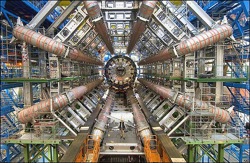
The Large Hadron Collider has successfully created a “mini-Big Bang” by smashing together lead ions instead of protons. The scientists working at the enormous machine on Franco-Swiss border achieved the unique conditions on 7 November.

The experiment created temperatures a million times hotter than the centre of the Sun. The LHC is housed in a 27km-long circular tunnel under the French-Swiss border near Geneva.

Up until now, the world’s highest-energy particle accelerator – which is run by the European Organization for Nuclear Research (Cern) – has been colliding protons, in a bid to uncover mysteries of the Universe’s formation.

Proton collisions could help spot the elusive Higgs boson particle and signs of new physical laws, such as a framework called supersymmetry.

But for the next four weeks, scientists at the LHC will concentrate on analysing the data obtained from the lead ion collisions.

This way, they hope to learn more about the plasma the Universe was made of a millionth of a second after the Big Bang, 13.7 billion years ago.

One of the accelerator’s experiments, ALICE, has been specifically designed to smash together lead ions, but the ATLAS and Compact Muon Solenoid (CMS) experiments have also switched to the new mode.

Continue reading about Large Hadron Collider Generates ‘Mini-Big Bang’.

© BBC, 2010

Photo by flickr user Image Editor

Geneva Atom Smasher Sets Collision Record

hadron colliderASSOCIATED PRESS– The world’s largest atom smasher conducted its first experiments at conditions nearing those after the Big Bang, breaking its own record for high-energy collisions with proton beams crashing into each other Tuesday at three times more force than ever before.

In a milestone for the $10 billion Large Hadron Collider’s ambitious bid to reveal details about theoretical particles and microforces, scientists at the European Organization for Nuclear Research, or CERN, collided the beams and took measurements at a combined energy level of 7 trillion electron volts. The collisions herald a new era for researchers working on the machine in a 17-mile (27-kilometer) tunnel below the Swiss-French border at Geneva.

“That’s it! They’ve had a collision,” said Oliver Buchmueller from Imperial College in London as people closely watched monitors.

In a control room, scientists erupted with applause when the first successful collisions were confirmed. Their colleagues from around the world were tuning in by remote links to witness the new record, which surpasses the 2.36 TeV CERN recorded last year. Dubbed the world’s largest scientific experiment, researchers hope the machine can approach on a tiny scale what happened in the first split seconds after the Big Bang, which they theorize was the creation of the universe some 14 billion years ago.

Continue reading about Geneva Atom Smasher Sets Collision Record.

© AP, 2010

Photo by flickr user Image Editor

Posted in Uncategorized | 1 Reply
