
Dr. Stephanie Kelton: Modern Money Theory Explained


NoMoneyFlickruserBugsyhoPacifica Radio’s Guns and Butter has stayed on the drumbeat coverage of the revolutionary economic school of thought, Modern Monetary Theory (MMT), broadcasting extensive audio from the grassroots economic summit in Rimini, Italy produced by journalist Paolo Barnard:  Summit Modern Money Theory 2012.  At Media Roots, we’ve covered the entire series.  With this week’s instalment, Dr. Stephanie Kelton’s discussion includes:

“Myths about taxation and government revenues in a sovereign currency situation; debts and deficits; full social security and price stability; the use of sectoral balances to analyze the financial position of the different sectors of the macro economy; the three sectors of the macro economy; the two rules governing the three sectors; the financial balance model.”

Messina

***

GUNS AND BUTTER — “MMT emphasises the relationship between the state’s power over its money and its power to do things, real things, to conduct policy in an unconstrained way.  It emphasises that the state, because of its power over money, has a form of power to command resources in the economy.”  —Dr. Stephanie Kelton

“I’m Bonnie Faulkner.  Today on Guns and Butter:  Stephanie Kelton.  Today’s show:  Modern Money Theory Explained.

“Today’s presentation was given at the first Italian grassroots economic summit on Modern Money Theory in Rimini, Italy in February, 2012.

“Stephanie Kelton is associate professor of economics at the University of Missouri, Kansas City, research scholar at the Levy Economics Institute, and director of graduate student research at the Center for Full Employment and Price Stability.”  

Dr. Stephanie Kelton (c. 1:45):  “I’m going to cover some new ground.  And I’m also gonna go back and talk a little bit about a few really important concepts in MMT, that Paolo [Barnard] asked me to spend some more time talking about because I, maybe, went a little bit too quickly in one of the previous lessons.  So, let’s talk about MMT.  And why we think it’s such a revolutionary way to think about so many important economic questions.

“A day ago, two days ago, I forget, I’ve been awake a long time.  The Financial Times ran an article on MMT.  It was a big deal for us in terms of getting these ideas out there, into the mainstream and taken seriously by politicians, financial writers, and journalists, academics, and even into the hands of regular people, who pick up and read the papers.  
(c. 2:53)  “The Financial Times piece said that seeing MMT is like seeing an autostereogram, those images that look wavy and like there’s no picture.  But if you let your eyes rest long enough, the picture becomes clear.  And this is how the Financial Times described MMT.  Some people might see it right away.  And others will have to spend more time wrestling in their minds with some of the ideas because they’re so counter to everything, that we’ve been taught and that we thought we understood about money and government deficits and debt.  

(c. 3:39)  “And, so, I wanna go back and talk again about some of those important concepts.  We think, most people think, that the government collects taxes from us.  And raises money by selling bonds, so that it can finance its expenditures:  ‘The government needs our money, in order to spend.’  But MMT rejects that.  MMT says that a sovereign currency issuer doesn’t have to go out and get the currency from the users in the economy.  The sovereign currency spends its own IOUs, it spends its own money.  It creates its own currency. 

(c. 4:32) “Not only that, but the taxes they collect from us can’t actually finance anything.  And the bonds, that are sold to raise revenue for the state, in a sovereign government, also doesn’t pay for government spending.

“We think of two aspects of monetary channels.  We think of a vertical channel; this is where state money becomes important.  MMT emphasises that the state spends by issuing, what we call, high-powered moneyHigh-powered money is a fancy word for the currency of the state, the notes, the coins, and also the liabilities of the central bank, that are called bank reserves.

(c. 5:27)  “When you and I write a check to the government to pay our taxes, the check goes through a process where our bank account gets debited; and the numbers go down.  A government account gets a credit; and the numbers go up.  But the money supply, the high-powered money itself, the liabilities of the state are destroyed in the processThey are eliminated from balance sheets.  The money has gone down the drain and it can’t be used to finance anything.  

(c. 6:07)  “In addition to the vertical money—the state money—there is a horizontal aspect in any modern monetary system.  Most of the transactions in the private sector don’t involve the government, but private-issued credit money.  We can think of this as the leveraging of state money.  So, high-powered money is the liability of the government.  It sits at the top of the pyramid.  And the private sector uses the government’s money to leverage the creation of its own IOUs, its own money, its own debt.

(c. 6:58)  “In all modern systems, the central bank targets an overnight interest rate.  And then it supplies reserves, on demand, horizontally, at the interest rate, that it sets.  It also drains any excess reserves using what we call open market operations, buying and selling government bonds to hit its overnight interest rate target.  So, bonds are thought of, more appropriately, not as a financing tool, but as an instrument of monetary policy.  Bonds help the government coordinate the reserve add, that is caused by its government spending, with the reserve drain, that’s caused by the collection of taxes.

“In the US, the Treasury and the Fed have a very complex way of coordinating the government’s fiscal operations.  Many of us in the MMT school have written about this.  It is very complex.  It involves a lot of institutional detail and it isn’t something, that we need to cover here today.  If you’re interested in finding out how the very detailed operations work, you can look for something published by Scott Fullwiler on the New Economic Perspectives blog.  You can look back at an article I published in 2000, in the Journal of Economic Issues, that was called ‘Do Taxes and Bonds Finance Government Spending?

(c. 8:52)  “And, of course, Randy Wray’s book, Understanding Modern Money, also deals with some of this.  But I’m gonna skip over the operational details and just tell you that when government spends it adds new money to the banking systemWhen government collects taxes, it takes money out of the banking system.  If the government spends more than it takes out, we say that the government has run a deficit.  The deficit leaves extra reserves in the banking system.  And this triggers a response by the central bank.  The extra reserves push the interest rate down.  This is different from what conventional economics teaches us.  Conventional economics teaches that a government deficit should push interest rates up because the government is thought to compete for some limited pool of savings, and if you want to increase your deficit, you have to pay a higher price to get some of those savings.  MMT rejects that.

We understand that the state creates money, that money is not scarce, that the government doesn’t borrow household saving to finance its deficit, but rather spends first, creating the reserves, that it then drains by selling bonds.  So, the private sector loses the reserves and gains the government bonds.  This is how bonds are used to maintain interest rates in a sovereign currency setting. 

“We use a graph.  I don’t know how helpful it is.  But the vertical component, is this component, that goes straight up and down, and it shows that Treasury spending adds high-powered money (HPM), that builds up in banks until we pay taxes and then some of that money goes down the drain or banks use the state money to create their own liabilities, lending to private citizens and to private firms, leveraging the state’s money.

(c. 11:31)  “So, this is what we like to think of as the vertical and horizontal parts of the story in MMT.  It incorporates the credit theory of money, endogenous money theory, and state money.  It’s all related to Lerner’s Theory of Functional Finance.  In that piece that Lerner wrote, entitled ‘Functional Finance and the Federal Debt,’ Lerner explained that taxes don’t finance anything.  The government can’t spend the money it collects.  It’s eliminated.  And he understood that bond sales are a tool for conducting monetary policy.  Conventional economics teaches that bonds are a tool for fiscal policy, that they are financing tools.  MMT views that very differently.  The bonds are important because they allow the central bank to sell and buy bonds, adding and draining reserves from the banking system in order to hit its interest rate target.  

(c. 12:44)  “So, we should reject the orthodox theory because it’s wrong.  Conventional wisdom on government finance, taxes, and bonds is incorrect.  The conventional theory is that if the government were to finance its spending by creating new money that it would be inflationary, hyperinflationary, they usually say.  But, in fact, as MMT shows, all government spending is, by definition, financed by the creation of new money.  Sometimes, people think that we’re proposing that government do something different, that MMT says sovereign governments should finance their spending by creating new money.  We’re just describing the way they do it now.  So, this isn’t a policy proposal.  It isn’t going to lead to inflation because they already do it that way and it’s not inflationary.

(c. 13:52)  “The orthodox position again suggests that the government sells bonds and that they have to compete for some little, limited, pool of financial resource that’s out there, and if the government wants a piece of that pool and private firms want a piece and households want a piece, we have to outbid one another, and the price of those savings goes up.  The argument in the textbooks is that as the price goes up, the interest rate rises, that this crowds out other forms of spending.  The government comes in and sees that pool and says I want this piece, pushes the interest rate up for all of the other borrowers who want to borrow.  

(c. 14:43)  “And, so, it crowds out the more efficient kinds of private sector spending to make room for the inefficient big government spending.  This is the conventional story.  But, of course, this is wrong.  The bonds are sold in order to take back government money that was created by running the government deficit in the first place.  So, the deficit creates the money that is then made available for purchasing the bonds.  The pool of resources is not limited.  It grows with deficit spending.

“So, everything that the conventional story teaches, what students in any economics class, in any classroom—as we were told yesterday, in Italy they’re being exposed to an orthodox, neoclassical version of economics that doesn’t apply to governments that issue a sovereign currency.”

Bonnie Faulkner (c. 15:54):  “You’re listening to professor and research scholar, Stephanie Kelton.  Today’s show:  ‘Modern Money Theory Explained.’  I’m Bonnie Faulkner.  This is Guns and Butter.  

Dr. Stephanie Kelton: “MMT emphasises the relationship between the state’s power over its money and its power to do things, real things, to conduct policy in an unconstrained way.  It emphasises that the state, because of its power over money, has a form of power to command resources in the economy.  The state imposes the tax; that allows the state to get people to want to work and produce and provide things to the state in order to get the money that they need to settle the tax liability.  This way, the state has command over how to use society’s resources.  It’s not something that’s immediately obvious, but it’s central to MMT.  

(c. 17:06)  “And, so, at an event like this, what we want to do, as much as anything, is to lift that veil that conceals the potential that the state has to use the monetary system in the public interest. [Applause]

“We talked a little bit yesterday about how economists think about the problem of unemployment.  Essentially, there are three options when it comes to dealing with the inevitability of unemployment in any market economy.  Pure unemployment means that the unemployed sit idle, as a buffer stock of people—human beings—who get no wage and have nothing useful to do.  They are assigned no tasks and they have no income.

“Under most systems, there is some form of support for the unemployed, a safety net of some kind.  It might be unemployment compensation, a small payment made to the person who’s lost a job and can’t find one.  That payment might go on for a period of weeks, months, or even years.  All the while, the person is drawing an income, but has no tasks to perform.  

The third option, the one that MMT prefers, is a buffer stock of, not, unemployed, but of employed people.  And I talked about this yesterday and we referred to it as an Employer of Last Resort [ELR] programme or a Job Guarantee.  In a programme like this, when a person loses a job in the private sector or in the public sector, they have another job to go to.  The government does not allow them to sit idle and to pay them to do nothing.  It assigns them a useful task, something society needs done.  They get a wage.  And they get a task.

“We mentioned yesterday that Argentina implemented a form of a Job Guarantee, theirs was called the Jefes Programme.  It offered a job to the head of household.  It gave them a useful task and it paid them a basic wage.  It was highly successful.

“ELR provides people with a transition job, as the economy goes through its normal business cycle of ups and downs.  And then business lay off and then rehire workers, these people have a place to go.  They don’t sit idle in the unemployed pool.  They work in a pool of employed people.  

“The Job Guarantee programme performs the task of a genuine automatic stabiliser; no government bureaucrat has to decide whether to spend when unemployment increases.  No bureaucrat has to decide; it happens automatically.  If you become unemployed and you would like to participate in the Job Guarantee programme, you show up and you’re assigned a task and paid a wage.  You may receive training while you’re in the programme.  When the private sector recovers and begins hiring again, workers will flow out of the Job Guarantee pool and back into other forms of employment.  In this way, the Job Guarantee is a buffer stock programme.  It buffers the economy against the inevitable economic cycle.  So, society gets workers performing useful tasks; the people get to do something useful that makes them feel like they are contributing members of society.  They have wages and benefits instead of nothing or a very minimum with probably no benefit.  

“We’ve never had a Job Guarantee programme in the U.S.  But we did have an interesting programme that did many of the same kinds of things.  Someone in the audience asked yesterday about Roosevelt’s New Deal.  When Franklin Delano Roosevelt was president and the U.S. economy was in the throes of the Great Depression, Roosevelt instituted an alphabet soup of jobs programmes:  the WPA was the Works Progress Administration, my grandfather, one of them, worked in the WPA; the CCC was the Civilian Conservation Corps.  Some of you have asked about environmental problems and whether MMT has anything to say about environmental policy or energy policy.  The CCC was very much concerned with the environmental aspects.  The NYA was the National Youth Administration.  This was a programme designed, specifically, to deal with the problem of youth unemployment, which we know is a very serious problem in many parts of Europe today.

(c. 22:59)  “Roosevelt’s programmes hired the unemployed, gave them a wage, and gave them something useful to do.  They built hospitals, schools, parks, bridges, roadways, airports, stadiums, and much, much more.  They rebuilt America.  The programmes employed millions of Americans in productive and socially useful jobs.  Builders, architects, engineers, and even painters, poets, and actors were employed in these programmes.  But this is something on a huge scale.  It requires the ability to run large government deficits.  It requires sovereign money.  With sovereign currency and a commitment to functional finance, people can design a democracy that works for them. 

“When the people understand this, it eliminates for the policymaker their excuse for not acting.  They cannot say, we don’t have the money to do it.  Whatever is physically possible is financially feasible.  The only constraints that we concern ourselves with, in MMT, are real constraints.  We have already overcome in our minds, because of the monetary system and our understanding of it, the financial constraints.  They don’t exist.  The issuer of the currency can mobilise resources to achieve public purpose.  In any democracy, the people should decide what that means.  As long as the real resources are available—when I say real resources, I mean the land, the cement, the steel, the real things you need to build roads and bridges and airports and schools, whatever it is that you decide you want and need as a people—as long as those things are available, the government, through its power to tax and spend and power to control its currency, can mobilise those resources for the benefit of all.

Certain activities are simply too important to be left entirely to markets and their profit motive, as orthodox economics would have it.  Care for the environment, energy security, healthcare, income security for the elderly and the dependent, and so on, and so on, are too important to be left to market forces.  MMT shows us all that a new and better world is possible.

(c. 26:15)  “Okay, so I’m going to turn to a very important concept in MMT—the use of sectoral balances to analyse what’s happening to the financial positions of different sectors in the macroeconomy.  We’re gonna begin by recognising that deficits are normal.  Capitalist economies, many capitalist economies, run permanent deficits.  Surpluses are rare and fleeting in many large, rich countries in the world.  For some countries, the deficit emerges the ugly way.  The deficit appears because the economy is in trouble.  A recession causes rising unemployment and falling income.  When incomes fall, tax revenues drop off; deficits explode.  You’ve all seen that.  There’s an even uglier way to run a deficit and that is to implement fiscal austerity—recession by design.  And then there are the good deficits, the kind that MMT understands, doesn’t worry about, and supports.  The government can run a deficit by allowing its budget to expand and contract without any arbitrary limit to its size or to the time-frame, under which the deficit is allowed to be sustained.

(c. 28:10)  “With the kinds of policies that I’ve outlined, Job Guarantee and beyond, these may require the government to run deficits most, or even all, of the time.  So, the question is:  Is that good economics?” 

Bonnie Faulkner:  “You’re listening to professor and research scholar, Stephanie Kelton.  Today’s show:  ‘Modern Money Theory Explained.’  I’m Bonnie Faulkner.  This is Guns and Butter.  

Dr. Stephanie Kelton (c. 28:44): “A deficit hawk, we call them in the United States, is someone who is opposed to the deficit on principle.  A deficit hawk often favours what they call ‘sound money,’ a gold standard, a monetary union.  A deficit hawk would legislate rules that mandate balanced budgets at all times.  A deficit hawk believes that there’s no such thing as a good deficit.  And a deficit hawk supports immediate austerity to sharply reduce budget deficits.

“A deficit dove is a friendlier bird.  A deficit dove supports limited deficit spending in tough economic times.  But the doves want the government’s deficit balanced over the business cycle.  Deficits in bad times, surpluses in good times, balanced over the cycle.

“A dove supports rules to limit or constrain government spending.  Think of the Stability and Growth Pact, which allows small deficits, but also expects surpluses over the cycle.  A deficit dove recognises that the deficit is important when the economy turns down and they’re willing to run the deficit in difficult times.  But they want austerity after the economy recovers.  What are they worried about?

“Both the hawks and the doves are worried about the negative consequences of running a deficit.  They are convinced that, at some point, markets will refuse to lend at reasonable rates; interest rates will spike; the debt will become unsustainable; and they think that running large deficits will eventually lead to serious inflation.  Paul Krugman is a deficit dove.  MMT knows better.

“If the government takes advantage of its status as the issuer of the currency, the government could finance its deficit without borrowing at all.  It could be done with no bond sales.  This means no discipline from the bond markets.  No bond market vigilantes.  No solvency problem to deal with.  Interest rates would be lower, not higher, as [Paul] Krugman would suggest.  

“But what about inflation from running the economy too hot?  MMT doesn’t recommend that you run the economy too hot.  MMT recommends using deficits to bring the economy up to full employment, not to push it beyond.  This is a common criticism that we deal with from our critics who say we want huge deficits and beyond full employment and we never want them to stop and they’ll always be large, and, therefore, we must be insane.

“So, they mischaracterise us, so they can mock us.  Functional finance calls upon the government to maintain full employment and price stability.  We are as concerned with inflation, as anyone.  But we don’t view it as a serious problem when the economy is operating far below full employment with lots of available unused resources.  The government has plenty of space to push the economy before inflation should become a relative concern.

(c. 33:18)  “Okay, MMT emphasises that you cannot examine, weigh in on, give opinion to, make statements about the size of the government’s deficit or budget overall in isolation.  You cannot look at just one sector in the economy when we have a multisector economy.  You need to understand how the government’s budget is related to the rest of the economy.  To do this, we need a basic understanding of sectoral balances.  

(c. 34:03)  “So, what did the sectoral balances show?  In any given period, they show whether a particular part of the economy is spending more than its income—running a deficit—spending less than its income—running a surplus—or spending just equal to its income—balancing its budget.  We have to look at three sectors: two internal sectors—domestic sectors—and one external sector.  The internal sectors are your domestic private sector—the combination of all the households and firms in the country put together for analytical purposes—and the domestic public sector—local, state, provincial governments, national government.  Outside of the domestic sphere is the external sector.  This is the rest of the world.  We can call it the foreign sector, foreign governments, foreign households, foreign businesses. 

(c. 35:20)  “So, we have three sectors and two rules.  The two rules are that all three sectors cannot be in surplus at the same time.  And all three sectors cannot be in deficit at the same time.  These are not my rules.  These are the rules of accounting.  One person’s surplus is another person’s deficit.  The only way for one sector to run a positive balance is for at least one other sector to run a negative balance.  You might think of having three coins: heads is positive, tails is negative.  Hold three coins in your hand and flip all three, if they all come up heads, throw it out; it won’t work.  If they all come up tails, throw it out.  You can have two heads and a tail—two surpluses and a deficit—or two tails and a head—two deficits and one surplus.

(c. 36:38)  “Balance sheet rules apply.  Instinctively, we probably think there’s something inherently better about being in a surplus position. But, remember, we can’t all be in surplus at the same time.  It defies the laws of accounting.  At least one sector must be in deficit.

(c. 37:09)  “Here we see the government sector on the left and the non-government sector on the right.  The non-government sector includes domestic households, domestic firms, and the rest of the world, everyone who’s not government.  If there’s a surplus in the government sector than, by definition, there is a deficit in the non-government sector.  If the government is in deficit, then, by definition, the non-government sector is in surplus.

(c. 37:57)  “Two choices: two heads, one tail; two tails, one head.  Which one’s better?  The private sector needs to be in surplus almost all the time.  As a general rule, the private sector cannot survive in a deficit position.  Households and firms, as users of the currency, cannot continually spend more than their income.  At some point, even the financial wizards of Wall Street will run out of credit-worthy borrowers who are looking to borrow more.  When that happens, asset prices go sideways; sales soften; jobless claims go higher; and the economy turns down.  Government budget moves into deficit automatically, the ugly way.

“The private sector cannot create net wealth for itself.  Businesses, banks, and households together can borrow and lend, but every asset is offset by a liability from someone else in the private sector.  The assets and liabilities cancel each other out.  We can’t create net financial assets internally by ourselves, as a private sector.  Net financial wealth must come from outside the private sector.  

So, where do surpluses come from?  Remember that a surplus means that your income exceeds your expenditure.  A deficit means you’re spending more than your income.  Any one of these sectors—the private sector on the left, the public sector and the foreign sector on the right—any one of them can be in deficit or surplus, but they can’t all be in deficit or surplus together. 

“If the government sector is running a deficit, it tends to add to the private sector’s surplus. 

“If the rest of the world is running a deficit against Italy, that means Italy has the surplus.  Either, a government deficit or a trade surplus will increase the private sector’s net wealth.  This is—for those of you who might’ve wondered where the equation came from—it comes from the national income accounting.  I’m just showing you, so that you know I’m legitimate.  You just move identities around.  Trust me, okay?   

(c. 41:42) “On one side of the equation, you see where our nation’s income comes from.  I call that sources of income.  On the other side of the equation, you see how we use our income.  Sources and uses have to be equal.  We can set these equations equal, move terms to other sides, and write this equation here.  Which is the important equation for us?  

(c. 42:10) “This is the difference between what the private sector is saving and spending.  This is the difference between what the public sector—the government—is spending and collecting.  This is the difference between what the rest of the world is buying from you—your exports—and what you are buying from them—imports.”

Bonnie Faulkner:  “You’re listening to professor and research scholar, Stephanie Kelton.  Today’s show:  ‘Modern Money Theory Explained.’  I’m Bonnie Faulkner.  This is Guns and Butter.”

Dr. Stephanie Kelton:  “I mentioned that if the private sector is going to be in surplus, it requires at least one other sector to be in deficit.  This is the actual data for Italy.  The red line on the bottom shows the government’s budget balance.  You can see that in every year, since 1996, the Italian government has run a deficit.  You can also see that the bigger the deficit in the government sector, the bigger the surplus in the private sector.  Indeed, they almost look like they move exactly opposite to one another.  You could even say that as the government goes down, you go up.  That’s a different way to think about the government’s deficit.  I’m not making it up.

(c. 44:08)  “Here’s Ireland.  It looks similar.  As Ireland’s government deficit exploded, so did the accumulation of financial assets—savings—in the private sector.

“Greece: similar.

“Spain: as deficits increase—here’s Spain at more than 10% deficit to GDP and here’s the Spanish private sector in surplus.

“Germany: Germany runs surpluses on occasion.  But what happened to the private sector?  As Germany’s budget moved in to surplus, you can see here in this period where the German budget was in surplus and the private sector was driven into deficit, not some place the private sector usually spends much time because the private sector can’t survive in deficit.  

(c. 45:20)  “Here’s the United Kingdom, Japan, and the United States.  The large deficits that have been run since the downturn in the economy following the financial crisis, huge deficits that have terrified the hawks, have helped the private sector rebuild and repair their balance sheets by adding to their financial savings.  This makes for a good deficit.  The reason that the two lines were not perfect mirror images in the last set of graphs was because I didn’t include the foreign sector.  I just wanted to focus you in on the relationship between the public sector’s deficit and the private sector’s surplus. 

Here is a complete picture for the United States.  Every area in red shows you the US government’s budget position.  Anything that falls below zero indicates a public sector deficit.  You’ll notice that the U.S. government is almost always in deficit.  The blue represents the private sector’s balance.  You’ll notice that the private sector is almost always in surplus.  The green represents the foreign balance.  It’s been quite some time since the US ran a positive trade surplus.  You can see a few back in the early years.  We are now running trade deficits, sometimes, fairly substantial ones.  And that reduces the private sector’s surplus. 

So, let’s focus in on a specific period of time.  The period in the late 1990s and early 2000s when for the first time in decades the US government ran budget surpluses.  You can see those surpluses where the red goes into positive territory.  These years here represent government budget surpluses.  Many people would inherently think that would be a good thing.  It shows fiscal responsibility.  Not only did they balance the budget, but they put it in surplus.  Meanwhile, our current account deficits were huge.  The rest of the world was running large positive balances against the US.  That reduced US private- sector savings.  Surpluses fell.  It pushed the private sector into deficit on an unprecedented scale.  The private sector went from surviving above the zero line to being pushed below zero.  And the private sector remained there for a period of years, spending more than its income, borrowing to do it.  And it was all fueled by a massive bubble economy that ended in recession, which drove the public sector’s balance back into deficit where it belongs. 

(c. 49:16)  “Okay, the last part that I want to introduce this morning is the Financial Balance Model.  We are very excited in the MMT world about this model.  It was developed by a friend of ours, who is an outstanding economist.  His name is Rob Parenteau.  He writes on the New Economics Perspectives blog.  And he came up with this model.  And it is the framework that allows us to compare all three sectors’ budget positions in a graph.  Economists like graphs.  So, in fact, it’s how you gain credibility in our world.  So, one must use models and graphs.

(c. 50:15)  “The vertical axis measures the public sector’s budget position.  If the government is in surplus, we’ll be in the top half of the graph.  If the government is in deficit, we’ll be in the bottom half of the graph.  The horizontal axis measure’s the current account, the foreign balance

“If you’re on the right half of the graph, the current account is in surplus. 

“If you’re on the left half of the graph, the current account is in deficit. 

“The dashed line shows the private sector’s financial balance set at zero. 

“So, every point along the dashed line is a point where the private sector has no surplus and no deficit—spending equals income.  Above the dashed line, the private sector is in deficit.  Remember what I said:  The private sector cannot survive in that territory.  Below the dashed line, the private sector is in surplus.  Okay?

(c. 51:39)  “For a country that issues a sovereign currency, fiat money, no fixed exchange rate, the world is your oyster.  You can be anywhere in the graph.  There are no rules or reasons that you can’t be located anywhere.  But remember the diagonal line, anywhere above that is unsustainable for the private sector.  So, the only sustainable space is below that line, the green line. 

“What about here for countries that use the euro?  Where are you supposed to operate?  Well, if you’re playing by the rules, your deficit is not supposed to exceed 3% of your GDP.  So, we put in a lower bound at 3%, negative.  This is the space that’s available—in theory.  What about countries in the Eurozone that run current account deficits?  Remember that current account deficit is every where to the left of the vertical line, but you can’t go below 3%.  So, countries with a current account deficit, they get that rectangle.  Countries that run current account surpluses have a different space.  A country with a current account surplus can put its private sector in surplus with a smaller public sector deficit.  

“Here’s the situation for a country that uses the euro and also runs a current account deficit.  Can you see it?  It’s a small space.  This is the space that you are given to work with.  Anything above the dashed line means a private sector deficit.  It’s not a sustainable space for you, for any of us.  You must be below the dashed line.  But you must also be above the red line.  But because you’re running a trade deficit, you’re also to the left of the vertical line.  You get only to play in that little triangle.

(c. 54:30)  “So, lets talk about what’s happened to Italy.  Germany has crushed many members of the Eurozone through its labour policies that began in the early 2000s.  Marshall [Auerback] talked last night about the Hirsch Commission and in Agenda 2012, which was Chancellor Schröder’s economic miracle, whereby Germany ‘reformed’ its labour markets by reducing the power of their labour unions and their craft guilds making it easier for their employers to fire people at will, cut unemployment benefits, so that German benefits last about half as long as benefits in the US.  They were harsh ‘reforms.’ And as they were being implemented, unemployment, initially, increased.  It hurt the German economy, but not for long because that pain was soon transferred to others. 

(c. 55:45)  “So, I want you to look at this picture:  Italy, in 1996, was running a trade surplus of more than 3% of your GDP.  You had more fiscal space before the German policies.  And now you have that little triangle.  It doesn’t give you enough policy space without breaking the Stability and Growth Pact rules it is extremely difficult for you to keep the private sector in surplus and the economy healthy.  I would say it’s impossible. 

(c. 56:22)  “Italy makes it into the small triangle, but not often.  Most of the time, though, your deficits have been large enough to compensate for the trade deficits that you run and you’ve been able to keep your private sector in surplus.  But that’s because the rules were broken.  If you had played by the rules, for the last 14 years, you would have been successful three times.

“Ireland would never be successful.  The space is just too small.

“You see Greece.  The triangle for Greece is way up in the corner.  They can’t play by these restrictive rules, either.

(c. 57:05)  “Same problem for Spain.

“Germany, on the other hand does brilliantly, almost every point is to the right of the green line where the private sector is in surplus.  Although, Germany breaks the Stability and Growth rules, like everyone else.  It’s the large current account surpluses that Germany runs, thanks to all of you.  It’s the secret to their success.  It’s why they can run smaller deficits, stay out of trouble.  You are financing it.

Bonnie Faulkner (c. 57:57):  “You’ve been listening to professor and research scholar, Stephanie Kelton at the Summit on Modern Money Theory in Rimini, Italy.  Today’s show:  Modern Money Theory Explained.

“Stephanie Kelton is Associate Professor of Economics at the University of Missouri, Kansas City, Research Scholar at the Levy Economics Institute, and Director of Graduate Student Research at the Center for Full Employment and Price Stability.

“She is Creator and Editor of New Economic Perspectives.  Her research expertise is in Federal Reserve operations, fiscal policy, social security, healthcare, international finance, and employment policy.

“Please visit the University of Missouri, Kansas City New Economic Perspectives blog at www.NewEconomicPerspectives.org.  Visit the website for the first Italian Summit on Modern Money Theory at www.DemocraziaMMT.info.

“Guns and Butter is produced by Bonnie Faulkner and Yara Mako.  To leave comments or order copies of shows, email us at [email protected].  Visit our website at www.gunsandbutter.org.”

Transcript by Felipe Messina for Media Roots and Guns and Butter

fm: Updated 27 MAR 2013 19:07 CST

***

Guns and Butter – April 18, 2012 at 1:00pm

Click to listen (or download)

***

UPDATE:

Also, please see MMT Summit: A Debate on How to Get Out of the Euro.
Posted in Uncategorized | 1 Reply

Academic Dr. William Black: How to Become a Billionaire


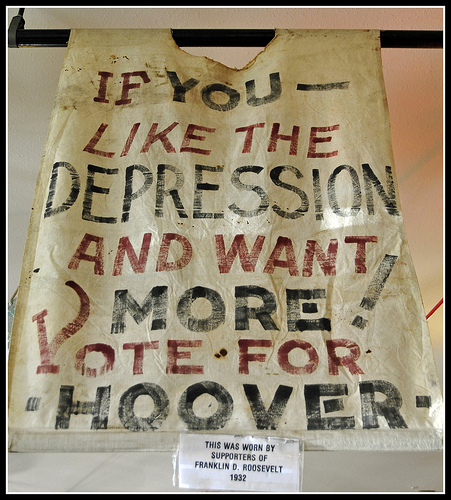
HoovervillesFlickrTony_Fischer_PhotographyMEDIA ROOTS — Pacifica Radio’s Guns and Butter have faithfully broadcast another potent weekly instalment of compelling discussions from the radical economics summit in Rimini, Italy produced by journalist Paolo Barnard:  Summit Modern Money Theory 2012.  Media Roots previously transcribed and featured the first, second, third, and fourth consecutive Guns and Butter broadcasts on the MMT Summit.  Here we present the most recent coverage of this important and inspiring international economic summit featuring academic Dr. William K. Black, author of The Best Way to Rob a Bank Is to Own One.

It’s essential to understand, at least, the basics of how the ruling-class widens inequality.  It’s equally important to understand our role in perpetuating that widening inequality by supporting their corrupt political parties, the Democrat and Republican parties, and their counterparts abroad, for which no amount of token reformers, such as Dennis Kucinich or Paul Wellstone or Barbara Lee or you name it, could compensate because corporate funding isn’t intended to benefit the working-class.  Dr. Black discusses many economics taboos never mentioned.  Similarly, we must acknowledge political taboos never mentioned, such as our rigged two-party system.  The days of New Deal Democrats are long gone.  It’s high time for expanding beyond U.S.A.’s monopolised two-party dictatorship, which undergirds the vast fraud Dr. Black discusses, as well as virtually every other single-issue, which atomised activists toil against.  As U.S.A. faces the masochistic prospect of electing another pro-1% Republican or re-electing the pro-1% Democrat Obama, we bear in mind the role of political parties and their principles, or lack thereof, and our atrophied votes for the least worst, rather than the best possible.  (Transcript below.) 

Messina

***

GUNS AND BUTTER — “And here’s the key question:  How many of you are bankers?  Not many, right?  How much brains does it take to make a bad loan?  I think we could all do that.  So, all the mediocre bankers have no way to make money with honest competition.  But they have a sure thing, if they’re willing to follow the fraud recipe.” —William K. Black

“I’m Bonnie Faulkner.  Today on Guns and Butter:  William K. Black.  Today’s show:  ‘Formula For Fraud.’  William Black is Associate Professor of Law and Economics at the University of Missouri, Kansas City.  He is a lawyer, academic, and former bank regulator and author of The Best Way to Rob a Bank is to Own One: How Corporate Executives and Politicians Looted the S&L Industry.  

“According to William Black, the current crisis is 70 times larger than the Collapse of the Savings and Loan Industry in the late 1980s.  Today’s programme includes two of Bill Black’s presentations on Saturday, February 25th, [2012] in Rimini, Italy at the first Italian grassroots economic Summit on Modern Money Theory produced by Italian journalist Paolo Barnard, which featured speakers Stephanie Kelton, William Black, Marshall Auerback, Michael Hudson, and Alain Parguez.

“In today’s show, Black deconstructs the elements, that constitute the recipe for fraud.”

Dr. William K. Black (c. 2:05):  “It’s difficult to follow such a raging optimist. [Applause]  But I can assure you, it’s actually far worse than they say.  First, there are no ‘technocrats,’ especially the ‘genius’ technocrats.  I suggest a new rule of thumb for judging a ‘genius technocrat.’  They have to be right at least two out of ten times.  And there’s not a single economist in Europe, who calls himself a technocrat, that could do the equivalent of making two penalty kicks out of ten.  So, I’m going to pick up on some of the things, that Michael [Hudson] has talked about.  He quoted Balzac’s famous phrase that behind every fortune lies a great scandal.  And I’m going to explain how that works.  So, you will now learn how to steal €10 billion euros. [Applause]  The purpose of this is not so that you will steal €10 billion euros.  The purpose is so that you can be an intelligent lion because they feed on sheep. 

(c. 3:40) “We’ve been asked to do our talks in four parts.  So, unlike Gaul, my speech is divided in four parts.  This talk will be about why we suffer recurrent, intensifying, financial crises.  Then, I’ll explain how theoclassical economic dogma produces these disastersThe third part will be to explain why our response to the crisis has made it worse.  And I, actually, will end on an optimistic note.  The fourth part is how we have succeeded in some places at some times and why you can do the same.

(c. 4:29) “Part one sounds like one question:  Why do we have recurrent, intensifying, financial crises?  But it’s really two questions.  The first one asks:  What is the cause of these crises?  The second one says:  Well, wait a minute. We keep on suffering crises. Why don’t we learn the right lessons from these crises?  So, part one will focus on what caused the crises.

(c. 5:05) “Part two will focus on why ideology prevents us from learning the right lessons.  

Santayana’s famous phrase, of course, is that those that forget the mistakes of the past are condemned to repeat them.  But, even if we remember the mistakes we’ve made, the new policy we pick could be another mistake.  So, part three discusses that, in part.  

“But part four says the real tragedy is when you forget the successes of the past, when you have something that you know works and that you refuse to use.  Because, as Michael [Hudson] said, there’s not an economics textbook in the world, that warns you that elite CEOs often become wealthy through fraud.  And there is a primitive, tribal, taboo in economics in English against using the five-letter eff-word—fraud.  When I go and talk to groups of economists, who are traditional, I start out the meeting by asking them each to say out loud the word fraudYou can’t believe how difficult it is for them, even, to utter the word.

(c. 6:42) “So, as I said, the lessons of success, it’s a real tragedy to forget them.  And I’m going to quote from George Akerlof and Paul Romer’s famous article, or, at least, an article, that should be famous where the title says it all:  ‘Looting: The Economic Underworld of Bankruptcy for Profit.’  So, the bank fails or, in the modern era, is ‘bailed‘ out, but the CEO walks away wealthy.  And this is what Akerlof and Romer wrote about 20 years ago:

“‘Neither the public, nor economists foresaw that savings and loan deregulation was bound to produce looting, nor, unaware of the concept, could they have known how serious it would be. Thus, the regulators in the field who understood what was happening from the beginning found lukewarm support, at best, for their cause. Now, we know better. If we learn from experience, history need not repeat itself.’

(c. 8:22) “George Akerlof was awarded the Nobel Prize in Economics in 2001.  So, you might think economists would pay attention.  You might think, since this article was written nearly 20 years ago, that the textbooks would mention fraud and looting.  They don’t just ignore everyone here.  They ignore Nobel Prize winners in Economics.

“So, what, again, was this lesson?  It was the regulators in the field, the little people, not the fancy people, who understood from the beginning that deregulation would lead to massive lootingAnd it was the economists, that ignored them.  And after we had proven that it was fraud, after we had sent over a thousand elite bankers and their cronies to prison, after a Nobel Prize winner warned about it, after all those things, they ignored it and produced crisis after crisis, including the one we experience now.

(c. 9:59) “So, what did we know out of that savings and loan crisis, that was widely described at the time as the worst financial scandal in U.S. history?  And we have a history rich in scandal.  Here is what the national commission, that investigated the causes of the crisis reported:

“‘The typical large failure [grew] at an extremely rapid rate, achieving high concentrations of assets in risky ventures… [E]very accounting trick available was used… Evidence of fraud was invariably present, as was the ability of the operators to ‘milk’ the organisation.’ 

(c. 11:04) “That means to loot the organisation.  But, speaking of milk, [Applause] the frauds I’m describing are in no way limited to the Unites States; they exist in every country.  And they are common enough to explain, and they are old enough to explain, what Balzac was saying because many of the wealthy become rich through precisely the scandals, the fraud, I will describe.

“In criminology, we call them financial super predators when we’re being lyrical.  When we’re writing journals, we call them ‘control frauds,’ which is boring.  Control fraud occurs when the person who controls a seemingly legitimate entity, like Parmalat, uses it as a weapon to defraud.  And they can often use this weapon with impunity.  In finance, accounting is the weapon of choice.  And these accounting frauds cause greater losses than all other property crimes combined; yet, economics, again, never talks about it.  Worse, when many of these frauds occur in the same area, they hyperinflate financial bubbles, which is what causes financial crises and mass unemployment.  It makes the CEOs wealthy, produces Balzac scandals, and destroys democracy.

(c. 13:10) “In criminology, we talk about criminogenic environments, long words, simple concept.  When the incentives are extremely perverse, you will get widespread fraud.  So, what makes for perverse incentives?  The ability to steal a lot of money and not go to prison and not having to live in disgrace.  In practice, that means, in English, the three Ds:  deregulation, desupervision, and de facto decriminalisation.  Deregulation: You get rid of the rules.  Desupervision: Any rules, that remain, you don’t enforce.  Decriminalisation: Even if you sometimes sue them and get a fine, you don’t put them in prison.  So, that’s the first area—deregulation

(c. 14:20) “The second area is executive compensation.  And what is ideal for accounting fraud?  Really high pay based on short-term-reported income with no way to claw it back, even when it proves to be a lie.  Those are the most important, but it’s also good, if your assets don’t have a readily verifiable market-value ‘cos then it’s easy to inflate the asset prices and it’s easy to hide the real losses.  And, if you want a true epidemic of fraud, if entry into the industry is very easy, then you’ll get much more fraud.”

Bonnie Faulkner (c. 15:15):  “You’re listening to lawyer, academic, author, and former bank regulator William K. Black.  Today’s show:  ‘Formula for Fraud.’  I’m Bonnie Faulkner.  This is Guns and Butter.”

Dr. William K. Black:  “So, this is what you were waiting for, at least from me.  This is the recipe, only four ingredients, that bankers in many parts of the world use to become billionaires.  And, again, it’s one that Akerlof and Romer agreed with.  So, first ingredient: grow massivelyTwo: by making really, really crappy loans, but at a higher interest rate.  Third ingredient: extreme leverage—that just means a lot of corporate debt.  Fourth ingredient: set aside virtually no loss reserves for the massive losses that will be coming.  By the way, in Europe, this last ingredient is mandated by international accounting rules, which are incredibly fraud-friendly.  And everybody knows that—in accounting—and nobody has changed it.  If you do these four things, you are mathematically guaranteed to report record short-term income.  This is why Akerlof and Romer referred to it as a sure thing—it’s guaranteed. 

(c. 17:10) “There are actually three sure things.  The bank will report record profits.  The profits, of course, are fictional.  The CEO will promptly become wealthy and, down the road, the bank will suffer catastrophic losses.  Again, if many banks do this, you will hyperinflate a bubble.  This recipe helps explain why bankers hate markets, why bankers hate capitalism, why they hate anything like an effective market.

So here’s a thought exercise:  What if you were a CEO of a bank and you wanted to grow exceptionally rapidly?  The first ingredient to the fraud recipe, that means 50% a year.  And that’s realistic; that’s what the banks in Iceland, that’s what many of the banks in Europe—continental Europe—and the US also did.  How would you do that if you were honest? You’re in a market that’s competitive.  The only way to grow that rapidly is to charge far less money—a lower interest rate—for your loans.  But if they’re a real market what would your competitors do?  They would match your price reduction.  You wouldn’t end up making any more loans; and all the banks would be loaning at a lower interest rate.  So, here’s the question?  Is that a good way to make money as a bank?  It’s a terrible thing for a bank, right?  So, all the bankers would lose.  And that’s why they hate markets.  And that’s why banks are the biggest proponents of crony capitalism and the leaders worldwide in crony capitalism

(c. 19:26) “And that leads us to a discussion of why bad loans are so perfect for bank fraud; you can charge a much higher rate to people who can’t get loans because they can’t repay the loans.  And there are millions, tens of millions, of such people.  So, you can grow very rapidly.  You can charge a higher interest rate.  If your competitors do the same thing, it’s actually ‘good’ for you because it hyperinflates the bubble.  And the bad loans, you just refinance them and you hide the losses for many more years. 

(c. 20:22) “So, the CEO takes no risk; all of this is a sure thing.  And here’s the key question:  How many of you are bankers?  Not many, right?  How much brains does it take to make a bad loan?  I think we could all do that.  So, all the mediocre bankers have no way to make money with honest competition.  But they have a sure thing, if they’re willing to follow the fraud recipe.  I’m now gonna quote from the person, the economist [James Pierce, NCFIRRE’s Executive Director], who led the national investigation of the savings and loan crisis.  And he called this dynamic I’ve just explained, ‘the ultimate perverse incentive.’  So, this is what he said:

(c. 21:28) “‘Accounting abuses also provided the ultimate perverse incentive:  it paid to seek out bad loans because only those who had no intention of repaying would be willing to offer the high loan fees and interest required for the best looting.  It was rational for operators’—that’s CEOs—‘to drive their banks ever deeper into insolvency, as they looted them.’  

(c. 22:12) “That is how crazy a world that theoclassical economics has built, where the best way, the surest way, to become wealthy, as a bank CEO, is to make the worst possible loans.  And to make so many bad loans, they have to gut the underwriting process.  Underwriting is what an honest bank does to make sure that it’s going to get repaid.  But, if you want to make bad loans, you have to get rid of your effective underwriting.  So, this is the key, if you get rid of underwriting.  We already established you’re not bankers. 

“So, imagine all of you run Competent Honest Bank and you do underwriting.  And you can tell can tell high-risk and low-risk borrowers.  Low risk borrowers you charge 10%.   High-risk borrowers you charge 20%.  I run Bill’s Incompetent Bank, I can’t tell risk.  So, I charge everybody 15%.  Which borrowers come to me?  Only the absolute worst borrowers.  No good borrower would come because they could borrow at your bank at 10%.  So, this is not like a usual risk.  In economics, we call this adverse selection.  And it means that a bank, that makes loans this way must lose vast amounts of money.  No honest banker would operate this way.  And the banks, that engage in these frauds, also create criminogenic environments, themselves, to recruit fraud allies.  For example, the people, that value homes. If they won’t inflate the value, the dishonest banks won’t use them.  Do they need to corrupt every person that values homes?  No.  5% of the profession would be fine.  They just send all their business to the corrupt—we call them—appraisers in America.  And this is called a Gresham’s Dynamic; and it means that cheaters prosper and bad ethics drives good ethics out of the marketplace.  

(c. 25:18) “Well, what about compensation?  In [the United States of] America, the largest corporations, the largest 100, created a group to lobby, called the Business Roundtable.  And you remember our Enron-era frauds, early 2000s?  Well, they got embarrassed.  And, so, they appointed a task force to look at the frauds.  And they named a particular CEO as head of their task force; and he was asked by Business Week, why do we have all these frauds?  This is the answer he gave:

“‘Don’t just say: ‘If you hit this revenue number, your bonus is going to be this. It sets up an incentive that’s overwhelming. You wave enough money in front of people; and good people will do bad things.’

(c. 26:28) “And that was Franklin Raines, the head of Fannie Mae, which is now insolvent by about $500 billion dollars.  How did Frank Raines know about this perverse incentive?  Because he used it at Fannie Mae to produce the frauds, that made him wealthy.

“How about Ireland?  This is a report by a Scandinavian banker hired to do an investigation, not a real investigation, of course.  He reported:

“‘Bonus targets, that were intended to be demanding through the pursuit of sound policies and prudent spread of risk were easily achieved through volume lending to the property sector.’

(c. 27:25) “Now, that requires a translation, not because it’s written in English, but because it’s written to be not understood.  So, what is he really saying?  The bank CEO sets a target for income, that is huge—three times the current income.  How can you triple income safely?  Wow, if somebody could really do that safely, we’d be happy to pay them a very big bonus, right?  But what does he say?  

“You don’t have to do it safely.  And it isn’t hard.  You just follow the fraud formula, the recipe, and it’s a sure thing.  It’s easily achieved.

“What’s wrong with his sentence, though?  

“He says the targets were intended to be difficult, demanding.  And they were intended to be met through prudent lending.

(c. 28:34) “Seriously, you think that?  The CEO is deciding how much money he is going to make.  Do you think he intended a demanding target or a target that was easily achieved and would make him wealthy?

“So, I will end on this.  We need a coast guard for our banks.  We can no longer allow CEOs to desert their posts after running their banks aground and causing such great destruction.  The cruise ship’s captain’s career is over.  But the elite bank CEOs, that destroyed the global economy remain wealthy, powerful, and famous because they looted.  They were ‘bailed’ out.  They did not leave in a lifeboat in the dark of night.  They left in their yachts, yachts that the governments paid for.  And no official anywhere in the world has demanded of those bank CEOs who deserted their vessels […] [Applause]  Grazie.”

Bonnie Faulkner (c.30:30):  “You’re listening to lawyer, academic, author, and former bank regulator William K. Black.  Today’s show:  ‘Formula for Fraud.’  I’m Bonnie Faulkner.  This is Guns and Butter.”

Dr. William K. Black:  “Someone called on the Black Plague?  I’m here. [Laughter, Applause]

In this part two, I’m going to talk about why we have recurrent, intensifying crises, why we don’t learn the right lessons from our past crises.  And then we’re going to discover something that, of course, you’ve been hearing.  The dominant economists are truly terrible at one thing.  They are terrible at economics.  But occasionally they go beyond economics and they are abysmal on ethics.  And they are the leading opponents and dangers to democracy throughout the EU, in particular, but in America as well.

(c. 31:40) “Economists tell us they want to be judged on their predictive ability.  We welcome their admission because their record in prediction is pitiful.  But, of course, it is precisely the fact that they’ve been wrong about everything important for three decades, that makes them unwilling to admit their error and evermore insistent on continuing their worst policy advice.

(c. 32:12) “As I said economics is particularly awful when it gets into the concept of morality.  In my first talk, I read you a quotation from the economist who conducted the study of the savings and loan crisis.  And he pointed out that it was ‘rational’ for looters to make bad loans.  Well, here is the reaction of one economist, Greg Mankiw, to hearing the work of that national commission and of that Nobel Prize winner-to-be, George Akerlof.  He listened to their story and he said—and this is not an off-hand comment; he was the official discussant; he had the paper a week in advance; he thought about these remarks—he said:

“‘[…] it would be irrational for savings and loans [CEOs] not to loot.’

“So, note that he goes from simply a statement about how you maximise fraud by making bad loans to the ethical proposition that if it would be rational action, it must be the appropriate action, even though the rational action is to defraud.  

(c. 33:40) “Now, there’s a very interesting book called Moral Markets, that had the unfortunate timing to come out in 2008 because it is a triumphal book about capitalism and about how capitalism makes markets more moral.  But even it contains this statement:

“‘Homo economicus is a sociopath. Homo economicus is what happens if people behave the way economists predict that they will behave.’  

And these scholars, who love capitalism, said: if you do that, you will create a nation of sociopaths.  

“Greg Mankiw was not a random economist.  [Then-]President Bush made him Chairman of the President’s Council of Economic Advisers, the most prominent economic position in America, after he had said these things.  

(c. 34:48) “The next two gentlemen are the leading law and economics scholars on corporate law.  And I’m quoting from their treatise in 1991; so, an entire generation of US lawyers have been taught this next phrase:

“‘A rule against fraud is not an essential or […] an important ingredient of securities markets.’

The key economist there—who is not really an economist, he’s a lawyer—is Daniel Fischel.  He worked for three of the worst control frauds, including the absolute worst savings and loan ‘control fraud,’ praised them as the best firms in America, and then wrote this two years later without ever admitting in his book that he had tried his theories in the real world and they had led him to praise the worst frauds.  So, this is rank academic dishonesty on top of getting everything wrong.  And what happened to Fischel after he got everything wrong?  He was made Dean of the University of Chicago Law School, one of the most prominent academic positions in America.

(c. 36:15) “Alan Greenspan also worked for the worst fraud in the savings and loan crisis.  Charles Keating’s Lincoln Savings.  And he personally recruited, as a lobbyist for this worst fraud, the five [bipartisan] US Senators who would intervene with us to try and prevent us from taking enforcement action against the largest violation in the history of our agency because that violation was by Charles Keating and Lincoln Savings.  And those five senators became known and ridiculed as the Keating Five.  By the way, [Republican Senator] John McCain was one of those senators who met with us.  [The other four were Democrats.]

Alan Greenspan then wrote a letter saying we should allow Lincoln Savings to do these terrible investments because ‘they posed no foreseeable risk of loss to the federal insurance fund.’  Lincoln Savings proved to be the largest cost to the insurance fund.  After he had gotten it as wrong, as it is possible to get something wrong, we made him Chairman of the Federal Reserve.  So, here you have a record of we promote and honour, in economics, the people who get it spectacularly wrong, as long as they get it wrong for powerful banks, that are frauds.

(c. 37:59) “So, what did they predict?  This is the short list.  Neoclassical economists predicted, that because markets were efficient they were self-correcting, fraud was automatically excluded, and financial bubbles could not occur

“They assured us that because of bankers’ interest in their reputations and auditors and appraisers, that they would never commit a fraud and never assist a fraud

“They predicted that massive financial derivatives would stabilise the economic system

“They told us, even when the bubble had reached proportions larger than any in the history of the world, that there was no housing bubble in the United States, that there was no housing bubble in Ireland, that there was no housing bubble in Japan, that there was no housing bubble in Spain

“They told us that if we paid CEOs massive amounts of money based on short-term performance, that was fictional, it would align the interests of the CEO with the shareholders and the public and be the best possible thing.  

(c. 39:30) “Every one of these predictions proved utterly false.  Actually, every single one of these predictions had been falsified before the economists ever said them; and they did not change. 

“What did they do back in the day?  They looked at Europe.  This is Cato, named, of course, after a famous Roman—a very conservative anti-think tank in the United States.  Cato, in 2007, as Iceland was collapsing in massive fraud, said these words:

“‘Iceland’s economic renaissance is an impressive story. Supply-side reforms’—that means tax cuts—‘along with policies, such as privatisation and deregulation, have yielded predictable results.’

“Remember, we’re making predictions. 

“‘Incomes are rising, unemployment is almost non-existent, and the government is collecting more revenue from a larger tax base.’ 

“So, they cut taxes, but overall tax revenue grows because the country is growing at a massive rate.  Why?  Because the big three banks in Iceland are all accounting control frauds.  They are growing at an average rate of 50% every year.  And by the time they collapse in 2008, they are ten times the GDP of Iceland.  And they suffer 60% losses on their assets.  That was their prediction of proof-positive that deregulation, low taxes, privatisation produce economic booms.

(c. 41:36) “They said something very similar about Ireland in an article entitled ‘It’s Not Luck‘:

Ireland […] boasts the fourth highest gross domestic product per capita in the world. In the mid-1980s, Ireland was a backwater with an average income level 30% below that of the European Union. Today, Irish incomes are 40% above the EU average.

“‘Was this dramatic change the luck of the Irish?  Not at all.  It resulted from a series of hard-headed decisions that shifted Ireland from big government stagnation to free market growth.’ 

And they wrote this in 2007, a year after the Irish bubble had popped and Ireland was going into freefall.  And what are we being told now is the answer?  Hard-headed decisions, that shift the governments from big government stagnation to free market growth.  They have learned absolutely nothing from their past failed ‘predictions.’  In fact, Trichet came to Ireland in 2004 and said Ireland should be the model for nations joining the European Union.”

Bonnie Faulkner (c. 43:20):  “You’re listening to lawyer, academic, author, and former bank regulator William K. Black.  Today’s show:  ‘Formula for Fraud.’  I’m Bonnie Faulkner.  This is Guns and Butter.”

Dr. William K. Black:  “But we have seen this movie many times before in many countries.  We had seen it in the Savings and Loan Crisis.  But then came the Enron-era Crisis and WorldCom.  And I’ll focus on just one aspect.  Again, we had accounting control fraud, that drove an immense crisis.  But what people forget is that most of the world’s largest banks eagerly aided and abetted Enron’s frauds.  They knew Enron was engaged in fraud; and they thought that was a good thing because they would get more deal flow, as we say, more volume.  These frauds were documented extensively by investigations, hundreds of pages about it.  Not a single one of the large conventional bankers were prosecuted.  There was a prosecution about Merrill Lynch, which the courts obstructed.  Indeed, the U.S. Supreme Court ruled that only the government could bring civil suits—against an enforcement action, of course—against banks, that aided and abetted fraud.  Think of that!  You could have indisputable proof that the bank had aided Enron, knowingly done so, caused you billions in losses, and you could not sue the bank.  That’s how bad the law has become in the United States. 

(c. 45:27) “So, that left us with, Will the government sue?  Well, the Federal Reserve, we now know from recent testimony in front of the national commission, that investigated this current crisis, the leadership actively resisted bringing any action against the banks, even what we call a slap on the wrist.  And it was only when the Securities and Exchange Commission took a slap on the wrist that the Federal Reserve was embarrassed into taking any action. 

“We also know, from this extraordinary testimony by the long-time head of supervision at the Federal Reserve, that he was deeply disturbed by the fact that most of the largest banks in the world had aided Enron’s fraud.  So, he put together a comprehensive briefing for the leadership of the Federal Reserve.  At that meeting, the senior officials of the Federal Reserve and the senior economists of the Federal Reserve did not criticise Enron and they did not criticise the banks that aided Enron’s frauds.  They were enraged at the supervisor.  How dare he criticise banks?  And this was the era—and continues, in the United States, to be the era—of reinventing government, which is a neoclassical, neoliberal, be soft on bankers

And I witnessed, personally, when our Washington staff came at a training conference and instructed us that we were to refer to banks as our clients.  We were the regulators.  And we were, not only, supposed to refer to them as clients, we were supposed to treat them as clients.  Being a quiet type, I stood up and began protesting; and they simply shouted us down. [Applause]”

(c. 47:59) “So, this is occurring in 2001, 2002, 2003, 2004.  At that point, Italy enters the picture.  And Italy enters the picture because of Parmalat.  And it enters the picture because, again, you have a massive accounting control fraud where the CEO is looting Parmalat and taking the money out of Italy to tax havens where he can hide it in a wave of special complex corporate forms designed to hide the fraud. 

“And what does the Federal Reserve say about all of this?  Well, first they brag about their ‘enforcement’ action.  Note that they won’t name the large institutions

“‘In these enforcement actions, certain large institutions were required to revise their risk management practices where examiners found failures by these institutions to identify those transactions, that presented heightened legal and reputational risk, particularly, in cases where transactions were used to facilitate a customer’s accounting or tax objective, that resulted in misrepresenting the company’s true financial condition to the public and regulators.’ 

(c. 49:42) “So, this is another passage that requires translation, not because it’s in English, but because it’s in gobbledygook.  So, what are they really saying?  First, they are bragging about an enforcement action, that they tried very hard not to bring and which was utterly useless.  Second, note what their concern is.  Their concern is “heightened legal and reputational risk.”  They’re worried that when the bank aids Enron or Parmalat’s frauds they’ll get caught and then their reputation will suffer.  They’re not worried about Enron’s shareholders.  They’re not worried about the 12,000 Enron employees who lose their jobs.  They’re not worried about Parma’s economy.  None of that matters.  They don’t even discuss it.  And they’re not worried about morality.  Call me old school, but I thought, when I was a regulator, if the banks I was regulating were engaged in fraud, first, my job was to stop it. Second, my job was to remove the CEO from office.  Third, my job was to help prosecute him and put him in prison.  And, fourth, my job was to sue him, so that he walked away with not a lira or a euro or a dollar.  But all of that is gone. [Applause]

(c. 51:25) “But you know this because you have probably seen a gem of a film.  And you know, probably, what Citicorp called this special vehicle it created to facilitate the looting of Parmalat.  Somehow, I think this means black hole; that’s what they called it.  And this is so wonderful.  Citicorp eventually said it regretted one thing, calling it bucanero.  The only thing it was honest about is the only thing it regretted.  What it did to Italy in Parma, not so much.

(c. 52:15) “So, what did people find in this crisis?  This is the National Commission Report on our crisis

“‘We conclude widespread failures in financial regulation and supervision proved devastating to the stability of the nation’s financial markets.  The sentries were not at their posts […] due to the widely-accepted faith in the self-correcting nature of the markets and the ability of financial institutions to effectively police themselves.’ 

“It specifically blames Greenspan and his deregulatory ideology.  That could have helped to avoid a catastrophe.  

(c. 53:05) “But those are words.  Here is an image.  The person—yes, this man—he is ‘Chainsaw Gilleran.’  That translates very well into Italian, I see.  He was the head of the agency I used to work for.  He is standing next to the three leading bank lobbyists in America and the guy who will be his successor.  They are poised and posed over a pile of federal regulations.  And, if that’s too subtle, they are tied up in red tape.  And the message is:  We will work with our clients, the banks, to destroy all regulation. And the reason we bring a chainsaw is to make clear that everything will be destroyed. 

(c. 54:00) “Well, what about Europe?  There was a conservative dissent to the conclusions I’ve just read.  They claimed that deregulation could not have been a major cause of the crisis in America because the crisis also occurred in Europe.  That’s all they said.  They implicitly assumed that Europe must have been tough on bank regulation.  

I will conclude with these words from the report on the Irish Crisis.  There were generic weaknesses in EU regulation and supervision.‘  So, the dissent has it exactly wrong.  They’re right; it’s important to look at Europe and the same causal mechanismderegulation, desupervision, and this absurd executive compensation—swept Europe and America.  And the economists got what they wanted and predicted it would be wonderful.  It produced a catastrophe. [Applause]”

Bonnie Faulkner (c. 55:30):  “You’ve been listening to William K. Black.  Today’s show has been ‘Formula for Fraud.’  William Black is Associate Professor of Law and Economics at the University of Missouri, Kansas City.  He is a lawyer, academic, and former bank regulator and the author of The Best Way to Rob a Bank is to Own One: How Corporate Executives and Politicians Looted the S&L Industry.  

“Please visit the University of Missouri, Kansas City New Economic Perspectives blog at www.NewEconomicPerspectives.org.  Visit the website for the first Italian Summit on Modern Money Theory at www.DemocraziaMMT.info.

Transcript by Felipe Messina for Media Roots and Guns and Butter

fm: Updated 27 MAR 2013 18:51 CST

***

Guns and Butter – April 4, 2012 at 1:00pm

Click to listen (or download)

MR Transcript: Modern Money Theory and Private Banks

econtextbooksFlickr_xshamethestrongxMEDIA ROOTSPacifica Radio’s Guns and Butter have faithfully broadcast another potent weekly installment of compelling discussions from last month’s Summit Modern Money Theory 2012 in Rimini, Italy, one of the more salient popular developments and signs of consciousness raising in recent history since Tahrir, Wisconsin, and the Occupy Movement.  Join us, as we continue our exploration through the MMT school of economic thought and its implications for the world’s working-class, currently facing the worst economic recession since the Great Depression.

Media Roots previously featured the first, second, and third consecutive Guns and Butter broadcasts reporting back from the MMT Summit in Italy and have archived those broadcasts and transcripts as well.  Here we present the most recent coverage of this important and inspiring international and grassroots economic summit. 

Messina

***

GUNS AND BUTTER — “MMT advocates a wide range of programmes.  The most important is probably the Job Guarantee.  Very briefly, the Job Guarantee is a programme, that would allow the government to achieve what’s never been achieved before in any market economy—true full employment.

The basic idea is that the government offers a wage and a benefits package to anyone who’s unemployed, but ready and willing and able to work.

Bonnie Faulkner:  “I’m Bonnie Faulkner.  Today on Guns and Butter:  Stephanie Kelton and Michael Hudson from the first Italian grassroots economic Summit on Modern Money Theory in Rimini, Italy, February 2012.  Today’s show:  Modern Money Theory and Private Banks.

“Stephanie Kelton is associate professor of economics at the University of Missouri, Kansas City, research scholar at the Levy Economics Institute, and director of graduate student research at the Center for Full Employment and Price Stability.”  

Dr. Stephanie Kelton (c. 1:37):  “The next thing I want to do is talk to you about functional finance It’s not a very interesting sounding topic.  In English, the opposite of functional finance is dysfunctional finance.  And that’s what, I would argue, most countries in the world deal with today.  And I think the reason is because none of us, that have sovereign currencies understand exactly what that means.  And we act as if we face the same kinds of constraints—governments act that way—that households and businesses face.  We’re told all the time that a government should have sound fiscal finances, should live within its means, should exercise fiscal discipline just the way a household must.  But, hopefully, by now you understand that a country, that operates with its own fiat currency, that is a non-convertible currency—government does not pledge to convert the currency into gold or into some other country’s currency—doesn’t have to behave like a household.  It can use its powers differently.  And that’s what functional finance is all about.

(c. 3:02) “I mentioned this morning the name Abba Lerner.  Abba Lerner wrote many important articles and books, that influence the work, that MMT economists do today.  Most of Lerner’s early and important works were written as the world was fighting and battling the effects of the Great Depression.  Lerner understood, as Keynes did, that unemployment was a normal feature of any money-using capitalist economy.  For Lerner, unemployment wasn’t just something that countries needed to deal with when there was a Great Depression or serious recession, but in normal times as well because the economy always operates with some level of unemployment.

(c. 4:03)  “Lerner, as an economist, viewed the workings of the economic system very differently from the conventional classical economist, who believes:  Supply creates its own demand. Markets, naturally, tend to full employment. Governments just get in the way; intervention by government is unnecessary and destabilising. When something bad happens in the economy, the best course for government is to keep its hands off—laissez-faire, let it be. Markets will fix themselves. They are self-correcting.

Lerner didn’t accept this, and neither did Keynes.  They both understood that market economies are complex, that the decisions taken by the producers are different and not coordinated with the decisions taken by consumers, foreigners, other businesses, government.  

(c. 5:17) “Lerner did not believe there was a mechanism, that would coordinate the spending decisions of all of us with the production decisions of the business sector in a way, that kept the economy operating in a healthy manner, in a way, that would provide full employment for everyone.  Businesses have to produce, today, without knowing what the future demand for their products will be.  Maybe they produced too little and demand was higher than they expected.  In that case, they see their inventories fall.  And it’s a good sign to them; people want more output.  They respond by producing more.  But if businesses produce output and find that the demand is not there; their inventories begin to rise.  The signal to them is:  You’ve produced too much.  What do they do?  

(c. 6:24) “Conventional economic theory tells us:  This is not a problem.  If inventories build up, prices fall until there’s demand for everything, that’s produced.  But in the real world we know better.  We know how businesses respond when demand for their goods is falling.  They respond by cutting back their production and laying off a part of the work force.  It gives rise to unemployment.  It’s natural; that’s the way market economies all operate.  There isn’t a single capitalist economy anywhere in the world, that achieves full employment and sustains it.  Every market economy goes through a business cycle, an upswing where times are good and unemployment is low, and a downswing, where times are not good and unemployment is rising.  Lerner recognised that; and he called on the government to respond in a particular way.

(c. 7:26) “The conventional view is that if there’s unemployment, it simply means employers don’t want to hire the workers at such a high price. The solution to unemployment for most of the academic economists in the world is, therefore, lower wages.  Right?  Too much supply of labour—unemploymentmust mean the price of labour is too high. So, the solution is to cut wages. If something goes wrong in markets, you let markets fix things. Keep government out!

(c. 8:07) “Sometimes, economists talk about structural problems in the labour market.  Well, unemployment exists because the jobs, that are available require certain skills, that the unemployed don’t have.  Therefore, they propose things like training programmes for the unemployed.  All we need to do is get the unemployed together, train them, give them better skills, and they will go out and find jobs. The problems are almost always with the worker.

Lerner and Keynes and the MMT school reject the notion that problem is with the worker.  The problem is that there aren’t enough jobs.  

“If you took 100 dogs and you buried 95 bones in a field and you told the dogs their job was to go out and find a bone, what’s the very best case scenario?  The best you can possibly hope for is that 95 dogs come back with bones.  Five dogs can’t get bones.  More likely, some dogs will get lucky; they’ll stumble across a few extras.  Some may have better skills; they’ll find three or four.  So, the number of dogs, that come back without bones may be ten or fifteen.

(c. 9:38)  “The conventional economist would gather the dogs together, the ones that had no bones, and train them to sniff out bones more effectively.  Then they would send those hundred dogs back out into the field and tell them to go come back with a bone.  And, again, the best you can get is 95 dogs with bones.  What’s wrong is that there aren’t enough bones.  There’s nothing wrong with the dogs.  The bones are the jobs.  There’s nothing wrong with the unemployed.  There simply aren’t enough jobs.  

(c. 10:20)  “Economists actually believe that unemployment is, not just unavoidable, but, actually, beneficialThey think that unemployment helps to discipline the worker because if you’re afraid of becoming unemployed, you’re more likely to work harder, do a better job for fear that you may lose your job.  Economists believe in a trade off:  We could have lower unemployment, but that would lead to inflation; and that’s the worst possible evil in the world. So, we better keep some people unemployed, so the economy doesn’t operate at too high a level, so that we can keep prices from rising too rapidly.  So, they actually define full employment, as the level of unemployment, that helps you keep prices from rising.  We define unemployment into our models.  We accept it.  It provides an excuse for not striving for more.  We enshrine in it in our policies.  

(c. 11:35)  “The Maastricht Treaty does not place full employment as a goal at all for the central bank, for the ECB.  It has a sole mandate, which means there is really only one cruel enemy in the world; and that is inflation.  The Federal Reserve, in the United States, has a dual mandate, at least in theory; the central bank in the U.S. is supposed to use policy to keep prices stable, but also to try to encourage high levels of growth and high levels of employment.  At the end of the day, though, the Fed considers price stability the primary objective, probably recognising that there’s little the central bank can do, anyway.  

(c. 12:33)  “Employment policy does not belong with the central bank.  It belongs with the national government, as part of its fiscal policy.  And that’s where Lerner placed it.

“Unemployment is every bit as damaging to a society as inflation.  The costs are tremendous.  We know, and we talked this morning, about what some of those costs are.  The direct costs are obvious.  Anyone who’s not working, not producing something, represents an economic waste, a loss of output for the whole of society, an income, that’s not produced.  But there are other costs, maybe even more important, indirect costs.  We talked this morning about some of these.

(c. 13:27)  “What happens when you’re unemployed?  You feel excluded from society?  Your skills degrade.  The longer you’re unemployed, the longer your skills break down.  The longer you’re unemployed, the less employable you are.  Businesses don’t wanna hire people who’ve been unemployed for months or, in the case of the US, years.  Unemployment creates psychological harm, depression, anxiety, suicide rates increase.  It may be great for the pharmaceutical companies, who sell anti-depressant drugs and make billions.  But it’s very, very damaging for society.  People lose their motivation.  Family relations, divorce, spousal abuse, all become problems when unemployment is high.  

(c. 14:24)  “It’s difficult to measure these kinds of costs, but it can be done.  Just this year, the White House put out a study, that attempted to figure out exactly what are the costs of having a young person unemployed, not in school.  What are the indirect costs, that are borne by all of us?  Crime goes up.  You lose your job.  You lose your health care.  You get sick; health care costs increase because you don’t seek care until you’re quite ill.  Spending on various social programmes increases because you don’t have an income to support yourself.  The White House estimates that the cost of a single unemployed, out-of-school, young American is almost $38,000 per year.” 

Bonnie Faulkner (c. 15:19):  “You’re listening to professor and research scholar, Stephanie Kelton.  Today’s show:  Modern Money Theory and Private Banks.  I’m Bonnie Faulkner.  This is Guns and Butter.”

Dr. Stephanie Kelton (c. 15:34):  “Now the direct costs, the loss of output and income from having someone sit on the sidelines, producing nothing, as opposed to being in a job producing a good or service in the economy.  If you see the light grey line at the top it shows you what the path was for the US GDP before the financial crisis and recession.  If that had never happened, the estimate is we would’ve been up on that light grey line.  But, because of the financial crisis and the economic recession, our GDP fell sharply.  The difference between the blue line and the grey line is our GDP gap.  It represents the lost income, the lost production from all of the additional unemployment.  How much is that?

(c. 16:33)  “Bill Mitchell, who is a major MMT figure has run the numbers.  What he did was estimate the daily costs of unemployment in the US, the difference between the blue line and the grey line on a daily basis.  And he concludes that the US is sacrificing the equivalent of between $6 and $11 billion dollars every single day that we permit our unemployment level to remain elevated.  So, Bill says—and he doesn’t mince words—he says, ‘Just say to yourself, every day the US government is allowing $9.7 billion dollars to go down the drain in lost income just because they’re too stupid to create sensible job creation.  What is sensible job creation?

(c. 17:38)  “If you ask a technocrat or a member of the conservative party in the US, they’ll tell you that the key to job creation is creating a better environment for businesses.  Okay.  I agree.  But what does creating a ‘better environment’ mean?  For them, it means lower taxes; it means less regulation.  Those are the things, that are really holding the employer back.  That’s why they won’t hire and invest.  It’s why the economy is not growing.

But ask an employer what’s holding them back.  Survey after survey, in the US, tells us that it’s not high taxes or burdensome regulation, that’s primarily keeping them from adding to their workforce and increasing their investment spending, it’s poor sales.  They don’t have customers.  And the reason they don’t have customers is that we had a financial crisis, that was fuelled by a huge debt bubble, that crashed and left major portions of the U.S. population without the income to go shopping. 

(c. 19:00)  “The fundamental economics for a person like Lerner, Keynes, or an MMTer is simple.  Sales create jobs.  Employers hire workers when they are swamped with demand, not when they get a tax cut, not when regulations are eased.  Customers create sales.  But customers have to have income to spend.  So, income creates sales.  And spending creates income.  Every time someone spends money, someone else is on the receiving end.  It becomes their income.  

“If you think that you’re going to cut your way to prosperity, I think you’ve got your economics all backwards.  Fiscal austerity, sound finance, as they call it, means cutting spending.  But that means cutting income.  But that means cutting sales And that means losing jobs.

(c. 20:05)  “So, what did Lerner suggest?  Unemployment exists because there’s not enough spending in the economy.  In any economy in the world, spending comes from one of four places: the household sector, the biggest and most important source of demand in the economy; business sector; the government sector; and the rest of the world, whatever they want to buy from you.  What’s the problem today?  Consumption spending is down because income is down.  If people aren’t consuming, businesses don’t have customers, investment spending falls.  So, two important components of demand in the economy are massively depressed right now.  Lerner’s recommendation is that you have to offset that with government spending.  Functional finance is the term he gave to his proposal for the way the government should run its fiscal, macroeconomic policies.

(c. 21:11)  “You have to have a sovereign currency in order to run functional finance.  You cannot do it on a gold standard or with fixed exchange rates.  You can’t do it with the euro.  The US has a sovereign currency, but its finances are dysfunctional.  Just because we can doesn’t mean we do.  So, it’s not enough just to create the correct monetary system; you also have to create the correct macro policy.

“Abba Lerner wrote a very colourful article called ‘The Economics of the Steering Wheel.’  And in the beginning of the article he talks about this imaginary planet where the Martians drive around on this complicated interplanetary highway system.  The cars don’t have steering wheels.  The roadways have high curbs.  The cars bounce from left to right, meandering around the path.  Lerner says, ‘If someone from Earth visited this planet, they would look at this highway system and call it crazy. Wow, aren’t we clever on Earth? We put steering wheels in our cars. We don’t bounce around from curb to curb. We control our destiny.’

(c. 22:39)  “And then he says, ‘Why aren’t we so smart when it comes to our economy? We give up the steering wheel. We let markets push us around. And we assume there’s nothing we can do.’  Laissez faire, let it be.

So, what does Lerner want?  Functional finance.  The government’s job is twofold.  One, the government has to keep the level of spending in the economy high enough to maintain full employment.  Two, the government uses its powers to adjust taxes, spending in order to achieve the first goal.  You don’t target an arbitrary deficit level. You let the deficit go where it needs to go in response to what’s happening in the economy.  Taxes don’t finance the government; they help to drive the monetary system.  They get the government’s currency accepted.  They give it value, but the government doesn’t need to get money from the private sector to spend.  The government spends by issuing its own currency.  The government doesn’t even need to borrow to do this.  In fact, Lerner said it shouldn’t.  Borrowing takes money from those that have it, when the goal is to let people spend as much as they will on their own to get to full employment.  With a sovereign currency, governments spend by directing their bank to credit someone else’s account.  This almost always happens without the government even writing a check.  In a modern era, governments spend with keystrokes.  And you can’t run out of keystrokes. 

(c. 24:31)  “We sometimes say the government is like a scorekeeper.  If you go to a football match and your team is doing really well, scoring goal after goal after goal after goal, do you sit in the audience and worry that the stadium is going to run out of points?  It’s impossible.  It’s also impossible for the government to run out of keystrokes.  There’s no financial constraint on a government, that issues its own currency.  The only relevant constraints are real constraints, resource constraints.  If you try to use more resources than there are available, you’ll push up the price of those resources and the result will be inflation.  

(c. 25:23)  “So, what should the government do?  Use its powers to tax and spend to keep the economy operating at the right temperature.  Lerner thinks of taxes and bonds, not as financing tools, but like a thermostat in your home.  What do you do if it’s too cold?  Turn up the heat.  What do you do if you’re too warm?  Turn down the heat.  Same thing with the economy.  If the economy is not operating at a high level, you cut taxes or increase spending.  If the economy is operating too hot, you raise taxes.  Or cut spending.  These are tools to use to achieve the goals of the macroeconomic policy.

(c. 26:09)  “Lerner recognised that deficits are normal.  Government will almost always be in deficit; and that was okay for him.  When it comes to the type of deficit, what should the government spend on?  If it cuts taxes, who should benefit?  

“MMT advocates a wide range of programmes.  The most important is probably the Job Guarantee.  Very briefly, the Job Guarantee is a programme, that would allow the government to achieve what’s never been achieved before in any market economy—true full employment.  The basic idea is that the government offers a wage and a benefits package to anyone who’s unemployed, but ready and willing and able to work.  This programme acts as a buffer stock.  It absorbs workers when the economy is weak; and it releases workers when the economy is strong.  They flow in and out of the government employment programme, as the economy goes through natural cycles.  The benefits of such a programme are many.  And we probably can talk more specifically later this evening.  Thank you. [Applause]”

Bonnie Faulkner:  “You’ve been listening to professor and research scholar, Stephanie Kelton at the Summit on Modern Money Theory in Rimini, Italy.  She is Creator and Editor of New Economic Perspectives.  Her research expertise is in Federal Reserve operations, fiscal policy, social security, healthcare, international finance, and employment policy.

“We next hear from financial economist and historian Michael Hudson.  Michael Hudson is a Wall Street financial analyst and Distinguished Research Professor of Economics at the University of Missouri, Kansas City.  Today’s show:  Modern Money Theory and Private Banks.  I’m Bonnie Faulkner.  This is Guns and Butter.”

Dr. Michael Hudson (c. 28:29):  “One of the last questions, before lunch, this morning was, how is it that Italians are so poor and work so hard if Berlusconi can have so many girlfriends? [Laughter in Audience]  So, just imagine how your world was back in 1945.  Suppose you were alive in 1945 and somebody had told you about all of the new technology, that would be invented between then and now.  What if you were told about all of the computers, the internet, the communications and television, the jet air travel, the super trains, the increased gas mileage, the plastics, the medical breakthroughs?  You would’ve imagined that we all would be living in a life of leisure society by this time.  And, in fact, all of this was celebrated, as a post-industrial economy.  And, indeed, productivity has grown so much that under all of the textbook models the idea was that rising productivity would be passed on to labour in the form of lower prices, so wages would go further or higher wages.  The whole idea was:  Who was to get the fruits of all of this productivity?  

“And in all the textbooks there was what was called Say’s Law; workers had to be able to buy the results of what they produced.  And this was a circular flow, the circular flow between producers and consumers.  And this idea goes all the way back to the French Physiocrats, just before the French Revolution, who created economics and account keeping.  The founder of Physiocracy, François Quesnay was a medical doctor and a surgeon.  And he based the idea of national income accounting on the circular flow within the body, between producers and consumers.

(c. 31:00)  “So, the idea was that all of this increased production had to increase consumption.  So, the idea was, as a variant of functional finance, that production creates its own market for consumption by paying workers, who’d then buy the products they produce.  So, the question is:  Why hasn’t this occurred?  With all of this productivity since the end of World War II and, especially, since 1980, why aren’t you all rich and enjoying a leisure economy?

“After World War II, mainly the men worked and the women were at home.  Since 1945, women have been forced into the labour force for what are called two-job families.  And now there are three-job families.  If you project labour participation rates, by the year 2020, every woman will have to work 18 hours a day and her children will have to begin working at age three to sustain their standard of living.  If you are going to have children, you had better send them to work at the age of three or you will go broke. [Applause]

(c. 32:28)  “Well, obviously, what has happened is that what was then applauded as the post-industrial economy has become the financialised economy.  The reason you are working so much harder than you were before is because you are paying off your debts.  You’re not buying the goods and services, that you produce.  You’re paying the banker because you can only maintain your consumption standards and keep on spending what you produce if you borrow to do it.  That is the euro plan for you.  That is how the euro plan is replacing industrial capitalism with finance capitalism.  

(c. 33:13)  “Wages and living standards have not risen.  All of the gains have been siphoned off by finance.  When they call for austerity, it is not the fat, that they are cutting—the fat is the financial sector—it’s the bone; it’s the industrial sector.  So, the post-industrial economy means deindustrialisation.  It means unemployment for you.  And unemployment means lower wages. 

“In all of the economics textbooks in Economics 101, as you saw on the door, there are supply and demand curves.  The idea is that the higher the employment rate, the more you have to pay labour to drive it into the labour force.  So, the government officials and the bankers read these textbooks and they say, Ah! Okay. So, the less employment, the more wages go down! And the more we earn! And, so, we want unemployment in order to maximise the power of our wealth over labour.  

(c. 34:34) “150 years ago, this was called the reserve army of the unemployed.  You need unemployment to keep labour down.  So, despite the fact that you have productivity rising since World War II, the real economy and you’re wages have become an S curve, tapering off.  What has grown, in keeping with productivity, is the magic of compound interest.  This growth in compound interest has absorbed all of the increase of productivity and it’s accrued to the 1% not to the 99%.

(c. 35:17) “So, when you understand this, you have to understand how to answer the questions, that were raised before lunch today.  The key is to look at how today’s economy is different from what occurred in 1945.  And you’ll see that we are at the end of a long cycle.  Back in 1945, in every country, the private sector was relatively free of debt.  There was very little for consumers to buy in the War.  And companies had little reason to invest, except for the government.  So, most families had very little debt, but they had a lot of savings.  And today, the economy is the reverse.  The savings have been run down.  And the economy is in debt.  

It’s important to know how this occurs to stop the process that has taken place for the last 70 years.  The reason is not only financial; it’s been fiscal.  The taxes have been shifted off banks and their customersmainly real estate and monopoliesonto labour.  In the United States, for instance, in the 1930s, 70% of all state and local tax revenues came from real estate, from the property tax.  Today, only 1/6 comes from that.  States and cities have been convinced to lower the property tax burden and to take an income tax and a sales tax and the worst, most anti-labour, tax of all—your value added tax.  Your value added tax is intruding onto the market and shrinking it and preventing you from buying the goods, that you produce.  And they are taking your value added tax and they are giving it to the bankers who control your governments and control your politicians.  And when even your politicians can’t sell out, they then say, we need a technocrat to impose even more taxes to tax you—labour—more to give more to the banks to ‘bail’ them out because the plan they have for you doesn’t work; and it leaves somebody bankrupt; and it’s not going to be the banks because they are who give us our jobs. [Applause]

(c. 38:10) “So, in the United States, for instance, one problem is that in 1982 Alan Greenspan, a free marketer, headed a social security commission and said, ‘social security should not be a public service. It should be a user fee. We have to make the private sector—the users, the labourers—pay for it. And they, not only, have to pay for it, they have to pay five times as much as they get for the banks because my clients—the bankers—we have overhead.

(c. 38:57)  “The saver in America, the pensions were paid by bankers saving the money in advance, creating a huge budget surplus, giving the budget surplus to the government, so that the government would cut taxes on real estate, cut taxes on finance, cut taxes on the rich, cut them in half, cut capital gains taxes, and then say, now, we’re broke; we have to increase the social security tax further because the workers have not paid enough to social security to give it enough money to fight the war in Iraq, to fight the war in Iran, to fight the war in Afghanistan, and most of all to fight the class war against labour. [Applause]

(c. 39:42)  “So, the banks have become part and parcel of this Finance, Insurance, and Real Estate sector, that I spoke about.  We have what is called pension fund capitalism in America where the employees are supposed to become capitalists in miniature by employee stock ownership programmes.  In America, one half of employee stock ownership programmes have gone bankrupt by being grabbed by the corporate employers, like I described Sam Zell of the Chicago Tribune today.  Banks lend money to corporate raiders and to management buyouts to buy the company, to pledge all of the earnings as interest, to steal the employee pension plans, and, essentially, become a process of looting.  So, you have the way to get fortunes today to be essentially by looting.  They’ve given a Nobel Prize for the writer who described this, but it basically is what I talked about earlier today, what Balzac said, ‘Behind every great fortune is a great theft.’

(c. 41:08) “Today, the economy is being based on theft and that’s called ‘free enterprise.’  That’s called ‘social democracy.’  That’s called ‘socialism.’  But it’s not socialism and it’s not social democracy, as people were told a hundred years ago.  It is a travesty of social democracy, a travesty of socialism.  And we’re living in an Orwellian world where the politician’s names for their parties are the exact opposite.  No party calls themselves fascist today.  No party calls themselves anti-labour.  They call themselves social democracy, but I get the idea you realise it’s not social democracy at all.”

Bonnie Faulkner “You are listening to financial economist and historian Michael Hudson.  Today’s show:  Modern Money Theory and Private Banks.  I’m Bonnie Faulkner.  This is Guns and Butter.”

Dr. Michael Hudson (c. 42:08):  “In America, in order to get a job, students now, instead of getting free education or low-priced education have to take out loans, that put them in debt.  To create a family, you have to take on a lifetime of 30-year mortgages in debt to pay a mortgage.  You have to take out an auto loan to be able to buy an automobile to get to work.  And then you have to take on credit card debt.  When you pay this debt and the result is debt deflation, that’s why the workers do not have enough money to buy the things that they produce.  That’s why the bankers have ended up with the increase in productivity.  

(c. 42:54)  “Now, I’ve spoken in generalities and principles so far.  But it’s good to give an example of the country, that is held out to you, as how you want to be.  If Italy succeeds, what country should you be?  You’re told:  Latvia.  Latvia is where the neoliberals had a completely free hand, as they did in Russia, as to what kind of an economy they were going to create.  And they created a neoliberal paradise.  Angela Merkel, SarkozyThis is what we want for Europe.  What they did in Latvia is have an employment tax of 59% for labour.  They have a real estate tax of 1%.  When I went there I asked how they got the 1%.  They based it on the most recent real estate appraisal they had, which is in 1917 before the Russian Revolution.  So, you can imagine that what happened was that, with real estate taxed so low and labour taxed so high, there was almost no employment.  But there was a real estate bubble.  People have blamed the real estate interests for making a ton of money and getting rich off absentee ownershipsBut the principle of real estate speculation in America is that rent is for paying interest.  Whatever the tax collector gives up and relinquishes in taxes, is available to be paid to the banks as interest.  So, the banks end up with all the rent, that used to accrue to the landed aristocracies of Europe.  So, bankers have become the new aristocracy.  And it is as hard, as if there is feudalism.

(c. 45:04)  “So, what you’re seeing today is the same economic grab, that gave birth to European feudalism.  And that grab is backed by the finance sector on behalf of its clients—the real estate sector, the monopolies, and the legal sector.  The result is that 1/3 of Latvia’s population between the age of 20 and 35, either, has emigrated from the country or is planning to emigrate.  The population has shrunken by 15% under neoliberalism.  Lifespans are shortening.  Marriage rates are falling off.  Who can marry and buy a house when your wages are taxed at 59% and you have to take on a debt?

(c. 46:00)  “Now, in Latvia, a year ago, I met with bank insurance agencies; and they saw that this was a problem.  And they told the banks, you cannot collect from the value of real estate, that you’re lending against.  Their solution was not to have the government tax real estate more, so that there’s less available to pay the creditor.  Their solution was to go to the banks and say, when somebody comes to borrow a mortgage you have to have their parents sign, their children sign, their aunts and their uncles sign, so that when we foreclose, we can not only foreclose on you, we can foreclose on the whole family. And we can make the whole family emigrate or be reduced to poverty.

The same thing has happened to Iceland.  Iceland’s debt, which is much worse, people have spoken to Iceland, as if it were a model of what should be.  It was only a model of how the populations should vote against the banks.  But Iceland, even more than Latvia, is a banker’s paradise and such a hell for workers that, as I said, 10% of the population30,000 Icelandershave emigrated to Norway and other countries.  Icelanders have moved elsewhere.  What Iceland has is what is planned as a model for you.  The index that they owe to the bank of the debt is linked to the foreign exchange and the consumer price index.  So, since the Credit Crash of 2008 from the crooked Icelandic banks, that were looted, if you took out a €1,000 euro debt, you now owe €180 euros on it against property, that has fallen from the equivalent of €100 euros down to €40 euros.  So, you’re in negative equity.  You’re personally liable.  You’re family is liable.  And the debt has gone up.

(c. 48:13)  “Now, Paolo [Barnard] asked me earlier to talk about the vulture banks.  When the crooked banks of Iceland went under—and they’ve just in the last few weeks begun to arrest the crooks—when the banks went under, the government took them over and, at European advice, saying, No matter what, you have to pay the bankers, you have to punish labour; but you have to sell the banks to vulture investorsThe vulture investors bought the banks at ten cents on the dollar.  Under the Constitution of Iceland, they were not allowed to increase the debts by indexing, but they did.  Under the bank agreement, their promise was if you write down, if you buy a bank at ten cents on the dollar, you have to write down its debts by 90%.  The banks promised to do this; they have not done it.  The Icelandic people and economists have demanded that the government apply this.  The social democratic government says:  We don’t have to do what the people said. The people voted to send the power. And we work for the banks, not for the people. Social democracy means rule by the bankers. It means rule by a small number of families in England, in Holland, in Germany.  The social democratic government says:  We’re part of Europe. We are not part of Iceland. We are not your democracy. We are the democracy of the European and German and French bankers and English bankers who’ve supported and put us in power. [Applause]

(c. 50:04)  “So, when many of you asked, before lunch, What do we do in this situation? We want to do something about it. We want to be active. What can you do when the political system on both ends of the spectrum are so corrupt?  To me, what is so amazing is how the social democratic parties, that were supposed to begin on the Left side of the political spectrum have moved to the Right wing of the political spectrum.

“Now, I’ve known most of the social democratic leaders of America and the world since I was a little boy.  In the 1960s, I was told that the travel and hotel expenses of every member of the Socialist International, the Second International, of which Dimitri Papandreou of Greece was the President, was paid for by the CIAI watched the Socialist Party in America come to support the Vietnam War and to ban all criticism of the Vietnam War in its youth magazine.  So, it lost 90% of its members.  The theory was that you could not have Marxism until you’ve freed the world from Stalinism.  And to do that, the Social Democratic Party of America, the socialist party, joined the Cold War effort and became the supporters of the Johnson Administration and the Vietnam War.  Politics was turned upside down by the triangulation of socialism and Stalinism and the ability of the United States to convince the social democrats of Europe that if it bribed them and paid them enough, they would be willing to support the banks, as a bulwark against communism and Stalinism.  So, the Social Democrats sold out with great personal benefit to themselves and really believed that the way to finance industry, to oppose the industrial exploitation, was to support financial exploitation.  They imagined that the banks would lead the world into economic progress, not in just the opposite direction of what the progressive era did.

(c. 52:38) “So, the result is that the Social Democratic parties of Iceland, of Latvia, of Scandinavia, and of other European countries, now believe the way to employ labour is by austerity.  If you can only lower your wages by 30%, stop having children, and emigrate there will be an equilibrium.  This is the exact opposite of what industrial capitalism proposed.  And, yet, it’s the dynamic, that you have today. 

“The alternatives—and I’m just hint them for what I will be talking about in the next—not all taxes are bad.  Taxes on labour add to the cost of labour.  Of course, you want to untax labour, untax consumers, get rid of the value added tax.  But there’s one kind of tax that’s good.  And that’s the tax on unearned income, on land rent, and monopoly rent.  The more you tax—you shift the tax system onto the land and property—the lower housing prices are; and the less you have to tax labour by income tax, the less there is for the banks to collect in interest.  The bankers are against government because they want all of the taxes, that are now paid to the government, to be paid to themselves as interest.  I’ll expand that in the later versions tomorrow morning.  Thank you.”

Paolo Barnard (c. 54:18):  “Un applauso per i traduttori, per favore.”

Bonnie Faulkner:  “You’ve been listening to financial economist and historian Michael Hudson at the Summit on Modern Money Theory in Rimini, Italy.  

“Today’s show has been:  Modern Money Theory and Private Banks.  

“Dr. Hudson is president of The Institute for the Study of Long Term Economic Trend, a Wall Street financial analyst, and Distinguished Research Professor of Economics at the University of Missouri, Kansas City.  His 1972 book, Super Imperialism: The Economic Strategy of American Empire is a critique of how the United States exploited foreign economies through the IMF and World Bank.  

“Please visit the University of Missouri, Kansas City New Economic Perspectives blog at www.NewEconomicPerspectives.org.  Visit the website for the first Italian Summit on Modern Money Theory at www.DemocraziaMMT.info.  

“Guns and Butter is produced by Bonnie Faulkner and Yara Mako.  To leave comments or order copies of shows, email us at [email protected].  Visit our website at www.gunsandbutter.org.”

Transcript by Felipe Messina for Media Roots and Guns and Butter

fm: Updated 27 MAR 2013 13:32 CST

***

Photo by Flickr user xshamethestrongx

Guns and Butter – March 28, 2012 at 1:00pm

Click to listen (or download)

Economist Marshall Auerback at Italian MMT Summit 2012

Lebanon by conjure1 flickrMEDIA ROOTS At Media Roots, we’ve been following and featuring the recent radical, or grassroots, economics summit in Rimini, Italy produced by journalist Paolo Barnard, the first annual grassroots Modern Monetary Theory (MMT) Summit.  Bonnie Faulkner, of Guns and Butter, travelled to Rimini, Italy and documented the event over its course of several days to broadcast the radical discussions challenging ruling-class dogma, which Italy’s corporate media has virtually censored and U.S. corporate media must similarly marginalise. 

Media Roots has previously featured the first and second Guns and Butter broadcasts covering the MMT Summit and have archived those broadcasts and transcripts as well.  And here we present the most recent coverage of this important and inspiring international and grassroots summit in Italy.  Whether you often follow economic trends or not, this is one discussion of political economy which carries such implications for everyone; you won’t want to miss.

Messina

***

GUNS AND BUTTER — “And it is ironic, in many respects, that the very policies the Allies imposed on Germany after World War I are now being introduced to some degree by the Germans in countries like Greece, Italy, Portugal, and Spain.” —Marshall Auerback

Bonnie Faulkner“I’m Bonnie Faulkner.  Today on Guns and Butter:  Marshall Auerback.  Today’s show:  European Integration: The ECB Laid Bare. 

“Marshall Auerback has over 28 years of experience in investment management.  He is currently a portfolio strategist with Madison Street Partners, a Denver-based investment management group.  He is a fellow with the Economists for Peace and Security and a research associate for the Levy Institute.  He is a frequent contributor to New Economic Perspectives. 

“Today’s show features introductory remarks by Marshall Auerback at the first Italian grassroots economic Summit on Modern Money Theory in Rimini, Italy, February 2012, produced by Italian journalist Paolo Barnard.  The five speakers were Stephanie Kelton, William Black, Marshall Auerback, Alain Parguez, and Michael Hudson.”

Marshall Auerback (c. 1:46)“I’m going to give you a small history lesson today just to explain that what you are experiencing today is nothing new.  Arguably, this has been a problem that has affected Europe for the last 150 years.  And the only difference is now it’s in the context of something we call the European Monetary Union

“Before I start let me explain that I have worked in the financial markets.  But when I started in the financial markets, we were trained to believe, in fact, finance was something that was the hand-maiden of industry and not the other way around

“So, I have never played any role in creating these financial Frankenstein products like credit default swaps.  I want to make that clear.  There is an expression called Gresham’s Law, which states that bad money drives out goodSome of us, who stay in finance, are trying to bring back the good money and drive out the bad.

“Okay, so this is the problem that you face today in the European Monetary Union:  When you joined the euro, you gave up your sovereign currency in favour of a new currency called the euro.  So, in a sense, national central banks obtain reserves from the European Central Bank for clearing purposes.  And the European Central Bank, in turn, is prevented from buying the public debt of the governments directly.  So, in a sense, you have surrendered your national sovereignty.  Your relationship to the European Central Bank is similar, in many respects, in all respects, in fact, to an American state or American provinces to the central bank.  You are a user of a currency, but you no longer create your currency.  And you have, therefore, lost your sovereignty.   

(c. 4:31) “Now, the reason why this was done—there may have been noble, historical reasons behind it—there was a desire to avoid the horrors of what we experienced from two World Wars.  And there was an ideal of creating a broader, United States of Europe.  But, ultimately, the house, these United States of Europe that we are trying to create is built on very faulty foundations.  And this faulty architecture is at the root cause of today’s problem.  This is not a fault of Italy as a lazy Mediterranean profligate, as say, the Germans like to indicate.  That is a myth being propagated by today’s financial elites, but it has no bearing in reality.

(c. 5:32) Okay, so, here’s the history lesson.  One could argue that the last 150 years has been a history of trying to deal with the so-called ‘German Problem’.  Now, when I say that there’s a ‘German Problem,’ I’m not trying to suggest that there is a problem with the German people.  And I’m not trying to reduce this to crude caricatures, like we’ve seen recently with some of the papers, where, for example, Angela Merkel has been appearing in Nazi uniforms.  I’m not trying to say that there’s a problem in those terms.

“What I’m trying to suggest is that we’ve had a problem of a country, that has been historically much more dominant economically and politically than its neighbours.  And we are attempting to resolve that problem in various different forms.

“Now, in the period of 1865 to 1870 it was very, very similar, in many respects, to the period we had in the aftermath of the fall of the Berlin Wall.  We had a severely divided continent.  And even Germany, itself, was a series of smaller principalities, which were gradually unified into one larger country during that period. 

(c. 7:10) “Now, the creation of that nation-state did not originally cause any problems.  And it didn’t because of the skillful diplomacy of Bismarck, who managed to keep her German aspirations in line and control the imperialist impulses of the Kaiser.  Unfortunately, Bismarck, ultimately, retired.  And the rest was history.  Ultimately, the expansionist impulse of the Kaiser led to the disaster of World War I.

(c. 7:56) “And in the aftermath of that, we had the first way of dealing with the so-called German Problem.  It’s what I call the Carthaginian solution.  We tried to destroy Germany, punish them.  We implemented very harsh reparations.  And we occupied large parts of their country.  And it is ironic, in many respects, that the very policies the Allies imposed on Germany after World War I are now being introduced to some degree by the Germans in countries like Greece, Italy, Portugal, and Spain.  And we all know what happened.  I’m not suggesting we are about to experience the rise of another Hitler, but certainly it is creating dangerous populist movements, which risks turning Europe into a much less civilised place, in which to live.  And it leaves us with a much more difficult future. 

(c. 9:20) “Now, obviously, the Carthaginian solution created a huge backlash.  We had the rise of Nazism.  And we had the Second World War.  And after the Second World War, we tried a different approach.  We divided Germany.  In the West, we had the French and American inluence.  And then East Germany became part of the Soviet bloc.  And I think this, obviously, could work for a short time until the force of history caused Germany to be reunified. 

(c. 10:03) “But I think it’s important to realise that the foundation of the modern German state came during that period.  We had a ‘Western’ government, that was fully committed to the freedom of the market, the freeplay of supply and demand, and the importance of where the state had to intervene to insure that competition was not unduly hindered by cartels and monopolies.  It was Germany’s social market economy. 

(c. 10:39) “And this worked very, very successfully.  It created the foundation of the modern Germany.  And I think it’s worth pointing out at that time it was aided largely by American generosity in the aftermath of World War II.  After the intense destruction of World War II, you didn’t have American politicians lecturing the Europeans about how they were lazy, profligate, and had to pull themselves up by their own bootstraps.  The Americans responded with massive fiscal transfers equivalent to about 2½% each year for several years in the late 1940s.  And this created the foundations for Europe’s greatest period of growth.  So, it’s important to realise we had fiscal surpluses recycled to create growth, not to repay debts and, certainly, not to aid in the imposition of financial reunification. 

(c. 12:00) “Now, obviously, once Germany was reunified, the whole issue of the German Problem arose again.  There were some, such as Prime Minister Margaret Thatcher in Great Britain who worried that we were going to create a new Fourth Reich.  But her concerns were, ultimately, overridden by the actions of what I would call the Europeanist wing in the German government.  The theory was that if Germany bound itself into Europe fully, into a United States of Europe, that somehow the rest of Europe wouldn’t have to worry about the so-called German problem.  So, we created the Treaty of Maastricht, which was negotiated in December 1991 and signed the following February where Germany’s sovereign powers were further reduced, in spite of the country’s tremendous post-war economic success, as an individual country.

(c. 13:18) “Now, that meant that Germany, like other countries, ultimately, would surrender the deutschmark.  Europe, in theory, was to have a common foreign and defence policy and the frontiers of the European Union were going to be open.  But there was a problem that came in the aftermath of the creation of the euro.  In spite of the many benefits offered by a single-market economy, there was a question as to how many countries should actually join this new union.  There were some who argued that the union should be small; it should be linked by a few countries that had common cultural, social, and economic policies.  This so-called small is beautiful school, of which the Bundesbank was a core member, argued that pooled national soveriegnty, greater monetary and fiscal coordination were all more feasible where the countries involved had common comparable social, political, and economic structures and similar social outlooks.  They argued that a large expansion of the Eurozone amongst a larger group of more heterogenous nations with substantially different ideological and historical traditions would complicate the desire and drive to converge.”

Bonnie Faulkner (c. 15:05):  “You’re listening to economist and portfolio strategist Marshall Auerback at the Summit on Modern Money Theory in Rimini, Italy.  Today’s show:  European Integration: The ECB Laid Bare.  I’m Bonnie Faulkner.  This is Guns and Butter.

Marshall AuerbacK:  “By contrast, you had the advocates of what I call a big and broad Eurozone.  And they argued that the bigger the Eurozone the more likely the currency could compete with the decaying dollar standard as a viable reserve currency.  Now, I think that’s questionable, but the gamble was that the euro was launched in the face of substantial regional economic disparities amongst the twelve founding members, both, in terms of unemployment rates and per capita income levels.  And there was no corresponding fiscal authority to help alleviate these problems.

(c. 16:10) “The belief was that the longer these countries stayed under a common currency the more they would converge.  And that’s been the gamble.  And, clearly, it has not been successful.  If anything, as we can see now, the disparities amongst the various countries has got worse, not better.  So, you have to ask, Why did Germany, ultimately, agree to this larger structure, in spite of the problems it’s now created?  And I think this is important because when you understand why Germany agreed to the bigger and broader union, it will help you to understand that they have been huge beneficiaries of this system, as it stands today.  And that they are totally unjustified in criticising countries like Italy and Greece, Spain or Portugal for what has happened in its aftermath.

(c. 17:19) “Let me go into that in a bit more detail because I think when we speak of Germany there are actually three Germanies that we have to talk aboutGermany number one is the Germany of the Bundesbank.  This is the finance capitol, the segment of the country, which to this day retains huge phobias about the recurrence of Weimar-style of inflation and they have an almost theological belief in hard money and a corresponding hatred of inflation.  In their heart of hearts, this Germany would probably rather be on a gold standard and, as much as possible, they have tried to recreate a Eurozone with a model of gold standard in mind.

(c. 18:10) Germany number two is what I would call the internationalist wing of the country.  And they were led for a long time by Helmut Kohl.  This group is probably the foremost exponent of the idea that Europe can rid itself of the so-called German Problem, once and for all, if Germany binds itself to a United States of Europe structure and continues to help institutions that move the EU broadly in this direction.  I think it is questionable whether this vision has survived significantly beyond the tenure of Helmut Khol, himself, but this is certainly a part of the German political spectrum, which still exists.

“Now, you could see the inherent tension between the two views.  Bundesbank Germany would never allow vague internationalist aspirations to dilute the goal of sound money, low inflation, and fiscal discipline.  You can almost imagine many of them looking askance at the Treaty of Maastricht and the corresponding threat to their ideals of sound money, which brings us to the key variable in German politics.

 Germany number three—and that’s industrial Germany.  This is the Germany of Siemens, Daimler-Benz, Volkswagen, and the great steel and chemical companies, the capital goods manufacturers.  These companies have clearly benefitted substantially from the economic stewardship provided by institutions such as the Bundesbank.  But they also recognised that there were huge benefits entailed by a completely open and integrated European market, which was still the largest component of their sales.  In their eyes, a currency union—even if it meant the admission of so-called fiscal profligates, such as Italy and Spain—minimised the threat of competitive currency devaluations.  So, the idea really was: lock in countries like Italy and Spain into uncompetitive exchange rates, insure that they could never use their currency to bear the burden of economic adjustment, and, thereby, entrench Germany’s dominant export position in global trade.

(c. 20:51) “And this is why Germany, today, continues to run large current account surpluses.  Yet, still has the audacity to blame other countries, such as Italy and Greece for running large deficits when they use those deficits, in fact, to buy German-manufactured products.  And I think that when the Germans contend that they are doing nothing, but bailing out profligates and they have derived no benefit from the union.  They crucially forget this component of the European Economic Union.

(c. 21:39) “So, I think, what we have today is a dysfunctional marriage.  The partners haven’t grown together.  Countries such as Greece, Portugal, Spain, Ireland have benefitted from the illusion of economic convergence through lower interest rates and a stable currency.  And when the European economy was growing these markets indulged the fantasy that there was little to choose between, say, Greek bonds and German debt.  And that’s all now changed.  All these countries now are struggling to compete with a much more productive German economy.  But because of fiscal austerity and the rules of the Stability and Growth Pact, they are given no means of competing and they are consigned to a form of indentured servitude.  There is a feeling that, somehow, all of these countries have to get their labour costs down, they have to undergo as what’s known as an internal devaluation.  So, that wages are crushed in order, [so] they can export and compete with the Germans.

(c. 23:00) “The problem is this runs into what we, economists, call the fallacy of composition, which is to say that; if we all deflate at the same time, there is no possibility of any of us growing.  So, there are two or three possible solutions.  One is to admit the whole thing is a failure and to go back to letting 17 individual currencies bloom.  This would have the virtue of restoring full fiscal sovereignty to all of the euro member states and getting them away from the insane fiscal austerity policies, that are now being advocated by the European Central Bank, the IMF, and a whole host of core countries, such as Germany.  

“Now, obviously the economic dislocations, to the banking system, the payment system, both, within Europe and globally, would be, potentially, catastrophic.  It could make the Lehman bankruptcy seem like a leisurely jog in the park by comparison.  Now, what some people in Germany have suggested is solution number two, therefore, is that you have a two-speed euro.  Some have even argued that Germany should withdraw from the euro, reestablish the deutschmark, and the euro, itself, can become a so-called soft currency.  

(c. 24:36) “Well, first of all, there’s the same problem in place.  You have no mechanism to do this in an orderly way.  And the question becomes:  Which countries join the hard-currency bloc?  And which join the soft-currency bloc?  One country, which I think is particularly vulnerable in this context, is France, even though the French like to think of themselves as a disciplined Teutonic-style country.  Its economic and industrial profile is more like that of Italy.  So, it could face huge competitive threats from Italian industry, were Italy to remain in a so-called soft currency bloc.  

(c. 25:25) “It’s also questionable, whether the French populace, as a whole, could withstand the kinds of restraints to living standards, which the Greeks and the Spanish and the Portuguese are now accepting in order to stay in the Eurozone.  This is, after all, the country that invented the guillotine.

“So, the third possibility, which, I think, is the most sensible for a longer term solution, is the United States of Europe.  Now, when I use the term United States of Europe, I don’t mean to conjure up an image that it has to be exactly like the United States [of America].  I’ll use the example of my own country, Canada, because it sounds like a lot less threatening example to many people.  

“So, let’s take my country, Canada, for example.  I come from Toronto.  I’m from the largest province, Ontario.  So, imagine for a moment that the two largest Canadian provinces—Ontario and Quebec—were independent countries.  If this were the case, their debt burdens would consist of their existing debts plus their respecting shares of the current federal government debt.  Their capacity to repay those debts would be determined by their respective tax bases, which is to say each province’s nominal GDP.  

(c. 27:03) “So, how will these debt burdens look?  Well, if you look at the numbers today, Ontario and Quebec would each have debts, that are higher than Spain and about the same as Portugal.  This reflects the growing significant social spending responsibilities of the Canadian provinces in areas, such as healthcare and education, which are the two largest sources of government expenditures in Canada.  Now, these spending commitments today are funded by fiscal deficits and dead issuance.  Quebec and Ontario are also similar to Spain and Portugal in the new environment, that I’ve described, in that they would not control the currency, in which they issue debt.  That would be the Canadian dollar, which would be issued by the Bank of Canada, which in turn is a central bank that is now controlled by the federal government.  So, given the poor fiscal fundamentals and its inability now to print money, these bonds would surely be skyrocketing in terms of the yields, if they were independent countries.  

(c. 28:14) “Well, clearly, that’s not the case.  Yields on 10-year Ontario/Quebec government bonds are substantially lower than almost any European Monetary Union country right now.  Why is that the case?  Because of fiscal federalism and the pooling of risk within the Canadian monetary union.  There is an implicit understanding that the federal government will rescue any Canadian province that runs into trouble in the bond market.

“So, that provides an indication that a monetary union, when it’s complemented by a credible fiscal union, can actually work.”

Bonnie Faulkner (c. 28:55):  “You’re listening to economist and portfolio strategist Marshall Auerback at the Summit on Modern Money Theory in Rimini, Italy.  Today’s show:  European Integration: The ECB Laid Bare.  I’m Bonnie Faulkner.  This is Guns and Butter.

Marshall Auerback (c. 29:15):  “Now, if Europe, ultimately, opted for this solution, then you would never have a situation where people worried about the creditworthiness of each individual country because it would all be aggregated into the broader Eurozone.  Nobody would be worrying about so-called balance of payments deficits.  Nobody would be talking about ‘profligate countries, tax cheats, etcetera.

“If you look at the United States today, nobody knows and nobody cares if, say, a country like Texas runs a huge current account surplus with the other 49 States.  Nobody cares if West Virginia is a constant recipient of federal fiscal transfers because West Virginia is seen as a broader part of the United States.  It’s not a relevant consideration.  That’s, ultimately, what we have to do.  

(c. 30:24) “But I think, obviously, to get from here to there will take several more years.  And the markets are not giving that time.  So, I would like to suggest that there is an interim proposal, which can be used to solve the immediate problems at hand.  

“Unfortunately, as I’ve said before, we do not have a United States of Europe treasury in Europe.  There is only one entity, which creates euros.  And that is the European Central Bank.  And the European Central Bank, unfortunately, has to play a quasi-fiscal role even though it [resists this] because it is the only entity that actually can solve the underlying solvency problem, which the European Union faces today.  

(c. 31:17) “What some of us have suggested, therefore, is for the European Central Bank to distribute trillions of euros, annually, to the national governments on a per capita basis.  The per capita criteria means that it is, neither, a targeted bailout nor a reward for so-called bad behaviour.  The idea is the distribution would immediately adjust national public debt ratios downward, whilst simultaneously easing credit fears, and not necessarily triggering additional government spending.

(c. 32:05) “Once markets perceive that the countries are no longer heading for insolvency they are more likely to demand less in terms of interest rate.  They are more likely to extend credit and to help the countries’ growth again.  I liken this to a company, which has a debt problem, which has a large rights issue in the capital markets.  If that company is able to successfully conclude a rights issue and is no longer perceived to be facing looming bankruptcy, it’s much easier for it to secure additional funding, so that it can begin to grow again.

“Now, I would emphasise that what I am suggesting is not a means of dealing with the problem of aggregate demand deficiency in the Eurozone.  But it is a means of providing a credible way of restoring perceptions of national solvency, so as to open up the capital markets again to countries like Italy, so that they can engage in fiscal expenditures to support growth.  Debt without growth is a non-starter, as the Greeks are finding out.

(c. 33:24) “The reason why Greece, for example, can’t grow today is because it is completely shut out of the capital markets for reasons of perceived insolvency.  If you eliminate that problem and you create a situation where countries like Italy, Spain, Ireland, Portugal, are viewed more like Ontario than a bankrupt state, then you’re no longer under the strictures of the ECB’s harsh enforced austerity programmes.  I will elaborate on these proposals later on this afternoon.  But I think it’s important to start to think in these terms.

(c. 34:08) “The crisis is, certainly, forcing a much more radical approach on policymakers than they may have originally felt comfortable about.  And I think that it’s important to point out that if this idea I propose seems radical, it’s worth recalling that a few years ago the idea of the European Central Bank buying sovereign debts in the secondary market, as they do today, was considered to be heretical.  We were told that this was going to create massive inflation; Zimbabwe was around the corner; and this was gonna be a real problem.  And, of course, it hasn’t been the case at all.

“So, we can actually see that the European Central Bank’s balance sheet has expanded massively over the last several months.  Weimar hasn’t come.  So, it’s time, I think, to dismiss these old economic shibboleths and make people realise that there is an alternative and we’ll try to sketch that out later.  But I thought it was important, first, to place this in a historic context.  This is a multi-year project.  But we can start now.  Thank you very much.

(c. 35:23) “I want to make a clarification on something that’s already been discussed a few times today regarding the difference between a user and an issuer of the currency.  Countries, such as the United States, Canada, Australia, Japan, and the United Kingdom, all issue their own currency.  They have sovereignty in the fullest sense of the word.  They can spend with no financing constraints.  There may be inflationary constraints, real resource constraints, but there is no inability to pay in a financial sense.  That used to be the case for Italy when you had the lira.  But now you are a user of a currency.  You use other people’s money, so to speak.  

“So, that means you are dependent on, either, tax revenues or funding from the capital markets, the bond markets, in order to sustain your growth.  So, if the bond markets decide that you are bankrupt or insolvent, they can, effectively, shut you down.  They can charge you such a high interest rate that the country can no longer function.  That, for example, is the situation in which Greece is in today.  And Portugal is coming into that situation as well.

(c. 36:58) “So, we in America we have control of the steering wheel.  We don’t often act like we do, but we have total control over the steering wheel.  And, unfortunately, you in Italy are passengers in the car.  And the bond markets have the steering wheel.  And it doesn’t matter what kind of car it is; it could be a dumpy little Ford or it could be a fancy Ferrari.  But if you don’t have control of the steering wheel, you can’t drive the car.  So, I think it’s very important to clarify that point.  

(c. 37:34) “The other thing I’d like to discuss this afternoon is this disturbing trend I see amongst my Italian friends who continue to blame themselves for the current crisis in which they find themselves.  There is this sense that somehow you have become lazy profligates and that you’ve been the brats of the European Union and that, therefore, you deserve to be punished.  Well, I’m here to absolve you of your sins, even though I’m not a priest. [Applause]

(c. 38:07) “I’m going to discuss a variation on an old Greek fable about the industrious ant and the profligate grasshopper.  You probably know the traditional story.  Over the past two years, in particular, the Greeks have earned an international reputation, as Europe’s grasshoppers.  And the Germans have become the ants.  Unfortunately, the Greek’s reputation has now spread westward to Portugal, Italy, Spain, and even northwards toward Ireland, as all sorts of non-Greeks are painted with the same brush, as being lazy grasshoppersThe bailout packages for Greece have been accompanied by this propaganda that the Eurozone has been divided into two regions full of industrious northern ants in Germany, the Netherlands, etcetera, and lazy southern grasshoppers.  

“So, now with the warmth of the euro’s summer days behind us, now that the easy money of Wall Street has gone, a winter of discontent has descended upon us, allegedly due to the lazy grasshopper’s idleness.  That’s the dominant story you hear in Europe today, that you lazy grasshoppers are knocking on the northern ants’ doors, cap in hand, seeking one bailout after another.  And the ants, understandably, are coy and they say, ‘Yeah, we’ll give you more money, if you promise to change your ways.’  So, what they are saying is that the stocks that the ants accumulated for the heavy winter are being endangered by these hungry, careless, lazy grasshoppers who resist changing their profligate ways.  I’m sure you’ve all heard this story over the last year.  

(c. 40:04) “Now, the problem with attractive stories like this is that they can distort as much as they can help.  This afternoon I’d like to argue that Aesop’s fable, as attractive as it might be contributes more to Europe’s problem, than it does the solution.  And my reason for this is simple.  The ants and grasshoppers are found in all areas, in Greece and Italy there are hard-working industrious people, just as there are lazy, profligate grasshoppers in Germany and in the Netherlands and in Austria.  But we have tended to assume that all the ants are in the north and all the grasshoppers are in the south.  And, therefore, we are introducing toxic remedies to rectify the problem.  

(c. 40:52)  “It is true that the crisis has placed a disproportionate share of burden on the back of Europe’s ants.  But the ants are not exclusively German, Dutch, or Austrian, nor are the grasshoppers exclusively Greek, Italian, or Spanish.  Some ants are German and some are Italian.  What unites all of Europe’s ants, north and south, east and west, is that they have worked very hard, struggling to make ends meet during the good times and are struggling even more during the bad times.  Meanwhile, the grasshoppers, otherwise known as bankers or technocrats, both, in the north and the south of Europe, have lived the good life before the ‘crisis’ and are still doing well today.  They are keen as always to privatise any gains they have and socialise the losses.  And they socialise the losses by distributing on the hard-working ants. [Applause]

(c. 41:54)  “As I’ve said, you’ve been told that you are a bunch of lazy grasshoppers.  You’ve been told that you are a nation of tax cheats, profligates, living beyond your means.  Those have been the charges.  We hear them all the time.  That’s the narrative, that has taken hold over the last couple of years.  And that’s what the Germans, in particular, continue to propagate.  And they have been so successful that even in this great proud nation many people believe it.  You have this very weird idea that you’ve been bad and you deserve to be punished.  It’s like a form of Stockholm syndrome, or I guess we could call it Berlin syndrome in this case.  

(c. 42:36)  “Well, it’s not true!  And the sooner we understand this fact, the quicker will be the possibility of a proper set of reforms, which will help ants everywhere and where we can stop bailing out the interests of corrupt bankers and EU technocrats, who are totally insulated from the realities of day to day life in Italy and other parts of the European Union.”

Bonnie Faulkner:  “You’re listening to economist and portfolio strategist Marshall Auerback at the Summit on Modern Money Theory in Rimini, Italy.  Today’s show:  European Integration: The ECB Laid Bare.  I’m Bonnie Faulkner.  This is Guns and Butter.”

Marshall Auerback (c. 43:17):  “In Italy, just as in Germany, you have many hard-working people.  In many instances, as Alain [Parquez] was saying earlier, they hold two jobs, but have traditionally found it very hard to make ends meet due to low wages, exploitative working conditions, and the rate of inflation for their lowly basket of goods, which is much above the official average, especially after the euro’s introduction boosted food and basic goods prices.  Because of this, they took on more debt.  They faced massive pressure from the banks to take out loans in order to provide for their children those things that the TV tells them no child should be without and which those with a meagre income cannot really afford.  

(c. 44:05)  “Now, comes the crisis.  A number of members of these families lost their jobs.  Many of you lost part of your earnings, bank loans were called in, taxes rose, and, in some instances, people have had to contemplate living without electricity because the state is trying to squeeze more tax out of them and they can’t afford it.  So, these families’ prospects have collapsed.  Yet, somehow, they are being painted as the villains of the peace and the source of the problems of the euro.

“Now, in Germany we also have ants, as I’ve said before.  We have hard-working people who make products, that many people enjoy.  But they have workers who have had stagnant wages.  They, also, have struggled to make ends meet before and after the Eurozone CrisisTheir increasingly productive labour and stagnant wages has meant that there has been a huge transfer of capital from workers to the manufacturers.  Profits in Germany have skyrocketed over the last few years; and these have been converted into surpluses whose size grew, largely, due to the redistribution of income away from the German ants, towards their employers.  And partly because of the countries greater net exports, which accelerated the cheap German labour, that Germany was becoming.

(c. 45:28)  “So, once created these surpluses, these trade surpluses, began to seek higher returns elsewhere due to the low interest rates they produced in Germany.  At this point, the German grasshoppers, these bankers, whose aim it was to maximise gain out of the short run out of zero effort, looked south for a good deal.  They turned their attention to Greece.  They turned their attention to Italy.  They turned their attention to Portugal and Ireland.  

(c. 46:00)  “Now, we were all at this point in this common currency area, but there was still the prospect for an interest rate arbitrage, especially in the areas of personal credit and credit card loans.  So, you had German capital produced by the manufacturers’ hard, cheap labour and directed by the irresponsible German grasshoppers flowed south in search of higher returns.  

So, what happens when money floods in unexpectedly?  Well, you get bubbles.  It’s that simple.  In Spain, this took the form of a real estate bubble.  In Greece, the bubble manifested itself in the form of public debt, as the Greek grasshoppers, otherwise known as Greek property developers, found it easier to grab the German capital flows by the accounts of the state and whose administrators were only keen to shower the Greek grasshoppers with procurement contracts.

“So, the precise form of the southern bubbles does not matter.  They would burst anyway, once the larger bubbles created by our über-grasshoppers on Wall Street popped.  What does matter is that the German ants could see that their hard work was not translating into a better life, but into more drudgery and less purchasing power.  Now, come the crisis:  The German ants, in particular, were told that they must tighten their belt again, at a time when they were falling deeper into a poverty trap.  They were told that their government was sending millions, trillions to the so-called P.I.I.G.S.Portugal, Italy, Ireland, Greece, and Spain, who these Germans assumed were the lazy grasshoppers, since they were never told that the Greek or Spanish or Italian governments are not allowed to use this money to revive growth, but simply to bail out the banks.  In fact, the loans were given on the condition that the blow against the ants would be maximised, so as to minimise the pain of the grasshoppers.  They were very puzzled.  ‘Why,’ they asked, ‘are we working harder than ever and taking home less money? Why does our government keep sending money to these so-called lazy profligates and not to us?

(c. 48:21)  “Meanwhile, here in Italy and in Greece and in Portugal, hard-working people like yourselves remain, both, desperate and, also, angry.  The grasshoppers of these countries, these would include, as I said, the bankers and the so-called technocrats, such as Signor Monti and Draghi, pointed the finger at them and called them all sorts of names.  They joined in the narrative.  In fact, just in yesterday’s American Wall Street Journal Mr. Draghi launched an extraordinary attack on the welfare state.  He suggested that it was and remains the source of today’s problems in the Eurozone.

(c. 49:09)  “So, we’ve had a complete change in the narrative.  No longer, as was the case after 2008, was it the reckless lending practices of the banks, their creation of crazy, nuclear style products like credit default swaps, which caused the crisis.  Thanks to people like Mr. Draghi, Mrs. Merkel, and Signor Monti, virtually all the so-called leading experts in the West now claim that the crisis was a product of public profligacy and that your failure to address this so-called problem would bring down civilisation as we know it.  

“Now, you’re probably all scratching your heads thinking, Well, there must be a mistake, because you’ve never really enjoyed any of the good times the way your bankers friends have.  You have struggled before.  And you are struggling now, admittedly, far more desperately.  

(c. 50:10)  “As for the bailouts, you and your neighbours across the Adriatic in Greece can’t see them.  Nobody tells you that the trillions end up in Europe’s insolvent banks where they fall into a bottomless black pit.  And then you have the added insult to injury where you have the Germans calling you thieves, corrupts, spendthrifts, over-reachers.  It’s hard not to reach into the collective memory for moments in history, that make it so easy to become anti-German.

“Now, when the euro was established, there was a very interesting experiment that took place simultaneously in, both, Greece and the periphery.  In Germany, governments, employers, and trade unions all tried to restore German competitiveness, they claimed, employment, and growth by reducing German wages and just squeezing German inflation below the European average.  

(c. 51:10)  “Meanwhile, in countries like Greece, Italy, Spain, and Ireland the governments of that time struggled to prepare the country for accession to the Eurozone by also squeezing real wages and taking advantage of the influx of immigrants into the county to drive them down even further.

“Now, here in Italy there was another interesting wrinkle.  And there’s been a very good paper written about this by one of your compatriots, Professor Gustavo Piga.  Your public accounts were doctored; they were understated for the use of a number of Wall Street derivatives, which masked the true size of Italy’s public debt.  I hasten to add that the use of these products was approved by, both, Eurostat and by Italy’s Treasury at the time.  And guess who was the senior official in charge of debt management at the Treasury at this time.  I’m sure you already know, but I’ll eliminate the mystery.  That’s right; it was Mario Draghi, who subsequently moved to Goldman Sachs where he helped earn fees for the bank by helping to privatise Italy’s national assets.  Nice work, if you can get it.

(c. 52:23)  “Now, in Germany, the experiment to reduce workers’ benefits by the so-called Hartz Reform, named after the former head of Volkswagen, worked extremely well and kept working after the euro was created.  Real wages for workers fell and fell and fell.  Unemployment was slashed.  But workers earned less; and they couldn’t buy their own output from the gleaning factories, that produced more and more for less and less.  German goods flooded the other European markets.  And, at the same time, Germany’s success caused money to become even cheaper, flooding the so-called surrounding Eurozone countries, including Greece, Italy, Spain, Ireland.  And you used that cheap money to buy more German goods.  In other words, your so-called profligacy helped to sustain Germany’s massive trade surplus, which allowed them to run smaller fiscal deficits.  But Germany’s ants worked harder for less, while Germany’s own grasshoppers laughed all the way to their bank.

(c. 53:32)  “And, for a time, this appeared to work well.  Once, the flood of cheap money from outside, from Germany and from Wall Street, allowed the Italians, the Spanish, and the Greeks, and the Portuguese, and their political allies in government to borrow from the Germans, they did so as if there was no tomorrow.  Who could blame them?  If you’re offered incredibly cheap credit, the temptation becomes overwhelming. The only problem was that every time the Italian or the Greek or the Portuguese ants asked for some of the benefits of being in the euro, they were either paid off with more cheap-skate public sector jobs, paid with borrowed money, or they were told to go to the banks and borrow directly to sustain their lifestyles.  

(c. 54:16)  “This was done on the back of European structural funds and tied to borrowed money.  The Italian grasshoppers, in alliance with some of the German ones, got fatter and fatter, while hard-working ants, such as yourselves, continued to struggle to make ends meet.  And then, of course, Wall Street collapsed in 2008.  When the collapse occurred across the Atlantic, it hit the banks first and then the Eurozone’s public finances later.  I think it’s important to recognise that the banks were hit first.  This ‘crisis’ was not caused by excessive government spending.  So, of course, when the funding dried up, the bond markets began to question the solvency of the various states who use the euro.
 
(c. 55:03)  “In the first instance, it was Greece.  We were told that this is a one-off, that they have been savedBut the reality is that the speculative forces of capital are now heading towards Lisbon.  And, after they take care of Lisbon, they will soon go to Spain and Italy.

“The euro was not supposed to work like this.  But someone had to be blamed because you can’t own up to a colossal failure like this.  Too many people like Signor Monti and Signor Draghi are invested with the success of the euro.  They couldn’t possibly admit that they were wrong.”

“So, they all found it convenient to fall back on the scoundrel’s last refuge, nationalism.  Suddenly, we have a war of words between Greeks and Germans, northerners and the southerners.  We’re now told that nobody was ever bailed out, except for some lazy, grasping people and the deeds of the banks are completely ignored.

“Now, as you know, all of Aesop’s fables have a moral.  Many like to think of Aesop’s parable as a morality tale, whose purpose was simply to warn against sloth, laziness, and an unhealthy disregard for the future.  But it was more than that; Aesop was also sounding the alarm against, both, the grasshopper spendthrift ways and the ant’s extreme parsimony

(c. 56:22) “Today, there is another wrinkle that needs to be added to his moral.  And that is that when the ants and the grasshoppers are distributed across the division, separating surplus from deficit nations within a badly designed monetary system, the stage is set for a depression, that sets all against each other in a vicious spiral, from which only losers can emerge.  So, our only option is that we have to start to subvert this dominant narrative.  We have to recognise that coexistence of neglected ants in, both, Italy and Germany, and also recognise that there are over-pampered grasshoppers in, both, Germany and Italy.  If we start recognising that, that is a good beginning.  Then we can start working towards a system that promotes growth and employment, not perpetual bailouts for banks.  And I will leave it at that.  Thank you very much.”

Bonnie Faulkner (c. 57:30):  “You’ve been listening to economist and investment manager Marshall Auerback.  Today’s show has been European Integration: The ECB Laid Bare.  I’m Bonnie Faulkner.  This is Guns and Butter.

“Marshall Auerback has over 28 years of experience in investment management.  He is currently a portfolio strategist with Madison Street Partners, a Denver-based investment management group.  He is a fellow with the Economists for Peace and Security and a research associate for the Levy Institute.  He is a frequent contributor to New Economic Perspectives.  Visit www.NewEconomicPerspectives.org  Or search online for Marshall Auerback.  Visit the website for the first Italian Summit on Modern Money Theory at www.DemocraziaMMT.info.”

Transcript by Felipe Messina for Media Roots and Guns and Butter

fm: Updated 24 MAR 2013 09:29 CST

***

Guns and Butter – March 21, 2012 at 1:00pm

Click to listen (or download)

***

Photo by Flickr users Conjure 1 (feature) and Christina Kekka (synopsis)

Economist Dr. Alain Parquez at Italian MMT Summit 2012

Lebanon by conjure1 flickrMEDIA ROOTS — Recently, Max Keiser discussed, on RT, the MF Global pillaging scandal, the USA’s eighth largest bankruptcy, and how the Occupy Movement has remained largely silent on the potential rallying-call issue due to a lack of financial literacy.  Fortunately, Max Keiser, Dr. Michael Hudson, Dr. Richard Wolff, and others have been speaking at Occupy Movement convergences.  Perhaps, in the USA, we may learn to head off the banker fascism austerity now looming over the Eurozone.  Media Roots considers the benefits of our increased collective interest in the dynamics of political economy and international relations, impacting our global regions.  In this spirit, we present the second broadcast from Pacifica Radio’s Guns and Butter, featuring excerpts of the introductory remarks from radical economist Dr. Alain Parquez at the recent Italian Modern Monetary Theory Summit in Rimini, Italy, February 2012.

Messina

***

GUNS AND BUTTER Real wages will collapse.  And what we have in mind is a total collapse of the share of labour income in the French society and how to get that by the Treaty of Maastricht and the creation of the euro system.”  — Dr. Alain Parquez

“I’m Bonnie Faulkner.  Today on Guns and Butter:  Alain Parquez.  Today’s show:  The Birth of the European Central Bank: Its Real Agenda.  Alain Parquez is Emeritus Professor of Economics, Ist Class, Université de Franche-Comte at Besancon, France; Faculty of Law, Economics and Political Science.  He has written extensively on monetary policy, crisis theory, and economic policy, including articles and books on the impact of austerity measures, which he believes are the cause of the world crisis.  He is currently writing a book on the general theory of the monetary circuit and its economic policy implications. 

“Today’s show features introductory remarks by Alain Parquez at the first Italian grassroots economic Summit on Modern Money Theory in Rimini, Italy, February 2012, produced by Italian journalist Paolo Barnard.  The five speakers were Stephanie Kelton, William Black, Alain Parquez, Michael Hudson, and Marshall Auerback.”

Dr. Alain Parquez (c. 2:00):  “Yes, when I look at this audience, I am ashamed to be French because such an event would be impossible in my own country for two reasons.  The government would have tried to forbid it.  And the economy and society is in such a state of total disaster that people, even young people, are completely despaired.  So, again, Italians are the sole hope of Europe. [Applause]

Contrary to what happens in France, you try to fight the total coup d’état which has been planned a very long time ago, and enshrined into the European monetary union.  I shall try to explain that the so-called ‘sovereign crisis’ of sovereign debt is a lie. [Applause]  But it has been carefully planned by those who build the European system.  What they had in mind was the creation of a new totalitarian social order destroying democracy, all kind of social legislation.  And now the new treaty imposed by our French president, who makes Berlusconi a saint, deprived the states of any kind of sovereignty, imposed permanent deflation.  So, yes, my colleague was right [reaching over to UMKC Professor W.K. Black, seated to his left].  You are what the European ruling-class is afraid ofmobilisation of the people.  They want to rule by fear and ignorance.  And, at least, thanks to Paolo and thanks to you, there is hope that fear and ignorance will defeat what should be deemed techno-fascism, which is the existing tradition of the European monetary union.  So, thank you and hail Italy. [Applause]

(c. 6:23) “Well, I am here to speak of a very dark and tragic story.  You already understood that the euro is a monster, contradicting all the rules of both modern money, modern economy.  So, the problem is why is such an absurd system exists at all.  I was told that in your country, like in mine, some people believe that if we get rid of the euro, Italy or France should be back to the state of the poorest part of Africa—Zimbabwe.  But the real economy in the Eurozone is already in the state of Zimbabwe.  For instance, some short data on France because the French invented and imposed the Eurosystem a very long time ago.   In France, the true amount of unemployment is around 60% of the active people, which is obviously enormous.  And we have a true rate of inflation of 7% or 8%.  So, we don’t have full employment and we don’t have price stability.  It means that all official data in Europe are lies.

(c. 9:38) “So, I shall start my true speech by a quotation from the Chief Executive of the French Ministry of Finance—by the way, is a monk of the Order of Santo Benedict and the Chief of the French Opus Dei; and by the way the European Commission is entirely controlled, like the French government, by the Opus Dei.  So, I try to discuss with him.  He told me, ‘Yes!  The French economy is dead, but not enough.’  He told me, ‘Professor, you should understand why the European system exists. What we want is to destroy, forever, the people. We want, forever, to create a new kind of European people, accepting sufferance, poverty, which could accept wages lower than in China. And it will be the core of my intervention.’

(c. 11:50) “The Eurosystem was never planned to be a monetary union.  It was not even planned as a neoliberal agenda.  The neoliberal economics, American style, was and is still completely ignored by the ruling European elite.  What you think that even for the leader of the French Socialist Party, President Obama is a Marxist.

“So, what is the euro?  A new totalitarian social order, which was planned a long time ago in the interwar period and completed by the regime of François MitterrandIn the new order, there will be no more sovereign state.  The state has to vanish, at least the state rooted into democracy, parliament, republic.  In the new order, power should be entirely transferred to those who deserve it, which means some elite capitalist class technocrats enjoying absolute power of control.”

Bonnie Faulkner (c. 14:49):  “You’re listening to economics professor and author Alain Parguez at the Summit on Modern Money Theory in Rimini, Italy.  Today’s show:  The Birth of the European Central Bank: Its Real Agenda.  I’m Bonnie Faulkner.  This is Guns and Butter.”

Dr. Alain Parquez:  “And, in the first part of my interventions, I shall try briefly to explain the story of the planning of the European monetary union. It started in the interwar period in the most reactionary, traditionalist, part of the French ruling-class with some support from an Italian philosopher, Julius Evola, the very one who accused Mussolini of being too soft to the people and who accused Adolf Hitler of being too soft on poor people. 

“In a second part, I shall try to explain that the so-called sovereign debt crisis is obviously an event who never happened in historyBut such a crisis has been carefully planned by the architects of the European system.  What they had in mind was to privatise the state.  And since they believed that the state, at least the state with democracy was always wasting real wealth.  It’s obvious that the state being forced to borrow money, the state debt should be looked at as bad debts and, thereby, the state should be completely enslaved to the so-called bonds market, which is exactly what is happening now.

(c. 18:37) “In [the] last part, I shall try to prove that there is not the least way of amending the system because as a social order it has its logic.  And those who control the system will never accept any kind of change, especially, any kind of intervention of the European Central Bank.  Only, indeed, if those interventions aim at increasing the banks’ wealth.  So, the sole possibility of saving the European society is to get rid of that system.  The private sector, capitalist sector, in Europe is now dead.  To quote Michael Hudson, ‘[few public] leaders of the capitalist sector are no more interested into the real economy. They are rentiers.’  So, European capitalism is dying. [Gross Domestic Product] is for five or six years, in France, minus 3% or 4% a year.

(c. 21:12) “As for the euro, it’s as I wrote, thanks to an invitation by my colleague Stephanie Kelton, a long time ago, on false money, I wrote an articleFalse Money Against the Real Economy.’  And, indeed, it destroyed the real economy.  But first let us, briefly, explain the origin of such an absurd system.  There are two stages into the planning of the Eurosystem.  The first in the interwar period and during 1940-1943.  And the second stage, the achievement of the system was, I must say, the masterwork of the regime of François Mitterrand.  So, we start in the mid-‘30s with people like Schuman, Jean Monnet.  Schuman wrote that in 1927 we need to create Europe as a new order rooted into tradition saving Europe from decadence.  Decadence for the poor Europeans means socialism, revolution, Protestants, Jews, Marxism, free access to health and education, abortions, homosexuality, etcetera, etcetera.

(c. 24:19) “And which is extremely interesting, for the early poor Europeans, what they wished was a system completely opposed to the United States society they hated.  And the European elite was more hating the United States society of consumption, shopping malls, than they hated USSR.  And now it is exactly the same.  So, what was required to build Europe, to abolish the state, to force a permanent deflation by squeezing and squeezing public expenditures.  It could help to transfer the power to a super-class of technocrats on a supranational scale.  But for those early Europeans, what meaned Europe?  It mean a condominium between France/Germany and a colonial empire, including Southern Europe and Eastern Europe.  They were absolutely explicit on this problem. 

“But how could we suppress the state?  By depriving the State of any power on money.  All of them were fanatical followers of Friedrich Hayek, the most right-wing Austrian economist of that time.  So, Europe should rely on a supranational currency, entirely controlled by a sovereign central bank enjoying absolute power to ration the state.  Indeed, there, finally, what they wished was to impose a future European currency, as a super-gold standard—”

Bonnie Faulkner (c. 28:35): “You’re listening to economics professor and author Alain Parguez at the Summit on Modern Money Theory in Rimini, Italy.  Today’s show:  The Birth of the European Central Bank: Its Real Agenda.  I’m Bonnie Faulkner.  This is Guns and Butter.”

Dr. Alain Parquez:  “—of the Treaty of Maastricht, was written by a French economist François Perroux in 1943 with the full support of a treaty passed between the [white] government and the French [Ponant] regime of that time.  And the new treaty, which has been decided by President Sarkozy and Madame Merkel, is exactly the blueprint of François Perroux 1943. 

“Those people were against the traditional gold standard because they believed that the gold standard had not allowed a total abolition of the power of the state to spend.  So, Europe should be a super-gold standard.  So, it was a first stage.  But, for some time, the European project was maybe in the backwards because all of his supporters were more Hitlerian than Adolf Hitler himself. 

“So, we had to wait.  The regime of Francois Mitterrand, I could speak on this question because I had been conscripted by the Chief Advisor of Francois Mitterrand, who by the way was a fanatical right-winger hating the modern world, hating the United States, a monarchist, who said, ‘I hate the poor.  So, Jacques Attali was, de facto, the Prime Minister of France.  And Attali was in charge with a lot of former Marxists, turned to supporters of the new regime, of drafting a more sustainable version of the Eurosystem.  But they had in mind the same vision:  We must destroy shopping malls, consumption.  Shopping malls were, for them, a pure infamy.  People should accept to be poor. 

(c. 33:18) “I remember debates at the secret commission who was in charge of the campaign of Mitterrand.  Mitterrand had to win the support of the then-Parti Communiste.  France had a communist party; now, no more.  So, I was charged to write some modest [condition]; I would say modern money programme.  But Attali was asked by those who funded [the] Mitterrand campaign.  And who [were] the major funders?  The Chase Manhattan Bank and two other American banks.  But we never gave you money to get a programme of full employment.  Attali said, I have the commitment of our dear future president, as soon as we could, we will destroy, we will cut, we will deflate the economy. Real wages will collapse. And what we have in mind is a total collapse of the share of labour income in the French society.  And how to get that?  By the Treaty of Maastricht and the creation of the Eurosystem.

“I shall end this intervention by emphasising, first, the lies.  It happened that I was quiet close to Francois Mitterrand.  He was some long time ago, some boyfriend of my mother before the war.  My mother told me, Francois lies so well that he could believe that he is for the people.  So, Francois Mitterrand during the sole debate on the Treaty of Maastricht dared to say, answering a question from a student, I can swear there is not the least independent central bank in the Treaty of Maastricht

(c. 37:28) “The second point.  The core principle of the European treaties was the privatisation of the state, was to oblige the state to borrow money by selling bonds to private banks.  So, the state, like any corporation, but a corporation with a very pure reputation had to beg money to banks at the rates of interest decreed by banks.  So, finally, the Treaty of Maastricht and the following Growth and Stability Pact, a very weird name.  The true name should have been Destruction and Instability PactSo, the true world they had in mind was that, finally, the State will be completely enslaved to private banks.  And, so, will be obliged to cut and cut and cut expenditures.  And it is exactly what happened.  And, finally, lies continue.  To be brief, the share of state debt in the assets of major French/German banks is below 5%.  Banks are losing money, not because of state debt, but because of the total collapse of the real economy.

(c. 40:50) “And, second point, I am horrified when people say, Oh, poor banks.  The Greek government lied.  But it is absurd; everybody was aware of the true state of the Greek economy.  90% of the Greek debt is held, like the Italian, by French and German banks.  So, everybody knew.  And, by the way, what is happening now sought to the new treaty is—if it is, indeed, finally endorsed—a total abdication of states, of fiscal policy, and any kind of social policy.  And, indeed, the dream of the new order will be achieved. 

“So, now, the problem of rulers of the system is how to maintain the control of society; of this, they are afraid because there is no debate.  Official economists in Germany, France, most European countries, are completely corrupt.  If I dare say, they are official prostitutes financed by grants of institutions; so, they never debate the infamy and collapse of European system.  Thank you. [Applause]”

Bonnie Faulkner (c. 43:47):  “You’re listening to Economics Professor and author Alain Parguez at the Summit on Modern Money Theory in Rimini, Italy.  Today’s show:  The Birth of the European Central Bank: Its Real Agenda.  I’m Bonnie Faulkner.  This is Guns and Butter.”

Dr. Alain Parquez (c. 44:08):  “You see, let me allow, for a while, [to differentiate] the European Central Bank and banks because, ultimately, who has created the ECB?  Who is imposing the European Central Bank policy? The states themselves.  Even if the European Central Bank decided to finance state expenditures, the French Government and the German Government will say no.  They absolutely are rejecting any kind of policy of saving the economy.  Everybody knows that.

(c. 45:14) “First, the European Central Bank is a weak oligarchy of 17 central banks de facto ruled by the French Central Bank and by the German Central Bank.  But everybody also knows that the central banks of France and Germany never do anything without the full advice, consent, and support of the new axis ruling in Europe—Paris/Berlin.  Thereby, it is exactly the same for banks; governments from France and Germany imposed policies of detritions all over Europe.  And now the economy is in such a state of disaster that we need an enormous increase in expenditures.  So, it is much more than a job guarantee programme when the majority of the population is forever unemployed.  So, my solution is let us support any movement to get rid of the euro.  There is no other way.  Give back full monetary sovereignty to the states. [Applause]

(c. 47:25) “I was told that this event is for the Chair of European Commission, an abomination; and your prime minister was asked to prevent it.  At least, the luck for Italy is that you have a weak state, whereas in France we have a very strong state.

“Second point, I do think that what is at stake is to impose a change of politics, people accepting—as learned audience—are living in a world of lies.  And you are absolutely right; the share of labour income, including pensions in France/Germany is at its lowest level since the interwar period or the Nazi period.  In France, in the span of 20 years, the share of labour income collapsed by at least 30% or 40% percent.  And, yes, more and more people are committing suicide in France because of labour conditions.  People who are still employed are living in firms who are more and more acting as some kind of Soviet forced-labour concentration [camp].  Never have people been so productive.  The productivity in France/Germany [and] is in Italy, one of the highest in the world.  But, at the same time, real wages collapsed and people are not aware of this scandal. 

“But now, in most parts of France, the shopping malls are empty.  A large part of the country is going back to some kind of middle age, an [item] for Germany.  And this is a scandal, [of which] we must try to make the people know the truth, to oblige the media to reveal the true situation.  Everybody knows that the euro is grossly over-and-over-valued.  The euro rate of exchange is maintained by a lot of artefacts, including permanent swaps with the Federal Reserve System

(c. 51:49) “And now, some thought of France and Germany to get an inflow of dollars from Saudi Arabia and even China.  So, the real value of the euro is absolutely nothing.  After all, Italy, like France, always survived and prospered in a global environment.  Without the euro, Italy was a highly competitive country, as Marshall [Auerback] said.  And, so, if I could assure you that Stephanie [Kelton] was right, the euro can’t survive, only if Italy decides to remain in the system.  All major banks in France and Germany are already trying to compute the effect of the end of the euro system.  It is a dying system.  So, the effect could be a benefit for Italy if it retains its monetary sovereignty, reconstruct the economy.

(c. 54:08) “The very option of the United States of Europe had been rejected since the start because those who intended to abolish the state at the national level did not intend to create a state at the European level.  We’ve reached a state of the society where the sole option is to leave the system.  And, by the way, banks do not want to be reimbursed.  It is a point I should address more.  The French and the Germans created a system, installing some kind of eternal debt for European people.  What banks want is income.  And if Italy decided to leave the Euro, the system would collapseThe real value of the euro is nothing.  And it is a fact that France and Germany, and mainly the French, are afraid of this point.”

Bonnie Faulkner (c. 55:55):  “You’ve been listening to Economics Professor and author Alain Parquez.  Today’s show has been:  The Birth of the European Central Bank: Its Real Agenda.  Alain Parquez is Emeritus Professor of Economics Ist Class, Université de Franche-Comté at Besancon (France); Faculty of Law, Economics and Political Science.  His main academic title is that of Docteur d’Etat Es Sciences Economiques, Université de Paris 1.  He is a member of the Eastern Economic Association in the United States.  Courses he has taught during the last eight years include, Principles of Macroeconomics, Theory of Economic Policy, Financial Economy, International Economic Relations, and Theory of Distribution.  Visit his website at www.neties.com.  Or google:  Alain Parquez.  Visit the website for the first Italian Summit on Modern Money Theory at www.DemocraziaMMT.info.

“Guns & Butter is produced by Bonnie Faulkner and Yara Mako.  To leave comments or order copies of shows, email us at [email protected].  Visit our website at www.gunsandbutter.org.”

Transcript by Felipe Messina for Media Roots and Pacifica Radio’s Guns and Butter

fm: Updated 22 MAR 2013 20:57 CST

***

Guns and Butter – March 14, 2012 at 1:00pm

Click to listen (or download)

Photo by Flickr user Conjure 1

Photo by Flickr user Christina Kekka (feature)